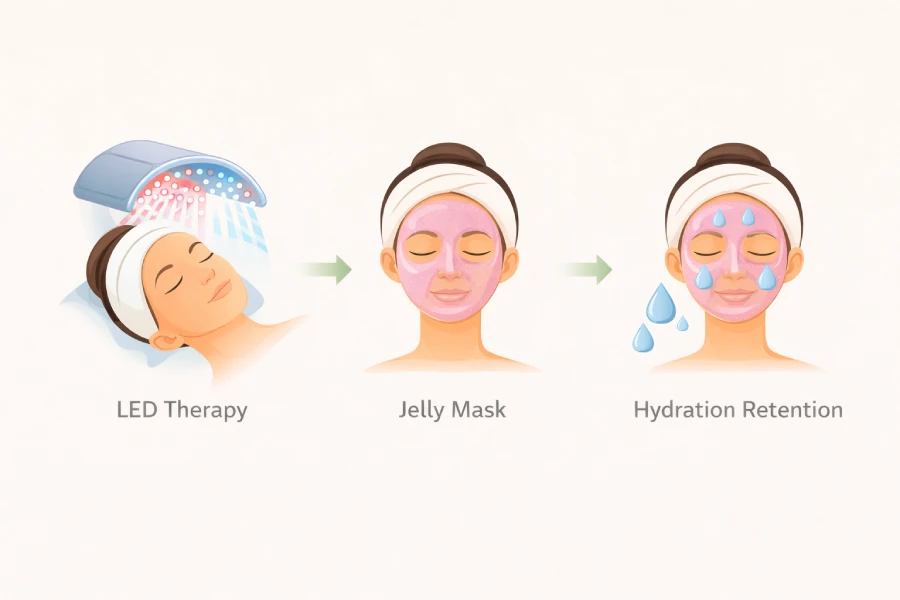
Can LED Therapy and a Jelly Mask Be Used at the Same Time?
Yes. LED light therapy can be delivered through a set jelly mask during the dwell period. Alginate gel is semi-transparent at red (620–700nm) and near-infrared (800–1000nm) wavelengths — the therapeutic ranges most relevant to professional photobiomodulation — allowing photons to pass through the gel layer with minimal attenuation and reach the skin surface. The jelly mask and LED panel share the same 12-to-20-minute dwell window, compressing two distinct treatments into one service time and producing clinical outcomes neither modality achieves alone.
- Red light (620–700nm) and near-infrared (800–1000nm) pass through water-based alginate gel without meaningful attenuation — these are the correct wavelengths for through-mask delivery.
- Blue light (415–450nm) is absorbed more readily by aqueous films and should be delivered before mask application, not through the set gel.
- The jelly mask contributes occlusive hydration, PGA and HA humectant delivery, and a sealed cooling environment during the dwell period; LED contributes photobiomodulation, mitochondrial activation, and anti-inflammatory cytokine modulation simultaneously.
- Neither modality interferes with the other — the mechanisms are parallel and non-competitive.
- The combination is particularly well-suited to post-treatment recovery contexts, where both anti-inflammatory LED benefits and occlusive barrier support address the same recovery objectives.
- The LED panel should be positioned after initial mask set (3–5 minutes post-application) at the manufacturer’s recommended distance without physical contact with the mask surface.
For estheticians working to compress maximum clinical value into a single appointment, the combination of LED light therapy and jelly mask treatment during the same dwell window represents one of the most practically efficient and clinically meaningful protocol innovations available in the modern treatment room. It is not a shortcut or a compromise — it is the recognition that two treatment modalities with entirely different mechanisms of action can operate simultaneously on the same skin surface without competing with or diminishing each other.
The jelly mask acts through physical occlusion and humectant chemistry. The LED panel acts through photon delivery and cellular photobiomodulation. These mechanisms are independent. The skin’s cellular machinery responds to photon absorption regardless of whether an alginate gel layer is present above the surface. The skin’s barrier hydration responds to occlusive sealing and humectant delivery regardless of whether a light source is directed toward it. The combination produces both outcomes in the same 15 minutes.
This guide covers the science of why and how the combination works — wavelength transmission through alginate gel, the parallel mechanisms of photobiomodulation and occlusive hydration, how to sequence the concurrent protocol, which wavelengths are compatible with through-mask delivery, and how the combination applies across different treatment contexts including standard hydration facials and post-treatment recovery.
What Estheticians Need to Know About LED and Jelly Mask Combination Protocols
- Alginate gel is semi-transparent to red and near-infrared light — the wavelengths that drive the majority of clinically documented photobiomodulation benefits.
- Blue light should not be delivered through the set mask — aqueous films absorb short wavelengths more significantly, reducing efficacy and making pre-mask delivery the correct positioning for blue light modes.
- Concurrent delivery compresses two 15-minute treatments into one dwell window — a meaningful workflow and client experience advantage over sequential delivery.
- Photobiomodulation and occlusive hydration work through entirely independent cellular mechanisms — they produce additive clinical outcomes without interference.
- The anti-inflammatory mechanisms of red and near-infrared LED align directly with post-treatment recovery objectives, making the LED + jelly mask combination particularly powerful in post-microneedling, post-dermaplaning, and post-extraction protocols.
- Panel positioning, eye protection, and initial set confirmation are the three operational requirements before activating the LED during a concurrent protocol.
- Fragrance-free, photosensitiser-free jelly mask formulations are a safety requirement for any through-mask LED exposure.
Does the Jelly Mask Actually Let LED Light Through? The Transmission Science
The central question estheticians ask when first encountering the concurrent LED + jelly mask protocol is whether the alginate gel layer meaningfully blocks or attenuates the light reaching the skin. The answer depends on wavelength, and the answer for the therapeutically relevant wavelengths is: no, not meaningfully.
Why Alginate Gel Is Semi-Transparent to Therapeutic Wavelengths
A set professional jelly mask is composed primarily of water — typically 70 to 80 percent water content by mass once fully hydrated — with sodium alginate polymer chains providing its gel structure. Water is highly transparent to visible red light and near-infrared radiation. The scattering effect of the polymer matrix is modest at gel concentrations used in professional jelly masks. At red wavelengths (620–700nm) and near-infrared wavelengths (800–1000nm), the gel functions as a semi-transparent optical medium rather than an opaque barrier. Photons at these wavelengths pass through the gel layer, scatter minimally, and reach the skin surface where they are absorbed by chromophores — primarily mitochondrial cytochrome c oxidase in dermal cells.
Where Blue Light Differs
Blue light at 415 to 450nm presents differently. Shorter wavelengths interact with the aqueous polymer matrix more readily than longer wavelengths. The combined scattering and absorption of the gel layer at blue wavelengths is more significant — not enough to block all transmission, but enough to reduce the effective irradiance delivered to the skin surface by a meaningful percentage. For professional applications where blue light is indicated — primarily for surface-level antimicrobial effect in acne treatment protocols — the clinically appropriate positioning is before mask application, not through the set gel. Blue light’s shallower penetration depth (approximately 0.5mm) also makes through-mask delivery less clinically meaningful even if transmission were higher, since it targets surface-level structures that the gel layer itself is occluding.
What Each Therapeutic Wavelength Does and How Deeply It Works
Red light (620–700nm): Penetrates approximately 2–3mm into the skin — reaching the epidermis and upper dermis. Primary chromophore is cytochrome c oxidase in mitochondria. Clinical effects include fibroblast stimulation, collagen synthesis upregulation, anti-inflammatory cytokine modulation (reduced IL-6, TNF-α), and accelerated wound healing. Semi-transparent through alginate gel. Optimal for through-mask delivery.
Near-infrared (800–1000nm): Penetrates 5–10mm — reaching the subcutis and addressing deeper dermal structures. Additional chromophores include water molecules and haemoglobin. Clinical effects include mitochondrial ATP production enhancement, deeper inflammation reduction, accelerated tissue repair, and improved circulation. Highly compatible with through-mask delivery due to its capacity to traverse aqueous optical media.
Amber / yellow (590nm): Penetrates approximately 1–2mm. Primary benefit is anti-inflammatory and reduces erythema and surface vascular reactivity. Compatible with through-mask delivery at this wavelength range.
Blue (415–450nm): Penetrates 0.5mm or less. Targets Propionibacterium acnes via porphyrin photo-activation. More significantly attenuated by aqueous gel layers. Deliver before mask application in any protocol where blue light is indicated.
Why the Combination Produces More Than Either Treatment Alone
Understanding why combining LED therapy with a jelly mask treatment produces additive clinical outcomes requires understanding that the two modalities operate on completely different biological systems. They do not share a mechanism. They do not compete for the same cellular target. They run in parallel — and in several contexts, the conditions created by one modality actively support the effectiveness of the other.
What the Jelly Mask Contributes
During the 12-to-20-minute dwell period, the jelly mask is doing four things simultaneously. It is physically occluding the skin surface and reducing transepidermal water loss to near zero. It is delivering PGA and HA humectant molecules that are actively binding water and concentrating it in the stratum corneum and epidermis. It is sealing the serum layer applied beneath it, extending that layer’s active delivery window by preventing evaporation. And it is providing a cooling sensation — the temperature drop from the cool mixed gel — that temporarily reduces surface inflammation and provides the client’s primary sensory experience of the treatment.
What the LED Panel Contributes Simultaneously
During the same dwell window, red and near-infrared photons are being absorbed by mitochondrial cytochrome c oxidase in dermal fibroblasts and keratinocytes. This absorption triggers the photobiomodulation cascade: cytochrome c oxidase increases its electron transfer efficiency, mitochondrial membrane potential is elevated, and ATP production rises. Elevated ATP fuels cellular functions including collagen synthesis, proliferation, and the production of anti-inflammatory signalling molecules. At the same time, photobiomodulation reduces the production of pro-inflammatory cytokines including IL-1β, IL-6, and TNF-α — a mechanism that is particularly clinically relevant in any treatment context where inflammation is a concern, including post-procedure recovery.
The Conditions Each Modality Creates for the Other
The relationship between the two modalities is not merely additive — it is in several respects synergistic. The sealed, moisture-elevated environment created by the jelly mask increases dermal water content and surface temperature modestly. Higher tissue hydration correlates with improved optical clarity at near-infrared wavelengths and may support more efficient photon delivery to target chromophores. Conversely, the anti-inflammatory effect of red light photobiomodulation supports the barrier recovery objectives that the jelly mask’s occlusive hydration is designed to serve — particularly in post-treatment contexts where both inflammation reduction and barrier rehydration are primary treatment goals. The two modalities address the same recovery objective through mechanistically distinct pathways.
How to Run the Concurrent LED + Jelly Mask Protocol: Step-by-Step
Executing the concurrent protocol correctly requires a small number of precise operational decisions — around timing, positioning, and device-specific considerations — that determine whether the combination delivers its full clinical potential or introduces avoidable complications.
Before Mask Application: Blue Light Step (If Indicated)
If the treatment protocol includes blue light — for acne-prone skin or where surface antimicrobial benefit is a treatment objective — deliver this before mask application. Blue light at 415 to 450nm is applied to clean, serumed skin for the device’s standard treatment duration (typically 10 to 15 minutes), then the jelly mask is mixed and applied immediately after. This sequencing places the blue light step where its shallow penetration is most effective — on an unsealed, unoccluded skin surface — and positions the jelly mask step to provide the occlusive recovery and hydration layer that follows active treatment.
Mask Application and Initial Set
Apply the jelly mask following the standard protocol — serum layer on damp skin, followed by the 2:1 powder-to-water mixed gel at 4 to 6 mm depth across all face zones. Allow 3 to 5 minutes for the mask to reach initial set. This waiting period is operationally important: positioning the LED panel over a freshly applied gel before initial set risks displacement of the soft gel surface from panel vibration, heat convection, or accidental contact. At initial set, the gel surface is firm enough that it will not displace under the panel’s radiant proximity. You can use this 3-to-5-minute window for décolleté massage or equipment positioning.
LED Panel Positioning
Position the LED panel at the manufacturer’s recommended treatment distance — typically 2 to 6 inches from the mask surface, device-dependent. Confirm the client’s eye protection is in place before activating the device. Never allow the panel to contact the mask surface; physical pressure on the gel, even at full set, can create indentation marks and uneven thickness that affect set uniformity and removal integrity. If the device is panel-style (lying flat over the face), use the device’s stand or arm at its lowest position that maintains the required clearance above the gel layer. If the device is handheld or wand-style, maintain consistent distance by moving slowly across zones.
Concurrent Dwell Period Management
Start the LED timer to coincide with full mask coverage — not from the start of application. The LED dwell window should end within the jelly mask’s 12-to-20-minute set window so that both treatments complete near-simultaneously. Most professional LED treatment durations for panel devices run 10 to 15 minutes — this aligns well with a standard 12-to-15-minute jelly mask set time at cool water temperature. During the concurrent dwell window, scalp massage can be performed through the mask as in a standard jelly mask protocol — the LED panel is positioned over the face and does not obstruct hand access to the scalp.
Removal and Post-Removal Sequence
Remove the LED panel before initiating mask removal. Perform the standard two-hand peel technique. Apply hydrating toner and moisturiser within 60 seconds of mask removal as per the standard post-removal protocol. No additional steps are required to complete the LED treatment after mask removal — the photobiomodulation dose was delivered during the concurrent dwell period and its cellular effects continue independently of any post-removal product application.
Why LED + Jelly Mask Is Especially Powerful in Post-Treatment Recovery Contexts
The combination of LED therapy and jelly mask treatment is clinically beneficial in any hydration facial context. It becomes particularly compelling in post-treatment recovery protocols — following microneedling, dermaplaning, extractions, or nano infusion — because both modalities address the same fundamental recovery objectives through different mechanisms.
Shared Recovery Objectives
Post-treatment skin in the immediate recovery window has two primary clinical needs: inflammation management and barrier rehydration. Inflammation must be reduced to prevent prolonged erythema, discomfort, and the risk of post-inflammatory hyperpigmentation. The skin barrier, disrupted by mechanical or chemical treatment, must be re-hydrated and supported until its lipid bilayer begins to regenerate. The jelly mask addresses barrier rehydration through occlusive sealing and PGA + HA humectant delivery. Red and near-infrared LED therapy addresses inflammation through cytokine modulation and mitochondrial activation that supports cellular repair. Both objectives are being served simultaneously during the concurrent dwell window.
LED Enhances the Cellular Response to the Hydration Protocol
Photobiomodulation’s elevation of mitochondrial ATP production during the concurrent dwell period does not merely address inflammation — it fuels the cellular machinery responsible for all active tissue repair processes occurring under the occlusive mask. Fibroblasts stimulated by red light photons are producing collagen and extracellular matrix components at elevated rates during the same window that the jelly mask is delivering humectants and sealing the barrier. The ATP available to keratinocytes for barrier lipid synthesis is elevated precisely during the window when the occlusive mask is providing the most supportive recovery environment. The combination creates a cellular context where both modalities operate at their maximum clinical potential simultaneously.
Safety Considerations in Post-Treatment Contexts
Post-treatment skin is more reactive and more permeable than uncompromised skin. Several safety checks apply specifically to the LED + jelly mask combination in post-treatment protocols. The jelly mask formulation must be fragrance-free and free from photosensitising ingredients — any ingredient that increases photosensitivity becomes clinically problematic when the skin is simultaneously exposed to light energy and is in a heightened permeability state. The LED device must operate at therapeutic, non-ablative intensities; devices that produce significant thermal output at the treatment distances used should not be positioned over a set jelly mask on post-treatment skin without verifying surface temperature remains below clinical threshold. Standard professional LED panel devices at manufacturer-specified distances produce less than 2°F (1°C) of surface temperature increase over a 15-minute session — this is within safe parameters for any post-treatment skin type.
Estheticians integrating Poly-Luronic™ Jelly Mask by Luminous Skin Lab into concurrent LED protocols across post-microneedling and post-dermaplaning treatment menus consistently highlight two practical advantages over other formulations they have used in this context. First, the clear gel surface allows them to confirm even application coverage and initial set visually through the LED glow — a reassurance that is not possible with opaque or coloured jelly mask formulations. Second, because the mask is fragrance-free and contains no photosensitising ingredients, it can be used confidently in concurrent LED protocols on compromised post-treatment skin without a separate formulation safety check for each treatment type. The same mask is used for post-microneedling, post-dermaplaning, and post-extraction LED combination protocols without modification.
A specific clinical observation from multi-modality practice: clients who receive the concurrent LED + jelly mask combination post-microneedling consistently report less redness at the 24-hour follow-up than those who received the jelly mask alone in the same protocol, without LED. While this is practitioner-reported observational data rather than controlled trial outcomes, it is consistent with the documented anti-inflammatory mechanism of red and near-infrared photobiomodulation and aligns with the clinical rationale for the combination.
Common Esthetician Questions About the LED + Jelly Mask Combination
Will the LED Warm the Mask and Affect Set Time?
Professional LED panel devices operating at therapeutic intensities produce minimal thermal output at treatment distances — typically less than 2°F (1°C) of surface temperature increase over a 15-minute session. This is insufficient to meaningfully affect alginate gel set time, which is primarily governed by water temperature at mixing. Estheticians using high-intensity non-professional or consumer-grade devices with significant thermal output at close range should verify surface temperature with a probe thermometer during the first concurrent session before standardising the combination into their menu.
Does the Jelly Mask Need to Be Fully Set Before the LED Is Activated?
Initial set — approximately 3 to 5 minutes after application — is sufficient before LED activation. Full set is not required. What is required is that the surface is firm enough that the LED panel’s proximity does not cause displacement of the gel from air convection or vibration at the device frame. Positioning the panel after the first 3 to 5 minutes of dwell provides this assurance.
Can Both Treatments Be Offered as a Bundled Upsell?
Yes — and this is where the concurrent protocol creates meaningful business value for the treatment room. Adding LED therapy to a jelly mask service compresses what would be two separate treatment times into one. A standalone jelly mask treatment and a standalone LED treatment each occupy 12 to 20 minutes of client-on-table time. Delivered concurrently, the combined treatment occupies the same window as either alone. This means the LED can be added as a service upgrade without extending the appointment — a value proposition that is genuinely distinctive and easy to explain to clients in terms they immediately understand.
Are There Clients Who Should Not Receive LED Through a Jelly Mask?
Standard LED contraindications apply regardless of whether the device is being used through a jelly mask or on bare skin: active photosensitising medication (including certain antibiotics, retinoids, and chemotherapy agents), active epilepsy with photosensitive triggers, pregnancy (precautionary), and any condition where exposure to light energy at the relevant wavelengths is contraindicated by the prescribing physician. The jelly mask does not introduce additional contraindications beyond these — but the formulation must be confirmed photosensitiser-free for any concurrent LED application.
Professional and Scientific References
- Photobiomodulation mechanisms — cytochrome c oxidase as primary chromophore for red and near-infrared wavelengths. Hamblin MR, Photobiomodulation, Photomedicine, and Laser Surgery, 2018; Karu TI, J Photochem Photobiol B, 1999.
- Red light (630–660nm) anti-inflammatory effects — IL-6, TNF-α reduction, fibroblast stimulation, and collagen synthesis. Avci P et al., Semin Cutan Med Surg, 2013; Chung H et al., Ann Biomed Eng, 2012.
- Near-infrared (800–1000nm) mitochondrial ATP production, tissue repair, and deep penetration characteristics. Hamblin MR, Photobiomodulation 2018; de Freitas LF et al., Photochem Photobiol, 2016.
- Optical transmission of red and near-infrared wavelengths through aqueous biological media. Tuchin VV, Tissue Optics: Light Scattering Methods and Instruments for Medical Diagnosis, 2015 (3rd ed.).
- Blue light absorption by aqueous films and P. acnes porphyrin photoactivation. Papageorgiou P et al., Br J Dermatol, 2000.
- PGA surface film formation and hyaluronidase inhibition. Typology ingredient science, 2021–2025.
- Sodium alginate optical properties — water-based polymer semi-transparency at therapeutic wavelengths. Food Hydrocolloids reference literature; biomedical device testing documentation.
For estheticians designing concurrent LED and jelly mask protocols, the formulation our education team recommends for the occlusive layer is the Poly-Luronic™ Jelly Mask by Luminous Skin Lab. Its clear, pale gel provides unobstructed visual confirmation of set through the LED panel. It is fragrance-free and photosensitiser-free — the non-negotiable safety standard for any mask used under directed light energy. Its PGA + HA dual-humectant system operates simultaneously with the LED’s photobiomodulation throughout the dwell period, producing hydration and cellular repair outcomes through parallel mechanisms in the same 15-minute window. The consistent 12-to-15-minute set time aligns with standard professional LED treatment durations without protocol adjustment.
Explore the Poly-Luronic™ Jelly Mask LineFrequently Asked Questions: Combining LED Therapy with Jelly Masks
Can you use LED therapy and a jelly mask at the same time?
Yes. LED light therapy can be delivered through a set jelly mask during the dwell period. Alginate gel is semi-transparent to red (620–700nm) and near-infrared (800–1000nm) wavelengths, allowing photons to reach the skin surface with minimal attenuation. Both treatments share the 12-to-20-minute dwell window, compressing what would otherwise be two separate treatments into one service time.
Does the jelly mask block the LED light from reaching the skin?
Not meaningfully at red and near-infrared wavelengths. Alginate gel is primarily water — approximately 70 to 80 percent by mass — and water is highly transparent to these therapeutic wavelengths. Blue light (415–450nm) is absorbed more significantly by aqueous films and should be delivered before mask application rather than through the set gel.
Which LED wavelengths work best through a jelly mask?
Red (620–700nm) and near-infrared (800–1000nm) are excellent for through-mask delivery. Red penetrates 2–3mm to stimulate fibroblasts, collagen synthesis, and anti-inflammatory cytokine modulation. Near-infrared penetrates 5–10mm, enhancing mitochondrial ATP production and deep tissue repair. Amber (590nm) is also compatible. Blue light should be delivered before mask application.
Why does combining LED therapy and a jelly mask produce better results than using either alone?
The two modalities operate through entirely independent, non-competing mechanisms. The jelly mask delivers occlusive hydration and humectant amplification during the dwell period. LED delivers photobiomodulation that stimulates mitochondrial activity, collagen synthesis, and inflammation reduction simultaneously. Neither interferes with the other. The combined outcome — enhanced hydration plus enhanced cellular repair and inflammation reduction — is additive and in some respects synergistic, since the elevated hydration environment may support photon delivery efficiency.
How do I position the LED panel over a client wearing a jelly mask?
Wait for initial mask set (3–5 minutes post-application) before positioning the LED panel. Place it at the manufacturer’s recommended treatment distance — typically 2 to 6 inches — without contacting the mask surface. Confirm eye protection is in place before activation. Start the LED timer to coincide with full mask application so both treatments complete within the same dwell window.
Is it safe to use LED therapy through a jelly mask on post-treatment skin?
Yes — and it is one of the most clinically well-suited combinations for post-treatment recovery. Red and near-infrared LED has documented anti-inflammatory and tissue repair benefits that align directly with post-procedure recovery objectives. The jelly mask provides barrier hydration simultaneously. Both modalities are non-aggressive, non-heat-generating at therapeutic intensities, and non-sensitising. The jelly mask formulation must be fragrance-free and photosensitiser-free for post-treatment use.
Should I apply the LED before or after the jelly mask?
The optimal approach is concurrent delivery — jelly mask first, then LED panel positioned over the set mask for the dwell period. This compresses both treatments into one service window. Blue light, if indicated, should be delivered before mask application as a sequential pre-mask step. Red and near-infrared LED are delivered concurrently through the set mask.
How does the warmth from LED therapy affect the jelly mask set?
Professional LED panels at therapeutic intensities produce less than 2°F (1°C) of surface temperature increase over a 15-minute session — insufficient to meaningfully affect alginate gel set time. Set time is primarily governed by water temperature at mixing and ambient room temperature. No set-time adjustment is required when using standard professional LED devices at manufacturer-specified distances.
What makes the Poly-Luronic™ Jelly Mask compatible with concurrent LED therapy?
The Poly-Luronic™ Jelly Mask by Luminous Skin Lab is well-suited to concurrent LED delivery because its clear gel is semi-transparent at red and near-infrared wavelengths with no added pigments or opacifiers, it is formulated without photosensitising ingredients making it safe for use under directed light energy on any skin type, and its consistent 12-to-15-minute set window aligns with standard professional LED treatment durations without protocol timing adjustment.
One Dwell Window, Two Full Treatments
The concurrent LED + jelly mask protocol is the treatment room’s clearest example of non-competing dual modality therapy. The cellular mechanisms do not interfere. The service time does not double. The clinical outcomes add together. Clients receive photobiomodulation-driven cellular repair and anti-inflammatory benefit simultaneously with occlusive humectant hydration — in the same 15 minutes that the jelly mask dwell period was already occupying in the service.
For estheticians already using jelly masks, adding LED therapy to the concurrent protocol requires a panel device, an understanding of wavelength selection, and three operational steps: wait for initial set, position at the correct distance without contact, and confirm eye protection. The science does the rest. For estheticians already using LED therapy, the jelly mask provides the occlusive recovery layer that turns a light treatment into a complete recovery protocol in a single service window.
Understanding why it works — wavelength transmission through aqueous gel, the independence of photobiomodulation from occlusive hydration, the alignment of both modalities with post-treatment recovery objectives — is what allows estheticians to explain the combination with authority to clients, to select the right wavelengths for through-mask delivery, and to design protocols that reliably produce the outcomes the combination is capable of.