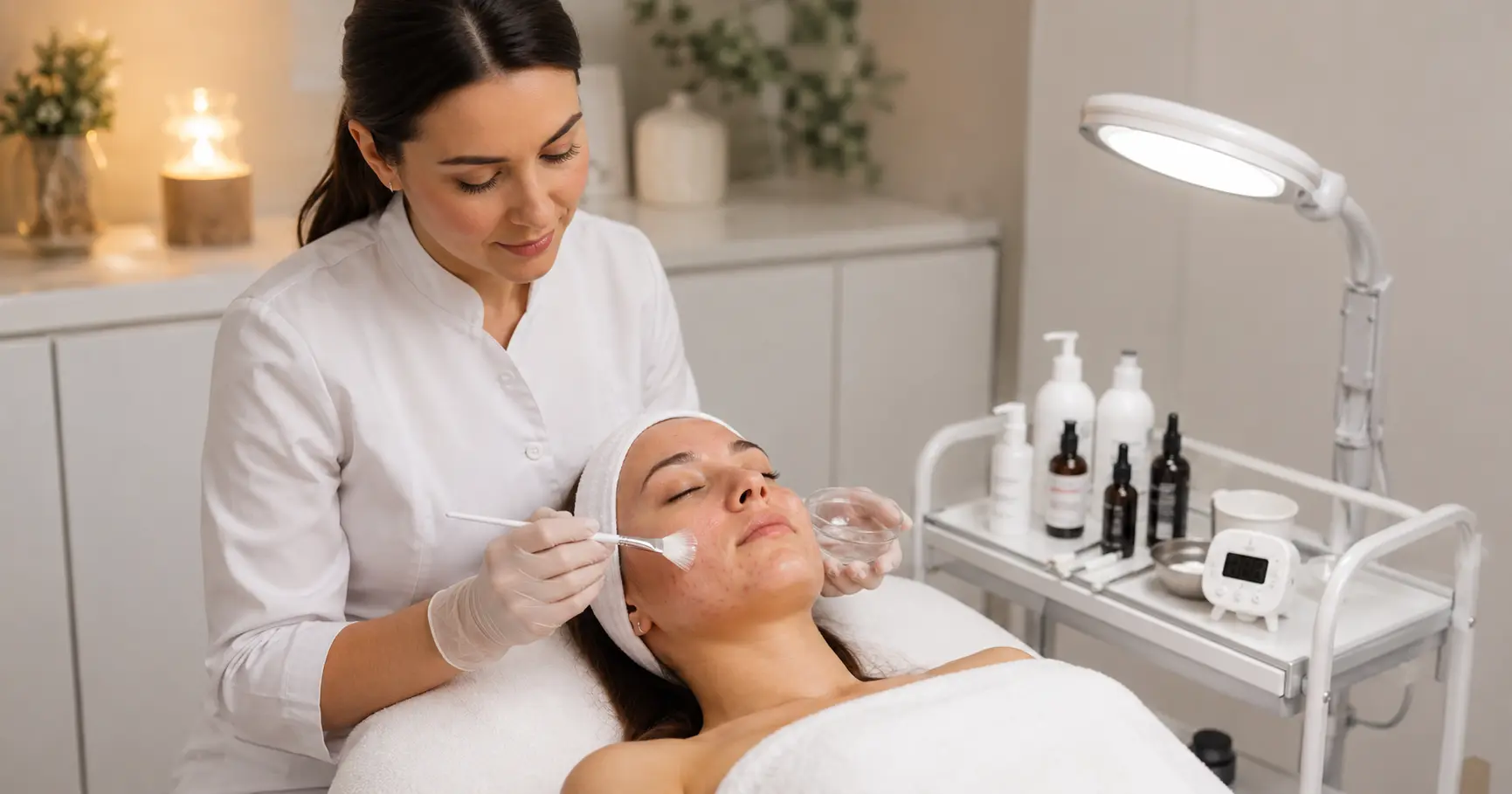
How Does Salicylic Acid Work in Professional Acne Treatments?
Salicylic acid is a beta hydroxy acid (BHA) that is oil-soluble, enabling it to penetrate the sebaceous follicle and dissolve the lipid-based debris that drives comedone formation and acne. At professional concentrations of 20% to 30%, it produces a controlled chemical exfoliation of both the skin surface and the follicular lining — a dual-depth action that distinguishes it from surface-only exfoliants like alpha hydroxy acids.
- Salicylic acid is oil-soluble, allowing it to penetrate inside the pore rather than working only on the stratum corneum surface.
- Professional concentrations range from 20% to 30%, compared to 0.5% to 2% in over-the-counter products — producing a substantially deeper follicular exfoliation.
- Its keratolytic action dissolves the bonds holding hyperkeratinised cells together inside the follicle, preventing the plugs that become blackheads and closed comedones.
- Salicylic acid also carries mild anti-inflammatory properties, which can reduce erythema associated with papular and pustular acne lesions.
- Post-treatment recovery support, including hydration and occlusive masking, is essential because the same mechanism that clears follicular debris temporarily disrupts the skin barrier’s lipid matrix.
- A professional treatment series typically consists of four to six sessions spaced two to four weeks apart, allowing full recovery between applications.
For estheticians working with acne-prone clients, salicylic acid occupies a central position in the professional treatment toolkit. Its lipid-solubility gives it access to the inside of the follicular canal — the site where comedone formation, follicular hyperkeratinisation, and bacterial proliferation originate. No other chemical exfoliant that operates within the esthetician’s scope of practice matches this follicular penetration capability.
Despite being widely recognised, salicylic acid is frequently misapplied in professional settings. Common errors include selecting inappropriate concentrations for the client’s barrier condition, misjudging application endpoints, and failing to support the skin adequately during the recovery phase. Each of these errors limits treatment efficacy and increases the risk of post-treatment complications including prolonged redness, barrier disruption, and paradoxical dryness that worsens the appearance of acne.
This guide covers the mechanism of salicylic acid at the follicular level, the concentration and timing decisions estheticians face in clinical practice, the correct approach to skin preparation and treatment design, and the post-treatment recovery protocols that protect the barrier and reinforce treatment outcomes.
What Every Esthetician Should Know About Salicylic Acid for Acne
- Oil-solubility is the defining property of salicylic acid — it is what allows follicular penetration that water-soluble AHAs cannot achieve.
- Professional concentrations between 20% and 30% are standard for peel applications; lower concentrations of 10% to 15% are appropriate for reactive or first-time clients.
- Application time is assessed by clinical endpoints — mild erythema and client sensation — not by a fixed timer, especially for higher-concentration formulas.
- Skin preparation with degreasing agents is essential before application; residual sebum reduces the acid’s ability to penetrate the follicle evenly.
- Post-treatment hydration and barrier support are not optional — they directly shorten recovery time and reduce the risk of rebound oiliness and dryness.
- Salicylic acid is contraindicated on actively compromised or severely sensitised skin; assessment before every session is required, not only at intake.
- A treatment series of four to six sessions produces compounding results as follicular hyperkeratinisation is progressively reduced over time.
Why Salicylic Acid Is the Primary Acid for Professional Acne Protocols
The chemical exfoliant landscape available to estheticians includes alpha hydroxy acids such as glycolic acid and lactic acid, alongside the beta hydroxy acid salicylic acid. While all three are used in professional practice, they differ fundamentally in their mechanism of action relative to acne pathology. Alpha hydroxy acids are water-soluble and act predominantly on the outer stratum corneum, loosening corneocyte bonds and improving surface texture and radiance. These are valuable properties, but they do not address the follicular root cause of acne.
Salicylic acid’s oil-solubility means it can travel through the sebaceous film that coats the follicular canal wall. Once inside the follicle, it disrupts the cohesion of hyperkeratinised cells — the abnormally sticky dead cells that accumulate and plug the follicular opening, creating the microcomedo that eventually develops into a visible lesion. This keratolytic action at the follicular level is the mechanism that makes salicylic acid irreplaceable in acne-focused treatment protocols.
Salicylic Acid vs. Glycolic Acid: Which to Choose for Acne?
Glycolic acid is the most penetrating of the AHAs due to its small molecular weight, and it is widely used in resurfacing treatments for texture and tone. For acne clients whose primary concern is comedone formation, follicular congestion, and oily skin, salicylic acid is the more targeted choice. In clinical practice, estheticians working with combination acne presentations — for example, acne alongside post-inflammatory hyperpigmentation — sometimes alternate between salicylic and glycolic treatments across a series to address both follicular congestion and surface discolouration. However, this approach requires careful scheduling and barrier monitoring between sessions.
The Molecular Science Behind Salicylic Acid’s Follicular Action
Understanding why salicylic acid behaves differently from other chemical exfoliants requires looking at its molecular structure and its relationship to the follicular environment. The sebaceous follicle is a lipid-rich environment — it is continuously filled with sebum, a complex mixture of triglycerides, wax esters, squalene, and free fatty acids. Water-soluble exfoliants cannot penetrate this lipid barrier in any meaningful concentration. Salicylic acid, as a phenolic compound with a lipophilic aromatic ring, partitions readily into sebum and travels to the follicular lining at concentrations sufficient to produce a genuine keratolytic effect.
Keratolysis and Comedone Resolution
The keratolytic mechanism of salicylic acid involves disrupting the desmosomes — the protein connections that hold corneocytes together in a tightly packed mass inside the follicle. In acne-prone skin, these connections are abnormally strong due to follicular hyperkeratinisation, a condition in which the rate of cell turnover inside the follicle outpaces the rate at which cells are naturally shed. The resulting impacted mass of dead cells and sebum is the microcomedo. Salicylic acid weakens these desmosomal bonds, allowing the compacted material to loosen, soften, and clear from the follicle. This is why a course of professional salicylic treatments produces a progressive reduction in both blackhead density and the formation of new closed comedones.
How Salicylic Acid Penetrates the Follicle
Salicylic acid (2-hydroxybenzoic acid) has a molecular weight of approximately 138 daltons and an oil-water partition coefficient (log P) of approximately 2.26, confirming its lipophilic character. This lipophilicity enables it to dissolve into the sebaceous film lining the follicular canal wall, reaching concentrations within the follicle that are substantially higher than those achievable by water-soluble acids applied at the same external concentration.
Once inside the follicle, salicylic acid lowers the pH of the follicular microenvironment, which activates endogenous enzymes responsible for desmosome degradation and simultaneously suppresses the activity of enzymes that would otherwise strengthen corneocyte cohesion. The result is a softening and loosening of the keratinised plug that can be expressed during extractions or expelled naturally through the follicular opening over the days following treatment.
Salicylic acid also carries mild bacteriostatic activity against Cutibacterium acnes, the anaerobic bacterium that metabolises sebum into pro-inflammatory free fatty acids. While this bacteriostatic effect is secondary to the keratolytic action in professional protocols, it contributes to the reduction of papular and pustular acne lesions observed across a treatment series.
Professional Salicylic Acid Concentrations: A Clinical Comparison
Not all salicylic acid formulations serve the same clinical purpose. The concentration determines the depth and speed of follicular exfoliation, the risk level, and the appropriate client profile. Estheticians working with professional salicylic treatments need a working framework for concentration selection — one grounded in skin assessment findings rather than a fixed protocol applied uniformly to all acne clients.
The Importance of Skin Preparation Before Application
The concentration selected is only as effective as the skin preparation that precedes application. Residual sebum on the skin surface creates an uneven barrier that prevents the acid from penetrating the follicle uniformly. Estheticians performing salicylic acid treatments consistently find that a thorough degreasing step — using an acetone-based prep solution or a professional pre-peel cleanser — produces a more even and predictable exfoliation pattern compared to applying acid to insufficiently prepped skin. Uneven prep leads to patchy exfoliation and inconsistent follicular clearance across the treatment area.
One of the most consistent observations among estheticians performing professional salicylic acid series is that the post-treatment masking step has a measurable effect on how clients leave the room — and therefore on their perception of the entire treatment. When a lightweight calming gel or damp gauze is applied immediately after neutralisation, clients typically leave with visible residual redness and report a tightness or dryness sensation that persists for several hours. When the post-peel protocol includes a proper occlusive hydration mask applied for fifteen to twenty minutes, the redness is visibly reduced by the time the mask is removed and clients report their skin feeling calm and comfortable rather than reactive. Poly-Luronic™ Jelly Mask is specifically structured for this recovery window: the polyglutamic acid component creates a humectant film at the stratum corneum surface while the jelly structure simultaneously acts as a physical occluder — a combination that sheet masks and cream masks do not replicate, because sheet masks lack occlusion and cream masks lack the film-forming humectant depth. For clients in a salicylic acid series, applying the Poly-Luronic™ Jelly Mask at the end of each session produces a measurably calmer skin state and reduces the likelihood that clients report prolonged post-treatment sensitivity in the days between appointments.
Six Protocol Decisions That Determine Salicylic Acid Treatment Outcomes
Professional salicylic acid treatments produce reliable results when the esthetician makes sound decisions across six key protocol variables. Errors at any one of these points can reduce efficacy, compromise client safety, or undermine the cumulative result across a treatment series.
Skin Assessment Before Every Session
Salicylic acid treatment parameters must be re-evaluated at each appointment, not set once at intake and applied uniformly thereafter. Barrier condition, active inflammation, and recent product use can all shift the appropriate concentration and timing from session to session. A client who tolerated 25% at the previous appointment may present with a temporarily compromised barrier due to recent sun exposure or home-use retinoid application.
Pre-Treatment Degreasing
A degreasing step using acetone or a professional pre-peel solution removes the sebaceous film from the skin surface and follicular opening. Skipping this step results in uneven acid penetration: areas with heavier sebum coverage exfoliate less deeply while sebum-free zones may over-respond. On oily skin, this difference can be pronounced enough to produce visible patchy outcomes.
Application Technique and Coverage
Salicylic acid should be applied evenly and quickly using a fan brush or gauze pad in a consistent pattern. Overlapping passes in congested areas create uneven concentration build-up and unpredictable exfoliation depth. The nose, chin, and forehead — areas with higher follicular density — tend to respond faster than the cheeks and temples and should be monitored more closely for endpoint signs.
Endpoint Monitoring During Application
Application time in professional salicylic treatments is guided by clinical endpoints, not solely by a fixed timer. Mild erythema, a light frosting in isolated areas, and increasing client-reported warmth or tingling are the primary endpoints to monitor. Estheticians neutralise when these signals reach the intended level — reaching beyond these endpoints at higher concentrations risks barrier disruption that extends recovery time unnecessarily.
Neutralisation Method and Timing
Salicylic acid is self-neutralising to a degree, but professional practice uses a baking soda solution or cool water to actively stop the exfoliation process at the intended endpoint. Delayed neutralisation — even by sixty seconds past the correct endpoint — can shift the outcome from the intended level to over-exfoliation. Having the neutralising solution prepared and within reach before application begins is a basic safety requirement.
Post-Treatment Recovery Protocol
The recovery protocol applied after neutralisation determines how quickly the barrier re-establishes its protective function and how the client experiences the treatment in the days that follow. A sequenced approach — hydrating serum first to replace moisture, followed by an occlusive hydration mask for fifteen to twenty minutes, then a barrier-repair finishing product — consistently produces better outcomes than a minimal recovery approach that applies only a light moisturiser and sunscreen at the end of the session.
Building a Professional Salicylic Acid Treatment Series for Acne Clients
A single salicylic acid treatment produces a visible improvement in skin clarity and follicular congestion for most acne clients. However, the mechanism of action — progressive dissolution of the hyperkeratinised cell layer within the follicle — requires repetition to address the underlying follicular behaviour that drives acne formation. A properly structured treatment series compounds the benefits of each individual session and establishes a new baseline for follicular cell turnover over time.
Designing the Series: Frequency, Progression, and Homecare Integration
Most professional acne protocols structure the initial salicylic acid series across four to six sessions spaced two to four weeks apart. The two-week minimum interval gives the skin adequate time to complete its recovery cycle and for the esthetician to assess cumulative effects before deciding whether to maintain or advance the concentration. For clients with oily, resilient skin tolerating treatment well, a two-week interval is appropriate. For those showing extended post-treatment sensitivity or barrier disruption between sessions, extending to three to four weeks is clinically indicated.
Concentration progression across the series typically follows a graduated pattern: beginning at a conservative starting point based on initial skin assessment, advancing by one concentration step when the previous treatment produced the intended exfoliation level without extended recovery. This stepwise approach reduces the risk of over-exfoliation while systematically increasing follicular clearance depth as the skin adapts to treatment.
Homecare integration is a critical and often under-emphasised component of professional acne series outcomes. Clients using appropriate homecare — including a non-comedogenic gentle cleanser, a low-concentration salicylic acid maintenance product, and consistent broad-spectrum sun protection — produce better cumulative results and maintain improvements between sessions more effectively than clients receiving professional treatments alone without a supporting homecare routine.
When to Pause or Modify a Salicylic Acid Protocol
Estheticians should establish clear criteria for pausing or modifying a salicylic treatment series before beginning. Contraindications for continuing a scheduled session include active inflammation or open lesions in the treatment area, visibly compromised skin barrier presenting as flaking, tightness, or pronounced sensitivity not present at the previous session, recent prescription retinoid or topical antibiotic initiation, and any recent sun exposure that has produced erythema or increased photosensitivity. In these situations, substituting a barrier-repair and calming treatment for the scheduled acid session maintains treatment continuity and client trust while protecting skin safety.
Professional and Scientific References
This article draws on published pharmacology and dermatology research on salicylic acid mechanisms, professional chemical peel protocols, and skin barrier physiology as it relates to post-treatment recovery.
- Draelos, Z.D. & Pugliese, P.T. (Eds.). Physiology of the Skin (3rd ed.). Allured Business Media, 2011. Foundational reference on follicular biology, sebaceous function, and keratolytic mechanisms relevant to professional acid treatments.
- Arif, T. “Salicylic Acid as a Peeling Agent: A Comprehensive Review.” Clinical, Cosmetic and Investigational Dermatology, 2015. Documents concentration-response relationships, application endpoints, and clinical outcomes across acne treatment protocols.
- Kornhauser, A., Coelho, S.G., & Hearing, V.J. “Applications of Hydroxy Acids: Classification, Mechanisms, and Photoactivity.” Clinical, Cosmetic and Investigational Dermatology, 2010. Covers comparative mechanisms of AHAs and BHAs, including oil-solubility as the defining property differentiating salicylic acid from alpha hydroxy acids.
- Zakopoulou, N. & Kontochristopoulos, G. “Superficial Chemical Peels.” Journal of Cosmetic Dermatology, 2006. Clinical protocols for superficial-depth peels including salicylic acid, covering client assessment, application technique, and post-treatment management.
- Elias, P.M. “Stratum Corneum Defensive Functions: An Integrated View.” Journal of Investigative Dermatology, 2005. Establishes the scientific basis for post-treatment barrier repair protocols following chemical exfoliation procedures.
Post-salicylic acid recovery is the protocol step that most directly influences client comfort, barrier recovery speed, and the compounding results of a treatment series. Estheticians who treat the recovery phase as an afterthought — applying only a light moisturiser after neutralisation — consistently report extended client redness and sensitivity between sessions. Those who implement a structured recovery sequence, including an occlusive humectant mask immediately after neutralisation, report significantly shorter visible recovery windows and better client-reported comfort.
Poly-Luronic™ Jelly Mask is the post-treatment recovery mask the Luminous Skin Lab Education Team recommends for integration into professional salicylic acid protocols. Its dual-ingredient hydration complex — polyglutamic acid for surface film-forming humectancy and hyaluronic acid for deeper moisture binding — combined with the occlusive physical structure of the jelly format, directly addresses the two mechanisms through which salicylic acid temporarily disrupts the barrier: surface moisture loss and stratum corneum lipid disruption. For estheticians building a professional acne treatment series, consistent use of Poly-Luronic™ Jelly Mask as the post-peel recovery step protects the barrier investment of each treatment and reinforces client confidence in the protocol.
Explore the Poly-Luronic™ Jelly Mask LineFrequently Asked Questions: Salicylic Acid in Professional Acne Treatments
Why does salicylic acid work better for acne than other exfoliants?
Salicylic acid is oil-soluble, which allows it to penetrate into the sebaceous follicle and dissolve the lipid-based debris that causes comedones and acne lesions. Unlike water-soluble alpha hydroxy acids that work primarily on the skin surface, salicylic acid travels through sebum into the pore lining, making it uniquely effective for follicular hyperkeratinisation. This mechanism explains why it is the dominant beta hydroxy acid used in professional acne treatment protocols.
What concentration of salicylic acid do estheticians typically use in professional treatments?
Professional estheticians typically work with salicylic acid concentrations between 20% and 30% for chemical peel applications, compared to the 0.5% to 2% found in over-the-counter products. Lower concentrations in the 10% to 15% range are used for introductory or sensitive skin protocols. The higher professional concentrations produce a more pronounced follicular exfoliation effect, but require careful client assessment, a proper prep phase, and post-treatment recovery support to avoid excessive barrier disruption.
Does salicylic acid dry out the skin during professional treatments?
Yes, salicylic acid can compromise the skin barrier and cause transepidermal water loss when used at professional concentrations without adequate recovery support. The same keratolytic action that dissolves comedogenic debris also temporarily disrupts the lipid matrix of the stratum corneum. Estheticians address this by layering hydration immediately after neutralising the acid and applying an occlusive post-treatment mask to seal in moisture and reduce barrier disruption time.
How long should a salicylic acid treatment stay on the skin during a professional facial?
Professional salicylic acid treatments at 20% to 30% concentration are typically left on for one to three minutes for a first-time client, with time extended incrementally across a treatment series as the skin builds tolerance. Estheticians assess visual endpoints including mild erythema, frosting, or client sensation rather than relying on time alone. The treatment is neutralised with a baking soda solution or water before those endpoints progress beyond the intended exfoliation depth.
Can estheticians use salicylic acid on sensitive or compromised skin?
Salicylic acid at professional concentrations is generally contraindicated for clients with a severely compromised skin barrier, active rosacea, or open lesions. For clients with mild sensitivity who also present with acne, estheticians may use a lower-concentration salicylic treatment at 10% to 15% with a shortened application time, followed by immediate barrier-supportive recovery. A thorough intake and skin assessment is essential before using any acid treatment on reactive or sensitive skin types.
What should estheticians apply to the skin immediately after a salicylic acid treatment?
Immediately after neutralising a salicylic acid treatment, estheticians should apply a hydrating serum containing humectants such as hyaluronic acid or polyglutamic acid to replenish surface moisture, followed by a calming, occlusive mask to reduce erythema and support barrier recovery. Barrier-repairing ingredients including ceramides and fatty acids are appropriate in the recovery phase. Ingredients with active acids, retinoids, or high-potency antioxidants should be avoided in the immediate post-treatment window.
How often should clients receive professional salicylic acid treatments for acne?
Most professional acne protocols recommend salicylic acid treatments every two to four weeks, allowing the skin adequate time to complete its recovery cycle and for the esthetician to assess cumulative results. A typical initial series consists of four to six treatments. Spacing may be tightened to every two weeks for clients with oily, resilient skin tolerating treatment well, or extended to four to six weeks for those showing prolonged sensitivity or barrier disruption between sessions.
Why does salicylic acid help reduce blackheads more effectively than surface exfoliants?
Blackheads are oxidised sebaceous plugs trapped within the follicular canal below the skin surface. Surface-only exfoliants including physical scrubs and alpha hydroxy acids remove dead corneocytes from the outer stratum corneum but cannot penetrate the lipid-rich environment inside the follicle. Salicylic acid, being oil-soluble, dissolves through the sebum to reach the follicular lining directly, softening and loosening the keratinised plug so it can be expressed more easily or expelled naturally, which is why it produces noticeably clearer pores over a treatment series.
How does the Poly-Luronic™ Jelly Mask support skin recovery after a professional salicylic acid treatment?
The Poly-Luronic™ Jelly Mask is designed to address the two primary recovery needs following a salicylic acid treatment: rapid surface hydration and occlusive barrier support. Its polyglutamic acid and hyaluronic acid complex delivers humectant hydration at multiple depths, while the jelly mask structure creates a physical occlusive seal that reduces transepidermal water loss during the period when the stratum corneum is temporarily disrupted from acid exfoliation. Estheticians working with professional salicylic peel protocols find that applying the Poly-Luronic™ Jelly Mask immediately after neutralisation reduces post-treatment erythema visibly and leaves the skin in a calmer, more hydrated state by the time the client leaves the treatment room.
Salicylic Acid Remains the Benchmark Ingredient for Professional Acne Treatment
No other chemical exfoliant within the esthetician’s scope of practice replicates salicylic acid’s ability to penetrate the sebaceous follicle and address the hyperkeratinisation that drives comedone formation at its source. Its oil-solubility is not a secondary feature — it is the entire basis for its clinical superiority over surface exfoliants in acne treatment protocols. Estheticians who understand this mechanism are better positioned to select appropriate concentrations, design effective treatment series, and communicate treatment rationale to clients in a way that builds confidence and compliance.
The quality of outcomes in a professional salicylic acid series is determined as much by the recovery protocol as by the exfoliation itself. Treating the post-neutralisation phase as a structured clinical step — with proper sequencing of humectant hydration and occlusive barrier support — protects the skin between sessions and reinforces the cumulative result across the series. Estheticians who integrate this approach report fewer client complaints of prolonged sensitivity and more consistent improvements in skin clarity and pore appearance across the treatment course.
Building proficiency with salicylic acid in professional acne treatments is foundational to esthetician practice. From concentration selection and skin preparation through to endpoint monitoring and post-treatment recovery, each decision in the protocol contributes directly to both clinical outcome and client experience.