What Does Azelaic Acid Do for Acne and Redness in Professional Skincare?
Azelaic acid is a dicarboxylic acid that treats acne and redness through three simultaneous mechanisms: it kills acne-causing bacteria, normalises follicular cell turnover to prevent pore blockages, and inhibits the inflammatory pathways that drive visible redness. Its multi-mechanism profile makes it one of the most broadly applicable actives in professional acne treatment, suitable for inflammatory acne, rosacea-prone skin, and post-inflammatory hyperpigmentation within the same protocol.
- Azelaic acid inhibits Cutibacterium acnes by disrupting bacterial energy metabolism, reducing the bacterial load that drives inflammatory breakouts.
- It normalises corneocyte desquamation inside the follicle, reducing the microcomedo formation that initiates the acne cycle.
- Its anti-inflammatory action suppresses pro-inflammatory cytokine production and reactive oxygen species, directly reducing facial redness in both acne and rosacea presentations.
- Azelaic acid inhibits tyrosinase activity, limiting melanin overproduction triggered by inflammation—making it effective against post-inflammatory hyperpigmentation as well as active breakouts.
- It is well-tolerated on sensitive and rosacea-prone skin types that cannot tolerate retinoids or benzoyl peroxide, broadening its clinical applicability in esthetic practice.
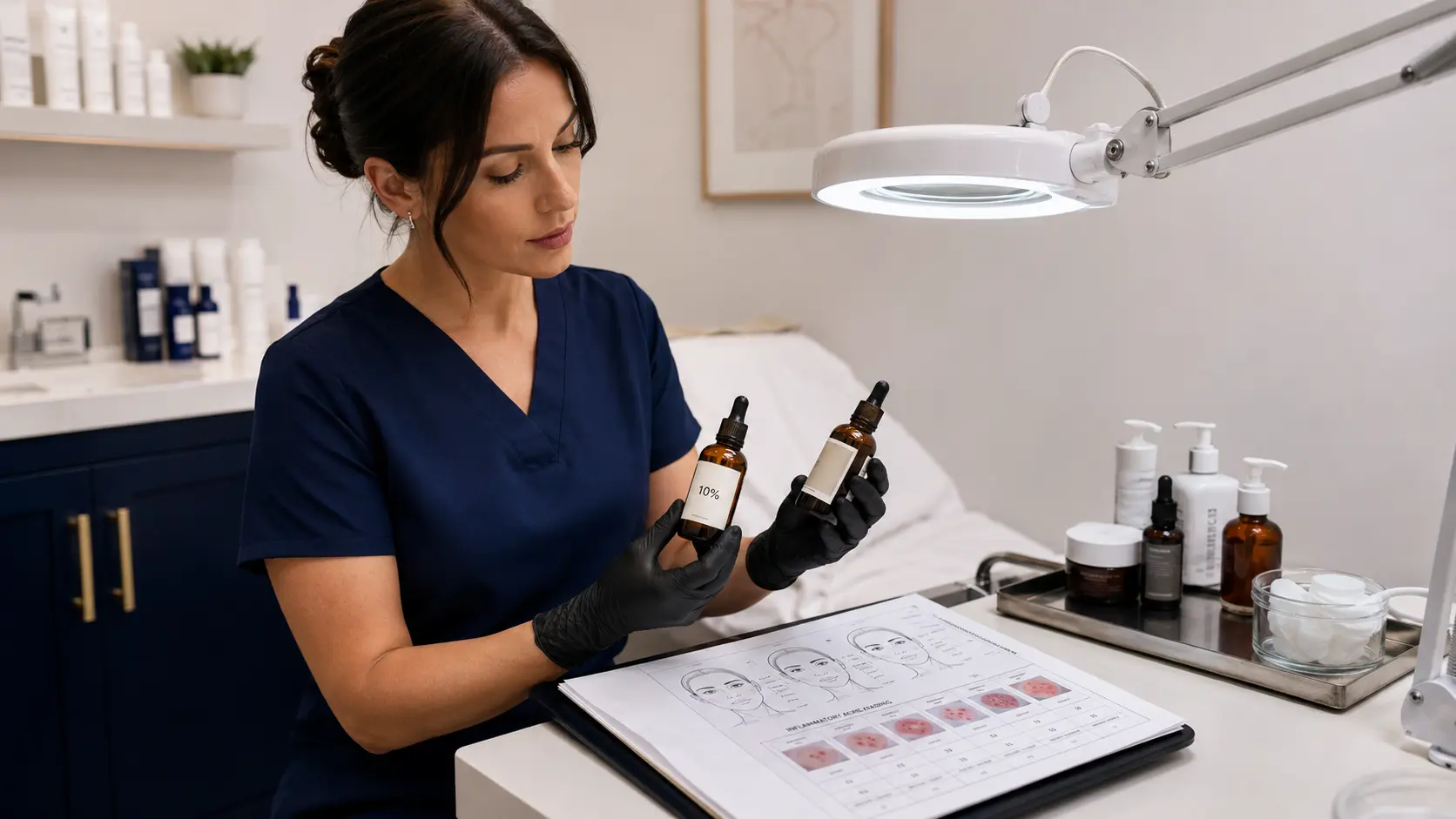
- Professional-grade azelaic acid serums typically work in the 10–15 percent concentration range, positioned mid-facial after exfoliation and before occlusive recovery treatments.
Most acne actives are built around a single mechanism. Salicylic acid dissolves the follicular plug. Benzoyl peroxide kills bacteria. Retinoids accelerate cell turnover. Each addresses one stage of the acne cycle, which is why estheticians frequently need to layer multiple actives to achieve comprehensive results—and why reactive skin types can become overwhelmed by the cumulative irritation load. Azelaic acid sits apart from this pattern. It targets bacteria, follicular keratinisation, and inflammation simultaneously within a single molecule, compressing what would otherwise require three separate active ingredients into one well-tolerated step.
For estheticians treating clients with inflammatory acne, rosacea-associated redness, or the persistent brown and red marks that follow breakouts, this multi-pathway action translates into measurable clinical utility. Azelaic acid can be introduced into a facial protocol where other actives have caused sensitisation, used on skin types that are excluded from retinoid or high-concentration BPO protocols, and applied during pregnancy where many other acne actives are contraindicated. Understanding precisely how it works, how to position it within a treatment sequence, and which skin presentations respond most predictably allows estheticians to build protocols that are both effective and appropriate for a wide client range.
This article covers the mechanism of action behind azelaic acid’s antibacterial, anti-inflammatory, and depigmenting effects; the concentration considerations relevant to professional practice; how to sequence it correctly within a facial; and how it compares to and combines with the other major acne actives estheticians use most frequently.
What Every Esthetician Should Know About Azelaic Acid
- Azelaic acid treats acne through three simultaneous pathways: antibacterial, antikeratinising, and anti-inflammatory—a unique profile among acne actives.
- Its tyrosinase-inhibiting action makes it effective not just against active acne but against the post-inflammatory hyperpigmentation that follows breakouts.
- Professional-grade concentrations of 10–15 percent are appropriate for esthetic practice; concentrations above 15 percent are typically prescription territory depending on jurisdiction.
- Azelaic acid is one of the safest acne actives for sensitive skin, rosacea-prone clients, and clients who are pregnant or breastfeeding.
- In a facial treatment sequence, azelaic acid is applied after exfoliation and before heavy serums or occlusive mask steps to maximise follicular contact.
- It pairs logically with salicylic acid (targeting complementary acne mechanisms), niacinamide (amplifying anti-inflammatory and pigmentation effects), and calming recovery masks.
- Transient tingling on first application is normal and expected; persistent burning or irritation indicates the concentration or skin barrier status requires reassessment.
How Azelaic Acid Works: The Three-Pathway Mechanism
Azelaic acid is a naturally occurring saturated dicarboxylic acid found in grains such as wheat, rye, and barley. In the context of professional skincare, it is produced through the fermentation of Malassezia furfur yeast or synthesised chemically to achieve controlled concentrations. Its therapeutic action against acne and redness emerges from three distinct biological mechanisms that operate simultaneously within the skin, distinguishing it fundamentally from single-mechanism actives.
Antibacterial Action
Azelaic acid kills Cutibacterium acnes (formerly Propionibacterium acnes) by interfering with the bacteria’s electron transport chain—the cellular mechanism by which they produce energy. Unlike antibiotic-based approaches, which kill bacteria by disrupting protein synthesis or cell wall formation, azelaic acid’s energy-disruption mechanism does not carry the same risk of promoting antibiotic resistance. This is a clinically significant property for estheticians treating clients who are managing long-term acne: it can be used consistently without the resistance-development concerns associated with topical antibiotic protocols. It is also selectively more toxic to C. acnes than to non-pathogenic commensal skin bacteria, which means it does not indiscriminately disrupt the broader skin microbiome.
Antikeratinising Action
Azelaic acid normalises the process of keratinisation—the rate at which skin cells mature and shed—specifically within the follicular lining. In acne-prone skin, corneocytes inside the follicle shed abnormally and adhere together rather than dispersing, forming the initial microcomedone that eventually becomes a blackhead, whitehead, or inflamed papule. Azelaic acid reduces this abnormal follicular adhesion by inhibiting certain enzymes involved in the terminal differentiation of keratinocytes, reducing the rate at which new microcomedones form. This action works upstream of the inflammation phase, addressing the root structural cause of congestion rather than only its visible consequences.
Anti-Inflammatory Action
The anti-inflammatory mechanism is the basis for azelaic acid’s effectiveness against both acne-associated redness and rosacea. It scavenges reactive oxygen species generated during the inflammatory cascade and inhibits the production of pro-inflammatory cytokines including interleukin-1 alpha. Reactive oxygen species are released by neutrophils in response to C. acnes activity and are directly responsible for the tissue damage that creates red, swollen papules. By reducing both the bacterial trigger and the downstream inflammatory amplification, azelaic acid addresses the redness component of acne more completely than antibacterial-only actives can achieve alone.
Concentration, Formulation, and Scope of Practice
Understanding azelaic acid concentration is essential before selecting a product for professional use, both for efficacy and for regulatory compliance. The ingredient’s clinical effects are dose-dependent, meaning that the outcomes achievable at 10 percent differ meaningfully from those achievable at 20 percent. This concentration gradient also maps approximately onto the regulatory landscape that governs what estheticians can and cannot use depending on jurisdiction.
How Concentration Affects Clinical Outcomes
At concentrations of 10 percent and below, azelaic acid delivers meaningful anti-inflammatory and mild antibacterial effects suitable for maintenance protocols, sensitive-skin acne management, and clients in the early stages of active breakouts. This is the range most commonly available in over-the-counter professional-grade formulations. At 15 percent, the ingredient reaches the threshold at which clinical evidence for rosacea-associated erythema reduction becomes robust—this concentration is the basis for several prescription rosacea formulations. At 20 percent, the antibacterial and antikeratinising effects are most pronounced, but so too is the potential for transient irritation, making client screening and patch testing more important. Estheticians should always verify the maximum concentration permissible under their state board regulations before selecting a professional-grade azelaic acid product.
Formulation Considerations for Professional Use
Azelaic acid is poorly soluble in water, which historically made formulating it into elegant, non-greasy products challenging. Modern professional-grade formulations use suspension technology, foam-based carriers, or emulsified gel systems that maintain particle size consistency and improve skin contact. Products using a homogenised suspension versus a simple emulsion can differ significantly in effective delivery, which is one reason estheticians should evaluate professional-grade formulations specifically rather than assuming that a stated percentage on any product label translates into equivalent clinical performance. Silicone-free, fragrance-free aqueous gel formulations tend to be the most universally applicable across acne-prone and reactive skin types.
Three Simultaneous Mechanisms in a Single Active Ingredient
Azelaic acid’s clinical profile is unusual among acne actives because it disrupts the acne cycle at three independent biological points rather than one. Its antibacterial action targets Cutibacterium acnes through electron transport chain disruption rather than conventional antibiotic pathways, reducing resistance risk. Its antikeratinising action inhibits abnormal follicular keratinocyte differentiation, reducing microcomedone formation upstream of visible breakouts. Its anti-inflammatory action scavenges reactive oxygen species and suppresses cytokine production, reducing the redness and tissue damage that characterise inflammatory acne lesions.
Additionally, azelaic acid selectively inhibits tyrosinase in abnormally pigmented melanocytes—those already in a state of melanin overproduction triggered by prior inflammation—while having minimal effect on normally functioning melanocytes. This selectivity is why it reduces post-inflammatory hyperpigmentation without producing the unwanted depigmentation that broader melanin-suppressing agents can cause.
Clinical studies comparing azelaic acid against established reference treatments have demonstrated equivalence to 0.05 percent tretinoin for comedonal and inflammatory acne at the 20 percent concentration, and equivalence to 4 percent hydroquinone for melasma and PIH management, with a significantly better tolerability profile in both comparisons.
Sequencing Azelaic Acid in a Professional Facial Protocol
The positioning of azelaic acid within a professional facial sequence affects how completely it reaches the follicular environment and how well clients tolerate it. Because it works most effectively when in direct contact with the skin surface and follicular opening, the steps preceding it must create an appropriately receptive skin state without compromising barrier integrity to the point where the active ingredient causes excess sensitivity. The steps following it must preserve its contact time without diluting it before it has completed its working phase.
The framework below illustrates the recommended positioning of azelaic acid within a comprehensive acne facial, showing the rationale for each placement decision relative to exfoliation, extraction, and recovery steps. This sequence is applicable to both standalone acne facials and to combination protocols that pair azelaic acid with other actives such as salicylic acid or niacinamide.
Timing and Absorption Between Steps
One of the most common sequencing errors estheticians encounter with azelaic acid is insufficient absorption time before the next product is applied. Because the ingredient needs to reach the follicular lining to exert its antikeratinising and antibacterial effects, applying another serum or mask product within seconds of azelaic acid application dilutes its contact with the skin surface. In practice, a 60-to-90-second wait after application—long enough for the product to visibly absorb into the skin rather than sitting as a visible film on the surface—is the minimum before proceeding to the recovery mask or next product step. On clients whose skin is particularly reactive, estheticians may choose to gently fan the area rather than applying another product immediately, allowing the surface to stabilise before proceeding.
The most consistent observation when working azelaic acid into an acne facial is that the recovery mask step immediately following it makes a disproportionate difference to how clients experience and tolerate the treatment. When a warm, freshly mixed Poly-Luronic™ Jelly Mask is applied approximately 90 seconds after the azelaic acid serum has absorbed, the cooling effect of the mask’s initial temperature drop—typically 2–4 degrees Fahrenheit below ambient room temperature when mixed with cooler water—neutralises most of the transient tingling that some clients report after azelaic acid application. Without this recovery step, first-time clients in particular can be concerned by the warmth sensation and associate it with irritation rather than normal active ingredient response, which affects their willingness to rebook. The jelly mask structure is notably better for this application than a traditional cream mask: because it peels off as a single cohesive piece rather than requiring rubbing to remove, it does not mechanically disturb the azelaic acid that has been absorbed into the follicular environment or drag across post-extraction tissue. Cream masks applied and wiped off with damp towels consistently produce more surface disruption in post-extraction skin, which is exactly the skin state where you want minimal mechanical manipulation in this step of the protocol.
Six Clinical Considerations When Using Azelaic Acid in Professional Facials
Effective integration of azelaic acid into professional facial protocols requires more than knowing its mechanism. These six considerations reflect the practical clinical decisions estheticians face most frequently when incorporating the ingredient across a varied client roster.
Patch Testing on First Application
Azelaic acid is well-tolerated by most skin types, but clients with severely compromised barriers or active rosacea flares should receive a patch test on the inner arm or behind the ear 24 to 48 hours before full-face application. Transient tingling is expected and not a contraindication, but persistent burning, significant erythema, or urticaria within the patch test period indicates the client is not a suitable candidate at that concentration.
Managing Client Expectations Around Warmth
A mild tingling or warmth sensation in the first 60 to 90 seconds after azelaic acid application is a normal and expected response, not a sign of adverse reaction. Estheticians should communicate this proactively before application to prevent client alarm. Describing the sensation as “a brief warm flush that fades within about a minute” sets accurate expectations and prevents the confusion between normal active ingredient response and genuine irritation that can cause clients to underreport or overreport sensitivity.
Pregnancy and Breastfeeding Compatibility
Azelaic acid is classified as pregnancy category B in the United States and is considered safe for topical use during pregnancy and breastfeeding by most clinical guidelines, making it one of the very few acne actives available to pregnant clients. This is a significant clinical value in esthetic practice, where a meaningful proportion of clients in certain age demographics will be pregnant or postpartum and simultaneously experiencing hormonally driven acne. Always advise clients to confirm suitability with their obstetrician, but azelaic acid should be the default active in acne protocols for pregnant clients where retinoids and salicylic acid at high concentrations are excluded.
Combination with Niacinamide
Azelaic acid and niacinamide are a well-established complementary pairing in professional acne and pigmentation protocols. Both ingredients reduce post-inflammatory hyperpigmentation through independent mechanisms—azelaic acid via tyrosinase inhibition, niacinamide via melanosome transfer inhibition—creating additive depigmenting effects without additional irritation risk. Niacinamide also reinforces the barrier-supportive aspects of the protocol, counterbalancing any mild barrier disruption that the azelaic acid exfoliation step may produce. In a facial, niacinamide can be layered beneath or above azelaic acid; beneath is preferred when both are applied as thin serums.
Home Care Continuity
Azelaic acid is one of the most appropriate actives to recommend for between-visit home care because it is effective at OTC concentrations, does not cause the photosensitisation that makes salicylic acid and retinoid home use more complicated for estheticians to recommend, and can be used consistently year-round. Clients who use a 10 percent azelaic acid product at home between professional treatments maintain the bacterial suppression and microcomedone reduction effects initiated in-facial. Recommending a specific home care concentration and application frequency (typically once or twice daily on cleansed skin) extends the clinical benefit of each professional treatment session.
Contraindications and Cautions
Azelaic acid is contraindicated in clients with known hypersensitivity to any component of the formulation. Because many professional azelaic acid products are formulated in propylene glycol bases, clients with propylene glycol sensitivity require a specifically formulated alternative. Azelaic acid should be applied with caution on skin that has been significantly disrupted by aggressive exfoliation or where the barrier is visibly compromised—in these cases, the active step should be skipped in favour of a purely recovery-focused treatment. Clients on oral isotretinoin should also be managed conservatively, as their skin is typically already in a sensitised state that can amplify the tingling response to topical actives.
Combining Azelaic Acid With Other Acne Treatment Actives
Azelaic acid’s multi-mechanism profile makes it a particularly effective combination partner because its mechanisms are largely non-overlapping with those of the other major acne actives. Understanding which combinations amplify outcomes and which create unnecessary redundancy or sensitisation risk allows estheticians to build protocols that are both more effective and more sustainable for clients to tolerate over a treatment series.
Azelaic Acid and Salicylic Acid
This is the most clinically logical pairing for estheticians treating comedonal and inflammatory acne simultaneously. Salicylic acid is a beta-hydroxy acid that is lipid-soluble and folliculotropic—it penetrates the sebum-filled follicular environment more effectively than water-soluble acids, making it the most targeted exfoliant for clogged pores and blackheads. Azelaic acid then addresses the bacterial and inflammatory component that salicylic acid does not target. In a professional facial, salicylic acid is typically applied earlier in the protocol as the primary exfoliation step, and azelaic acid is applied later as the dedicated treatment serum. This sequencing avoids the redundancy of applying two products with overlapping keratinolytic effects and allows each ingredient to perform its distinct function at the optimal stage of the treatment sequence.
Azelaic Acid and Retinoids
The combination of azelaic acid and retinoids is clinically effective for both acne and post-inflammatory pigmentation but carries a higher sensitisation risk than either ingredient alone. In professional facial practice, this combination is most appropriate for clients who are already using retinoids in their home care routine and have established tolerance, where the esthetician is adding an azelaic acid serum step within the facial to amplify the antibacterial and anti-inflammatory effects not addressed by the retinoid. On clients who are new to either ingredient, it is prudent to introduce one at a time and assess tolerance before combining both within a single treatment. Estheticians should not apply prescription-strength retinoids in most jurisdictions—but the principle applies equally when working with professional-grade retinaldehyde or retinol formulations.
Azelaic Acid and Calming Ingredients
For clients with acne-prone skin that is also reactive or rosacea-prone, pairing azelaic acid with calming ingredients such as centella asiatica, green tea extract, or aloe vera in the recovery phase of the facial creates a protocol that addresses active breakouts without overwhelming the skin’s inflammatory threshold. Centella asiatica in particular has demonstrated complementary anti-inflammatory activity through the inhibition of matrix metalloproteinases and the stimulation of collagen synthesis in compromised skin, making it a logical ingredient partner in the recovery mask step following azelaic acid application. The calming ingredient is applied in the mask step, not combined with the azelaic acid serum, to avoid creating formulation incompatibilities or diluting either ingredient’s effective concentration.
Professional and Scientific References
The clinical evidence base for azelaic acid spans dermatological literature on acne, rosacea, and pigmentation disorders. The following sources inform the mechanism descriptions, concentration guidelines, and combination protocol guidance presented in this article.
- Draelos, Z.D. & Thaman, L.A. (eds.), Cosmetic Formulation of Skin Care Products, Taylor & Francis, 2006. Covers azelaic acid formulation science including suspension technology and bioavailability considerations relevant to professional-grade product selection.
- Fisk, W.A., Lev-Tov, H.A., Sivamani, R.K., “Botanical and Phytochemical Therapy of Acne,” Journal of Evidence-Based Complementary & Alternative Medicine, 2014. Reviews the comparative mechanism data for azelaic acid versus prescription retinoids and antibiotic-based approaches.
- Gupta, A.K. & Gover, M.D., “Azelaic acid (15% gel) in the treatment of acne rosacea,” International Journal of Dermatology, 2007. Documents the 15 percent concentration threshold for clinical rosacea erythema reduction.
- Nazzaro-Porro, M., “Azelaic acid,” Journal of the American Academy of Dermatology, 1987. The foundational published work on azelaic acid’s mechanism of selective toxicity toward C. acnes and hyperpigmented melanocytes.
- Breathnach, A.S., “Melanin hyperpigmentation of skin: melasma, topical treatment with azelaic acid and other therapies,” Cutis, 1996. Establishes the tyrosinase-inhibition mechanism and comparative efficacy against hydroquinone for PIH management.
When building a professional acne treatment protocol that incorporates azelaic acid, the recovery step following active ingredient application is where the long-term tolerability of the protocol is established. A client who associates the azelaic acid step with residual warmth and no follow-through recovery is less likely to commit to a multi-session treatment series than one who experiences the immediate calming transition that a well-chosen recovery mask provides. The Poly-Luronic™ Jelly Mask is the recovery step we recommend specifically within this protocol context because its alginate-based occlusive structure seals the azelaic acid treatment serum against the skin surface during the mask’s dwell time while simultaneously delivering concentrated hyaluronic acid and polyglutamic acid hydration to a barrier that has been through exfoliation, potential extractions, and active ingredient exposure within a single session. Its clean, fragrance-free formulation is also appropriate for the reactive and sensitive skin types that most frequently present with acne-redness co-conditions—the client population where azelaic acid protocols are most clinically indicated. For estheticians building a repeatable acne treatment framework, pairing azelaic acid at the treatment serum step with the Poly-Luronic™ Jelly Mask at the recovery step creates a protocol sequence that is both clinically sound and consistently well-tolerated across the widest range of acne-prone skin presentations.
Explore the Poly-Luronic™ Jelly Mask LineFrequently Asked Questions: Azelaic Acid for Acne and Redness
What does azelaic acid actually do for acne-prone skin?
Azelaic acid treats acne through three simultaneous mechanisms: it kills acne-causing bacteria (particularly Cutibacterium acnes) by disrupting their cellular energy production, it normalises the rate of skin cell turnover inside the follicle to prevent pore blockages from forming, and it reduces the inflammatory response that turns minor congestion into visible red papules. Unlike many acne actives that address only one pathway, azelaic acid’s multi-mechanism action makes it particularly effective for inflammatory acne that has not responded to single-pathway treatments such as salicylic acid alone.
Why does azelaic acid help with redness as well as acne?
Azelaic acid reduces redness through its anti-inflammatory and vasodilatory-calming properties. It inhibits the production of pro-inflammatory cytokines and reactive oxygen species in the skin, which are the primary drivers of persistent facial redness in acne-prone and rosacea-prone clients. At concentrations of 15 percent and above, azelaic acid has clinical evidence supporting its use specifically for rosacea-associated erythema, making it one of the few actives that addresses both active breakouts and the residual redness they leave behind within the same formula.
What concentration of azelaic acid should estheticians use in professional treatments?
For professional esthetic practice, azelaic acid concentrations typically fall between 10 and 20 percent. Over-the-counter products are generally capped at 10 percent in most markets, while prescription formulations reach 15 to 20 percent. Estheticians working with professional-grade serums commonly use 10 to 15 percent concentrations for facial treatments, which provides meaningful anti-inflammatory and antibacterial action without the significant tingling or transient skin sensitivity that higher concentrations can produce in reactive skin types. Always verify the regulatory scope for azelaic acid concentrations in your specific jurisdiction before selecting a professional-grade formula.
Can azelaic acid be used on sensitive skin during a facial?
Yes, azelaic acid is generally well-tolerated on sensitive skin and is one of the preferred acne actives for clients who cannot tolerate retinoids, benzoyl peroxide, or high-concentration salicylic acid. It does not cause the significant photosensitisation associated with other actives and is considered safe for pregnancy in many clinical guidelines. Some clients experience a transient tingling or mild warmth on first application, which typically resolves within minutes and diminishes with continued use. Estheticians should patch-test on reactive or rosacea-prone clients before full-face application and should begin with lower concentrations to assess tolerance.
Does azelaic acid also treat dark spots left by acne?
Yes, azelaic acid is an effective ingredient for post-inflammatory hyperpigmentation (PIH) because it inhibits tyrosinase, the key enzyme that drives melanin production in response to inflammation. When acne lesions heal, the inflammatory cascade can trigger excess melanin deposition in the affected area, producing flat brown or red marks. Azelaic acid applied consistently during and after the active acne phase reduces the intensity of these marks by limiting the melanin synthesis triggered by prior inflammation. This dual action on both active breakouts and residual discolouration makes it particularly valuable in protocols where PIH is a concurrent client concern.
How should estheticians layer azelaic acid in a facial treatment?
Azelaic acid should be applied after cleansing and any exfoliation step but before heavier serums, occlusive treatments, or mask application. Because it is water-soluble and works most effectively when in direct contact with clean skin, applying it on a dry or slightly damp face following light exfoliation maximises follicular penetration. Estheticians should allow one to two minutes for initial absorption before layering hydrating serums or barrier-supportive products on top. In protocols that include a hydration mask as a final recovery step, azelaic acid is applied as a treatment serum mid-facial rather than underneath the mask, as occlusion can amplify the sensation of warmth in some clients.
Is azelaic acid safe to use after extractions?
Azelaic acid can be used after extractions and is actually a clinically logical choice for the post-extraction phase because of its antibacterial and anti-inflammatory properties. Following extractions, the follicle is open and the surrounding tissue is mildly traumatised, creating conditions where residual bacteria can recolonise the pore. Applying a low-to-mid concentration azelaic acid serum in this window reduces bacterial recolonisation risk and helps calm the inflammation triggered by the extraction process. However, on skin that has been significantly compromised during extractions—particularly where surface abrasion or pinpoint bleeding occurred—estheticians should wait until the skin surface has visibly calmed before applying any active ingredient.
How does azelaic acid compare to salicylic acid for treating acne in professional facials?
Salicylic acid and azelaic acid target different aspects of the acne cycle and are frequently used together rather than as either-or choices. Salicylic acid is lipid-soluble and penetrates the follicle most effectively, making it the stronger option for comedonal acne—blackheads and clogged pores that have not become inflamed. Azelaic acid is more effective against the inflammatory and bacterial components of acne and produces significantly less irritation, making it the better option for clients with inflamed papular acne, sensitive skin, or concurrent redness concerns. In practice, many estheticians use a salicylic acid exfoliation step earlier in the facial followed by an azelaic acid serum in the treatment phase, leveraging both mechanisms in a single protocol.
How does the Poly-Luronic™ Jelly Mask work after an azelaic acid treatment step in a professional facial?
After an azelaic acid serum has been applied and allowed to absorb, the Poly-Luronic™ Jelly Mask serves as an ideal recovery and occlusion layer that seals in the active ingredient while delivering concentrated hydration to a skin barrier that may be mildly sensitised by the treatment. The jelly mask’s occlusive structure reduces transepidermal water loss during the treatment phase, which is particularly important for acne-prone clients whose barrier function is often already compromised. The cooling effect of the freshly mixed mask also helps neutralise any residual warmth or tingling that some clients experience after azelaic acid application, improving client comfort and supporting a calmer post-treatment result.
Azelaic Acid as a Foundation Ingredient in Professional Acne and Redness Protocols
Azelaic acid’s value in professional esthetic practice is not that it is the most powerful acne active available—it is that it is the most broadly applicable one. Its ability to address bacteria, follicular keratinisation, inflammation, and post-inflammatory pigmentation through independent, simultaneous mechanisms allows estheticians to build single-active-ingredient protocols that achieve outcomes that would otherwise require three separate steps. Its tolerability profile on sensitive, rosacea-prone, pregnant, and reactive skin types extends its clinical relevance to the full range of clients presenting with acne and redness concerns, including those excluded from the more aggressive actives that dominate conventional acne treatment protocols.
The practical execution of an azelaic acid protocol in a professional facial comes down to three decisions: selecting the appropriate concentration for the client’s skin state and jurisdiction, positioning the active at the correct point in the treatment sequence (after exfoliation and extractions, before any occlusive recovery layer), and pairing it with a recovery mask step that supports barrier recovery and maintains client comfort during and after the treatment. When those decisions are made deliberately, azelaic acid consistently delivers results that reinforce client confidence in the treatment series and build the consistency of appointment that is necessary for meaningful, visible progress in acne and redness management.
For estheticians building or refining their acne treatment offerings, integrating azelaic acid as a core treatment serum rather than an incidental option expands the range of clients who can benefit from a professional acne protocol and strengthens the clinical depth of the treatments themselves.