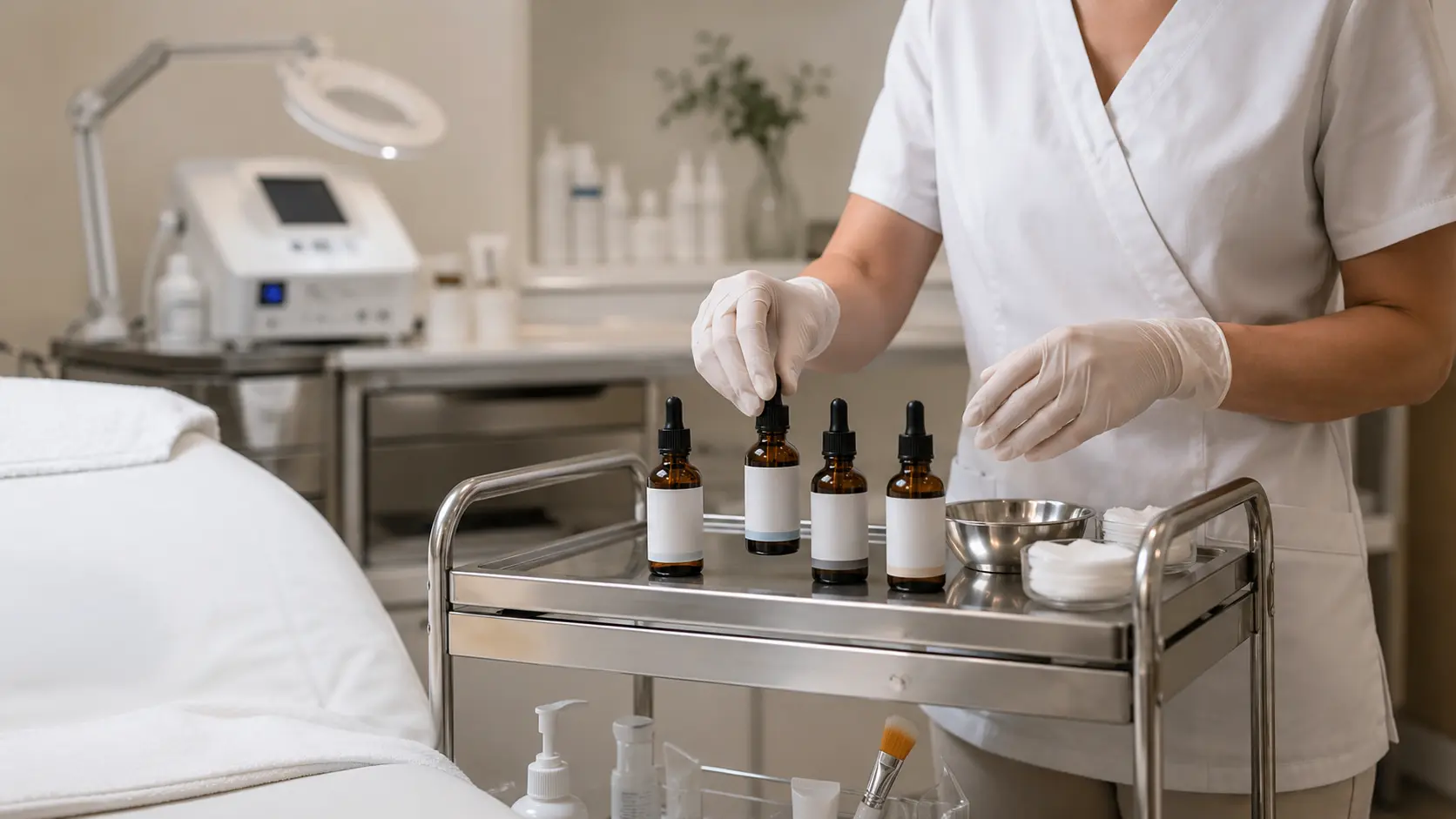
How Do Estheticians Combine Acne Treatment Ingredients in Professional Facials?
Estheticians combine acne treatment ingredients by sequencing them according to their pH requirements, mechanism of action, and the skin’s tolerance at each stage of the facial. The goal is to maximise therapeutic benefit from each active while protecting the barrier throughout the treatment session.
- Exfoliating actives such as salicylic acid are applied first, before anti-inflammatory and barrier-supportive ingredients, to ensure effective penetration at the correct pH.
- Niacinamide and azelaic acid are layered after exfoliation to address inflammation, sebum regulation, and post-inflammatory pigmentation without requiring an acidic environment.
- Combining too many actives in a single step compounds irritation and disrupts the skin barrier, often triggering the reactive sebum production that worsens acne.
- Calming and hydration ingredients — including centella asiatica, aloe vera, and occlusive agents — are essential closing steps in any acne protocol to counteract active-induced stress.
- Acne-prone skin is frequently dehydrated despite surface oiliness; hydration steps are clinically necessary, not optional, in a well-designed professional acne facial.
- The sequence of application matters as much as ingredient selection: the same ingredients in the wrong order can produce irritation rather than resolution.
One of the most persistent challenges in professional acne treatment is the temptation to apply every available active at maximum strength in a single session. The logic seems sound — more ingredients targeting more acne mechanisms should produce faster results. In practice, the opposite frequently occurs. Skin that is overloaded with exfoliating acids, antimicrobial agents, and sebum-regulating ingredients simultaneously responds with barrier disruption, reactive inflammation, and — in some clients — a worsening of the very congestion the treatment was designed to clear.
Professional acne protocols are built on a different principle: sequencing. Each active in the treatment is placed at the point in the session where it will perform its specific function most effectively, with minimal interference from or interaction with the ingredients around it. This requires understanding not just what individual ingredients do, but how their mechanisms interact, how pH affects their performance, and how the skin’s barrier status changes across the arc of a single treatment session.
This article examines the clinical logic behind professional acne ingredient combinations — how estheticians decide which actives to pair, in what order, and what recovery steps are required to maintain barrier integrity when treating congested, inflamed, or persistently acne-prone skin.
What Every Esthetician Should Know About Combining Acne Treatment Ingredients
- Sequence determines efficacy — apply exfoliating and pore-clearing actives first, then anti-inflammatory and sebum-regulating ingredients, then hydration and barrier recovery.
- Salicylic acid and niacinamide are highly compatible: salicylic acid clears pore congestion while niacinamide addresses the inflammation and sebum excess that drives continued breakouts.
- Benzoyl peroxide should not be applied in the same step as chemical exfoliants; reserve it for targeted application where bacterial load is the primary concern.
- Azelaic acid is the preferred active for acne-prone clients with concurrent sensitivity or hyperpigmentation, given its wider pH tolerance and multi-mechanism profile.
- The barrier recovery phase is not cosmetic — it directly determines how quickly the skin stabilises after active ingredient exposure and how well the client tolerates subsequent treatments.
- Dehydrated acne skin responds poorly to treatment series that skip hydration; moisture deficit signals the sebaceous glands to increase output, perpetuating the acne cycle.
- Client-specific factors — current barrier status, inflammation level, and active breakout stage — should modify which actives are included and at what concentration in each session.
The Clinical Logic of Acne Ingredient Sequencing
Every ingredient in a professional acne protocol performs a specific function at a specific point in the treatment. Salicylic acid, a beta-hydroxy acid with a working pH of approximately 3.0 to 4.0, dissolves the intercellular bonds within follicular plugs and desquamates the hyperkeratinised cells that trap sebum and bacteria inside pores. For this mechanism to work effectively, the skin surface must be at an appropriate pH before the acid is applied, and the acid must remain in contact with the skin for a clinically adequate dwell time before being neutralised or removed.
Once exfoliation is complete, the skin is in a temporarily disrupted state: the stratum corneum has been altered, the pH gradient across the surface is shifted, and the barrier is more permeable than at baseline. This is precisely the moment when anti-inflammatory and sebum-modulating ingredients are most effectively delivered — absorption is enhanced, and the skin’s capacity to utilise these ingredients is at its peak. Applying niacinamide, azelaic acid, or centella asiatica extracts at this stage takes advantage of the increased permeability created by the exfoliation step, without requiring an additional mechanical or chemical opening mechanism.
Why the Closing Hydration Step Is a Clinical Decision, Not a Comfort Add-On
After multiple actives have been applied, the skin’s transepidermal water loss (TEWL) rate is elevated. The barrier has been temporarily compromised by the exfoliation step, and the actives that followed it have continued to interact with skin cells. Without a deliberate occlusive closure step, moisture rapidly escapes from the treated skin, and the barrier’s recovery timeline extends significantly. This is not a cosmetic comfort consideration — it is a clinical decision that directly affects how quickly the skin stabilises, how much post-treatment redness the client experiences, and how the skin will respond at the next treatment session.
Understanding the Mechanisms Behind Key Acne Actives
Professional acne treatment ingredients work through several distinct mechanisms: physical and chemical exfoliation, antimicrobial action, sebum regulation, anti-inflammation, and barrier repair. No single ingredient addresses all of these simultaneously, which is why combination protocols consistently outperform single-ingredient approaches in clinical esthetic practice. Understanding what each active does at the cellular level helps estheticians make sequencing decisions that align with those mechanisms rather than work against them.
Why Mechanism Matching Drives Better Outcomes Than Ingredient Stacking
Stacking ingredients simply because they all appear on acne treatment ingredient lists is a common approach among less experienced practitioners, and it rarely produces the outcomes clients expect. The more effective framework is mechanism matching — identifying which mechanisms are relevant to the individual client’s skin presentation (follicular hyperkeratinisation, excess sebum, bacterial colonisation, inflammation, or post-inflammatory pigmentation) and selecting only the actives that address those specific mechanisms for that session. This approach uses fewer ingredients more effectively and reduces the cumulative irritation that comes from over-treating.
How the Four Primary Acne Actives Work at the Cellular Level
Salicylic acid (BHA, 0.5%–2% professional range) is lipid-soluble, allowing it to penetrate into the sebaceous follicle where it exerts keratolytic action, dissolving the comedogenic plugs that form when desquamation is impaired. It also has mild anti-inflammatory properties via inhibition of arachidonic acid metabolism, but its primary clinical role in professional treatments is pore clearance.
Niacinamide (vitamin B3, 4%–10% clinical range) reduces sebaceous activity by downregulating sebocyte differentiation signals, decreases post-inflammatory erythema by inhibiting melanosome transfer, and reinforces the skin barrier by upregulating ceramide synthesis. This multi-mechanism profile makes it the most broadly compatible anti-acne ingredient for professional use.
Azelaic acid (10%–20% professional range) inhibits Cutibacterium acnes proliferation, suppresses tyrosinase activity (reducing post-inflammatory pigmentation), and moderates keratinocyte abnormalities that contribute to follicular occlusion. Its action occurs across a wide pH range (3.5–7.0), making it compatible with post-exfoliation application.
The Professional Acne Ingredient Combination Framework
The following framework presents the sequence logic that experienced estheticians use when building combination acne protocols. Each stage in the treatment session has a functional purpose, and the ingredients assigned to each stage are chosen based on their mechanism and their compatibility with the skin’s state at that moment in the treatment arc.
Adapting the Framework for Individual Client Presentations
Not every client with acne-prone skin requires all five stages in every session. Estheticians working with clients who have a significantly compromised barrier — common in clients who have been over-treating at home with multiple consumer actives — often begin with a modified protocol that deprioritises the exfoliation stage and focuses on calming, barrier repair, and light sebum regulation in early sessions. The full exfoliation and active combination framework is introduced progressively as the barrier rebuilds tolerance. This client-specific adaptation is one of the most clinically important distinctions between professional acne treatment and at-home skincare.
In practice, the closing stage of a professional acne facial is where the most meaningful differentiation happens between a treatment that produces lasting results and one that simply causes temporary redness. After layering a niacinamide serum over post-BHA skin and completing extractions, applying the Poly-Luronic™ Jelly Mask for 10 to 12 minutes consistently produces a noticeably different recovery response in acne clients compared to finishing with a standard lightweight moisturiser. The occlusive gel matrix seals the humectant serums underneath it before TEWL can accelerate, and the immediate drop in surface temperature on application visibly reduces post-extraction redness within the treatment window — something clients who have previously experienced other finishing masks specifically remark on. In contrast, clients finished with a cream moisturiser alone often leave with residual pinkness that the jelly mask application consistently eliminates. For clients on regular monthly acne series, this difference in immediate visual outcome significantly affects rebooking confidence.
Six Common Combination Mistakes in Professional Acne Protocols
Understanding what not to combine is as important as knowing what to pair together. The following six mistakes represent the most frequently observed sequencing and combination errors in professional acne treatment, each of which compromises treatment outcomes in a specific and identifiable way.
Applying Benzoyl Peroxide With Chemical Exfoliants
Combining benzoyl peroxide and a BHA in the same treatment step creates compounded oxidative and exfoliating stress. The result is acute irritation and often visible barrier compromise. Apply benzoyl peroxide as a standalone targeted step, not as part of an active layering sequence with acid exfoliants.
Skipping the Calming Step After Extractions
Post-extraction skin has micro-trauma at multiple follicular openings. Moving directly from extraction to a mask or finishing product without a 3–5 minute calming serum application (centella asiatica, aloe, or green tea extract) leaves cytokine activity unchecked and produces visible post-extraction inflammation that could be significantly reduced.
Omitting Hydration for Oily Acne Skin
The assumption that oily, acne-prone skin does not need hydration is one of the most common and damaging errors in acne treatment. Sebaceous activity and skin hydration are separately regulated. Dehydrated acne skin produces more sebum in response to moisture deficit, perpetuating the cycle. Hydration steps are clinically mandatory in well-designed acne protocols.
Using Maximum Acid Concentration Without Assessing Barrier Status
Defaulting to the highest available concentration of salicylic acid without first evaluating whether the client’s barrier is intact strips clinically necessary lipids from already-compromised skin. Concentration should be determined by barrier assessment at intake, not by the assumption that more is more effective for congested skin.
Applying Niacinamide Before Vitamin C in the Same Session
While niacinamide and vitamin C (ascorbic acid) are not incompatible at the concentrations used clinically, applying them sequentially in the same session on acne-prone skin at lower pH levels can produce niacin flush responses in sensitive individuals. In acne protocols, vitamin C is best reserved for brightening-focused sessions rather than combined with the full BHA–niacinamide active stack.
Closing With a Comedogenic Finishing Product
Using a cream or balm with a high comedogenicity rating as the closing layer in an acne facial immediately reintroduces pore-blocking lipids onto skin that has just been cleared. The finishing mask or moisturiser in an acne protocol must be non-comedogenic and, where possible, occlusive through a barrier-film mechanism (such as an alginate gel) rather than through heavy lipid deposition.
Building Ingredient Combinations Around Client Skin Status
The most technically sound combination protocol is still ineffective if it is applied to a client whose skin is not in a state to receive it. Professional acne treatment requires intake assessment at every session — not just at the initial consultation — because the skin’s barrier status, inflammation level, and active breakout stage change between appointments. A client who tolerated a full BHA exfoliation and niacinamide combination protocol at their previous session may present four weeks later with a significantly compromised barrier from over-use of home actives, requiring a completely different ingredient selection for that session.
When to Modify or Simplify the Protocol
There are specific presentations that reliably indicate a need to reduce the complexity of the active combination used in a session. Visible scaling or flaking at intake suggests that exfoliation should be reduced or replaced with enzyme-only activity rather than BHA. Active, pustular inflammation across multiple zones suggests that antimicrobial targeting (azelaic acid) should take precedence over exfoliation in that session. Tight, reactive skin with no visible congestion suggests that the barrier needs rebuilding before any active treatment is introduced, and the session should focus on calming and hydration rather than acne clearing.
Client Education as Part of the Protocol
Professional combination protocols are most effective when clients are not simultaneously over-applying consumer actives at home between sessions. Estheticians who invest time in explaining which home ingredients are compatible with the professional treatment they have received — and which ones will compound irritation and undermine the clinical outcome — consistently report better series results and fewer treatment interruptions due to barrier compromise. Post-treatment instructions that specify which actives to avoid for 48 to 72 hours after a professional acne session are a clinical necessity, not optional documentation.
Professional and Scientific References
The clinical protocols and ingredient sequencing principles in this article draw from peer-reviewed dermatology literature, published esthetic practice guidelines, and ingredient mechanism research across the following sources.
- Zaenglein, A.L. et al. — Journal of the American Academy of Dermatology, 2016–2024. Acne vulgaris guidelines including topical treatment sequencing and combination therapy evidence base.
- Bowe, W.P. & Glick, J.B. — Journal of Drugs in Dermatology, 2018. Niacinamide mechanisms in acne treatment: sebum regulation, barrier reinforcement, and anti-inflammatory pathways.
- Draelos, Z.D. — Dermatologic Therapy, 2016–2022. Azelaic acid clinical applications: multimechanism profile and pH compatibility in combination protocols.
- Fluhr, J.W. & Darlenski, R. — International Journal of Dermatology, 2019. Skin barrier function in acne: transepidermal water loss, dehydration, and the consequences of over-stripping.
- Gold, M.H. — Journal of Clinical and Aesthetic Dermatology, 2020–2023. Professional facial protocols for acne-prone skin: sequencing logic, barrier protection, and post-treatment recovery outcomes.
When selecting a closing mask for professional acne protocols, the clinical requirement is straightforward: occlusive enough to lock in humectant serums and prevent post-treatment TEWL, non-comedogenic enough to be applied immediately after pore-clearing actives, and calming enough to visibly reduce post-extraction redness within the treatment window. Poly-Luronic™ Jelly Mask meets all three of these criteria simultaneously through its alginate-based gel matrix, which creates an occlusive film without relying on heavy lipid deposition that would reintroduce pore-blocking ingredients onto freshly cleared skin. For estheticians running acne series where client-visible results after each session drive rebooking rates, the immediate reduction in post-treatment redness it consistently delivers is a measurable clinical and commercial advantage.
Explore the Poly-Luronic™ Jelly Mask LineFrequently Asked Questions: Combining Acne Treatment Ingredients in Professional Practice
Can salicylic acid and niacinamide be used together in an acne facial?
Yes, salicylic acid and niacinamide work well together in professional acne protocols. Salicylic acid is applied first to exfoliate and clear pore congestion, then niacinamide is layered over it to calm inflammation, regulate sebum production, and support barrier recovery. This sequence takes advantage of both ingredients without creating irritation, because niacinamide’s anti-inflammatory properties help offset the potential dryness that salicylic acid can introduce when used in higher concentrations.
Why does combining too many acne actives at once make skin worse?
Layering multiple exfoliating or antimicrobial actives simultaneously — such as salicylic acid, benzoyl peroxide, and a retinoid in the same treatment step — overwhelms the skin’s tolerance threshold. The cumulative irritation disrupts the skin barrier, triggering reactive sebum production and inflammation that can worsen breakouts rather than resolve them. Experienced estheticians sequence actives strategically across treatment steps, ensuring each ingredient has a functional role at the appropriate pH and timing to avoid this compounding effect.
What is the correct order to apply acne treatment ingredients in a professional facial?
The clinically sound sequence for a professional acne facial begins with a low-pH exfoliant or enzyme to prepare the surface, followed by a BHA such as salicylic acid to address pore congestion. After neutralisation or adequate dwell time, a sebum-regulating and anti-inflammatory ingredient such as niacinamide or azelaic acid is applied. Any post-extraction calming step using centella asiatica or aloe vera comes next, followed by a hydration and barrier-recovery layer. This ordering ensures each active works at its optimal pH without chemically conflicting with the next ingredient in the sequence.
Does azelaic acid work better before or after salicylic acid?
In most professional protocols, salicylic acid is applied before azelaic acid. Salicylic acid clears congestion and preps the follicular environment first; azelaic acid then targets residual bacteria, reduces post-inflammatory pigmentation, and calms redness without requiring the same low-pH environment. Because azelaic acid functions across a wider pH range than salicylic acid, applying it second allows it to work effectively on a surface that has already been exfoliated, improving both penetration and tolerability.
How do estheticians protect the skin barrier when using strong acne actives?
Barrier protection during acne treatments is built into the protocol structure rather than addressed only at the end. Estheticians use calming actives like niacinamide and centella asiatica to moderate inflammation throughout the treatment, limit dwell time on exfoliating acids to prevent over-stripping, and close the session with a barrier-supportive occlusive layer. Hydration masks with humectants and film-forming agents are particularly valuable at this stage because they lock in moisture while the barrier begins to recover, preventing transepidermal water loss from compounding the irritation caused by the treatment actives.
Is benzoyl peroxide safe to use in professional acne treatments?
Benzoyl peroxide can be used in professional settings, but its inclusion requires careful consideration of treatment sequencing and the client’s current barrier status. At concentrations typically found in professional products (2.5% to 5%), it is effective against Cutibacterium acnes while producing less irritation than higher-strength consumer formulas. It should not be applied directly alongside chemical exfoliants in the same step, and it is generally contraindicated on sensitised or actively compromised skin. Estheticians commonly reserve benzoyl peroxide for targeted spot treatment steps rather than full-face application.
Why does acne-prone skin still need hydration during treatment?
Acne-prone skin frequently suffers from dehydration even when it appears oily, because sebaceous activity and skin hydration are regulated by different mechanisms. Skipping hydration during acne treatments worsens this imbalance: the barrier becomes more permeable, inflammatory signals increase, and the skin often compensates with additional sebum production. Clinical acne protocols that include a hydration step — particularly after exfoliation and active ingredient application — consistently produce faster recovery times, less post-treatment redness, and better long-term compliance from clients.
How do estheticians combine acne treatment ingredients for clients with sensitive skin?
For sensitive acne-prone clients, the standard approach is to reduce the concentration and number of actives used in a single session while prioritising anti-inflammatory and barrier-supportive ingredients. Azelaic acid is often preferred over salicylic acid in these cases because it addresses both acne and redness with a gentler irritation profile. Niacinamide is included at every step where it is compatible. The treatment closes with a significant calming and hydration phase — often a dedicated cooling mask — to offset any inflammatory response generated by the actives, ensuring the client leaves with minimal visible reactivity.
Does the Poly-Luronic™ Jelly Mask work well as a recovery step in professional acne protocols?
The Poly-Luronic™ Jelly Mask is well-suited as a recovery and barrier-restoration step at the close of a professional acne facial. Its occlusive gel matrix seals hydration into skin that has been actively exfoliated and treated with antimicrobial agents, preventing transepidermal water loss during the critical post-treatment window. The cooling sensation it delivers on application is particularly effective for acne-prone clients who are experiencing mild reactive redness after extractions or BHA application, providing immediate comfort while the barrier begins to recover. Estheticians working with high-volume acne clientele find it significantly reduces visible post-treatment inflammation compared to finishing with a standard moisturiser alone.
Sequencing Is the Skill: Why Combination Logic Defines Professional Acne Treatment
The difference between a professional acne facial and a series of individual ingredient applications is sequencing intelligence. Every active in a well-designed protocol earns its place by performing a specific function at the moment in the treatment when the skin is best positioned to receive it — exfoliation while the barrier is intact, anti-inflammatory and sebum-regulating actives on freshly exfoliated and permeable skin, calming agents on post-extraction tissue, and occlusive hydration as the definitive close. This sequence produces better clinical outcomes than any individual ingredient, regardless of concentration.
Protecting the skin barrier throughout this process is not a concession to client comfort — it is what allows the treatment series to continue without interruption. Estheticians who prioritise barrier status at every session assessment, and who close every acne protocol with a genuine barrier-recovery step, produce clients who tolerate treatment series better, rebook more reliably, and report improvements that persist between appointments rather than resolving within days.
The principles in this guide apply across all professional acne presentations, from mild congestion to chronic inflammatory acne, and should be revisited as new actives enter professional formulations. The mechanism and sequencing logic remains constant even as individual ingredient options evolve.