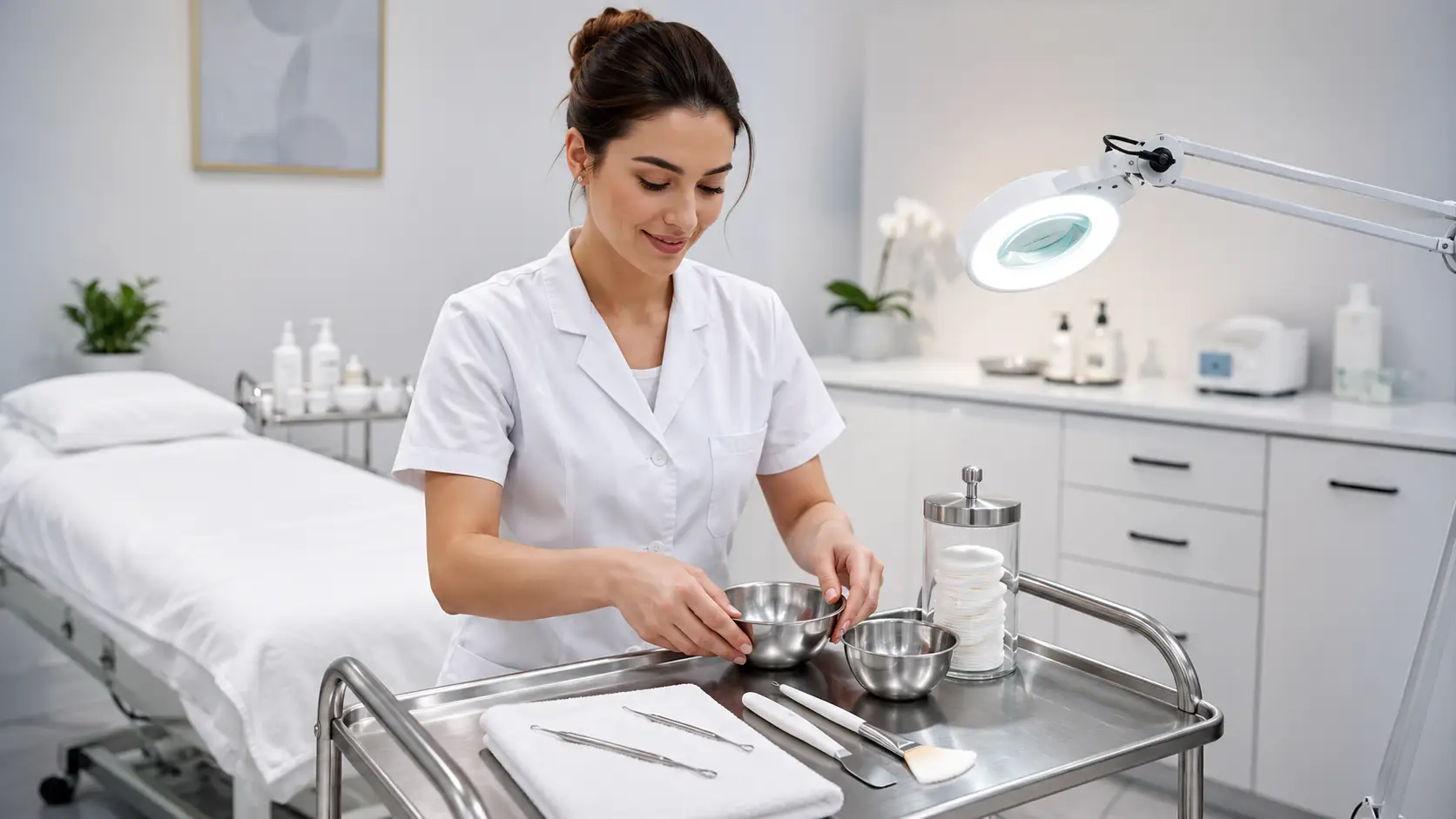
What Tools Does a New Esthetician Need for Beginner Facial Services?
New estheticians need seven categories of tools to perform beginner facial services professionally: a facial bed, a magnifying lamp, mixing bowls and spatulas, a steamer, extraction tools, facial brushes, and a complete sanitation setup including disposable supplies. These categories represent the minimum functional requirements for a safe, consistent, and professional facial service delivery.
- A professional facial bed is the single most important equipment investment — it affects every service, your body mechanics, and your client’s perception of your professionalism.
- A magnifying lamp is non-negotiable for safe skin analysis and extraction work; performing either without adequate magnification increases the risk of skin trauma and missed pathology.
- Stainless steel mixing bowls in small-to-medium sizes and dedicated mask and mixing spatulas are required for hygienic product preparation across every facial step.
- A steamer significantly improves extraction safety and outcomes and is worth investing in from day one rather than attempting to work around its absence.
- Synthetic-bristle facial brushes in three types — cleansing, mask, and fan — cover application needs across all standard beginner protocols.
- Add-on tools such as professional mask systems can be incorporated immediately without advanced training or devices, elevating client experience from the very first service.
- Disposable supplies — cotton rounds, gauze, sponges, and headbands — need to be stocked in sufficient volume before your first session to avoid mid-service supply gaps.
One of the most common questions new estheticians ask after graduation is deceptively simple: what do I actually need to start doing facials? The challenge is that cosmetology and esthetics schools teach you technique and theory within an environment that already has all the equipment in place. When you step into your own treatment room — whether in a spa, a salon, or a private suite — the responsibility for what tools are available falls entirely on you.
The industry does not make this easier. Trade shows, supplier catalogs, and social media are full of equipment that looks impressive and promises to elevate your services. For someone just starting out, the signal-to-noise ratio is extremely low. New estheticians frequently overspend in the wrong categories while underequipping in the areas that actually matter most for safe, consistent, professional facial delivery.
This guide cuts through that noise with a clear, practice-based breakdown of what is genuinely essential for beginner facial services, what can realistically wait until your business generates revenue, and how to think about the progression from minimal functional setup to fully equipped treatment room over time. Every tool category discussed here is one that affects either client safety, service consistency, or professional presentation — the three things that matter most when you are building a reputation from scratch.
What You Need to Know Before Building Your Beginner Facial Tool Kit
- Seven tool categories are non-negotiable for safe professional facial delivery — everything else is an upgrade, not a requirement.
- The facial bed and magnifying lamp are the two highest-impact investments for day one — prioritize these above devices and extras.
- Stainless steel mixing bowls and proper spatulas are unglamorous but critical — cross-contamination from poor product handling is a real professional risk.
- A steamer is worth buying early even on a budget — working without one makes extractions harder, more uncomfortable for clients, and riskier for skin.
- Synthetic brushes outperform natural bristle for professional facial use because of easier sanitization and more consistent performance across product types.
- Add-on treatments that require no additional devices — such as professional mask systems — can elevate your services and revenue from the very first client.
- Disposable supply volume is underestimated by almost every new esthetician — run out mid-session once and you will never understock again.
- Your tool setup communicates your professional standard to every client before a word is spoken — an organized, clean, well-equipped cart is a silent credibility signal.
Why Getting Your Tool Foundations Right Matters More Than Advanced Equipment
There is a predictable pattern in how new estheticians approach their initial equipment purchases. Drawn in by device demonstrations at trade shows or aspirational treatment room content on social media, many new practitioners spend early budget on microcurrent devices, high-frequency machines, or LED panels before they have addressed the foundational tools that every facial service requires regardless of technique level.
The result is a common and frustrating situation: technically capable new estheticians who have a shelf of devices but struggle with inconsistent mixing, poor extraction outcomes, or awkward workflow because they are working on an inadequate facial bed or without proper magnification. Advanced tools amplify your technique — they do not compensate for foundational gaps.
The most experienced estheticians in high-volume practices consistently report that the setup elements that matter most to client outcomes are not the devices — they are the bed, the lamp, the sanitation system, and the practitioner’s technique. Getting those foundations right first creates the stable platform that advanced tools can build on effectively.
This guide is organized around that principle. We start with what is essential, explain why each category matters to actual service delivery, and only then address the upgrade tools that genuinely add professional value once your foundations are solid.
The Seven Essential Tool Categories for Beginner Facial Services
These seven categories represent the non-negotiable minimum for safe, professional facial service delivery. A new esthetician without any one of these will either be unable to perform standard services safely or will produce outcomes that are inconsistent with professional standards.
Professional Facial Bed
Adjustable height, stable under client weight, comfortable for extended service durations. This is your single highest-impact investment and should not be compromised on price at the expense of stability or client comfort.
Magnifying Lamp
5-diopter minimum for skin analysis and extractions. Floor-mounted or clamp-mount depending on your room configuration. Non-negotiable for safe professional work on any skin type or condition.
Mixing Bowls and Spatulas
Three to four stainless steel or ceramic bowls in small-to-medium sizes, one mask application spatula, one mixing spatula. Stainless steel is preferred for consistent sanitization between clients.
Professional Steamer
Ozone-free or ozone-option models for skin type flexibility. Warm steam softens the stratum corneum and follicular plugs before extractions, reducing trauma and improving outcomes. Worth buying early.
Extraction Tools
Loop-end comedone extractor for closed comedones, lancet holder for milia work within scope of practice. A basic two-piece set covers the vast majority of beginner service extraction needs.
Facial Brushes
Synthetic bristle cleansing brush, mask application brush, and fan brush for eye and nostril areas. Synthetic bristles sanitize more effectively than natural bristle and perform consistently across gel, cream, and powder formulas.
Sanitation Setup and Disposables
Hospital-grade disinfectant spray, covered disposal bins, cotton rounds, gauze squares, esthetic sponges, disposable spatulas, and client headbands. Stock significantly more than you think you need for your first sessions.
Treatment Cart or Trolley
A stable, wheeled treatment cart keeps tools organized and within reach throughout your service sequence without requiring you to turn away from the client. Organization directly reduces procedural errors.
Every item in these eight categories has a direct functional role in the safety, consistency, or professional presentation of your facial services. None of them is optional once you are performing paid client services.
Breaking Down Each Essential Tool Category in Practice
The Facial Bed: Why This Comes First
New estheticians who invest in a quality facial bed from the start notice a difference in every service they perform. A stable, adjustable bed allows you to position clients correctly for each step of the facial, maintain proper body mechanics to prevent your own injury over long service days, and present a professional treatment environment that communicates quality before the service begins.
Facial beds come in manual, hydraulic, and electric adjustment types. For most new estheticians working in a fixed suite or spa room, a hydraulic or electric-lift model offers the flexibility to adjust height during service without disrupting client positioning. Minimum weight capacity of 450 lbs accommodates the full range of client body types comfortably. Budget models often fail at the gas cylinder or mechanism within 12 to 18 months of regular use — this is one area where mid-range investment pays measurable dividends in reliability.
The Magnifying Lamp: Non-Negotiable for Safe Work
A professional magnifying lamp is not just a convenience — it is a safety tool. Performing skin analysis without adequate magnification means working with incomplete information about skin condition, follicular status, and extraction contraindications. Performing extractions without magnification is a meaningful risk for client skin trauma, missed congestion, and improper technique on structures you cannot clearly see.
The standard for professional facial work is a 5-diopter lens, which provides enough magnification for detailed skin analysis and extraction work without distorting spatial depth perception. Some estheticians prefer 10-diopter central magnification with a 5-diopter outer ring for enhanced detail on specific areas. LED ring-lamp models provide consistent, shadow-free illumination that significantly improves your ability to assess skin texture, tone, and congestion accurately.
Mixing Bowls and Spatulas: The Hygiene Foundation of Your Protocol
Cross-contamination through shared product containers is one of the most common sanitation errors in professional facial services. Using dedicated mixing bowls to portion out individual-use amounts of each product for each client, and applying products with spatulas rather than fingers dipped into product jars, is the professional standard that prevents contamination of your entire back bar product inventory.
Stainless steel bowls are the professional preference because they can withstand hospital-grade disinfectant cleaning between clients without degradation over time. Plastic bowls absorb product residue and develop micro-scratches that harbour bacterial growth even after visible cleaning. Three to four bowls in graduated sizes — small for serums and actives, medium for cleansers and masks — covers the preparation needs of a standard beginner facial protocol without creating workflow interruptions.
The Steamer: Why Working Without One Is Not a Viable Option
Estheticians who have performed facials both with and without a steamer consistently report that the steamer makes extractable congestion more accessible, client discomfort during extractions lower, and outcomes more consistent for clients with oily or congested skin types. Warm steam softens the stratum corneum and the keratin plug within follicles, reducing the mechanical pressure required for extraction and therefore reducing the risk of post-extraction skin damage or bruising.
For new estheticians on a restricted budget, a basic professional steamer from a reputable esthetic supply brand is a more important early investment than almost any device or specialty tool. The clinical and experience difference it produces for extraction-dependent services is immediately apparent and directly affects client satisfaction in the sessions where it matters most.
Extraction Tools: Starting Simple and Building Forward
New estheticians performing beginner facial services need two extraction tool types in their initial kit. A loop-end comedone extractor is used for soft closed comedones that can be gently expressed with controlled pressure through the loop. A lancet holder is needed for milia extraction in states where this falls within the esthetician scope of practice — always verify your state board’s specific scope guidelines before performing any lancet work.
Beyond these two basics, specialized extraction tools — angled extractors, different loop sizes, flat-pressure models — can be added as your technique develops and your client profile becomes clearer. Starting with more tools than your technique level requires often leads to confusion and inconsistent outcomes rather than expanded capability.
Facial Brushes: Three Types That Cover Your Full Beginner Service Range
Professional facial brush sets marketed to new estheticians often include far more brushes than a beginner protocol actually requires. Three brush types cover the application needs of every standard beginner facial service. A medium-density cleansing brush applies facial cleansers in circular movements for manual cleansing steps. A flat mask brush applies cream, clay, alginate, and powder-activated masks evenly across the face and neck. A fan brush handles serums and treatments around delicate eye and nostril areas where larger brushes create application control challenges.
Synthetic bristle brushes are universally preferred for professional use over natural bristle alternatives. Synthetic filaments do not absorb product in the same way natural bristles do, they sanitize completely with professional disinfectants without bristle damage, and they maintain consistent application performance across both gel-based and cream-based formulations. Natural bristle brushes require more careful handling and have a higher contamination risk in high-volume treatment environments.
Essential vs. Upgrade: What Can Wait and What Cannot
One of the most valuable frameworks a new esthetician can apply to equipment decisions is a clear distinction between what is essential for safe service delivery from day one and what represents a meaningful upgrade once foundational capability is established. These are genuinely different categories with different financial priorities attached to them.
Must Have Before First Paying Client
- Professional facial bed with adjustable height mechanism
- 5-diopter magnifying lamp with LED illumination
- Stainless steel mixing bowls (set of 3–4) and professional spatulas
- Professional ozone-free steamer
- Loop-end comedone extractor and lancet holder
- Synthetic-bristle brush set (cleansing, mask, fan)
- Hospital-grade disinfectant and complete sanitation supplies
- Disposable supplies: cotton rounds, gauze, esthetic sponges, headbands
- Wheeled treatment cart or trolley
- Back bar product line covering cleanse, tone, treat, mask, and protect steps
Meaningful Additions After Foundations Are Established
- Professional galvanic or ultrasonic device for enhanced product penetration
- High-frequency machine for acne and antiseptic protocols
- Microcurrent device for facial lifting and contouring services
- Dermaplaning tool and certification for exfoliation add-on services
- Nano infusion device for needle-free serum infusion protocols
- Hydro-dermabrasion or microdermabrasion machine for resurfacing services
- Specialized extraction magnification (10-diopter combination lenses)
- Treatment bed upgrade to electric-lift model with memory positions
The upgrade tier contains tools that meaningfully expand your service menu and can justify higher price points once you have the client base and cash flow to support the investment. None of them compensate for foundational gaps — and all of them perform significantly better when the practitioner is working on a solid foundational setup.
How Add-On Tools Fit Into a Beginner Facial Setup Without Overcomplicating It
There is a meaningful distinction between add-on tools that require new equipment investment and additional training, and add-on treatments that integrate seamlessly into a beginner setup using tools already in place. New estheticians benefit enormously from focusing on the second category first.
Mask Systems as the Most Accessible Service Upgrade
Professional mask systems — particularly powder-activated formulations — represent one of the highest-value service additions available to new estheticians without any additional equipment. They use the mixing bowls, spatulas, and mask brushes that are already part of every standard facial setup. They require no device, no additional certification in most states, and no significant modification to an existing protocol workflow.
From a client experience perspective, professional masks — especially those with distinctive application or removal characteristics — consistently rank among the most memorable moments in a facial service. Clients who have experienced a well-executed professional mask application and removal describe it as a sensory highlight that significantly elevates their perception of the overall treatment quality. For new estheticians still building their service reputation, this kind of client response is directly useful for rebooking and word-of-mouth referral generation.
Pairing the Right Mask With the Right Skin Concern
New estheticians developing their service menu benefit from having mask options that work across multiple skin types rather than requiring an extensive inventory of skin-type-specific products. Hydration-focused professional masks that are fragrance-free and formulated with clinical humectants can be safely applied across dry, dehydrated, sensitive, and post-active-treatment skin without separate product sourcing for each presentation. This reduces inventory complexity and the cognitive load on new practitioners still developing their skin analysis confidence.
New estheticians who add the Poly-Luronic™ Jelly Mask by Luminous Skin Lab into their beginner facial services early in their career consistently report two practical advantages that matter specifically at the beginner stage. First, the formulation mixes to a consistent texture with the standard 2:1 water-to-powder ratio using the stainless steel bowls and silicone mixing spatulas already in their setup — no additional equipment required, no ratio guesswork, no inconsistency between sessions. Second, the PGA and hyaluronic acid dual-humectant formulation produces immediately visible hydration results that clients comment on without prompting, which gives new estheticians a confidence-building win in the post-service conversation that is particularly valuable when you are still developing your treatment room voice.
Practitioners who have used competing jelly mask formulations before switching note that the consistent 12-to-15-minute set window gives them reliable time to complete a hand or arm massage add-on during the mask phase without adjusting their service timing — a workflow consistency that matters more in beginner sessions where timing uncertainty already adds stress. The fragrance-free formulation also means they can use it across the full range of skin types they see as beginners, including sensitive and reactive presentations, without maintaining a separate post-treatment mask inventory.
A Visual Framework: Essential Tools Organized by Service Phase
Understanding not just which tools you need but when in a facial service sequence they are used helps new estheticians organize their treatment cart logically and reduces the cognitive load of managing workflow during early-career services. The infographic below maps each essential tool category to the facial service phase where it is primarily used.
Sanitation Setup and Disposables: The Part Most New Estheticians Underestimate
No tool category is more consistently underestimated by new estheticians than sanitation supplies and disposables. The instinct is to focus on what clients can see — the equipment, the products, the mask application. Sanitation standards are the invisible foundation of every professional service, and the supply chain for disposables needs to be planned before you see your first paying client, not during or after.
Hospital-Grade Disinfectant: The Correct Standard for Professional Esthetic Work
Esthetic regulatory boards in most states require the use of EPA-registered hospital-grade disinfectants on implements and surfaces. Consumer-grade cleaning products — including many products marketed to estheticians with professional-sounding branding — do not meet this standard. Verify that every disinfectant product in your sanitation setup carries the EPA registration number and is labelled for use on the specific implement types in your practice.
Disposable Supply Volume: Stock More Than You Think
The calculation new estheticians typically make when stocking disposables for the first time is based on the number of services they expect to perform. What that calculation misses is the per-service consumption rate of items used across multiple steps — cotton rounds in particular can be used six to ten times per service across pre-cleanse, toning, post-extraction, and product removal steps. A practitioner who stocks 50 cotton rounds for their first day of four clients will run short. Stock for three times your expected service volume until you have established your actual per-service usage patterns.
Organize Your Sanitation System Before Client Day One
A sanitation system that is not organized in advance becomes a source of procedural errors under the time pressure of live client services. Estheticians who set up their covered disposal systems, disinfectant spray stations, and implement storage protocols before their first client session report significantly less anxiety and fewer workflow disruptions in early-career services compared to those who organize these systems reactively. Sanitation setup is not a background task — it is part of your professional infrastructure.
Common Tool Setup Mistakes New Estheticians Make and How to Avoid Them
Spending on Devices Before Foundational Tools Are in Place
The most common setup mistake new estheticians make is purchasing a device — microcurrent, high-frequency, ultrasonic — before they have invested adequately in their foundational tool categories. Devices add genuine service value once your foundational technique is strong and your treatment room is properly equipped. Added before that point, they often collect dust because the practitioner’s confidence and workflow are not yet at the level where a device meaningfully enhances client outcomes.
Using Plastic Mixing Bowls Instead of Stainless Steel
Plastic mixing bowls feel like a cost-saving choice, but the inability to fully sanitize them between clients introduces a real contamination risk that compound over a high-volume service week. Stainless steel is the professional standard for this reason. The additional cost is nominal compared to the professional risk reduction.
Not Testing the Steamer Before the First Client Session
Steamers require filling, preheating, and in some cases descaling before their first professional use. Discovering this during a live client service creates a service disruption that could have been entirely avoided. Run your steamer at full operation at least once before your first client session to identify any equipment issues, calibrate your heat and distance settings, and integrate it into your pre-service preparation routine.
Skipping the Treatment Cart in Favor of a Counter Setup
Working from a fixed counter rather than a wheeled cart forces you to turn away from the client to access supplies during service steps — a motion that breaks the continuity of the service experience and introduces the possibility of reaching across or above a reclined client. A treatment cart that positions all phase tools within arm’s reach in sequence order is a professional workflow standard that significantly reduces physical risk and improves service pacing.
Professional and Industry References
The tool standards and sanitation requirements referenced in this article are consistent with the following professional and regulatory sources:
- State Esthetic and Cosmetology Board regulations — implement sanitation and disinfection standards, scope of practice for extraction procedures. Verify specific requirements for your state board before performing any extraction services.
- EPA Registered Hospital-Grade Disinfectant standards — United States Environmental Protection Agency registration requirements for professional surface and implement disinfection in personal care service environments.
- Associated Skin Care Professionals (ASCP) — industry standards for treatment room setup, sanitation protocols, and scope of practice guidance for licensed estheticians.
- National Coalition of Estheticians, Manufacturers/Distributors and Associations (NCEA) — professional standards and certification benchmarks for esthetician education and practice.
- Milady Standard Esthetics: Fundamentals — textbook standard for facial equipment categories, application techniques, and sanitation requirements in professional esthetic education.
For new estheticians ready to add a professional mask add-on that integrates seamlessly into their existing beginner tool setup without any additional equipment investment, the Poly-Luronic™ Jelly Mask by Luminous Skin Lab is the formulation our education team most frequently recommends in new esthetician contexts. Developed by a licensed esthetician specifically for professional treatment room use, it mixes with standard stainless steel bowls and spatulas at a consistent 2:1 ratio, sets within a predictable window that accommodates standard beginner facial service timing, and delivers immediately visible dual-depth hydration results through a PGA and hyaluronic acid formulation that clients notice without prompting. Fragrance-free and formulated across all skin types — including sensitive and reactive presentations — it functions as both a hydration treatment upgrade and a rebooking and referral driver from the very first session it is used.
Explore the Poly-Luronic™ Jelly Mask Line →Frequently Asked Questions: Essential Tools for Beginner Facial Services
What tools does a new esthetician absolutely need to start doing facials?
The non-negotiable tools for beginner facial services are a professional facial bed, a magnifying lamp, bowls and spatulas, a steamer, extraction tools, facial brushes, and a sanitation setup. These seven categories cover the physical requirements of every standard facial protocol and should be in place before you see your first paying client.
Do I need a steamer as a new esthetician or can I skip it?
A steamer is strongly recommended for beginner estheticians performing extractions and standard facial services. It softens follicular plugs, opens pores, and makes the extraction step safer and more effective for clients. New estheticians who skip the steamer find extractions harder, client discomfort higher, and outcomes less consistent. It is one of the few pieces of equipment worth investing in from day one.
What is the most important piece of equipment for a beginner facial room?
The facial bed is the single most important equipment investment for a beginner esthetician. A stable, adjustable, comfortable facial bed directly affects every service you perform, your body mechanics and injury prevention, and your client’s perception of professionalism. Skimping on the facial bed while overspending on devices is one of the most common setup mistakes new estheticians make.
How do I know which extraction tools I actually need as a beginner?
Most beginner estheticians need two extraction tool types: a comedone extractor with a loop end for closed comedones and a lancet holder for milia work where your scope of practice permits. A basic two-piece set covers the vast majority of extraction scenarios you will encounter in beginner facial services. More specialized tools can be added later as your technique and client base develop.
Can I do a professional facial without a magnifying lamp?
Technically yes, but you should not. A magnifying lamp is essential for safe skin analysis and extractions. It allows you to see follicular plugs, milia, and skin texture clearly enough to perform accurate assessments and safe extractions. Performing extractions without adequate magnification increases the risk of skin trauma and missed congestion. This is a non-negotiable tool for professional facial work.
What bowls and spatulas do I need to start doing facials?
New estheticians need at minimum three to four stainless steel or ceramic mixing bowls in small to medium sizes, one mask spatula for application, and one mixing spatula for product preparation. Stainless steel bowls are preferred over plastic because they are easier to sanitize between clients and do not absorb product residue. Starting with a set of four bowls allows you to pre-measure products for each treatment step without cross-contamination.
What facial brushes do I need as a new esthetician?
The three essential facial brush types for beginner services are a cleansing brush for manual application, a mask brush for even product distribution, and a fan brush for delicate application around eyes and nostrils. Synthetic bristle brushes are preferred for professional use because they are easier to sanitize, less prone to bacterial retention, and work effectively across all formula types including gel, cream, and powder-activated products.
When should a new esthetician add a jelly mask to their facial service menu?
New estheticians can add a professional jelly mask as a facial add-on from their very first services. Jelly masks require no specialized device, no advanced certification, and minimal additional setup beyond standard bowls and spatulas. They elevate the client experience immediately, add visible treatment value, and give new estheticians a high-impact tool that clients respond to enthusiastically even during early-stage practice.
What makes the Poly-Luronic Jelly Mask a good choice for new estheticians adding their first mask add-on?
The Poly-Luronic Jelly Mask by Luminous Skin Lab is beginner-friendly because it mixes predictably, sets within a consistent time window that works within standard facial service timing, and requires only the basic bowls and spatulas already in a new esthetician’s setup. The PGA and hyaluronic acid dual-humectant formulation produces immediate, visible hydration results that clients notice without prompting, which builds confidence for new practitioners still developing their treatment room voice.
Build the Foundation First — Everything Else Follows
The most important thing a new esthetician can understand about tool selection is that professional confidence is built on professional foundations. A well-organized treatment room with the right seven tool categories in place — a quality bed, a proper magnifying lamp, clean stainless steel mixing equipment, a working steamer, extraction tools, synthetic brushes, and a complete sanitation setup — gives you everything you need to perform safe, consistent, professional facial services from day one.
Devices can come later. Advanced certifications can come later. Specialty equipment can come later. What cannot come later, and cannot be substituted for by any device or product, is the foundational competence that comes from working in a properly equipped environment with the right tools in the right places at every step of your service sequence.
New estheticians who get their foundations right first build faster, more confidently, and with better client outcomes than those who chase advanced tools before their fundamentals are solid. The clients in your first sessions are setting the word-of-mouth foundation of your entire career. Give them the experience that a professionally equipped, properly prepared treatment room makes possible.