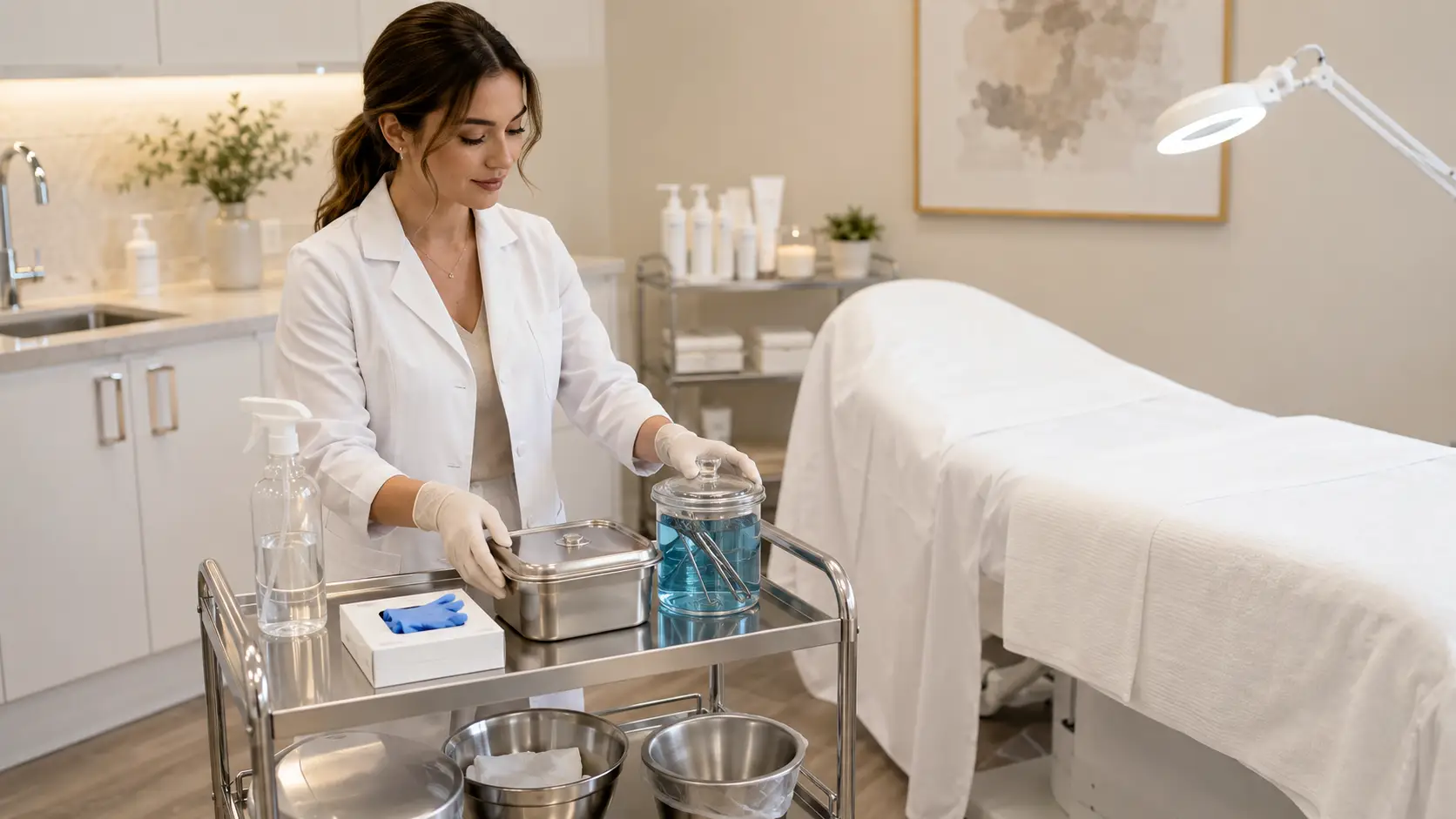
What Does a New Esthetician Need for a Proper Sanitation Setup?
A proper beginner esthetician sanitation setup requires understanding the difference between disinfection and sterilization, acquiring the correct EPA-registered hospital-grade products, establishing separate clean and contaminated zones, and building consistent between-client infection control habits from the very first day of practice. Sanitation compliance is not optional — it is a state board requirement, a professional obligation, and the single most important non-negotiable standard in every esthetic treatment room.
- Disinfection kills most pathogens and is required for all non-invasive implements and surfaces between clients. Sterilization eliminates all microbial life and is required for any implement that pierces the skin barrier.
- EPA-registered hospital-grade disinfectants are required by most state boards — general-purpose cleaners and natural sprays do not meet this standard regardless of marketing claims.
- Separate clean and contaminated zones must be established and maintained in every treatment room — these zones must never overlap.
- Full disinfectant contact time must be observed — spraying and immediately wiping does not allow the pathogen kill the label specifies.
- Single-use items including cotton rounds, spatulas, and disposable draping must be discarded after each client without exception.
- Sanitation habits built from day one become automatic professional practice — building them correctly from the start is far easier than correcting lapses later.
Of all the things that can feel overwhelming when you are setting up your first treatment room as a new esthetician, sanitation is the one area where there is no room for learning by trial and error. A missed disinfection step, a contaminated implement, or a misunderstanding about what EPA-registered actually means does not just result in a bad client experience — it can result in a client infection, a state board complaint, and a license suspension. This is the one area of your practice where the standard is set before you open your doors, and meeting it is not negotiable.
The good news is that building a proper sanitation setup as a new esthetician is genuinely straightforward when you understand the underlying framework. The complexity of infection control protocols in esthetics is often overstated in ways that leave new practitioners either over-investing in unnecessary equipment or under-investing in the basics that actually matter. This guide cuts through that confusion with a clear, education-first approach to everything you need to know about sanitation from day one.
We cover the foundational concepts of disinfection versus sterilization and why that distinction determines what you buy, what you need in your sanitation station, how to set up clean and contaminated zones correctly, how to build a between-client workflow that becomes automatic, what the most common sanitation mistakes look like in practice, and how your sanitation setup communicates professional credibility to every client who walks into your room.
What Every New Esthetician Needs to Know About Sanitation Setup
- Disinfection and sterilization are not interchangeable terms — knowing which one applies to each implement in your service determines what equipment you actually need.
- EPA-registered hospital-grade disinfectant is the professional standard — check the EPA registration number on every product you purchase for your sanitation station.
- Contact time is the most commonly skipped step in treatment room disinfection — always read and observe the full dwell time listed on your disinfectant label.
- Clean and contaminated zones must be physically separated and clearly labeled — this is a state board standard in most jurisdictions, not just a best practice.
- Single-use items are single-use without exception — cotton rounds, disposable spatulas, and draping are discarded after every client.
- A visible, organized sanitation station builds client trust faster than almost any other environmental signal in your treatment room.
- Your sanitation habits become your professional reputation — building them correctly from your first client is a long-term investment in your career.
Disinfection vs. Sterilization: The Foundational Distinction Every New Esthetician Must Understand
Before you buy a single sanitation supply, you need to understand the difference between disinfection and sterilization. These two terms are frequently used interchangeably in casual conversation, but in a professional esthetics context they describe fundamentally different levels of microbial kill — and getting this distinction wrong has direct consequences for client safety and regulatory compliance.
What Is Disinfection?
Disinfection is the process of eliminating most harmful microorganisms from surfaces and implements using chemical agents. A properly applied EPA-registered hospital-grade disinfectant will kill bacteria, most viruses, and fungi at the concentration and contact time specified on the product label. Disinfection does not eliminate all microbial life — specifically, it does not reliably kill bacterial spores. For the vast majority of esthetic services performed on intact skin, disinfection is the appropriate and required standard.
Disinfection applies to all non-invasive implements and surfaces in your treatment room: metal comedone extractors, stainless steel spatulas, hard-surface implement handles, facial bed surfaces, trolley tops, equipment housings, and any hard non-porous surface that comes into contact with clients or your hands during a service. Between each and every client, these surfaces must be disinfected using a properly diluted EPA-registered disinfectant applied at the correct contact time.
What Is Sterilization?
Sterilization eliminates all microbial life including bacterial spores, which disinfection cannot reliably destroy. In esthetics, sterilization is required for any implement that pierces or significantly disrupts the intact skin barrier. The gold standard for sterilization in professional esthetics is an autoclave — a device that uses pressurized steam at high temperature to achieve complete microbial elimination. Some states also permit chemical sterilization using specific high-level disinfectant solutions with extended contact times, but autoclave sterilization is the most universally accepted standard.
Which Level Do You Need as a New Esthetician?
For most new estheticians offering standard facial services — cleansing, extractions, mask application, hydration treatments — a proper chemical disinfection system is what you need, not an autoclave. An autoclave becomes a compliance requirement only when you introduce services that break the skin barrier. If you plan to offer microneedling from the start, single-use disposable cartridges are the most practical compliance solution, and an autoclave is required for any non-disposable skin-piercing implement. Check your state board regulations specifically for the services you plan to offer — requirements vary meaningfully by state.
The Three Levels of Decontamination in Esthetics
Sanitation: Reduces microbial count on a surface to a safe level. Hand washing is the most common example. Required as a baseline habit throughout every service but is not sufficient on its own for implements or contact surfaces between clients.
Disinfection: Kills most pathogens including bacteria, viruses, and fungi using EPA-registered chemical agents. Required for all non-invasive implements and hard contact surfaces between each client. The primary standard for most esthetic treatment room protocols.
Sterilization: Eliminates all microbial life including spores. Required for implements that penetrate the skin barrier. Autoclave sterilization is the accepted professional standard. Required if you offer microneedling or any skin-penetrating service with reusable implements.
What Does EPA-Registered Hospital-Grade Disinfectant Actually Mean?
You will see the phrase “EPA-registered hospital-grade disinfectant” in virtually every state board sanitation standard. Understanding what this phrase means — and how to verify that a product actually meets it — is a non-negotiable piece of professional knowledge.
The EPA Registration System
The United States Environmental Protection Agency regulates pesticides and antimicrobial products including disinfectants. Every product legally sold as a disinfectant in the United States must be registered with the EPA and assigned a unique EPA registration number. This number confirms that the manufacturer has submitted testing data demonstrating the product’s efficacy against specific listed pathogens at the stated concentration and contact time. The EPA registration number appears on the product label, typically in small print near the active ingredient list.
When a product is described as “hospital-grade,” this refers to its kill spectrum — specifically that it has demonstrated efficacy against bacteria including Staphylococcus aureus and Pseudomonas aeruginosa, as well as fungi and viruses as listed on the label. These kill claims are what make the product appropriate for use in professional health and beauty service environments where pathogen transmission risk is a real concern.
Why Natural and DIY Alternatives Do Not Meet This Standard
Products marketed as natural disinfectants, essential oil-based antimicrobials, vinegar solutions, or even many commercial all-purpose sprays do not carry EPA registration numbers as hospital-grade disinfectants. Regardless of how these products are marketed, using them in place of an EPA-registered disinfectant in your professional treatment room does not meet state board standards and leaves you professionally exposed if a client experiences an infection-related adverse event. The only way to verify compliance is to check the EPA registration number on the label of every product you use.
Contact Time: The Most Commonly Ignored Instruction
The single most common disinfection error in professional esthetic settings is failing to observe the full contact time listed on the product label. Contact time — also called dwell time — is the amount of time the disinfectant must remain wet on the surface in order to achieve the stated pathogen kill. For most professional disinfectants used in esthetics, contact time ranges from one to ten minutes. Spraying a surface and immediately wiping it removes the disinfectant before pathogen kill has occurred. Always apply your disinfectant and allow the full contact time to elapse before wiping or touching the surface.
Contact time is not optional. The pathogen kill claim on your disinfectant label is only valid when the product remains wet on the surface for the full specified contact time. Wiping immediately after spraying is one of the most common disinfection protocol failures observed in professional inspections. Read your product label and build the habit of timing your contact dwell from your very first client.
Additionally, disinfectants must always be used at the correct dilution. Using a product at too low a concentration reduces or eliminates its efficacy. Using it at too high a concentration can damage implements and surfaces and does not improve kill spectrum. Follow the manufacturer’s dilution instructions exactly.
Essential Sanitation Supplies for a New Esthetician’s Treatment Room
Once you understand what you are trying to accomplish with your sanitation setup, the supplies you need become straightforward. Estheticians starting out frequently either overspend on equipment they do not need yet or underspend on the basics that matter most. This list represents the non-negotiable core of a compliant beginner sanitation station.
EPA-Registered Hospital-Grade Disinfectant
Your primary surface and implement disinfectant. Verify the EPA registration number on the label. Barbicide concentrate, Cavicide, Rejuvenate, and similar professional-grade products are widely used in esthetics. Have both a spray formulation for hard surfaces and a liquid soak solution for fully submersible metal implements.
Wet Sanitizer Container with Lid
A glass or food-safe plastic container large enough to fully submerge your metal implements in disinfectant solution. Labeled clearly with the disinfectant solution name and date mixed. Change solution daily or per manufacturer instructions. Never leave implements dry in an empty container.
Covered Clean Implement Tray
A covered tray or container for clean, disinfected implements ready for use. Must be physically separated from the contaminated zone. Many estheticians use a covered stainless steel tray or lined covered container. Label this tray clearly as the clean zone.
Covered Contaminated Implement Container
A separate covered container for used implements awaiting disinfection. Must be physically distinct from the clean zone and labeled accordingly. Never place used implements back into the clean tray. Never place used implements loosely on the trolley surface.
Nitrile Disposable Gloves
A full box of nitrile gloves in your size kept accessible at your sanitation station. Gloves are changed between the clean and contaminated phases of each service. Never reuse gloves between clients. Latex alternatives are preferred for esthetics settings where client latex sensitivity is a common consideration.
Foot-Pedal Lined Waste Bin
A covered, foot-pedal-operated waste bin lined with a disposable bag for single-use items discarded during services. Hands-free operation prevents cross-contamination. Empty and reline between every client. Use a separate sharps container if any piercing services are offered.
Paper Towels and Disposable Draping
Paper towels for hand drying, surface wiping, and general sanitation use throughout services. Fresh disposable draping or clean laundered covering for the treatment bed placed fresh for every client. Never reuse draping between clients regardless of visible soiling.
Hand Sanitizer and Hand Washing Station
A professional-grade alcohol-based hand sanitizer (minimum 60% ethanol) accessible at your sanitation station. Hand washing with soap and water must be performed before and after each client — hand sanitizer is a supplement to hand washing, not a replacement. Access to a sink within or immediately adjacent to your treatment room is a state board requirement in most jurisdictions.
How to Set Up Clean and Contaminated Zones in Your Treatment Room
One of the most important structural concepts in treatment room infection control is the physical separation of clean and contaminated zones. This is not simply a best practice — in most states it is an explicit state board requirement, and the failure to maintain it is one of the most common citations issued during professional inspections.
What the Clean Zone Contains
The clean zone is the area of your trolley or supply station designated exclusively for items that are ready for use with a client. This includes your covered clean implement tray containing freshly disinfected metal implements, product dispensing supplies that have not yet been used in a service, fresh disposable supplies still in their packaging, and your hand sanitizer. Nothing that has been in contact with a client or used during a service should ever be returned to the clean zone.
What the Contaminated Zone Contains
The contaminated zone is the area designated for used items awaiting disinfection or disposal. This includes your covered container for used metal implements awaiting disinfection, your waste bin for single-use disposables, and any supplies that have been opened and used during a service. The contaminated zone must be physically separated from the clean zone — not simply placed on a different part of the same surface.
How to Organize Your Trolley for Zone Separation
In a typical single-tier treatment trolley setup, estheticians establish zones by dedicating the left side of the trolley surface to the clean zone and the right side to the contaminated zone, or by using separate clearly labeled containers with physical separation between them. In a multi-tier trolley, the top tier is commonly reserved for the active clean zone and a lower tier or side container for contaminated items. The critical rule is that clean and contaminated never share the same unlabeled, undelineated space. Label your containers clearly — “Clean” and “Used / Awaiting Disinfection” written on adhesive labels is a simple and effective solution.
How to Build a Between-Client Sanitation Workflow That Becomes Automatic
The goal of a between-client sanitation workflow is to complete every required disinfection step efficiently and without interrupting your service rhythm. New estheticians who build this workflow deliberately from their first client find that it becomes fully automatic within a few weeks. Those who skip steps early because it feels efficient typically develop habits that create real compliance and safety risks over time.
- Glove up before beginning cleanup. After your client leaves the treatment table, put on fresh nitrile gloves before touching any used implements, linens, or surfaces. Your gloves are the barrier between the contaminated environment and your clean hands.
- Transfer all used implements to the contaminated container. Move every metal implement used during the service directly into your covered contaminated container. Do not place used implements on the trolley surface, back in the clean tray, or anywhere other than the designated contaminated zone.
- Discard all single-use items. Remove all used cotton rounds, disposable spatulas, opened packaging, and any other single-use items directly into the lined waste bin. Never leave used disposables on the trolley between clients.
- Strip and dispose of all draping. Remove the facial bed draping, headrest cover, and any additional draping used during the service. Disposable draping goes directly into the waste bin. Reusable linens go directly into a closed laundry container — never placed on surfaces or the floor.
- Disinfect all contact surfaces. Apply EPA-registered disinfectant to the facial bed surface and headrest, armrests, trolley top, and any equipment handles or surfaces touched during the service. Spray and allow full contact time as specified on your product label before wiping. Time it if necessary until the habit is established.
- Apply disinfectant to used metal implements. Transfer used metal implements from the contaminated container into your EPA-registered disinfectant soak container. Ensure implements are fully submerged and note the time. Implements must remain in solution for the full contact time before being transferred to the clean tray.
- Apply fresh draping to the treatment bed. Once surfaces have been disinfected and the contact time has elapsed, apply fresh disposable draping or clean laundered covering to the treatment bed. Handle clean draping only with clean hands or clean gloves.
- Remove gloves and wash hands. Remove gloves by inverting them and discard in the waste bin. Wash hands thoroughly with soap and water for a minimum of 20 seconds. Apply hand sanitizer after drying. You are now ready for your next client.
Practiced consistently, this eight-step workflow requires approximately five to eight minutes between clients and eliminates the most common sanitation compliance gaps observed in professional esthetic settings. The investment in consistent execution protects your clients, your practice, and your professional license.
Estheticians who integrate single-use dispensing practices throughout their service protocols find that their between-client cleanup workflow is meaningfully simplified. When Poly-Luronic™ Jelly Masks by Luminous Skin Lab are incorporated into a facial service, the powder-based mixing system means that mask product is prepared fresh in a single-use dispensing bowl per client — eliminating the shared-jar cross-contamination risk that multi-use jar products introduce into the cleanup workflow. Practitioners report that dispensing into a clean bowl, mixing, applying, and then discarding the entire mixing setup as a single-use assembly removes one of the more time-consuming contamination management steps from the between-client protocol, particularly in higher-volume treatment schedules.
The clean-label, fragrance-free formulation also means that the product itself does not add sensitization risk to the post-service skin environment — a meaningful consideration when the skin has been in contact with professional-grade disinfecting agents during the prep phase of the service. Estheticians working with sensitive or reactive skin clients consistently note that the product’s clean ingredient profile aligns naturally with the careful, low-irritant approach that a well-run sanitation protocol is designed to support throughout the service.
The Most Common Sanitation Mistakes New Estheticians Make
Understanding what proper sanitation looks like is essential. Equally valuable is understanding the specific failure patterns that appear most frequently among new estheticians, so you can identify and correct them before they become habitual.
Not Observing Full Contact Time
The single most prevalent compliance failure in professional esthetic settings is spraying a disinfectant and wiping the surface within seconds. This is so common that it bears repeating in the context of common mistakes: if you spray and immediately wipe, you are not disinfecting. You are removing the product before it has done its job. Build the habit of timing contact time from your very first client.
Using Non-EPA-Registered Products
Many new estheticians use products that smell clean, seem professional, or are marketed with claims like “kills 99.9% of germs” without verifying the EPA registration number. Products without an EPA registration number as a hospital-grade disinfectant do not meet the professional standard regardless of how they are marketed. Check every product label before it goes in your sanitation station.
Double-Dipping Spatulas
Using a spatula to apply product from a shared container, touching it to client skin, and then returning it to the same container to apply more product is one of the most common contamination errors in facial services. It introduces bacteria from the client’s skin directly into the product supply. The correct practice is to dispense product into a secondary single-use dish at the start of each service and never return a used spatula to the shared product container.
Failing to Change Gloves Between Phases
Wearing gloves throughout a service is good practice, but gloves that have been in contact with client skin during extractions or other active service steps are contaminated implements, not clean protection. Estheticians who wear the same gloves from extraction through the rest of the service, including product application over compromised skin, are transferring contamination rather than preventing it. Learn which phases of your service require fresh gloves and build the change into your workflow.
Not Labeling Clean and Contaminated Zones
Many estheticians know conceptually which side of their trolley is clean and which is contaminated but fail to label either. In the moment-to-moment pace of a busy service, unlabeled zones create uncertainty and invite cross-contamination errors — particularly for any assistant or colleague who may need to work in your space. Two adhesive labels cost nothing and eliminate this ambiguity entirely.
Treating Disinfection as a Cleanup Task Rather Than a Safety Protocol
The deeper habit error is framing sanitation as tidying up rather than as the professional safety protocol it is. Estheticians who mentally frame the between-client disinfection process as “cleaning” are more likely to skip steps when they are tired, rushed, or behind schedule. Estheticians who frame it as the infection control protocol it is — the thing that protects their clients and their license — do it consistently regardless of how their day is going.
Why Your Sanitation Setup Is One of the Most Powerful Client Trust Signals in Your Treatment Room
There is a professional dimension to sanitation setup that goes beyond compliance and client safety, though both of those are sufficient reasons on their own. The way your sanitation station is organized and the way you execute your infection control practices in view of clients communicates something important about who you are as a practitioner.
Clients who watch you change gloves before beginning a sensitive phase of treatment, who see you disinfect your treatment bed in front of them before they lie down, and who observe clearly labeled clean and contaminated zones on your trolley draw immediate conclusions about your professionalism. These conclusions happen faster than any verbal interaction and carry more credibility than any certificate on your wall. For a new esthetician who has not yet built a track record of client relationships, the visible execution of a professional sanitation protocol is one of the fastest trust-building actions available to you.
This is particularly true for clients who have had experiences with practitioners who visibly cut corners on sanitation. They are often the most attentive observers in your treatment room, and the most loyal converts when you demonstrate that your standards are different.
The Three Moments Clients Notice Most
Based on feedback patterns across professional esthetic practices, the three sanitation moments clients notice most consistently are: the treatment bed disinfection and fresh draping setup before they lie down (communicates preparation and care); glove changes during the service at appropriate transition points (communicates procedural discipline and skill); and the organized and labeled sanitation station visible on your trolley (communicates systematic professionalism rather than improvisation).
Each of these moments costs nothing beyond the habit of doing them correctly. Together they create a cumulative impression of clinical-grade professionalism that clients associate with trust, premium service quality, and the confidence to rebook and refer.
State Board Compliance: What You Need to Know Before Your First Inspection
State cosmetology and esthetics boards have specific sanitation requirements that vary by jurisdiction. While the fundamental standards — EPA-registered disinfectants, clean and contaminated zone separation, single-use item disposal, hand hygiene — are broadly consistent across the United States, the specific products, containers, labeling requirements, and documentation practices required vary in ways that matter for compliance.
How to Find Your State Board Requirements
Your state cosmetology or esthetics board publishes its sanitation and infection control requirements, typically available on the board’s official website as part of its licensing rules or administrative code. Look specifically for the sections addressing infection control, disinfection requirements, and treatment room standards. If you are renting a suite or working in an established spa, the facility owner may have a compliance document already in place — but you are individually responsible for understanding and meeting the requirements that apply to your license and your service area.
What Inspectors Commonly Evaluate
State board inspections of esthetic treatment rooms typically evaluate: the presence and appropriate labeling of EPA-registered disinfectant products; the separation and labeling of clean and contaminated zones; whether wet sanitizer containers are properly filled with the correct solution and changed on schedule; whether single-use items are being properly discarded; and whether estheticians can demonstrate knowledge of their infection control protocols when asked. The most common inspection citations are for unlabeled containers, improper disinfectant dilution, missing EPA registration numbers, and failure to maintain separate clean and contaminated zones.
Documentation and Logging
Some state boards require or strongly recommend logging your disinfectant changes, solution concentrations, and equipment cleaning schedules. Even where not explicitly required, maintaining a simple sanitation log — date, product used, dilution, time — demonstrates systematic compliance and provides documentation if any client complaint or adverse event is ever investigated. A simple notebook kept at your sanitation station serves this purpose and costs almost nothing.
Professional and Regulatory References
The sanitation standards and infection control frameworks referenced in this article draw from the following authoritative sources:
- United States Environmental Protection Agency (EPA) — Antimicrobial Pesticide Products registration and efficacy requirements. EPA.gov Registered Antimicrobials Database.
- Centers for Disease Control and Prevention (CDC) — Guideline for Disinfection and Sterilization in Healthcare Facilities. Foundational reference for pathogen kill levels and disinfection classification framework.
- National-Interstate Council of State Boards of Cosmetology (NIC) — Model Curriculum and state board examination content outlines covering infection control and sanitation standards for estheticians.
- Individual state cosmetology and esthetics board administrative rules — consulted for jurisdiction-specific sanitation requirements. Always verify requirements with your specific state board before finalizing your protocol.
- Milady Standard Esthetics: Fundamentals — Standard professional esthetics education reference for infection control, disinfection procedures, and treatment room setup standards.
As you build your treatment room sanitation setup, the professional products you introduce into that clean environment should align with the same standards of transparency and safety you are establishing in your protocols. The Poly-Luronic™ Jelly Mask by Luminous Skin Lab is a product our education team frequently recommends in new esthetician contexts precisely because its powder-based, single-use dispensing system, fragrance-free formulation, and fully disclosed clean ingredient profile are designed to work within — rather than complicate — a properly structured sanitation workflow. For new estheticians committed to building a professional practice from the ground up, using products that support rather than undermine your infection control standards is the natural extension of the compliance mindset this guide describes.
Explore the Poly-Luronic™ Jelly Mask LineFrequently Asked Questions: Beginner Esthetician Sanitation Setup
What is the difference between disinfection and sterilization for estheticians?
Disinfection kills most pathogens on a surface or implement but does not eliminate all microbial life. Sterilization eliminates all microbial life including bacterial spores. In esthetics, most non-invasive implements require disinfection using an EPA-registered hospital-grade disinfectant. Sterilization is required for any implement that pierces or significantly disrupts the skin barrier, and in most states must be performed using an autoclave. Understanding which level of decontamination each implement requires is one of the foundational compliance skills every new esthetician must develop before their first client.
What sanitation supplies does a new esthetician actually need to buy first?
New estheticians need an EPA-registered hospital-grade disinfectant spray or solution, a wet sanitizer container with barbicide or equivalent for metal implements, disposable nitrile gloves, covered waste containers with foot-pedal lids, lined covered clean supply storage, paper towels and disposable draping supplies, hand sanitizer, and a reliable surface disinfectant for the facial bed, trolley, and hard surfaces. An autoclave is required only if you perform any skin-piercing services. For facial-only and hydration-based services, a proper chemical disinfection system is the priority purchase.
Does a new esthetician need an autoclave?
Most new estheticians performing standard facial services do not need an autoclave immediately. Autoclaves are required for implements that pierce or significantly disrupt the intact skin barrier. For clean-only facial services including cleansing, masking, extractions with comedone extractors, and application-based treatments, a properly maintained EPA-registered chemical disinfection system meets the standard. If you plan to offer services like microneedling that penetrate the skin, an autoclave or fully disposable single-use cartridge system becomes a compliance requirement depending on your state board rules.
How do I set up a sanitation station in my treatment room?
A compliant esthetician sanitation station requires a dedicated surface separate from your product and supply area. It should include a labeled wet disinfectant container with implement-safe solution at the correct dilution, a clean covered holding area for disinfected implements ready for use, a separate covered container for used implements awaiting disinfection, disposable gloves, paper towels, and EPA-registered surface disinfectant. Clean and contaminated zones must be physically separated and clearly distinguished. Many state boards require labeled containers specifying clean versus dirty, so check your specific state regulations before finalizing your setup.
What does EPA-registered hospital-grade disinfectant mean and why does it matter?
An EPA-registered hospital-grade disinfectant has been tested and approved by the United States Environmental Protection Agency to kill specific pathogens at the listed concentration and contact time. In a professional esthetics setting, using a product that meets this classification is typically required by state board regulations and protects both your clients and your license. Products marketed as natural cleaners or general-purpose sprays do not meet this standard regardless of how they are advertised. Check the EPA registration number on the product label and confirm the listed kill claims include bacteria, viruses, and fungi before using any product in your sanitation protocol.
How often should I disinfect my facial bed and surfaces between clients?
All contact surfaces including the facial bed, headrest, armrests, trolley top, and any equipment handles must be disinfected between every single client using an EPA-registered disinfectant applied at the correct concentration and left to air-dry for the full contact time specified on the product label. Wiping a surface immediately after spraying does not allow adequate contact time for pathogen kill. Fresh disposable draping or a clean laundered covering must also be placed on the treatment bed before each new client. This is not optional — it is a state board standard and a professional obligation.
Can I reuse cotton rounds, sponges, or spatulas between clients?
Cotton rounds and disposable spatulas are single-use only and must be discarded after each client without exception. Reusable esthetic sponges can be laundered and disinfected between clients following your state board protocol, but many estheticians choose to use disposable alternatives for high-touch items to simplify compliance. Metal comedone extractors, stainless steel implements, and reusable brushes with appropriate non-porous handles can be disinfected using an EPA-registered chemical solution or autoclave depending on the service type. Never double-dip a spatula into a product container — dispense product into a secondary dish instead.
What are the most common sanitation mistakes new estheticians make?
The most common sanitation mistakes new estheticians make include not allowing full contact time for disinfectants to work before wiping surfaces, using products that are not EPA-registered hospital-grade, double-dipping spatulas into shared product containers, failing to change gloves between the clean and dirty phases of a treatment, not disinfecting equipment handles and device surfaces between clients, and storing clean and contaminated implements in the same area. Building the habit of systematic disinfection from your very first client is far easier than correcting lapses later, and protects your professional license from the start.
How does having a clean and organized sanitation setup affect the client experience?
A visible, organized sanitation station communicates professionalism, care, and safety to every client who walks into your treatment room. Clients notice when estheticians change gloves, disinfect surfaces in front of them, and handle implements from covered clean containers. This visible practice of infection control builds trust faster than any verbal reassurance and is one of the most powerful non-verbal signals that positions you as a skilled and credible practitioner — especially critical in your first months of practice when you are still building a client base and reputation.
How does using professional-grade treatment products support the sanitation standards I have set up in my treatment room?
Professional-grade products like the Poly-Luronic Jelly Mask by Luminous Skin Lab are designed for single-use dispensing and clean treatment room workflows. Powder-based jelly mask systems that are mixed fresh per client eliminate the cross-contamination risks associated with multi-dip jar products and support the single-use dispensing practice that complements a proper sanitation protocol. Fragrance-free, clean-label formulations also reduce the risk of sensitization reactions that can occur on skin that has been prepped with professional-grade sanitizers and active treatment products.
Sanitation Is the Foundation Every Successful Esthetic Practice Builds On
Everything you build in your esthetics practice — your protocols, your client relationships, your reputation, your income — sits on top of a foundation of professional safety and compliance. Sanitation is that foundation. It is not the most glamorous part of setting up your treatment room, and it is not something clients will typically mention in their reviews. But it is the thing that makes everything else possible, and the thing whose absence can end a career.
The good news is that a compliant, professional sanitation setup for a new esthetician is genuinely achievable without significant complexity or expense. Understanding the distinction between disinfection and sterilization, acquiring EPA-registered products, establishing clearly labeled clean and contaminated zones, and building a consistent between-client workflow are the four actions that cover the vast majority of what your infection control practice needs to accomplish.
Build these habits correctly from your first client and they will be fully automatic within weeks. You will execute them without thinking, which means your mental energy is free for the parts of your practice that require creative attention — your protocols, your client relationships, and the quality of the service experience you deliver. That is the real return on the investment you make in getting sanitation right from day one.