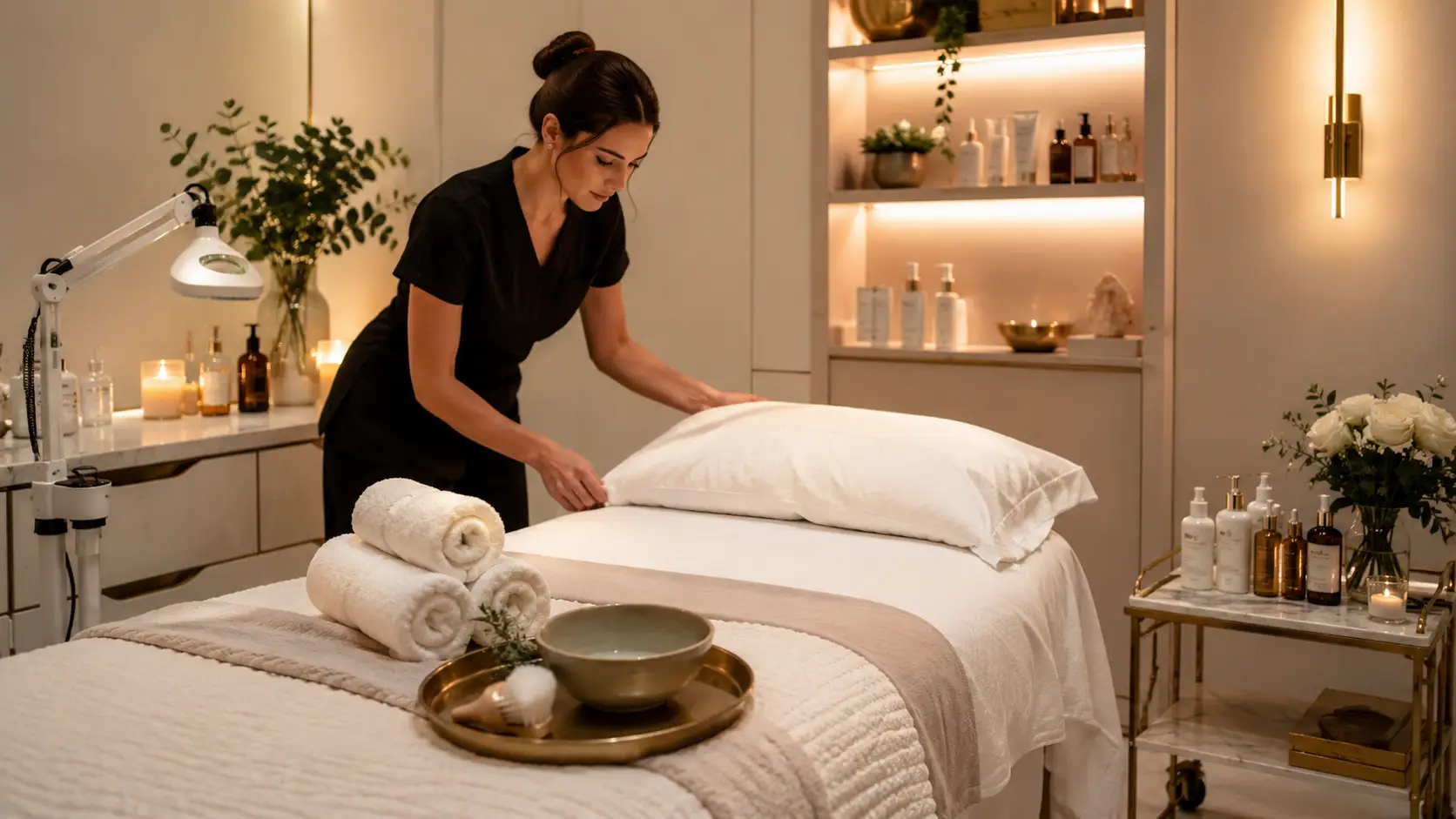
How Do You Make a Beginner Facial Feel Premium?
Making a beginner facial feel premium is primarily a function of sensory experience design, deliberate pacing, and strategic add-on selection — not the number of products in your back bar or years of practice behind you. Clients evaluate the perceived value of a facial through what they feel, hear, smell, and see throughout the entire service window, not just through visible skin results at the end.
- Slowing down is the single highest-impact and zero-cost upgrade available to any new esthetician. Rushed movement communicates inexperience; deliberate, unhurried technique communicates mastery.
- Sensory layering — warm towel compresses, cooling mask application, intentional hand pressure, and ambient environment — creates a multi-dimensional experience clients associate with high-end treatment rooms.
- Brief, confident narration of key service steps signals expertise and personalizes the treatment, transforming a basic facial into a guided skin consultation experience.
- Strategic add-ons with strong tactile novelty and visible immediate results — particularly a professional jelly mask finishing step — anchor premium perception at a very low per-service cost.
- A clean, consistently organized, quietly atmospheric treatment room establishes the luxury context before a single product is applied.
- Post-service communication — a specific skin observation and a single tailored recommendation — closes the service at a premium level and drives rebooking.
One of the most persistent misconceptions among new estheticians is that premium-feeling facials require premium-level experience, a fully stocked back bar, or expensive equipment. They do not. The clients who walk out of a basic service raving about it to their friends — the ones who rebook immediately and tip generously — are not reacting to the number of serums you used or the brand recognition of your skincare line. They are reacting to how the entire experience made them feel from the moment they walked into your treatment room to the moment they left.
Understanding this distinction is one of the most commercially important things a new esthetician can internalize early. Perceived value and actual service cost are not the same thing. A facial built around three or four well-chosen products, delivered with genuine attentiveness, deliberate pacing, confident communication, and one or two high-sensory add-on moments can feel more luxurious than a twelve-step facial delivered mechanically by an esthetician who is clearly working through a checklist.
This guide gives new estheticians a practical, implementable framework for elevating the perceived value of their beginner facials across every stage of the service — environment, pacing, narration, touch technique, add-on selection, and the post-service close. None of these strategies require significant investment. All of them require deliberate attention.
What Actually Makes a Facial Feel Luxurious to Clients
- Perceived value is an experience, not a product count. Clients remember how a service made them feel, not how many serums you applied.
- Slowing down is free. The pace of your service communicates confidence or anxiety more clearly than any technique choice.
- Sensory contrast — warm followed by cool, pressure followed by light touch — creates the physical sensation of a premium treatment.
- A single tactile novelty moment, like a jelly mask peel-off removal, anchors the entire service in memory and drives word-of-mouth.
- Brief, personalized narration transforms a procedure into a guided experience. It costs nothing and signals genuine expertise.
- Your treatment room environment is evaluated before you say a word. Consistent atmospheric care is a professional habit, not an occasional effort.
- The post-service close is as important as the opening. A specific skin observation and a single tailored recommendation leave clients feeling genuinely seen.
- Premium positioning is built through consistent execution of small decisions — not through a single upgrade purchase.
Why the Experience Frame Matters More Than the Product List
When clients describe a facial as luxurious, they almost never lead with the products. They describe how it felt — the warmth, the quiet, the sensation of someone paying complete attention to their skin. The psychology of perceived luxury in service environments is well-established across hospitality, retail, and personal care research: people consistently overestimate the quality of a product or service when the experiential context around it signals care, expertise, and attentiveness.
For estheticians, this means that the experience frame — the totality of sensory impressions, pacing, communication, and environmental atmosphere surrounding your actual technique — does more work than the products inside it. A high-quality moisturizer applied hurriedly in a cluttered room feels unremarkable. A basic moisturizer applied slowly and deliberately after a warm towel compress in a clean, softly lit room with quiet background sound feels genuinely restorative.
Experienced estheticians working in high-end treatment rooms consistently find that new clients who arrive expecting a basic service leave describing it as one of the best facials they have had — not because the product protocol was unusually sophisticated, but because every experiential detail was handled with deliberate care. New estheticians who understand this early have a significant competitive advantage over those who spend years trying to upgrade their product lists before understanding that their service experience was the variable that actually needed development.
The Five Dimensions of Premium Facial Experience
Every premium facial experience operates across five simultaneous sensory and emotional dimensions. Mapping your current service against all five reveals where the most impactful improvements can be made:
- Tactile: Temperature contrast, pressure variation, texture transitions, and touch rhythm.
- Atmospheric: Lighting quality, ambient sound, scent neutrality, and room temperature.
- Verbal: Narration confidence, personalization signals, and post-service communication depth.
- Visual: Treatment room organization, product presentation, and the esthetician’s own professional presentation.
- Outcome: Visible, immediate skin results the client can see and feel before leaving the room.
Most new estheticians focus almost entirely on the outcome dimension — worrying about whether their technique is producing the right skin results — while underinvesting in the first four. In reality, clients cannot accurately evaluate skin results during a service. They are evaluating the other four dimensions almost continuously, and forming their premium perception verdict well before you apply the finishing product.
Building the Atmospheric Foundation Before Clients Arrive
Lighting Is the Single Highest-Impact Environmental Variable
Overhead fluorescent lighting is the fastest way to undermine premium perception in a treatment room before a single service step begins. Warm, dimmed ambient lighting — whether from adjustable overhead fixtures, LED strip lighting behind treatment bed headboards, or low-wattage warm-white table lamps — creates the physiological relaxation response that primes clients to experience the service as genuinely restorative. If your treatment room currently uses overhead fluorescent fixtures without a dimmer alternative, this is the single highest-return environmental upgrade available to you.
Consistent lighting protocol across every service matters as much as the lighting quality itself. Clients who experience variable lighting conditions — different every visit — register it as inconsistency, even if they cannot articulate why. Premium service experiences feel consistent. Develop a lighting setup you use every time, set it before clients arrive, and do not change it mid-service.
Scent Neutrality Over Fragrance
A common instinct among new estheticians is to introduce pleasant fragrance into the treatment room — scented candles, essential oil diffusers, or scented linens. In a professional context, this is more likely to reduce perceived professionalism than increase it. Fragrance sensitivity is extremely common; a scent one client finds pleasant will be a headache trigger for another. The professional standard for a premium treatment environment is scent neutrality: a room that smells clean, fresh, and completely neutral.
Scent neutrality is achieved through consistent linen laundering, adequate ventilation between services, product storage away from the main service area, and avoiding any scented products in the room itself. The absence of scent — rather than the presence of a pleasant one — is the professional premium signal.
Organization as a Confidence Signal
A clean, organized treatment cart and work surface signal to clients that you are a competent professional before you have performed a single technique. Practitioners who work in consistently organized treatment rooms observe that clients are more relaxed, more receptive to recommendations, and more trusting of the service from the first minutes. Disorganized surfaces — even when everything on them is high-quality — create a low-level anxiety signal that works against the premium experience you are building.
Develop a pre-service setup routine and execute it identically for every client. Products in the same positions, tools organized in the same sequence you will use them, linens folded and placed consistently. This is not perfectionism — it is the visible expression of professional preparation that clients read as expertise.
How Pace and Touch Technique Create the Physical Sensation of Luxury
Slowing Down Is the Most Powerful Free Upgrade You Have
In every professional development context — massage therapy, fine dining service, premium retail — pace is one of the primary signals through which clients distinguish premium from basic. Fast movement communicates efficiency. Slow, deliberate movement communicates mastery, confidence, and the luxury of unhurried attention.
New estheticians almost universally move too fast during services, particularly in the early months of practice. The anxiety of performing correctly, remembering protocol sequences, and managing timing creates a physical urgency that clients register as stress. Deliberately practicing slower movement — not slow to the point of inefficiency, but deliberately unhurried — is one of the most transformative investments a new esthetician can make in the perceived quality of their services.
Practical application: identify the two or three transitions in your service sequence where you naturally tend to rush — the move from cleansing to toning, from serum application to mask application, from mask removal to finishing. Deliberately build a three-to-five-second intentional pause at each of those transitions. Those pauses feel like attentiveness to clients. They feel like taking a breath to you. Both interpretations are correct.
Temperature Contrast as a Premium Tactile Signal
The most consistently memorable physical sensation in a facial is temperature contrast — the shift between warm and cool, between steam warmth and cool mask application, between warm towel compress and room-temperature finishing application. Luxury spas build entire service sequences around temperature contrast because the physiological response it produces — a mild pleasure signal from the autonomic nervous system — registers consciously as the feeling of being genuinely cared for.
New estheticians can create meaningful temperature contrast with minimal investment. Warm towel compresses at the cleansing and mask-removal stages are the easiest entry point. A cool application of a professional jelly mask after a warm compress sequence creates a contrast moment that clients almost universally respond to with an audible or visible relaxation signal. That moment becomes the tactile anchor of the entire service — the sensory memory clients reach for when they describe the experience to a friend.
Pressure Variation and Touch Rhythm
Premium facial touch is not simply “firm” or “gentle” — it is varied. Services where pressure and pace remain constant throughout feel mechanical; services where pressure transitions from firm and grounding to light and finishing feel intentionally crafted. Even within a basic cleansing or massage sequence, deliberate variation between effleurage, gentle petrissage, and light finishing strokes creates the physical sensation of skilled, attentive touch.
Estheticians who pay deliberate attention to their touch rhythm report that clients consistently describe their services as “more advanced” or “more relaxing” than comparable services elsewhere — even when the product protocol was nearly identical. The touch is the service, in many clients’ experience. Developing conscious, intentional touch rhythm is one of the highest-value skills a new esthetician can develop in their first year of practice.
Strategic Add-Ons That Create Memorable Premium Moments
Add-ons function differently depending on their sensory profile. Some add-ons extend the service without creating a distinct memorable moment — they add value but do not anchor memory. Others create a discrete, novel sensory experience that becomes the emotional centerpiece of the entire facial in the client’s memory. For new estheticians building premium perception, the second category is far more commercially valuable.
The Anatomy of a Memorable Add-On Moment
Add-ons with the highest premium perception impact share three characteristics: they involve sensory novelty (something the client has not experienced in a basic facial before), they produce an immediate visible or physical result the client can perceive before leaving the room, and they have a natural “reveal” or completion moment that feels ceremonial rather than procedural. Services that check all three of these boxes become the story clients tell about the treatment afterward.
High-Impact Add-Ons for New Estheticians
The following add-ons are consistently high-impact for premium perception without requiring advanced training, significant equipment investment, or complex protocol integration:
Professional Jelly Mask Finishing Step
Multi-stage sensory experience: mixing ritual, cool application, mask set window (10–15 min for additional massage or LED), and dramatic peel-off removal. Highest premium perception score of any low-cost add-on. Produces visible immediate hydration results.
Warm Towel Compress Sequence
Two or three warm towel compress applications at cleansing and mask-removal stages. Creates immediate physical relaxation response. Temperature contrast against cool products amplifies premium sensation. Cost per service: negligible.
Scalp Massage During Mask
Three to five minutes of scalp massage performed while a mask is setting extends the service meaningfully without adding product cost. Clients consistently describe scalp massage as one of the most memorable and appreciated elements of a facial experience.
Hand and Arm Massage
A brief hand and forearm massage with a hydrating lotion during mask set time transforms a standard service into a multi-zone experience. Product cost is minimal; perceived value addition is substantial.
Décolleté Extension
Extending cleansing, toning, and finishing moisturizer application from the face down through the neck and décolleté region adds visible treatment scope without meaningful additional time or cost. Clients consistently note this extension as a marker of thorough professional service.
Facial Acupressure Points
A brief acupressure point sequence at the forehead, temples, jaw, and sinus areas during or after masking takes under three minutes, requires no products, and produces an immediate visible softening in clients’ facial tension that they notice and comment on unprompted.
How Narration and Communication Build Premium Perception During the Service
Why Brief Narration Signals Expertise Rather Than Insecurity
Many new estheticians are uncertain whether narrating their service steps will make them sound inexperienced or like they are reading from a protocol sheet. The opposite is true when narration is brief, confident, and personalized. A single sentence naming what you are applying and why — “I am going to apply a hydrating serum here first, which will work with the mask that follows” — communicates clinical intention and transforms the application from a product step into a curated decision. Clients do not hear a checklist; they hear expertise.
The key discipline is brevity. One sentence per major step transition, not a running commentary. Let the touch and the product experience carry the weight of the service. Use narration at the moments of highest sensory novelty — when you introduce a new product, when you apply the mask, when you are about to remove it — to give clients language for what they are experiencing. This linguistic framing becomes the vocabulary they use when describing the service to others.
The Personalization Signal
The most powerful single communication moment in a premium facial is a genuine observation about the client’s specific skin. Not a generic comment about skin hydration being important, but a real, specific observation: “I can feel that the skin along your jawline is holding more tension today” or “Your T-zone is significantly more dehydrated than your cheeks — that tells me something specific about what your skin needs right now.” These observations signal that the service is not a generic protocol being applied to a generic face; it is a skilled professional responding to this client’s specific skin in real time. This is the verbal component of premium perception that no product upgrade can replicate.
The Post-Service Close
The final two minutes of a facial — from finishing moisturizer application through the client sitting up and the initial post-service conversation — are disproportionately influential on overall experience perception. Clients are transitioning from a deeply relaxed state to re-engagement with the world; their emotional receptivity is at a peak. The esthetician who fills this moment with a brief, warm, specific skin observation (“Your skin is holding the hydration from the mask really well today — the tone looks noticeably more even than when you came in”) and a single tailored recommendation creates a closing moment that clients remember and repeat to others. The esthetician who fills this moment with generic checkout pleasantries misses one of the highest-value moments in the entire service.
Using the Jelly Mask Finishing Step as a Premium Experience Anchor
Among all the add-on options available to new estheticians, the professional jelly mask finishing step occupies a unique position in the premium experience toolkit. It is the only common add-on that delivers all five premium experience dimensions simultaneously: a tactile temperature contrast moment, an atmospheric visual ritual, a verbal narration opportunity, a visual spectacle of transformation, and an immediate visible skin outcome that clients can see in the mirror before they leave.
The Five Stages of the Jelly Mask Experience
Understanding the jelly mask add-on as a five-stage experience rather than a single product application helps new estheticians deliver it at its full potential:
- Stage 1 — The Mixing Ritual: Mixing the jelly mask powder with water or serum in front of the client (or audibly, if they are already reclined) creates anticipation and demonstrates professional preparation. A brief narration here — mentioning the hydrating ingredients in the formulation — primes the client for what they are about to experience.
- Stage 2 — The Cool Application: The cool temperature of the freshly mixed mask on skin recently warmed by product application and light steam creates an immediate autonomic relaxation response. This is the first memorable physical moment of the add-on. Apply with deliberate, smooth strokes and allow a brief pause after full coverage before speaking.
- Stage 3 — The Set Window: The 10 to 15 minutes of mask set time is the premium service window within the add-on. This is where scalp massage, hand massage, or acupressure sequences are performed, compounding the sensory experience. The mask setting against the face creates a gentle occlusive pressure that clients describe as deeply restful.
- Stage 4 — The Peel-Off Removal: The peel-off removal is the most viscerally memorable moment of the entire facial for most clients. A skilled, confident removal as a single intact piece is both a clinical quality indicator and a dramatic reveal moment. Narrate it briefly: “I am going to peel this off in one piece now — you will feel the skin temperature change immediately afterward.”
- Stage 5 — The Immediate Result Reveal: Offer the client a hand mirror immediately after mask removal. The visible immediate hydration, radiance improvement, and redness reduction produced by a quality jelly mask formulation create a mirror moment that clients react to with genuine surprise. This is the outcome validation that makes every other premium experience decision feel credible.
Estheticians who have integrated the Poly-Luronic™ Jelly Mask by Luminous Skin Lab as a standard finishing step add-on in their beginner facial menus consistently describe the same pattern: the peel-off removal moment and the immediate mirror reveal together become the moment that clients most frequently reference in their post-service feedback, reviews, and referral conversations. Practitioners report that new clients who booked a basic facial specifically because of the low entry price point regularly rebook at higher service tiers after experiencing the jelly mask finishing step — not because the underlying facial changed, but because the experiential anchor of the jelly mask step shifted their perception of the overall service value.
Specifically regarding the PGA-forward formulation: estheticians observe that the immediate post-removal skin response — the visible plumping, tone evenness, and reduced surface dryness that the dual-humectant system produces — is noticeably more pronounced compared to single-humectant jelly mask alternatives they had used previously. This clinically meaningful outcome improvement translates directly into stronger client reactions at the mirror reveal moment, which is the emotional anchor of the entire premium experience sequence. The formulation delivers both the sensory experience and the visible result that makes the premium perception frame credible and not merely theatrical.
Pricing the Jelly Mask as a Premium Add-On
The standard add-on pricing for a professional jelly mask finishing step in a beginner esthetician context typically ranges from fifteen to thirty dollars above the base facial price, depending on market and positioning. At an ingredient cost of two to four dollars per service for a professional-grade formulation, the margin profile of this add-on is among the strongest available to a new esthetician. More importantly, consistent conversion of basic facial clients to jelly mask add-on bookings meaningfully increases average service ticket without requiring any increase in service duration or technical complexity.
The Consistency Principle: Why Premium Feels Different Every Time It Appears Inconsistently
Inconsistency Is the Primary Enemy of Premium Perception
The most common reason new estheticians fail to build premium perception despite genuine effort is inconsistency. A beautifully executed service one week followed by a rushed, disorganized one the following week does not average out to a moderately premium experience in the client’s evaluation framework. It produces an unpredictable experience that the client describes as “good sometimes” — which is not a premium positioning statement and is not a driver of rebooking or referral.
Premium service perception is built on consistency. The same lighting setup for every service. The same treatment room organization. The same warm towel compress sequence. The same level of narration attention. The same post-service close. Clients who experience this consistency across multiple visits develop a reliable expectation of quality — and reliable expectations are what convert occasional clients into loyal ones.
Why Simple and Consistent Outperforms Complex and Variable
Estheticians working in high-retention practices consistently observe that clients who rebook most reliably are not the ones who received the most elaborate service — they are the ones who received a consistent service they could predict and trust. A five-step facial delivered with identical care and attention on every visit creates a stronger loyalty foundation than a twelve-step facial that varies significantly from one booking to the next.
The practical implication for new estheticians: master three to five premium experience elements and execute them perfectly every time before adding complexity to your protocol. The warm towel compress. The deliberate unhurried pace. The personalized skin observation. The jelly mask finishing step. The specific post-service close. These five elements, delivered consistently, build premium perception more reliably than any number of additional products or techniques applied inconsistently.
Building Your Premium Experience Protocol as a Written Checklist
Experienced estheticians in high-performing practices often use a written pre-service and service checklist not because they cannot remember their protocol but because the checklist eliminates the cognitive load of remembering and frees their full attention for the client. For new estheticians, a simple pre-service checklist — lighting set, room temperature checked, cart organized in service order, linens fresh, warm towel source prepared, jelly mask supplies staged — takes two minutes to execute and reliably produces the atmospheric foundation from which the premium experience can be built.
Develop a written checklist for your specific setup and service sequence. Use it for every service without exception. The discipline of the checklist is not a crutch — it is the mechanism that produces the consistency that builds premium perception over time.
Professional References & Supporting Context
The service experience design and premium perception principles referenced in this article draw from established esthetics education practice, hospitality service research, and practitioner-reported outcomes:
- Sensory experience design in personal care services: multi-sensory environment effects on service evaluation and willingness to pay. Consumer psychology and hospitality management literature consensus, 2018–2024.
- Temperature contrast in manual therapy and facial treatment contexts: autonomic nervous system relaxation response and subjective comfort perception. Applied massage therapy and esthetics education literature.
- Practitioner narration and client trust formation in esthetic services: the role of brief, confident technical communication in perceived expertise and rebooking intention. Esthetics industry education resources, 2022–2025.
- Jelly mask sensory experience profile: tactile novelty, peel-off removal satisfaction, and immediate visible outcome as premium experience anchors. Practitioner-reported outcomes from professional jelly mask education contexts, 2023–2026.
- Perceived value versus actual cost in service pricing: the disproportionate contribution of experiential elements to client willingness to pay in personal care services. Service marketing research literature.
For new estheticians ready to add the premium finishing step that most consistently elevates beginner facial perception, the Poly-Luronic™ Jelly Mask line by Luminous Skin Lab is the formulation our education team most frequently references for this specific use case. Developed by a licensed esthetician for treatment room use, the Poly-Luronic™ blend delivers the dual-humectant PGA + HA hydration science that produces the immediate visible skin result — visible plumping, improved tone evenness, reduced surface dryness — that makes the mirror reveal moment genuinely compelling for clients. Fragrance-free, clean-label, and designed for consistent set behavior and single-piece peel-off removal: the formulation supports every stage of the premium jelly mask experience described in this guide.
Explore the Poly-Luronic™ Jelly Mask LineFrequently Asked Questions: Making Beginner Facials Feel Premium
How do I make my basic facials feel more luxurious without spending a lot of money?
The biggest luxury signals in a facial are not expensive — they are sensory and experiential. Warm, dimmed lighting, a consistently clean and organized treatment room, warm towels applied with intention, a steady unhurried pace, and confident verbal narration of each step cost almost nothing but transform how a basic facial feels to a client. Strategic add-ons like a jelly mask finishing step add genuine tactile novelty and visible results for a low per-service cost.
What is the single most effective thing a new esthetician can do to elevate a basic facial?
Slowing down is the single most effective and lowest-cost upgrade a new esthetician can make. Rushed movements, fast transitions between steps, and hurried product application are the primary reasons basic facials feel basic. Deliberately extending application time, adding intentional pauses, and performing each step with visible care and precision elevates the perceived value of even the simplest service without adding a single new product or tool.
What facial add-ons make the biggest impression on first-time clients?
Add-ons with strong sensory novelty and visible immediate results create the most memorable impressions on first-time clients. A professional jelly mask finishing step is one of the most consistently impactful because the application, cooling sensation, setting time, and peel-off removal together create a multi-stage sensory experience unlike anything most clients have had before. Scalp massage, warm towel compresses, and hand or décolleté massage are also consistently high-impact at very low cost.
How do I explain what I am doing during a facial so clients feel like they are getting something special?
Brief, confident narration of what you are applying and why creates an immediate sense of expertise and personalization. A single sentence — such as mentioning that you are applying a serum chosen specifically for hydration or that the mask you are mixing is setting up to seal in everything applied before it — signals professionalism and care. Clients who understand what is happening feel more engaged and more confident in the value of the service.
Does the treatment room setup really affect how premium a facial feels?
Yes, significantly. The treatment room experience begins the moment a client walks in. Consistent ambient lighting, a clean and organized treatment cart, fresh linens, a subtle non-fragrant atmosphere, and quiet background sound all contribute to the client’s sense of being in a professional, elevated environment before the first product is applied. Small, low-cost environmental details collectively create the luxury perception framework within which your technique is evaluated.
Can I charge more for a basic facial just by improving the experience?
Yes. Perceived value — not product cost — is what determines how much clients feel a service is worth. A facial performed in a thoughtfully designed environment, with confident narration, warm towel compresses, an unhurried pace, and a memorable finishing step like a jelly mask peel can command significantly higher pricing than the same underlying steps performed without those experience elements. Pricing reflects perceived transformation, not ingredient cost.
How do I keep a facial from feeling rushed when I am still learning the timing?
Build buffer time into your service schedule rather than your service steps. A 60-minute facial should be booked with 75 minutes of schedule time so you are never genuinely rushed. Within the service itself, identify two or three natural pause moments — during mask set time, during steam, or during a compress application — where you can slow your pace without losing the thread of the service. Clients interpret those pauses as attentiveness, not inefficiency.
What role does client communication play in making a facial feel premium?
Client communication is one of the most underutilized luxury levers available to new estheticians. A warm, unhurried check-in at the start of the service, brief confident narration during key steps, a genuine skin observation shared during the facial, and a specific post-service recommendation tied to what you observed all signal expertise and personal attention. These communication moments cost nothing and consistently distinguish premium-feeling services from forgettable ones.
How does adding a jelly mask finishing step make a beginner facial feel more premium?
A professional jelly mask finishing step creates a multi-stage sensory experience that most clients have never encountered in a basic facial. The mixing ritual, the cool application sensation, the mask setting over the face, the 10-to-15-minute window of warmth and quiet, and the dramatic peel-off removal together form a memorable sequence that clients associate with high-end treatment room experiences. Formulations like the Poly-Luronic™ Jelly Mask by Luminous Skin Lab deliver visible immediate hydration results that clients feel and see before they leave the treatment room — giving them a concrete, tangible reason to rebook and describe the service to others.
Premium Facials Are Built From Decisions, Not From Equipment
The gap between a basic facial and a premium-feeling one is narrower than most new estheticians believe — and it is filled almost entirely by deliberate experiential decisions rather than product investment. Slowing down. Choosing warm lighting and neutral scent. Organizing your treatment room identically before every service. Narrating key steps with quiet confidence. Introducing a tactile novelty moment that clients have not experienced before. Sharing a genuine skin observation and a specific recommendation before the client leaves.
These decisions compound. A client who experiences all of them together does not leave thinking “that was a surprisingly good basic facial.” They leave thinking “that was an exceptional facial” — and they say so to other people. That is the mechanism through which premium perception becomes a business asset: it creates the kind of word-of-mouth that no marketing budget can replicate.
New estheticians who build these habits early — before adding menu complexity, before upgrading equipment, before expanding protocols — establish a service delivery standard that will support everything else they build in their career. The clients who experience premium care in a beginner’s treatment room do not care that you are new. They care that they felt genuinely looked after. That is the standard. Everything else follows from it.