How Do Beginner Estheticians Create a Luxury Facial Experience?
Beginner estheticians create luxury facial experiences by mastering the sensory and sequencing elements that clients actually perceive as premium — none of which require advanced equipment or years of experience. Luxury in a facial is defined by how cared-for the client feels throughout the service, not by the price of the products or the complexity of the protocol.
- Sensory preparation — room temperature, lighting, ambient scent, and warm linens — communicates professional care before a single product is applied.
- Deliberate, confident touch and unhurried pacing are the most powerful luxury signals available to any esthetician at any experience level.
- A structured treatment arc with a clear sensory peak moment — such as a jelly mask application and removal — creates the memorable experience clients describe to others and return for.
- Strategic add-ons that extend the mask step into massage time, hand and arm work, or scalp attention multiply perceived service value without adding cost or complexity.
- Intentional client communication — brief narration of key steps and a warm professional close — elevates a good facial into a genuinely premium one.
- The ending of a facial carries disproportionate weight in how the client remembers the entire experience.
One of the most persistent myths in early esthetic practice is that luxury requires expense. New estheticians often believe that creating a premium client experience means buying high-end equipment, investing in a full advanced treatment menu, or waiting until they have accumulated years of experience and confidence. The evidence from treatment rooms consistently says otherwise.
The elements that make a facial feel genuinely luxurious to a client — warmth, attentiveness, sensory pleasure, visible results, and a feeling of being cared for with real skill — are available to every esthetician from their very first session. What they require is not advanced technique or expensive tools. What they require is deliberate attention to the details that most beginners overlook because they are focused on remembering the protocol steps rather than the client experience those steps are meant to create.
This guide covers exactly that: the sensory layers, sequencing principles, strategic add-on decisions, and communication techniques that consistently produce luxury client experiences — and that any beginner can begin implementing immediately, with the equipment and products they already have.
What Creates a Luxury Facial Experience — and What Does Not
- Luxury is primarily experienced through sensory comfort, attentive pacing, and a memorable peak moment — not through product price or protocol complexity.
- Room preparation before the client arrives sets the expectation tone before you have said a word or touched their skin.
- Unhurried pacing and warm, confident hands are the two most universally cited luxury signals in post-service client feedback.
- A structured treatment arc with a clear sensory peak — typically during the mask step — gives the client a memorable moment they will describe to others.
- Strategic use of the mask application window for massage add-ons multiplies perceived service value at no additional product cost.
- The close of the service is the moment clients carry out the door — how you end a facial matters as much as how you begin it.
- Consistent luxury experiences produce the rebooking and referral behavior that builds a sustainable practice faster than any other single factor.
Why Luxury in a Facial Is Mostly About Sensory Details, Not Products
When clients describe a facial as luxurious — in conversation, in reviews, in the comments that drive referrals — they rarely cite specific product names or treatment modalities. What they consistently describe are feelings: warmth, calm, being taken care of, leaving with skin that looked visibly different than when they arrived. These are sensory and emotional experiences. They are produced by the sum of dozens of small deliberate choices made before, during, and after the service.
Understanding this is liberating for a beginner. You do not need to master microcurrent before your facials feel luxurious. You need to master the controllable sensory environment and the practitioner presence elements that are available to you from day one.
The Five Sensory Channels of a Facial Experience
Every client processes a facial through five sensory channels simultaneously. Luxury is the result of deliberately managing all five rather than leaving them to chance.
- Touch: Warmth of hands, pressure consistency, transition smoothness, massage integration
- Temperature: Room warmth, bed warmth, product warmth, cooling sensations during mask steps
- Sound: Ambient music volume and character, practitioner voice pace and tone, absence of jarring interruptions
- Scent: Subtle ambient fragrance at entry, product scent during application, absence of competing chemical smells
- Visual: Room organization, lighting quality and softness, product presentation, the client’s own skin appearance at the close
Most beginners manage touch reasonably well because they have been trained to. The other four channels are frequently underattended — and this is where the gap between a standard facial and a luxury one most often lives for new practitioners.
The Luxury Perception Gap Beginners Most Often Miss
In post-service feedback patterns, estheticians working in high-volume settings consistently find that clients who describe a service as “just okay” most frequently cite temperature issues (cool room, unwarmed products), pacing disruptions (fumbling for products, unannounced pauses), and an abrupt or businesslike ending. None of these are skill problems. They are attention problems — and they are entirely within the control of a beginner who knows to look for them.
How to Prepare Your Treatment Room for a Luxury Experience Before the Client Arrives
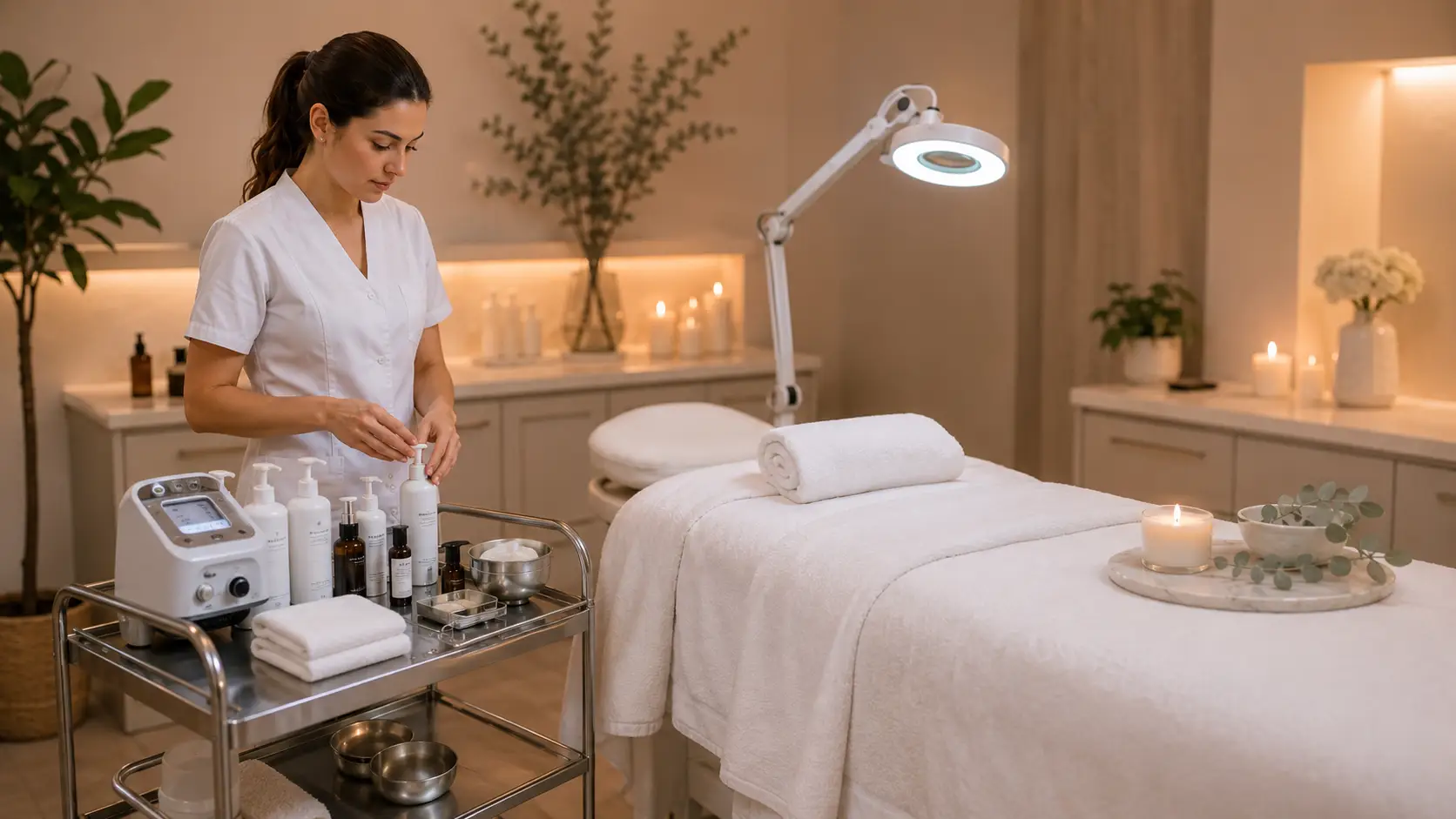
Room preparation is the first chapter of a luxury facial, and it happens before the client walks in. A room that communicates calm, warmth, and professional readiness sets the experiential expectation that every subsequent service step then meets or exceeds. A room that communicates hurry, disorder, or indifference creates a ceiling on how premium the service can feel regardless of what happens next.
Temperature and Bedding
Warm the treatment room to a comfortable ambient temperature before the client arrives — typically 68 to 72 degrees Fahrenheit. A warm blanket or table warmer set to low heat transforms a treatment bed from furniture into a comfort destination. Clients who are physically warm relax significantly faster, which benefits every step of the service. Fresh, crisply folded linens communicate cleanliness and care. A soft, pre-warmed neck pillow or bolster adds a comfort signal that registers immediately.
Lighting
Overhead fluorescent or harsh white lighting creates a clinical rather than luxurious environment. Where your room allows, use warm-spectrum lighting — a lamp rather than an overhead fixture, or a dimmer setting on overhead lights. The exception is the consultation and post-service skin review moment, where you want the client to see their skin clearly. Having the ability to adjust lighting between the treatment and the reveal creates a deliberate theatrical arc that premium spas use intentionally.
Scent and Sound
Ambient scent should be subtle and non-competing — a diffuser with a clean, uncomplicated fragrance rather than strong candles or plug-in air fresheners. The goal is a room that smells clean and pleasant, not perfumed. Ambient music should be at a volume where it is clearly present but requires no concentration to tune out. Genre matters less than tempo — slower tempos at moderate volume consistently correlate with client relaxation more than any specific music style.
Product and Cart Organization
Everything you need for the service should be within reach and pre-organized before the client enters. Product bottles and vessels should face forward and be free of smudges. Your jelly mask bowl, spatula, and mixing supplies should be laid out in application order. A client who catches a glimpse of a prepared, organized cart reads it as a signal of competence and care. A practitioner who has to search for products mid-service breaks the luxury atmosphere with every hesitation.
The Luxury Treatment Arc: How to Structure a Facial That Feels Premium From Start to Finish
A luxury facial has a shape that the client experiences emotionally even if they cannot articulate it. It moves from welcome and preparation, through building intensity, to a sensory peak moment, and then into a calming, unhurried close. When the arc is present, the facial feels complete and intentional. When it is absent — when steps feel randomly sequenced or abruptly transitioned — the experience feels unfinished even if every individual technique was executed correctly.
Phase 1 — Welcome and Preparation (First 10 Minutes)
The welcome phase establishes safety and trust. It includes the room entry experience, the brief consultation or intake review, the draping and positioning ritual, and the first cleanse. This phase should feel unhurried and attentive. Take genuine time with the consultation, make eye contact, and frame the service clearly: what you are going to do and why. A client who understands what is coming relaxes into it rather than bracing for uncertainty.
The first cleanse is where many estheticians underinvest. A warm, thorough, methodical cleanse with deliberate touch communicates professional skill before any active product has been applied. Spend real time here — it sets the quality expectation for everything that follows.
Phase 2 — Active Treatment (Middle 20–30 Minutes)
This phase contains the primary clinical work of the service — exfoliation, extractions, serum application, device steps if applicable. Transitions between steps should be smooth and announced: a brief phrase like “I’m moving into your exfoliation now” or “I’m applying a serum specifically for your hydration goals” keeps the client oriented and signals that the treatment is intentional rather than improvised.
Product warmth matters throughout this phase. Where it is appropriate and safe for the formulation, warming serums and mask mixes slightly in your hands before application creates a tactile premium signal that costs nothing.
Phase 3 — The Sensory Peak (Mask Step, 10–20 Minutes)
The mask step is the natural location for the sensory peak of a facial — and managing it intentionally is one of the highest-leverage skills a beginner can develop. This is the moment the client is most fully surrendered to the experience. The application of a cooling, setting mask creates a physical sensation that signals “this is the special part.” What you do during the mask window and how you execute the removal determines whether the sensory peak lands as memorable or merely adequate.
During the mask set time, use the window to deliver massage sequences — scalp, neck, hands, arms, décolleté — rather than leaving the client unattended. A client who has received 15 minutes of mask application and simultaneous massage has received a fundamentally different service than one who lay under a mask while the esthetician prepared their paperwork. The former books again. The latter may not.
Phase 4 — The Close (Final 10 Minutes)
The close carries disproportionate memory weight. Psychological research on peak-end memory consistently shows that how an experience ends is one of the two moments most strongly encoded in long-term recall — the other being the most intense moment, which is the sensory peak just discussed. A professional close includes a gentle transition announcement, the post-mask reveal in good lighting, a warm brief summary of what was done and why, and a natural transition into home care conversation. Allowing the client a moment of unhurried transition before they rise — offering water, dim lighting while they collect themselves — completes the arc with grace.
How to Use the Mask Step as Your Luxury Pivot Point
For beginner estheticians working without an advanced device menu, the mask step is the single most powerful leverage point for creating a luxury experience. How you approach the mask application, what you do during the set time, and how you execute the removal determines more of the client’s post-service emotional response than almost any other single element of the protocol.
Why the Mask Step Is the Natural Luxury Moment
The mask step marks the shift from active clinical work to something the client experiences passively and pleasurably. The application itself is tactile and immersive. The set time creates a defined window where the client is physically still and receptive. The removal — particularly with a setting mask that peels as a single intact piece — creates a sensory punctuation mark that clients consistently describe as the most memorable moment of the service.
None of this requires advanced skills. It requires good product selection, confident application technique, and deliberate use of the set window for additional value delivery.
What to Do During the Mask Set Window
The mask set window is service time, not downtime. Beginners who use this window for simultaneous add-ons report significantly higher client satisfaction scores and rebook rates than those who leave clients unattended. Options for the mask window include:
- Scalp massage: A gentle scalp massage through the mask layer is deeply relaxing and extends perceived service time significantly. It requires no additional products and takes no preparation.
- Hand and arm massage: Warm a small amount of lotion or oil and deliver a focused hand and forearm massage. Clients cite this as one of the most memorable add-on moments in any facial service.
- Décolleté attention: A neck and décolleté massage during the mask step extends the treatment area and communicates full-body attentiveness.
- Warm towel application: Applying a warm towel to the hands, feet, or décolleté while the mask sets creates a spa-level sensory signal at zero additional cost.
How to Execute the Mask Removal as a Luxury Moment
The removal of a well-formulated setting mask should be treated with the same deliberateness as any other step in the service. Announce it gently — “I’m going to remove the mask now” — and execute it slowly and confidently. A single-piece peel removal, when performed with a steady, unhurried hand, creates an audible and tactile moment that consistently produces visible client delight. Rushing the removal, or having a mask that tears or requires towel assistance, undermines the entire sensory arc that was building toward it.
The Six Pillars of Luxury Client Experience at Any Skill Level
Every element of a luxury facial experience traces back to one or more of six foundational pillars. Understanding these pillars gives beginners a diagnostic framework for evaluating their own services — and for identifying exactly where a service that “felt fine” to a client can be elevated to something they describe as genuinely exceptional.
Physical Warmth and Comfort
Warm room, warm bed, warm hands, warm products. Physical warmth is the fastest route to client relaxation and is available at zero cost beyond attention.
Unhurried Pacing
Speed communicates transaction. Slowness communicates care. Every deliberate pause, every unhurried transition, every warm moment of stillness adds to the luxury perception.
Intentional Sensory Layering
Manage touch, temperature, sound, scent, and visual environment deliberately. Luxury is the absence of jarring sensory interruptions as much as it is the presence of pleasurable ones.
Practitioner Presence
Clients sense when a practitioner is distracted, rushed, or uncertain. The most powerful luxury signal an esthetician can offer is full, present, unhurried attention to this one client in this one hour.
Visible Immediate Results
Clients who see a visible difference in their skin at the post-service reveal — hydration, radiance, reduced redness — feel that the service delivered genuine value. This outcome is directly linked to protocol and product quality choices.
Memorable Sensory Peak
The mask step, executed well, creates a peak moment that the client describes to others. This is the single step most responsible for organic referral behavior from a facial service.
Estheticians who have introduced the Poly-Luronic™ Jelly Mask by Luminous Skin Lab into their beginner facial protocols report a consistent pattern across their first several months of use: the mask step becomes the moment clients discuss unprompted after the service. The combination of the cooling application, the 12-to-15-minute set window — which comfortably accommodates simultaneous scalp and hand massage without adjustment — and the single-piece peel removal creates a sensory sequence that lands with clients as something categorically different from the standard mask experiences they have had elsewhere.
Practitioners also note that the post-removal skin result — the visible immediate hydration and radiance from the PGA plus HA formulation — gives them a genuine, evidence-based talking point at the reveal moment: what the client sees in the mirror is not lighting or wishful thinking, it is the measurable result of the dual-humectant hydration mechanism completing its work. For a beginning esthetician building confidence in client communication, being able to point to a visible, explainable result is a substantial professional advantage compared to formulations where the outcome is more modest or harder to attribute.
Client Communication That Elevates a Facial From Good to Memorable
The quality of verbal communication during a facial is as important as any product or technique choice. Beginners often underestimate this because they are focused on executing the physical protocol correctly. But from the client’s perspective, what is said — and what is not said — shapes the entire experiential context around each physical step.
Narrating the Protocol Without Lecturing
Brief, warm narration of key transitions keeps the client oriented and communicates expertise without requiring lengthy explanations. A single sentence at each major transition is typically sufficient: “I’m moving into your exfoliation step now, which will prepare your skin to absorb the serum we’re using for your hydration goals.” This communicates intentionality, links each step to the client’s specific skin concern, and delivers education without disrupting the relaxation arc.
The Mask Application Announcement
The mask step deserves particular attention in how it is verbally framed. Rather than saying “I’m going to put a mask on now,” a brief framing like “I’m applying our jelly mask now — you’ll feel it cooling as it sets, and while it works I’ll take care of your scalp and hands” sets up the sensory expectation and signals that more luxury is coming rather than a static pause. This framing consistently produces noticeably higher client relaxation responses than unannounced mask application.
The Post-Service Reveal Conversation
The reveal moment — when you hold up a mirror and the client sees their skin — should not be left to silence. A warm, specific observation that the client can verify in the mirror gives them language to use when they describe the service to others: “Look at the luminosity — that’s what the deep hydration we put in during the mask step looks like on your skin.” Clients who leave with a specific, positive observation to share are your most effective referral channel.
The Natural Home Care Transition
Home care recommendations should feel like a continuation of care, not a sales pitch. Framing your recommendations in terms of what the client experienced in the service — “The serum we used today for your hydration is something you can use at home twice a week to maintain this” — creates continuity between the professional service and the client’s home practice. This framing converts retail recommendations from commerce into education, which consistently produces higher conversion and higher trust.
Common Beginner Mistakes That Undermine a Luxury Experience
Knowing what to do is only half of the preparation. Understanding the specific patterns that break the luxury perception — even when the underlying protocol execution is technically correct — gives beginners a diagnostic lens for their own services.
Leaving the Client Alone During the Mask Step
This is the single most common luxury-breaking behavior in beginner facial practice. The mask step is often treated as a break rather than a service opportunity. Clients who lie unattended under a mask for 15 minutes experience an interruption in the care arc that is difficult to recover from regardless of how good the removal moment is.
Fumbling for Products Mid-Service
Any visible search for products, dropped tools, or unannounced pauses while the esthetician locates something breaks the professional illusion regardless of the quality of surrounding technique. Thorough pre-service setup is not optional — it is a non-negotiable prerequisite for luxury service delivery.
Rushing the Close
The close is often sacrificed when a service runs long. Compressing the reveal, the home care conversation, and the transition into a hurried 90-second sequence collapses the entire arc the service was building toward. If timing is a consistent issue, the solution is to tighten earlier phases rather than compress the close, which carries disproportionate memory weight.
Inconsistent Touch Pressure and Pace
Erratic touch — alternating between light and heavy pressure without purpose, or varying massage pace abruptly — breaks the relaxation continuity even when individual techniques are correct. Deliberate, consistent pressure and pace is a trainable skill that beginners often develop faster by recording and reviewing their own technique than through instructor feedback alone.
Neglecting the Non-Facial Touch Moments
Many beginners focus exclusively on facial massage techniques and overlook the significant luxury contribution of hand, arm, scalp, and neck work. These secondary touch zones are frequently described by clients as the most relaxing elements of a full facial service — and they require no additional products or training beyond the willingness to use the mask step as an opportunity rather than a pause.
Professional and Educational References
The experiential and clinical frameworks discussed in this article draw from established esthetic education practice and skin science literature:
- Peak-end memory and client experience recall — psychological research on how memorable experiences are encoded and described. Kahneman, D. et al., foundational literature in behavioral economics applied to service industry contexts.
- Sensory comfort and parasympathetic activation in treatment room environments — esthetic education literature on environmental design for client relaxation outcomes.
- PGA dual-humectant mechanisms and visible immediate hydration outcomes — MDPI 2024; Typology 2021–2025; Reviva Labs 2025; Stanford Chemistry cosmetic formulation literature 2024.
- Professional jelly mask application protocols and set-time workflow optimization — Luminous Skin Lab esthetician education curriculum, Pro-Line Series 2025–2026.
- Verbal communication frameworks in esthetic client experience — applied professional esthetics education literature on consultation and home care recommendation best practices.
For beginners looking for the single most impactful product addition to elevate their facial protocols into luxury-level client experiences, our education team consistently points to the Poly-Luronic™ Jelly Mask by Luminous Skin Lab. Formulated by a licensed esthetician specifically for professional treatment room use, it delivers the sensory peak — a smooth cooling application, a reliable set window that accommodates simultaneous massage sequences, and a clean single-piece peel removal — that clients describe as the defining moment of the service. Its PGA plus HA dual-humectant system also delivers visible immediate hydration results that give estheticians a genuine, explainable talking point at the post-service reveal. Fragrance-free, clean-label, and beginner-friendly to apply from the first session.
Explore the Poly-Luronic™ Jelly Mask Line →Frequently Asked Questions: Creating a Luxury Facial Experience as a Beginner
How do I make my facials feel more luxurious when I am just starting out?
Luxury is built from sensory layers, not expensive equipment. As a beginner, focus on the controllable details: warm the treatment bed, use a consistent room temperature, choose a subtle ambient scent that does not compete with product, warm your hands before every touch, and slow your pace deliberately. These details collectively create the premium feeling clients associate with high-end spas. Adding a structured add-on like a jelly mask or a scalp and hand massage during a mask step elevates the service without requiring advanced skills.
What does a luxury facial actually mean in a treatment room context?
A luxury facial is defined less by the price of the products and more by the quality of the client experience — how cared-for the client feels from the moment they enter the room to the moment they leave. It combines sensory comfort, practitioner attentiveness, treatment sequencing that feels intentional and unhurried, and visible skin results the client notices immediately. Beginners can deliver all of these elements without high-end equipment or a full advanced service menu.
What is the single most effective add-on for making a basic facial feel premium?
A professional jelly mask is consistently cited by estheticians as the most impactful single add-on for elevating a basic facial into a memorable luxury experience. The setting, cooling, and peel-removal moment creates a sensory peak that clients describe and share with others. It requires no specialized device, is beginner-friendly to apply, and delivers visible immediate results. Combined with a serum layer underneath, it also creates genuinely superior hydration outcomes compared to standard cream masks.
How do I create a luxury feel without spending a lot of money on equipment?
The elements clients most associate with luxury are largely cost-free: unhurried pacing, warm hands and products, deliberate and confident touch, a clean and organized room, soft ambient music at the right volume, and genuine attentiveness. Equipment can enhance a luxury experience, but it rarely creates one. Beginners who master the non-equipment elements of client experience consistently outperform those who invest in devices before they have developed their foundational service craft.
How important is the order of a facial when it comes to making it feel luxurious?
Sequence matters significantly. A luxury facial follows a logical arc that the client senses even if they cannot articulate it: preparation and cleansing, active treatment, a sensory peak moment, and a calming finish. When the sequence feels thoughtful and each step transitions smoothly into the next, the treatment feels professional and intentional. Disruptions in sequence — fumbling for products, unannounced pauses, abrupt transitions — break the luxury illusion regardless of how good the individual steps are.
Should I talk to my client during a facial or stay quiet for a more luxurious feel?
This depends on reading the client. Some clients find silence deeply relaxing; others find it uncomfortable. A good opening is to let the client know at the start of the service that they are welcome to relax quietly or chat, and that you will briefly narrate key transitions so they always know what is coming. During active treatment steps, minimize unnecessary conversation. During mask time, a brief warm check-in before moving into quiet is appreciated. The key is intentional communication rather than constant talking or complete silence.
How do I end a facial in a way that feels luxurious and professional?
The ending of a facial carries disproportionate weight in how the client remembers the service. A professional close includes a gentle transition signal, a brief warm verbal summary of what was done and why, a moment where the client sees their skin in good lighting, and a natural transition into home care recommendations. Handing the client a warm towel, offering water, and allowing a moment of unhurried transition before the client rises completes the luxury arc effectively.
How do I explain to clients what makes my facial different from a cheaper one?
Focus on the three things clients actually value: the quality of attention they receive, the ingredient and product standards you use, and the visible results they see immediately after. You do not need to cite science to convey professional authority — describing why you chose a specific serum for their skin concern, or explaining what the jelly mask step is doing for their hydration, communicates expertise effectively. Clients who understand what they are receiving and why are far more likely to rebook and refer.
How does the Poly-Luronic jelly mask help beginners create a luxury facial experience?
The Poly-Luronic Jelly Mask by Luminous Skin Lab is specifically designed to deliver the sensory and clinical elements that define a luxury facial add-on: a smooth, consistent set, a cooling effect during the mask stage, and a clean peel-off removal that clients consistently describe as the most memorable part of the service. Its PGA plus hyaluronic acid formulation delivers visible immediate hydration results that clients notice and comment on, giving the esthetician a natural and genuine talking point. For beginners looking for a single add-on that elevates every facial, it delivers both the sensory impact and the clinical outcome that build rebooking and referral.
The Luxury Facial Is Built From Attention, Not Equipment
The gap between a standard facial and a luxury one is not primarily a skill gap or a product gap. It is an attention gap — the difference between a practitioner who executes a protocol and one who deliberately manages the sensory, emotional, and communicative experience of a client from room entry to post-service close.
Beginners who internalize this distinction early — who learn to manage the six sensory pillars, to use the mask step as a leverage point rather than a pause, to communicate with warmth and specificity, and to close a service with the unhurried care that it took to open one — develop a luxury reputation that builds clientele faster and more durably than any advanced modality or premium product alone could achieve.
The tools for a luxury facial experience are already in your room. The skills are already in your hands. What remains is the deliberate intention to apply them to the experience of the person on your table, from the first touch to the last warm word at the door.