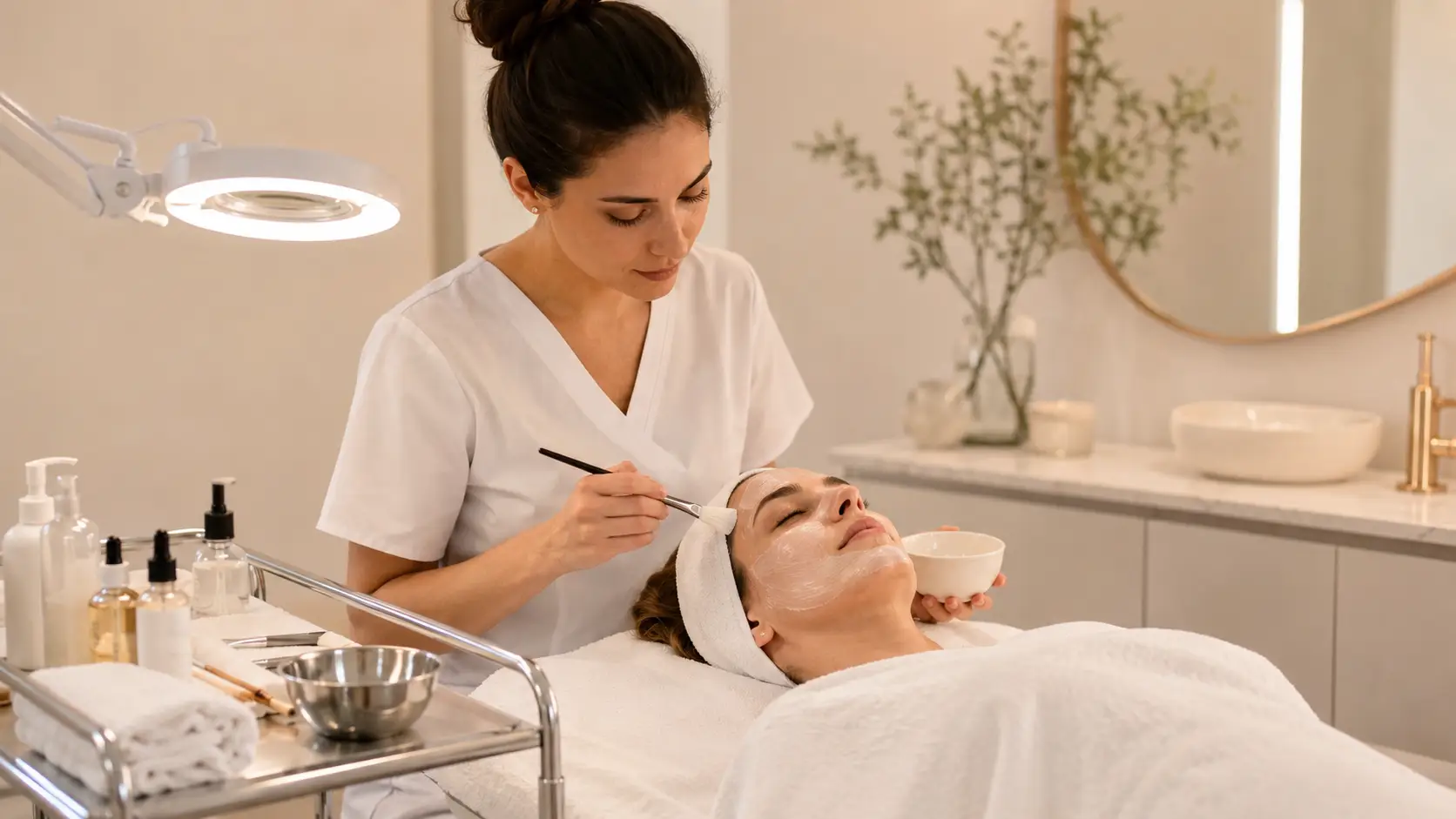
How Do You Make a Basic Facial Feel More Advanced?
New estheticians can make basic facials feel significantly more advanced through four interconnected strategies: technique refinement, intentional pacing and sensory layering, strategic product upgrades, and mastering the mask step as a multi-purpose service window. None of these require new equipment, advanced certifications, or a more complex menu. The elevation comes from how you deliver a service, not how many steps it contains.
- Pacing and touch quality are the two variables that most directly determine how premium a facial feels to a client. Slow, deliberate movements with genuine pressure variation communicate expertise more reliably than any product can.
- Serum-then-mask layering amplifies treatment outcomes by trapping active ingredients against the skin during the occlusive mask window, creating visible results that clients notice and mention without prompting.
- The mask set window — typically ten to fifteen minutes — is a service opportunity for hand massage, scalp work, or neck and décolleté attention, not a waiting period.
- A strong close, including walking clients to a mirror and pointing out specific skin improvements, reinforces the perceived value of the entire treatment and directly drives rebooking.
- Confident, brief narration at key transition points educates clients and builds trust without turning the facial into a lecture.
- Adding one well-executed sensory upgrade — a warmed towel, a cooling mask moment, a signature application technique — creates a memorable treatment anchor clients describe when recommending you to others.
One of the most common frustrations among new estheticians is the gap between the service they know how to perform technically and the service they want clients to experience. You know the steps. You can execute the protocol. But somehow the facial feels like a student treatment rather than the premium experience you want to be known for. And you are not sure exactly what is missing.
The answer is almost never more equipment. It is rarely more products. And it is almost never a longer menu. What separates a basic facial that feels basic from one that feels elevated is a specific set of execution decisions — about touch, pacing, product use, how you use downtime during the treatment, and how you open and close the service. Every one of these decisions is within reach for a new esthetician working with a simple menu and a modest back bar.
This guide covers the specific, practical levers that move a basic facial from ordinary to memorable — and explains why each one works from both a clinical and a client-experience perspective. If you have been wondering what experienced estheticians do differently, most of the answer is here.
What Actually Makes a Basic Facial Feel More Advanced
- Touch quality and pacing are the primary drivers of perceived luxury — and both are free to develop with practice.
- Serum layering before an occlusive mask produces visible, immediate results that clients notice and comment on post-removal.
- The mask set window is not downtime — it is a service expansion opportunity that costs nothing and adds significant perceived value.
- Confident narration at key points builds client trust and positions your expertise without sounding like a sales pitch.
- One well-executed sensory moment — a cooling gel application, a warmed towel, a signature removal — becomes the emotional anchor of the treatment in the client's memory.
- A strong, intentional close that includes a mirror moment and specific skin observations drives rebooking more reliably than discounts or promotions.
- Overcomplicated menus and rushed delivery are the two most common ways new estheticians undermine services that are technically competent.
Why the Gap Between Technical Competence and Premium Experience Exists
Esthetic school teaches you how to perform facials correctly. It covers anatomy, skin physiology, product chemistry, sanitation, and step-by-step protocol execution. What it typically does not teach in sufficient depth is the experiential layer of professional facial delivery — the decisions that determine how the treatment feels to the person on the table, not just what happens to their skin scientifically.
A client receiving a basic facial cannot evaluate your knowledge of transepidermal water loss. They cannot assess your understanding of humectant mechanisms or your sanitation protocol. What they experience is the weight and rhythm of your hands, the temperature of products as they land on their skin, whether the room feels intentional and calm or hurried and procedural, and whether they leave with skin that looks visibly different from when they walked in.
The gap between a technically correct facial and a premium facial is almost entirely located in these experiential variables. The good news: every one of them can be developed without additional equipment, without advanced certifications, and without adding complexity to your service menu.
The Three Layers of Facial Quality
Professional facial quality exists across three distinct layers. New estheticians typically develop the first layer quickly and underinvest in the other two:
- Technical layer: Correct product selection, protocol steps, sanitation, timing. This is what school teaches. New estheticians develop this relatively quickly.
- Clinical outcome layer: Visible skin improvement immediately post-treatment, driven by strategic product layering, ingredient selection, and protocol sequencing. This is where smart product decisions create results clients can see.
- Experience layer: How the treatment feels from the moment a client enters the room to the moment they leave. This is the layer most responsible for rebooking, referrals, and the perception that you are worth more than a discount price point.
Sustainable practice growth depends on intentionally developing all three. The techniques in this guide address primarily the second and third layers — the ones that turn a technically correct facial into a premium service clients return for.
Pacing and Touch Quality: The Two Variables That Matter Most
Experienced estheticians consistently identify the same two variables as the primary drivers of perceived facial quality: how slow and deliberate the touch is, and how much genuine pressure variation is used across the treatment. These two variables cost nothing to develop. They require only practice and intentionality — and the willingness to slow down when instinct says to move faster.
Why Speed Signals Inexperience More Than Anything Else
New estheticians tend to move quickly because speed feels professional. Efficiency feels competent. Moving through each step without hesitation signals that you know what you are doing. This instinct is understandable — and it is exactly backwards from how clients experience it.
When a client is on the table with their eyes closed, their entire perception of the treatment comes through touch, temperature, sound, and scent. Fast, uniform movements feel rushed and procedural. Slow, varied, deliberate movements feel skilled and exclusive. The client on the table cannot tell whether you are moving quickly because you are efficient or because you are anxious. They experience the result the same way: not quite relaxed, not quite confident you are fully present with them.
Estheticians who have worked extensively in high-end environments note a consistent pattern: the single change that most reliably upgrades client feedback scores and rebooking rates for newer practitioners is deliberately slowing every massage movement by approximately thirty percent. Not changing the technique. Not adding new steps. Simply slowing the pace of what already exists in the protocol.
Pressure Variation and Technique Intentionality
Beyond pace, pressure variation communicates expertise more directly than any other touch variable. Uniform light effleurage throughout an entire facial feels like a single note. A massage sequence that moves from light superficial strokes into deeper petrissage on the jaw and temples, then back to light lymphatic drainage sequences, then into acupressure point holds at the brow ridge and orbital area, communicates a practitioner who understands what different tissues need and responds to them intentionally.
None of these techniques require additional training. They are part of standard esthetic curriculum. The upgrade is in applying them as a deliberate sequence rather than defaulting to uniform light strokes throughout the massage phase. Practice the sequence on yourself or a practice partner until the transitions feel natural and confident. Hesitation in touch communicates uncertainty to the client far more than any verbal cue would.
The Facial Massage Sequence That Signals Professional Depth
Effleurage opening: Three slow, full-face effleurage passes from chin to forehead to establish contact and a consistent rhythm. Light pressure. Let the client settle into the touch.
Petrissage mid-sequence: Transition to jawline petrissage, temporal circles, and frontal ridge work with moderate pressure. This is where clients feel the treatment shift from relaxing to actively working.
Lymphatic drainage: Light, directional strokes from cheekbones toward pre-auricular nodes, then down the sternocleidomastoid. This is the sequence that produces the immediate post-facial depuffing clients notice in the mirror.
Acupressure holds: Three to five second holds at the supraorbital notch, the nasal bridge, and the mentolabial groove. These create a moment of stillness that clients consistently describe as the most memorable touch experience of the facial.
Effleurage close: Return to light effleurage for the final two passes. Signal the transition to the next step with a deliberate, slow lift of hands from the skin. Do not abruptly break contact.
Strategic Layering: How to Create Clinical Results That Clients Can See
The visible result a client sees when they look in the mirror immediately after a facial is the single most powerful driver of rebooking and referral. Technique and pacing drive the experiential quality. Strategic product layering drives the clinical outcome quality — and in a basic facial, a relatively small number of product decisions determine whether clients see a meaningful visible difference or leave with skin that looks essentially the same as when they arrived.
The Serum-Then-Mask Principle
The most impactful layering decision in a basic facial is applying a targeted serum immediately before the mask step and allowing the occlusive mask to trap it against the skin during the set window. This is not a new concept in professional esthetics, but it is one that new estheticians frequently skip or execute incorrectly.
The mechanism is straightforward: when a hydrating serum containing humectants like hyaluronic acid is applied to clean skin and then covered by an occlusive mask, the physical barrier created by the mask dramatically reduces transepidermal water loss during the treatment window. The serum ingredients are held in close contact with the skin surface under mild occlusion, enhancing absorption. When the mask is removed, the skin has been in sustained contact with those actives for the full set period rather than the two to three minutes that serum-only application provides before a moisturizer is applied over the top.
The practical difference is visible to the client immediately post-removal: noticeably more hydrated, more even-toned skin that has a quality of plumpness that a non-layered facial rarely produces. Clients who experience this result for the first time consistently ask what you did differently. Being able to explain it confidently — without making it sound complicated — is a significant trust-building moment in the client relationship.
Application Timing for Maximum Layering Effect
Apply serums on skin that is still slightly damp from cleansing or toning — not fully dry. The residual moisture on the skin surface creates a more receptive environment for humectant binding before the occlusive mask seals everything in place. Allow the serum fifteen to twenty seconds of absorption before applying the mask. If the serum is fully dry before the mask layer goes on, you have missed the optimal application window for the layering effect.
Cleanser and Exfoliant Layering
The layering principle applies earlier in the facial as well. Estheticians who double-cleanse — using a balm or oil cleanser to remove any makeup or surface debris, followed by a foam or gel cleanser for deeper skin preparation — create a noticeably cleaner canvas for subsequent steps. The difference in product absorption after a proper double cleanse versus a single cleanse pass is measurable by the esthetician during application and visible in the final skin result. For new estheticians working with a minimal back bar, adding a double cleanse step to existing protocols is one of the highest return technique investments available.
The Seven Upgrade Levers Available to Every New Esthetician
The following framework maps the seven highest-impact upgrade decisions available in a basic facial, organized by which layer of quality they primarily affect. Use this as a practical diagnostic tool to identify which upgrades your current protocol is missing.
Using the Mask Window as a Service Expansion Opportunity
The moment a professional mask is applied and begins to set, many new estheticians step back and wait. This is one of the most significant missed opportunities in a basic facial. The mask set window — typically ten to fifteen minutes for a professional-grade occlusive mask — is not downtime. It is a structured service window that experienced estheticians use intentionally to add value without adding cost.
Three Secondary Service Options for the Mask Window
Plan your secondary service sequence before the facial begins. Deciding on the fly wastes time and creates a hesitant, unpolished impression during what should be a seamlessly flowing treatment.
- Hand and arm massage: Warm your hands and apply a small amount of body lotion or oil. A focused five-to-seven-minute hand and arm massage is consistently one of the highest-rated complimentary additions to a basic facial. It requires no additional equipment and takes no setup time. Clients who receive it for the first time almost always mention it as a highlight of the treatment and ask if it is included as standard.
- Scalp massage: A three-to-five-minute scalp massage using fingertip pressure in circular movements is deeply relaxing and creates a full-body treatment experience from what is technically a facial. Work from the frontal hairline to the occipital base. Avoid product in the hair unless specifically discussed in the consultation. The touch-through-the-mask approach — light effleurage through the set mask on the forehead, at the temples — maintains skin contact continuity while the scalp work proceeds.
- Neck and décolleté focus: Use the mask window to apply a targeted serum to the neck and upper chest, followed by light effleurage and lymphatic drainage strokes downward. This is the most clinically beneficial secondary option and the one most likely to produce visible results that reinforce the treatment’s value.
Why the Mask Removal Moment Matters More Than You Think
The removal of a properly set occlusive mask is a signature service moment that standard cream masks and sheet masks cannot replicate. Clients frequently describe it as the most memorable tactile experience of the facial — and the immediate post-removal skin appearance is the visual that stays with them and that they describe to others. Executing the removal slowly, confidently, and as a single intact peel rather than a fragmented removal produces a reaction that is entirely disproportionate to the time it takes. Practice on yourself before doing it on a client. The technique is simple but the effect of a confident, clean removal versus a hesitant, fragmented one is significant.
Estheticians who have integrated Poly-Luronic™ Jelly Masks by Luminous Skin Lab into basic facial protocols consistently report that the mask window becomes one of the most operationally productive parts of the service. The consistent twelve-to-fifteen-minute set window — which does not vary substantially with room temperature or humidity the way less predictable formulations do — allows practitioners to plan and execute a complete hand and arm massage sequence without needing to monitor the mask or interrupt the secondary service to check set progress. Practitioners note that clients who receive the hand massage during the mask window and then experience the single-piece removal are substantially more likely to rebook at the close of the appointment than those who received the same facial without the mask window service or with a standard cream mask that lacks the removal moment. The PGA and HA dual-humectant formulation also produces a noticeably more hydrated immediate skin result post-removal compared to single-humectant alternatives, which gives the mirror close a stronger visual anchor to work from.
The most common feedback from estheticians new to this workflow is that they had underestimated how much the removal experience alone changes the client’s perception of the entire facial. One practitioner noted that clients who had previously received facials at other establishments and said they “didn’t really notice a difference afterward” immediately changed their evaluation of the service after the first jelly mask removal. The visible, tactile combination of the cooling set experience and the clean peel-off removal creates a concrete before-and-after moment that cream mask formats simply do not produce.
Temperature Contrast: The Sensory Upgrade Most New Estheticians Overlook
Temperature contrast is one of the oldest and most effective tools in professional spa and esthetic treatment design. The contrast between warm and cool sensations on the skin is physiologically activating — it increases alertness, enhances product absorption, and creates a memorable sensory experience that differs fundamentally from a treatment conducted entirely at a single temperature.
How to Build Temperature Contrast Into a Basic Facial
The most accessible entry point for temperature contrast in a basic facial is the towel removal sequence at the cleansing step. Applying warm, moist towels over the cleanser rather than using cool cotton rounds creates an immediately different tactile experience at the opening of the treatment. The warmth softens the skin surface, enhances cleanser removal, and signals to the client that this is a treatment that pays attention to sensory details.
The second temperature moment is the mask application. A cooling gel or jelly mask creates a distinct thermal contrast with the warmed, massaged skin beneath it. This contrast is genuinely physiologically pleasant — it triggers a mild vasoconstrictive response that temporarily reduces redness and creates a tightening sensation clients associate with clinical effectiveness. The cooling moment during mask application is frequently cited by clients as the most distinctly spa-like element of a professional facial.
Implementing Temperature Contrast Without Additional Equipment
Warm towels require only a towel warmer or a brief microwave warming step with moisture added — both accessible for any new esthetician regardless of budget. A cooling mask that sets at room temperature without refrigeration, applied from a properly mixed bowl directly from the mixing bowl to the face, creates adequate temperature contrast through the cooling evaporative effect of the gel application process. No specialty cooling equipment is required. The contrast comes from the sequence of warm-then-cool, not from achieving a specific temperature target.
Narration, Communication, and the Trust Layer of a Facial
There is a meaningful difference between explaining everything you are doing throughout a facial and using brief, confident narration at key transition points to build client understanding and trust. The first approach is exhausting for the client and creates the impression of a practitioner who is verbalizing their own checklist. The second approach positions you as an expert who is letting the client into the reasoning behind intentional choices.
Four Narration Moments That Build Perceived Expertise
After the Consultation
Briefly summarize what you observed and what you are going to focus on. One to two sentences. This demonstrates that you listened and that your treatment is customized, not scripted.
Before the Serum Step
Name the serum and its primary function in one sentence. “I’m applying a hydrating serum now, and the mask layer going on next will help it absorb more deeply.” Simple. Educational. Positions the layering as intentional.
At Mask Application
One sentence about what the mask is doing and what the client will feel. “This will feel cool and firm as it sets — I’ll be working on your hands while it does.” Sets the expectation, introduces the secondary service, eliminates any client anxiety about the sensation.
At the Close
Walk the client to a mirror and name two or three specific things you see in their skin. “Notice how much more even your tone looks, and the texture on your forehead is significantly smoother than when you came in.” This moment anchors the entire treatment in a visible result and drives rebooking decisions more reliably than any verbal booking prompt.
Silence Is Not Awkward — It Is a Professional Signal
New estheticians frequently fill silence with conversation during treatment steps because silence feels uncomfortable. In practice, intentional silence during active massage and treatment application communicates full professional attention and creates the conditions for genuine relaxation. Clients who receive a facial from a practitioner who is fully quiet during the treatment phases and speaks only at key narration moments consistently rate those treatments as more professional and more relaxing than technically equivalent treatments accompanied by sustained conversation. Practice being comfortable with silence. It is a professional tool, not an oversight.
The Mirror Close: Why How You End a Facial Determines Whether Clients Come Back
The close of a facial has more influence on rebooking rates than any other single element of the service. It is the last impression, the moment that consolidates the client’s experience into a narrative they carry with them and share with others. And it is the moment most consistently handled weakly by new estheticians, who tend to focus their preparation energy on the beginning of the treatment rather than the end.
The Four Elements of a Strong Facial Close
A strong facial close has four elements that work together. Missing any one of them diminishes the impact of the others.
- Intentional final effleurage: Do not abruptly stop touch at the end of the massage sequence. Finish with three deliberate, slow passes from neck to forehead and allow your hands to lift very slowly from the client’s skin. This single detail changes how the transition from treatment to close feels from the client’s perspective more than almost anything else in the final sequence.
- Unhurried product application: Apply the final moisturizer and SPF with the same intentionality and pace as everything that preceded them. New estheticians often rush these final steps because the treatment is technically over. Clients feel the difference immediately.
- A rest moment: After the final product application, allow the client twenty to thirty seconds of stillness before inviting them to sit up. Place your hands gently on their shoulders for the first few seconds. This brief moment creates a sense of completion that rushing past eliminates entirely.
- The mirror close: Walk the client to a mirror or hand them one. Do not wait for them to ask or simply point them to it as an afterthought. Name two or three specific, genuine observations about what has visibly changed in their skin. Be specific: tone, texture, hydration level, redness reduction, radiance. Vague compliments feel like flattery. Specific clinical observations feel like expertise. Clients who receive a specific mirror close are significantly more likely to rebook before leaving the appointment than those who do not.
What Not to Do: The Mistakes That Make Basic Facials Feel Basic
Understanding the upgrade levers is most useful in combination with understanding the specific mistakes that undermine them. These are the patterns most consistently observed in new estheticians who are technically competent but receiving weaker client retention than their skill level warrants.
Rushing the Massage Phase
The massage phase is where a basic facial either becomes a premium experience or confirms itself as a student-level treatment. New estheticians who work too quickly through this phase, using uniform light effleurage without pressure variation and without the full sequence, produce a pleasant but unmemorable result. Slowing down and executing the full technique sequence takes the same amount of time — sometimes less, because deliberate movements are more efficient than anxious ones — and produces a dramatically different client experience.
Not Preparing the Mask Window
Deciding what to do during the mask window after the mask is already on the client’s face creates hesitation that clients experience as dead time or uncertainty. Plan the secondary service before the client arrives. Have whatever you need already at the treatment bed. The transition from mask application to hand massage should be seamless — not a pause while you decide what to do or gather supplies.
Skipping the Mirror Close
This is the single most common and most costly omission in new esthetician treatment delivery. The mirror close is not optional for a practitioner who wants strong rebooking rates. It is the moment where the client’s investment in the service is confirmed by what they can see. Without it, the treatment ends with a good feeling that has no specific visual anchor and fades quickly. With it, the client leaves with a concrete, named result they will describe to friends and that they will return to repeat.
Explaining Products as a Sales Activity Rather Than Education
Clients who perceive product mentions as sales pitches disengage and become skeptical. Clients who receive brief, confident, non-pressured education about what a specific ingredient does for their skin become engaged and receptive. The difference is not in whether you mention products — it is in whether you frame the mention as serving the client’s understanding or serving your own sales target. The narration framework described earlier in this guide is designed specifically to keep product and ingredient mentions in the education frame rather than the sales frame.
Professional References & Further Reading
The professional frameworks and client experience principles referenced in this article draw from established esthetic education resources and practitioner knowledge bases:
- Milady Standard Esthetics: Fundamentals — facial massage technique sequences, lymphatic drainage protocols, and product layering principles. Current edition.
- Associated Skin Care Professionals (ASCP) — treatment room workflow guidance and client retention research for independent estheticians.
- International Spa Association (ISPA) — consumer research on sensory experience variables in professional facial treatments and their correlation with rebooking rates.
- Occlusive mask mechanisms and humectant absorption under occlusion: established cosmetic chemistry literature on transepidermal water loss reduction and ingredient penetration enhancement under physical barrier conditions.
- PGA and HA dual-humectant synergistic mechanisms: peer-reviewed research cited in the Luminous Skin Lab Ingredient Science series, including MDPI 2024 on gamma-PGA HA synthase upregulation.
For new estheticians ready to implement the serum-then-mask layering strategy and mask window service expansion techniques described in this guide, the product decision that most directly enables both is the choice of mask format. The Poly-Luronic™ Jelly Mask by Luminous Skin Lab is the formulation our education team most consistently recommends to new estheticians who want to add an elevation upgrade to their basic facial menu without investing in new equipment or advanced services. The consistent twelve-to-fifteen-minute set window supports structured mask window secondary services. The PGA and hyaluronic acid dual-humectant formulation produces the visible, immediate post-removal skin result that makes the mirror close a genuinely powerful rebooking tool. And the signature single-piece removal creates the service moment clients describe when they recommend you to others. It was developed by a licensed esthetician specifically for treatment room use and is fragrance-free and clean-label — safe for all skin types including post-treatment skin.
Explore the Poly-Luronic™ Jelly Mask Line →Frequently Asked Questions: Making Basic Facials Feel More Advanced
How do I make a basic facial feel more luxurious without buying new equipment?
The most effective upgrades to a basic facial come from technique refinement, sensory layering, and strategic product add-ons rather than new equipment. Slowing your massage movements, warming your hands before touching the client, using intentional facial massage sequences, and adding a properly formulated occlusive mask creates a dramatically elevated experience. Clients consistently perceive the quality of a facial through touch, temperature, and the visible result on their skin immediately post-treatment.
What is the single most impactful upgrade a new esthetician can add to a basic facial?
For most new estheticians, adding a professional-grade occlusive mask as either a standalone step or an add-on delivers the highest perceived value relative to its cost. An occlusive jelly mask creates a signature removal moment that clients remember and describe to others, produces visible immediate skin improvement, and allows the esthetician to perform additional service steps like hand massage during the set window, compressing treatment time and value simultaneously.
How do I explain to a client why my basic facial is worth more than what they paid elsewhere?
Focus on what your client actually experiences and sees on their skin, not on a list of steps or products. Walk them through what you are doing and why during the treatment in simple, confident language. After the facial, direct their attention to their skin in the mirror with specific observations: skin texture, tone, hydration level. Clients who understand the why behind each step, and who can see and feel the result, consistently rebook at higher rates than those who received a technically equivalent service without explanation.
Can layering serums under a mask really change how a facial feels to the client?
Yes, and it changes the clinical outcome, not just the perception. When a hydrating serum is applied before an occlusive mask layer, the mask traps the serum against the skin and amplifies its absorption during the treatment window. Clients notice the difference in their skin feel post-removal when serums have been layered correctly. The key is applying serums on still-slightly-damp skin, allowing a brief absorption moment, then applying the occlusive mask before the serum fully dries.
How do I make the end of a facial feel as good as the beginning?
The close of a facial is where many new estheticians lose the premium feeling they built earlier. Finish with deliberate, slow effleurage strokes from neck to forehead rather than abruptly removing your hands. Apply the final moisturizer and SPF with intention, not as a rushed afterthought. Give the client a moment to rest before sitting up. Then walk them to a mirror and point out specific positive changes to their skin. A strong close reinforces everything that happened in the treatment and drives rebooking.
What touch techniques make a basic facial feel more advanced?
The techniques that most consistently elevate a basic facial are effleurage with genuine pressure variation rather than uniform light strokes, petrissage movements on the jawline and temples, lymphatic drainage sequences below the ear and down the neck, and acupressure point holds at the brow and orbital ridge. None of these require additional training beyond standard esthetic curriculum and none require equipment. The difference is intentionality and pace rather than new technique.
How does pacing and silence during a facial affect how premium it feels?
Pacing is one of the most underestimated variables in facial quality. Moving slowly and deliberately signals confidence and expertise to the client far more effectively than speed or efficiency. Intentional silence during active treatment steps, with brief educational narration at transition points, creates the experience of a practitioner who is fully focused. Clients who receive rushed services with constant chatter almost always describe the experience as less professional, regardless of the products used.
How do I use the mask step to add value to other parts of the facial at the same time?
The mask set window, typically ten to fifteen minutes for professional-grade occlusive masks, is a service opportunity rather than a waiting period. During this window, experienced estheticians perform hand and arm massage as a complimentary enhancement, scalp massage through or around the mask, neck and décolleté focused work, or a brief consultation about home care and rebooking. Using this window intentionally compresses your service time and increases perceived value without adding cost.
How does a professional jelly mask specifically make a basic facial feel more elevated compared to a standard cream mask?
A professional jelly mask creates three distinctly premium moments that a standard cream mask cannot replicate: the cooling gel application experience, the visible transformation as the mask sets into a firm flexible layer, and the signature single-piece removal. The Poly-Luronic™ Jelly Mask by Luminous Skin Lab adds a fourth layer of perceived quality through the immediate visible skin improvement after removal, driven by the PGA and hyaluronic acid dual-humectant formulation that produces a noticeably plumped, hydrated result clients comment on unprompted. That result is what turns a one-time client into a regular.
Elevation Is a Delivery Decision, Not an Equipment Decision
The gap between a basic facial that feels basic and one that feels like a premium treatment is almost entirely a function of how the service is delivered — not what equipment is in the room or how many items are on the menu. The seven upgrade levers in this guide are all accessible to a new esthetician on day one of independent practice. None require additional certifications, none require capital investment, and none require adding complexity to a service menu that should stay simple in the early stages of practice growth.
Pacing, touch quality, intentional layering, strategic use of the mask window, temperature contrast, calibrated narration, and a strong mirror close are execution skills. They develop with deliberate practice and intentional repetition. The estheticians who are consistently able to charge more for basic services than market averages, who build client retention without running discounts, and who receive word-of-mouth referrals at rates that sustain a practice are almost always practitioners who have invested deeply in these execution skills — not practitioners who have invested in the most equipment or the most extensive menu.
Start with two or three of the upgrades in this guide, implement them consistently until they feel natural, and then add the next. Consistency of execution at depth outperforms inconsistent delivery of a broader upgrade set every time.