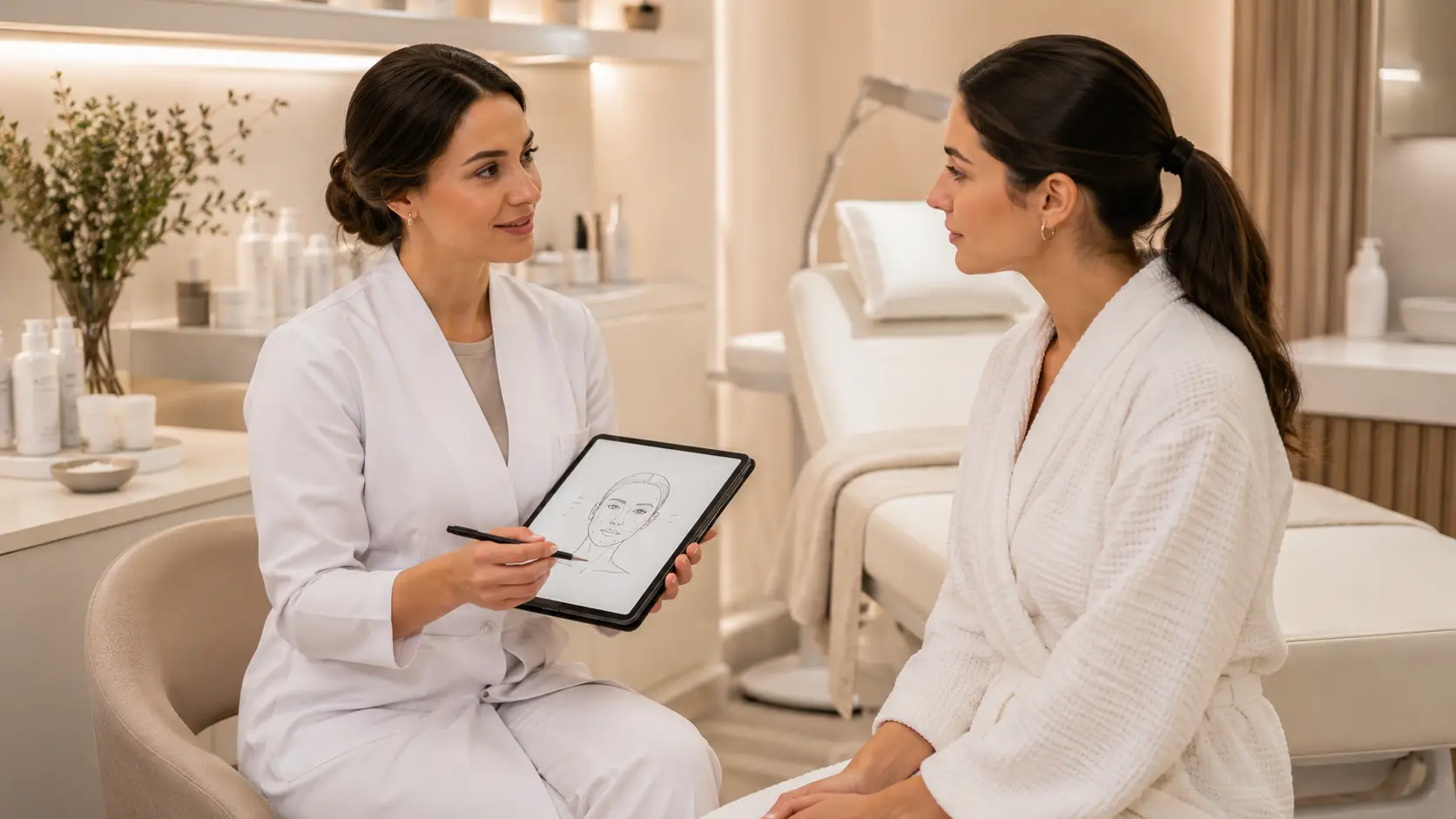
How Do You Talk About Skin Goals Without Overpromising as a New Esthetician?
New estheticians can talk about skin goals confidently without overpromising by anchoring every goal conversation in the process rather than the outcome. This means describing what treatments do physiologically, explaining the individual variables that influence skin response, and framing progress as a direction rather than a guaranteed destination. Honest, process-oriented language does not undermine confidence — it builds it.
- Replace outcome guarantees with process descriptions: say what a treatment does, not what it will definitely produce, because individual skin response genuinely varies.
- Use language like “most clients notice,” “we are working toward,” and “this treatment supports” rather than “this will eliminate” or “you will see.”
- Address unrealistic expectations directly during the consultation, before the service begins — never after, when managing disappointment is harder.
- Frame realistic timelines as a sign of professional expertise, not a warning. Clients who understand the process stay committed longer.
- Understand the four variables that most influence skin outcome communication: the concern being treated, the treatment modality, the client’s home care compliance, and lifestyle factors outside your control.
- Distinguish between what a single session can deliver and what a series of treatments builds toward — and communicate both clearly every time.
One of the most common traps new estheticians fall into is not a technique mistake — it is a language mistake. It happens in consultations, in the minutes before a service begins, in the excited pitch of an add-on recommendation. A client mentions their skin concern and the impulse to reassure them, to secure the booking, to seem capable and confident, leads to a sentence that goes slightly too far: “We can absolutely clear that up.” “After a series, that will be gone.” “This treatment will make a huge difference.”
These are not malicious statements. They come from genuine enthusiasm, genuine belief in the work, and a very human desire to give clients what they are hoping for. But they are also statements that plant seeds of future disappointment — and disappointment, in the esthetics business, is a retention killer.
The good news is that the fix is not to become guarded, cautious, or less enthusiastic. The fix is to replace outcome-based language with process-based language, and to understand why that swap actually makes you sound more credible, not less confident. This guide gives new estheticians a practical, conversation-ready framework for talking about skin goals honestly — in a way that builds the kind of client trust that keeps people rebooked for years.
What Every New Esthetician Needs to Know About Skin Goal Conversations
- Overpromising is almost never intentional — it is the result of using outcome language when process language is what the conversation actually needs.
- Process language is not hedging. Describing what a treatment does is more credible than promising what it will produce, because real skin response genuinely varies between individuals.
- Unrealistic client expectations must be addressed before the service begins — not managed after the fact when disappointment has already set in.
- Clients who understand the timeline and biology of skin improvement are more committed to treatment series, not less.
- The four key variables to communicate: the concern, the treatment modality, home care compliance, and lifestyle factors. These are what govern outcomes — and explaining them builds authority.
- Single-session results and series results are different conversations. Both deserve to be had clearly, at every relevant point in the client relationship.
- The esthetician who tells the truth about what skin care can achieve will always outlast the esthetician who tells clients what they want to hear.
Why New Estheticians Overpromise — and Why It Costs Them Clients
Understanding where overpromising comes from is the first step toward correcting it. For most new estheticians, it stems from one of three sources: the pressure to justify pricing and secure bookings, genuine belief in the power of the treatments being offered, or subconscious alignment with the before-and-after culture of social media esthetics.
The Pressure to Justify and Secure
When a potential client asks “will this actually work for my skin?” and the esthetician is new, nervous about pricing, and eager to close the booking, the honest answer — “it depends on several factors, but here is what we can reasonably expect” — can feel like it risks losing the client. In reality, the honest answer is the one that builds the relationship. The client who books based on a realistic expectation is the client who comes back. The client who books based on an overpromise is the client who leaves disappointed and never rebooking.
Genuine Enthusiasm Misdirected
New estheticians typically enter the profession with real passion for skin science and visible results. That enthusiasm is an asset in the treatment room. The problem arises when enthusiasm is channeled into outcome claims rather than ingredient and treatment mechanism education. Estheticians who learn to express their genuine excitement through explaining the science of what a treatment does — rather than the result it will produce — are far more compelling to clients and far more protected from the fallout of unmet expectations.
Social Media’s Before-and-After Problem
The esthetics content that performs best on social media tends to feature dramatic transformations. For newer estheticians who have grown up consuming and producing this content, the implicit standard of what a treatment “should” deliver can become unrealistically skewed. Real professional skin care — practiced ethically, within scope, on real individual skin — produces meaningful results over time. It does not routinely produce the kind of dramatic single-session visual transformation that dominates social feeds. Building a practice on honest expectation setting, rather than implied before-and-after promises, is the longer arc toward sustainable professional reputation.
The Four Variables That Actually Govern Skin Outcomes
When a new esthetician can name and explain the four core variables that influence whether a client’s skin goal is achievable — and at what pace — the entire skin goal conversation changes. These are not excuses for limited outcomes. They are the honest professional framework within which real outcomes occur. Clients who understand this framework have dramatically better retention than clients who were simply told what to hope for.
The Skin Concern Itself
Different concerns respond to professional treatment at different rates and to different degrees. Active acne, dehydration, and surface texture are often more responsive to short treatment series than concerns like deep atrophic scarring, genetic hyperpigmentation patterns, or significant laxity. Being specific about what category of concern you are addressing — and what the realistic scope of professional esthetic treatment is for that category — protects both you and the client from misaligned expectations.
The Treatment Modality
Every treatment modality has a specific, evidence-supported mechanism of action and a realistic range of outcomes for that mechanism. Being able to describe what a hydration facial, a chemical exfoliation, or a nano infusion treatment actually does at the skin level — clearly and accessibly — is both the most credible and the most honest way to have a skin goal conversation. The modality determines the direction of improvement; it does not guarantee a specific destination.
Home Care Compliance
Professional treatments produce their best and most sustained results when supported by appropriate at-home care. A client who follows a simple, well-matched home care routine between professional sessions will see meaningfully different results than one who does not. This is not an excuse for treatment results — it is an honest explanation of how skin improvement actually works. Including home care compliance as part of every skin goal conversation repositions the client as an active participant in their skin health rather than a passive recipient of services.
Lifestyle Factors Outside Your Control
Sleep quality, stress levels, diet, sun exposure, hydration, and hormonal factors all influence skin condition in ways that professional treatment can support but cannot override. Clients who understand this context are more realistic about the pace of improvement, more engaged in the overall skin health process, and less likely to attribute slower-than-expected progress entirely to the professional treatment. Raising lifestyle factors during a consultation is not pessimism — it is the context that makes everything else you say about skin goals more credible.
Process Language vs. Outcome Language: What the Swap Looks Like in Practice
The most practical tool a new esthetician can develop for skin goal conversations is fluency in process language. Process language describes what a treatment does mechanically and physiologically. Outcome language describes what the treatment will produce. The difference is not subtle — and the credibility gap between the two is significant.
Process language is not hedging or weakness. It is honesty dressed in professional confidence. “This treatment creates the conditions for your skin to hold more moisture over time” is more accurate, more defensible, and more interesting to a client than “this will fix your dehydration.” It also opens the door to a real education conversation that most clients respond to with engagement rather than skepticism.
Outcome Language vs. Process Language: Direct Swaps
“This will clear your acne.”
“This treatment supports pore regulation and reduces the bacterial environment that contributes to breakouts — most clients notice fewer active lesions over a consistent series.”
“You’ll see a huge difference after this.”
“After this treatment, your skin should feel noticeably more hydrated and look brighter — results like this are what most clients experience immediately post-service.”
“A series of six will eliminate those fine lines.”
“Consistent treatment over a series supports collagen synthesis and hydration levels — both of which reduce the visible depth and dryness of surface fine lines over time.”
“This is going to completely fix your barrier.”
“This protocol is specifically designed to support barrier recovery — the ingredients we are using create the environment your skin needs to repair its own protective function.”
“We can definitely get rid of those dark spots.”
“Targeted brightening treatments can meaningfully reduce the appearance of hyperpigmentation over a consistent series — the timeline depends on the depth and cause of the discolouration, which is something we will assess together.”
How to Structure a Skin Goal Conversation: A Five-Stage Consultation Framework
Having the right language is one part of avoiding overpromising. Having a reliable structure for how you move through a skin goal conversation is the other. New estheticians who follow a consistent consultation framework are less likely to be caught off-guard by ambitious client expectations, more likely to surface the relevant variables, and more confident in their ability to redirect without appearing uncertain.
The following five-stage framework gives new estheticians a reproducible sequence that works across skin concerns, treatment types, and client personalities. It is designed to be conversational, not clinical — something you internalise and express naturally rather than read from a script.
Stage One: Listen and Identify Before You Respond
Most estheticians are trained to assess, prescribe, and act quickly. In a skin goal conversation, speed is the enemy of accuracy. The first stage of any effective skin goal consultation is extended listening — asking the client to describe their concern in their own language, without immediately steering toward a treatment recommendation. This does two things: it gives you information you cannot get from a skin assessment alone, and it signals to the client that you are a practitioner who takes their experience seriously rather than a salesperson who is waiting to pitch them a service.
During the listening stage, experienced practitioners are also privately assessing whether the client’s stated goal is realistic for professional esthetic treatment, and if not, how to redirect that conversation with warmth and accuracy. A client who says “I want to completely erase my acne scars” is presenting a goal that needs honest contextualisation. A client who says “I just want my skin to feel less tight and dry” is presenting a goal that is highly achievable. Identifying which category you are in before you respond prevents the impulse overpromise that comes from reacting before thinking.
Stage Two: Validate Before You Reframe
When a client’s expectation needs to be redirected, the sequence matters. Validate first, reframe second. Saying “that makes complete sense, and here is how we think about working toward that together” lands very differently from immediately launching into a list of limitations. Clients who feel heard are far more receptive to honest expectation-setting than clients who feel corrected. This is not a communication trick — it is just good professional relationship-building.
Estheticians who incorporate the Poly-Luronic™ Jelly Mask by Luminous Skin Lab into their beginner facial protocols consistently note that it gives them a specific, science-grounded reference point during the mechanism explanation stage of skin goal consultations. Rather than making a vague statement about hydration, they can explain that the mask’s dual-humectant system — polyglutamic acid working at the skin surface to seal moisture and inhibit the enzyme that breaks down hyaluronic acid, while the HA component delivers deeper hydration — is why the immediate post-treatment skin feel is noticeably different from a standard mask treatment.
This kind of specific, ingredient-level explanation replaces outcome promises with process education. Clients respond to it with genuine curiosity, and practitioners find that explaining what the treatment does at the skin level builds more confidence in their consultations than almost any amount of reassuring outcome language. The observable immediate result — measurably more hydrated, more plump-feeling skin immediately after removal — then validates the mechanism explanation rather than having to carry the conversation alone.
Stage Three: Explain What the Treatment Does, Not What It Will Produce
This is where the language swap described earlier becomes the practical vehicle for honest consultation. At stage three, you are presenting your treatment recommendation — and the most effective way to do so is through mechanism description rather than outcome promise. What does the treatment do to the skin? What physiological process does it support? What specific ingredients are working at which skin level? Clients who receive this kind of explanation feel educated rather than sold to, and they carry that education into their relationship with the results they experience over time.
The mechanism explanation also naturally accommodates the “it depends” reality of individual skin response. When you describe what a treatment does rather than what it will produce, you are not making a claim that individual variation can undermine — you are describing a process that will occur regardless of the individual speed of response. This is intrinsically more defensible and more accurate.
Stage Four: Separate Single-Session Results From Series Results
One of the most common sources of unmet expectation is clients who receive a first treatment and compare the immediate result to the transformation they were mentally picturing after a full series. The fix is to have two explicit conversations, clearly separated: what you will likely notice after today’s treatment, and what consistent treatment over time builds toward. These are not the same outcome, and conflating them is a primary driver of the “I tried it once and it didn’t work” client response.
For single sessions, be specific and honest about what immediate results are realistic: improved texture, hydration, radiance, calming of redness, or brightening are all outcomes that many clients can observe immediately following appropriate treatment. For series results, communicate a realistic range, explain the biological processes that take time — collagen remodeling, sustained barrier improvement, progressive hyperpigmentation reduction — and frame the series as a commitment, not a calendar.
How to Handle Specific Scenarios Where Overpromising Is Most Likely to Happen
When a Client Asks: “Will This Actually Work?”
This is the question that most reliably elicits an overpromise from new estheticians. The impulse to say “yes, absolutely” is understandable — but it commits you to a claim you cannot guarantee. A stronger response: “Based on what you’ve told me about your skin and your goals, this approach is the right one to support the improvement you’re looking for. Most clients in your situation notice meaningful improvement with consistent treatment. Here is what that typically looks like.” This is confident, honest, and accurate in a way that “yes, absolutely” is not.
When a Client Has Seen a Dramatic Transformation Online and Wants the Same
Before-and-after images on social media often represent the best possible outcome, sometimes achieved over extended series, under optimal lifestyle conditions, or with treatments outside the scope of standard esthetic practice. When a client presents this kind of reference, acknowledge it directly: “Those results are definitely what the treatments can work toward over time, and there are a lot of factors that determine how quickly any individual gets there. What I can tell you is what this specific protocol will do for your skin and what we can realistically expect to see at each stage.” This is honest without being deflating.
When a Client Is Impatient and Wants to Know How Fast Results Come
Estheticians who have worked with many clients on long-term skin goals consistently note that impatience is one of the most common retention risks in the first three to six months of a treatment series. Addressing the pace of results proactively — before the client asks — reduces drop-off significantly. “The first two treatments are about creating the foundation. By treatments three and four, most clients start noticing consistent improvement. That is the timeline to expect.” Setting this expectation at the start of a series is far more effective than trying to manage disappointment after the second session.
When You Are Recommending an Add-On or Upsell
Add-on recommendations carry their own overpromising risk. The pressure to justify the additional cost can push language toward outcome claims. The safer and more effective approach is the same as everywhere else: mechanism description over outcome promise. “Adding this masks the treatment with a dual-humectant system that supports hydration recovery specifically — it extends the benefit of what we have already done and most clients feel it immediately.” That is an accurate, honest add-on recommendation that clients respond to because it explains value rather than promising a result.
Why Honest Goal-Setting Is the Foundation of Long-Term Client Retention
Everything discussed in this guide ultimately points to one professional truth: the esthetician who tells clients what their skin can realistically achieve — and who is right about it — is the esthetician those clients stay with for years. Overpromising is a short-term retention strategy that produces long-term retention failure. Honest goal-setting is a long-term retention strategy that sometimes requires a harder conversation in the first appointment.
Trust Is the Only Sustainable Client Currency
The clients who stay longest in any esthetics practice are the clients who trust their practitioner’s judgment. That trust is built from accurate predictions: when you tell a client what they are likely to experience and they experience it, the trust relationship deepens. When you tell a client what they want to hear and reality does not match it, that trust erodes in a way that is very difficult to recover. New estheticians who establish honesty as the foundation of every skin goal conversation from the very first consultation are building the trust infrastructure their practice will run on for years.
Clients Who Understand the Process Become Your Advocates
There is a secondary benefit to honest goal-setting that new estheticians often do not anticipate: clients who understand the skin improvement process become significantly better communicators about their own treatment experience. They describe their results accurately to friends and family, they do not oversell your services with claims you will have to walk back with new clients, and they represent your practice as competent and trustworthy rather than as the source of a miracle transformation. Word-of-mouth from a client who says “my esthetician really explains everything and I always know what to expect” is more powerful and more sustainable than word-of-mouth based on a transformation story that is hard to replicate.
Professional Education References
The communication frameworks and expectation-setting principles referenced in this article draw from established professional esthetics education, client retention research, and skincare science literature:
- Client expectation management in professional beauty services — established retention literature in the professional beauty and esthetics industry emphasising the relationship between accurate expectation-setting and long-term client retention rates.
- Process-oriented versus outcome-oriented professional communication — applied communication principles in healthcare and professional services, adapted for esthetic practice client consultation contexts.
- Skin improvement timeline education for client retention — professional esthetics education frameworks emphasising the role of realistic timeline communication in treatment series compliance and client retention.
- Individual variation in skin response to professional treatment — dermatological and cosmetic science literature on the influence of skin type, lifestyle factors, home care compliance, and genetic variables on professional treatment outcomes.
For new estheticians building both their consultation confidence and their professional product knowledge simultaneously, having a treatment tool whose mechanism you can explain clearly and accurately is one of the most practical supports for honest skin goal conversations. The Poly-Luronic™ Jelly Mask by Luminous Skin Lab is the formulation our education team most frequently references in beginner consultation training contexts, precisely because the PGA and HA dual-humectant science gives new estheticians a concrete, ingredient-level description to offer clients during the mechanism explanation stage — replacing vague outcome language with specific, defensible process education. The immediate, observable hydration result the mask delivers post-treatment then validates the mechanism explanation naturally, without requiring any additional outcome promise from the practitioner.
Explore the Poly-Luronic™ Jelly Mask LineFrequently Asked Questions: Talking About Skin Goals Without Overpromising
Why do new estheticians overpromise results to clients?
New estheticians often overpromise because they feel pressure to justify their pricing, hold onto nervous clients, or compete with the dramatic before-and-after content flooding social media. Enthusiasm for esthetics is genuine, but without a framework for honest goal-setting conversations, that enthusiasm can translate into claims that exceed what a single service or even a series of services can realistically deliver. The fix is not less enthusiasm — it is learning to channel it into accurate, confidence-building language.
What is the right way to talk about skin goals without making promises you cannot keep?
The right approach is to anchor every skin goal conversation in the process rather than the outcome. Instead of promising a result, describe what the treatment does physiologically, explain the variables that influence how an individual’s skin responds, and frame progress as a direction rather than a destination. Use language like “we are working toward” and “most clients notice” rather than “this will” or “you will see.” This positions you as credible, not cautious.
How do I handle a client who has totally unrealistic expectations about what a facial can do?
Address unrealistic expectations directly but warmly during the consultation, before the service begins. Acknowledge the client’s goal, validate their desire for improvement, and then redirect to what professional skin care can genuinely contribute toward that goal over time. Phrases like “that is absolutely something we can make meaningful progress on, and here is what that progress realistically looks like” keep the conversation positive while establishing honesty as the foundation of your professional relationship.
What words should I use when talking about skin goals so I sound confident but not like I am overpromising?
Use process-anchored language that describes mechanism and direction rather than guaranteed outcomes. Strong examples include: “this treatment supports hydration recovery,” “most clients notice a visible improvement in texture after a series,” “we are creating the conditions for your skin to function better,” and “your skin responds to consistent treatment over time.” Avoid absolute language like “will eliminate,” “completely clears,” or “guaranteed results” in any context.
How do I set realistic expectations at the start of a client relationship without scaring them off?
Frame realistic expectations as a sign of professional expertise, not limitation. Clients who understand the timeline and process for skin improvement are more committed, not less. Opening the expectation conversation with something like “I want to share what you can realistically expect so you can track the progress we make together” positions honesty as an asset. Clients stay when they feel informed and respected — they leave when they feel misled.
What is the difference between educating a client about skin goals versus just telling them what they want to hear?
Telling clients what they want to hear is a short-term strategy that creates long-term retention problems. Genuine client education means explaining the skin’s actual biology — how collagen remodeling takes time, how hydration and barrier function are ongoing processes, how lifestyle factors influence treatment outcomes — in accessible language. A client who understands why something works trusts the process even when results feel gradual. A client who was just told what they wanted to hear becomes frustrated and disappears.
How many treatments should I tell a new client they need before they see results?
Rather than citing a fixed number, communicate a realistic range and explain the factors that influence it. For most skin concerns addressed through professional facial services, estheticians typically discuss a series of four to six treatments to begin seeing consistent improvement, with ongoing maintenance thereafter. Always qualify this with individual skin factors — age, lifestyle, home care compliance, and the specific concern being addressed — so clients understand the estimate is personalised, not a generic promise.
Should I talk about skin goals differently for clients who want quick fixes versus long-term improvement?
Yes. Clients seeking quick fixes need gentle redirection toward what is actually achievable in a single session — immediate hydration, radiance, texture smoothing, calming — while being introduced to the longer arc of sustainable skin improvement. Clients already committed to long-term improvement can be engaged in a more detailed treatment plan conversation. In both cases, honesty serves the relationship better than accommodation. The goal is to move every client toward a realistic, process-oriented mindset.
How does using a professional jelly mask in a treatment help me have more credible skin goal conversations with clients?
When you can explain the specific mechanisms behind what a treatment does — not just what it feels like — your skin goal conversations carry significantly more authority. A professional jelly mask like the Poly-Luronic Jelly Mask by Luminous Skin Lab gives new estheticians a tangible, science-backed tool to reference: the PGA and HA dual-humectant system delivers measurable immediate hydration that clients can see and feel right after the treatment. Being able to say “this mask contains both polyglutamic acid and hyaluronic acid, which work together at different skin depths to deliver and seal hydration” is the kind of specific, honest language that builds trust without overpromising outcomes.
Honesty Is the Most Confident Thing You Can Bring to a Consultation
The new esthetician who learns to talk about skin goals honestly — with process language, with the four variables framed clearly, with single-session and series results distinguished explicitly — is building something far more valuable than a full appointment book in the short term. They are building a practice on the only currency that sustains itself: the trust of clients who know they will always receive an accurate, informed assessment of what their skin can achieve and how to get there.
This does not require becoming cautious, hedged, or less enthusiastic about the work. The esthetician who says “here is exactly what this treatment does at the skin level, and here is the realistic arc of what consistent treatment builds toward” sounds significantly more confident and more credible than the one who says “this will definitely fix it.” The science of what professional treatments do is genuinely impressive — and it does not need to be exaggerated to be compelling.
Every honest skin goal conversation you have is an investment in a client who stays, who rebooking consistently, and who tells other people they can trust you. That is the practice worth building.