How Do Beginner Estheticians Create Professional Treatment Plans?
New estheticians create effective treatment plans by following a clear four-phase process: assess the client’s skin condition and primary concern during the consultation, identify one or two realistic goals the client can achieve within your current service menu, match those goals to a specific sequence of treatments spaced at appropriate intervals, and set a concrete success marker so both you and the client can measure progress. The plan does not need to be complex to be professional — clarity, honesty, and a realistic timeline build more trust and more rebooking momentum than an elaborate document that overpromises.
- A beginner treatment plan should address one primary concern at a time and span three to four visits for most beginner-appropriate skin conditions.
- Frame the plan around the client’s goal, not your service menu — clients who feel guided rather than sold to are far more likely to follow through and rebook.
- Skin concerns best suited to beginner treatment planning include dehydration, dullness, mild congestion, sensitivity, and early barrier disruption — all of which respond predictably to consistent hydration and calming protocols.
- A written plan, even a simple one-page summary, measurably increases client compliance and positions you as a credible professional from the first visit.
- Evaluate progress at every visit using the same criteria you established at the initial consultation and adjust the plan based on real observation, not assumption.
- Home care instructions are an essential part of every treatment plan — results achieved in the treatment room are maintained or extended by what the client does between sessions.
One of the most confidence-building things a new esthetician can do in their first year of practice is learn to present a treatment plan. Not because treatment plans are complicated — at the beginner level, they rarely need to be — but because the act of presenting one signals something important to the client: that you have assessed their skin, that you have a professional rationale for what you are recommending, and that you are invested in their results over time, not just in the service they booked today.
Many new estheticians avoid treatment plans because they feel they do not yet have enough experience to confidently predict outcomes. That hesitation is understandable, but it confuses expertise with professionalism. You do not need years of clinical experience to create a meaningful treatment plan. You need a clear framework, an honest assessment, a service menu you understand confidently, and the communication skills to explain your reasoning to a client in plain language.
This guide gives beginner estheticians exactly that framework. We cover what a treatment plan actually needs to include, how to structure one around beginner-appropriate skin concerns, how to communicate it to clients without sounding like a sales pitch, how to adjust it when results do not come as expected, and how the treatments and products you select within the plan affect the outcomes you can honestly promise.
What Every Beginner Needs to Know About Treatment Planning
- A beginner treatment plan is a three-to-four visit roadmap built around one primary skin concern — not a comprehensive skincare prescription covering every issue at once.
- The plan is framed around the client’s goal. Always start with what they want to improve, not with what services you can perform.
- Written plans, even brief ones, measurably increase client follow-through and position you as a credible professional regardless of how long you have been licensed.
- Dehydration, dullness, mild congestion, and early barrier disruption are the most treatment-plan-friendly concerns for new estheticians because they respond predictably to consistent protocols.
- Home care instructions are not optional — without them, the results you achieve in the treatment room cannot be maintained between sessions.
- Adjusting a plan based on observed progress is a sign of clinical competence, not failure. Build adjustment into the plan from the beginning.
- The treatments you choose within the plan — including which add-ons, masks, and recovery steps you sequence — directly determine the visible results the client attributes to your professional judgment.
Why Treatment Plans Matter More for New Estheticians Than for Experienced Ones
Experienced estheticians can often communicate treatment recommendations conversationally and have clients trust their judgment based on the visible results of previous work. New estheticians do not yet have that accumulated credibility. A treatment plan is the structural substitute for that credibility — it communicates professional intent, organized thinking, and genuine investment in the client’s outcome without requiring a decade of experience to back it up.
In research on professional services broadly, the act of presenting a written plan — even a simple, brief one — increases client perception of competence significantly more than verbal recommendations alone. Clients who receive a treatment plan are more likely to follow home care instructions, more likely to rebook at the recommended interval, and more likely to refer others to a practitioner they perceive as organized and results-focused. For a new esthetician building a client base, these are not small advantages.
What a Treatment Plan Does That a Single Appointment Cannot
A single facial, however skillfully performed, produces a temporary result. Consistent treatment, paced at the right interval for a specific skin condition, produces lasting change. A treatment plan is the professional mechanism that bridges those two realities. It converts a client who came in for a one-time treat to someone who understands that their skin goal requires a committed process — and who has agreed to participate in that process because you explained it clearly and honestly during the consultation.
For new estheticians, the treatment plan also provides a professional accountability structure. When you have committed to a written roadmap with specific goals and a defined timeline, you have a clear reference point at every subsequent visit. You can measure progress against baseline. You can explain adjustments in context. You can demonstrate professional continuity even when your clinical instincts are still developing.
What Skin Concerns Are Best Suited to Beginner Treatment Planning?
Not every skin concern is appropriate for a beginner esthetician to build a treatment plan around. Concerns that require advanced clinical judgment, specialized training, or high-risk treatments should be referred out or deferred until you have the experience and certifications to manage them safely. The following categories represent the most treatment-plan-friendly concerns for new estheticians — each responds predictably to consistent hydration and calming protocols, produces visible results within a realistic timeline, and stays firmly within standard beginner esthetics scope of practice.
Chronic Skin Dehydration
Responds within three to four consistent visits to barrier-focused hydration protocols. Visible, measurable results clients notice immediately make this an ideal beginner treatment plan anchor.
Dullness and Uneven Texture
Mild exfoliation followed by targeted hydration and occlusive recovery steps produces visible brightening within two to three sessions. Easy for clients to observe and attribute to your work.
Mild Congestion and Enlarged Pores
Consistent extraction with barrier-recovery follow-up and appropriate home care produces steady visible improvement over four to six visits. Predictable and within beginner scope.
Sensitivity and Barrier Disruption
Clients who have over-exfoliated, used harsh home products, or experienced stress-related reactive skin respond well to a calm, consistent barrier-repair protocol over three to five visits.
General Skin Health and Maintenance
Clients with generally healthy skin seeking professional maintenance are ideal for beginner treatment plans. Low clinical risk, predictable outcomes, and easy-to-communicate progress markers.
Severe Acne, Hyperpigmentation, Rosacea
These conditions require advanced training, clinical experience, and often medical collaboration. Attempting treatment plans for complex conditions before you are ready is a professional and ethical risk.
Staying within these parameters as a new esthetician is not a limitation — it is professionalism. Clients with straightforward skin concerns can still achieve meaningful, visible results under a well-designed beginner treatment plan, and the professional confidence you build through consistent successful outcomes with these clients creates the foundation for expanding your scope over time.
How to Build a Beginner Treatment Plan Step by Step
The following five-step framework is designed to be completed during or immediately after the initial client consultation. It takes approximately ten minutes to complete the first time and becomes faster with practice. Every treatment plan you write follows the same structure — what changes is the specific information within each step.
Document the Primary Skin Concern
Write down the one skin concern the client most wants to address — in their own words if possible, then translated into clinical language. Limit this to one primary concern for beginner plans. Attempting to address multiple concerns simultaneously reduces your ability to attribute visible results to specific interventions and makes progress harder to measure.
Identify the Measurable Goal
Translate the concern into a specific, observable outcome you can evaluate at follow-up visits. “Skin that feels less tight and looks more radiant” is a measurable goal for a dehydration concern. “Better skin” is not. The goal should be something both you and the client can assess without specialized equipment.
Select the Treatment Sequence
Choose one to two services from your current menu that directly address the identified concern. Sequence them across three to four visits at two-to-four-week intervals. For beginner plans, the first visit is assessment and treatment, the second is evaluation and continuation, and the third is progress assessment and plan adjustment or graduation to maintenance.
Assign Home Care Instructions
Include two to three specific home care steps the client should follow between sessions. Keep these simple and achievable. A client who successfully completes their home care protocol arrives at their next visit with skin that is more receptive to treatment, produces faster visible progress, and attributes that progress to the plan you built together.
Set the Progress Check and Adjustment Point
Identify the visit at which you will formally evaluate progress against the baseline goal and discuss whether to continue, adjust, or graduate the client to a maintenance schedule. Building this check-in explicitly into the plan frames adjustment as a planned professional step, not an admission that the previous plan did not work.
How to Communicate a Treatment Plan Without Sounding Like a Sales Pitch
The single most common reason treatment plans fail in beginner practices is not poor design — it is poor communication. When a new esthetician presents a multi-visit recommendation in a way that sounds like upselling, clients disengage. When the same recommendation is framed as honest professional guidance rooted in what the skin needs to achieve the client’s own stated goal, clients lean in.
Start With What the Client Said
Open your treatment plan presentation by repeating the client’s primary concern back to them in their own language. “You mentioned your skin has been feeling really tight and dull lately, especially after the winter — that is exactly what I was seeing during the assessment.” This approach establishes that the plan is built around their goal, not around filling your schedule, and it demonstrates that you listened during the consultation.
Explain the Biology, Not the Service List
Clients understand their own skin much better when they understand why it behaves the way it does. Rather than listing the services you are recommending, briefly explain the biological mechanism behind the concern and why consistent treatment addresses it more effectively than a single session. A client who understands that dehydrated skin has a compromised barrier that needs repeated support to repair is far more motivated to follow through on a three-visit plan than a client who hears “I recommend you come back three more times.”
Use Language That Centers the Client’s Goal
Every sentence in your treatment plan communication should connect back to the outcome the client wants. Compare these two approaches to the same recommendation. First approach: “I’d recommend booking a hydration facial series, so I can also offer you a jelly mask add-on and a serum upgrade each visit.” Second approach: “To get your skin to hold onto moisture consistently, your barrier needs a few sessions of targeted support — I’ll use a deep occlusive hydration step each visit so you can see the difference at removal and track how your skin is building on it between sessions.” The second approach communicates the same recommendation but centers the client’s experience and observable result rather than the service components.
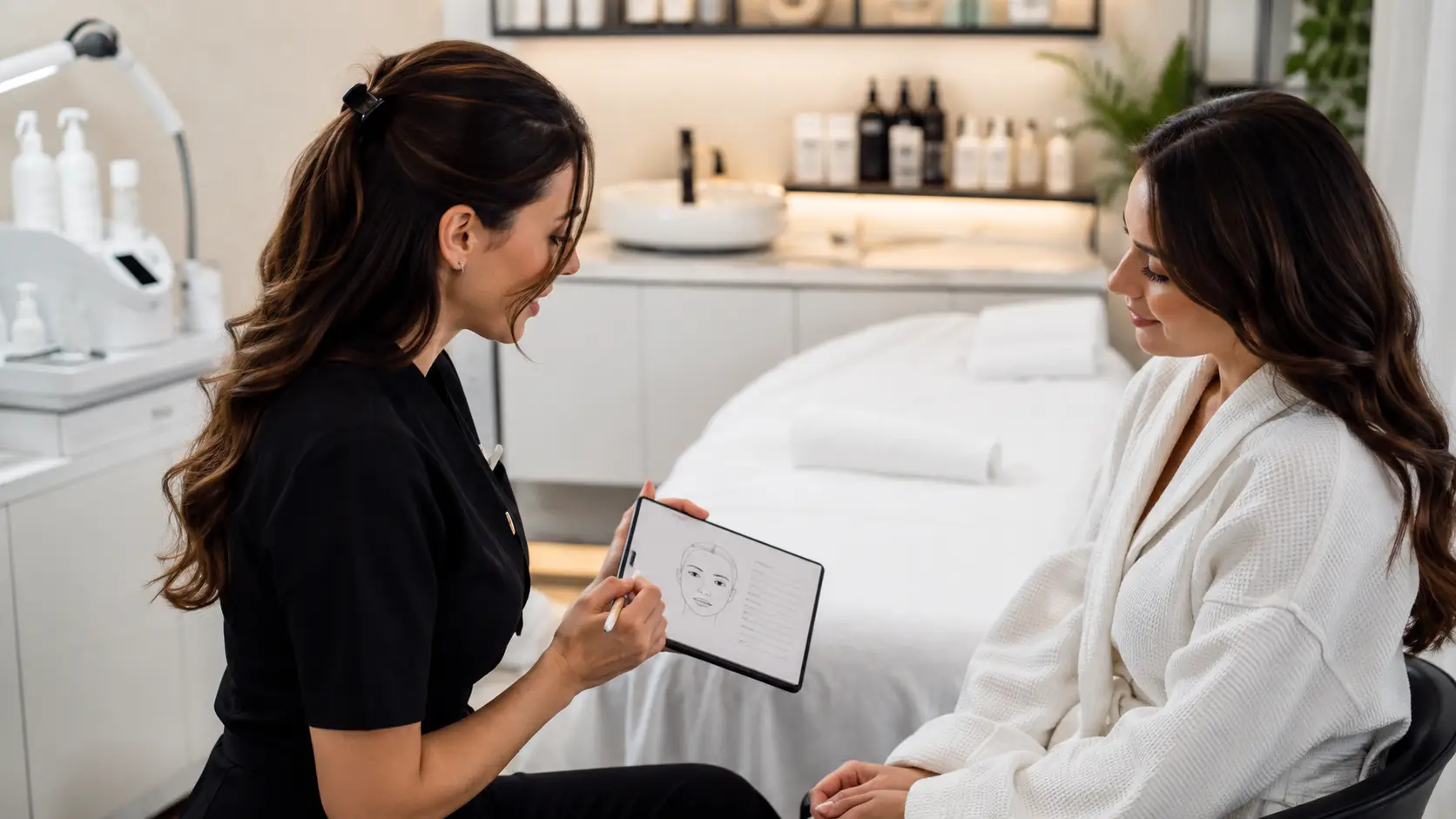
Give the Plan a Written Form Before They Leave
Even a handwritten note summarizing the three to four visit plan, the home care steps, and the progress check point dramatically increases follow-through. Many estheticians use a simple pre-printed form they complete by hand during or after the consultation. The physical document is a tangible signal that the plan is real, considered, and worth committing to.
How to Select the Right Treatments to Include in a Beginner Treatment Plan
The treatments you choose to include in a plan are as important as the plan structure itself. A well-structured plan built around the wrong treatments will underdeliver, damage client trust, and make accurate progress assessment impossible. For beginner estheticians, the best treatment plan components share three characteristics: they address the identified concern directly, they produce visible results the client can observe at removal or in the days following the session, and they are within your current scope of practice and confidence level.
Match the Treatment to the Concern, Not to the Price Point
One of the most common beginner mistakes is selecting treatments for a plan based on their retail value rather than their relevance to the client’s concern. A plan that includes a premium add-on the client does not need yet will not produce better results, and clients who do not see results proportional to what they spent will not return. Select treatments because they are the most direct path to the client’s stated goal, and the pricing conversation becomes far easier because the value is self-evident.
Sequence Treatments to Build on Each Other
Professional treatment plans are most effective when each visit prepares the skin for the next. A first visit that focuses on assessment, cleansing, and baseline hydration creates a more receptive skin environment for deeper exfoliation or targeted active delivery at visit two. A second visit that incorporates gentle exfoliation followed by occlusive recovery creates better conditions for results assessment and potential protocol intensification at visit three. This kind of intentional sequencing is what separates a treatment plan from a series of disconnected appointments.
Choose Components That Give Clients Visible Progress Markers
Treatments that produce visible, immediate results are especially valuable in beginner treatment plans because they give clients a tangible benchmark to evaluate between sessions. When a client can see and feel a difference at removal — hydrated, plump, radiant skin where the treatment delivered its intended result — they connect that result to your professional judgment and to the plan you designed. Occlusive hydration steps in particular are effective at producing this kind of immediately observable result that reinforces client confidence in the treatment pathway.
Estheticians who incorporate Poly-Luronic™ Jelly Masks by Luminous Skin Lab as a consistent component of their beginner treatment plans for dehydration and barrier-recovery clients consistently report that the immediate post-removal skin response serves as an especially effective progress marker within the plan structure. Practitioners note that clients who would otherwise struggle to articulate whether they are seeing improvement between visits have no difficulty observing the difference at jelly mask removal — the skin visibly holds moisture, texture smooths, and redness recedes in a way that is perceptible without any prompting. In the context of a three-to-four-visit plan, this provides a concrete, repeatable reference point that both the esthetician and client can track across sessions.
Estheticians working with this formulation in treatment plan contexts also note that the PGA-forward Poly-Luronic™ system produces a noticeably different skin response than the single-humectant HA-only alternatives commonly used as beginner add-ons. The surface-sealing mechanism of PGA combined with HA’s deep delivery creates a visible plumping and smoothing effect at removal that clients consistently describe as “the best their skin has felt” — a response that, when repeated across multiple plan visits, builds cumulative confidence in both the treatment plan itself and in the professional who designed it.
How to Manage Client Expectations Within a Treatment Plan
Managing expectations is arguably the most important skill in beginner treatment planning — and it is one that new estheticians frequently underestimate. A client whose expectations are accurately calibrated from the beginning will experience every visit as a success, even if progress is gradual. A client who was led to expect dramatic transformation after a single session will be disappointed by results that an experienced esthetician would consider excellent.
Be Specific About What “Progress” Looks Like at Each Stage
Rather than describing the end result the client will achieve, describe what they should notice after each individual visit. After the first visit: “Your skin may feel more comfortable and hydrated for a few days, then return toward its baseline — that is normal and expected at this stage.” After the second visit: “Most clients notice the result lasting a bit longer than after the first session, and your skin should feel noticeably more receptive to the treatment.” This kind of staged expectation-setting makes the gradual progression feel like exactly what you planned, not like slow progress.
Separate What You Control From What the Client Controls
Experienced estheticians understand that treatment results are a shared responsibility between what happens in the treatment room and what the client does at home. When you communicate the treatment plan, make this dynamic explicit. “What we do together in the treatment room will start the repair process — what you do at home between sessions determines how quickly we can build on each visit.” This framing positions home care compliance as a professional partnership rather than a product upsell and gives clients a sense of agency over their own results.
Address the Timeline Question Directly
Clients almost always want to know how long it will take. Give them a direct, honest answer: “For the level of dehydration we’re working with, most clients notice a consistent improvement by the third visit at three to four week intervals. After that, maintenance every four to six weeks is usually enough to sustain the result.” A specific timeline with honest caveats is far more confidence-building than a vague “it depends” answer, and it prevents the disappointment that comes when clients have unrealistic timelines in their heads.
How to Adjust a Treatment Plan When Results Are Not Coming as Expected
Treatment plans that work exactly as designed from start to finish are the ideal. They are also not the universal experience, especially for new estheticians who are still developing their clinical assessment skills and learning how individual clients respond to specific protocols. Knowing how to adjust a plan professionally — and how to communicate that adjustment to the client — is a skill that separates a developing professional from one who gets defensive when results are slower than anticipated.
Build Adjustment In From the Beginning
The most important step in professional plan adjustment is making the possibility of adjustment explicit when you first present the plan. “At your second visit, we’ll take stock of how your skin has responded and I may adjust the approach based on what I’m seeing.” This statement at the initial consultation means that when you do adjust the plan, it feels like planned professional oversight rather than course correction after failure.
Revisit the Skin Assessment Before Changing the Protocol
When results are slower than expected after two consistent visits, the first step is not to add more treatments or switch products. It is to revisit the original skin assessment and ask whether the primary concern you identified was correctly diagnosed. External factors — significant lifestyle changes, new medications, seasonal shifts, diet, stress levels — can all affect how skin responds to a consistent protocol. Asking about these factors at the adjustment visit often reveals information that changes the clinical picture and points toward a targeted protocol adjustment rather than a complete plan overhaul.
Communicate Adjustments as Professional Advancement
When you do adjust a plan, frame it as a demonstration of professional attentiveness, not as a correction of a prior mistake. “Based on how your skin has been responding, I want to shift our focus slightly at this visit — instead of the exfoliation step, I’m going to prioritize barrier repair, which I think will get us to your goal faster.” The client experiences this as sophisticated professional judgment, not as uncertainty about what they should be doing.
The Retention Science Behind Written Treatment Planning
Research in professional services consistently shows that clients who receive a written plan with a defined timeline are significantly more likely to complete the recommended course of treatment than clients who receive only verbal recommendations. In esthetic practice specifically, written treatment plans are associated with higher rebook rates, stronger retail compliance, and more frequent referrals to new clients.
The mechanism is partly cognitive: a physical document gives the client a concrete reference point that makes the recommendation feel more real and more committed. It is also partly relational: taking the time to produce a written plan signals to the client that you take their skin goals seriously and have invested professional effort in their outcome. For new estheticians whose credibility is still being established, this signal is disproportionately valuable.
The plan does not need to be elaborate to be effective. A single page with the primary concern, the treatment sequence, the home care steps, and the visit timeline achieves the full retention benefit. Complexity in the plan itself does not add credibility — clarity and specificity do.
Common Treatment Plan Mistakes Beginner Estheticians Make
Addressing Too Many Concerns at Once
New estheticians, eager to demonstrate the breadth of their knowledge, often present treatment plans that attempt to address four or five skin concerns simultaneously. The result is a plan that is difficult to execute, impossible to track, and overwhelming for the client. Pick the single most important concern, build the plan around it, and acknowledge secondary concerns as future opportunities once the primary concern is resolved or in maintenance.
Using Aspirational Language About Results
Phrases like “we’ll completely clear up” or “you’ll see a huge transformation” create expectations that a beginner protocol simply cannot reliably deliver. Aspirational language feels motivating in the moment and damaging at the three-month mark when the client’s expectations have not been met. Use specific, honest, calibrated language about what the skin can realistically achieve within the plan’s timeline.
Omitting Home Care From the Plan
Treatment plans without home care components deliver approximately half the results of plans with clear home care instructions, because the skin reverts to its baseline condition between sessions without any maintenance support. Including two or three specific, achievable home care steps turns the plan into a genuine partnership and creates a concrete follow-up conversation point at every subsequent visit.
Presenting the Plan as a Sales Pitch Rather Than a Clinical Recommendation
Clients are sophisticated enough to distinguish between a recommendation rooted in their skin’s needs and a recommendation rooted in additional service revenue. When the plan is framed around their goal and the biological reasoning behind the treatment sequence, the additional visit recommendation lands as professional guidance. When it is framed around service options and pricing tiers, it lands as upselling. The framing determines whether the client trusts the plan or resists it.
Professional References and Educational Resources
The treatment planning framework and client communication approaches referenced in this article draw from established professional esthetics education, client psychology research, and practitioner experience in beginner-stage esthetic practice:
- Client compliance and written treatment plan efficacy in professional service contexts. Professional services psychology literature, general. Written plans increase follow-through rates measurably compared to verbal-only recommendations across healthcare and personal services fields.
- Skin barrier function and transepidermal water loss in response to consistent occlusive treatment. Dermatological sciences literature. Repeated occlusive treatment at appropriate intervals supports measurable barrier recovery in compromised skin over three to five sessions.
- Scope of practice standards for licensed estheticians in the United States. National-Interstate Council of State Boards of Cosmetology (NIC); individual state cosmetology board regulations. Beginner estheticians should verify their state-specific scope of practice before incorporating any advanced treatment into a client plan.
- Client retention and rebook behavior in esthetic practice. Associated Skin Care Professionals (ASCP) professional practice guidance, 2023–2025.
- Consultation and treatment documentation best practices for licensed estheticians. Esthetics industry professional training standards; individual state board requirements for client record-keeping.
For new estheticians building beginner treatment plans around dehydration, barrier recovery, and dullness — the skin concerns most appropriate for entry-level practice — incorporating a professional-grade occlusive hydration mask as a consistent plan component gives clients a visible, repeatable benchmark to evaluate their progress at every visit. The Poly-Luronic™ Jelly Mask by Luminous Skin Lab, formulated with a PGA and HA dual-humectant system, is the mask most frequently referenced by our education team in this context. The combination of PGA’s surface-sealing occlusion, HA’s deep hydration delivery, hyaluronidase inhibition, and NMF stimulation produces an immediate post-removal result that clients attribute directly to the treatment plan you designed — building professional credibility at the exact moment when new estheticians need it most. Fragrance-free and clean-label, it is safe for all skin types encountered in beginner practice including sensitive and post-extraction skin.
Explore the Poly-Luronic™ Jelly Mask LineFrequently Asked Questions: Creating Treatment Plans as a New Esthetician
How do I create a treatment plan when I am a brand new esthetician with very little experience?
Start with a simple four-step framework: assess the skin during the consultation, identify the client’s primary concern, match one or two services from your current menu to that concern, and set a realistic timeline for visible progress. New estheticians do not need complex multi-step plans. A clear, honest two to four visit roadmap built around your strongest services is more professional and more useful than an elaborate plan you cannot confidently deliver.
What should a beginner esthetician’s treatment plan actually include?
A beginner treatment plan should include the client’s primary skin concern, the service or services you are recommending and why, the expected interval between visits, any home care steps the client needs to follow between sessions, and a simple success marker so both you and the client know what progress looks like. Keep it to one page or less. Clarity and simplicity build more trust than a densely detailed document.
How many visits should I recommend in a treatment plan as a new esthetician?
For most beginner-appropriate concerns like dehydration, dullness, or mild congestion, a three to four visit initial plan is realistic and achievable. Recommend the first visit to assess and treat, a follow-up at two to four weeks to evaluate progress, and a third visit to adjust or continue. Avoid committing clients to long series upfront until you have the experience to confidently predict outcomes. A shorter plan that delivers visible results builds more rebooking momentum than an ambitious plan that underwhelms.
How do I explain a treatment plan to a client without sounding like I am just trying to sell them more services?
Frame the plan around the client’s goal, not your service menu. Instead of listing what they should book, explain what their skin needs to achieve the result they described during the consultation and why consistent treatment supports that goal. Use language like “to get your skin to hold hydration consistently, your barrier needs a few sessions of targeted support” rather than “I recommend you book three more facials.” The client should feel guided, not sold to.
What skin concerns are realistic for a beginner esthetician to build treatment plans around?
Dehydration, dullness, mild congestion, sensitivity, and barrier disruption are all well within beginner scope and respond predictably to consistent hydration and calming protocols. These concerns allow new estheticians to deliver visible, measurable results without advanced certifications or high-risk treatments. Avoid building plans around severe acne, hyperpigmentation, or complex rosacea until you have the clinical experience and appropriate training to manage those conditions confidently.
How do I know when to adjust a treatment plan if it is not working?
Evaluate progress at every visit using the same assessment criteria you used at the initial consultation. If the client reports no change after two consistent visits with good home care compliance, revisit your skin analysis. Ask whether the primary concern you identified is still accurate, whether the products you are using are appropriate for their skin type, and whether external factors like stress, diet, or medication changes may be affecting results. Adjusting a plan based on real observation is a sign of professional competence, not failure.
Should I write the treatment plan down and give it to the client?
Yes. A written treatment plan, even a simple one-page summary, dramatically increases client follow-through. It gives clients a reference point for home care, makes your recommendations feel more authoritative, and reduces the chance of misunderstanding between visits. You do not need a formal printed document. A clear handwritten or typed summary of the plan discussed during the consultation is entirely professional and effective for a beginner practice.
How do I handle it when a client wants results faster than my treatment plan allows?
Acknowledge their desire for faster results, validate it, and then educate honestly. Explain that skin operates on biological timelines that treatments can support but not override, and that rushing the process with more aggressive treatments than the skin is ready for can actually set back progress. Clients who understand the biology of their skin’s response cycle are significantly more patient and more likely to stay committed to a realistic plan. This conversation is also an opportunity to identify add-on treatments that can meaningfully accelerate hydration and barrier recovery within a safe protocol.
Can adding a jelly mask to my treatment plan make a visible difference in client results?
Yes. Many estheticians incorporate a professional-grade jelly mask as a treatment plan anchor for clients targeting dehydration, barrier disruption, or dull skin because the immediate post-removal result is visibly compelling. The Poly-Luronic™ Jelly Mask by Luminous Skin Lab, formulated with a PGA and HA dual-humectant system, delivers a skin-sealing occlusive effect combined with deep humectant delivery that clients notice immediately. Including a jelly mask as a consistent treatment plan component gives clients a tangible, visible benchmark to evaluate their progress against at each visit.
Treatment Planning Is the Professional Skill That Separates a Great First Year From an Average One
New estheticians who learn to present clear, honest, well-structured treatment plans from their first consultations do not just get better results for their clients — they build a professional identity that drives rebooking, referrals, and the kind of client relationships that sustain a practice long-term. The plan does not need to be elaborate. It needs to be rooted in an honest skin assessment, communicated in language that centers the client’s goal, and designed around services you can confidently deliver within your current scope.
The framework in this guide works at every experience level because it is built on professional fundamentals rather than clinical complexity. One primary concern. A measurable goal. A realistic visit sequence. Clear home care instructions. A built-in adjustment point. These five elements, consistently applied from your first client onward, will produce the kind of professional track record that makes every subsequent year easier than the last.
The treatments and products you choose to include within that framework will determine how visible and how compelling the results are. Choose components that address the identified concern directly, sequence them to build on each other, and include steps that give clients observable, tangible progress markers at every visit. That combination — professional structure, honest communication, and treatment choices that deliver visible results — is the foundation every sustainable esthetic practice is built on.