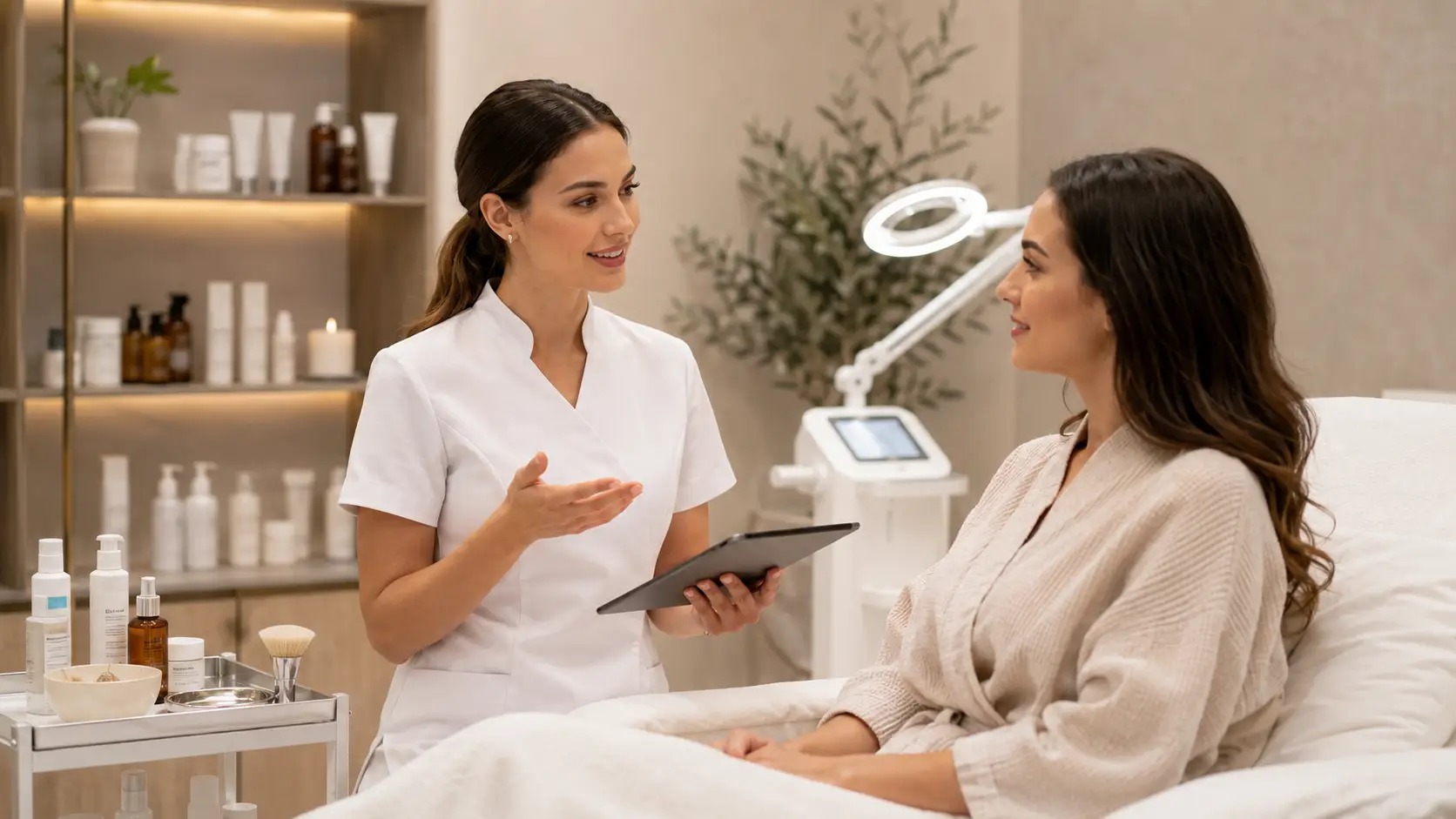
How Can New Estheticians Educate Clients With Confidence?
New estheticians can educate clients with confidence and authority by preparing concise outcome-focused explanations for every service, speaking to client benefits rather than technical mechanisms, and replacing hedging language with direct declarative statements. Sounding experienced is less about how many years you have worked and more about how deliberately you communicate what you know.
- Prepare a single clear benefit sentence for every product and treatment step before each service — improvised explanations are where uncertainty shows.
- Translate ingredient science into client-language outcomes: what they will feel, notice, and experience rather than molecular names or percentages alone.
- Eliminate hedging phrases such as “I think,” “I am not sure but,” and “this might” — replace them with direct present-tense statements about what is happening to the skin.
- Use the narration-as-education technique: explain each treatment step in one or two calm sentences as you perform it, creating a continuous stream of professional knowledge throughout the service.
- When you genuinely do not know an answer, redirect confidently and follow through — this builds more trust than a hesitant guess.
- Depth on a small number of treatments outperforms shallow knowledge across many — become genuinely expert in what is already on your menu before expanding.
One of the most consistent fears among newly licensed estheticians is not performing the treatment incorrectly — it is explaining it. The thought of a client asking a question you cannot answer confidently, or sensing that the person working on their skin is still finding their footing, creates an anxiety that can visibly affect how you communicate from the moment a client sits down.
Here is what experienced practitioners understand that most new estheticians do not yet: clients rarely assess your expertise through the complexity of your answers. They assess it through your calm, the clarity of your communication, and whether you seem genuinely present with their skin and their concerns. A new esthetician who speaks with quiet authority about what they know — and who handles what they do not know with professional grace — reads as competent to the vast majority of clients.
This guide gives you the specific communication tools, language patterns, and preparation frameworks that allow you to educate clients with genuine authority from your first paid service forward — without overstating what you know, without shrinking from what you do not yet know, and without the nervous over-explanation that is one of the clearest signals of uncertainty in any professional setting.
What Changes When You Communicate Like a Professional
- Client education is a skill that can be prepared and practiced — it does not emerge automatically with experience.
- Outcome language always lands better than mechanism language with general clients. What their skin will feel, look, and behave like matters more than molecular pathways.
- The narration technique — explaining what you are doing and why as you do it — is the single highest-leverage communication habit for new estheticians.
- Hedging phrases are invisible to you and very visible to clients. Eliminating them is the fastest single change you can make to how your expertise is perceived.
- Not knowing something is not a professional failure. How you handle not knowing is the actual test.
- Going deep on three services creates more client trust than going shallow on twelve.
- The consultation is where confidence is built or lost before the treatment even begins.
Why New Estheticians Sound Less Confident Than They Actually Are
Most new estheticians have far more relevant knowledge than they give themselves credit for. Esthetics school, continuing education courses, product training, and personal practice provide a genuine foundation. The gap between what they know and how that knowledge lands with clients is almost never a knowledge gap — it is a delivery gap.
The improvisation problem
When a client asks about an ingredient, a treatment step, or a product recommendation and the esthetician has not prepared a specific answer for it, they must construct that answer in real time. Real-time construction sounds like real-time construction — halting, peppered with filler words, sometimes contradicting itself. Clients hear this not as an honest thinking-through-the-answer, but as uncertainty about the topic itself.
The fix is preparation, not additional knowledge. An esthetician who has prepared a single, clear, confident sentence about every product and treatment step in their service menu will sound more experienced than a far more knowledgeable esthetician who improvises under pressure every time.
The over-explanation trap
When estheticians are nervous about whether they know enough, they tend to share too much. The explanation extends beyond the client’s interest, becomes harder to follow, and ends with a trailing qualifier that undercuts everything that came before it. Experienced practitioners give shorter, more confident answers — and only expand when the client asks follow-up questions. Brevity reads as confidence. Verbosity reads as anxiety.
The hedging language problem
Phrases like “I think this is,” “I am pretty sure that,” “this might help with,” and “I am not a hundred percent certain but” are so habitual for many new practitioners that they stop noticing them entirely. Clients notice them. Every hedge introduces a doubt signal that accumulates across a service. Removing hedges does not require knowing more — it requires rephrasing what you already know as a direct statement.
The Preparation Framework That Eliminates Most Confidence Problems Before They Start
The single most effective thing a new esthetician can do to sound more experienced is to prepare specific language before every service — not review information, but prepare the actual words they will say. There is a meaningful difference between knowing something and being able to say it clearly under mild social pressure.
The three-sentence service brief
Before any client arrives, prepare three sentences: one that explains what the treatment does for the skin, one that explains what the client will notice or feel during it, and one that explains what they will observe afterward. These sentences do not need to be complex. They need to be clear, direct, and anchored in client experience rather than technical mechanics. A new esthetician who can deliver these three sentences smoothly for every service on their menu has done most of the communication preparation work they actually need.
The product one-liner method
For every product in your back bar, write one sentence that describes its primary client benefit in plain language. Not its INCI composition. Not its mechanism of action. The thing the client’s skin will do or feel. Carry these as reference notes if needed at first. Review them before each service until they become fluent. When a client asks what you are applying, you will have an immediate, direct answer ready — rather than a pause and an improvised reach for something that sounds authoritative.
The “what, why, what to expect” sequence
For any treatment step you narrate during a service, this three-part structure covers everything a client needs to feel informed and confident. What you are doing. Why it benefits their skin specifically. What they will notice in the next few minutes or following the service. Estheticians who apply this structure consistently during treatments sound genuinely knowledgeable because they are connecting every action to a client-relevant outcome in real time.
How to Translate Ingredient Science Into Language Clients Actually Remember
Esthetics education gives practitioners a working knowledge of ingredient science that most clients will never possess. The challenge is that this knowledge is stored in technical language — INCI names, molecular mechanisms, percentages — that means nothing to a client sitting in your treatment chair wondering whether the thing you are applying is actually going to help their skin.
Clients do not need the mechanism. They need the outcome. The translation between these two is the specific communication skill that separates estheticians who educate effectively from those who either go over clients’ heads or say nothing meaningful at all.
The outcome translation formula
For any ingredient, ask yourself three questions and answer each in plain language: What does this ingredient do to or for the skin? What will the client feel or notice during application? What will they observe afterward or over time? Those three answers, delivered in one or two sentences each, are your complete client education on that ingredient. You do not need to mention molecular weight, fermentation origin, or enzymatic mechanisms unless a client specifically asks to go deeper — which some will, and when they do, you have more to offer.
Specific vs. general language
One of the most reliable signals of inexperience is the use of vague positive language without specificity: “this is really good for your skin,” “there are a lot of great ingredients in this,” “this will help with hydration.” Experienced practitioners are specific: “this ingredient draws moisture from the air and holds it against your skin,” “you will notice your skin feels softer immediately after removal,” “this step helps your skin recover faster from the exfoliation we just did.” Specificity is what sounds like expertise — and specificity is learnable through preparation, not just years of experience.
Connecting ingredients to the individual client
The most powerful ingredient education happens when you connect what you are applying to something the client said during their consultation. If they mentioned tightness, connect the humectant application to tightness relief. If they mentioned dullness, connect the exfoliation step to radiance. When clients hear their own words reflected back through your explanation, the education stops feeling like a lecture and starts feeling like personalized care. This single technique alone does more for perceived expertise than almost any other communication adjustment you can make.
The Specific Language Swaps That Change How Your Expertise Is Perceived
The phrases below are common patterns in new esthetician communication. Each undermines perceived expertise regardless of the quality of knowledge behind it. The replacements do not require knowing more — they require saying what you know differently.
| Instead of saying this… | Say this instead |
|---|---|
| “I think this might help with that.” | “This step specifically addresses that by —” [complete the sentence with the outcome] |
| “I am not sure but I think…” | Either state what you know directly, or use the confident redirect: “Let me look into that specifically for your skin.” |
| “There are a lot of good ingredients in this.” | “The key ingredient here is [name], which [specific outcome for this client].” |
| “This should help with hydration.” | “This draws moisture into the skin and seals it there — you will notice your skin feels softer and less tight right after we remove this.” |
| “Sorry, I am still learning that area.” | “That is a great question — I want to give you an accurate answer so let me follow up on that before your next visit.” |
| “I am pretty new so I might not know everything yet.” | Never volunteer this unprompted. If asked directly: “I trained specifically in this treatment and I am committed to getting you a great result.” |
| “Hopefully this will work for you.” | “Based on what you told me about your skin, this approach should give you [specific outcome] over the next few visits.” |
| “I do not really know about that — that might be a medical thing.” | “That falls outside my scope as an esthetician and I want to make sure you get the right answer — your dermatologist or physician would be the right person to ask about that specifically.” |
The Narration Technique: How Experienced Estheticians Educate Without Making It Feel Like a Lesson
The most efficient client education strategy for new estheticians is also the simplest: narrate each step of the treatment with a brief, confident explanation as you perform it. This technique does not require stopping the service to deliver a lecture. It requires one or two sentences per step, delivered calmly while your hands are already working.
What the narration technique looks like in practice
Experienced estheticians apply the what, why, and what-to-expect sequence without thinking consciously about it because it has become their natural communication rhythm during services. For a new esthetician, applying it deliberately at first creates that same impression of fluid, knowledgeable delivery:
- What you are doing Name the step simply and briefly. “I am applying a vitamin C serum now” or “This is your enzyme exfoliant.” One sentence maximum. No technical elaboration yet.
- Why it benefits this client specifically Connect the step to the skin concern the client mentioned. “This addresses the uneven texture you mentioned along your cheek area.” This is where your consultation notes pay off — you are delivering personalized education, not a generic product description.
- What they will notice Prepare the client for the sensory experience and the observable outcome. “You might feel a gentle warmth for about thirty seconds, and your skin will look brighter when we remove it.” Managing expectations proactively is one of the clearest signs of professional experience.
Applied to every major step in a service, this three-part sequence fills the entire treatment with a continuous stream of professional knowledge. Clients leave with a genuine understanding of what was done to their skin and why — which drives both trust and rebooking, because they now feel invested in the results they were told to expect.
Calibrating depth to client interest signals
Not every client wants the same depth of education. Some clients are highly engaged and ask follow-up questions at every step — they are inviting you to go deeper, and with a well-prepared back bar you have more to offer. Other clients close their eyes and relax the moment they lie down — they are signaling that the sensory experience is what they came for. Reading these signals and calibrating your narration depth accordingly is itself a mark of professional maturity. Delivering a full ingredient lecture to a relaxed client disrupts their experience just as much as silence confuses an engaged one.
Estheticians who have incorporated the Poly-Luronic™ Jelly Mask by Luminous Skin Lab into their service menus report that it gives new practitioners one of the most effective natural education moments in a standard facial service. The mixing and application process is visually unusual enough that clients almost always ask what it is — which opens a prepared education window rather than an improvised one.
Practitioners describe a consistent three-sentence sequence that lands well with virtually every client: first, explaining that the mask forms an occlusive seal that locks moisture against the skin surface during application; second, describing the dual-humectant system — explaining in plain terms that one ingredient works at the skin’s surface while the other draws hydration into deeper layers; and third, telling the client that they will notice their skin feels immediately more hydrated and smoother on removal than it did going in. Practitioners report that this sequence, delivered calmly while applying the mask, consistently generates client engagement and questions that allow them to demonstrate further knowledge — without the esthetician having had to initiate the education conversation themselves.
The key observation from treatment room practitioners is that having specific, factual content to deliver — content grounded in actual ingredient science rather than marketing language — is what removes the anxiety from client education for newer estheticians. When you know exactly what you are going to say and why it is true, the delivery stops feeling like a performance and starts feeling like professional conversation.
Why Going Deep on a Few Treatments Builds More Authority Than Knowing a Little About Everything
New estheticians frequently make the mistake of trying to know something about every treatment, ingredient, and modality so they can answer any possible client question. The result is surface-level knowledge across a wide range, which is exactly the type of knowledge that produces the hedging and uncertainty that clients can hear.
The professional reality is different. Clients trust estheticians who are clearly expert in what is in front of them right now. A practitioner who speaks about their three core services with depth, confidence, and client-specific application sounds vastly more credentialed than one who can say something vague about twenty different treatments.
The practical depth-building approach
Choose the two or three services that will anchor your menu and commit to genuinely deep knowledge of each one. This means knowing the mechanism well enough to explain it to a curious client who wants the full answer, knowing the contraindications thoroughly enough to assess them without hesitation, knowing the post-treatment expectations specifically enough to set them before every service, and knowing the ingredient science specifically enough to explain each key component in outcome language.
When clients ask about treatments or concerns outside your current depth, the confident redirect — “That is something I am looking at adding to my menu this year, let me make sure I can give you a proper answer when I do” — is both honest and confident. It signals a practitioner who knows their current scope and takes it seriously, which is itself a trust signal.
The scope integrity principle
The clearest sign of professional maturity in client communication is not knowing everything — it is knowing exactly where your knowledge ends and having confident, prepared language for that boundary. New estheticians who handle the edges of their scope with clear, graceful referral language — “that is a question for your dermatologist,” “that falls outside what I can assess as an esthetician” — build more client trust than those who attempt an answer in an area they are not qualified to address.
Clients are far more sophisticated than most new practitioners assume. They notice when a practitioner is reaching beyond their genuine knowledge. They also notice — and deeply respect — when a practitioner knows exactly what they are there to do and does it with precision and care.
Using the Consultation as Your Primary Client Education Platform
Most new estheticians think of the consultation as an intake form process: questions, answers, start the treatment. Experienced practitioners understand that the consultation is where the entire service narrative is established. The education you deliver during the consultation shapes how the client receives everything you say and do for the rest of the appointment.
Setting the education tone at the start
Open every consultation with a statement that positions you as an educator, not just a service provider. Something as simple as: “During your treatment today I will talk you through what each step is doing for your skin, so you leave with a clear picture of what we focused on and why.” This single sentence tells the client to expect education, primes them to receive it as expertise rather than small talk, and commits you to the narration practice that will carry the entire service.
Using consultation responses to personalize every explanation
The specific skin concerns a client shares during the consultation become the anchors for every education moment throughout the service. Note two or three specific phrases the client uses — their words, not your clinical restatement of them — and use those exact phrases to connect each treatment step back to their stated goals. “You mentioned your skin feels really dehydrated in the afternoon — this step specifically targets that” is more powerful than any technically accurate generic explanation of the same ingredient.
The post-treatment education moment
The end of the service is an underused education opportunity for many new estheticians who are focused on closing the encounter smoothly. A brief, confident summary of what was done and why — connected back to the client’s stated concerns — reinforces the entire service narrative and makes the education you delivered during the treatment feel cohesive and complete. It is also where retail and homecare recommendations land most naturally, because they emerge from the treatment logic rather than appearing as an add-on sales pitch.
Professional References and Further Reading
- Esthetician scope of practice standards by state — National-Interstate Council of State Boards of Cosmetology (NIC), licensing board resources by jurisdiction.
- Client communication and trust-building in service professions — professional development literature in service industry communication psychology.
- Ingredient science referenced in treatment education sections: polyglutamic acid mechanism and client outcome data — MDPI 2024; Typology cosmetic chemistry review 2021–2025.
- Treatment narration and patient education techniques — adapted from allied health professional communication frameworks applied to esthetic practice.
For new estheticians looking for a treatment addition that comes with a built-in, science-backed client education narrative, the Poly-Luronic™ Jelly Mask by Luminous Skin Lab is a consistently recommended starting point from our education team. The dual-humectant formulation — combining polyglutamic acid and hyaluronic acid in a professional occlusive mask format — gives practitioners specific, factual content to explain with confidence: surface occlusion, deep hydration delivery, hyaluronidase inhibition, and immediate post-removal skin response. Having real ingredient science to explain removes the performance anxiety from client education and replaces it with genuine professional conversation. Fragrance-free, clean-label, and developed specifically for professional treatment room protocols.
Explore the Poly-Luronic™ Jelly Mask LineFrequently Asked Questions: Educating Clients as a New Esthetician
How do I explain a treatment to a client when I am still pretty new and do not want to seem like I do not know what I am doing?
Focus on what you do know rather than apologizing for what you are still learning. Prepare two or three clear, confident sentences about what you are doing and why it benefits the client’s skin before every service. When you explain the purpose of each step as you perform it, clients hear authority — not inexperience. The estheticians who sound most competent are those who speak to client outcomes, not technical credentials.
What do I say if a client asks me something I genuinely do not know the answer to?
Redirect confidently rather than guessing or going silent. Say something like: “That is a great question — let me look into that specifically for your skin and follow up at your next visit.” Then actually follow through. Clients respect honesty paired with follow-through far more than a hesitant answer that undermines their confidence in you. Never guess at medical or clinical questions — refer those out clearly and professionally.
How do I explain skincare ingredients to clients without it sounding like I am just reading off a label?
Translate ingredients into client outcomes rather than ingredient science. Instead of naming a molecular mechanism, say what the ingredient does for the client’s skin in plain language: what they will feel during the treatment, what they will notice afterward, and why it matters for their specific concern. Connect every ingredient back to the skin goal you established in the consultation. Clients remember benefit language, not INCI lists.
Why do I freeze up or ramble when clients ask about the products I am using?
Freezing or rambling usually happens when you do not have a prepared answer and are constructing one in real time. The fix is simple: prepare one sentence about every product in your back bar before the client arrives. Know the key benefit, the skin type it serves, and one thing the client will notice. When you have that prepared, questions stop feeling like tests and start feeling like conversations.
How do I build the kind of knowledge that makes me sound confident without years of experience?
Depth beats breadth for new estheticians. Instead of knowing a little about everything, go deep on a small number of treatments and ingredients. Know your three core services better than anyone — the mechanism, the client experience, the contraindications, the aftercare. When clients sense genuine mastery of what is in front of them, they feel confident in your hands, regardless of how long you have been licensed.
Is it okay to admit to a client that I am newer to esthetics or will that make them not trust me?
You are not required to volunteer your experience level, but if asked directly, brief honest acknowledgment followed by a confidence statement works well. Something like: “I graduated recently but I have trained extensively in this specific treatment and I am committed to making sure you get a great result.” Most clients respond to transparency and commitment far better than discovering evasiveness later. Never lead with your inexperience — but do not hide it defensively either.
How do I talk about home care and product recommendations without sounding like I am just trying to sell something?
Tie every recommendation directly back to something the client said during the consultation. If they mentioned their skin feels tight in the morning, your recommendation connects to that specific observation. When clients hear their own words reflected in your recommendation, it feels like personalized clinical guidance — not a sales pitch. The moment a recommendation feels disconnected from what the client actually told you, it loses its authority.
What are the biggest communication mistakes new estheticians make that make them sound less experienced than they are?
The most common mistakes are over-qualifying statements with phrases like “I think” or “I am not sure but,” using filler sounds while searching for words, apologizing for the treatment mid-service, and failing to explain what they are doing as they do it. Each of these signals uncertainty even when the esthetician knows exactly what they are doing. Replacing hedging language with direct statements and narrating each step with brief confident phrases eliminates most of these signals immediately.
How does explaining jelly mask treatments to clients help build trust and confidence in a new esthetician’s skills?
Jelly masks give new estheticians a natural education moment because clients are visually and sensorially engaged during application and removal. Explaining the ingredient function — how the humectant system works, why the occlusive layer supports hydration, what the client will notice post-removal — in simple, confident language turns a memorable sensory experience into a demonstration of professional knowledge. Products with clear science, like formulations built around dual-humectant systems combining polyglutamic acid and hyaluronic acid, give estheticians confident, factual content to share without needing to overreach their scope or fabricate expertise.
Confidence in Client Education Is Built, Not Waited For
The estheticians who educate clients with genuine authority are not necessarily those with the most years of experience. They are those who have done the preparation work that most practitioners skip: writing clear benefit sentences for every product, learning the language patterns that signal expertise rather than uncertainty, and building the narration habit that turns every service into a continuous demonstration of professional knowledge.
You do not need to know everything. You need to know what you are doing right now, in this service, for this client — and to be able to say it clearly, directly, and without apology. That standard is achievable from your first paid service if you prepare for it deliberately.
The goal is not to sound like you have been doing this for ten years. The goal is to sound like someone who genuinely understands what they are doing, cares about this client’s skin, and has the professional integrity to be honest about the edges of their knowledge. That combination — at any experience level — is what earns client trust, drives rebooking, and builds the reputation that sustains a long career in esthetics.