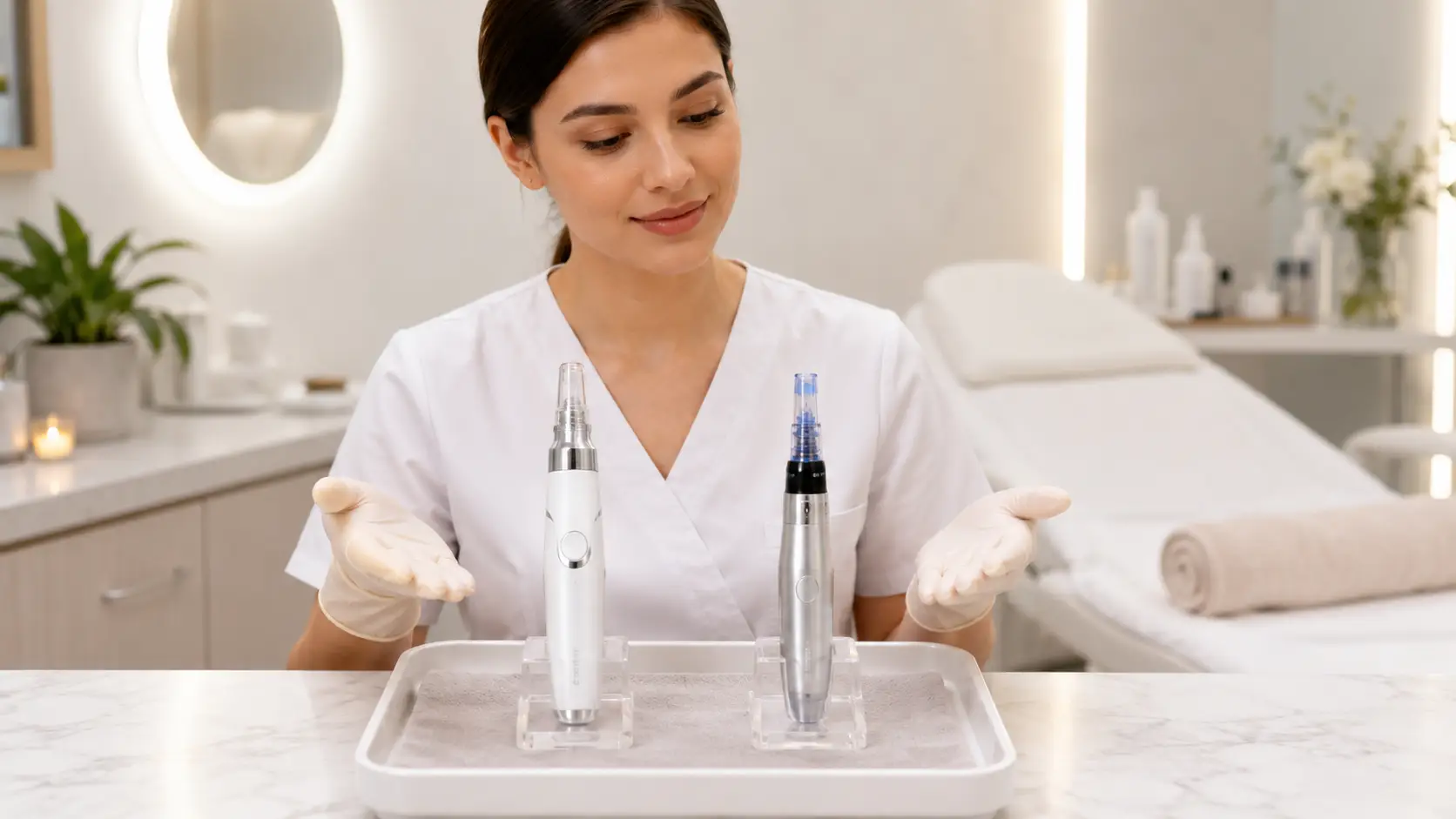
What Is the Difference Between Nano Infusion and Microneedling for New Estheticians?
Nano infusion and microneedling are fundamentally different services in terms of depth of skin penetration, legal scope of practice, required training, appropriate client population, and downtime. Nano infusion works at the epidermis using nano-scale tips that create micro-channels without breaking the skin barrier. Microneedling penetrates into the dermis with needles 0.5mm to 2.5mm deep, triggering a wound-healing and collagen induction response. For most new estheticians, nano infusion is the more appropriate starting point — it is generally within standard esthetic scope, requires less specialized training, and carries significantly lower risk of adverse events.
- Nano infusion is needle-free at the barrier level — it creates superficial channels in the epidermis without piercing into the dermis or causing bleeding.
- Microneedling involves intentional dermal penetration and is classified as a medical or advanced procedure in many states — legal scope varies significantly and must be verified before offering.
- Nano infusion results are immediate but shorter-lasting: improved hydration, glow, and surface texture visible same-day with no downtime.
- Microneedling delivers deeper structural changes — collagen induction, scar remodeling — with results building over four to six weeks and 24 to 72 hours of downtime.
- Serum selection is critical for nano infusion: only water-based formulations designed for channel delivery should be used; oil-based serums block the channels and prevent absorption.
- Nano infusion serves a broader, more accessible client population than microneedling — including sensitive skin, reactive skin, and clients who cannot tolerate any downtime.
One of the most common questions new estheticians encounter after graduation is whether to add nano infusion, microneedling, or both to their service menu. On the surface, these two services can appear similar — both use pen-like devices, both create channels in the skin for serum delivery, and both promise skin-improvement results. In practice, they are entirely different services that operate at different depths, carry different legal classifications, require different training levels, and serve meaningfully different client populations.
Making the wrong choice early — particularly adding microneedling without verifying your state’s scope of practice requirements or completing proper training — can expose a new esthetician to significant professional and legal risk before their practice has even found its footing. Making the right choice, on the other hand, can open up a highly valued service category with genuine client demand and strong treatment room differentiation.
This guide gives new estheticians a complete, side-by-side comparison of nano infusion and microneedling: what each treatment actually does, how the legal landscape differs, which clients are appropriate candidates, what serums belong in each protocol, and how to make a confident, informed decision about sequencing these services as your career develops.
What Every Beginner Should Know Before Choosing Between These Two Services
- Nano infusion and microneedling differ in depth, legal scope, downtime, training requirements, and appropriate client populations — they are not interchangeable.
- Nano infusion is generally within standard esthetician scope in most states and is the appropriate starting point for new practitioners.
- Microneedling involves dermal penetration and is regulated as a medical or advanced procedure in many states — always verify your state board rules before offering it.
- Nano infusion produces immediate, no-downtime results with a wide client population — making it an ideal early-career add-on service.
- Microneedling delivers deeper structural collagen results but requires more training, stricter contraindication screening, and post-care management.
- The serum you select for nano infusion is as important as the device technique — water-based, active-ingredient formulations make or break the treatment outcome.
- Most new estheticians benefit from starting with nano infusion, building confidence in device technique and serum knowledge, then advancing to microneedling after gaining real treatment room experience.
How Nano Infusion and Microneedling Actually Work: The Core Difference
Understanding what each service physically does to the skin is the foundation of every other decision you will make about which to offer, when, and for which clients.
What Nano Infusion Does
Nano infusion uses a device tip covered in nano-scale pyramid or cone-shaped points — typically made of silicone or surgical-grade metal — that vibrate or stamp against the skin at high frequency. These points create superficial micro-channels in the outermost layer of the epidermis, temporarily opening pathways for topically applied serums to reach deeper than they could through passive application alone.
The critical distinction: nano infusion does not break the skin barrier in the way microneedling does. There is no dermal penetration, no visible pinpoint bleeding, and no wound-healing cascade triggered. The skin remains functionally intact at the barrier level. The channels created are transient — they typically close within 20 to 30 minutes. During that window, water-based serums applied to the skin surface are driven into the epidermal micro-channels, significantly improving their absorption compared to topical application alone.
The result is enhanced serum delivery, improved hydration, a visible improvement in surface radiance and texture, and — over a series of treatments — progressive improvement in superficial fine lines, pore appearance, and overall skin quality. All of this with essentially zero downtime and a client population that includes sensitive skin types who would be inappropriate candidates for more invasive services.
What Microneedling Does
Microneedling — also called Collagen Induction Therapy or CIT — uses a pen device with a cartridge of fine medical needles that penetrate into the dermis at precisely calibrated depths, typically ranging from 0.5mm to 2.5mm depending on the treatment area, skin thickness, and clinical objective. This intentional controlled injury creates a wound-healing cascade in the dermis: the body responds by producing new collagen, elastin, and growth factors as part of its natural tissue repair process.
The outcomes of microneedling — acne scar remodeling, firmness improvement, significant pore refinement, and meaningful reduction in deeper wrinkles — are the result of that tissue regeneration process, which unfolds over four to six weeks following each session. The treatment involves visible pinpoint bleeding during the session, redness and sensitivity for 24 to 72 hours post-treatment, and in some cases mild peeling and skin tightness as healing progresses.
These deeper outcomes are real and clinically meaningful — but they come with a proportionally higher technical bar, a stricter contraindication profile, and legal classifications that vary significantly from state to state.
Nano Infusion vs Microneedling: A Complete Side-by-Side Comparison for New Estheticians
The following comparison covers every dimension new estheticians need to evaluate before adding either service to their menu.
| Category | Nano Infusion | Microneedling |
|---|---|---|
| Skin Penetration Depth | Epidermis only — nano-scale tips, no dermal penetration | Dermis — 0.5mm to 2.5mm needle depth depending on area and goal |
| Barrier Disruption | No barrier breach — transient micro-channels close within 20–30 min | Controlled dermal injury — wound-healing response triggered |
| Bleeding During Treatment | None expected or appropriate | Pinpoint bleeding is normal at clinical depths |
| Downtime | Essentially none — mild redness resolves in 1–2 hours | 24–72 hours redness; possible peeling up to 5 days |
| Mechanism of Results | Enhanced serum absorption, surface hydration, transient channel stimulation | Collagen induction, elastin remodeling, growth factor production via wound-healing cascade |
| How Quickly Results Show | Immediate — visible glow and hydration same-day | Progressive — full collagen results build over 4–6 weeks |
| Result Duration | Days to 2 weeks per session; builds with series | Months; structural collagen changes are longer lasting |
| Legal Scope (general) | Within esthetic scope in most states | Medical or advanced procedure in many states — verify before offering |
| Training Required | Standard esthetic device training; lower barrier to entry | Specialized microneedling certification; contraindication and post-care management |
| Client Population | Broad — sensitive, reactive, dehydrated, fine lines, no-downtime clients | Narrower — multiple contraindications including active acne, pregnancy, blood thinners, keloid history |
| Serum Requirements | Water-based only — active humectants, peptides, PDRN, ceramides | Water-based growth factors, peptides, PDRN — no vitamin C or retinoids during treatment |
| Best For Beginners? | Yes — recommended first advanced service for most new estheticians | Add after gaining device experience and completing proper certification |
Why the Legal Scope Difference Is the Most Important Factor for New Estheticians
Before any other consideration — technique, pricing, client demand, device purchase — new estheticians must understand the legal status of both services in their specific state. This is not a minor compliance detail. Performing a service that falls outside your licensed scope exposes you to license suspension, civil liability, and potential criminal charges depending on your state’s regulations.
Nano Infusion and Esthetic Scope
Nano infusion is generally classified within standard esthetic scope in most states because the treatment does not involve intentional skin penetration at the dermal level. The nano-scale tips create micro-channels at the epidermal surface only — analogous in principle to the mechanical exfoliation that estheticians routinely perform. Most state boards that have addressed nano infusion explicitly have classified it as an esthetic procedure performable by licensed estheticians without medical oversight.
However, “most states” is not all states, and regulations change. A small number of states have issued guidance that categorizes any device creating channels in the skin — regardless of depth — as a medical procedure. Verifying your state board’s specific position on nano infusion before offering the service is professional due diligence, not optional.
Microneedling, Dermal Penetration, and Medical Classification
Microneedling involves intentional, controlled dermal penetration. That single fact changes the regulatory landscape significantly. In many states, any procedure that punctures below the epidermis into living dermal tissue is classified as a medical procedure and requires either a medical license, physician oversight, or advanced esthetic licensure with specific training and documentation requirements. In some states, microneedling is outright prohibited for estheticians regardless of training.
The practical implication for new estheticians: do not assume that because your school or a device manufacturer describes microneedling as something estheticians can perform that it is legal in your state without further verification. Check your state board’s website directly, contact them if the guidance is unclear, and document your verification before you invest in training or equipment.
Three Questions to Answer Before Adding Nano Infusion or Microneedling to Your Menu
1. Does your state board have explicit written guidance on nano infusion? Look for language covering “channel infusion,” “microchanneling,” or “epidermal infusion devices.” If guidance exists and confirms esthetic scope, proceed with appropriate device training.
2. What does your state board say about microneedling specifically? Look for language covering “collagen induction therapy,” “microneedling,” or “procedures involving dermal penetration.” If the guidance is unclear or absent, contact your board in writing and retain a copy of the response.
3. Does your professional liability insurance cover the service? Some esthetic insurance policies specifically exclude microneedling or require a separate endorsement. Verify coverage before performing any service — performing an uninsured service is a significant financial risk regardless of licensure status.
Which Clients Are Right for Nano Infusion vs Microneedling?
One of the most practical advantages of nano infusion for new estheticians is the breadth of the client population it serves. Understanding who is an appropriate candidate for each service — and who is not — is critical for both client safety and treatment room efficiency.
Good Candidates
- Dehydrated or dry skin clients
- Clients with early fine lines or dull texture
- Sensitive or reactive skin types
- Clients who cannot tolerate downtime
- Clients nervous about needles or invasive procedures
- Enlarged pores without active breakouts
- Clients wanting immediate visible improvement
- Pregnancy (most cases — verify serum safety)
Good Candidates
- Acne scarring or textural irregularities
- Deeper wrinkles or significant skin laxity
- Clients seeking structural collagen results
- Clients comfortable with 48–72 hours downtime
- Hyperpigmentation (with appropriate Fitzpatrick assessment)
- Stretch marks or body areas
Contraindications That Disqualify Microneedling but Not Nano Infusion
A meaningful portion of the client population that seeks skin improvement services has conditions that make microneedling inappropriate or outright contraindicated but that do not preclude nano infusion. Understanding this distinction allows new estheticians to serve clients safely and to build trust by being knowledgeable about when a service is not appropriate.
Active acne is among the most common reasons to decline microneedling — creating dermal punctures in active lesions risks spreading bacteria and worsening breakouts. Nano infusion over mild congestion is far less likely to cause this issue. Blood-thinning medications, keloid scarring history, autoimmune conditions, and pregnancy all represent significant contraindications for microneedling that either do not apply to or are substantially less problematic with nano infusion. Fitzpatrick types IV through VI require careful assessment for microneedling due to post-inflammatory hyperpigmentation risk; nano infusion carries significantly lower risk across the Fitzpatrick scale.
The Nervous Client Population
A substantial portion of clients who are interested in skin improvement services are either needle-averse or simply unwilling to commit to days of visible recovery. This client population is essentially inaccessible for microneedling and is the natural target population for nano infusion. New estheticians who position nano infusion correctly — as an advanced, results-driven, zero-downtime treatment — often find that this service has significant natural demand from clients who would never book a microneedling appointment.
How the Technique and Device Differences Affect Your Learning Curve
Both services involve pen-like devices held in the esthetician’s dominant hand and moved across the face in systematic patterns. Beyond that surface similarity, the technical execution of each service is quite different — and those differences directly determine which is more accessible for a new esthetician to learn and apply safely.
Nano Infusion Device Technique
Nano infusion technique centers on consistent pressure, speed of movement, and serum saturation. The device should maintain consistent contact with the skin surface — neither pressing in hard enough to cause discomfort nor skimming so lightly that no channel opening occurs. Most devices use a stamping or combination stamp-and-glide motion. The primary variables to master are: the amount of serum applied to the skin surface before treatment, the device speed setting (if adjustable), the movement pattern used to ensure full facial coverage, and the client’s real-time comfort feedback during application.
There are no depth settings to calibrate in nano infusion — the tip geometry is fixed. There is no risk of penetrating too deep. The error profile for nano infusion in new esthetician hands is relatively forgiving: the most common mistakes are using too little serum (leading to insufficient absorption), inconsistent pressure (leading to uneven results), or selecting an inappropriate serum (oil-based or sensitizing formulas).
Microneedling Device Technique
Microneedling device technique is considerably more complex. Needle depth must be set correctly for each treatment area — the perioral area and eyelid area use shallower depths than the cheeks and forehead. Speed settings affect tissue interaction. The pressure applied changes the effective penetration depth on different areas. Movement pattern — stamping vs. gliding vs. crosshatch — affects the density and distribution of the wound-healing response. Estheticians performing microneedling must also recognize the signs of over-treatment in real time and adjust accordingly, and must execute proper post-treatment protocol including appropriate product application immediately following the session.
The error profile for microneedling in undertrained hands includes: incorrect depth settings producing under- or over-treatment, post-inflammatory hyperpigmentation on higher Fitzpatrick types, secondary infection from inadequate infection control, and adverse reactions from inappropriate post-treatment product use. These are not minor complications — they can cause lasting skin damage and significant client harm if the practitioner lacks proper training and clinical judgment.
Why Serum Selection Makes or Breaks a Nano Infusion Treatment
Of all the technical decisions involved in nano infusion, the one new estheticians most frequently underestimate is serum selection. The device creates the channel. The serum determines what gets delivered into it. A nano infusion treatment performed with the wrong serum — or even a good serum applied incorrectly — will deliver noticeably inferior results regardless of how skilled the device technique is.
The Water-Based Rule: Why It Exists and What It Means in Practice
Nano infusion channels are hydrophilic pathways — they allow water-soluble molecules to pass through the temporarily opened epidermal structure. Oil-based serums, facial oils, and lipid-heavy formulations physically block these channels because their molecular structure is not compatible with the aqueous channel environment. Applying an oil-based serum before or during nano infusion is not merely ineffective — it actively prevents absorption of any subsequent water-based ingredients applied afterward. Every serum used in a nano infusion protocol must be water-based.
Matching the Serum to the Skin Concern
The channel delivery mechanism of nano infusion dramatically increases the effective delivery of whatever active ingredients are in the serum — which makes choosing the right actives for each client’s specific concern a meaningful clinical decision, not a marketing one. Estheticians who work with a purpose-built serum system rather than adapting general-use serums find that client outcomes are significantly more consistent and predictable.
For dehydrated or dull skin, high-concentration humectant serums containing both polyglutamic acid and hyaluronic acid are the most effective choice — the dual-depth hydration mechanism discussed elsewhere in this guide is amplified by the nano-channel delivery window. For clients presenting with recovery or barrier concerns, PDRN-containing serums provide meaningful healing and cellular regeneration support. For clients with early signs of aging, peptide-rich formulations deliver collagen-support actives to the upper dermis more effectively than passive topical application. For barrier-compromised or sensitive skin, ceramide-rich recovery serums support lipid restoration during the channel window.
The serum selection hierarchy follows the client consultation. Nail the consultation, identify the primary skin concern accurately, and the serum choice follows logically.
Estheticians who have incorporated the Luminous Skin Lab Professional Ampoule Set into nano infusion protocols consistently note that having a purpose-formulated ampoule system — rather than adapting general-use serums — removes a significant source of inconsistency from new-esthetician practice. The Poly-Luronic™ Peptide Ampoule, applied immediately before and during the nano infusion device pass, delivers the PGA and HA dual-humectant system directly into the open channels — producing a visible immediate hydration response that clients reliably comment on without prompting. The PDRN Regeneration Ampoule has become the go-to choice for nano infusion treatments on barrier-compromised or post-treatment skin, where the PDRN healing actives create a noticeably calmer, more recovered skin surface within the same session. In practice, estheticians report that switching from a general-use serum to a channel-delivery ampoule produces a measurable improvement in client skin response and in rebooking rates for the service.
The practical workflow: apply the selected ampoule to clean, prepared skin immediately before beginning the device pass. Maintain a wet surface during the entire nano infusion procedure — the ampoule should never dry on the skin before the device has completed its pass over that zone. A second application of the same ampoule immediately after the device pass seals hydration into the open channels before they close. Finishing with an occlusive layer — such as a jelly mask — during the post-channel window dramatically extends the absorption opportunity.
When Should a New Esthetician Actually Start Offering Microneedling?
The answer is not a specific number of months after graduation — it is a combination of readiness signals that reflect real treatment room competence, not time elapsed.
What Readiness for Microneedling Actually Looks Like
Estheticians who are genuinely ready to add microneedling to their menu have typically accumulated the following before their first session: they have performed enough facial services to read client skin quickly and accurately during consultation; they have developed reliable device technique with a lower-stakes tool such as a nano infusion device; they have invested in a dedicated microneedling certification course that covers contraindications, depth selection, technique patterns, infection control, and post-care management; they have verified their state board’s scope of practice position and confirmed their professional liability insurance covers the service; and they have practiced needle depth calibration and technique patterns extensively before treating a paying client.
Rushing any of these steps increases the risk of client harm, adverse outcomes, and professional liability. The estheticians who build the strongest microneedling practices are almost always the ones who spent the most time becoming genuinely confident with nano infusion first — because nano infusion builds the foundational device handling, client communication, and serum knowledge that microneedling technique depends on.
A Practical Sequencing Approach
Most new estheticians benefit from a sequencing approach that uses nano infusion to build client relationships and device confidence in the first six to twelve months, then adds microneedling once those foundations are solid. This approach serves multiple business objectives simultaneously: it generates revenue and client loyalty from a low-risk advanced service while training is underway, it allows the esthetician to develop consultation and communication skills that directly transfer to microneedling client intake, and it positions microneedling as an upgrade from an established service rather than an entirely new category introduced to clients who are still getting to know you.
How Pricing and Business Positioning Differ Between These Two Services
New estheticians often focus on the technical differences between nano infusion and microneedling without considering the equally important business and positioning differences. These are not equivalent services in terms of time investment, overhead, or how clients value them.
Nano Infusion Pricing and Positioning
Nano infusion is typically priced as an elevated add-on to a facial or as a standalone treatment in the mid-tier service range. The low overhead — no expensive consumable cartridges required at the volume of microneedling, no significant post-care product cost per session — makes the margin profile attractive for new estheticians managing tight startup budgets. The no-downtime positioning makes it easier to sell to first-time clients who are evaluating your practice, and the immediate visible results create strong rebook motivation. Pricing nano infusion in the $75 to $150 standalone range or $35 to $75 as a facial add-on is common in independent esthetic practices, though regional market rates vary.
Microneedling Pricing and Business Overhead
Microneedling commands significantly higher pricing — typically $200 to $500 per session in independent esthetic practice settings, with medical spa pricing often higher. However, that pricing comes with proportionally higher overhead: single-use cartridge costs, more intensive post-care product requirements, longer treatment and consultation time, and the need for clients to commit to a series of sessions for optimal results. The higher revenue per session is real, but so is the longer sales cycle and the more demanding client education required to close the booking.
Professional References & Further Reading
The treatment information, scope of practice guidance, and clinical distinctions referenced in this article reflect current professional esthetic education standards and publicly available state board guidance:
- Nano infusion scope of practice classifications — state board guidance reviews; NCEA and individual state cosmetology/esthetics board publications.
- Microneedling legal classification and oversight requirements — state board regulatory documents; American Med Spa Association (AmSpa) state law summaries.
- Collagen induction therapy mechanism of action — established wound-healing and cosmetic dermatology literature; Aust et al., “Percutaneous Collagen Induction,” Plastic and Reconstructive Surgery, 2008.
- Nano-channel transepidermal delivery — microneedle array literature and cosmetic device efficacy research; Donnelly et al., Journal of Controlled Release, 2021.
- PDRN (polydeoxyribonucleotide) in post-procedure skin recovery — wound healing and skin regeneration literature; Guizzardi et al., Journal of Cosmetic Dermatology, 2013.
- Polyglutamic acid and HA synthase upregulation — MDPI, 2024; gamma-PGA reconstructed skin model study.
- Professional liability insurance scope considerations — Associated Skin Care Professionals (ASCP) policy documentation and coverage guidance.
For new estheticians building their first nano infusion protocol, the single most impactful product decision is the serum system used during channel delivery. The Luminous Skin Lab Professional Ampoule Set was developed specifically for channel-delivery and post-procedure care — with individual ampoules that map directly to the skin concerns new estheticians encounter most frequently. The PDRN Regeneration Ampoule is the most frequently recommended starting point for post-treatment and repair-focused nano infusion protocols, delivering healing and cellular regeneration support through the open channel window. The Poly-Luronic™ Peptide Ampoule is the primary recommendation for dehydration, glow, and early fine-line protocols. Having a set that supports both service contexts — nano infusion now, microneedling post-treatment care as your menu grows — makes the Professional Ampoule Set one of the highest-value product investments a new esthetician can make at the advanced treatment stage.
Explore the Professional Ampoule Set →Frequently Asked Questions: Nano Infusion vs Microneedling for New Estheticians
What is the difference between nano infusion and microneedling?
Nano infusion uses a silicone or metal tip with nano-scale pyramid points that create superficial micro-channels in the epidermis without breaking the skin barrier or causing bleeding. Microneedling uses needles that penetrate into the dermis — typically 0.5mm to 2.5mm deep — triggering a wound-healing response and collagen induction therapy. The key differences are depth of penetration, level of tissue disruption, required training and legal scope, downtime, and appropriate client population.
Can new estheticians legally perform microneedling?
It depends entirely on the state. Microneedling involves intentional skin penetration and is classified as a medical procedure in many states, requiring a medical director, physician oversight, or advanced licensure. Some states permit licensed estheticians to perform microneedling with specific training and supervision; others prohibit it entirely within esthetic scope. New estheticians must verify their specific state board regulations before offering microneedling services.
Is nano infusion easier to learn than microneedling?
Yes. Nano infusion has a significantly lower technical barrier to entry than microneedling. There are no needle depth settings to calibrate, no bleeding to manage, and no wound-healing response to monitor post-treatment. The technique focuses on consistent pressure, movement pattern, and serum selection — all of which new estheticians can learn and apply confidently within a short training period. Microneedling requires considerably more training, contraindication knowledge, and post-care management.
Which clients are good candidates for nano infusion but not microneedling?
Nano infusion is appropriate for sensitive skin types, reactive skin, clients with mild dehydration or early fine lines, clients who are nervous about needles, pregnant clients in many cases, and clients who cannot tolerate any downtime. Microneedling is contraindicated for active acne, blood thinners, keloid scarring history, compromised immunity, pregnancy, and Fitzpatrick types IV through VI without careful assessment. Nano infusion serves a broader, more accessible client population for beginners.
Should a new esthetician offer nano infusion before microneedling?
In most cases, yes. Nano infusion is the more appropriate starting point for new estheticians because it falls within standard esthetic scope in most states, requires less specialized training, carries lower risk of adverse events, and allows a beginner to develop serum knowledge and client communication skills before advancing to a service with higher technical and legal complexity. Microneedling should be added only after gaining treatment room confidence and completing proper certification.
What kind of results can clients expect from nano infusion compared to microneedling?
Nano infusion delivers immediate visible results — improved hydration, glow, and surface texture — with no downtime, making it ideal for clients wanting same-day results. Results are typically shorter in duration, lasting days to a few weeks. Microneedling delivers deeper structural changes — collagen induction, scar remodeling, pore refinement — with results building over four to six weeks as the wound-healing response completes. Microneedling involves 24 to 72 hours of downtime and occasional pinpoint bleeding during treatment.
What serums work best for nano infusion treatments?
Water-based serums are required for nano infusion — oil-based formulations block the micro-channels and prevent absorption. The best serums contain hydrating actives such as hyaluronic acid and polyglutamic acid for dehydrated skin, PDRN for recovery and repair, peptides for anti-aging concerns, and ceramides for barrier-compromised or sensitive clients. The serum selected should match the client’s primary skin concern and be free of sensitizing ingredients such as synthetic fragrance, retinoids, and high-strength exfoliating acids during the nano infusion session.
How much downtime does nano infusion have compared to microneedling?
Nano infusion has essentially no downtime. Clients may experience mild temporary redness or warmth for one to two hours post-treatment that typically resolves completely the same day. Microneedling typically produces 24 to 72 hours of visible redness, sensitivity, and mild swelling depending on depth, with some clients experiencing skin peeling or tightness for up to five days at deeper needle settings. This difference in downtime is a significant factor in client selection and treatment room scheduling.
What makes the Professional Ampoule Set a good choice for both nano infusion and microneedling protocols?
The Luminous Skin Lab Professional Ampoule Set is formulated specifically for channel-delivery and post-procedure care, making individual ampoules well suited to both treatment contexts. The PDRN Regeneration Ampoule supports healing and post-procedure repair, making it particularly relevant after microneedling. The Poly-Luronic Peptide Ampoule delivers hydration and anti-aging support ideally suited to nano infusion delivery. Having a set that covers both protocols allows new estheticians to build a single product investment that supports multiple advanced services as their menu grows.
The Right Starting Point Makes All the Difference
The decision between nano infusion and microneedling is not a competition — it is a sequencing question. Both services have real clinical value and genuine client demand. What changes between them is the appropriate point in a new esthetician’s career to introduce each one.
Nano infusion gives you an advanced, results-driven service you can offer safely, legally, and confidently from the early stages of your practice — building the device technique, serum expertise, client communication skills, and treatment room confidence that microneedling requires. Microneedling, added later with proper training and verified legal scope, extends that foundation into a higher-revenue service tier that many of your existing nano infusion clients will naturally graduate into over time.
The most successful esthetic practices are not built by trying to offer every advanced service simultaneously at the beginning. They are built by mastering a sequence of services that build on each other — developing depth of expertise at each stage before advancing to the next. Nano infusion is not a lesser service than microneedling. It is a different service with a different clinical profile, and for most new estheticians, it is exactly the right place to start.