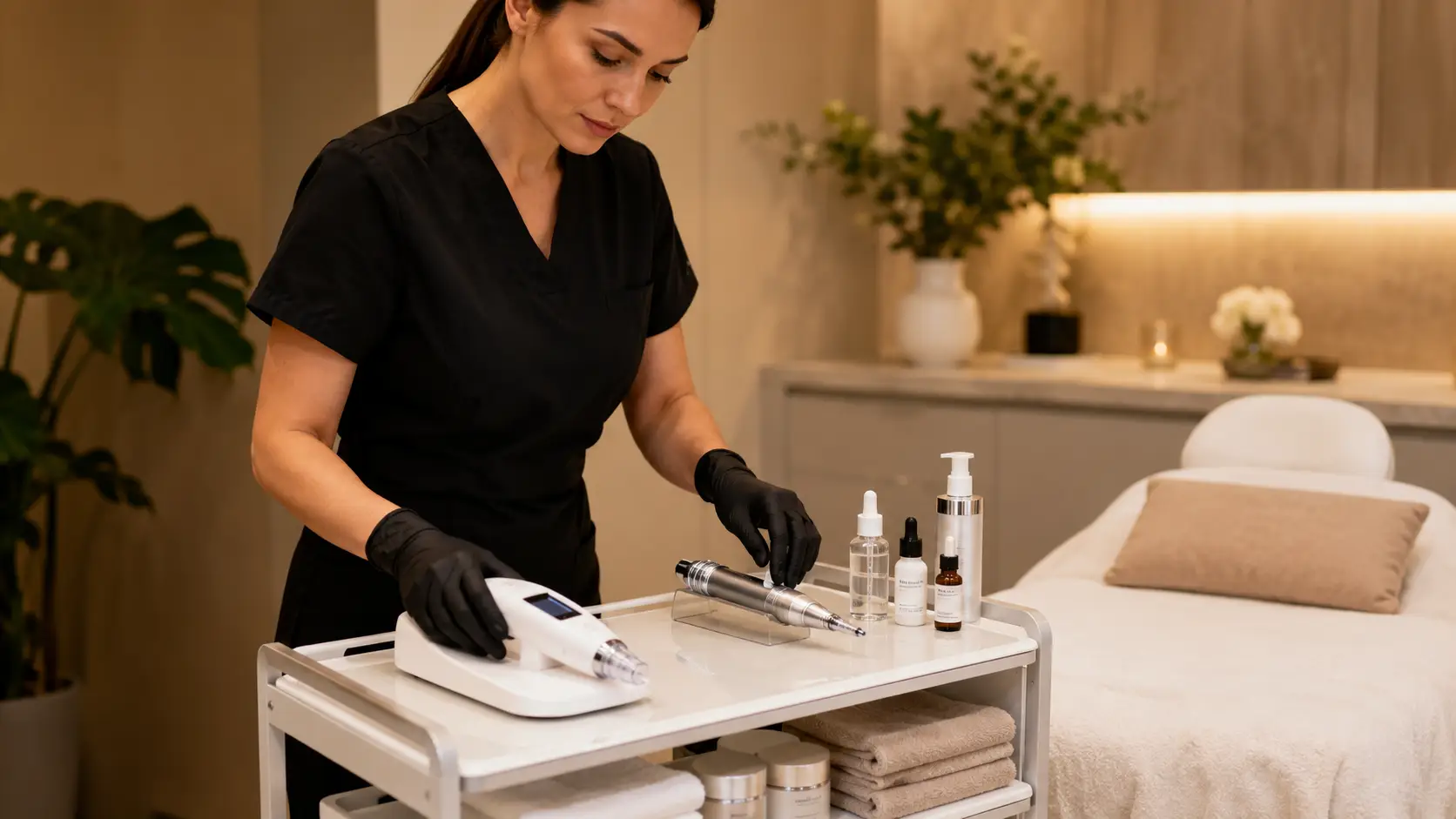
Should New Estheticians Start with Nano Infusion or Go Straight to Microneedling?
For most new estheticians, nano infusion is the smarter starting point before pursuing microneedling. Nano infusion does not breach the skin barrier, sits clearly within esthetician scope of practice in nearly every state, does not require medical oversight, and carries a substantially lower adverse event risk profile than microneedling. It also teaches the device handling, skin mapping, serum pairing, and client communication skills that transfer directly to microneedling training when you are ready to advance.
- Nano infusion is needle-free — it creates temporary surface micro-channels without breaking the dermal barrier. Microneedling physically punctures into the dermis and triggers a wound-healing response. The regulatory, safety, and training requirements are fundamentally different.
- In most states, microneedling requires medical oversight, advanced certification, or physician supervision that new estheticians typically cannot access immediately after graduation.
- Nano infusion can generate $75–$150 per standalone session and $45–$75 as a facial add-on from your first year in practice, with modest equipment investment and low consumable costs.
- The foundational skills built through consistent nano infusion practice — device pressure control, treatment mapping, serum selection, contraindication recognition — directly accelerate microneedling training effectiveness.
- Offering nano infusion first does not delay your career — it builds the client base, treatment revenue, and technical confidence that makes the eventual transition to microneedling smoother and more profitable.
- Serum selection is critical for nano infusion outcomes. Water-based hydration, peptide, and recovery-focused formulations are the most appropriate choices for a new esthetician’s early nano infusion practice.
One of the most common questions new estheticians ask within the first year of practice is some version of the same decision: should I go straight for microneedling training, or should I start with nano infusion first? The instinct to jump to microneedling is understandable. It is a higher-ticket service, it generates client interest, and it signals a level of technical sophistication that many new estheticians want to project as quickly as possible.
But the instinct is often poorly calibrated, for reasons that become clear when you examine the actual differences between the two treatments — not in terms of marketing positioning, but in terms of legal landscape, skill prerequisites, equipment investment, adverse event risk, and what each treatment actually demands of the esthetician performing it.
This article gives new estheticians a clear, evidence-grounded answer to that question. We will cover the fundamental clinical difference between nano infusion and microneedling, why that difference has significant legal and regulatory consequences for early-career estheticians, how nano infusion builds skills that directly accelerate microneedling training readiness, what the realistic revenue and career trajectory looks like for each path, and what a thoughtful progression from one to the other looks like in practice.
The short answer is yes — for most new estheticians, nano infusion before microneedling is the right sequence, for reasons that go well beyond simply being more cautious.
What New Estheticians Need to Know About Sequencing These Two Treatments
- Nano infusion does not break the skin barrier. Microneedling does. That single distinction drives the entire difference in their legal status, training requirements, and risk profiles.
- Most states do not permit new estheticians to perform microneedling without additional licensing, advanced certification, or medical director supervision — often none of which are immediately available after graduation.
- Nano infusion sits within standard esthetician scope of practice in most states and requires no medical oversight to offer.
- Starting with nano infusion is not settling. It is a genuine revenue-generating advanced treatment that clients actively seek out and that produces visible results they notice after a single session.
- The skills nano infusion develops — device control, pressure mapping, treatment sequencing, serum pairing, contraindication screening — are the same skills microneedling training builds on. Starting earlier makes the next step easier.
- Most experienced estheticians who perform microneedling continue offering nano infusion because they serve different client needs, different risk profiles, and different price points.
- Six to twelve months of consistent nano infusion practice before pursuing microneedling certification is the benchmark most educators and advanced practitioners recommend.
What is the actual clinical difference between nano infusion and microneedling?
Understanding this distinction clearly is the foundation for everything else in this article. The terms sound similar and both involve handheld devices used on the face, but the mechanisms of action and what they do to skin tissue are fundamentally different in ways that matter enormously from a regulatory and safety perspective.
Nano infusion: surface channel delivery without barrier breach
Nano infusion uses a device tipped with silicon or metal nano-points — structures measured in nanometers, far smaller than any needle — that oscillate or stamp against the skin surface. These nano-tips create temporary micro-channels in the outermost layers of the stratum corneum that enhance the transdermal absorption of topically applied serums and actives. The skin’s barrier is not broken in the clinical sense — the nano-channels close within minutes and no bleeding, bruising, or significant tissue disruption occurs. The skin’s immune and healing systems are not meaningfully activated because there is no wound to heal.
The result is enhanced ingredient penetration, improved hydration, visible surface radiance, and mild refining of texture — all achieved without the barrier breach that triggers a systemic wound-healing response. Because no barrier breach occurs, the adverse event risk profile is substantially lower, contraindications are fewer, and the regulatory classification in most states falls comfortably within esthetician scope of practice.
Microneedling: controlled dermal injury and wound-healing collagen induction
Microneedling uses a device with actual needles — measured in millimeters, typically ranging from 0.25 mm to 2.5 mm in depth depending on the treatment target — that penetrate through the epidermis into the dermis. This creates genuine microchannels, activates the skin’s wound-healing cascade, triggers controlled inflammation, and stimulates fibroblasts to produce new collagen and elastin. The results — scar remodeling, significant fine line reduction, pore refinement, and firmness improvement — are more dramatic and longer-lasting than nano infusion precisely because the mechanism is more aggressive.
But that same mechanism carries a substantially different risk profile. Active bleeding, bruising, post-inflammatory hyperpigmentation, infection risk, and contraindication complexity are all significantly higher. The post-treatment skin management requirements are more demanding. And from a regulatory perspective, the fact that needles break the dermal barrier is exactly why most state boards classify microneedling differently from surface-level esthetic treatments.
The Barrier Breach Line: Why It Matters Legally and Practically
The concept of barrier breach is the single most important clinical and regulatory dividing line between nano infusion and microneedling. When a treatment breaches the dermal barrier, it transitions from an esthetic service into a category that most state boards consider either a medical procedure or an advanced esthetic procedure requiring specific certification and, in many states, medical oversight.
Nano infusion works above the barrier. It enhances transdermal delivery through temporary stratum corneum channels without activating wound healing, triggering bleeding, or requiring post-treatment wound management. Most state boards classify this as within standard esthetician scope of practice.
Microneedling works through the barrier. It creates actual dermal wounds, activates collagen induction through the wound-healing cascade, and requires post-treatment management of compromised skin. Most state boards restrict this to licensed medical professionals, advanced esthetic certifications, or require physician supervision or a medical director arrangement.
This is not a subtle difference. It is the difference between a service a new esthetician can legally offer on their first day in their own suite and a service that may require two to three years of additional credentialing and business infrastructure before it can be offered legally.
Why do scope of practice rules affect new estheticians differently for these two treatments?
Scope of practice regulations exist at the state level, which means the specific rules governing what licensed estheticians can and cannot perform vary considerably from state to state. But a clear pattern emerges when you examine these regulations across the country: nano infusion is consistently classified as within esthetician scope of practice, while microneedling occupies a more complicated and frequently restricted regulatory position.
Nano infusion and esthetician scope
Because nano infusion does not break the skin barrier and does not activate a wound-healing response, most state cosmetology and esthetics boards classify it as a surface-level esthetic treatment. New estheticians in most states can legally add nano infusion to their service menu with their standard license, with no requirement for medical director agreements, physician supervision, or additional certification beyond device-specific training. This means the path from graduation to legally offering nano infusion is typically short, straightforward, and does not require legal infrastructure that most new estheticians are not yet positioned to build.
Microneedling and the regulatory complexity new estheticians face
Microneedling is regulated much more variably and restrictively across states. Some states permit licensed estheticians to perform microneedling at shallow depths with appropriate certification. Others restrict it to registered nurses, nurse practitioners, physician assistants, or physicians. Many states require a medical director agreement, meaning an esthetician must have a formal legal and supervisory relationship with a licensed physician before offering microneedling regardless of their own training. Building a medical director arrangement is not typically feasible for a new esthetician working out of a small suite or booth rental in their first year of practice.
Even in states where estheticians can legally perform microneedling, the certification and training requirements typically assume a baseline of device experience, client assessment competence, and post-treatment management skill that new graduates are still building. Rushing into microneedling training before those foundations are solid produces estheticians who are technically certified but not practically competent — a combination that increases client risk and professional liability.
Why verifying your state’s specific rules is non-negotiable
Every new esthetician should verify the specific regulations in their state before offering any advanced treatment. State board websites, professional associations like ASCP (Associated Skin Care Professionals) and NCEA (National Coalition of Estheticians, Manufacturers/Distributors and Associations), and consultation with a licensed attorney familiar with esthetic regulation are the appropriate resources. Do not rely on what another esthetician or a training provider tells you about scope — verify directly with your state licensing authority.
How does starting with nano infusion actually build better microneedling skills later?
This is the argument that most experienced estheticians who have made both transitions make most compellingly: nano infusion is not just a safe first step on the way to microneedling. It actively builds the skills that make microneedling training more meaningful and safer to apply from day one of certification.
Device handling and pressure control
Both nano infusion and microneedling require precise, consistent device handling. The ability to maintain consistent pressure across different facial zones, adapt technique for delicate areas around the eyes and lips, work with the contours of the face without over-treating, and maintain a steady, controlled pass speed are all technique elements that take genuine practice to develop. Estheticians who have performed dozens of nano infusion sessions before entering microneedling training arrive with those motor skills already internalized, rather than trying to develop them simultaneously with learning a higher-risk procedure.
Skin mapping and contraindication recognition
Microneedling has a longer and more consequential contraindication list than nano infusion — active acne, certain medications like isotretinoin, blood thinners, recent procedures, Fitzpatrick skin type considerations for hyperpigmentation risk, and multiple others. But the habit of systematically assessing skin before any device treatment, asking the right intake questions, recognizing presentations that suggest contraindications, and communicating those assessments to clients develops through practice. Estheticians who have built that habit through nano infusion will apply it far more reliably in microneedling contexts than those who try to develop it simultaneously with learning the procedure itself.
Serum selection and ingredient knowledge
Serum selection is critical for nano infusion outcomes and the stakes around ingredient compatibility are even higher in microneedling contexts where barrier breach means deeper penetration of everything applied to the skin. Learning which ingredients work well with transdermal delivery, which are contraindicated on channeled skin, and how to match serums to specific skin concerns and treatment goals in a nano infusion context builds the knowledge base that microneedling serum protocols draw directly from.
Client communication and expectation management
Clients who are new to device treatments need specific preparation, education, and post-treatment guidance. The communication patterns — explaining what the treatment does, what sensations are normal, what post-treatment care is required, when results become visible, and what the realistic timeline for repeated treatments looks like — are similar enough between nano infusion and microneedling that developing them in the lower-stakes nano infusion context produces estheticians who manage microneedling clients more professionally from the start.
How do the two treatments compare across the factors that matter most for new estheticians?
Putting nano infusion and microneedling side by side across the criteria that most directly affect new estheticians — regulatory requirements, risk profile, investment, training timeline, and revenue potential — makes the case for sequencing visually clear.
What does a realistic career progression from nano infusion to microneedling look like?
Most estheticians who have made this progression successfully describe it in similar terms: nano infusion was not a waiting room. It was an active phase of skill and business development that made microneedling training substantially more productive and the transition to offering it far smoother. A realistic progression framework looks like this:
Foundation Building
Master standard facial protocols. Build consistent client communication habits. Develop a reliable consultation and intake process. Begin device research and nano infusion training enrollment.
Nano Infusion Launch
Complete nano infusion device training. Add to service menu as a premium add-on and standalone treatment. Build serum selection confidence. Track client outcomes and develop your preferred protocol sequences.
Nano Infusion Refinement
Develop advanced serum pairings. Build treatment series packages. Refine contraindication screening. Start researching microneedling regulations in your state and evaluating certification programs.
Microneedling Preparation
Verify state scope and legal requirements. Research medical director arrangements if required. Evaluate microneedling certification programs. Build the business infrastructure to support the service before training.
Microneedling Certification
Complete certification. Launch microneedling as a premium service tier. Maintain nano infusion as a complementary lower-entry-point option. Position both services distinctly on your menu with clear outcome differentiation.
Dual Service Practice
Both treatments serve different client segments. Nano infusion remains relevant for maintenance, sensitive skin, and clients not ready for microneedling. Neither service replaces the other in a mature practice.
This timeline is not prescriptive — individual circumstances, state regulations, and practice environments vary considerably. Some estheticians in states with permissive regulations and access to medical director arrangements may move faster. Others working in solo booth rental settings may find the legal infrastructure for microneedling takes longer to build. The principle is consistent across those variations: build the foundation before the advanced application.
How does serum selection affect nano infusion results for new estheticians?
Nano infusion is fundamentally a delivery mechanism. The nano-channels it creates are the means by which serums penetrate more effectively into the skin — but the clinical outcome is determined by what those serums contain. For new estheticians, serum selection is one of the most consequential early decisions in building a nano infusion practice, and it is also where the most common protocol mistakes occur.
Water-based formulations are the foundation of nano infusion serum selection
Nano-channel delivery is most effective with water-based, low-viscosity formulations. Oil-based products do not penetrate efficiently through nano-channels and can interfere with the device’s surface contact mechanics. Serums for nano infusion should be water-based, free from oils and waxes that would create an occlusive barrier at the surface, and formulated without ingredients that carry elevated sensitization risk on channeled skin — including high-concentration actives like retinoids and strong exfoliating acids that are contraindicated for nano infusion application.
Matching serum function to treatment intent
Not all nano infusion sessions have the same clinical goal. A hydration and radiance treatment for a dehydrated client calls for a different serum than a post-extraction calming treatment or a session targeting fine lines and firmness for a mature skin client. Developing the judgment to match serum function to treatment intent is one of the most valuable skills nano infusion practice builds in the early career period. For new estheticians, starting with a limited, clearly categorized serum toolkit reduces decision fatigue and protocol errors during sessions while that judgment develops.
Recovery and repair serums matter more than new estheticians typically realize
Even though nano infusion does not break the skin barrier in the clinical sense, clients presenting with barrier compromise, post-inflammatory skin, reactive history, or significant dehydration benefit significantly from recovery-oriented serum formulations rather than stimulating actives. Recognizing this distinction from early in a nano infusion practice — knowing when to reach for a recovery or barrier-repair serum rather than a stimulating peptide or brightening formula — is a clinical judgment that transfers directly to microneedling post-treatment care protocols.
Estheticians in their first year of nano infusion practice consistently report the same challenge: knowing which serum to reach for across the varied presentations they encounter in early client work. The Poly-Luronic™ Peptide Ampoule from the Luminous Skin Lab Professional Ampoule Set is frequently described as the workhorse starting point — its water-based formulation delivers hydration and peptide activity effectively through nano-channels across the widest range of client skin types, making it the appropriate choice for the majority of standard hydration and anti-aging sessions without requiring complex skin analysis decisions from an esthetician still building their assessment confidence.
For sessions where client skin presents with redness, post-inflammatory sensitivity, visible barrier compromise, or a history of reactive responses to treatment, practitioners find the PDRN Regeneration Ampoule a more appropriate serum choice — its recovery and healing formulation reduces the risk of exacerbating sensitized skin while still delivering meaningful results through the nano-channel delivery mechanism. Using these two ampoules as a primary serum pair for the first three to six months of nano infusion practice teaches new estheticians the core clinical distinction between maintenance and repair indications in a low-stakes format, building the judgment that carries directly into post-treatment serum selection decisions in microneedling contexts later in their career.
What are the most common mistakes new estheticians make when deciding between these two treatments?
Assuming microneedling is always the more professional choice
The perception that microneedling is inherently more advanced or more professional than nano infusion is a marketing-driven impression rather than a clinical one. Nano infusion performed with precision, appropriate serum selection, and strong client communication is a genuinely sophisticated esthetic service. Estheticians who allow the perception gap to rush them into microneedling before they are ready — in terms of skill, legal standing, or business infrastructure — are making a decision based on positioning rather than substance.
Not verifying state regulations before investing in training
Purchasing a microneedling device and training course before verifying that your specific state allows you to perform the procedure legally as a licensed esthetician is an expensive mistake that happens more often than it should. State regulations change, interpretation varies, and some states that permit estheticians to offer microneedling impose conditions — depth limits, medical oversight, specific certification standards — that are not always clearly communicated in training program marketing. Verify before you invest.
Treating nano infusion as merely a placeholder
Estheticians who approach nano infusion as a placeholder service to offer until they can get microneedling certified tend to under-invest in developing their technique, serum knowledge, and client communication for nano infusion. This means they miss the skill-building phase that makes microneedling training more productive, they leave revenue on the table by not developing nano infusion as a genuine premium service, and they often arrive at microneedling training with less foundational device competence than estheticians who treated nano infusion seriously from the start.
Selecting serums based on cost rather than clinical function
New estheticians operating on tight startup budgets sometimes default to the least expensive serums available for nano infusion without evaluating whether those serums are appropriate for transdermal delivery, compatible with the skin types in their client base, and free from ingredients that are contraindicated on channeled skin. A single adverse client reaction caused by an inappropriate serum choice costs more in client trust, potential liability, and reputation repair than the cost difference between budget and professional-grade serum options. Invest in appropriate serums from the beginning.
Does starting with nano infusion actually generate meaningful revenue for new estheticians?
One of the most persistent concerns new estheticians express about starting with nano infusion rather than immediately pursuing microneedling is the revenue question: is nano infusion actually generating enough income to make the investment worthwhile, or is it just a stepping stone service with thin margins?
The realistic answer is that nano infusion is a genuinely profitable service from early in a new esthetician’s practice, particularly when positioned thoughtfully and paired with existing facial services. Consider a practical scenario: an esthetician charging $65 per standard facial and adding a nano infusion upgrade at $55–$65 per session can add $220–$260 per day to their revenue on a four-facial schedule without any additional booking time, because nano infusion replaces rather than extends the mask step of a standard facial protocol. In a week, that is $1,100–$1,300 in incremental nano infusion revenue from existing bookings. Against a device cost of $400–$600, the return on investment timeline is measured in weeks rather than months.
As a standalone service, nano infusion priced at $95–$130 per session competes effectively in most markets with the growing demand for needle-free skin enhancement treatments — a category that has expanded considerably as clients who are interested in results-driven treatments seek options that do not involve the downtime, discomfort, or cost of microneedling or more aggressive procedures. New estheticians who position nano infusion clearly as a needle-free advanced treatment — distinct from a basic facial but accessible to clients not ready for microneedling — find strong demand from exactly the client profile that is building a beginning-to-intermediate esthetic practice: clients who want visible results and a premium experience without the barrier of medical-grade treatment intimidation.
Professional References and Regulatory Resources
The regulatory and clinical information referenced in this article draws from professional esthetics education and licensing resources:
- State scope of practice regulations for estheticians — individual state cosmetology and esthetics licensing boards. Verify your specific state at your state board website before offering any advanced treatment.
- Associated Skin Care Professionals (ASCP) — scope of practice guidance for advanced esthetic treatments including microneedling and device-based services. ascp.com
- National Coalition of Estheticians, Manufacturers/Distributors and Associations (NCEA) — professional standards and scope guidance for esthetician practice. ncea.tv
- Nano infusion mechanism of action and transdermal delivery enhancement — cosmetic dermatology literature on nano-channel formation and stratum corneum permeability. Established skincare science literature, 2019–2025.
- PDRN (polydeoxyribonucleotide) in skin repair and recovery applications — post-procedure healing and tissue regeneration literature. Dermatology and aesthetic medicine research, 2018–2024.
- Polyglutamic acid and peptide delivery in esthetic practice — cosmetic formulation and transdermal absorption literature, 2021–2025.
For new estheticians building their first nano infusion practice, the Luminous Skin Lab Professional Ampoule Set offers a purpose-designed serum system for both nano infusion and post-procedure care. The Poly-Luronic™ Peptide Ampoule delivers hydration enhancement with anti-aging peptide activity in a water-based formulation optimized for nano-channel delivery across the widest range of skin types. The PDRN Regeneration Ampoule is specifically formulated for healing and recovery applications, making it the appropriate choice for clients with sensitivity, post-inflammatory history, or barrier compromise. Together these two ampoules cover the core clinical distinction new estheticians need to navigate — maintenance versus repair — from their earliest sessions. Additional ampoules in the set cover barrier restoration, congestion, firming, and post-treatment mask applications, allowing estheticians to expand their serum toolkit as their client needs and clinical judgment develop.
Explore the Professional Ampoule Set →Frequently Asked Questions: Nano Infusion vs. Microneedling for New Estheticians
Should new estheticians start with nano infusion before learning microneedling?
Yes, for most new estheticians nano infusion is the smarter starting point before adding microneedling. Nano infusion is needle-free, does not breach the skin barrier, falls clearly within esthetician scope of practice in nearly every state, and requires no medical oversight. It teaches the foundational device technique, skin mapping, serum pairing, and client consultation skills that directly transfer to microneedling when you are ready for that next step.
What is the main difference between nano infusion and microneedling for estheticians?
The core difference is barrier breach. Microneedling uses needles that physically puncture into the dermis, creating microchannels and triggering a wound-healing collagen response. This is why it is regulated as a medical or advanced esthetic procedure in many states and often requires medical oversight or physician supervision. Nano infusion uses silicon or metal nano-tips that create micro-channels at the surface without breaking the skin barrier, which is why it typically falls within esthetician scope of practice. The risk profile, training requirements, legal landscape, and equipment costs are substantially different.
Can new estheticians legally do microneedling right after graduation?
In most states, microneedling is not within standard esthetician scope of practice without additional licensing, advanced certification, or medical director supervision. Some states restrict it to medical professionals entirely. New estheticians should verify their specific state board regulations before offering microneedling in any form. Nano infusion, by contrast, is generally permitted for estheticians in most states because it does not breach the dermal barrier.
How long should a new esthetician practice nano infusion before adding microneedling?
Most experienced estheticians and educators recommend building at least six to twelve months of consistent nano infusion experience before pursuing microneedling training and certification. This timeline allows you to develop confident device handling, skin assessment skills, serum selection judgment, contraindication recognition, and client communication habits that make microneedling training more meaningful and safer to apply immediately after certification.
Is nano infusion worth it for a new esthetician or should I just wait and learn microneedling?
Nano infusion is genuinely worth adding as a new esthetician, not just as a placeholder for microneedling. It delivers visible hydration, glow, and serum penetration results that clients love, it can be priced as a premium add-on from your first year, it creates a lower-risk advanced treatment revenue stream before you qualify for microneedling, and the technique and consultation skills you build carry directly into microneedling when you advance. Many experienced estheticians continue offering both services because they serve different client needs.
What serums should new estheticians use for nano infusion treatments?
New estheticians should start with water-based hydration and peptide serums for nano infusion. Ideal options for beginners include hyaluronic acid serums, peptide complexes, and growth factor formulations. These ingredients are compatible with nano-channel delivery, unlikely to cause adverse reactions on most skin types, and deliver visible results clients notice immediately. Avoid oil-based products, retinoids, and active acids for nano infusion, as they are either incompatible with the delivery mechanism or carry elevated sensitization risk on channeled skin.
What makes nano infusion a good beginner advanced treatment for new estheticians?
Nano infusion is beginner-friendly for several important reasons: it does not breach the skin barrier so the adverse event risk is substantially lower than microneedling, it sits within standard esthetician scope of practice in most states without requiring medical oversight, the device technique is straightforward to learn with proper training, it pairs naturally with existing facial services as a premium add-on, and it generates meaningful additional revenue from a modest equipment investment. For new estheticians building confidence with advanced devices before committing to medical-adjacent treatments, nano infusion is an ideal bridge service.
How much should a new esthetician charge for nano infusion compared to microneedling?
Nano infusion services typically range from $75 to $150 as a standalone treatment or $45 to $75 as an add-on to an existing facial. Microneedling is typically priced between $200 and $400 per session as a standalone service. The price difference reflects the difference in regulatory requirements, training investment, liability, and perceived clinical intensity. New estheticians can command strong margins on nano infusion from the start because the equipment and consumable costs are relatively low while client demand for needle-free skin enhancement treatments is high.
Which ampoules from the Luminous Skin Lab Professional Ampoule Set work best for nano infusion treatments on new estheticians' clients?
For new estheticians building their nano infusion practice, the Poly-Luronic Peptide Ampoule and the PDRN Regeneration Ampoule from the Luminous Skin Lab Professional Ampoule Set are the most versatile starting choices. The Poly-Luronic Peptide Ampoule pairs deep hydration with anti-aging peptide activity in a water-based formulation ideal for nano-channel delivery, making it effective across most skin types new estheticians encounter. The PDRN Regeneration Ampoule is specifically formulated for post-procedure healing and recovery, making it the appropriate choice for any client presenting with sensitivity, barrier compromise, or post-inflammatory history. Both are water-based, compatible with nano infusion delivery, and designed to produce visible results clients notice in a single session.
The Right Sequence Is the Foundation of a Sustainable Advanced Treatment Practice
The question of whether new estheticians should offer nano infusion before microneedling is not really a question about which treatment is better. It is a question about sequencing — and about building the skill, legal standing, and clinical judgment that makes advanced treatments genuinely safe and genuinely profitable rather than just theoretically possible.
For most new estheticians, nano infusion is the right first step for clear reasons: it falls within standard scope of practice, it does not require the legal infrastructure that microneedling demands, it carries a substantially lower adverse event risk that is appropriate for a practitioner still building their assessment and response skills, and it develops the specific competencies that make microneedling training more productive and safer to apply when the time comes.
But this framing should not diminish nano infusion into a waiting room service. Done well, with precision technique, intelligent serum selection, and confident client communication, nano infusion is a genuine clinical service that delivers visible results, generates meaningful revenue from early in practice, and serves a client segment — those who want results-driven treatment without the intensity or barrier of more aggressive procedures — that remains relevant throughout an esthetician’s entire career. Many of the most established and profitable esthetic practices in the country offer both treatments because they serve different client profiles, different comfort levels, and different clinical needs. Starting with nano infusion does not close the door to microneedling later. It opens it more thoughtfully.