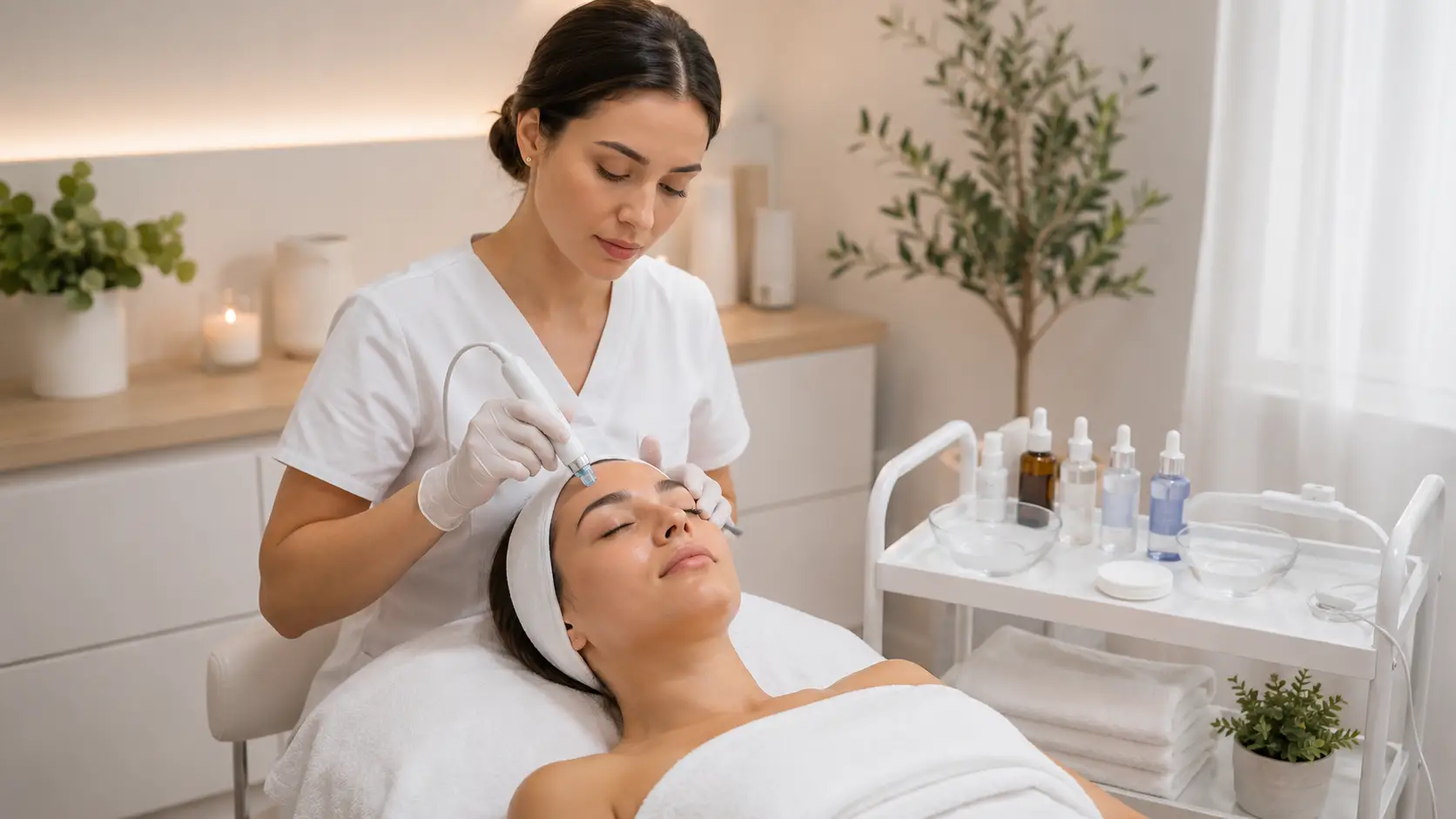
What Does a Beginner Nano Infusion Facial Workflow Look Like?
A beginner nano infusion facial workflow follows seven sequential phases: consultation and contraindication screening, double cleanse and skin preparation, optional light exfoliation, serum application to damp skin, nano infusion device pass across the full face using consistent pressure and movement patterns, post-infusion masking for hydration and calming, and SPF application with client home-care guidance. The entire service runs 45 to 75 minutes depending on experience level and whether optional add-on steps are included.
- The consultation phase is not optional — contraindication screening before every nano infusion service protects both client and esthetician, regardless of how straightforward the client appears.
- Serum is applied to damp skin immediately before the device pass — damp skin reduces friction, allows smooth device glide, and supports consistent delivery into temporarily opened microchannels.
- Correct pressure is light to medium and consistent throughout. Pressing harder does not improve results with nano infusion and increases the risk of unnecessary redness and client discomfort.
- Post-infusion masking is a clinical step, not a luxury add-on — it supports barrier recovery and seals in the serums delivered during the device pass.
- Clients should leave with written home-care instructions that specify what to avoid for the first 24 hours, particularly exfoliating acids, active vitamin C, and direct sun exposure.
- Beginners who practice the workflow in a systematic sequence — same steps, same order, same timing cues — build confidence and technical fluency faster than those who improvise the order session to session.
One of the most common questions new estheticians ask after completing their first nano infusion training is some version of: “I understand how the device works — but what does the actual facial look like from beginning to end?” Training courses frequently spend the most time on the device itself: how the nano tips create temporary microchannels, why the treatment is considered needle-free, what skin concerns it addresses. What often gets less attention is the full clinical workflow that wraps around the device pass — the consultation questions to ask, the prep steps that make the device pass more effective, the serum selection logic, and the post-treatment protocol that determines how long the results last.
This guide is built around the practical workflow question. It walks through every phase of a professionally structured nano infusion facial, explains why each step exists, and highlights the most common beginner errors at each stage. The goal is not just to give you a sequence to follow but to help you understand the clinical reasoning behind the sequence so that you can adapt it confidently as you encounter different client needs.
Nano infusion is an excellent first advanced service for new estheticians precisely because it rewards structured, methodical technique over aggressive intervention. Estheticians who internalize the workflow logic early build a foundation for every more advanced service that follows.
What New Estheticians Need to Know About Nano Infusion Workflow
- Nano infusion is a seven-phase service — the device pass is only one of those phases, and it is not the most important one.
- Skin preparation determines device pass quality more than technique does — clean, damp, appropriately exfoliated skin allows maximum serum delivery.
- Water-based serums are required for nano infusion — oil-based formulations do not travel through temporarily created microchannels effectively.
- The stamping movement pattern is the safest and most learnable starting technique for beginners — it provides coverage control and reduces over-working risk.
- Post-infusion masking amplifies the results clients see immediately after the service — skipping it is one of the most common beginner protocol errors.
- Written home-care instructions set accurate client expectations and reduce post-treatment reactive calls and messages.
- Practicing the full workflow on a model before charging for the service accelerates both technical skill and service confidence simultaneously.
Why Having a Structured Workflow Matters More Than You Think
New estheticians often approach the first few advanced services they learn with a device-centric mindset — the goal is to learn how to use the tool correctly. This is understandable, but it creates a subtle problem: it trains the esthetician to think of the device pass as the service, rather than as one phase within a larger clinical sequence.
In reality, the outcome a client experiences from a nano infusion facial is determined by the sum of all phases, not by the device pass alone. A poorly prepared skin surface reduces how effectively the nano tips create functional microchannels. The wrong serum choice wastes the enhanced delivery window the microchannels create. Skipping post-infusion masking means the serums delivered during the pass begin evaporating before they complete absorption. Sending a client home without clear instructions means they may unknowingly compromise their results within hours of leaving.
A structured, repeatable workflow removes these variables. It means every client gets the same quality of care regardless of how busy the schedule is, how tired the esthetician is, or how much a particular client distracts with conversation during the service. It also makes skill development faster: when you practice the same sequence in the same order every time, you accumulate real-time feedback on each individual phase rather than performing a different improvised sequence with each client.
Professional estheticians working with nano infusion in high-volume practices consistently describe workflow discipline as the single most important factor in producing consistent results across a diverse client base.
The Seven-Phase Beginner Nano Infusion Facial Workflow
The workflow below is structured for a 60-minute service with an optional 15-minute extension for premium add-ons. Each phase has a specific clinical purpose and approximate time allocation. New estheticians should use these time targets as learning benchmarks — most will run longer initially and compress toward these targets over the first ten to fifteen services.
Consultation, Intake Review & Contraindication Screening
Every nano infusion service begins with a consultation, even for returning clients. At a minimum, confirm or update the client intake form, review any product or sensitivity changes since the last visit, and verbally screen for the primary contraindications to nano infusion.
- Active acne lesions, open wounds, or broken skin in the treatment area
- Active cold sore or herpes simplex outbreak
- Sunburn, chemical burn, or significant recent skin trauma
- Active eczema, psoriasis, or rosacea flare in the treatment zone
- Isotretinoin (Accutane) use within the past six to twelve months — confirm with your state board guidance
- Pregnancy — screen for product sensitivity concerns related to serums in use
Use this phase to discuss what the client wants to achieve from the service and set realistic expectations for the immediate post-treatment appearance and timeline to visible results.
Double Cleanse & Skin Preparation
A double cleanse is non-negotiable before nano infusion. The first cleanse removes surface makeup, SPF, and environmental debris. The second cleanse reaches any residual product layer and prepares the skin surface for the device pass. Any product film remaining on the skin during nano infusion reduces microchannel formation quality and can drive unwanted surface residue into the temporary openings created by the nano tips.
After cleansing, assess skin hydration level and surface condition. Dry, tight skin will respond differently during the device pass than well-hydrated skin. Note any areas of visible active congestion, broken capillaries, or sensitivity that will require adjusted pressure or device avoidance during the pass.
Optional Light Exfoliation
Light exfoliation before nano infusion improves device contact quality by removing loose dead skin cells that create an uneven surface layer. A gentle enzyme exfoliation or light lactic acid application is appropriate. Mechanical exfoliation or dermaplaning immediately before nano infusion should be approached carefully and is generally not recommended for beginners until a clear understanding of combined treatment skin response has been developed.
If exfoliation is used, rinse thoroughly and allow the skin to return to a calm, non-flushed state before proceeding to the device pass. Performing nano infusion over actively warm, reactive skin from aggressive exfoliation can amplify redness unnecessarily.
Avoid combining medium or deep chemical peels with nano infusion in the same service. Exfoliation before nano infusion should be light and fully rinsed. When in doubt, omit exfoliation entirely until you have developed better calibration of your client’s individual skin reactivity.
Serum Selection & Application to Damp Skin
Serum selection is one of the most clinically meaningful decisions in the nano infusion workflow. Only water-based serums are appropriate for nano infusion delivery. Oil-based formulations, thick creams, and silicone-heavy serums do not travel efficiently through the temporary microchannels created by the nano tips and can clog or foul the device tips themselves.
Apply the selected serum to skin that is slightly damp — either misted lightly with distilled water immediately before application or applied immediately after a light toning step. Damp skin reduces the friction the nano tips experience during the pass and supports more fluid device glide across the surface. The serum layer should be visible on the skin surface — a generous but not dripping application.
During the device pass, reapply serum to any area that has dried or absorbed before that zone is treated. Maintaining a consistently damp serum layer throughout the pass is one of the most frequently overlooked technique details at the beginner level.
Nano Infusion Device Pass
The device pass is the technical core of the service. For beginners, a systematic stamping pattern across defined facial zones provides the most controllable, reproducible coverage. Divide the face into six zones for systematic coverage: forehead, right cheek, left cheek, nose and perinasal area, perioral area and chin, and eye area (approached with significant caution or avoided entirely until technique is well established).
Work through each zone methodically before moving to the next. Within each zone, use a consistent stamping motion: lift, reposition by approximately half a tip width, press lightly, lift again. This systematic overlap pattern ensures complete coverage without over-working any individual area.
- Pressure: Light to medium, consistent throughout. Think of the device gliding across the skin surface, not pressing into it.
- Speed: Moderate and deliberate. Moving too quickly reduces contact time per zone and leaves gaps in coverage.
- Overlap: Approximately 30 to 50 percent overlap between stamp positions prevents missed areas and creates even coverage.
- Reapply serum: Keep the skin surface visibly damp throughout the entire pass. Dry areas during the pass are a technique error.
After completing the full face, assess for any areas that appear significantly less treated than others and perform a second gentle pass over those zones if needed. A single thorough first pass is preferable to multiple rushed passes.
Post-Infusion Masking
Post-infusion masking is not optional. Following the device pass, the skin’s barrier has been temporarily altered by the microchannel formation process. Applying a hydrating, calming, and occlusive mask immediately after the pass accomplishes three clinically distinct objectives: it amplifies the absorption of serums already delivered during the pass, it reduces any transient redness or warmth from device contact, and it supports the barrier recovery process before the client leaves the treatment room.
A cooling occlusive mask — such as a professional jelly mask applied over a residual serum layer — provides both the occlusive seal and thermal comfort simultaneously. The mask dwell time of 12 to 15 minutes also creates a service window during which new estheticians can perform scalp massage or hand and arm massage as a value-added luxury step.
After mask removal, apply a gentle, fragrance-free moisturizer appropriate to the client’s skin type and proceed immediately to SPF application before the client stands up.
SPF Application & Home-Care Guidance
SPF application before the client leaves is a professional non-negotiable after any treatment that temporarily alters skin barrier integrity. The temporarily heightened permeability created during nano infusion increases UV sensitivity for the first 24 hours post-treatment.
Provide the client with written home-care instructions before they leave. Verbal-only guidance is frequently forgotten or misremembered. At minimum, instructions should cover:
- Avoid exfoliating acids (AHAs, BHAs), active retinol, and high-concentration vitamin C for 24 to 48 hours post-treatment
- Avoid direct sun exposure and exercise-induced sweating for the first 24 hours
- Use only gentle, fragrance-free products the day of and day after treatment
- Reapply SPF regularly if going outdoors
- Mild temporary redness or tightness in the first few hours is normal and not a cause for concern
How to Choose the Right Serum for Different Client Goals
Serum selection is where new estheticians have the most meaningful clinical influence on treatment outcomes. The nano infusion device creates temporary microchannels that temporarily increase the skin’s permeability to topically applied actives — the serum you choose determines what those actives are and what they accomplish during that enhanced delivery window.
Hydration and Anti-Aging Focused Treatments
For clients presenting with dehydration, fine lines, or general luminosity goals, humectant and peptide-rich serums produce the most visible and immediately appreciated outcomes. Polyglutamic acid combined with peptides creates a dual-action effect: the PGA surface film seals moisture and inhibits hyaluronidase while the peptides support collagen-signaling pathways in the skin. The nano infusion delivery window amplifies both mechanisms because temporarily heightened permeability allows deeper and more uniform serum penetration than standard topical application alone achieves.
Recovery and Barrier Repair Focused Treatments
For clients recovering from stress, environmental damage, over-exfoliation, or mild post-procedure concerns, regenerative and barrier-supportive formulations are the appropriate serum category. Polydeoxyribonucleotide (PDRN), derived from salmon DNA, is one of the most studied regenerative compounds used in professional skin care. It supports tissue healing through adenosine receptor activation, promotes angiogenesis for improved nutrient delivery to the skin, and has demonstrated wound-healing and anti-inflammatory properties in both medical and cosmetic research literature. In a nano infusion context, PDRN delivery takes advantage of the same enhanced permeability window to reach the upper dermis more effectively than surface application alone.
Congested and Acne-Prone Skin
Clients with congested, oily, or acne-prone skin require careful serum selection. BHA-based formulations can be used in some nano infusion workflows but require an experienced esthetician’s judgement about current skin condition, presence of active breakouts, and irritation threshold. For new estheticians, starting with barrier-supportive and hydration-focused serums for congested-skin clients is generally the safer initial approach while technique is still being refined.
Why Nano Infusion Amplifies Serum Efficacy
Nano infusion devices create temporary microchannels in the stratum corneum that increase transdermal permeability for a window of approximately 20 to 40 minutes post-treatment. During this window, topically applied water-based actives penetrate more deeply and more uniformly than standard topical application allows.
The clinical significance for serum selection: concentration and molecular weight both matter more during nano infusion than in routine topical application. Smaller molecular weight compounds penetrate more deeply. Higher-concentration formulations deliver more active ingredient per pass. Water-based formulations travel through the aqueous microchannels; oil-based formulations do not.
This is why applying the wrong serum type during nano infusion is not simply a missed opportunity — it can mean a completely ineffective treatment delivery while the enhanced permeability window closes. Serum selection is a clinical decision, not a product preference.
Common Beginner Mistakes in Nano Infusion Workflows
Most beginner errors in nano infusion are workflow errors rather than device technique errors. Understanding what these are before encountering them reduces the likelihood of building habits that compromise results or client experience.
Skipping or Shortening the Consultation
Even returning clients can present new contraindications at any appointment. A client who started isotretinoin, developed an active cold sore, or received a chemical peel at another provider in the two weeks since their last visit would be contraindicated for nano infusion that day. The consultation is not a formality — it is the safety gate that every service passes through before treatment begins.
Performing the Device Pass on Dry Skin
Allowing the serum layer to dry before completing the pass over an area is one of the most commonly observed beginner technique errors. It increases friction, reduces glide quality, creates drag on the nano tips, and decreases effective serum delivery in the zones where dryness has occurred. Keep a misting bottle within reach and reapply serum to any zone that dries before it is treated.
Pressing Too Hard
The intuition that more pressure creates better results is not correct for nano infusion. Excess pressure creates unnecessary micro-abrasion, activates inflammatory pathways unnecessarily, and produces a redness response that clients notice and remember. The nano tips are designed to create microchannels at light to medium pressure. Correct technique involves consistent, controlled contact — not force.
Using Oil-Based or Silicone-Heavy Serums
Only water-based formulations are appropriate for nano infusion delivery. Oils and silicones do not travel through the aqueous microchannels created by the nano tips. More problematically, they can coat the device tips and impair performance for the remainder of the service. When in doubt about a serum’s base composition, the first few ingredients on the INCI list and the serum’s texture and spreadability when applied to damp skin are reliable indicators.
Skipping Post-Infusion Masking
The post-infusion mask is the phase that locks in the treatment results the client will see when they look in the mirror immediately after the service. Clients who experience a nano infusion facial without the masking step frequently report that the visible difference feels modest. Clients who experience the full protocol with proper post-infusion masking consistently report a more dramatic immediate result. The masking phase is not a luxury add-on — it is integral to the clinical outcome.
Sending Clients Home Without Written Instructions
Verbal home-care guidance is routinely misremembered or partially forgotten. Clients who unknowingly apply an exfoliating acid, exercise vigorously, or sun themselves the same afternoon as a nano infusion treatment can experience unnecessary redness or reactive responses that they may then associate with the treatment itself rather than with their home-care choices. Written instructions remove this ambiguity and protect both the client’s result and the esthetician’s professional reputation.
How to Practice Timing and Build Service Pacing Confidence
Service pacing is a skill that develops through repetition, and nano infusion is an excellent service on which to develop it because the seven-phase structure gives clear transition points that can be timed and refined independently.
Practice the Full Workflow Before Charging
Estheticians who practice the complete seven-phase workflow on model clients before booking paying clients for nano infusion consistently report a higher level of confidence in their first few commercial services. Practice sessions allow the esthetician to become comfortable with the physical flow of the service — where supplies are positioned, how the transition between phases feels, and how long each phase actually takes under real conditions — without the pressure of a commercial booking.
Use Phase Timing as a Learning Benchmark
Timing each phase individually during practice sessions reveals where time is being lost or where technique is creating inefficiency. Common findings: the consultation runs long because questions are being asked in an unstructured order, the cleanse phase takes too long because products are not pre-staged, or the device pass is rushed because earlier phases ran over time. Once the specific phase creating timing problems is identified, it can be addressed in isolation.
Build a Supply Staging Routine
Having all supplies organized and within reach before the client is draped significantly reduces dead time between phases. Experienced estheticians develop a consistent pre-service staging routine that ensures serums are at working temperature, the device is charged and tipped, the mask materials are measured, and all single-use items are opened and ready before the service begins. For new estheticians, developing this staging habit early eliminates one of the most common sources of mid-service hesitation.
A 60-minute nano infusion service booking requires all seven phases to run within that window including transition time. In the first ten services, most beginners will run 15 to 20 minutes over. This is normal and expected. The goal is not to rush — it is to develop phase efficiency through repetition until the natural pacing of the service matches the booking window.
Adapting the Workflow for Different Skin Types and Concerns
The seven-phase structure is fixed — but several variables within the workflow are adjusted based on the specific client presenting in the treatment room.
Sensitive and Reactive Skin
For clients with sensitive or reactive skin, omit Phase 3 exfoliation entirely and select a serum with barrier-supportive properties rather than high-concentration actives. Reduce device pass pressure to the lighter end of the recommended range and consider performing only a single systematic pass rather than follow-up passes on under-treated zones. Post-infusion masking is particularly important for sensitive skin clients — the occlusive seal reduces post-treatment inflammatory response and reassures clients who experience more visible initial redness than average.
Dehydrated Skin
Dehydrated skin requires more serum reapplication during the device pass than adequately hydrated skin, because the skin surface absorbs the serum layer faster. Keep more serum prepared and apply liberally throughout the pass. A peptide-and-humectant serum applied during the pass followed by a jelly mask in Phase 6 creates a particularly effective hydration recovery protocol for dehydrated clients who want to see visible plumping and luminosity improvement after a single session.
Mature Skin
Mature skin benefits from peptide-rich and growth-factor-adjacent serums that support collagen signaling. The nano infusion delivery window is particularly valuable for this skin type because transepidermal penetration of larger-molecule actives is limited under normal application conditions. The temporarily heightened permeability created during the device pass allows more effective delivery of peptide compounds than standard topical application achieves.
Sensitive skin: Omit exfoliation, reduce pressure, barrier-supportive serum, single pass only
Dehydrated skin: Extra serum reapplication, humectant-rich formulation, occlusive jelly mask finish
Mature skin: Peptide or growth-factor serum, full systematic pass, extended post-masking time
Congested skin: Thorough double cleanse, enzyme exfoliation only, barrier-supportive serum first
First-time clients: Thorough phase 1 consultation, narrate each phase before it begins, check in frequently
Post-procedure skin: Regenerative serum, skip exfoliation, extended masking phase, gentle home-care instructions
Estheticians developing their nano infusion protocol for the first time frequently discover that the serum selection decision has a more significant impact on client outcome than they expected during training. In practice, switching between the Poly-Luronic™ Peptide Ampoule and the PDRN Regeneration Ampoule from the Luminous Skin Lab Professional Ampoule Set based on client consultation reveals a consistently observable difference in the immediate post-masking skin response: the Poly-Luronic™ Peptide Ampoule produces more pronounced visible plumping and luminosity in hydration-focused treatments, while the PDRN Regeneration Ampoule produces a calmer, more uniform skin tone response that clients with barrier sensitivity or mild reactive concerns report as distinctly more comfortable post-treatment.
In high-volume practices where multiple nano infusion clients are seen consecutively, the single-dose ampoule format eliminates the cross-contamination and consistency concerns that come with dispensing from multi-use serum bottles. Each ampoule contains exactly the right volume for one full-face application, which also removes the estimation error that causes some beginners to under-apply serum during the pass when working from an open bottle for the first time.
How to Position and Build This Service Into Your Menu as a New Esthetician
Nano infusion is well-suited for new estheticians because it can be positioned effectively as a standalone service or as an upgrade add-on to a standard facial, and the technical barrier to competency is lower than microneedling while the perceived value is considerably higher than a routine hydration facial.
Standalone Service vs. Add-On
As a standalone service, a 60-minute nano infusion facial can be positioned on the service menu as a premium treatment step above a basic facial. The scientific justification is legitimate: the serum delivery mechanism, enhanced permeability window, and post-infusion masking protocol create results that standard topical application cannot replicate. As an add-on to an existing facial booking, nano infusion is typically positioned as a 20-to-30-minute enhancement added after cleansing and basic prep, with the device pass and masking phases completed before the standard facial close-out sequence.
Pricing Considerations for New Estheticians
New estheticians often undercharge for nano infusion because they feel their technique is not yet expert-level. The more useful framing: the service delivers clinically meaningful results at every experience level because the workflow — not the esthetician’s years of experience — is what drives outcomes. Price the service based on the quality of the materials and the clinical value of the protocol, not on self-assessed technique confidence. Most markets support standalone nano infusion facials in the $120 to $180 range, with add-on pricing typically $45 to $75 above the base facial price.
Client Education as a Retention Tool
Nano infusion produces best results as part of a regular protocol rather than as a one-time treatment. Educating clients during the Phase 7 home-care conversation on the cumulative benefit of regular sessions — typically four to six sessions spaced two to four weeks apart for initial results, then monthly maintenance — creates a natural rebooking conversation that is educational rather than sales-oriented. Clients who understand why repeated sessions produce better results than a single treatment are substantially more likely to rebook consistently.
Professional References
The workflow structure, serum selection principles, and clinical rationale discussed in this article draw from established esthetic education frameworks and ingredient science research:
- Nano infusion microchanneling mechanism and transdermal delivery enhancement. Established cosmetic device literature; esthetic education training resources, 2022–2026.
- Polydeoxyribonucleotide (PDRN) wound healing and tissue regeneration mechanisms. Peer-reviewed dermatology and aesthetic medicine research; adenosine receptor activation and angiogenesis support documented in multiple published studies, 2018–2024.
- Polyglutamic acid surface film formation, hyaluronidase inhibition, and NMF stimulation. MDPI 2024; Typology cosmetic chemistry literature, 2021–2025.
- Transepidermal water loss reduction and barrier recovery through occlusive mask application. Established barrier function literature; cosmetic dermatology education resources.
- Serum delivery efficacy comparison: topical application vs. microchanneling-assisted delivery. Cosmetic device education and esthetic training literature, 2020–2025.
- Scope of practice and infection control standards for nano infusion. State board esthetic licensing frameworks; National-Interstate Council of State Boards of Cosmetology (NIC) educational guidelines.
For new estheticians building their first nano infusion protocol, selecting serums that are purpose-formulated for professional device delivery makes a measurable difference in both treatment outcomes and service consistency. The Poly-Luronic™ Peptide Ampoule and the PDRN Regeneration Ampoule from the Luminous Skin Lab Professional Ampoule Set are the two formulations our education team most frequently recommends as the beginner nano infusion starting pair. The Poly-Luronic™ Peptide Ampoule delivers dual-depth hydration through PGA and peptide synergy for hydration-focused and anti-aging treatments. The PDRN Regeneration Ampoule delivers targeted tissue repair support for recovery-focused protocols. Both are water-based, single-dose ampoule format, and formulated specifically for professional infusion delivery compatibility — removing the guesswork of serum selection that frequently creates inconsistent outcomes for new practitioners. The complete Professional Ampoule Set also includes the Ceramide Restoration, Tri-Peptide Complex, BHA Renewal, and HA Sheet Mask options to support the full range of concerns a growing client base presents.
Explore the Professional Ampoule SetFrequently Asked Questions: Beginner Nano Infusion Facial Workflow
What does a basic nano infusion facial workflow look like for a beginner?
A beginner nano infusion facial workflow typically follows seven steps: consultation and intake review, double cleanse and skin prep, optional light exfoliation, serum application to damp skin, nano infusion device pass over the full face, post-infusion masking for hydration and calming, and SPF application with home-care guidance. Each step has a specific clinical purpose, and understanding why each phase exists helps new estheticians perform the service with genuine confidence rather than just following a checklist.
How long does a nano infusion facial take when you are just starting out?
Most new estheticians complete a nano infusion facial in 60 to 75 minutes when they are first learning the workflow. As technique becomes more fluent, the service can typically be delivered in 45 to 60 minutes. The device pass itself takes approximately 10 to 15 minutes. The additional time goes into consultation, prep, masking, and home-care discussion. Rushing the device pass to save time is one of the most common beginner mistakes and reduces both results and client safety.
Should skin be wet or dry when you apply serum before nano infusion?
Skin should be damp, not dripping wet and not fully dry, when serum is applied before nano infusion. Damp skin allows the nano tips to glide smoothly across the surface, reduces drag and friction, and supports consistent serum delivery into the microchannels created during the pass. Dry skin increases friction and can cause the device to skip. Overly wet skin dilutes the serum concentration being delivered. A light mist of distilled water or the serum itself applied directly to damp skin is the standard professional approach.
What is the correct movement pattern when using a nano infusion device on a client?
The two most common movement patterns for nano infusion are the stamping method and the circular or gliding method. Stamping involves lifting and repositioning the device in a systematic grid pattern across the face, which gives precise coverage control and is generally recommended for beginners. The gliding or circular motion covers larger areas more quickly but requires more experience to maintain consistent pressure and avoid over-working any one zone. Most new estheticians are taught stamping first, then introduce gliding technique once comfortable with pressure calibration.
What happens if you press too hard with a nano infusion device?
Applying too much pressure during nano infusion can cause micro-abrasion, increased redness, and client discomfort. Unlike microneedling, nano infusion tips are not designed to penetrate the dermis, and excessive pressure does not improve results. It creates unnecessary trauma, may trigger reactive skin responses in sensitive clients, and can leave temporary visible irritation that concerns clients immediately post-treatment. The correct pressure is light to medium, consistent, and intentional. Most beginners over-press because they associate pressure with efficacy, but with nano infusion, glide and coverage consistency matter far more than force.
Can you do nano infusion on a client who has never had a facial before?
Yes, nano infusion is generally well-tolerated by first-time facial clients because it is a non-invasive, needle-free treatment with minimal to no downtime. However, new estheticians should still perform a thorough intake consultation to screen for contraindications including active acne lesions in the treatment area, known product sensitivities, recent sunburn, or active skin conditions such as eczema or rosacea flares. Setting clear expectations before the service about mild temporary redness and the sensation of the device pass helps first-time clients feel comfortable and informed.
What do you put on a client's face after nano infusion is done?
Immediately after the nano infusion device pass, a hydrating and calming mask is applied to support barrier recovery, lock in serum absorption, and reduce any transient redness. A cooling occlusive mask such as a jelly mask creates a physical seal that enhances penetration of the serums already infused while providing thermal comfort to the skin. After mask removal, a gentle moisturizer and broad-spectrum SPF are applied before the client leaves. Avoid active ingredients like retinol, exfoliating acids, or vitamin C in the immediate post-infusion step, as the skin’s permeability is temporarily elevated.
How do you talk a nervous client through their first nano infusion treatment?
Narrating each step before you do it is the most effective technique for managing nervous first-time clients during nano infusion. Tell the client what they will feel before the device touches their skin, describe the sound and sensation of the device in simple, reassuring language, and check in after the first pass on a less sensitive area such as the forehead or cheek. Most client anxiety dissolves within the first 60 to 90 seconds once they experience that the treatment is comfortable. Framing it as a serum delivery treatment rather than anything that penetrates or punctures is language that consistently reduces pre-treatment concern.
Which ampoules from the Luminous Skin Lab Professional Ampoule Set work best in a beginner nano infusion workflow?
For a beginner nano infusion workflow, the Poly-Luronic Peptide Ampoule and the PDRN Regeneration Ampoule from the Luminous Skin Lab Professional Ampoule Set are the most versatile starting choices. The Poly-Luronic Peptide Ampoule delivers dual-depth hydration and peptide support appropriate for general hydration facials and first-time clients. The PDRN Regeneration Ampoule is the preferred option for clients focused on recovery, repair, or post-procedure concerns, as PDRN actively supports tissue healing and barrier restoration. Both are water-based formulations compatible with nano infusion device delivery and appropriate for the range of skin types a new esthetician is likely to encounter in early practice.
A Structured Workflow Is the Foundation of a Confident Service
Nano infusion rewards estheticians who respect the full workflow rather than fixating on the device pass alone. The consultation that identifies the right client and sets accurate expectations, the cleanse that gives the nano tips a clean surface to work with, the serum choice that determines what the enhanced delivery window actually delivers, the masking phase that seals those results into the skin — each of these phases is where service quality is either built or undermined.
New estheticians who commit to a systematic seven-phase workflow from the first service they offer — rather than improvising as they go — build skill, confidence, and consistent client outcomes simultaneously. The seven phases do not take longer than an improvised approach. They simply organize the same time more intentionally, with each minute serving a defined clinical purpose.
As you develop fluency with the workflow, the individual phases will begin to feel natural rather than sequential. That is the point at which the technical aspect of the service recedes into the background and the quality of your client communication, your skin analysis, and your treatment customization become the primary differentiators in the room. The workflow is not the ceiling of what nano infusion can be in your practice — it is the floor that everything else is built on.