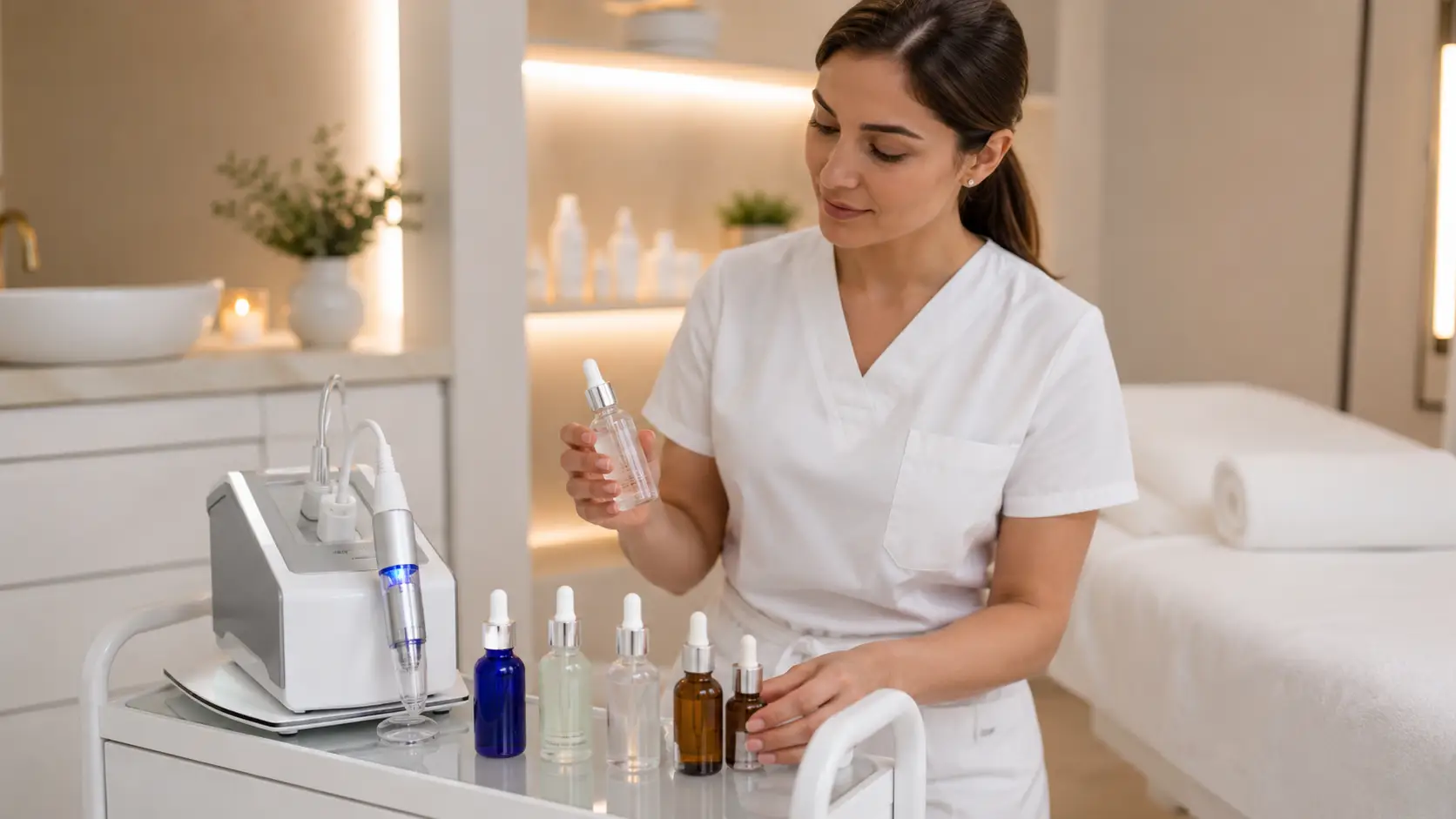
What Serums Should New Estheticians Use for Nano Infusion?
For beginner nano infusion treatments, the most effective and safest serums are water-based, fragrance-free formulations built around a single well-tolerated active ingredient. The four categories new estheticians should start with are: hyaluronic acid serums for hydration, peptide serums for firming and anti-aging, PDRN serums for recovery and barrier repair, and ceramide-based serums for reactive or compromised skin. Oil-based formulations, high-concentration acids, and complex multi-active blends should be avoided until more advanced protocol experience is established.
- Water-based formulations are the only appropriate delivery medium for nano infusion — oil-based serums do not travel through nano-tip channels and risk device clogging.
- Peptide serums are among the most beginner-friendly options: well-tolerated across skin types, low sensitization risk, and visible firming results clients notice immediately.
- PDRN serums are the category of choice for post-procedure recovery nano infusion, particularly on compromised or recently treated skin.
- Hyaluronic acid serums deliver the most immediate visible hydration results and work synergistically with any occlusive finishing mask applied after the infusion pass.
- Single-active serums are the right starting point for beginners — introduce layering only after mastering solo-serum protocol performance across multiple skin types.
- Every serum used for nano infusion should be verified as appropriate for infusion delivery, not just topical application — concentration, pH, and base type all behave differently under infusion conditions.
When new estheticians begin offering nano infusion, most of the learning curve is focused on device handling, pass technique, and treatment timing. Those skills matter enormously — but the serum decision is equally important and far less often discussed in beginner training contexts. The serum you choose for nano infusion determines what your client’s skin actually receives, how their skin responds during and after the treatment, and whether the results you produce are consistent and repeatable across different clients and skin types.
Nano infusion creates thousands of temporary micro-channels in the upper epidermis, dramatically increasing the skin’s permeability to topically applied ingredients during the treatment window. That enhanced delivery capacity is precisely what makes nano infusion valuable — but it also means that every ingredient in your chosen serum reaches the skin more effectively than it would through standard topical application. For a new esthetician, that amplification effect makes informed serum selection even more important, not less.
This guide covers everything a new esthetician needs to make confident, informed serum decisions for beginner nano infusion protocols: why formulation base type matters, which ingredient categories are most appropriate for different skin concerns, how to match serums to client presentations, what to avoid while you are still building protocol experience, and how to structure a starter serum selection that gives you clinical versatility without overwhelming complexity.
What Every Beginner Should Know About Nano Infusion Serum Selection
- Water-based is not a preference — it is the only formulation base that works correctly with nano infusion delivery mechanics.
- Increased skin permeability during nano infusion amplifies both the benefits and the risks of every ingredient you apply. Know what you are using before you put it on channeled skin.
- Start with one serum per treatment. Add complexity only after you understand how individual serums perform across your client base.
- Peptide and hyaluronic acid serums are the safest, most versatile starting categories for beginners — broad skin type compatibility, low sensitization risk, and visible client results.
- PDRN serums are the appropriate choice when the treatment goal is recovery and barrier repair, not just hydration.
- Avoid retinoids, high-concentration vitamin C, and AHAs during nano infusion until you have advanced training in those protocols.
- The finishing step after nano infusion is as important as the serum itself — an occlusive mask seals channels, locks in actives, and delivers the visible skin improvement clients associate with a premium treatment outcome.
- Pre-measured single-treatment ampoules eliminate the formulation uncertainty that causes inconsistency in beginner nano infusion protocols.
Why the Formulation Base Is the First Decision in Nano Infusion Serum Selection
Before any conversation about active ingredients, skin concerns, or treatment goals, the single most important serum selection criterion for nano infusion is formulation base type. This is not a nuanced clinical judgment — it is a mechanical constraint of how nano infusion delivery works.
How Nano Infusion Delivers Ingredients
Nano infusion tips — whether silicone or metal — create micro-channels in the upper epidermis through repetitive stamping or gliding motion. These channels are extremely shallow, typically reaching only into the stratum corneum and upper viable epidermis. The device’s motion creates hydraulic pressure that drives liquid-phase ingredients into these channels via a combination of mechanical pressure and capillary action. This delivery mechanism is fundamentally hydrophilic — it favors water-soluble, low-viscosity liquids.
Oil-based formulations do not travel through these channels effectively. The hydrophobic nature of oils means they do not disperse or penetrate through the aqueous environment of the upper skin layers under the relatively low pressure generated by a nano infusion device. Additionally, oil-based serums increase the risk of clogging the nano tip cartridge during treatment, which compromises device performance and creates sanitation concerns that are particularly problematic for new estheticians still developing equipment maintenance routines.
What Water-Based Means in Practice
A water-based serum has water (aqua) listed as its first INCI ingredient and does not contain significant quantities of heavy emollient oils, silicones, or waxes as primary base components. This does not mean the serum cannot contain any lipid-derived ingredients — some ceramides, for example, can be incorporated into water-based delivery systems. The test is whether the serum flows freely as a liquid at room temperature, has low viscosity, and absorbs quickly into the skin without leaving a greasy or occlusive film during device movement.
Serums that pass these criteria are appropriate for nano infusion delivery. Serums that feel rich, oily, or heavily emollient in texture — regardless of label claims — should be reserved for the finishing step after nano infusion, not the infusion pass itself.
Why Viscosity and pH Also Matter for Nano Infusion Serums
Beyond base type, two additional formulation properties affect how a serum performs during nano infusion: viscosity and pH.
Viscosity: Higher-viscosity serums — thick gels, heavily cross-linked HA formulations, or serums with significant gelling agents — flow less efficiently through nano channels and require more product per pass to maintain consistent skin contact. Thin, freely flowing serums distribute more evenly during device movement and deliver more consistently across the treatment area.
pH: Very low pH serums — particularly L-ascorbic acid vitamin C formulations (pH 2.5–3.5) and high-concentration AHA serums — create heightened sensitization risk when delivered through nano channels into skin with increased permeability. These formulation categories require advanced protocol understanding and are not appropriate for beginner nano infusion use. Neutral to mildly acidic serums (pH 5.5–7.0) are the safest beginner range.
The Four Serum Categories New Estheticians Should Start With
Once the water-based formulation requirement is established, the next decision is ingredient category. For beginner nano infusion protocols, four categories cover the vast majority of client skin concerns with appropriate safety profiles and predictable performance. Starting within these four categories — rather than reaching immediately for more complex multi-active blends — gives new estheticians a structured foundation to build protocol confidence from.
Hyaluronic Acid Serums
The most universally appropriate starting category. HA serums deliver immediate, visible hydration results across all skin types with minimal sensitization risk. Multi-weight HA formulations — combining high, medium, and low molecular weight fractions — provide both surface and deeper hydration delivery. Best for: dehydrated skin, first-time clients, combination skin, post-summer or seasonal hydration treatments.
Peptide Serums
Signal peptides, carrier peptides, and neurotransmitter-inhibiting peptides are all appropriate for nano infusion delivery. Peptide serums produce visible firming and radiance results that clients notice without needing explanation, making them excellent for client retention. Low sensitization risk across most skin types. Best for: anti-aging concerns, fine lines, loss of firmness, combination and normal skin.
PDRN Serums
Polydeoxyribonucleotide (PDRN) is a salmon-derived DNA fragment that activates the adenosine A2A receptor, stimulating tissue repair and fibroblast proliferation. PDRN serums are the appropriate choice for recovery-focused nano infusion protocols: post-procedure skin, compromised barrier function, healing concerns, and clients presenting with redness or irritation from prior treatments. Best for: post-treatment recovery, barrier-compromised skin, sensitive skin with repair goals.
Ceramide-Based Serums
Ceramides are lipid molecules critical to the skin barrier structure. Water-phase ceramide serums (not oil-based formulations) can be delivered through nano infusion to support barrier reinforcement. Best for: reactive skin, eczema-adjacent presentations, clients with chronic dryness or barrier disruption, post-winter skin, and any client presenting with visible flaking or tightness alongside hydration concerns.
What to Add as You Gain Experience
After establishing confidence with the four starter categories above, more experienced nano infusion practitioners typically introduce growth factor serums for advanced anti-aging protocols, exosome serums for high-performance regeneration treatments, and niacinamide-forward formulations for brightening and pore refinement. These additions require a stronger understanding of ingredient interactions and client skin response patterns under infusion conditions — which is why they belong in a second phase of protocol development, not a beginner’s starter kit.
How to Match Serums to Skin Concerns in a Beginner Nano Infusion Practice
The clearest framework for beginner serum selection is matching ingredient category to the client’s primary presenting skin concern. Most clients presenting for nano infusion have one dominant concern — dehydration, early aging signs, dullness, reactive or irritated skin, or post-treatment recovery — and the serum that best addresses that concern is almost always the right choice for the infusion pass.
The visual below maps the four beginner serum categories to their most appropriate client presentations, helping new estheticians build a decision framework they can apply in consultation without having to recreate the reasoning process from scratch for each client.
What to Do When a Client Presents With Multiple Concerns
Most clients presenting for nano infusion will have more than one skin concern. A client may describe both dehydration and early aging signs, or reactive skin alongside visible dullness. For new estheticians, the decision rule here is to identify the primary presenting concern — the one the client volunteers first or rates as most important — and match your serum to that concern for the infusion pass. You can address secondary concerns through the finishing step: an occlusive mask, a targeted moisturizer, or a follow-up home care recommendation.
Resist the temptation to layer two serums during the infusion pass to address both concerns simultaneously. Before you understand how each serum performs independently on your client base, combining them introduces variables that make it impossible to assess what is producing the outcome you observe. Single-serum clarity first, then strategic layering as your experience develops.
How Much Serum to Use, When to Apply It, and How to Maintain Coverage During the Treatment
Serum application technique during nano infusion is a practical skill that takes a few sessions to calibrate. The mechanics are straightforward, but new estheticians frequently either under-apply (allowing the skin surface to dry between passes, which increases friction and reduces infusion efficiency) or over-apply (wasting product and creating a slippery surface that reduces tip contact quality).
The Thin Film Standard
The target is a thin, consistent serum film on the skin surface at all times during device movement. The skin should look visibly moist — like a light mist has been applied — but not pooled or puddled with excess product. When you look at the treatment area, you should see a subtle sheen without the serum moving or flowing when the face is tilted. This standard varies slightly by serum viscosity: thinner serums require more frequent reapplication in small amounts; more viscous gels hold the film longer but may need to be redistributed with the device if they begin to clump.
Application Sequence and Reapplication Timing
Most estheticians work in zones — forehead, right cheek, left cheek, nose, chin — applying serum to one zone, completing the nano infusion pass for that zone, then moving to the next. Apply serum to each zone immediately before beginning the pass for that zone rather than applying to the whole face at once. This prevents the serum from partially absorbing or drying on areas you haven’t reached yet, which is particularly important in warm treatment rooms where evaporation is faster.
For a standard full-face treatment, most estheticians use between 1 and 3 milliliters of serum total, depending on formulation viscosity and application pace. Pre-measured single-treatment ampoules eliminate the decision about how much to dispense and prevent product waste from over-pouring, which is a common source of inconsistency for beginners still developing their sense of how much product each zone requires.
How to Handle Sensitive Areas
The periorbital area (under-eye and lid area), upper lip, and nose wings are thinner-skinned zones where sensitization risk is marginally higher during nano infusion. Many experienced practitioners use the same serum across the full face but reduce device speed and pass repetition in these zones rather than switching serums mid-treatment. For beginners, avoiding the immediate eyelid margin and working just below and beside the orbit rather than directly on it is the appropriate conservative approach until technique confidence is established.
Estheticians integrating the Luminous Skin Lab Professional Ampoule Set into beginner nano infusion protocols consistently report that the pre-measured single-treatment format resolves one of the most common sources of early-stage inconsistency: product volume uncertainty. When practitioners were free-pouring serums from bottles, minor differences in the amount dispensed per treatment session produced differences in coverage consistency and skin response that were difficult to isolate from technique variables. Switching to pre-measured ampoules — particularly the Poly-Luronic™ Peptide Ampoule for hydration and anti-aging treatments and the PDRN Regeneration Ampoule for recovery-focused protocols — reduced that variable completely.
Practitioners also note that the Poly-Luronic™ Peptide Ampoule’s viscosity falls precisely within the thin-film application window: it distributes evenly under device movement without pooling or drying before the zone pass is complete, maintains consistent serum contact throughout the treatment, and does not require reapplication mid-zone during a standard-paced treatment. The PDRN Regeneration Ampoule is consistently reported as the serum that produces the most dramatic immediate visible redness reduction in post-procedure clients, making it the preferred option for any nano infusion booking that follows a more active prior treatment within the same service session or same-week appointment sequence.
The Finishing Step: Why the Mask After Nano Infusion Is as Important as the Serum
Experienced nano infusion practitioners consistently emphasize that the treatment outcome clients experience is determined not just by the serum used during the infusion pass, but by the finishing step that follows it. This is not a secondary or optional element — it is a clinically important component of the complete protocol.
Why the Finishing Step Matters
Nano infusion temporarily increases skin permeability by creating micro-channels in the upper epidermis. Those channels remain transiently open for a short period after device use ends. An occlusive finishing mask applied during this window serves three distinct functions: it seals the channels and prevents trans-channel water loss that would otherwise work against the hydration delivered during the infusion pass; it locks the infused actives in place and prevents their evaporation from the skin surface; and it provides an additional delivery opportunity for the mask’s own ingredients through the still-permeable skin surface.
The combined effect — infused serum actives locked in place by an occlusive mask, plus the mask’s own hydrating and calming ingredients absorbing through transiently open channels — is where much of the visible skin improvement clients see at the end-of-service mirror check actually comes from. The serum creates the delivery event; the finishing mask seals and amplifies it.
What Makes an Effective Post-Infusion Finishing Mask
The ideal post-nano infusion finishing mask is occlusive enough to seal the skin surface, calming enough to support any mild inflammatory response from the treatment, and clean enough in ingredient profile to be appropriate for use on transiently compromised skin. Professional hydration jelly masks, sheet masks formulated for post-procedure use, and alginate-based masks all meet these criteria in different ways. The choice between them is partly clinical (occlusion level, ingredient delivery capacity) and partly a client experience decision (the tactile and visual impact of the finishing step on the client’s perception of treatment quality).
Regardless of which finishing mask format is used, applying it immediately after the nano infusion pass — before the channels close and before the infused serum has time to partially evaporate from the surface — is the most clinically effective timing. The window is short: within two to three minutes of completing the final device pass is the standard professional protocol timing.
Building Your Starter Serum Kit: What to Have on Hand Before You See Your First Nano Infusion Client
New estheticians building a nano infusion service from scratch do not need a large serum inventory to begin. A focused starter kit built around the four beginner categories covers the clinical range of most initial client presentations without the cost, complexity, or shelf-life management concerns that come with stocking too many products before you understand your client base’s patterns.
A Practical Starter Kit Framework
At minimum, have the following ready before your first nano infusion appointment:
- One hyaluronic acid serum — your universal default for any first-time client, dehydrated skin presentation, or situation where you are uncertain which category is most appropriate.
- One peptide serum — your anti-aging and firming protocol option, appropriate for the broadest range of clients with fine line or elasticity concerns.
- One PDRN or recovery serum — for any client presenting with recent treatment history, redness, barrier compromise, or who books nano infusion as a recovery service after a more active prior treatment.
A ceramide-based serum can be added once you begin seeing clients with chronic reactive or barrier-compromised skin regularly enough to justify the stock. For most new estheticians, the three-serum starter kit above covers 90% of initial client presentations without unnecessary inventory complexity.
Pre-Measured vs. Bottled Serum Format
Both pre-measured single-treatment ampoules and multi-use bottles work as professional nano infusion serum sources. The practical difference is in consistency management. Multi-use bottles require the esthetician to pour consistent quantities per treatment, store the product appropriately between sessions, and track product age and integrity over time. Pre-measured ampoules eliminate all three of those variables — each treatment uses exactly one ampoule, opened fresh at the time of service, with no guesswork about quantity or concerns about product degradation between uses. For beginners still developing treatment routines, the reduced decision load of single-use ampoules is a meaningful practical advantage during the early months of practice.
Common Serum Selection Mistakes New Estheticians Make in Nano Infusion Protocols
Choosing Serums Based on What They Use at Home
Consumer-grade serums purchased for personal skincare use are not reliably appropriate for professional nano infusion delivery. Concentration levels, pH, base type, and preservative profiles in consumer products are designed for topical application — not infusion under nano-channel permeability conditions. Estheticians who begin nano infusion by reaching for the serums they know from their own skincare routine are starting from an assumption that has not been verified for infusion use. Verify every serum for infusion appropriateness before it goes near a nano infusion device in a professional context.
Using the Same Serum for Every Client Regardless of Skin Concern
Hyaluronic acid is an excellent universal starting point, but defaulting to the same serum for every client regardless of their primary concern is a protocol gap that limits both clinical outcomes and client retention. Clients presenting for recovery, firming, or barrier repair have different clinical needs that a hydration serum alone does not fully address. Building the habit of matching serum to concern — even when the matching decision is simple — is the foundation of professional protocol thinking that serves estheticians far beyond nano infusion.
Skipping the Finishing Mask
New estheticians under time pressure sometimes skip or abbreviate the finishing mask step to stay within their appointment window. This is a significant protocol error. The finishing mask is not a luxury add-on — it is the step that seals the channels, locks in the infused actives, and delivers much of the visible skin improvement the client sees at end of service. Build your treatment timing to always include the full mask dwell time. If the appointment window is too tight, the nano infusion pass needs to be shorter — not the finishing mask.
Introducing Multiple Serums Too Early
Layering serums during nano infusion is an advanced technique that requires understanding how individual ingredients interact under infusion conditions across different skin types. Beginning with layered serums before mastering single-serum protocols produces outcomes that are impossible to attribute clearly — making it very difficult to improve, troubleshoot, or explain results to clients with confidence. The instruction here is simple: one serum per treatment until you know exactly what that serum does on your client base.
Professional and Scientific References
The ingredient science and protocol principles referenced in this article draw from established cosmetic chemistry research and professional esthetics education literature:
- PDRN (polydeoxyribonucleotide) mechanism of action — adenosine A2A receptor activation, fibroblast proliferation, and tissue repair signaling. Established wound healing and dermatology literature; clinical skin care education sources.
- Hyaluronic acid molecular weight and penetration depth — low vs. high molecular weight HA delivery characteristics in topical and infusion contexts. Cosmetic chemistry formulation literature.
- Peptide categories in professional skincare — signal peptides, carrier peptides, and neurotransmitter-inhibiting peptides: mechanisms and application contexts. Professional formulation education literature.
- Nano infusion delivery mechanics — hydraulic pressure, capillary action, and hydrophilic formulation requirements for nano-channel ingredient delivery. Device manufacturer technical documentation and professional training materials.
- Ceramide barrier function — lipid matrix composition, transepidermal water loss, and barrier reinforcement mechanisms. Established skin physiology literature.
- Transient permeability increase following nano infusion — professional protocol literature on post-channeling ingredient delivery windows and occlusive finishing step timing.
For new estheticians building their first nano infusion serum selection, the Luminous Skin Lab Professional Ampoule Set is the formulation system our education team most frequently recommends as a structured beginner starting point. The set includes the Poly-Luronic™ Peptide Ampoule — a water-based dual peptide and hyaluronic acid system ideal for hydration and anti-aging nano infusion protocols — and the PDRN Regeneration Ampoule, formulated specifically for recovery-focused and post-procedure nano infusion treatments. Both are fragrance-free, pre-measured for single-treatment use, and developed with professional infusion delivery in mind. Pre-measured format eliminates the product volume uncertainty that causes inconsistency in beginner protocols, and the clean ingredient profiles make them appropriate across a wide range of client skin types including sensitive and reactive presentations.
Explore the Professional Ampoule Set →Frequently Asked Questions: Serums for Beginner Nano Infusion Treatments
What kind of serums work best for nano infusion?
Water-based serums with low molecular weight active ingredients work best for nano infusion because the nano-tip channels are very shallow and oil-based formulations do not travel through them effectively. Hyaluronic acid, peptides, PDRN, growth factors, and ceramide-based hydration serums are the most commonly used categories. The key rule is water-based first — anything with heavy oils, silicones, or occlusive waxes should be avoided as a nano infusion medium.
Can new estheticians use peptide serums for nano infusion right away?
Yes. Peptide serums are considered one of the most beginner-friendly nano infusion options because they are generally well-tolerated across skin types, carry low sensitization risk, and produce visible firming and radiance results that clients notice quickly. Starting with a single-function peptide serum — rather than a complex multi-acid blend — gives new estheticians a predictable, low-risk introduction to infusion protocols.
Should I use one serum or layer multiple serums during nano infusion?
Beginners should start with one serum per treatment and master that protocol before layering. Layering multiple serums during nano infusion introduces more variables — ingredient interactions, absorption competition, and the risk of overloading sensitized skin. Once you understand how a single serum performs across different skin types in your practice, you can begin introducing complementary layering sequences strategically.
Why can’t I use oil-based serums for nano infusion?
Oil-based formulations do not travel efficiently through the micro-channels created by nano infusion tips. The channels are extremely shallow — reaching only into the upper epidermis — and the delivery mechanism relies on hydraulic pressure and capillary action that favors water-soluble, low-viscosity liquids. Oil-based serums also increase the risk of clogging the nano tip cartridge, which affects device performance and sanitation integrity.
What serums are safest for nano infusion on sensitive skin?
For sensitive skin, the safest nano infusion serums are fragrance-free, preservative-minimal formulations built around a single calming active — hyaluronic acid, ceramides, or PDRN. Avoid any serum containing retinol, alpha hydroxy acids, high-concentration niacinamide, or vitamin C during nano infusion on reactive or sensitized skin. The increased permeability created by micro-channeling amplifies both the benefits and the irritation risk of every ingredient that enters.
How much serum should I use during a nano infusion treatment?
Most estheticians apply serum in small amounts continuously throughout the nano infusion pass — enough to keep the skin surface visibly moist but not pooling. The general principle is to keep a thin, consistent serum film on the skin surface at all times during device movement. For a full face treatment, this typically uses between 1 and 3 milliliters of serum depending on the formulation viscosity and application speed.
Can I use the same serum for nano infusion that I use in a regular facial?
Not always. A serum appropriate for topical facial application may not be formulated for infusion delivery. The key considerations are base type (water-based only for infusion), ingredient concentration (higher concentrations penetrate deeper under infusion than topical application), and pH (very low pH serums like L-ascorbic acid vitamin C should not be used during nano infusion without advanced training). Always verify a serum is appropriate for infusion use before incorporating it into nano infusion protocols.
What should I apply after nano infusion serum to finish the treatment?
After completing the nano infusion serum pass, most professional protocols close with an occlusive or barrier-supportive finishing step — a hydration mask, jelly mask, or sheet mask. This step seals the channels, locks in the infused actives, reduces post-treatment redness, and enhances the overall hydration result. The finishing mask is where many estheticians see the most visible client skin improvement at end-of-service.
Which ampoules from the Luminous Skin Lab Professional Ampoule Set work best for beginner nano infusion?
The Poly-Luronic Peptide Ampoule and PDRN Regeneration Ampoule from the Luminous Skin Lab Professional Ampoule Set are the two most beginner-friendly options for nano infusion protocols. The Poly-Luronic Peptide Ampoule delivers a dual peptide and hyaluronic acid hydration system ideal for hydration facials and anti-aging concerns with low sensitization risk. The PDRN Regeneration Ampoule is formulated for post-procedure recovery and skin repair, making it particularly effective for clients with compromised barrier function or those booking nano infusion as a recovery service. Both are water-based, fragrance-free, and pre-measured for single-treatment use — reducing the formulation uncertainty that commonly challenges new estheticians when building nano infusion protocols.
The Serum Decision Is Where Nano Infusion Results Are Made
Nano infusion technique matters — pass pattern, device pressure, and treatment timing are all real variables that affect outcomes. But experienced practitioners know that the serum decision is equally determinative. The right water-based formulation, matched to the right skin concern, applied at the right amount and pace, and sealed with an appropriate finishing mask: that is the complete nano infusion protocol, not just the device pass.
For new estheticians, the path to confident serum selection is narrow but clear: start with one serum per treatment from one of the four beginner-appropriate categories, understand why that serum works for the concern you are targeting, observe how it performs across your client base, and build complexity only after you have that single-serum foundation established. The practitioners who produce the most consistently impressive nano infusion results are not the ones using the most complex multi-serum layering sequences — they are the ones who understood the fundamentals deeply enough to apply them with precision and confidence every time.
That precision starts with knowing what goes on the skin and why. This guide gives you that foundation. The rest builds from here.