Why Should You Use a Hydration Mask After Nano Infusion?
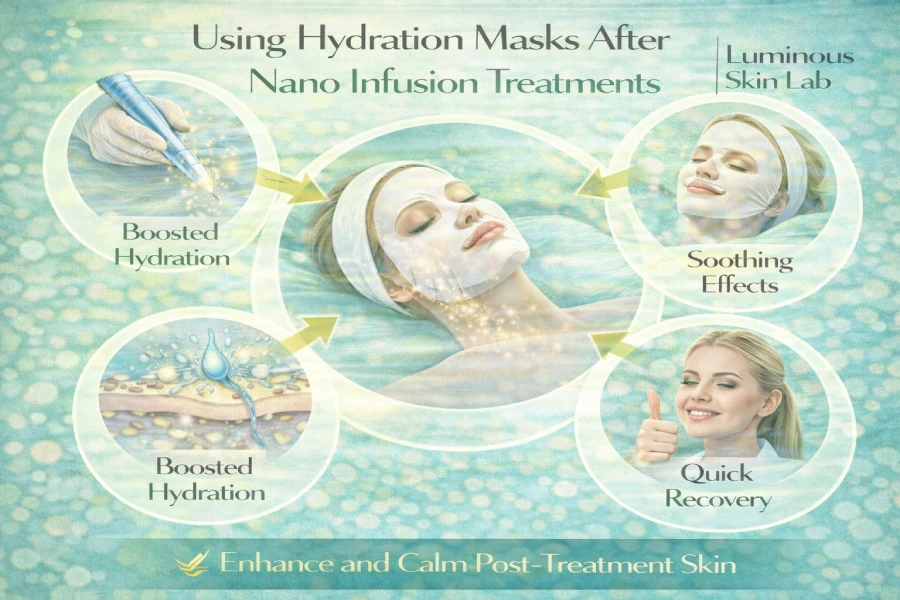
A hydration mask applied immediately after nano infusion serves a distinct clinical function: it seals the temporary microchannels created during treatment, prevents transepidermal water loss (TEWL) during the most vulnerable recovery window, and enhances absorption of any serum infused during the treatment pass. Without this step, the skin’s open surface accelerates moisture loss before the barrier has time to reseal naturally, which can reduce results and increase post-treatment sensitivity.
- Nano infusion temporarily increases skin permeability, which elevates TEWL for 20–40 minutes post-treatment.
- Occlusive hydration masks slow TEWL and prevent the serums infused during treatment from evaporating before full absorption.
- Jelly-format, hydrogel, and cream masks with humectant-occlusive combinations are the most clinically appropriate mask types for this step.
- The mask should be applied within two to three minutes of completing the final nano infusion pass to capture the open-channel absorption window.
- Masks with polyglutamic acid, hyaluronic acid, or panthenol as primary ingredients deliver both immediate hydration and sustained barrier support.
- Avoid active exfoliants, retinoids, and high-concentration vitamin C in post-nano masks due to increased absorption rates through open microchannels.
Among the decisions an esthetician makes during a nano infusion service, the post-treatment masking step is one of the most consequential and most frequently abbreviated. In high-volume treatment rooms, time pressure often leads to skipping or shortening the mask phase entirely — a choice that is clinically counterproductive and visible in client results. The post-nano infusion period represents a narrow but high-value window during which the skin is primed for maximal ingredient uptake while simultaneously at elevated risk of moisture loss.
Understanding why this window exists, which mask formulations exploit it most effectively, and how to build a repeatable post-treatment protocol is foundational knowledge for any esthetician offering nano infusion as part of their service menu. This article covers the science behind post-nano hydration masking, the clinical distinctions between mask formats, ingredient selection criteria, and the practical protocol considerations that separate an adequate finish from a truly exceptional client result.
Whether you are introducing nano infusion into your practice for the first time or refining an existing protocol, the masking step covered here represents one of the lowest-cost, highest-impact upgrades available in this service category.
What Every Esthetician Should Know About Post-Nano Infusion Masking
- The post-nano infusion skin surface is temporarily more permeable, making this the highest absorption window in the entire treatment sequence.
- TEWL elevates immediately after nano infusion and peaks within the first ten minutes — this is when a properly selected hydration mask has the greatest protective effect.
- Mask format matters as much as ingredient content: occlusive formats that physically seal the skin surface outperform breathable formats in the post-treatment context.
- Polyglutamic acid is particularly suited to this window because it inhibits hyaluronidase, protecting both applied and naturally occurring hyaluronic acid in the skin.
- Active exfoliants, retinoids, and fragrance should be excluded from any mask used directly after nano infusion due to elevated permeability risk.
- The mask step supports client comfort as well as clinical outcomes — reduced post-treatment tightness directly improves rebooking rates.
- Preparing the mask during the final nano infusion pass allows seamless, immediate application and eliminates delay-related absorption loss.
Why the Post-Nano Infusion Window Is Clinically Unique
Nano infusion works by creating temporary, superficial microchannels in the skin surface using densely packed silicon or metal nano-tips oscillating at high frequency. These microchannels are not true dermal punctures — they remain within the epidermis and do not reach the dermis — but they do temporarily compromise the integrity of the stratum corneum, the skin’s primary barrier layer. This disruption has two simultaneous effects that define the post-treatment clinical context.
First, ingredient permeability increases significantly. Research on temporary barrier disruption consistently shows that the period immediately following treatment, when microchannels are open and the stratum corneum lipid matrix is temporarily disorganised, allows topically applied ingredients to penetrate more deeply and more rapidly than they would on uncompromised skin. This is the core mechanism that makes nano infusion an effective delivery system for serums, and it is also what makes the post-treatment masking step so strategically important.
Second, TEWL accelerates. The same barrier disruption that creates enhanced permeability also reduces the skin’s ability to retain water. Water molecules that would normally be held within the stratum corneum begin to evaporate at a faster rate than the undisturbed skin allows. Without an occlusive layer applied quickly after treatment, this moisture loss can counteract part of the hydration benefit delivered during the nano infusion pass itself.
How Long the Permeability Window Stays Open
The enhanced permeability created by nano infusion is transient. Skin begins resealing within minutes of the final treatment pass, with the majority of microchannel closure occurring within 30 to 60 minutes depending on the individual’s barrier function, the device settings used, and skin type. This time sensitivity is what separates nano infusion post-treatment protocols from standard facial masking: the mask must be applied immediately to function as a clinical tool rather than simply a finishing aesthetic step.
The Ingredient Science Behind Effective Post-Treatment Masking
Not all hydrating ingredients perform equally in the post-nano infusion context. The temporarily elevated permeability of the skin surface changes the absorption dynamics for every ingredient in a mask formulation, which means that ingredient selection in this step requires more clinical consideration than ingredient selection for a standard maintenance facial mask.
The most clinically appropriate ingredients for post-nano masking fall into two functional categories: humectants that draw and bind water within the epidermis, and occlusives that prevent that water from evaporating. The most effective post-treatment masks deliver both functions from a single formulation, ideally with an outer physical layer that serves the occlusive function and an active ingredient payload that serves the humectant function simultaneously.
Polyglutamic Acid and Its Unique Role in Post-Treatment Recovery
Polyglutamic acid (PGA) is a fermentation-derived biopolymer that has become increasingly relevant in professional post-treatment contexts because of a mechanism that extends beyond standard humectancy. PGA forms a moisture-retaining film at the stratum corneum surface — this film simultaneously acts as a humectant, drawing water to the skin, and as an inhibitor of hyaluronidase, the enzyme responsible for breaking down hyaluronic acid in the skin. In the post-nano infusion context, this dual action means that PGA not only delivers hydration but actively protects the hyaluronic acid already present in the skin from enzymatic degradation during the recovery window. This makes PGA particularly valuable when the infused serum during treatment already contains hyaluronic acid, as PGA effectively extends the functional lifespan of both the applied and naturally occurring HA.
Key Hydration Ingredient Properties in Post-Treatment Recovery Masks
Polyglutamic acid (PGA) holds up to 5,000 times its weight in water — approximately five times the water-binding capacity of hyaluronic acid — and uniquely inhibits hyaluronidase activity at the stratum corneum surface, protecting both applied and naturally occurring HA during the recovery window.
Hyaluronic acid (HA) penetrates to the upper dermis in lower molecular weight forms and delivers deep-layer hydration, but is subject to enzymatic breakdown by hyaluronidase unless protected by a PGA film layer. Combined PGA and HA creates a complete dual-depth hydration system with complementary mechanisms.
Panthenol (provitamin B5) supports barrier repair by improving corneocyte cohesion and is well-tolerated on skin with temporarily disrupted barrier function. Allantoin provides additional calming support and reduces the incidence of post-treatment erythema in reactive skin types.
Comparing Mask Formats for Post-Nano Infusion Recovery
The format of the hydration mask — not just its ingredient content — determines how effectively it performs the occlusive function during the post-nano recovery window. Estheticians evaluating which mask format to incorporate into their post-nano protocol should consider occlusion quality, contact consistency, set behaviour, ingredient compatibility, and suitability for sensitive or reactive skin as primary selection criteria.
Why Mask Format Is Not Interchangeable in This Context
Estheticians who have offered nano infusion for some time often observe that the mask step produces noticeably different client outcomes depending on which format they use, even when the humectant ingredient content is similar across products. This is because the occlusive function of a mask in the post-nano context is inseparable from its physical contact with the skin. A sheet mask that gaps at the nose bridge or jaw allows TEWL to continue at an elevated rate in those areas throughout the mask-on period. A cream mask that is applied too thinly achieves only partial occlusion. The physical characteristics of a mask — how completely it conforms to facial contours, how long its occlusive properties are maintained before it begins to dry or shift — are clinically meaningful variables in a way that they are not during a standard maintenance facial.
One of the most consistent observations in nano infusion treatment rooms is the difference in client skin feel at the end of the service depending on whether the post-treatment mask is applied within two minutes or delayed by five or more minutes while the esthetician prepares the product. Clients masked within the immediate window consistently present with more plumped, luminous skin at mask removal, while those who waited even briefly show relatively more texture and tightness. This prompted a workflow change: preparing the Poly-Luronic™ Jelly Mask during the final nano infusion pass rather than after it, so the mix is ready before the device is set down. The practical result is seamless, immediate masking without any gap. Compared to leaving a sheet mask on for the same duration, the jelly format holds contact consistently across the full face — including the nose bridge and jaw where sheet masks routinely gap — and the cooling temperature of the freshly mixed mask also calms any mild post-treatment warmth without needing a separate cold compress step, which eliminates one tool from the treatment sequence entirely.
Six Protocol Decisions That Determine Post-Nano Masking Outcomes
Estheticians who achieve the strongest post-nano infusion results consistently make deliberate decisions across six key protocol variables. These are not prescriptive steps so much as decision points where clinical knowledge should guide practice rather than habit or convenience.
Application Timing
Apply the hydration mask within two to three minutes of completing the final nano infusion pass. Delay reduces the absorption advantage created by open microchannels and allows TEWL to accelerate unchecked. Prepare the mask during the last treatment pass to eliminate any gap.
Mask Format Selection
Choose a mask format that provides full-face occlusive contact without gaps. Jelly and hydrogel formats outperform cream and sheet formats in this criterion. Format suitability should be evaluated alongside ingredient content as an equally important variable.
Ingredient Screening for Safety
Screen the post-treatment mask formulation for active exfoliants (AHAs, BHAs), retinoids, and fragrance before applying to skin with open microchannels. Enhanced permeability elevates the risk of sensitisation from ingredients that are safe on intact skin but irritating through a disrupted barrier.
Mask-On Duration
Maintain the mask for ten to twenty minutes to allow full humectant delivery and establish a sustained occlusive effect. Remove before the mask begins to dry at the edges, which signals the point at which occlusion starts to reverse. Jelly formats extend the removal window compared to sheet masks.
Serum Sequencing Under the Mask
Apply the nano infusion serum first, complete the treatment pass, then apply the hydration mask directly over the residual serum without removing it. The mask traps the serum against the skin and prolongs its contact time. Removing the serum residue before masking eliminates a significant portion of the treatment’s active ingredient benefit.
Post-Mask Finish Protocol
After mask removal, apply a barrier-supportive moisturiser or serum rather than moving directly to SPF. The skin is still in a semi-permeable state immediately after nano infusion, and a barrier-support ingredient at this stage reinforces the recovery initiated by the mask and extends hydration retention through the remainder of the day.
Building the Post-Nano Hydration Mask Step Into a Repeatable Protocol
The challenge for many estheticians is not understanding the value of post-nano masking but incorporating it consistently into a treatment sequence that must also manage client time expectations, setup logistics, and service flow. A mask step that requires significant preparation time or introduces delays into the treatment rhythm is more likely to be abbreviated or skipped under schedule pressure. Building the step in a way that it can be executed without any disruption to treatment flow is what separates an occasional clinical addition from a consistently applied protocol component.
Workflow Integration Without Adding Treatment Time
In practice, the most efficient approach involves treating the mask preparation as part of the nano infusion phase rather than a separate step that begins after the device is put down. During the final nano infusion pass — typically two to three minutes in duration — the esthetician can prepare the mask on a mixing pad alongside the treatment table. When the nano infusion pass is complete, the mask is ready and can be applied within seconds. This approach adds no additional time to the service and eliminates the TEWL gap that occurs when the mask preparation delays application by several minutes.
Communicating the Masking Step to Clients
Clients who understand why the mask is included in their nano infusion service are significantly more receptive to it and more likely to rebook for the full treatment sequence. Framing the mask step as the phase that “locks in” the serums infused during treatment — explaining that the mask seals the treatment and prevents moisture loss during the critical recovery window — gives clients a concrete mental model for what they are experiencing. This explanation also positions the mask as an essential component of the service value rather than an optional upgrade, which supports both treatment completion rates and client education goals. Estheticians who communicate this clearly consistently report higher client satisfaction scores for their nano infusion services compared to those who present the mask as an add-on.
Adapting the Protocol for Sensitive and Reactive Skin
Post-nano infusion masking for sensitive or reactive skin types requires the same ingredient screening described throughout this article — fragrance-free, essential oil-free, exfoliant-free formulations — but the protocol itself does not need to be significantly modified. If anything, clients with compromised or reactive skin benefit more from the occlusive masking step than clients with resilient skin types, because their baseline barrier function is lower and their TEWL response to temporary barrier disruption is proportionally greater. Confirm ingredient compatibility during the intake consultation and patch test clients with known reactivity prior to the full treatment sequence.
Professional and Scientific References
This article draws on peer-reviewed research into transepidermal water loss mechanisms, humectant and occlusive ingredient science, and the clinical behaviour of temporarily disrupted skin barriers following minimally invasive surface treatments.
- Fluhr, J.W., et al. “Transepidermal water loss reflects permeability barrier status: validation in human and rodent skin.” Experimental Dermatology, 1999–2006. Establishes the TEWL measurement framework used to assess barrier disruption in post-treatment contexts.
- Stern, R., et al. “Hyaluronidase in human skin.” Journal of Investigative Dermatology, 2007. Documents hyaluronidase activity in the epidermis and dermis, providing the scientific basis for PGA’s role in protecting HA from enzymatic degradation.
- Becker, L.C., et al. “Safety assessment of polyglutamic acid as used in cosmetics.” International Journal of Toxicology, 2011. Reviews PGA safety, water-binding properties, and film-forming mechanism as relevant to professional cosmetic application.
- Elias, P.M. “Stratum corneum defensive functions: an integrated view.” Journal of Investigative Dermatology, 2005. Core reference on stratum corneum barrier function, lipid matrix organisation, and recovery kinetics following barrier disruption.
- Gorcea, M., et al. “Effective skin moisturisation: comparing cream, gel, and occlusive mask delivery systems for transepidermal water loss reduction.” International Journal of Cosmetic Science, 2012–2018. Documents the occlusive performance differential between gel/jelly format masks and cream or sheet format masks under standardised conditions.
For estheticians building or refining a post-nano infusion masking protocol, the mask selection criteria covered in this article — full-face occlusive contact, dual-humectant ingredient payload, fragrance-free formulation, and a format that remains clinically stable for the full ten-to-twenty-minute mask-on period — collectively point toward jelly-format masks as the most consistently appropriate choice. The Poly-Luronic™ Jelly Mask is formulated with both polyglutamic acid and hyaluronic acid as primary humectants, uses an alginate matrix to form the occlusive film needed to limit TEWL during the post-nano window, and carries no fragrance, exfoliants, or retinoids that would be contraindicated when microchannels are open. For estheticians who want a single masking solution that can function reliably across all skin types in the post-nano context — including sensitive and reactive presentations — the Poly-Luronic™ Jelly Mask consistently meets all of the protocol criteria evaluated in this article.
Explore the Poly-Luronic™ Jelly Mask LineFrequently Asked Questions: Hydration Masks After Nano Infusion
Why does skin need a hydration mask after nano infusion?
Nano infusion temporarily disrupts the skin surface through microchannels, which increases transepidermal water loss (TEWL) for a short window after treatment. A hydration mask applied immediately after closes that recovery window by delivering concentrated humectants while an occlusive seal traps moisture against the skin. Without this step, the serums infused during the treatment can evaporate before full absorption occurs, reducing results and leaving clients with temporary tightness or sensitivity.
How soon after nano infusion should I apply a hydration mask?
The hydration mask should be applied within two to three minutes of completing the nano infusion pass, while the microchannels are still open and the skin surface is primed for absorption. Waiting longer allows TEWL to accelerate and reduces the window of enhanced permeability that makes post-nano masking so clinically effective. Most experienced estheticians prepare the mask during the final nano infusion pass so application is seamless and immediate.
What type of hydration mask works best after nano infusion?
Masks that combine a high-concentration humectant with an occlusive outer layer perform best after nano infusion. Jelly-format masks are particularly well-suited because their gel matrix seals against the skin surface, limiting TEWL while the humectant ingredients draw and bind water in the upper layers of the epidermis. Sheet masks and cream masks can also work but typically provide less consistent occlusion across the full treatment area. Avoid clay or kaolin-based masks after nano infusion, as these are designed to draw moisture out of the skin rather than lock it in.
Can I still use nano infusion serums under the mask, or does the mask replace them?
The hydration mask does not replace the nano infusion serum — these are two distinct steps with different functions. The serum is infused during the nano infusion pass and is selected for its active ingredient payload: growth factors, peptides, hyaluronic acid, or brightening complexes. The hydration mask applied afterward serves a recovery function: it seals the treatment, limits TEWL, and supports the barrier while the skin processes the infused actives. Skipping the serum reduces treatment results; skipping the mask reduces recovery quality and client comfort.
How long should a hydration mask stay on after nano infusion?
Most estheticians leave a hydration mask on for ten to twenty minutes following nano infusion. This gives the mask enough time to deliver its humectant payload and establish an occlusive seal that slows TEWL during the most vulnerable post-treatment window. Jelly-format masks can often be left longer without risk of the mask drying out and reversing the hydration benefit, which is a common issue with some sheet masks. Remove the mask before it begins to pull moisture back from the skin as it dries.
Does using a hydration mask after nano infusion actually improve client results?
Yes, adding a hydration mask step consistently improves visible client outcomes after nano infusion. Estheticians who include a post-nano hydration mask report that clients leave with more luminous, plumped skin compared to treatments that end immediately after the nano infusion pass. The mask step also reduces the incidence of post-treatment tightness and sensitivity, which matters for client comfort and rebooking rates. From a physiological standpoint, this improvement occurs because the mask prevents TEWL from undoing the hydration delivered by the infused serum before the skin barrier has time to reseal.
What ingredients should I look for in a post-nano infusion hydration mask?
The most effective post-nano infusion hydration masks contain polyglutamic acid, hyaluronic acid, or both, as primary humectants. Polyglutamic acid is particularly well-suited to this context because it forms a film at the stratum corneum surface that actively inhibits hyaluronidase, the enzyme that breaks down naturally occurring hyaluronic acid in the skin. This protective action extends the hydration benefit beyond the time the mask is physically on the skin. Additional ingredients worth prioritising include panthenol for barrier support, allantoin for calming, and glycerin as a reliable secondary humectant. Avoid masks containing active exfoliants, retinoids, or high concentrations of vitamin C immediately after nano infusion, as the open microchannels increase absorption rates and the risk of irritation.
Is it safe to apply a hydration mask if a client has sensitive or reactive skin?
A hydration mask is not only safe for sensitive or reactive skin after nano infusion — it is arguably more important for these clients than for resilient skin types. Sensitive skin has a compromised or thinner barrier function, which makes it more vulnerable to TEWL spikes following any treatment that temporarily disrupts the skin surface. Prioritise fragrance-free, dye-free masks formulated without known sensitising ingredients such as essential oils, alcohols, or synthetic preservatives. Confirm ingredient compatibility during the intake consultation, and always patch test clients with highly reactive skin prior to the full treatment.
Why do estheticians use the Poly-Luronic™ Jelly Mask specifically after nano infusion treatments?
Estheticians working with nano infusion protocols frequently use the Poly-Luronic™ Jelly Mask in the post-treatment recovery step because of its dual-humectant formula combining polyglutamic acid and hyaluronic acid, its alginate-based occlusive matrix, and its clean, fragrance-free ingredient profile. The jelly format sets into a flexible, breathable seal against the skin that limits TEWL without causing compression or slippage during the mask-on period. Estheticians also note that the cooling temperature of the mixed jelly mask immediately calms any treatment warmth or mild erythema, improving client comfort without additional steps or products. The Poly-Luronic™ Jelly Mask does not contain active exfoliants, making it safe to apply directly to skin with open microchannels.
The Post-Nano Infusion Mask Step Is a Clinical Decision, Not a Finishing Touch
The evidence for post-nano infusion hydration masking is rooted in well-established barrier science: the temporary permeability created by nano infusion is a clinical asset when exploited correctly and a liability when left unmanaged. A mask applied within the correct timing window, in the correct format, with the correct ingredient profile does three things simultaneously — it continues the ingredient delivery initiated during the nano infusion pass, it limits TEWL during the skin’s most vulnerable recovery period, and it delivers the immediate sensory experience of cooling, calming, and comfort that clients associate with treatment excellence.
For estheticians who are not yet including a structured post-treatment masking step in their nano infusion protocol, the modification is low-cost and high-impact. For those who are already masking but using a format or timing that does not capture the full clinical value of this step, the protocol refinements covered in this article offer a practical, evidence-based pathway to stronger, more consistent results.
Continue building your nano infusion knowledge base with the related articles below, including serums selection for treatment and the role of LED therapy in post-nano recovery workflows.