How Does Nano Infusion Work for Anti-Aging Skin Treatments?
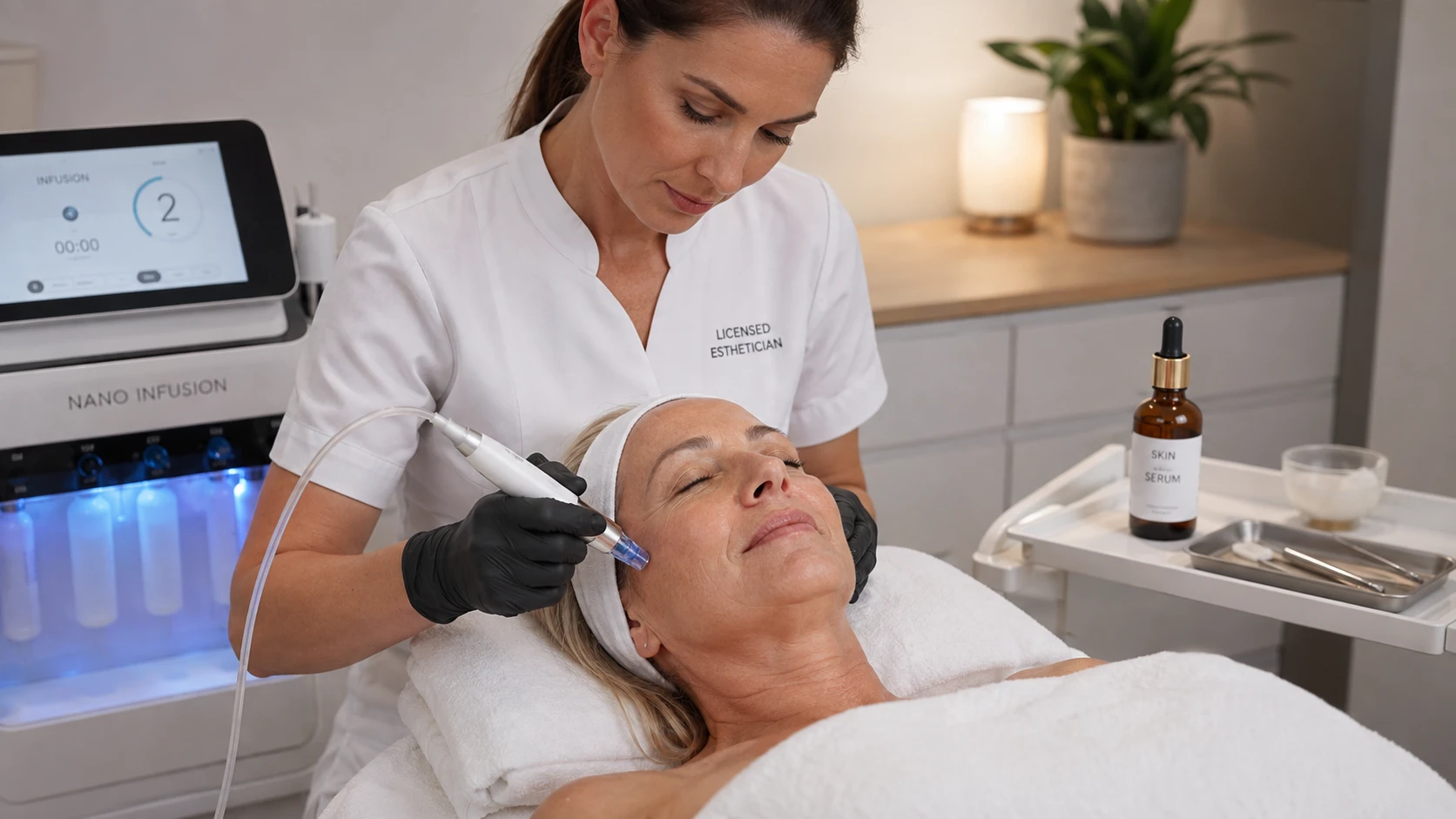
Nano infusion addresses anti-aging concerns by using a silicone nano-tip device to create temporary microchannels in the stratum corneum, allowing active anti-aging ingredients such as peptides, growth factors, and hyaluronic acid to bypass the skin’s natural barrier and reach viable epidermal cells at concentrations far exceeding standard topical application. The mechanical action of the device also produces a mild stimulatory signal that supports collagen and elastin remodeling over a series of treatments.
- Nano infusion can increase active ingredient penetration by up to 97 times compared to passive topical application, making serum selection the most critical clinical decision in the treatment.
- Peptide complexes and growth factors are the highest-value anti-aging serums for nano infusion because their molecular size normally prevents effective topical delivery without channel access.
- A series of four to six treatments spaced one to two weeks apart builds cumulative collagen-stimulating effects; monthly maintenance preserves results long-term.
- Nano infusion is well-suited to mature and sensitive skin because it operates at the epidermal-dermal junction with minimal trauma and no required downtime.
- Following nano infusion with LED red light therapy amplifies the collagen-stimulating response, while an occlusive hydration mask seals microchannels and consolidates the active ingredient delivery.
- Clients should avoid retinol, acids, and direct sun exposure for 24 hours post-treatment to protect the temporarily sensitised skin.
Anti-aging represents one of the most consistently requested treatment outcomes in professional esthetic practice. Clients seeking to address fine lines, loss of elasticity, uneven tone, and overall dullness increasingly want results that go beyond what a standard facial can deliver—but many are not ready for the downtime associated with clinical microneedling or resurfacing procedures. Nano infusion fills this gap by offering a meaningful delivery mechanism for anti-aging actives in a treatment with a recovery profile gentle enough for regular maintenance scheduling.
The core clinical argument for nano infusion in anti-aging work is straightforward: the most effective anti-aging ingredients—peptides, growth factors, niacinamide—are largely blocked by the intact stratum corneum at the molecular weights required for biological activity. A nano infusion pass temporarily disrupts that barrier layer in a controlled, non-dermal way, creating a delivery window that significantly elevates the clinical return on the serums applied. Understanding this mechanism allows estheticians to build nano infusion anti-aging protocols that are both technically sound and commercially compelling.
This article covers the science behind nano infusion’s anti-aging mechanism, serum selection principles, full treatment sequencing, the six key protocol decisions that determine outcomes, and recovery strategies that support lasting results between sessions.
What Every Esthetician Should Know About Nano Infusion for Anti-Aging
- Serum selection is the single most important clinical decision in nano infusion anti-aging treatments—the channel access created by the device is only as valuable as the actives being infused.
- Peptides and growth factors are the highest-priority anti-aging serums for nano infusion because they are most constrained by the intact stratum corneum under normal topical conditions.
- A structured series of four to six initial treatments spaced one to two weeks apart is required to build the cumulative collagen-stimulating and skin-remodeling response.
- Nano infusion is not a replacement for clinical microneedling in cases of significant collagen loss or deep scarring, but it is the preferred modality for regular anti-aging maintenance in low-downtime clients.
- Sequencing matters: cleanse and prep first, infuse second, apply LED third, mask fourth—deviating from this order reduces clinical efficacy at each step.
- Post-treatment occlusion is clinically significant after nano infusion—it preserves the hydration delivered during the treatment and protects temporarily open microchannels.
- Client education on post-treatment avoidances—especially SPF use and active ingredient timing—directly affects the outcome of each session and the cumulative series result.
Why Nano Infusion Is Effective for Anti-Aging Skin Concerns
The skin’s stratum corneum is a highly effective barrier. This is, of course, its purpose—but it presents a significant challenge for topical anti-aging treatment. Large-molecule actives such as tripeptide complexes, hexapeptides, and epidermal growth factors have molecular weights that prevent meaningful transdermal penetration through passive application alone. Studies on transepidermal delivery consistently show that molecules above approximately 500 daltons have severely limited passive penetration rates, and most high-potency anti-aging peptides fall well above this threshold.
Nano infusion devices use a cartridge of silicone nano-tips vibrating at high frequency to create temporary, shallow microchannels in the stratum corneum. These channels are not true dermal punctures—they do not reach the papillary dermis the way microneedling needles do—but they represent a meaningful disruption of the outermost barrier layer that dramatically increases topical permeability for the duration of the treatment and for a brief window afterward. Research on similar transepidermal delivery enhancement technologies consistently demonstrates penetration increases in the range of 40 to 97 times compared to passive application, depending on the molecular size of the active and the device used.
The Mechanical Stimulation Signal
Beyond delivery enhancement, the mechanical action of nano infusion produces a mild stimulatory signal at the epidermal-dermal interface. While this signal is considerably less intense than the wound-healing cascade triggered by clinical microneedling, it is sufficient to encourage fibroblast activity over a series of treatments. Estheticians who have delivered nano infusion series protocols consistently observe progressive improvements in skin texture, firmness, and luminosity that exceed what the ingredient delivery alone would explain—suggesting that the cumulative mechanical stimulation contributes to the overall anti-aging outcome.
This combination of enhanced delivery and mild mechanical stimulation is what positions nano infusion as a genuinely anti-aging treatment rather than simply an enhanced hydration treatment. The distinction matters clinically and commercially: clients investing in a nano infusion series for anti-aging outcomes are receiving both the active ingredient benefit and a progressive structural support benefit that builds over time.
The Science of Anti-Aging Serum Selection for Nano Infusion
The quality and specificity of the anti-aging serums selected for nano infusion determines the clinical ceiling of the treatment. Because the device creates temporary access past the stratum corneum, serums that would otherwise be largely ineffective as passive topicals become genuinely active at the cellular level. This makes serum selection a higher-stakes clinical decision in nano infusion than in a standard facial—the right choices significantly amplify outcomes, while poor choices waste the delivery opportunity the treatment creates.
Priority Active Ingredients for Anti-Aging Nano Infusion
Peptide complexes are the most clinically valuable primary actives for anti-aging nano infusion work. Signal peptides such as argireline (acetyl hexapeptide-3) and leuphasyl mimic the mechanism of neuromodulators by reducing repetitive muscle contractions that deepen expression lines over time. Matrixyl (palmitoyl pentapeptide-4) and its variants signal fibroblasts to increase collagen I, collagen III, and hyaluronic acid synthesis. These ingredients work best when delivered directly to epidermal and upper dermal fibroblast populations, which is precisely what nano infusion facilitates.
Growth factors—including epidermal growth factor (EGF) and transforming growth factor beta (TGF-β)—represent another high-value category for nano infusion anti-aging work. These proteins have significant molecular weights that severely limit passive transepidermal delivery, making them ideal candidates for channel-assisted infusion. Growth factors signal keratinocyte and fibroblast proliferation, accelerate cellular turnover, and support the structural protein matrix that underpins skin firmness and resilience. Incorporating growth factor serums into a nano infusion anti-aging protocol addresses the cellular repair dimension of aging that peptides alone do not fully cover.
How Key Anti-Aging Actives Work Through Nano Infusion Channels
The stratum corneum functions as a molecular sieve. Under passive topical conditions, large-molecule actives including most peptides and growth factors have critically limited penetration rates. Nano infusion bypasses this limitation by creating temporary epidermal microchannels, delivering actives to viable epidermal cells at concentrations that passive application cannot achieve.
Peptides signal fibroblasts to increase collagen and elastin synthesis when they reach viable epidermal and upper dermal tissue. Growth factors stimulate cellular proliferation and structural repair but require channel access due to their molecular weight. Hyaluronic acid (low-molecular-weight) provides immediate volumising hydration at the epidermal level. Niacinamide supports barrier function, suppresses melanin transfer for tone correction, and reduces the appearance of enlarged pores—all of which contribute to the anti-aging visual outcome.
Retinol and vitamin C (ascorbic acid) should be reserved for home care use rather than infused during treatment, as their chemical properties can cause irritation through open microchannels—particularly in mature or sensitised skin.
Anti-Aging Nano Infusion Treatment Sequencing and Protocol Structure
The sequence in which nano infusion steps are delivered has a direct clinical impact on outcomes. Each step in an anti-aging nano infusion protocol builds the conditions for the next, and deviating from the established order reduces the efficacy of every subsequent step. The infographic below maps the full treatment sequence with timing benchmarks for an anti-aging nano infusion facial.
Why Sequencing Affects Clinical Outcomes
Each step in the protocol above creates the conditions for the next. A thorough double cleanse and mild enzyme prep increases stratum corneum receptivity before the nano infusion pass. Performing LED therapy immediately after infusion—before the microchannels close and inflammation resolves—means the photobiomodulation signal reaches tissue that is actively in the post-stimulation repair state. Applying an occlusive hydration mask during LED exposure rather than afterward means the mask is working while the skin is both open and photobiomodulated, compounding the hydration benefit. These timing interdependencies are not incidental; they are the structural logic of a well-designed protocol.
In high-volume nano infusion practice, one of the most consistent differentiators in anti-aging outcome quality is what happens in the 20 minutes immediately after the infusion pass. Estheticians who transition directly from infusion to a lightweight, non-occlusive hydrator consistently see more redness and tighter, more sensitised skin the following day compared to those who use an occlusive masking step. The Poly-Luronic™ Jelly Mask has become the preferred post-infusion masking protocol for anti-aging work specifically because of how its gel matrix behaves on freshly infused skin—the cooling application immediately calms the mild thermal sensation that follows the device pass, and the 15-to-20-minute set time coincides almost exactly with the LED therapy phase, meaning the two recovery tools are working simultaneously rather than sequentially. Compared to standard sheet masks applied in the same position, the jelly mask’s occlusive seal is noticeably more effective at maintaining the hydration delivered during the infusion pass, which is particularly visible on mature clients whose barrier is already compromised. For clients in their 50s and 60s with significant dehydration alongside structural aging concerns, this combination of occlusion during LED exposure consistently produces a more luminous and plump post-treatment appearance than infusion followed by LED alone.
Six Protocol Decisions That Determine Anti-Aging Nano Infusion Outcomes
Beyond the treatment sequence, six specific protocol decisions have an outsized impact on the clinical results of a nano infusion anti-aging series. Understanding these variables allows estheticians to customise treatments for individual clients rather than delivering a one-size-fits-all protocol.
Primary Serum Selection
The serum infused during the nano infusion pass is the primary clinical driver of the anti-aging outcome. For fine lines and early collagen loss, a peptide complex serum (Matrixyl, argireline) is the first choice. For clients with significantly reduced cellular turnover or post-inflammatory texture, a growth factor serum is more appropriate. Matching serum to concern is the foundational protocol decision.
Device Pass Technique
Overlapping linear passes followed by cross-hatch passes across each treatment zone ensures consistent microchannel coverage. Estheticians who apply the device in random or non-systematic patterns consistently produce less uniform serum delivery. For anti-aging work on the periorbital area and upper lip, shorter, lighter passes are required due to skin thickness and proximity to sensitive structures.
Wet vs. Dry Working Surface
Maintaining a continuously wet working surface during the nano infusion pass is non-negotiable for anti-aging treatments. The serum serves as both the active being infused and the glide medium for the device. Allowing the surface to dry between passes reduces delivery efficiency and increases the risk of friction-related micro-irritation, particularly on mature skin with reduced lipid reserves.
LED Wavelength Pairing
Red light at 630–660 nm is the primary anti-aging wavelength, supporting fibroblast activity and collagen synthesis. Near-infrared at 830–850 nm penetrates more deeply and supports mitochondrial energy production, enhancing cellular repair. Pairing both wavelengths in the post-infusion LED step provides a more complete anti-aging photobiomodulation response than red light alone.
Masking Material and Timing
The mask applied after the nano infusion pass must be occlusive, fragrance-free, and formulated for sensitised skin. The timing of mask application relative to LED therapy determines whether the two modalities work concurrently or sequentially—concurrent application (mask during LED) compounds the recovery benefit. Choosing a mask with active humectant ingredients rather than a purely neutral recovery mask adds an additional delivery layer to the protocol.
Home Care Bridging Protocol
The anti-aging outcome of a nano infusion session is partially determined by what the client does in the 72 hours following treatment. A clear home care bridging protocol—gentle cleanser, fragrance-free moisturiser, consistent SPF, and no actives for 24 hours—prevents post-treatment sensitisation from undermining the clinical gains. Providing written aftercare instructions at the time of treatment significantly improves client compliance and series outcomes.
Building an Effective Nano Infusion Anti-Aging Series for Clients
A single nano infusion anti-aging treatment produces noticeable results—improved luminosity, plumper texture, and reduced line visibility from the hydration component are typically visible immediately. However, the collagen-stimulating and structural remodeling benefits of nano infusion are cumulative and require a committed series to produce meaningful long-term change. Communicating this to clients at the consultation stage is essential for setting realistic expectations and securing series bookings.
Series Structuring for Anti-Aging Goals
The standard professional recommendation for anti-aging nano infusion is an initial series of four to six treatments spaced one to two weeks apart. This spacing allows the skin to complete each micro-stimulation cycle before the next treatment begins, while maintaining enough frequency for the cumulative collagen response to build without regressing between sessions. After the initial series, clients typically transition to monthly maintenance treatments to preserve the structural gains and continue the anti-aging serum delivery benefit.
Clients with more advanced signs of aging—significant laxity, deep expression lines, or notable textural irregularity—may benefit from a combined modality approach in which nano infusion maintenance sessions are interspersed with quarterly clinical microneedling treatments. This hybrid approach uses nano infusion for the high-frequency, low-downtime active delivery work and reserves clinical microneedling for the deeper collagen induction passes that nano infusion cannot achieve at its operating depth. Estheticians who clearly articulate this distinction help clients understand why both modalities remain valuable in a long-term anti-aging programme.
Client Selection and Contraindication Screening
Nano infusion for anti-aging is appropriate for a wide range of clients, including those with mature, sensitive, and compromised barrier skin types who may not be suitable candidates for more aggressive treatments. Active acne lesions, open wounds, or active skin infections in the treatment area are contraindications for nano infusion regardless of the anti-aging serum being used, as the microchannels created by the device can introduce bacteria into the skin. Clients on isotretinoin, those with blood-clotting disorders, and those with a history of keloid scarring should be referred to a physician before receiving any microchannel-based treatment.
For clients who are candidates, the low-downtime profile of nano infusion is frequently its most compelling selling point alongside the clinical results. Estheticians who position the treatment as a regular maintenance modality—rather than a one-time intensive—consistently build stronger retention and more predictable client outcomes over a treatment year.
Professional and Scientific References
The protocols and mechanisms described in this article are grounded in peer-reviewed research on transepidermal delivery enhancement, photobiomodulation, and topical anti-aging active ingredients in professional esthetic practice.
- Prausnitz, M.R. & Langer, R. (2008). Transdermal drug delivery. Nature Biotechnology, 26(11), 1261–1268. Establishes the molecular weight threshold for passive transepidermal penetration and the role of physical enhancement technologies in overcoming barrier limitations.
- Peptu, C., Humelnicu, A.C., Rotaru, R., et al. (2019). Peptide-based anti-aging cosmeceuticals: An overview. Pharmaceutics, 11(7), 337. Reviews the mechanism of action of signal and carrier peptides as anti-aging actives and the delivery constraints imposed by the stratum corneum.
- Hamblin, M.R. (2017). Mechanisms and mitochondrial redox signaling in photobiomodulation. Photochemistry and Photobiology, 94(2), 199–212. Describes the cellular mechanisms by which red and near-infrared LED wavelengths stimulate fibroblast activity and collagen synthesis.
- Aust, M.C., Fernandes, D., Kolokythas, P., et al. (2008). Percutaneous collagen induction therapy: An alternative treatment for scars, wrinkles and skin laxity. Plastic and Reconstructive Surgery, 121(4), 1421–1429. Provides foundational evidence for mechanical stimulation as a driver of collagen induction in the absence of full dermal puncture.
- Junger, M. & Zuder, D. (2020). Hyaluronic acid: From biochemistry to clinical aspects. Current Pharmaceutical Design, 26(32). Reviews hyaluronic acid’s role in epidermal hydration and skin volume, supporting its use as a primary infusion active in anti-aging nano infusion protocols.
For estheticians delivering nano infusion anti-aging treatments, the post-infusion masking step is where clinical outcomes are either consolidated or lost. A mask that fails to provide genuine occlusion allows the hydration and active delivery benefit of the nano infusion pass to dissipate before the skin can recover—undermining the entire protocol investment. The Poly-Luronic™ Jelly Mask addresses this requirement with a dual-function formulation: its alginate-based gel matrix provides the occlusive seal required to lock in the actives delivered during infusion, while its polyglutamic acid and hyaluronic acid blend continues active humectant delivery throughout the masking phase. For mature clients with significant dehydration alongside structural aging concerns, this combination of occlusion and continued active delivery is the most clinically appropriate recovery step available in a professional treatment room context. The fragrance-free, calming formulation also ensures compatibility with the temporarily sensitised skin that follows any microchannel treatment, making it the recommended masking choice across the full range of nano infusion anti-aging client profiles.
Explore the Poly-Luronic™ Jelly Mask LineFrequently Asked Questions: Nano Infusion for Anti-Aging Treatments
Does nano infusion actually help with anti-aging?
Yes, nano infusion supports anti-aging outcomes through two mechanisms: it creates temporary microchannels that significantly increase penetration of active anti-aging ingredients, and the mechanical stimulation itself can trigger a mild wound-healing response that encourages collagen and elastin remodeling over repeated treatments. Clinical observations consistently show improvements in skin texture, fine line appearance, and overall luminosity, particularly when high-quality peptide and growth factor serums are infused during the treatment.
What serums work best for anti-aging nano infusion treatments?
Peptide complexes, growth factors, hyaluronic acid, and niacinamide are the most clinically appropriate serums for anti-aging nano infusion. Peptides such as argireline and leuphasyl signal fibroblasts to produce collagen, while growth factors directly support cellular repair and regeneration. Hyaluronic acid provides immediate volumizing hydration at the epidermal level, and niacinamide supports barrier function and tone correction. Estheticians should avoid retinol and vitamin C during the infusion pass due to potential irritation through open microchannels, reserving those actives for follow-up home care.
How often should clients come in for nano infusion anti-aging treatments?
For anti-aging goals, a series of four to six treatments spaced one to two weeks apart is the standard professional recommendation, followed by monthly maintenance sessions. The initial series builds cumulative collagen-stimulating effects, while monthly maintenance preserves results and allows continued active ingredient absorption. Clients with significantly lax skin or deep lines may benefit from biweekly sessions in the initial phase before transitioning to monthly intervals.
Can nano infusion stimulate collagen the same way microneedling does?
Nano infusion and microneedling both trigger collagen stimulation, but through different mechanisms and at different intensities. Microneedling creates dermal punctures that reach deeper tissue layers and produce a more pronounced wound-healing cascade, making it more effective for significant collagen remodeling in clients with advanced aging or scarring. Nano infusion operates at the epidermal-dermal junction with silicone nano-tips that create shallower channels, producing a milder stimulation with minimal downtime. For clients seeking consistent, low-downtime anti-aging maintenance, nano infusion delivers meaningful results without the recovery requirements of clinical microneedling.
Is nano infusion safe for mature or sensitive skin clients?
Nano infusion is well-suited for mature and sensitive skin clients because it does not pierce the dermis and produces minimal trauma compared to other resurfacing modalities. Mature skin often has a compromised barrier and reduced tolerance for aggressive treatments, making nano infusion an appropriate option for delivering anti-aging actives without triggering significant inflammation. Estheticians should select calming, barrier-supportive serums and avoid high-concentration acids during the infusion pass. Post-treatment hydration and occlusion are especially important for mature skin to protect the temporarily open channels.
Where does nano infusion fit in an anti-aging facial protocol?
In a structured anti-aging facial, nano infusion is most effective after cleansing, exfoliation, and any enzyme or mild acid preparation, and before LED therapy and the masking step. Performing nano infusion on freshly prepped skin maximises channel access for active serums, while following it with LED light therapy—particularly red and near-infrared wavelengths—amplifies the collagen-stimulating response and reduces post-treatment inflammation. A hydrating occlusive mask applied after LED therapy seals the skin and supports barrier recovery, completing the treatment sequence.
Why does serum absorption matter so much in nano infusion anti-aging treatments?
Serum absorption is the primary clinical mechanism that distinguishes nano infusion from a standard facial massage. The stratum corneum normally limits topical penetration of large-molecule actives such as peptides and growth factors to the upper epidermal layers, significantly reducing their efficacy. Nano infusion temporarily bypasses this barrier by creating microchannels estimated to increase active ingredient delivery by a factor of up to 97 times compared to passive topical application. This means that the quality, molecular weight, and concentration of the serum chosen for infusion directly determines the clinical outcome of the treatment.
What should clients avoid after a nano infusion anti-aging treatment?
For the first 24 hours after nano infusion, clients should avoid active exfoliants such as retinol, AHAs, and BHAs, direct sun exposure without SPF, heavy exercise that produces significant sweating, and any abrasive or fragrance-heavy products. The temporarily open microchannels make skin more susceptible to irritation and sensitisation, so gentle, hydrating, and barrier-supportive products are strongly recommended in the immediate post-treatment window. Broad-spectrum SPF 30 or higher should be applied the following morning and consistently maintained during the treatment series.
How does the Poly-Luronic™ Jelly Mask support recovery after nano infusion anti-aging treatments?
The Poly-Luronic™ Jelly Mask is particularly well-matched to post-nano-infusion anti-aging recovery because its occlusive jelly matrix seals the temporarily open microchannels while delivering dual-depth hydration through polyglutamic acid and hyaluronic acid working in combination. After infusing anti-aging actives, the skin requires both barrier protection and continued humectant support to consolidate the treatment outcome. Estheticians working with mature clients find the cooling application of the jelly mask immediately calms any residual warmth from the nano infusion pass, and the 15-to-20-minute set time allows clients to rest while the mask works. The fragrance-free, calming formulation is appropriate even for reactive mature skin that would not tolerate more aggressive post-treatment products.
Nano Infusion as a Core Anti-Aging Modality in Professional Practice
Nano infusion occupies a uniquely valuable position in the anti-aging treatment toolkit: it delivers clinical-grade active ingredients past the primary barrier to efficacy, produces cumulative structural benefits through mechanical stimulation, and does so without the recovery requirements that prevent many clients from committing to regular treatment series. For estheticians, this combination makes nano infusion one of the most commercially and clinically sustainable anti-aging services available within the esthetic scope of practice.
The quality of outcomes from nano infusion anti-aging treatments is directly proportional to the quality of the clinical decisions made at each protocol stage—serum selection, device technique, sequencing, masking, and post-treatment care. Estheticians who develop systematic, evidence-informed approaches to each of these decisions will consistently outperform those working from intuition alone. Treating nano infusion as a full protocol rather than a single-step add-on is the key distinction between average and exceptional anti-aging results.
Building a nano infusion anti-aging service menu around a clear treatment series structure, well-chosen actives, and a professional recovery protocol creates a repeatable clinical service that drives both client retention and consistent anti-aging outcomes—the foundation of a sustainable, results-driven esthetic practice.