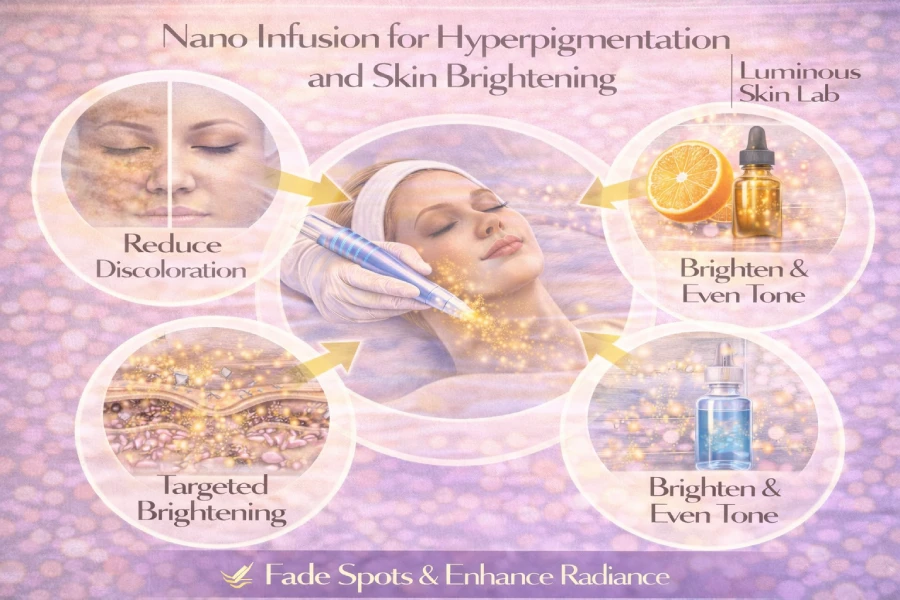
Can Nano Infusion Improve Hyperpigmentation and Uneven Skin Tone?
Yes. Nano infusion microchanneling improves hyperpigmentation by temporarily opening superficial delivery pathways in the stratum corneum, allowing brightening actives such as tranexamic acid, vitamin C, niacinamide, and alpha-arbutin to penetrate at significantly higher concentrations than topical application alone can achieve. Over a series of treatments, clients experience measurable reduction in pigmentation intensity and overall improvement in skin tone evenness.
- Nano infusion enhances active ingredient absorption by temporarily disrupting the stratum corneum’s barrier function without triggering the trauma response associated with needled devices.
- Tranexamic acid, vitamin C, niacinamide, kojic acid, and alpha-arbutin are the most clinically supported brightening actives for nano infusion delivery.
- Post-inflammatory hyperpigmentation from acne responds particularly well because nano infusion does not introduce heat or mechanical trauma that can trigger further reactive pigmentation.
- Clients with higher Fitzpatrick skin types (III–VI) benefit from nano infusion’s low-trauma profile compared to peels or laser-adjacent modalities.
- A series of six to eight sessions spaced one to two weeks apart is typically required for measurable, lasting improvement in established pigmentation.
- Post-infusion occlusion and hydration immediately following treatment lock brightening actives against the skin surface and reduce the inflammation that can worsen pigmentation.
Hyperpigmentation is one of the most common concerns estheticians encounter across all skin types, and it is also one of the most frustrating to treat with topical-only protocols. The fundamental challenge is delivery: melanin-modulating ingredients such as tranexamic acid and vitamin C have well-documented mechanisms for reducing pigmentation, but their ability to reach the melanocytes and keratinocytes involved in pigment production is limited when applied to intact, fully keratinised skin. Most of the active ingredient remains at the surface and is cleared before it can exert a meaningful effect on the underlying pigmentation pathway.
Nano infusion microchanneling addresses this delivery barrier directly. By creating thousands of temporary, nano-scale channels in the stratum corneum, the treatment provides a brief window during which serums applied to the skin surface can penetrate to depths and concentrations that passive application cannot replicate. For brightening protocols specifically, this means estheticians can deliver ingredient loads that produce visible changes in pigmentation without resorting to aggressive exfoliation, heat-based devices, or treatments that carry significant downtime or post-inflammatory pigmentation risk.
This article covers the clinical rationale for nano infusion in hyperpigmentation protocols, the brightening actives best suited to infusion delivery, the client profiles that respond most predictably, and the protocol considerations that distinguish effective treatment series from frustrating, inconsistent outcomes.
What Every Esthetician Should Know About Nano Infusion for Hyperpigmentation
- Nano infusion treats hyperpigmentation by enhancing delivery of brightening actives, not by physically removing pigmented cells — this distinction shapes client expectation setting and timeline communication.
- Serum selection is the most critical variable in outcomes: ingredient choice must match pigmentation type, skin sensitivity, and any concurrent at-home regimen.
- Tranexamic acid is the preferred first-line brightening active for post-inflammatory and reactive pigmentation due to its tolerability across all Fitzpatrick types.
- Clients with Fitzpatrick types III–VI are ideal candidates because nano infusion avoids the heat and trauma that commonly trigger reactive hyperpigmentation in darker skin tones.
- A minimum series of six sessions is required for lasting improvement — single treatments improve luminosity but do not shift established pigmentation deposits.
- Post-treatment occlusion immediately after infusion is a protocol step, not optional — it extends active ingredient contact time during the critical open-channel window.
- Sun protection adherence between sessions is the single most important client compliance factor — UV exposure will reverse treatment progress regardless of protocol quality.
How Nano Infusion Addresses the Delivery Problem in Hyperpigmentation Treatment
The skin’s stratum corneum is extraordinarily effective at limiting what crosses it in both directions — which is precisely why topical brightening ingredients often underperform in clinical settings. The outer layer of keratinised cells presents a lipid-rich, tightly structured barrier that restricts penetration of most active ingredients to negligible depths. Even formulations designed with penetration-enhancing vehicles rarely achieve the dermal concentrations required to meaningfully interrupt melanin synthesis pathways at the cellular level.
Nano infusion creates a transient permeation window by mechanically disrupting the stratum corneum with silicone or steel nano-tips that oscillate at high speed across the skin surface. This creates thousands of microscopic channels per square centimetre, temporarily bypassing the barrier and allowing serums applied during the treatment to reach the epidermis at concentrations significantly above what passive application achieves. Critically, the channels are shallow — typically 0.1 to 0.15 mm — and close within hours, so the disruption is brief and the recovery window is minimal.
Why This Mechanism Is Particularly Relevant for Pigmentation
Melanogenesis — the process by which melanocytes produce melanin — occurs in the basal layer of the epidermis, not at the skin surface. For brightening actives to interrupt tyrosinase activity, inhibit melanin transfer to keratinocytes, or block the inflammatory signalling that drives post-inflammatory hyperpigmentation, they need to reach epidermal depth. Nano infusion’s transient microchannels provide a route that brings well-formulated serums meaningfully closer to the cell populations where pigmentation is actually being produced. This is why the combination of the right device settings, the right serum, and the right post-treatment protocol produces outcomes that topical-only brightening regimens struggle to match, even when those regimens use the same active ingredients.
The Science Behind Brightening Actives Used in Nano Infusion Protocols
Not all brightening ingredients behave the same way when delivered via nano infusion, and understanding the mechanism of each active helps estheticians match serum selection to pigmentation type, skin sensitivity, and treatment goals. The most effective brightening actives for nano infusion delivery work either by directly inhibiting tyrosinase (the enzyme that catalyses melanin synthesis), by interrupting the transfer of melanin from melanocytes to surrounding keratinocytes, or by modulating the inflammatory signals that drive post-inflammatory hyperpigmentation. Knowing which mechanism is most relevant to a client’s pigmentation type determines which active should be prioritised in serum selection.
Primary Brightening Actives and Their Mechanisms
Tranexamic acid works by inhibiting the interaction between keratinocytes and melanocytes during the inflammatory cascade, making it the most targeted active for post-inflammatory hyperpigmentation. Vitamin C (L-ascorbic acid and stabilised derivatives) inhibits tyrosinase directly and provides antioxidant protection against UV-induced pigmentation. Niacinamide blocks the transfer of melanosomes from melanocytes to keratinocytes, reducing pigment expression without affecting melanin production itself — which means it is effective as a preventive and maintenance active rather than a corrective one. Alpha-arbutin and kojic acid are additional tyrosinase inhibitors that are well tolerated during infusion delivery.
Key Brightening Actives: Mechanism, Target, and Infusion Profile
Tranexamic acid inhibits the plasminogen-keratinocyte interaction that drives melanocyte stimulation during inflammation. It does not directly inhibit tyrosinase, which means it is most effective for post-inflammatory and reactive pigmentation rather than UV-induced sun spots. It is highly tolerable, pH-flexible, and suitable for all Fitzpatrick types, making it the most versatile first-line choice for nano infusion brightening serums.
L-ascorbic acid (vitamin C) inhibits tyrosinase by reducing the copper ions required for enzyme activity, while simultaneously acting as an antioxidant that interrupts UV-triggered melanogenesis. Stabilised vitamin C derivatives such as ascorbyl glucoside and sodium ascorbyl phosphate are preferred for nano infusion delivery as they are less pH-dependent and less likely to cause irritation through open microchannels. Effective concentrations in infusion serums typically range from 10 to 20 percent for stabilised forms.
Niacinamide operates downstream of melanin synthesis by inhibiting melanosome transfer from melanocytes to keratinocytes. Concentrations of 5 percent are clinically effective, and niacinamide’s simultaneous barrier-supportive properties make it a dual-function active that is particularly appropriate for sensitive or compromised skin types undergoing nano infusion.
Matching Brightening Actives to Pigmentation Type: A Clinical Framework
One of the most common reasons nano infusion brightening protocols underperform is serum selection that does not match the underlying pigmentation mechanism. A client with post-acne PIH requires a different active profile than a client with UV-induced lentigines or melasma. The framework below maps the most common hyperpigmentation presentations to the brightening actives with the strongest clinical rationale for each type, providing estheticians with a decision structure that improves consistency across their client base.
Why Serum Concentration and Formulation pH Matter During Infusion
Delivering brightening actives through nano infusion microchannels is not simply a matter of using any available brightening serum during the treatment. Formulation factors including pH, vehicle viscosity, and preservative load affect both tolerability through open microchannels and the stability of active ingredients once they have been delivered. L-ascorbic acid, for example, requires a pH below 3.5 for effective tyrosinase inhibition, but at that pH it may cause stinging or irritation through the transiently disrupted stratum corneum — which is one reason stabilised vitamin C derivatives at a more neutral pH are generally preferred for infusion delivery. Estheticians should source serums that are specifically formulated or confirmed by manufacturers for use with microchanneling devices.
The most consistent feedback from estheticians running nano infusion brightening series is that the post-infusion step determines client satisfaction as much as the infusion itself. In practice, applying the Poly-Luronic™ Jelly Mask immediately after the final infusion pass — while the skin is still slightly flushed and the microchannels are transiently open — seals the tranexamic acid or vitamin C serum against the skin surface for the full 15-minute mask period, extending active contact time in a way that simply leaving the serum on without occlusion does not replicate. Estheticians who previously finished brightening treatments with a standard hydrating mask noticed that switching to an alginate-based occlusive mask reduced the residual redness clients presented with at the end of the appointment, which is particularly relevant when treating higher Fitzpatrick types where any post-treatment inflammation is a potential trigger for reactive pigmentation. The cooling temperature of the freshly mixed jelly mask also provides an immediate sensory signal to clients that the treatment is calming down, which supports the high-tolerance perception that makes brightening series easy to rebook.
Six Protocol Decisions That Determine Brightening Outcomes
The difference between a nano infusion brightening series that produces visible, lasting improvement and one that generates inconsistent results is rarely the device — it is typically the cumulative effect of several protocol decisions that practitioners make before, during, and after each session. The following six factors account for most of the outcome variation estheticians encounter in practice.
Pigmentation Type Identification at Consultation
Accurately categorising the pigmentation type before beginning a series is the foundational step. PIH, UV-induced, hormonal, and melasma presentations require different active profiles and have different prognoses. Applying the wrong active to a hormonally driven presentation will produce minimal results and erode client confidence in the protocol. Use structured intake questions to identify likely underlying drivers before selecting serums.
Serum Selection Matched to Mechanism
Select serums whose active ingredients match the melanogenesis pathway driving the client’s specific pigmentation type. Do not default to a single brightening serum for all hyperpigmentation presentations. Confirm that the formulation is appropriate for microchanneling delivery: appropriate pH, non-irritating vehicle, and free of contraindicated ingredients such as undiluted essential oils or high-concentration AHAs.
Device Speed and Pass Count by Skin Sensitivity
Higher Fitzpatrick types and sensitive skin presentations require conservative device settings — lower oscillation speed and fewer passes over reactive areas — to avoid triggering the post-inflammatory response that perpetuates the pigmentation cycle. Standard brightening protocols typically use two to three passes per treatment zone, but this should be reduced to one to two passes on reactive or rosacea-prone presentations.
Post-Infusion Occlusion Timing
The post-infusion occlusive mask must be applied immediately after the final device pass, before the transient microchannels begin to close. Delaying the mask by more than three to five minutes significantly reduces the occlusion benefit. Instruct support staff or prepare the mask application materials in advance so the transition from infusion to mask is seamless within the treatment workflow.
Session Frequency for Pigmentation Series
Brightening protocols require closer session spacing than general skin maintenance nano infusion treatments. Sessions scheduled one to two weeks apart are appropriate for most clients because this allows sufficient cellular turnover between visits to allow the previous session’s active delivery to translate into visible surface change. Spacing sessions more than three weeks apart in the initial series significantly slows cumulative progress.
Client Sun Protection Compliance
UV exposure between sessions will reverse treatment progress even when all other protocol variables are optimised. At every session, confirm client SPF compliance and address any barriers to daily use. Provide specific, actionable product recommendations rather than a general instruction to wear sunscreen. Estheticians who build SPF check-ins into the pre-treatment consultation consistently report better brightening outcomes across their client base.
Building a Nano Infusion Brightening Series: Client Selection and Realistic Outcomes
Setting accurate client expectations before beginning a brightening series is one of the most important clinical communication skills an esthetician can develop. Clients who arrive expecting dramatic improvement after a single session will be disappointed even by technically successful treatment. Equally, clients who understand the timeline and underlying biology of pigmentation management are more likely to complete the full series, maintain compliance with home care, and return for maintenance treatments — all of which are prerequisites for lasting outcomes.
Ideal Candidate Profile for Nano Infusion Brightening
The clients who respond most predictably and satisfyingly to nano infusion brightening protocols share several characteristics. They have pigmentation that is predominantly epidermal rather than dermal — surface-level or mid-epidermal pigmentation responds to ingredient delivery in a way that deep dermal deposits do not. They have consistent sun protection habits or are willing to adopt them. They are not actively taking photosensitising medications that would contraindicate microchanneling. And they have realistic expectations about treatment timelines, understanding that six to eight sessions over a three-to-four-month period represents the minimum commitment for lasting improvement in established pigmentation.
Clients with Fitzpatrick skin types III through VI are particularly well-served by nano infusion as a brightening modality because the alternative options — medium-depth chemical peels, laser treatments, and aggressive mechanical exfoliation — carry a meaningfully higher risk of triggering post-inflammatory hyperpigmentation in these skin types. The low-trauma, no-heat nature of nano infusion makes it one of the few professional brightening modalities that is appropriate as a first-line treatment rather than a secondary option for this population.
Maintenance Protocol After the Initial Series
Once a client has completed a six-to-eight-session brightening series and achieved their target improvement, transitioning to a maintenance protocol prevents pigmentation recurrence. For most clients, monthly nano infusion brightening sessions paired with a consistent at-home regimen of brightening actives and daily SPF 30 or higher provides adequate maintenance. Clients who have hormonally driven or melasma-type pigmentation may require more frequent maintenance visits or concurrent management strategies to sustain results during periods of hormonal fluctuation.
Documenting pre-treatment photography under standardised lighting and distance at the start of each series is a practical step that significantly improves client retention. Clients who can see side-by-side comparison images of their pigmentation before and after the series are far more likely to continue maintenance treatments than those relying on subjective memory alone. This is also clinically valuable for the esthetician, providing objective data to guide protocol adjustments in subsequent series.
Professional and Scientific References
The protocols and ingredient recommendations in this article are informed by published research on melanogenesis pathways, microchanneling-enhanced ingredient delivery, and the clinical evidence base for individual brightening actives in professional skincare contexts.
- Piquero-Casals, J. et al. — Dermatology and Therapy, 2021–2023 — Review of tranexamic acid mechanisms in hyperpigmentation treatment, including post-inflammatory and melasma presentations across Fitzpatrick skin types.
- Telang, P.S. — Indian Dermatology Online Journal, 2013 — Clinical review of vitamin C in dermatology: tyrosinase inhibition mechanisms, formulation stability, and topical delivery considerations.
- Hakozaki, T. et al. — British Journal of Dermatology, 2002 — Niacinamide inhibition of melanosome transfer: mechanism and clinical applications for skin tone improvement.
- Badawi, A. et al. — Journal of Cosmetic Dermatology, 2019–2022 — Microchanneling-enhanced transdermal delivery: penetration depth studies and ingredient absorption data relevant to nano infusion protocols.
- Handel, A.C. et al. — Anais Brasileiros de Dermatologia, 2014 — Risk factors for melasma and hyperpigmentation in higher Fitzpatrick skin types, with discussion of low-trauma treatment selection rationale.
For estheticians building nano infusion brightening protocols, the post-infusion recovery step is where a significant portion of the treatment’s value is either preserved or lost. The Poly-Luronic™ Jelly Mask meets the specific clinical requirements of this phase: its alginate-based occlusive structure creates the sealed environment that extends active ingredient contact time against the transiently open skin surface, while its polyglutamic acid and hyaluronic acid delivery simultaneously supports barrier recovery and reduces the post-treatment inflammation that is a known trigger for reactive pigmentation in higher Fitzpatrick types. For estheticians who treat diverse skin tone populations and need a post-infusion mask that supports brightening outcomes without introducing heat, fragrance, or sensitising additives, this formulation is consistent with the clinical protocol framework described in this article.
Explore the Poly-Luronic™ Jelly Mask LineFrequently Asked Questions: Nano Infusion for Hyperpigmentation and Skin Brightening
Can nano infusion actually improve hyperpigmentation?
Yes, nano infusion can meaningfully improve hyperpigmentation when paired with the right brightening serums. The microchanneling action temporarily opens superficial delivery pathways in the stratum corneum, allowing active ingredients such as tranexamic acid, vitamin C, niacinamide, and kojic acid to penetrate far more effectively than topical application alone. Over a series of treatments, clients typically see a measurable reduction in patch intensity and a more even overall skin tone. Results depend heavily on serum selection, treatment frequency, and whether the underlying cause of pigmentation is being managed concurrently.
What brightening serums work best during a nano infusion treatment?
The most effective brightening serums for nano infusion contain tranexamic acid, L-ascorbic acid (vitamin C), niacinamide, kojic acid, or alpha-arbutin as active ingredients. Tranexamic acid is widely considered the most tolerable option for reactive or post-inflammatory pigmentation because it inhibits melanin transfer without provoking irritation. Vitamin C in stabilised forms works well for sun-induced pigmentation and overall luminosity. Niacinamide is a versatile choice that addresses both pigmentation and barrier support simultaneously. Estheticians working in scope should always verify that serum formulations are appropriate for use during microchanneling and are not contraindicated for compromised skin.
How many nano infusion sessions does it take to see results on dark spots?
Most clients begin to see visible improvement in pigmentation after three to four sessions, with optimal results typically achieved across a series of six to eight treatments spaced one to two weeks apart. Superficial pigmentation such as mild sun damage tends to respond more quickly than deeper post-inflammatory hyperpigmentation. Consistency is critical: single treatments produce temporary improvement in skin luminosity but do not meaningfully shift established pigmentation deposits. Setting realistic client expectations at consultation, including an honest timeline, significantly improves both satisfaction and retention.
Is nano infusion safe for post-inflammatory hyperpigmentation after acne?
Nano infusion is generally well-suited for post-inflammatory hyperpigmentation (PIH) following acne because the treatment does not involve heat, needles, or significant trauma to the skin. Active acne lesions must be avoided during treatment, but healed PIH marks respond well to the combination of microchanneling-enhanced delivery and calming brightening serums. Using tranexamic acid or niacinamide serums during the infusion phase addresses melanin synthesis without the irritation risk associated with stronger acids. Practitioners should conduct a thorough skin assessment before each session and adjust protocol intensity based on current skin condition.
Does nano infusion work better than a chemical peel for hyperpigmentation?
Nano infusion and chemical peels address hyperpigmentation through fundamentally different mechanisms and are not direct substitutes. Chemical peels accelerate cell turnover, physically removing pigmented surface cells, while nano infusion delivers active brightening ingredients deeper into the skin with minimal barrier disruption. Nano infusion is typically better tolerated by sensitive or reactive skin types and carries essentially no downtime, making it a strong choice for clients who cannot accommodate recovery periods. Chemical peels tend to produce faster initial improvement for surface-level pigmentation. Many estheticians find that alternating both modalities across a treatment programme delivers superior long-term outcomes compared to either approach alone.
Why does hydration matter so much when treating hyperpigmentation with nano infusion?
Hydration is critical in hyperpigmentation protocols because a compromised or dehydrated skin barrier impairs both active ingredient absorption and the skin’s natural recovery process. When the stratum corneum is dehydrated, cell turnover slows, which allows pigmented cells to persist longer at the surface. Delivering hydration concurrent with or immediately after brightening treatments ensures the skin barrier remains intact, which is particularly important given that many brightening actives can be mildly sensitising. Occlusive post-treatment masks that seal hydration into the skin extend the active ingredient contact window while simultaneously calming the microchanneled tissue.
What skin types respond best to nano infusion for brightening?
Nano infusion for brightening produces strong results across a broad range of skin types, but clients with Fitzpatrick skin types III through VI benefit particularly from its low-trauma profile. Higher Fitzpatrick types are more susceptible to post-inflammatory hyperpigmentation from aggressive treatments, making nano infusion an especially appropriate first-line brightening modality. Sensitive and reactive skin types also respond well because the treatment avoids the heat, friction, and aggressive exfoliation that can trigger reactive pigmentation. Contraindications include active breakouts over treatment zones, open wounds, and active rosacea flares.
Should estheticians use LED therapy after nano infusion for hyperpigmentation?
Yes, incorporating LED light therapy after nano infusion is a well-supported combination for hyperpigmentation protocols. Red light at 630 to 660 nm reduces post-treatment inflammation and supports cellular recovery, which is especially valuable when the skin has been microchanneled and loaded with active brightening serums. Some devices offer yellow light at approximately 590 nm, which has demonstrated specific support for reducing redness and uneven skin tone. The critical sequencing rule is that LED should follow the nano infusion and mask step rather than precede it, ensuring the skin is calm and the barrier is supported before photic stimulation is applied.
How does the Poly-Luronic™ Jelly Mask support nano infusion hyperpigmentation treatments?
The Poly-Luronic™ Jelly Mask is well-suited for the post-infusion recovery phase of a hyperpigmentation protocol because its occlusive alginate structure seals the brightening serums infused during nano infusion against the skin surface, extending active ingredient contact time and preventing rapid transepidermal water loss. The cooling effect of the set mask simultaneously calms the microchanneled tissue, reducing redness and inflammation that could otherwise trigger reactive pigmentation in susceptible skin types. Applying the mask immediately after the infusion step — while the transient microchannels remain open — maximises the hydration and ingredient lock-in benefit. Estheticians treating higher Fitzpatrick types find the low-trauma, no-heat nature of this post-treatment step particularly appropriate for preventing treatment-induced PIH.
Building a Brightening Practice With Nano Infusion
Hyperpigmentation is one of the most in-demand treatment concerns in professional esthetics, and nano infusion microchanneling gives practitioners a powerful tool for addressing it across a broad range of skin types and presentations. The treatment’s core advantage is delivery precision: by temporarily opening superficial pathways in the stratum corneum, it allows clinically validated brightening actives to reach epidermal depth at concentrations that topical application cannot achieve, and it does so without the trauma, heat, or extended downtime that limits other brightening modalities for sensitive and high-Fitzpatrick clients.
Consistent outcomes depend on disciplined protocol execution across the six key decision points discussed in this article: accurate pigmentation classification, mechanism-matched serum selection, sensitivity-appropriate device settings, immediate post-infusion occlusion, appropriate session frequency, and rigorous sun protection compliance. Practitioners who systematically address all six factors will see meaningfully better and more consistent brightening results than those who apply a single generic approach to all hyperpigmentation presentations.
As with all professional treatment series, client education and expectation management are as important as the technical protocol. Estheticians who communicate honestly about timelines, explain the biology of melanin production in accessible terms, and document progress visually will build the kind of client relationships that sustain long-term brightening series — which is where the most significant and lasting clinical outcomes occur.