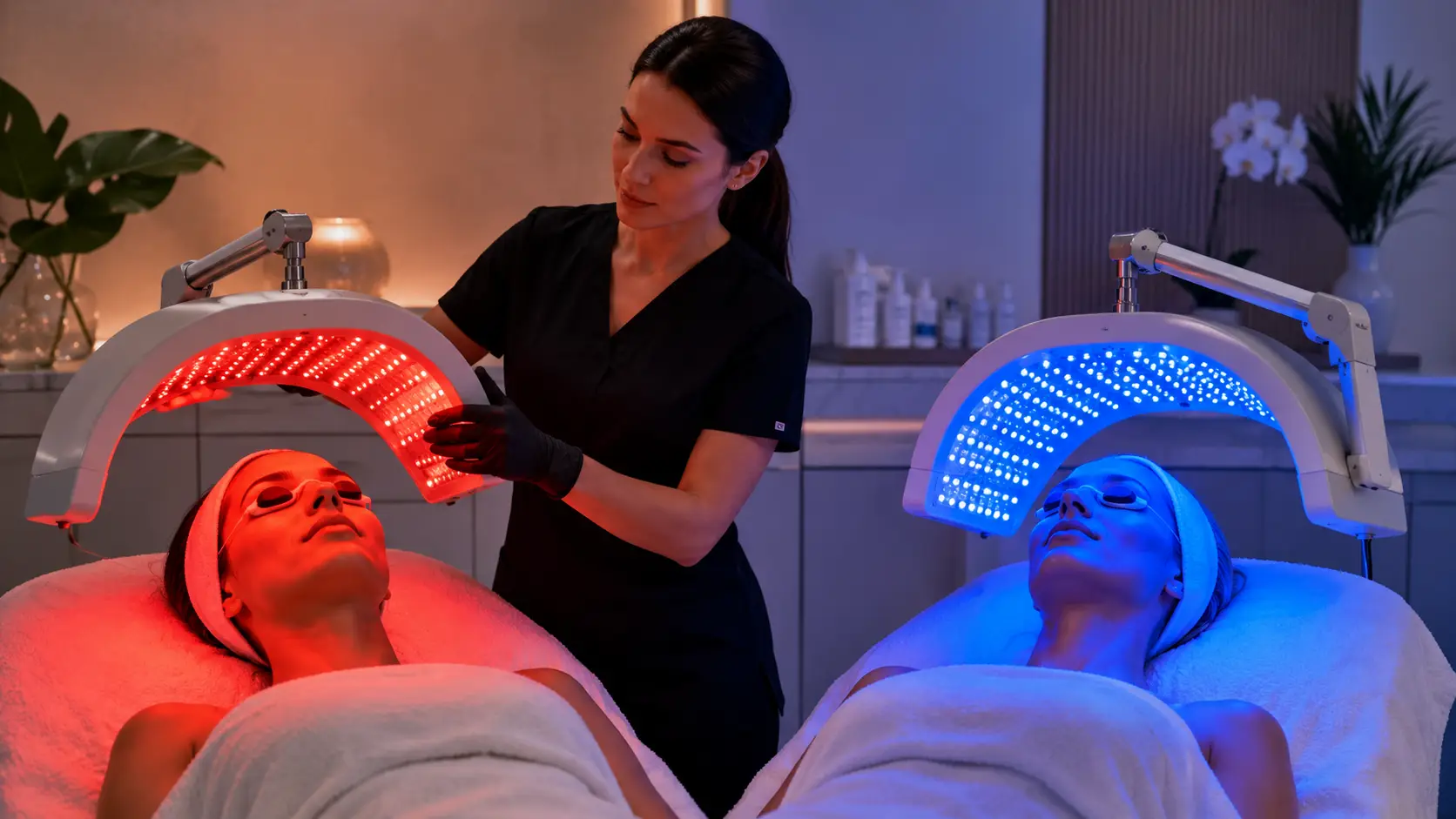
What Is the Difference Between Red Light and Blue Light Therapy for Skin?
Red light therapy (630–660 nm) and blue light therapy (415–430 nm) are both LED-based treatments but they operate through entirely different biological mechanisms, reach different skin depths, and target different concerns. Red light penetrates the dermis to stimulate fibroblast activity, collagen production, and tissue repair. Blue light remains at the skin surface, where it destroys acne-causing bacteria through selective porphyrin photoexcitation. Choosing between them — or combining them — is a clinical decision based on the client’s presenting concern, skin type, and treatment objective.
- Red light (630–660 nm) targets fibroblasts in the epidermis and upper dermis — stimulating collagen and elastin synthesis, reducing inflammation, and accelerating cellular repair. Primary applications: anti-aging, skin density, redness reduction, post-treatment recovery.
- Blue light (415–430 nm) targets Propionibacterium acnes bacteria at the skin surface through porphyrin photoexcitation — producing reactive oxygen species that destroy bacteria without antibiotics. Primary application: active acne and bacterial load reduction.
- Red and blue light are not interchangeable — they address different biological structures at different depths and should be selected based on the clinical objective, not brand preference or availability.
- Combined red-plus-blue protocols outperform either wavelength alone for acne by simultaneously reducing bacterial load (blue) and the inflammatory response bacteria trigger (red).
- Red light is the only LED wavelength with meaningful direct anti-aging evidence. Blue light has no significant anti-aging mechanism and should not be marketed as one.
- Session frequency, irradiance levels, and total protocol length follow different clinical standards for red and blue — protocol structure should be tailored to the wavelength and the objective, not defaulted to a single template.
The question “should I use red light or blue light?” is one of the most common decision points for estheticians integrating LED therapy into their practice. It sounds like a simple product selection question. It is actually a clinical question about mechanism, anatomy, and treatment objective — and the answer determines whether a client receives a treatment aligned with what their skin actually needs or one chosen arbitrarily because a particular device was available.
Red and blue are the two most widely offered LED wavelengths in professional esthetics. Most estheticians have a functional understanding that red is for anti-aging and blue is for acne. But this surface-level differentiation misses the clinical nuance that drives genuinely effective protocol design: why the mechanisms are different, what happens at the cellular level when each wavelength is absorbed, under what conditions one outperforms the other, and — critically — when using both simultaneously is not just acceptable but clinically superior to either alone.
This article builds the comparison from the science up. Understanding the distinction at a mechanistic level changes how estheticians design protocols, communicate with clients, and respond to the increasingly common situation where a client has tried consumer versions of both and wants to understand why professional treatment should produce different results.
What Separates Red Light and Blue Light — and When to Use Each
- Red and blue light are not two versions of the same treatment. They operate through different mechanisms on different cell types at different skin depths.
- Red light (630–660 nm) works through cytochrome c oxidase absorption in fibroblast mitochondria — the collagen-producing cell. Blue light (415–430 nm) works through porphyrin photoexcitation in bacterial cells. These are entirely different biological targets.
- The depth difference matters clinically: blue light cannot reach fibroblasts. Red light cannot destroy bacteria in the same selective, targeted way blue does.
- Combined red-plus-blue protocols produce measurably better acne outcomes than blue alone by addressing both the bacterial cause and the inflammatory consequences simultaneously.
- Blue light has no meaningful anti-aging mechanism and should not be positioned as one. Red light is the evidence-based choice for collagen, density, and skin rejuvenation.
- Skin tone screening is more relevant for blue light than red — blue light can stimulate melanogenesis in deeper Fitzpatrick types and requires additional caution in those protocols.
- Knowing when and why to run each wavelength — and when to run both — is a clinical competency that directly distinguishes the results an esthetician can deliver.
Why Wavelength Is the Starting Point for Every LED Protocol Decision
Visible light occupies the electromagnetic spectrum between approximately 380 nm (violet) and 700 nm (red). Beyond 700 nm lies near-infrared, invisible to the human eye but highly therapeutically relevant. Within the visible range, every nanometer carries different energy and exhibits different behavior when it encounters biological tissue. Two properties determine a wavelength’s clinical utility: how deeply it penetrates into skin, and which chromophores — light-absorbing molecules — absorb it at that depth.
Penetration depth is inversely related to photon energy: shorter wavelengths (higher energy, such as blue at 415 nm) scatter more aggressively in biological tissue and are absorbed quickly near the surface. Longer wavelengths (lower energy per photon, such as red at 660 nm) penetrate more deeply because they scatter less and are absorbed by chromophores at deeper anatomical levels. This is not a design feature of a device — it is a physical property of light that cannot be engineered around.
Why This Physical Law Determines Clinical Outcome
The clinical implication is straightforward but profoundly important: if you want to stimulate a cell type that lives 1–2 mm below the skin surface — such as a dermal fibroblast — you need a wavelength that physically reaches that depth. Blue light at 415 nm does not penetrate that far. If you want to target bacteria living in the follicle and at the skin surface, blue light is precisely the right wavelength — and red light, while it reaches the necessary depth, does not destroy bacteria through the same selective porphyrin mechanism. Wavelength is not a preference or a marketing category. It is the determinant of which biological process is accessible to the treatment.
The Optical Window: Where Therapeutic LED Wavelengths Live
The “therapeutic optical window” for photobiomodulation in biological tissue runs from approximately 600 nm to 1,100 nm — a range where water and melanin absorption are both low enough to allow meaningful photon penetration at therapeutic intensities. Blue light at 415–430 nm sits outside this traditional deep-penetration window, which explains both its surface-limited depth and its distinct mechanism. Red at 630–660 nm and near-infrared at 830–850 nm sit squarely within the optimal window for cytochrome c oxidase absorption and deep-tissue photobiomodulation. Blue light therapy works — but through a different mechanism operating at a different depth, not through the same photobiomodulation cascade that drives red light’s collagen and repair effects.
Red Light Therapy: What It Does, How It Works, and Who Needs It
Red light therapy in the 630–660 nm range is the most evidence-supported wavelength in aesthetic LED applications. Its photobiomodulation mechanism through cytochrome c oxidase (CCO) in mitochondria is well-characterized in peer-reviewed dermatology and photomedicine literature, and its clinical outcomes — particularly around collagen stimulation, inflammation reduction, and post-procedure recovery — are reproducible across multiple patient populations and study designs.
The Cellular Mechanism: CCO, ATP, and the Fibroblast Response
When red light photons reach the dermis, they are absorbed by cytochrome c oxidase — the terminal enzyme in the mitochondrial electron transport chain present in every living cell. In fibroblasts (the dermal cells responsible for producing collagen and elastin), this absorption increases ATP production, releases nitric oxide into local tissue, and initiates a cascade of gene expression changes that upregulate collagen I and III synthesis, elastin production, and matrix metalloproteinase activity that remodels the existing extracellular matrix.
The result, measured over a course of treatments, is a measurable increase in collagen density, improved skin firmness and elasticity, accelerated keratinocyte turnover in the epidermis, and a reduction in inflammatory signaling through prostaglandin and cytokine modulation. The nitric oxide released during red light absorption also produces a vasodilatory effect — the visible warmth and luminosity that clients frequently notice immediately after a professional red light session is the microcirculatory response to NO release, not a superficial effect or placebo.
What Red Light Therapy Is Clinically Best For
In professional esthetics practice, the presenting concerns best addressed by red light therapy include skin aging and loss of density (the direct collagen stimulation mechanism makes red light the strongest LED choice for progressive anti-aging protocols), inflammatory conditions including rosacea and reactive skin (prostaglandin modulation reduces diffuse redness and skin reactivity over a treatment course), post-procedure recovery from microneedling, chemical peels, dermaplaning, and extraction-heavy facials (anti-inflammatory effects accelerate barrier repair and reduce downtime), and texture irregularity and dullness (accelerated cellular turnover driven by keratinocyte stimulation at the epidermal level).
The Collagen Timeline: What to Tell Clients
Red light collagen outcomes require consistent protocol adherence to a biological timescale. Fibroblasts stimulated by red light begin increasing collagen synthesis within the treatment session, but new collagen takes weeks to weeks to fully organize into functional tissue. Clinically visible improvements in skin density and texture typically become measurable by sessions four through six, with more pronounced improvement at the completion of a full course of eight to ten sessions. Clients who understand this timeline maintain compliance; clients who expect visible change in one or two sessions discontinue protocols before results accrue. Communicating the mechanism accurately is the most effective tool for course completion rates.
Blue Light Therapy: What It Does, How It Works, and Who Needs It
Blue light therapy at 415–430 nm operates through a mechanism entirely distinct from red light’s photobiomodulation pathway. Understanding this distinction is essential, because many estheticians and clients conflate the two, leading to protocol decisions that fail to match mechanism to objective. Blue light does not primarily work through cytochrome c oxidase. It does not stimulate fibroblasts. It does not drive collagen synthesis in the dermis. What it does — with precision and without antibiotics — is destroy acne-causing bacteria through selective photosensitization.
Porphyrin Photoexcitation: The Mechanism Behind Blue Light Acne Treatment
Propionibacterium acnes (P. acnes) is the gram-positive anaerobic bacterium implicated in the pathogenesis of inflammatory acne. As part of its normal metabolic activity, P. acnes produces porphyrins — specifically coproporphyrin III and protoporphyrin IX — which accumulate within the bacterial cell. Porphyrins have strong optical absorption peaks in the blue-violet wavelength range, with coproporphyrin III peaking at approximately 415 nm.
When blue light at 415–430 nm illuminates the skin, it excites these endogenous porphyrins in P. acnes bacteria. The excited porphyrins transfer energy to molecular oxygen, generating reactive oxygen species (ROS) — principally singlet oxygen — within the bacterial cell. This intracellular oxidative stress rapidly exceeds the bacterium’s antioxidant capacity and destroys the bacterial cell from within. Human skin cells do not accumulate porphyrins in comparable quantities under normal conditions, making this bacterial destruction highly selective. No drug resistance develops because the mechanism is photochemical, not antibiotic.
How Blue Light Destroys Acne Bacteria Without Antibiotics
Step 1 — Porphyrin Accumulation: P. acnes bacteria produce coproporphyrin III and protoporphyrin IX as natural metabolic byproducts. These porphyrins accumulate intracellularly and in the sebaceous follicle environment.
Step 2 — Blue Light Excitation: Blue light at 415–430 nm is absorbed by the porphyrins at their optical absorption peak. The porphyrins enter an excited energy state.
Step 3 — Singlet Oxygen Generation: Excited porphyrins transfer energy to molecular oxygen in the immediate cellular environment, generating singlet oxygen and other reactive oxygen species. This is a Type II photosensitization reaction.
Step 4 — Bacterial Cell Destruction: The intracellular ROS rapidly exceed P. acnes’s antioxidant defenses, causing lipid peroxidation of bacterial membranes and oxidative damage to cellular structures. Bacterial cell death follows. Human skin cells are largely spared because they do not accumulate porphyrins at equivalent concentrations under normal conditions.
What Blue Light Therapy Is Clinically Best For
Blue light therapy is most clinically appropriate for clients with active inflammatory and non-inflammatory acne driven by P. acnes bacterial activity, acne-prone clients who are antibiotic-averse or cannot tolerate topical antibacterial treatments, maintenance protocols between more intensive acne treatments to control bacterial recurrence, and targeted sebaceous follicle management in clients with oily skin and comedonal acne. Blue light is not effective for hormonal acne that does not involve significant P. acnes bacterial involvement, cystic acne that originates deeper in the dermis beyond blue light’s surface penetration range, or any presenting concern that is primarily about collagen, aging, or tissue repair.
Blue Light and Skin Tone: An Important Clinical Nuance
Estheticians treating clients across the full Fitzpatrick spectrum should be aware that blue light in the 415–430 nm range can stimulate melanocyte activity. In clients with deeper skin tones (Fitzpatrick IV through VI), blue light exposure carries a meaningful potential to contribute to post-inflammatory hyperpigmentation, particularly in skin that is already inflamed from active acne. Conservative session durations, careful post-treatment monitoring, and thorough contraindication review are professional-standard precautions when applying blue light to melanocyte-rich skin. This nuance does not disqualify blue light as a treatment option for deeper skin tones, but it requires active clinical management rather than default protocol application.
Red Light vs Blue Light: A Complete Clinical Comparison for Estheticians
The following comparison presents both wavelengths across the dimensions that matter most for professional protocol decisions — from the physics of light to the biological targets to the presenting concerns each wavelength addresses.
When Should Estheticians Choose Red, Blue, or Both?
Protocol selection between red and blue — or both — should follow from the client’s presenting concern and treatment objective. The following clinical decision framework reflects the evidence base and practical protocol design principles that estheticians working in professional LED therapy apply consistently.
Choose Red Light When the Primary Objective Is Rejuvenation or Recovery
Red light is the correct protocol choice whenever the clinical objective involves stimulating cell-level repair or synthesis activity in the dermis. Anti-aging maintenance, progressive collagen building, post-procedure recovery from microneedling or peels, inflammation management in rosacea or reactive skin, and skin density improvement all fall in this category. Red light is appropriate as a standalone session when acne is not an active presenting concern and should be the anchor wavelength in anti-aging treatment plans regardless of whether blue is added for other reasons.
Choose Blue Light When Active Bacterial Acne Is the Presenting Concern
Blue light is most appropriate when the client presents with active inflammatory or non-inflammatory acne driven by P. acnes bacterial activity, when antibiotic options are contraindicated or have failed, or as a maintenance protocol between more intensive acne treatments. Blue light alone is appropriate for clients with straightforward bacterial acne, mild Fitzpatrick types, and no concurrent aging or inflammatory concerns beyond the acne itself. It is not appropriate as a primary treatment for cystic or hormonal acne that does not involve significant surface bacterial activity.
Choose Both When Acne Involves Inflammation — Which Is Most of the Time
Inflammatory acne — which includes the majority of client presentations estheticians encounter — is characterized by two simultaneous processes: bacterial proliferation and the immune-mediated inflammatory response that bacteria trigger. Blue light addresses the bacteria. Red light addresses the inflammation. Treating one without the other leaves half the pathological process unaddressed. Multiple controlled clinical studies have demonstrated that combined red-plus-blue protocols produce greater acne lesion count reduction and faster visible improvement than blue-alone treatment. For acne clients presenting with active papules, pustules, or significant redness around lesions, the combination protocol is the evidence-based standard of care, not a premium upgrade.
When to Choose Red Alone
- Anti-aging & collagen maintenance
- Post-microneedling / chemical peel recovery
- Rosacea & diffuse facial redness
- Sensitive or reactive skin management
- Post-procedure barrier repair
- Skin density and texture improvement
- No active bacterial acne present
When to Choose Blue Alone
- Non-inflammatory / comedonal acne
- Mild acne maintenance between treatments
- Antibiotic-alternative bacterial management
- Clients with minimal aging concerns
- Standalone targeted acne sessions
- Oily skin & enlarged pore management
- No post-treatment recovery component
When to Combine Both Wavelengths
- Active inflammatory acne (papules, pustules)
- Acne with visible redness & swelling
- Post-inflammatory hyperpigmentation risk
- Acne on post-procedure compromised skin
- Clients with concurrent aging concerns
- Any acne where inflammation is a component
- Evidence-based standard for most acne clients
For Deep Recovery Protocols
- Post-microneedling (same day)
- Post-chemical peel recovery
- Deeply inflamed or sensitized skin
- Clients reporting pain or tightness
- Subcutaneous inflammation management
- Scar tissue and barrier repair
- Advanced anti-aging with deep remodeling
How Do Red and Blue Work Together in a Professional Protocol?
The complementary nature of red and blue wavelengths is most clearly expressed in acne treatment, where the two mechanisms address adjacent aspects of the same pathological process. Understanding the logic of their combination helps estheticians design protocols that are genuinely synergistic rather than merely additive — and helps them explain the rationale to clients who may question why they are receiving two light treatments when they expected one.
The Acne Pathology Loop: Bacteria, Inflammation, and the Two-Wavelength Solution
Inflammatory acne follows a predictable pathological sequence. P. acnes colonize the sebaceous follicle, producing free fatty acids and porphyrins as metabolic byproducts. The free fatty acids and bacterial antigens trigger an immune response, activating toll-like receptors on adjacent keratinocytes and macrophages and generating the inflammatory cascade that produces the redness, swelling, and tissue damage characteristic of papules and pustules. Post-inflammatory hyperpigmentation and scarring result from the unresolved inflammatory activity and tissue injury that follow.
Blue light interrupts the first step of this loop by reducing the bacterial population through porphyrin-mediated ROS generation. But if inflammation is already established by the time treatment begins — which is the case for virtually all actively inflamed lesions — reducing the bacterial load does not immediately extinguish the inflammatory response already underway. Red light addresses this second step directly: its anti-inflammatory action through prostaglandin modulation and cytokine downregulation works on the inflammatory cascade in parallel with blue light’s antibacterial action. Together, they compress both the bacterial and inflammatory phases of acne pathology within a single treatment session.
Session Duration and Wavelength Sequencing Considerations
When combining red and blue in a single session, estheticians face a practical sequencing question: simultaneous delivery, blue-then-red, or red-then-blue. Professional multi-channel devices capable of simultaneous delivery eliminate the need for this decision by delivering both wavelengths concurrently. Where devices require sequential delivery, many practitioners in high-volume acne-focused practices find that running blue first — targeting the bacteria before the anti-inflammatory vasodilation of red light potentially alters superficial tissue perfusion — produces consistent clinical results. The most important variables are irradiance, session length, and protocol consistency across the course, not the specific order in which wavelengths are delivered when both fall within the safe parameter range.
Estheticians transitioning acne clients from blue-only LED protocols to combined red-plus-blue sessions using ILUMILUX by Luminous Skin Lab report a consistent pattern: within two to three sessions of the combined protocol, clients frequently comment on a reduction not just in the number of active breakouts — which blue alone had been managing partially — but in the inflammatory redness and texture around existing lesions. This is the red light anti-inflammatory mechanism doing what blue light cannot: quieting the immune response that makes acne-prone skin perpetually reactive and visibly inflamed between breakout cycles.
A specific operational pattern emerging among practitioners: for clients with both inflammatory acne and early aging concerns — a presentation common in late-twenties and thirties clients — the ILUMILUX’s channel architecture allows estheticians to run a full combined red-plus-blue session for the first portion of a course to bring acne under control, then transition to red-dominant sessions as bacterial activity decreases and the anti-aging objective becomes primary. This protocol evolution — adjusting channel emphasis across a treatment course based on clinical response — is what separates a device with true multi-channel control from a single-wavelength unit that forces the esthetician to choose one objective and commit to it for the entire course.
Common Errors Estheticians Make When Choosing Between Red and Blue Light
Using Blue Light for Anti-Aging
This is the most common wavelength misapplication in professional esthetics. Blue light does not penetrate deeply enough to reach fibroblasts, does not stimulate cytochrome c oxidase, and has no documented mechanism for collagen stimulation or skin rejuvenation. Estheticians who offer blue light to clients with primarily aging concerns are providing treatment that does not match the clinical objective — regardless of how the session feels to the client. The corrective is straightforward: redirect aging-focused clients to red or red-plus-near-infrared protocols.
Using Red Light Alone for Inflammatory Acne
Red light’s anti-inflammatory effects are real and meaningful in acne management — but without the antibacterial action of blue light, the inflammatory cycle is dampened without addressing the bacterial proliferation driving it. Clients in this scenario may experience temporary improvement in redness while the bacterial load continues unchecked. The full protocol solution for inflammatory acne almost always requires both wavelengths.
Applying Standard Red Light Protocols to Darker Skin Tones Without Adjusting Blue
Red light protocols require no meaningful adjustment for Fitzpatrick type. Blue light protocols do. Estheticians who adopt a one-size-fits-all LED protocol without distinguishing between the melanogenesis risk profiles of red and blue are missing a clinically significant difference that can affect client outcomes and trust in darker skin tone populations.
Setting Outcome Expectations Based on Session Count, Not Mechanism
Red light collagen results and blue light acne results follow different timelines because they act on different biological processes at different rates. Communicating “you’ll see results in 4 to 6 sessions” as a universal statement regardless of which wavelength or objective is involved creates misaligned expectations. Acne clients may see measurable bacterial reduction within four sessions; collagen clients will not see meaningful structural improvement in that window. Accurate expectation-setting requires communicating the mechanism, not just the session count.
Professional and Scientific References
The red light and blue light comparison science referenced in this article draws from peer-reviewed photomedicine, dermatology, and acne treatment research:
- Avci P, Gupta A, Sadasivam M, et al. Low-level laser (light) therapy (LLLT) in skin: stimulating, healing, restoring. Semin Cutan Med Surg, 2013. Comprehensive review covering both red light photobiomodulation and blue light porphyrin photosensitization mechanisms.
- Goldberg DJ, Russell BA. Combination blue (415 nm) and red (633 nm) LED phototherapy in the treatment of mild-to-moderate acne vulgaris. J Cosmet Laser Ther, 2006. Clinical trial demonstrating combined red-plus-blue superiority over blue-alone for acne lesion count reduction.
- Dai T, Gupta A, Murray CK, et al. Blue light for infectious diseases: Propionibacterium acnes, Helicobacter pylori, and beyond? Drug Resist Updat, 2012. Mechanism detail on porphyrin photoexcitation and bacterial selectivity of blue light.
- Hamblin MR. Mechanisms and applications of the anti-inflammatory effects of photobiomodulation. AIMS Biophysics, 2017. Anti-inflammatory mechanism detail for red light including prostaglandin modulation and cytokine signaling.
- Papageorgiou P, Katsambas A, Chu AC. Phototherapy with blue (415 nm) and red (660 nm) light in the treatment of acne vulgaris. Br J Dermatol, 2000. Landmark clinical study establishing blue-red combination therapy for acne; 76% reduction in inflammatory lesions at 12 weeks.
- Liebmann J, Born M, Kolb-Bachofen V. Blue-light irradiation regulates proliferation and differentiation in human skin cells. J Invest Dermatol, 2010. Melanogenesis stimulation data relevant to blue light use in deeper skin tones.
For estheticians building a professional LED practice that can address both anti-aging and acne client populations with clinical precision, multi-channel wavelength flexibility is not optional equipment — it is the foundational device requirement. The ILUMILUX by Luminous Skin Lab delivers calibrated narrow-band output across independent red (660 nm) and blue (415 nm) channels, with the architecture to run each independently or in simultaneous combination based on the protocol the client requires. For practitioners who treat the full range of skin concerns — and who want the science behind their wavelength selections to match the clinical literature — the ILUMILUX is the platform our education team references as the professional-grade standard for treatment room LED application.
Explore the ILUMILUX Professional LED Device →Frequently Asked Questions: Red Light vs Blue Light Therapy for Estheticians
What is the difference between red light and blue light therapy for skin?
Red light (630–660 nm) and blue light (415–430 nm) therapy differ in wavelength, penetration depth, mechanism, and clinical target. Red light penetrates 1–2 mm into the dermis and stimulates fibroblasts through cytochrome c oxidase absorption, driving collagen synthesis, ATP production, and inflammation reduction. Blue light remains at the skin surface and destroys acne bacteria through porphyrin photoexcitation. Red targets aging, collagen loss, and inflammation; blue targets active acne and bacterial load. They are not interchangeable and should be selected based on the specific clinical objective.
Does red light or blue light work better for acne?
Both address different aspects of acne. Blue light (415–430 nm) targets and destroys P. acnes bacteria through porphyrin photoexcitation. Red light (630–660 nm) reduces the inflammatory response bacteria trigger. A combined red-plus-blue protocol is consistently more effective than either wavelength alone for inflammatory acne because it attacks both the bacterial cause and the immune-driven inflammation simultaneously. Multiple clinical studies — including the landmark Papageorgiou et al. study — demonstrate the combination producing greater lesion count reduction than blue-only treatment.
Can you use red and blue light therapy together in the same session?
Yes, and for acne-prone clients with active inflammation this is the clinically recommended approach. Red and blue light target complementary biological processes — blue destroys bacteria while red reduces the inflammatory cascade bacteria produce. Professional multi-channel LED devices can deliver both wavelengths simultaneously or in sequence. Clinical evidence consistently shows combined red-plus-blue therapy producing superior acne outcomes over either wavelength used independently.
Is red light or blue light better for anti-aging treatments?
Red light is the only LED wavelength with meaningful, direct anti-aging evidence. Its penetration into the dermis stimulates fibroblast mitochondria through cytochrome c oxidase absorption, driving collagen Type I and III synthesis, elastin production, and matrix remodeling. Blue light does not penetrate deeply enough to reach fibroblasts and has no significant direct anti-aging mechanism. For any anti-aging protocol, red light at 630–660 nm — often combined with near-infrared for deeper tissue effects — is the evidence-based wavelength selection.
How does blue light kill acne bacteria without harming skin cells?
Blue light destroys P. acnes through selective photosensitization. The bacteria produce porphyrins — coproporphyrin III and protoporphyrin IX — as metabolic byproducts. These porphyrins absorb blue light strongly at around 415 nm. When excited, porphyrins transfer energy to molecular oxygen, generating singlet oxygen and reactive oxygen species inside the bacterial cell. This intracellular oxidative stress kills the bacteria. Human skin cells do not accumulate porphyrins in significant amounts under normal conditions, making the destruction highly selective to bacteria — with no antibiotic resistance risk because the mechanism is photochemical.
Why does red light reduce inflammation and what skin conditions does that help?
Red light reduces inflammation through prostaglandin modulation, cytokine downregulation (including TNF-alpha and IL-6), and upregulation of anti-inflammatory mediators. It also promotes macrophage activity that clears inflammatory debris. Clinical applications include inflammatory acne, rosacea (reducing diffuse redness and reactivity), post-procedure recovery after microneedling or peels, and general skin sensitivity reduction. Red light’s anti-inflammatory effects work in parallel with its collagen-stimulating action, making it uniquely versatile across both aging and reactive skin presentations.
Is blue light therapy safe for all skin tones?
Blue light therapy is generally safe across skin tones, but estheticians should exercise additional caution with deeper Fitzpatrick types (IV–VI). Blue light at 415–430 nm can stimulate melanogenesis in melanocyte-rich skin, potentially contributing to post-inflammatory hyperpigmentation in predisposed individuals. Conservative session durations, careful monitoring over initial treatments, and thorough contraindication screening for photosensitizing medications are professional-standard precautions. Red light does not carry the same melanogenesis concern and is safe across all Fitzpatrick types with standard screening.
How many sessions of red or blue light therapy does it take to see results?
Red light anti-aging results require 6–10 structured sessions to produce visible improvements in skin density, texture, and fine lines, because collagen remodeling operates on a weeks-to-months biological timescale. Blue light acne results can appear more rapidly — measurable lesion count reduction is often observed within 4–6 sessions — because bacterial destruction is a more immediate mechanical effect than new collagen synthesis. Both modalities produce better long-term outcomes when maintained with periodic sessions after the initial course is completed.
What makes the ILUMILUX effective for both red and blue light protocols?
The ILUMILUX by Luminous Skin Lab is a professional multi-channel LED device delivering calibrated narrow-band output across independent therapeutic red (660 nm) and blue (415 nm) channels at professional irradiance levels. Its channel architecture allows estheticians to run red-only rejuvenation, blue-only acne-targeting, or simultaneous red-plus-blue combination protocols within a single device. This flexibility makes clinical wavelength decision-making executable in a treatment room environment — eliminating the need for separate devices for each clinical objective while ensuring irradiance and wavelength accuracy that matches clinical literature parameters.
The Right Wavelength Is a Clinical Decision, Not a Default Setting
Red and blue LED therapy are not two points on a spectrum of the same treatment. They are two distinct clinical tools with different mechanisms, different anatomical targets, and different evidence bases for different skin concerns. Treating them as interchangeable — or as a brand choice rather than a clinical choice — produces protocols that are at best suboptimal and at worst actively mismatched to what the client’s skin requires.
The esthetician who understands why red light reaches fibroblasts and blue light does not, why porphyrin photoexcitation is specific to bacterial cells, and why inflammatory acne almost always requires both wavelengths simultaneously is positioned to design protocols that produce genuinely better outcomes than those chosen by wavelength availability or client preference. That understanding is also what allows a credible, science-grounded conversation with clients about why professional LED treatment is worth the investment when consumer devices at multiple wavelengths are increasingly accessible at retail price points.
The clinical answer to “red or blue?” is almost always both — with the emphasis determined by the client’s primary presenting concern, their Fitzpatrick type, the other modalities in the protocol, and where they are in their treatment course. That nuance is the professional standard.