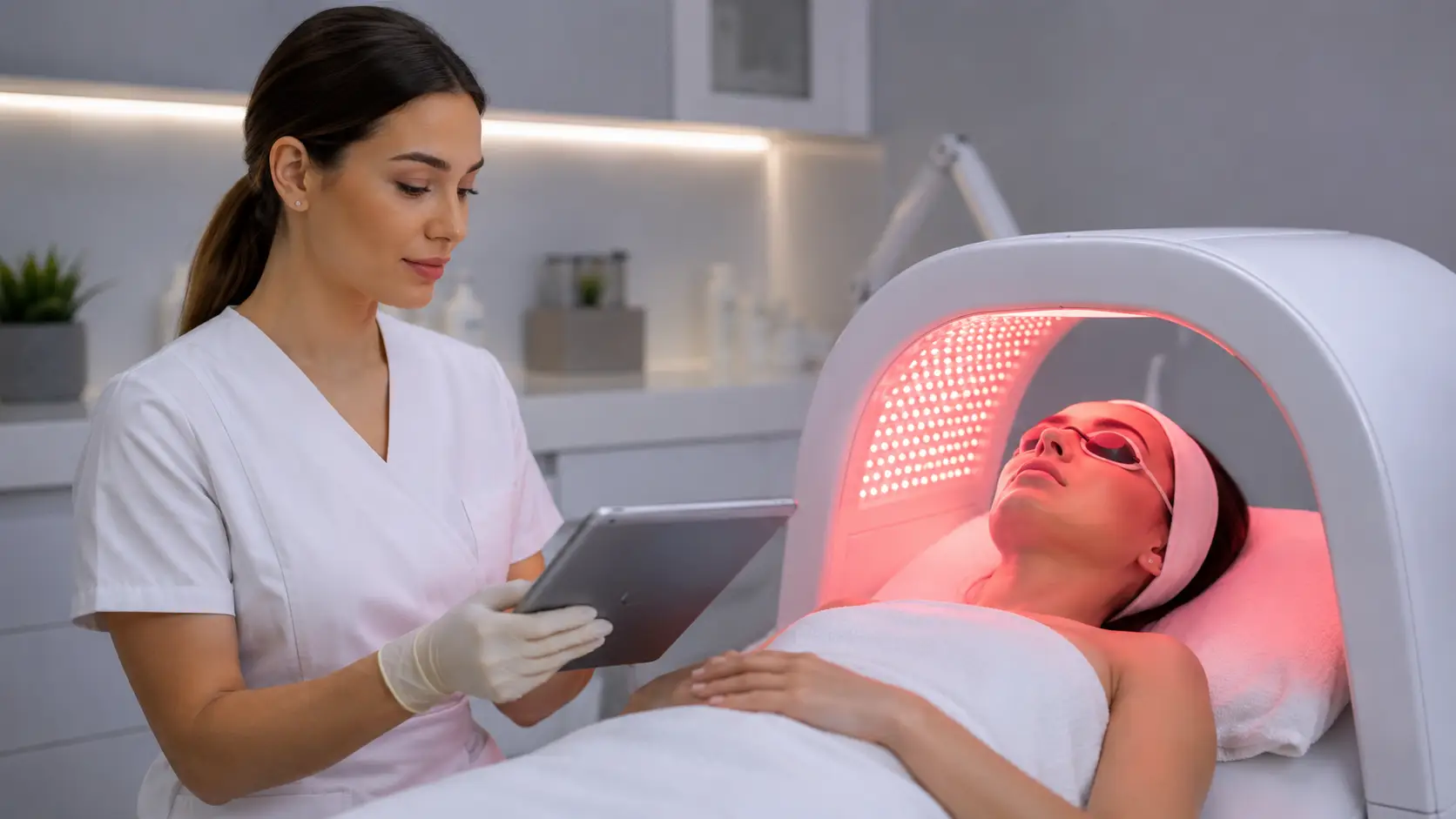
Does LED Light Therapy Have Real Clinical Evidence Behind It?
Yes. LED light therapy is supported by a substantial and growing body of peer-reviewed research. The strongest evidence exists for two primary indications: skin rejuvenation and collagen stimulation using red and near-infrared wavelengths, and inflammatory acne reduction using blue light. Multiple randomized controlled trials, histological biopsy studies, and systematic reviews confirm measurable clinical outcomes when LED is administered at verified therapeutic parameters.
- Skin rejuvenation: multiple RCTs document statistically significant improvements in dermal collagen density, skin texture, elasticity, and fine line depth following structured red and near-infrared LED series. The effect is confirmed by histological biopsy in the most rigorous studies.
- Acne: blue light at 415–450nm has strong evidence for reducing inflammatory acne lesion counts through photoexcitation of endogenous porphyrins in Propionibacterium acnes. Blue combined with red light shows superior outcomes to blue alone in several head-to-head studies.
- Post-procedure recovery: growing evidence supports LED for accelerating wound healing, reducing post-treatment erythema and swelling, and enhancing collagen outcomes when combined with microneedling.
- Rosacea and inflammation: emerging evidence supports yellow and red wavelengths for erythema reduction; less robust than the rejuvenation and acne evidence bases but directionally consistent.
- The most important variable in determining whether any given LED device produces the outcomes seen in studies is irradiance — power density at the skin surface. Consumer devices frequently fall below the therapeutic threshold used in research. Device specifications matter as much as wavelength.
The question “does LED therapy actually work?” is one of the most common and most important questions estheticians field — from skeptical clients, from colleagues evaluating whether to add the modality, and from their own professional due diligence when making equipment investment decisions. The answer requires more nuance than a simple yes or no, because the evidence is not uniform across all claimed applications, all wavelengths, or all devices.
What the research shows is this: LED light therapy, when administered with the correct wavelengths at clinically validated irradiance levels across a properly structured treatment series, produces measurable biological changes in the skin that translate into quantifiable clinical outcomes. Those outcomes have been confirmed by objective measurement methods — including histological biopsy, corneometry, spectrophotometry, and standardized photographic scoring — in peer-reviewed journals. The evidence is not theoretical or anecdotal.
What the research also shows is that the device matters enormously. The clinical evidence was generated using specific devices with specific parameters. A device that does not match those parameters — in wavelength accuracy or in irradiance delivery — cannot be assumed to produce the same outcomes. This distinction is perhaps the most practically important piece of LED literacy an esthetician can carry into the treatment room and into purchasing decisions.
This article reviews the evidence by indication, explains what differentiates strong evidence from weak, and gives estheticians the framework to evaluate claims — from brands, from clients, and from their own practice observations — with scientific grounding.
What the Research Actually Supports — and What It Doesn’t
- The strongest evidence for LED therapy is in skin rejuvenation (red/NIR) and acne (blue). Both have multiple randomized controlled trials and objective outcome measurements. These are clinically defensible claims.
- Post-procedure recovery support is well-mechanistically supported and supported by combining evidence from wound healing, photobiomodulation, and multi-modality studies.
- Rosacea, hyperpigmentation, and hair growth applications have emerging or limited controlled evidence — promising but not yet at the level of the rejuvenation and acne evidence base.
- Device irradiance is the single most important variable between a device that replicates research outcomes and one that does not. Always ask for mW/cm² at skin surface, not LED count or wattage.
- Studies that don’t report device irradiance, wavelength accuracy, or energy dose cannot be used to validate a specific device. Clinical outcomes belong to the specific device tested, not to “LED therapy” as a generic category.
- LED therapy is safe across all Fitzpatrick skin types when properly administered — a significant clinical advantage over thermal and ablative modalities for darker skin tones.
- Communicating the evidence to clients honestly — what is confirmed, what is emerging, and what the device parameters mean — builds the kind of treatment room authority that retains clients through full protocols.
What does “the research shows” actually mean for LED therapy?
Not all research is created equal, and estheticians who understand the hierarchy of clinical evidence are better equipped to evaluate the claims that brand marketing and trade publications make about LED therapy. Before reviewing what the research shows by indication, it helps to understand what kinds of research produce the most trustworthy conclusions.
Levels of evidence in clinical research
The strongest clinical evidence comes from randomized controlled trials (RCTs) with blinded outcome assessment and objective measurement. In an RCT, participants are randomly assigned to treatment or control conditions, the investigators assessing outcomes do not know which condition each participant received, and outcomes are measured by validated objective tools rather than patient or clinician self-report alone. Multiple RCTs in the same direction, summarized in a systematic review or meta-analysis, represent the highest level of clinical evidence available.
Below RCTs are prospective cohort studies and case series, which follow participants forward in time but without randomization or control groups. These studies can identify consistent trends but cannot rule out confounding variables as explanations for observed outcomes. Below these are retrospective case reports and case series, which are useful for generating hypotheses but insufficient to establish causation. Expert opinion and anecdotal reports are not evidence in the scientific sense, regardless of the authority of the source.
The LED therapy literature spans all of these levels. The strongest indications have multiple RCTs. Others have primarily cohort data or mechanistic studies with limited controlled human trials. Estheticians who understand this distinction can communicate the evidence accurately to clients — neither dismissing LED therapy as unproven nor overstating the certainty of its effects in areas where the evidence remains preliminary.
Why device specifications in published studies matter
A frequently overlooked aspect of LED research interpretation is that study outcomes belong to the specific device used in that study. A clinical trial demonstrating statistically significant collagen improvement used a device with specific wavelength emission peaks, specific irradiance values, specific treatment durations, and specific session frequencies. Those outcomes cannot automatically be attributed to a different device with the same nominal wavelength but a different irradiance output — or to a consumer device with no published irradiance specification at all.
Estheticians evaluating whether a particular device will produce the outcomes seen in published research should apply one core test: does the device irradiance and wavelength specification match the parameters of the studies generating the outcomes being claimed? If a brand cannot provide irradiance specifications in mW/cm², that absence of information is itself a meaningful data point.
What does the evidence show for skin rejuvenation and anti-aging?
Skin rejuvenation is the indication with the strongest and most extensive controlled clinical evidence for LED light therapy. The mechanism is well-characterized: red and near-infrared photons activate cytochrome c oxidase in dermal fibroblasts, driving ATP production, TGF-β signaling, collagen type I and III gene upregulation, and MMP suppression. This cascade produces measurable changes in dermal architecture that are visible both histologically and clinically.
What controlled trials have measured
A landmark randomized controlled trial published in Photomedicine and Laser Surgery evaluated red and near-infrared LED treatment against sham device control across 136 participants. Blinded evaluator assessments showed statistically significant improvements in skin roughness, skin laxity, and overall photoaging scores in the LED group. Both patients and independent evaluators were more likely to rate LED-treated skin as improved. Critically, dermal biopsy at the conclusion of the study showed histologically confirmed increases in collagen and elastic fiber density — structural changes in the dermis, not surface optical artifacts.
Additional controlled studies document improvements in periorbital rhytids, lateral canthal fine lines, and overall facial aging scores following LED series using red and near-infrared wavelengths. Corneometry and cutometry data from multiple studies confirm improvements in skin hydration and elasticity as objective secondary outcomes alongside the collagen histology.
What the data says about response time
Across the controlled trial evidence base, the collagen response to LED therapy is consistently reported as cumulative and progressive. Measurable improvements in skin texture and firmness appear in blinded photographic assessment between weeks three and six of structured protocols. Histological collagen density improvements — the most objective measure — are documented after series completion, typically 8 to 12 sessions over four to six weeks, with continued development in the weeks following treatment cessation as the collagen maturation and remodeling process continues.
What Controlled Trials Document for Red and Near-Infrared LED
Collagen density: Histologically confirmed dermal collagen and elastic fiber density increases in multiple controlled studies using red and near-infrared LED, verified by biopsy — the gold standard objective measurement for dermal structural change.
Skin texture and roughness: Statistically significant improvements in blinded evaluator scoring for skin roughness and surface texture. Corneometry confirms associated hydration improvements in several studies.
Fine lines and laxity: Blinded photographic assessment documents improvement in periorbital rhytids, lateral canthal lines, and global facial laxity scores following structured LED series in multiple published RCTs.
Safety record: No documented cases of post-inflammatory hyperpigmentation, thermal injury, or other adverse events in correctly administered LED rejuvenation protocols across all Fitzpatrick skin types in the peer-reviewed literature.
What does the evidence show for acne and inflammatory skin conditions?
Acne represents the second major indication with strong controlled trial evidence for LED therapy. The mechanism is distinct from the collagen pathway and involves blue light’s interaction with endogenous porphyrins in Propionibacterium acnes (P. acnes, recently reclassified as Cutibacterium acnes).
How blue light targets acne bacteria
P. acnes bacteria produce endogenous porphyrins — specifically coproporphyrin III and protoporphyrin IX — as metabolic byproducts. When blue light at 415 to 450nm is absorbed by these porphyrins, a photodynamic reaction is triggered that generates singlet oxygen and reactive oxygen species within the bacterial cell, leading to bacterial destruction without antibiotic resistance risk and without the systemic side effects associated with oral acne medications. The mechanism is well-characterized at both the photochemistry and clinical levels.
Multiple randomized controlled trials comparing blue LED to sham treatment or to no treatment document statistically significant reductions in inflammatory and non-inflammatory acne lesion counts following consistent LED series. Studies comparing blue light alone to blue combined with red light consistently find that the combination produces superior outcomes: red light contributes anti-inflammatory effects through cytokine modulation and sebaceous gland activity reduction, adding to the direct bactericidal effect of blue.
LED for rosacea-associated inflammation
Yellow light at approximately 590nm and red light at 630 to 660nm have been studied for rosacea-associated erythema, with results that are directionally consistent but less extensively replicated than the acne evidence base. The proposed mechanisms include anti-inflammatory modulation of cytokine activity and reduced mast cell degranulation in the dermal vasculature. Observational studies and small controlled trials document visible erythema reduction and subjective comfort improvement following LED series in rosacea clients. For estheticians, this positions yellow and red LED as rationally supported options for clients with rosacea, while being honest that this evidence base is less mature than the skin rejuvenation and acne literature.
Why do some estheticians report great results while others see very little?
Inconsistency in LED therapy outcomes across treatment rooms is one of the most common observations among estheticians who have worked with multiple devices or compared notes with colleagues. The explanation is almost always traceable to one of four variables: device irradiance, wavelength accuracy, treatment frequency, or protocol structure. Understanding which variable is the likely culprit when outcomes fall short of expectations is a meaningful clinical skill.
Device irradiance: the most commonly underestimated variable
Irradiance — power density at the skin surface, in milliwatts per square centimeter — is the variable most responsible for the outcome gap between consumer and professional LED devices. Clinical studies generating the outcomes associated with skin rejuvenation, collagen improvement, and acne reduction used devices delivering 10 to 150 mW/cm² at the treatment surface. Most consumer devices, when tested at the distances they are actually used, deliver 1 to 10 mW/cm². This difference is not a marginal shortfall — it is an order of magnitude below the level at which meaningful photobiomodulation of dermal fibroblasts is triggered. Estheticians who have used consumer-grade devices and found limited outcomes, then transitioned to a professional-grade device with verified irradiance specifications, consistently report a meaningful difference in observable client response within the same treatment timeline.
Wavelength drift in low-cost manufacture
LED wavelength accuracy varies by manufacturing quality. Devices nominal-rated at 630nm may emit with a peak anywhere from 620nm to 660nm depending on component quality and binning standards. At 660nm, the absorption efficiency of cytochrome c oxidase is measurably lower than at 630nm to 640nm, the true CCO absorption peak. While this drift does not eliminate LED therapy efficacy, it reduces the fibroblast activation signal per photon delivered, which compounds with the irradiance problem in low-cost devices. Professional devices from manufacturers who specify wavelength emission peaks with chromaticity measurements offer greater clinical predictability than those reporting only nominal wavelengths.
Treatment frequency gaps
The collagen synthesis and remodeling cycle operates over weeks, not days. Evidence-based protocols delivering 8 to 12 sessions over four to six weeks maintain the cumulative photobiological activation needed to drive a measurable collagen response. Estheticians who offer LED as a single-session add-on, or who see clients monthly without a structured series, are not providing the treatment frequency documented in the research. This is not a device problem — it is a protocol design problem. Estheticians who restructure their LED offerings around documented series protocols consistently see improved client-reported and objectively measurable outcomes.
The transition from an unspecified consumer-grade panel to the ILUMILUX is consistently described by practitioners as the point at which their LED results became reliable and repeatable rather than variable and anecdotal. In practice, the most observable shift is in skin response immediacy: clients treated with the ILUMILUX at therapeutic irradiance consistently report visible radiance improvement and skin comfort within the session, and by session four or five, estheticians typically observe measurable texture changes they can document with consistent photography. The second most commonly noted operational difference is client retention through the series: when practitioners can describe a specific session count, a specific wavelength rationale, and a specific expected timeline, clients who understand the evidence behind the protocol complete significantly higher proportions of their treatment series than those who are simply offered “LED add-ons.”
How should estheticians communicate LED evidence to clients honestly?
Client communication about LED therapy evidence is one of the areas where estheticians most frequently either undersell the modality out of excessive caution or oversell it by borrowing from device marketing language that is not tightly connected to what the peer-reviewed research actually shows. Both errors undermine professional authority. The goal is accurate, confident communication grounded in what the evidence does and does not support.
What is appropriate to state with confidence
Estheticians can state with confidence, and with genuine research backing, that LED light therapy has been shown in multiple peer-reviewed controlled trials to stimulate collagen production through a documented photobiomodulation pathway; that those trials confirm measurable improvements in skin texture, elasticity, and fine line depth when LED is administered in a structured series at therapeutic device parameters; that blue light therapy is a clinically validated non-antibiotic option for inflammatory acne with a well-characterized mechanism and multiple randomized controlled trial confirmations; and that post-procedure LED has mechanistic and clinical trial support for accelerating recovery following microneedling and other treatments.
What requires more careful framing
Claims about LED therapy for rosacea, hyperpigmentation, and hair growth are appropriate to discuss as emerging or investigational indications with promising early evidence — not as confirmed clinical outcomes equivalent to the collagen and acne literature. Estheticians should avoid extrapolating outcomes from high-irradiance professional device studies to make claims about consumer devices. And claims about specific timelines — “you will see results in one session” — are not supported by the evidence and erode client trust when they are not realized.
The framework that builds trust
Estheticians who communicate with clients using a consistent framework — here is what the research shows, here is the mechanism, here is the specific protocol we’re using, here is when you can expect to see results and why — build the kind of treatment room authority that differentiates clinically literate practitioners from those who simply repeat brand marketing. Clients who understand the science behind their treatment are also more likely to complete the full series required to produce the collagen response documented in research, because they understand why each session matters rather than viewing it as optional.
State with Confidence
Skin rejuvenation, collagen stimulation (red/NIR), acne reduction (blue), post-procedure recovery support. Multiple RCTs with objective outcome measurement confirm these indications.
Frame as Emerging
Rosacea erythema reduction, hyperpigmentation support, hair growth stimulation. Promising directional evidence exists; state these as supported by early research, not yet at RCT consensus level.
Explain Irradiance
Clients who ask why professional LED produces different results than their home device deserve an honest answer: irradiance and wavelength accuracy determine whether the photobiomodulation threshold is met. This is not marketing — it is measurable physics.
Give a Specific Timeline
Tell clients that the collagen response is cumulative, that results develop progressively over 8 to 12 sessions, and that texture improvements are typically visible in weeks 3 to 6. Specific timelines grounded in research build far more trust than vague “consistent results” language.
Distinguish Modalities
LED produces results through a slower, non-traumatic, cumulative mechanism. It does not produce the same speed or magnitude of change as laser resurfacing or microneedling. Accurate expectation setting prevents disappointment and retains clients who understand the realistic value of the modality.
Lead with the Safety Profile
LED is the only collagen-stimulating modality with a clean safety record across all Fitzpatrick skin types in the peer-reviewed literature. For clients with darker skin tones who have been burned by IPL or laser, this is clinically significant and worth communicating clearly.
Professional and Scientific References
The clinical evidence reviewed in this article draws from peer-reviewed photomedicine, dermatology, and cosmetic medicine literature:
- Wunsch A, Matuschka K. A controlled trial to determine the efficacy of red and near-infrared light treatment in patient satisfaction, reduction of fine lines, wrinkles, skin roughness, and intradermal collagen density increase. Photomed Laser Surg, 2014. Randomized controlled trial with 136 participants; statistically significant skin rejuvenation outcomes and dermal collagen density improvement.
- Papageorgiou P, Katsambas A, Chu A. Phototherapy with blue (415nm) and red (660nm) light in the treatment of acne vulgaris. Br J Dermatol, 2000. Landmark controlled trial establishing blue and combined blue+red LED superiority for inflammatory acne lesion count reduction.
- Avci P, Gupta A, Sadasivam M, et al. Low-level laser (light) therapy (LLLT) in skin: stimulating, healing, restoring. Semin Cutan Med Surg, 2013. Comprehensive review of mechanism and clinical evidence across multiple indications.
- Hamblin MR. Mechanisms and applications of the anti-inflammatory effects of photobiomodulation. AIMS Biophysics, 2017. Detailed mechanistic review of cytochrome c oxidase pathway, ATP production, and downstream cellular effects.
- Lee SY, Park KH, Choi JW, et al. A prospective, randomized, placebo-controlled, double-blinded, and split-face clinical study on LED phototherapy for skin rejuvenation. J Photochem Photobiol B, 2007. Split-face controlled trial with blinded evaluator assessment and histological confirmation of collagen response.
- Calderhead RG, Vasily DB. Low level light therapy with light-emitting diodes for the aging face. Clin Plast Surg, 2016. Clinical review summarizing LED safety profile across Fitzpatrick skin types and evidence base for anti-aging indications.
- Galíndez-Tardó V, et al. Photobiomodulation therapy in skin: Mechanisms of action and overview of clinical applications. J Clin Aesthetic Dermatol, 2022. Updated systematic review including wound healing, post-procedure, and rejuvenation evidence.
For estheticians who want to offer LED therapy backed by the research reviewed in this article, the foundation is a device calibrated to deliver the wavelengths and irradiance levels used in the controlled trials that generated the clinical evidence. The ILUMILUX by Luminous Skin Lab is the professional LED device our education team most consistently recommends for practitioners building evidence-based skin rejuvenation, acne, and post-procedure recovery protocols. Its dual red and near-infrared wavelength output — delivered at verified therapeutic irradiance — aligns with the device parameters of the peer-reviewed studies behind the outcomes documented throughout this article. For practitioners who want LED therapy to be a clinically defensible, evidence-backed component of their service menu, device specification alignment with published research is the non-negotiable starting point.
Explore the ILUMILUX Professional LED DeviceFrequently Asked Questions: LED Therapy Research and Clinical Evidence
Is there actual scientific evidence that LED therapy works for skin?
Yes. LED light therapy is supported by a substantial body of peer-reviewed clinical research across multiple skin conditions. The strongest evidence exists for skin rejuvenation and collagen stimulation using red and near-infrared wavelengths, and for acne reduction using blue light. Multiple randomized controlled trials, systematic reviews, and histological biopsy studies confirm measurable improvements in dermal collagen density, skin texture, elasticity, and acne lesion counts following structured LED treatment series. The evidence quality is sufficient for LED to be described as a clinically validated non-invasive modality when properly administered.
What conditions does LED therapy have the strongest evidence for?
LED therapy has the strongest peer-reviewed evidence for two primary indications: skin rejuvenation and collagen stimulation using red and near-infrared wavelengths, and inflammatory acne vulgaris using blue light alone or in combination with red light. Secondary evidence supports LED therapy for wound healing acceleration, periorbital fine line improvement, rosacea-associated inflammation reduction, and post-procedure recovery support following microneedling, chemical peels, and other treatments. The evidence for each condition varies in study quality and sample size, with skin rejuvenation and acne having the largest controlled trial evidence base.
Why do some LED devices seem to work and others don’t?
The primary differentiator between LED devices that produce clinical outcomes and those that do not is irradiance: the power density of light delivered to the skin in milliwatts per square centimeter. Consumer devices frequently deliver 1 to 10 mW/cm² at skin distance, well below the 10 to 150 mW/cm² range used in controlled clinical studies. Additionally, wavelength accuracy varies significantly in low-cost manufacture, with actual emission peaks drifting from nominal specifications. A device marketed as 630nm red light may emit at 650nm or 700nm, producing weaker cytochrome c oxidase absorption and reduced fibroblast activation. Professional-grade devices calibrated to verified wavelengths and therapeutic irradiance levels consistently outperform consumer alternatives in every comparative study.
How long does it take to see results from LED therapy?
Acne clients typically observe visible lesion reduction within two to four weeks of consistent LED treatment, as the antibacterial effect of blue light on Propionibacterium acnes begins early in the treatment series. Skin rejuvenation and collagen outcomes develop more slowly, as collagen synthesis and remodeling are biological processes measured in weeks. Most clients undergoing structured skin rejuvenation protocols report visible improvements in skin texture, radiance, and firmness between weeks three and six of a consistent treatment series, with collagen density improvements continuing to develop for several weeks after the series ends.
Can LED therapy help with rosacea or skin redness?
Emerging research supports the use of yellow light at approximately 590 nanometers and red light at 630 to 660 nanometers for reducing rosacea-associated erythema and inflammation. The proposed mechanism involves anti-inflammatory modulation of cytokine activity and reduced mast cell reactivity in the dermal vasculature. While the evidence base for LED and rosacea is less extensive than for skin rejuvenation or acne, multiple observational studies and small controlled trials have documented visible erythema reduction following LED treatment series. Red light at non-irritating wavelengths is generally well tolerated on rosacea skin, where many other treatment modalities are contraindicated.
Does LED therapy help skin heal faster after microneedling or peels?
Yes. Post-treatment LED therapy is well-supported by both mechanistic evidence and clinical observation. Following procedures that create controlled tissue disruption, LED photobiomodulation accelerates the early phases of wound healing by reducing oxidative stress, promoting cellular energy production, modulating pro-inflammatory cytokine activity, and supporting fibroblast migration to the treatment area. Multiple studies combining LED with microneedling report faster resolution of post-procedure redness and swelling, reduced discomfort duration, and enhanced overall collagen outcomes compared to microneedling alone. For estheticians, this positions LED as a medically rational recovery support tool, not merely a comfort measure.
Is LED therapy safe for all skin types and tones?
LED light therapy is non-thermal and non-ablative, meaning it does not damage tissue to produce its effects. This makes it safe across all Fitzpatrick skin types when properly administered, including deeper skin tones where thermal modalities such as laser and IPL carry elevated post-inflammatory hyperpigmentation risk. There are no documented cases of post-inflammatory hyperpigmentation from correctly administered LED therapy in the dermatological literature. Standard contraindications include photosensitizing medications, active skin infections, and epilepsy where flashing light is a seizure trigger. Eye protection is required for all wavelengths.
What should I look for in a study before trusting a claim about LED therapy?
Estheticians evaluating LED research should look for four key indicators of study quality: a control group or control condition to rule out placebo effect and natural skin variation; objective outcome measurements such as histological biopsy, corneometry, or spectrophotometry rather than subjective self-report alone; full reporting of device wavelength, irradiance in mW/cm², energy dose in J/cm², and treatment protocol; and peer-reviewed publication in a dermatology, photomedicine, or cosmetic medicine journal. Studies that report outcomes without disclosing device specifications cannot be meaningfully replicated or applied to other devices, and should not be used to justify clinical LED protocols.
How does the ILUMILUX align with the published LED therapy research?
The ILUMILUX by Luminous Skin Lab is engineered to deliver red and near-infrared wavelengths at irradiance levels calibrated to the therapeutic parameters documented in peer-reviewed LED therapy research. The device specifications align with the wavelength ranges and energy dose windows used in the controlled clinical trials that form the evidence base for LED skin rejuvenation, collagen stimulation, and post-treatment recovery outcomes. For estheticians who want to offer LED therapy with clinical confidence, ILUMILUX provides the device foundation that makes research-backed protocol design achievable in a professional treatment room setting.
Reading the Research Honestly Is the Foundation of Credible LED Practice
LED light therapy works — when the right device, the right wavelengths, the right irradiance, and the right protocol structure are in place. The evidence for skin rejuvenation and acne is not theoretical or preliminary; it is documented in randomized controlled trials with objective outcome measurement, published in peer-reviewed journals and replicated across multiple independent research groups. Estheticians who understand this evidence base are in a position to offer LED therapy as a genuine clinical service rather than a wellness amenity.
The most important practical takeaway from the research is that device specifications are not a secondary consideration — they are the primary variable that determines whether a treatment room LED program produces the outcomes documented in clinical literature or produces something that merely resembles those treatments visually. Irradiance matters. Wavelength accuracy matters. Protocol structure matters. And honest communication about what the evidence does and does not support builds the kind of professional authority that retains clients through full treatment series and produces the cumulative results the science actually demonstrates.
For the growing number of clients who are arriving at treatment rooms having already done their research — and who are asking precisely the kinds of evidence questions that this article addresses — estheticians who can answer those questions with clinical accuracy will consistently win their confidence over practitioners who can only offer marketing language in return.