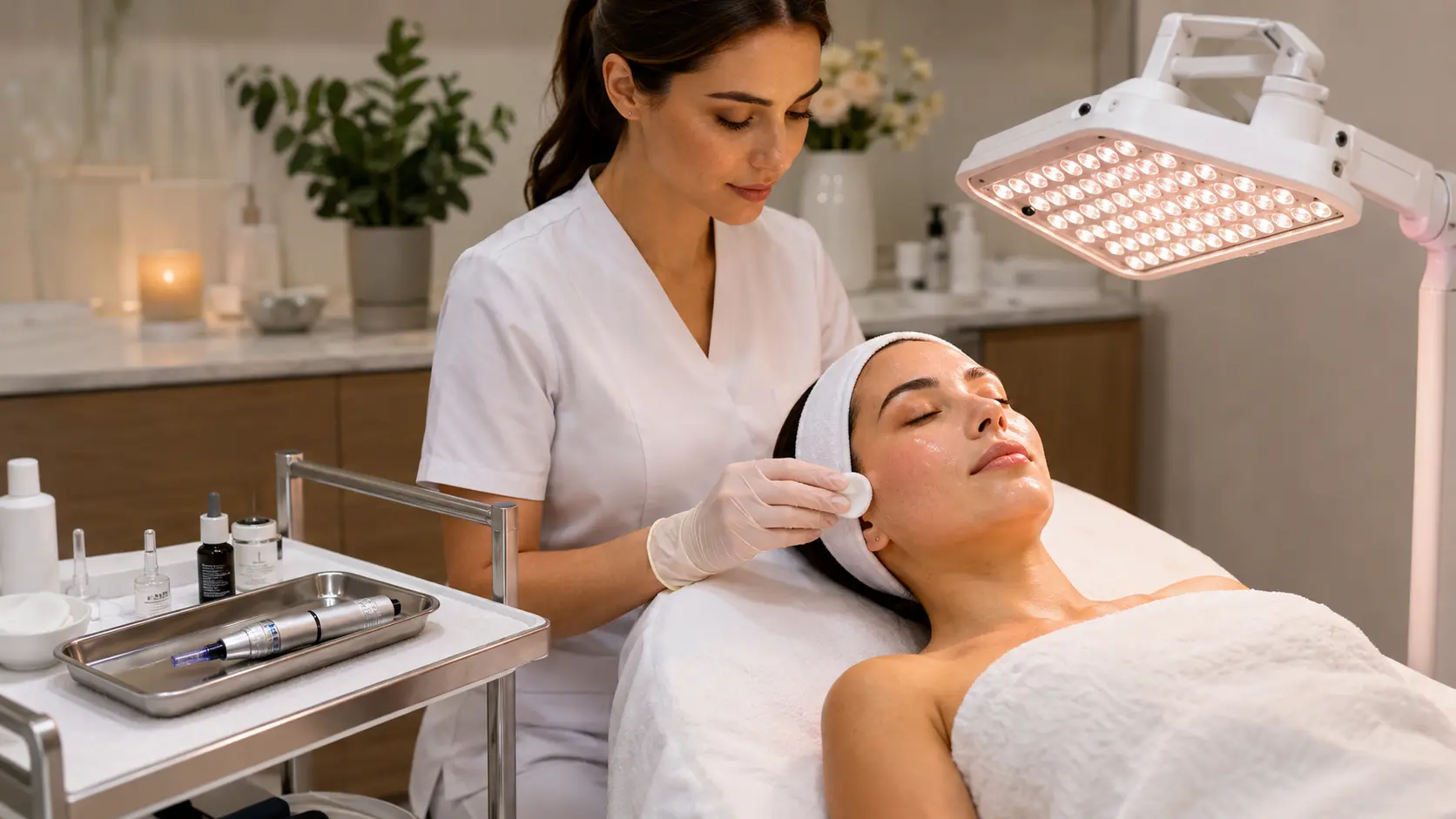
How Does Combining LED Therapy With Microneedling Improve Treatment Outcomes?
Combining LED light therapy with microneedling produces superior outcomes to either treatment performed alone because the two modalities operate through complementary mechanisms that reinforce each other at exactly the moment post-needling skin is most receptive. Microneedling creates controlled micro-injury that triggers a wound healing cascade including inflammation, collagen synthesis, and tissue remodeling. LED photobiomodulation, applied immediately after needling, amplifies cellular energy availability for that healing process while simultaneously moderating the acute inflammatory response — compressing visible downtime and enhancing the collagen result.
- Red light (630–660nm) activates cytochrome c oxidase in the mitochondrial respiratory chain, increasing ATP production in skin cells by up to 150% — providing the cellular energy that fibroblasts need to synthesize collagen more efficiently during the post-needling repair phase.
- Near-infrared light (810–850nm) penetrates to the mid-dermis and deeper, modulating the post-needling inflammatory response by reducing pro-inflammatory cytokines (TNF-α, IL-1β, IL-6) and increasing anti-inflammatory mediators, which compresses visible erythema and redness recovery time.
- The optimal sequence is microneedling first, then serum application, then LED therapy, then a post-treatment recovery mask — LED performed before needling does not produce the same photobiomodulation benefit.
- Post-needling skin permeability is dramatically elevated, amplifying absorption of serums applied before LED — hyaluronic acid, growth factor, and peptide serums deliver more actively into the skin during the LED treatment window than at any other point in the facial sequence.
- Most estheticians structure the combined protocol as a 15–20 minute LED session following needling, incorporated within the same appointment rather than as a separate visit.
Among the growing number of treatment combination protocols available to licensed estheticians, the pairing of microneedling with LED light therapy stands out for the quality of its clinical rationale. This is not a combination born from marketing opportunity or client demand — it is a pairing that makes deep biological sense, where the mechanism of each treatment supports and amplifies the mechanism of the other in a precisely timed sequence.
Microneedling works by creating controlled, calibrated injury. The needle channels trigger a cascade of wound healing responses — acute inflammation, growth factor release, fibroblast recruitment, collagen and elastin synthesis — that ultimately produce the skin improvements clients seek: improved texture, reduced fine lines, diminished scarring, firmer and more even skin. The challenge with microneedling as a standalone treatment is that this response comes with a recovery cost: erythema, sensitivity, and downtime that can range from 24 hours to several days depending on needle depth and client skin.
LED photobiomodulation applied in the immediate post-needling window does something precise and clinically meaningful: it increases the cellular energy available to execute the healing cascade more efficiently, while simultaneously moderating the inflammatory component that creates the recovery cost. The result — which estheticians working with this combination consistently observe — is better collagen outcomes with faster visible recovery. Understanding why this happens at the cellular level, and how to build a protocol that reliably delivers this benefit, is what this article provides.
What Matters Most When Combining LED Therapy and Microneedling
- LED therapy is always performed after microneedling, not before — the post-needling wound healing state is the biological context that makes photobiomodulation most effective.
- Red light (630–660nm) and near-infrared (810–850nm) are the two clinically supported wavelengths for post-needling application. Blue light is contraindicated on post-needling compromised barrier skin.
- The LED session should begin within the same appointment, ideally within 10–30 minutes of completing the needling procedure to capture peak cellular receptivity.
- Serum selection between microneedling and LED is a critical safety and efficacy variable — fragrance-free, active-free, recovery-specific serums only on freshly needled skin.
- Post-needling skin permeability enhancement is a double-edged opportunity: it amplifies beneficial serum absorption but also amplifies absorption of any sensitizing ingredient that should not be on the skin.
- Clients typically experience measurably reduced post-treatment erythema duration with the LED adjunct compared to microneedling alone — a result that directly affects rebooking rates and client satisfaction.
- The combined protocol positions the treatment room as an advanced care environment, not a basic service provider — with a clinical outcome rationale that can be clearly communicated to clients.
Why Microneedling and LED Therapy Work Better Together Than Either Treatment Alone
To understand why combining microneedling with LED therapy produces superior outcomes, it helps to understand what each modality independently does and where those individual mechanisms leave room for enhancement.
What Microneedling Does at the Cellular Level
Microneedling creates physical microchannels through the epidermis into the papillary dermis. This controlled injury immediately triggers the body’s wound healing response along three overlapping phases. In the first phase — the inflammatory phase, lasting roughly 24 to 72 hours — platelets aggregate at the injury sites, releasing growth factors including PDGF, TGF-β, and VEGF, which signal the immune system and recruit fibroblasts. Neutrophils and macrophages clear cellular debris. This phase is responsible for the post-treatment erythema and sensitivity clients experience.
In the proliferative phase that follows, fibroblasts migrate to the treatment area and begin synthesizing new collagen (primarily type III, the temporary scaffolding collagen) and elastin. New blood vessels form to supply the remodeling zone. This phase, lasting roughly 2 to 4 weeks post-treatment, is where the foundational improvements in skin architecture are built. Finally, in the remodeling phase — which can extend 3 to 6 months — type III collagen is progressively replaced by the stronger, more organized type I collagen. The visible improvements in skin texture, tone, and firmness that clients associate with microneedling results emerge primarily from this final phase.
Where LED Photobiomodulation Fits Into This Cascade
The key insight is that each phase of the microneedling wound healing cascade has a specific energy requirement and inflammatory environment that LED photobiomodulation can directly influence. Red light’s activation of cytochrome c oxidase in mitochondria increases cellular ATP production precisely when fibroblasts need maximum energy to synthesize collagen. Near-infrared’s modulation of pro-inflammatory cytokines shortens the acute inflammatory phase without eliminating it — preserving the growth factor signaling that drives fibroblast recruitment while reducing the unproductive inflammatory burden that creates downtime without contributing to collagen outcomes.
The result is a healing cascade that executes more efficiently: the productive biological work of collagen synthesis is amplified, while the unproductive inflammatory excess that clients experience as erythema, sensitivity, and downtime is moderated. Estheticians who have tracked client outcomes across microneedling series with and without the LED adjunct consistently find this compression of recovery time alongside improved skin results to be the clearest observable evidence of the combination’s clinical superiority.
What Photobiomodulation Does to a Post-Needling Wound Healing Cascade
Cytochrome c oxidase activation (red 630–660nm): The primary chromophore for red light photobiomodulation is cytochrome c oxidase (COX), a key enzyme in the mitochondrial electron transport chain. Red light photons are absorbed by COX, increasing its activity and driving up ATP synthesis in skin cells. Post-microneedling fibroblasts operating at the site of tissue repair are energy-intensive — collagen synthesis is a metabolically demanding process. Increased ATP availability directly supports faster and more productive collagen synthesis during the critical proliferative phase.
Anti-inflammatory cytokine modulation (near-infrared 810–850nm): Near-infrared wavelengths penetrate to the mid-dermis where much of the post-needling inflammatory activity occurs. Research consistently demonstrates reduction of pro-inflammatory mediators including TNF-α, IL-1β, and IL-6 following near-infrared photobiomodulation, alongside increases in anti-inflammatory prostaglandin E2 and anti-oxidant enzyme activity. In post-needling skin, this modulation shortens the inflammatory phase duration and reduces the excessive inflammatory signaling that drives visible erythema without contributing to productive healing outcomes.
Fibroblast proliferation enhancement: Multiple photobiomodulation studies demonstrate direct stimulation of fibroblast proliferation and migration following red and near-infrared light exposure — accelerating the cellular population build-up that the proliferative healing phase depends on for collagen production volume.
Which Wavelengths to Use After Microneedling and Why Blue Light Is Excluded
Not all LED wavelengths are appropriate for post-microneedling application, and understanding which wavelengths to select — and why certain wavelengths must be excluded — is one of the most important clinical decisions in the combined protocol.
Red Light (630–660nm): The Primary Collagen Amplifier
Red light in the 630–660nm range is the most extensively researched wavelength for wound healing and collagen stimulation applications. Its primary mechanism — cytochrome c oxidase activation increasing mitochondrial ATP production — makes it directly relevant to the energy-intensive collagen synthesis that microneedling initiates. Research in wound healing literature consistently shows accelerated re-epithelialization, reduced wound closure time, upregulation of collagen type I and III synthesis, and improved tensile strength in LED-treated tissue compared to controls. In the post-microneedling context, these mechanisms translate directly to the clinical objectives of the treatment: more collagen, faster skin recovery, improved skin architecture outcomes.
Red light at 660nm also demonstrates direct anti-inflammatory activity through pathways distinct from near-infrared, including modulation of nitric oxide signaling and reduction of reactive oxygen species. For post-needling skin where the inflammatory response is elevated, this second anti-inflammatory mechanism adds meaningful support beyond ATP production alone.
Near-Infrared (810–850nm): The Deep Anti-Inflammatory and Penetration Advantage
Near-infrared light penetrates significantly deeper than visible red light — reaching 5 to 8mm into dermal tissue compared to 1 to 2mm for red. This penetration depth is clinically relevant for post-microneedling application because the inflammatory activity, fibroblast recruitment, and early collagen synthesis associated with microneedling wound healing occur primarily in the papillary and reticular dermis, not only at the epidermal surface. Near-infrared’s deeper reach allows photobiomodulation to act at the tissue depth where the most important post-needling biological work is happening.
The anti-inflammatory cytokine modulation of near-infrared — reducing TNF-α, IL-1β, and IL-6 while supporting anti-inflammatory prostaglandin E2 — is the mechanism most directly responsible for the visible erythema reduction that estheticians and clients consistently observe when LED is added to the post-microneedling protocol. It is also the mechanism that makes near-infrared specifically valuable for clients with reactive skin, rosacea-prone skin, or any baseline that tends toward inflammatory response amplification.
Most professional LED panels used in advanced esthetic practice deliver red and near-infrared simultaneously in a combined wavelength setting. This combination addresses both the collagen amplification objective (red) and the inflammation modulation objective (near-infrared) in a single treatment pass, which is both efficient and clinically complete.
Why Blue Light (415nm) Is Contraindicated After Microneedling
Blue light at 415nm is clinically effective for acne treatment because it activates porphyrins in Cutibacterium acnes bacteria, producing reactive oxygen species that destroy the bacteria. This same reactive oxygen species mechanism makes blue light inappropriate for use on post-microneedling skin where the epidermal barrier has been physically disrupted. On intact skin, the barrier limits blue light’s reactive oxygen species activity to the surface. On skin with open microchannels, the same mechanism can produce oxidative stress in the tissue at the needle entry points, potentially interfering with the wound healing response that the treatment is designed to support. Blue light should not be included in any post-microneedling LED protocol regardless of the client’s acne history.
The Complete Post-Microneedling LED Protocol: Sequencing, Timing, and Serums
The clinical benefit of combining LED therapy with microneedling is maximized only when the sequence, timing, and serum selection are all executed correctly. Each step in the protocol matters — and the decisions made between microneedling and LED application are as important as the LED session itself.
The Full Treatment Sequence
Thorough Skin Preparation and Cleanse
Double cleanse to remove all skincare products, SPF, makeup, and topical actives. Any residual retinoid, AHA, BHA, or benzoyl peroxide on the skin surface at the time of needling creates a sensitization risk as the actives are driven deeper through the microchannels. Confirm with the client that no topical prescriptions have been applied that day. Document in session notes.
Microneedling Treatment at Target Depth and Pass Count
Perform microneedling at the treatment depth and pass count appropriate for the client’s skin goals and needle depth tolerances. A numbing cream pre-treatment is standard for depths above 0.5mm. Apply a safe, fragrance-free hydrating serum (hyaluronic acid, growth factors, or peptides) as the glide medium during needling — these serums are driven into the skin through the microchannels as part of the treatment, not removed afterward.
Post-Needling Serum Application Over Needled Skin
Apply a recovery serum appropriate for the treatment goals and the post-needling skin state. Hyaluronic acid serums, growth factor concentrates, and peptide blends are the standard categories. This serum layer will be present under the LED panel during the photobiomodulation session — LED’s enhancement of cellular activity during the session supports the absorption and utilization of these actives. No retinoids, AHAs, BHAs, vitamin C, or any other active exfoliant or potentially irritating ingredient on freshly needled skin.
LED Therapy — Red + Near-Infrared
Position client under the LED panel at the device’s specified operating distance. Confirm opaque goggles are in position before activation. Deliver red (630–660nm) and near-infrared (810–850nm) simultaneously for 15 to 20 minutes per the device manufacturer’s session duration guidance. The client should feel minimal to no heat sensation throughout. Monitor for any discomfort indicating panel proximity adjustment is needed. This is an ideal time for hand, arm, or scalp service additions.
Post-Treatment Recovery Mask
Apply a professional recovery mask that supports barrier recovery while delivering additional hydration to the post-needling skin. A fragrance-free, clean-label cooling jelly mask or an occlusive barrier recovery mask are the standard selections. The mask layer seals in the serum applied in step 3, maintains hydration during the recovery window, and provides client comfort through the cooling effect. This is the final active treatment step before the client departs.
Post-Treatment Instructions and Home Care Protocol
Review post-microneedling home care: no active skincare (retinoids, AHAs, BHAs, vitamin C) for a minimum of 48 to 72 hours. Broad-spectrum SPF 30 or higher is non-negotiable from the morning following treatment. No heat (sauna, steam, hot yoga) for 24 hours. Fragrance-free, gentle cleansing for 72 hours. Provide these instructions in written form — verbal-only post-care instructions have a significantly higher non-compliance rate than written take-home guides.
Why Timing Matters: The Window of Peak LED Receptivity
The case for applying LED immediately following microneedling — within the same appointment, not at a follow-up the next day — is grounded in the biology of the wound healing cascade. The initial inflammatory response that microneedling triggers, including platelet activation, growth factor release, and early cytokine signaling, is most active in the first 30 to 60 minutes after needling. This is the window during which anti-inflammatory photobiomodulation has the greatest opportunity to modulate the cytokine environment before the inflammatory response becomes self-sustaining. Applying LED at this moment catches the cellular response at its most malleable point. Delaying to the following day means applying photobiomodulation to a healing response that is already several hours into its established pattern — still beneficial, but not capturing the peak modulation opportunity.
Estheticians who have built the post-microneedling LED protocol into their standard treatment structure using the ILUMILUX by Luminous Skin Lab consistently report two observations that distinguish the combined protocol from microneedling performed alone. First, the visible erythema pattern immediately post-treatment is meaningfully different: skin that has received the LED adjunct typically presents with a more uniform, less intense flush compared to the deeper, patchy redness common with standalone microneedling at equivalent depth. Clients frequently notice and comment on this difference unprompted during the removal of the recovery mask.
Second, the next-day check-in outcomes shift measurably. Estheticians running this protocol report that clients who received the ILUMILUX LED session post-needling consistently describe their 24-hour recovery as faster and more comfortable than previous microneedling sessions they had without LED — particularly in the first 12 hours, which is when the cytokine modulation effect is most observable as reduced sensitivity and faster erythema resolution. The 15 to 20 minute LED window fits naturally into the combined appointment timeline without extending the session in a way clients find inconvenient, which supports consistent protocol inclusion rather than selective application.
How Post-Needling Skin Permeability Changes What Serums Can and Cannot Be Applied
The microchannels created by microneedling dramatically increase the skin’s transdermal absorption capacity. In clinical research, microneedling has been shown to increase the penetration of topically applied molecules by 200 to 1,000 times depending on needle depth, channel density, and molecular size. This is simultaneously the greatest opportunity and the most significant safety responsibility of the post-microneedling treatment window.
The opportunity: beneficial ingredients — hyaluronic acid, growth factors, peptides, skin-identical ceramides — are delivered into skin tissue at concentrations and depths that normal topical application cannot achieve. The recovery and remodeling phase that follows is supported by a higher volume and deeper penetration of these actives than the same serums would deliver on intact skin. When LED photobiomodulation is layered over a serum application on this heightened-permeability skin, the cellular activation effect of LED further supports the utilization of these actives during the treatment window.
The safety responsibility: every ingredient on the skin surface has access to the same enhanced penetration. Synthetic fragrance, active exfoliants, potentially sensitizing preservatives, and any ingredient that would be flagged as inappropriate for compromised skin presents at 200 to 1,000 times normal penetration depth for the duration of the window while microchannels are open. This is why the serum selection decision in a post-microneedling protocol is not a formality — it is a direct safety variable with clinical consequences.
Approved Serums for the Post-Microneedling LED Window
- Hyaluronic acid serums: Multi-weight HA formulations are the most universally applicable post-microneedling serum category. HA is skin-identical, non-sensitizing, and the enhanced penetration of the post-needling window amplifies both immediate hydration delivery and the longer-term hydration signaling that HA provides at deeper tissue levels. Apply before both the LED session and the recovery mask for layered hydration delivery.
- Growth factor concentrates: EGF (epidermal growth factor), TGF-β (transforming growth factor-beta), and FGF (fibroblast growth factor) serums are specifically formulated to amplify the wound healing cascade that microneedling initiates. The post-needling permeability window significantly increases the delivery of these large molecules into the dermis where their signaling activity is most relevant. Growth factor serums applied in the LED window represent one of the most clinically potent post-microneedling adjunct combinations available.
- Peptide blends: Signal peptides (Matrixyl, Argireline analogs), carrier peptides (copper peptides), and enzyme inhibitor peptides are appropriate for post-microneedling application when formulated without fragrance or sensitizing co-ingredients. Copper peptides in particular have well-documented wound healing support activity that complements both microneedling and LED mechanisms.
Ingredients That Must Never Be Applied Post-Microneedling
- Vitamin C (ascorbic acid): Low-pH ascorbic acid serums on post-needling skin can produce intense burning and irritation. Vitamin C derivatives at neutral pH are less acutely problematic but the standard professional protocol excludes all vitamin C formulations for a minimum of 48 hours post-needling.
- Retinoids and retinol: Post-needling skin cannot safely process retinoid application. Retinoids on microchannel-disrupted skin produce a risk of severe irritation, desquamation, and prolonged sensitization. The minimum exclusion window is 72 hours post-needling; many protocols extend this to a full week.
- AHAs, BHAs, and exfoliating acids: Glycolic acid, lactic acid, salicylic acid, and all related exfoliating acids are absolute exclusions on post-needling skin. Any chemical exfoliant on a disrupted barrier presents an acute sensitization and tissue damage risk.
- Synthetic fragrance: At 200 to 1,000 times normal absorption depth, any synthetic fragrance compound on post-microneedling skin has meaningfully elevated sensitization potential. Fragrance-free is a non-negotiable requirement for all post-needling topical applications.
Client Outcomes and How to Communicate the Combination Protocol Value
Understanding the clinical rationale of the LED plus microneedling combination is important. Communicating it effectively to clients — in a way that builds treatment confidence, supports rebooking, and justifies the service value — is equally important for estheticians who want to build this combination into their practice as a premium service tier.
The Client-Facing Outcome Story
Most clients who have experienced microneedling have a reference point for what the recovery typically looks like: redness lasting one to three days, sensitivity and tightness, a period of visible skin disruption before the results emerge. The LED adjunct changes this recovery narrative in ways that clients can directly observe and experience — which makes it one of the most self-evidently valuable service upgrades in advanced esthetic practice.
Estheticians consistently find that framing the LED addition in terms of three client-centered outcomes lands most effectively: faster visible recovery (less erythema, sooner), better skin results (amplified collagen response), and a more comfortable post-treatment experience (reduced sensitivity and warmth through the first 12 to 24 hours). These three outcomes speak directly to the two objections that prevent many clients from returning for follow-up microneedling: recovery disruption and uncertainty about outcome quality.
Frequency Recommendations for the Combined Protocol
Standard microneedling treatment series are structured as three to six sessions spaced four weeks apart — the four-week spacing reflects the time required for the collagen remodeling initiated by each session to progress far enough that the next session builds productively on the previous one rather than interrupting mid-remodel. LED therapy incorporated into every microneedling session adds no additional recovery time and does not alter the four-week spacing recommendation.
Between microneedling sessions, clients may receive standalone LED therapy sessions at weekly intervals without any of the post-needling precautions described above. These interim LED sessions support the ongoing collagen remodeling phase with additional photobiomodulation during the weeks between needling appointments. Estheticians offering interim LED sessions as a series add-on between microneedling appointments consistently find this extends client engagement with the practice between procedure appointments.
Safety Considerations Specific to the LED + Microneedling Combination
The safety considerations for the LED plus microneedling combination protocol are largely governed by the post-microneedling safety requirements that apply to the needling procedure itself — but there are a few LED-specific considerations that are particularly relevant in the combined context.
Eye Protection Remains Mandatory Post-Needling
Eye protection standards for LED therapy do not change based on the treatment that precedes it. Opaque goggles are mandatory for every client during every LED session, including those performed immediately after microneedling. Estheticians sometimes encounter clients who are reluctant to have goggles placed over post-needling flushed and sensitive skin — soft-edged goggles with minimal facial contact are the practical solution. The eye protection standard is not negotiable regardless of skin state.
Device Heat Output Is a Critical Variable on Post-Needling Skin
Post-microneedling skin has a compromised barrier and elevated vascular activity. Any thermal component from an LED panel is more acutely felt and potentially more disruptive on post-needling skin than on intact skin. Professional-grade LED devices with controlled, low heat output at the skin surface are significantly more appropriate for this application than consumer devices that may produce unverified thermal load alongside their photonic output. Estheticians should verify that no meaningful heat buildup occurs during the LED session by checking in with the client at the five-minute mark and monitoring for any reported warmth that exceeds “barely perceptible.”
Contraindications from the Pre-Microneedling Intake Apply to the Full Session
The standard LED therapy contraindication screening — including photosensitizing medications, photosensitivity disorders, and active infection checks — applies to the full combined session. A complete intake that covers both microneedling and LED safety considerations should be conducted before the first combined session, and a verbal update check (“any new medications or health changes since your last visit?”) should be performed at every follow-up. A client who has started doxycycline for an acne flare between appointments needs this identified before both the microneedling and the LED components of the combined session proceed.
Professional and Scientific References
The clinical mechanisms described in this article draw from the following bodies of research:
- Photobiomodulation in wound healing and collagen synthesis — Hamblin MR. Photobiomodulation in Dermatology. Multiple publications 2017–2024. Foundational literature on red and near-infrared light mechanisms in tissue repair, fibroblast activity, and anti-inflammatory cytokine modulation.
- Microneedling wound healing cascade — Doddaballapur S. Microneedling with Dermaroller. Journal of Cutaneous and Aesthetic Surgery, 2009; and subsequent clinical literature 2015–2024 on collagen induction therapy mechanisms, phase timings, and treatment interval rationale.
- LED photobiomodulation ATP production — Karu TI. Primary and secondary mechanisms of action of visible to near-IR radiation on cells. Journal of Photochemistry and Photobiology B: Biology, 1999; updated citations in Hamblin & Huang (eds.), Handbook of Photomedicine, 2014.
- Post-needling skin permeability and transdermal absorption enhancement — Tuan-Mahmood TM, et al. Microneedles for transdermal and intradermal drug delivery. European Journal of Pharmaceutical Sciences, 2013; Ita K. Transdermal delivery of drugs with microneedles. Pharmaceutics, 2015.
- Combined microneedling and LED therapy clinical outcomes — Selected case series and prospective studies in Journal of Cosmetic Dermatology and Lasers in Surgery and Medicine, 2019–2024. Consistently demonstrate reduced post-treatment erythema duration and improved collagen density markers with the LED adjunct versus microneedling alone.
- Cytokine modulation by near-infrared photobiomodulation — Arany PR, et al. Photoactivation of endogenous latent transforming growth factor-β1 directs dental stem cell differentiation. Stem Cells, 2014; and supporting inflammation modulation literature 2016–2024.
For estheticians ready to build the LED plus microneedling combination into their service menu as a premium protocol, the LED device choice at the center of the combination matters significantly. The ILUMILUX by Luminous Skin Lab is the device our education team references for post-microneedling application specifically because it delivers what the biology of this combination requires: precisely calibrated red (630nm) and near-infrared (830nm) wavelengths at documented, consistent irradiance across the full treatment surface, with professional heat management that keeps thermal output at the skin level within the range appropriate for post-needling barrier-compromised skin.
The estheticians building the strongest combined protocols are those who can articulate both the mechanism science and the device specifications to clients and referring physicians. The ILUMILUX is built to support both — with documented wavelength accuracy and irradiance data that places every combined session within the photobiomodulation research framework, rather than relying on the general estimates that consumer-grade alternatives require.
Explore the ILUMILUX Professional LED Device →Frequently Asked Questions: Combining LED Therapy With Microneedling
Should LED therapy be done before or after microneedling?
LED therapy is performed after microneedling, not before. The correct sequence is: microneedling first, then serum application, then LED therapy, then a post-treatment recovery mask. Applying LED before microneedling does not produce the post-needling photobiomodulation benefits that make the combination clinically valuable. The wound healing cascade and inflammatory response triggered by microneedling is precisely what LED’s anti-inflammatory and tissue repair mechanisms are designed to work with — and that cascade begins at the moment of needling, not before it.
Why does LED therapy help with microneedling recovery?
LED therapy accelerates microneedling recovery through two primary mechanisms. Red light (630–660nm) activates cytochrome c oxidase in mitochondria, increasing ATP production in skin cells and amplifying the energy available for the collagen synthesis and tissue repair that microneedling initiates. Near-infrared light (830nm) modulates the inflammatory response by reducing pro-inflammatory cytokine levels and increasing anti-inflammatory mediators, compressing the acute erythema and downtime phase. Together, the two wavelengths amplify collagen outcomes while shortening visible recovery — the two most clinically meaningful results clients ask about after microneedling.
How long after microneedling should LED therapy be applied?
LED therapy is most effective when applied immediately after microneedling, within the same treatment session — typically within 10 to 30 minutes of completing the needling procedure. The post-needling inflammatory and healing cascade is most active in the first hour after treatment, and applying LED within this window delivers photobiomodulation at the peak of cellular receptivity. Delaying LED to a separate appointment the following day is clinically less effective for recovery support, though it can still contribute to the collagen remodeling phase during subsequent days.
What wavelength of LED should be used after microneedling?
Red light at 630–660nm and near-infrared light at 810–850nm are the two wavelengths best supported by research for post-microneedling application. Red light targets mitochondrial function and ATP production for enhanced collagen synthesis. Near-infrared penetrates more deeply into the dermis and modulates the acute inflammatory response, reducing post-needling erythema. Most professional LED devices deliver both wavelengths simultaneously in a combined red and near-infrared setting. Blue light (415nm) is contraindicated on post-needling broken barrier skin due to pro-oxidant activity at the needle entry sites.
Can estheticians do microneedling and LED in the same appointment?
Yes — combining microneedling and LED therapy within a single appointment is a well-established professional protocol. The standard session structure is: skin preparation and cleanse, microneedling, serum application over needled skin, LED therapy with red and near-infrared wavelengths, then a post-treatment recovery mask. The combined session typically adds 15 to 20 minutes of LED time to the standard microneedling appointment. Most clients experience measurably reduced erythema and faster visible recovery compared to microneedling performed without the LED adjunct.
Does LED after microneedling actually increase collagen production?
Yes, with an important clarification. Microneedling independently stimulates collagen production through the controlled wound healing response it triggers. LED therapy’s role in the combination is to amplify that response — by increasing the ATP available for fibroblast collagen synthesis and by moderating the inflammatory environment to favor productive tissue remodeling. Research on photobiomodulation in wound healing consistently shows upregulation of collagen type I and III production, accelerated fibroblast proliferation, and improved tensile strength in treated tissue. The combination produces collagen outcomes that exceed either treatment performed alone.
What serums can be applied between microneedling and LED therapy?
Serums applied immediately post-microneedling before LED must be fragrance-free, free from active exfoliants, and formulated specifically for barrier disruption recovery. Hyaluronic acid serums, growth factor concentrates, and peptide-based recovery serums are the most commonly used in professional post-microneedling LED protocols. Vitamin C, retinoids, AHAs, and BHAs must never be applied over freshly needled skin. The serum layer benefits from LED’s enhancement of cellular activity during the treatment window, which increases uptake of topical actives.
How many sessions of LED and microneedling together does a client need to see results?
Most estheticians structure microneedling courses as three to six sessions spaced four weeks apart, with LED therapy incorporated into every session. Clients typically report visible improvements in skin texture and tone after two to three combined sessions. More significant collagen remodeling outcomes generally become measurably apparent after a complete four-to-six session course, as collagen remodeling continues for three to six months post-needling. LED therapy at each session is cumulative in its collagen support role, which is why consistent inclusion at every session produces the most consistent client outcomes.
What makes the ILUMILUX a good choice for post-microneedling LED therapy?
The ILUMILUX by Luminous Skin Lab delivers precisely calibrated red (630nm) and near-infrared (830nm) wavelengths at documented irradiance levels across the full treatment surface — the two core requirements for an LED device used in post-microneedling protocols. Its low thermal output at the skin surface makes it appropriate for use on freshly needled skin without heat buildup risk, and its verified wavelength accuracy allows estheticians to place their post-needling LED protocol within the peer-reviewed photobiomodulation research framework. For estheticians building premium combination protocols, device precision at this stage of the treatment sequence directly determines the quality and consistency of client outcomes.
Why the LED + Microneedling Combination Belongs in Every Advanced Esthetic Practice
The LED plus microneedling combination is not an upsell — it is a protocol improvement grounded in mechanism science. Every element of why it works can be explained to clients, documented for referring physicians, and built into a treatment series that produces observably better outcomes than microneedling performed alone. That combination of clinical validity and client-observable results is rare in esthetic practice, and it is precisely why this combination has become a defining feature of advanced treatment rooms.
For estheticians who understand the biology — what ATP production does for fibroblasts, what cytokine modulation does to the inflammatory phase, what the timing window means for LED receptivity — the combined protocol becomes something they can speak about with genuine authority. That authority changes how clients experience the treatment recommendation: it is not a salesperson suggesting an add-on, it is a clinician explaining the science behind a better outcome.
The full protocol benefit depends on correct execution at every step: the right sequence, the right wavelengths, the right serums, the right timing, the right device. Estheticians who build that execution into their standard operating procedure — not as an occasional upgrade but as the expected standard for every microneedling client — are building the kind of results-oriented practice that generates the referrals and retention that marketing alone cannot replicate.