What Is the Difference Between Poly-Luronic® and HydroJelly®?
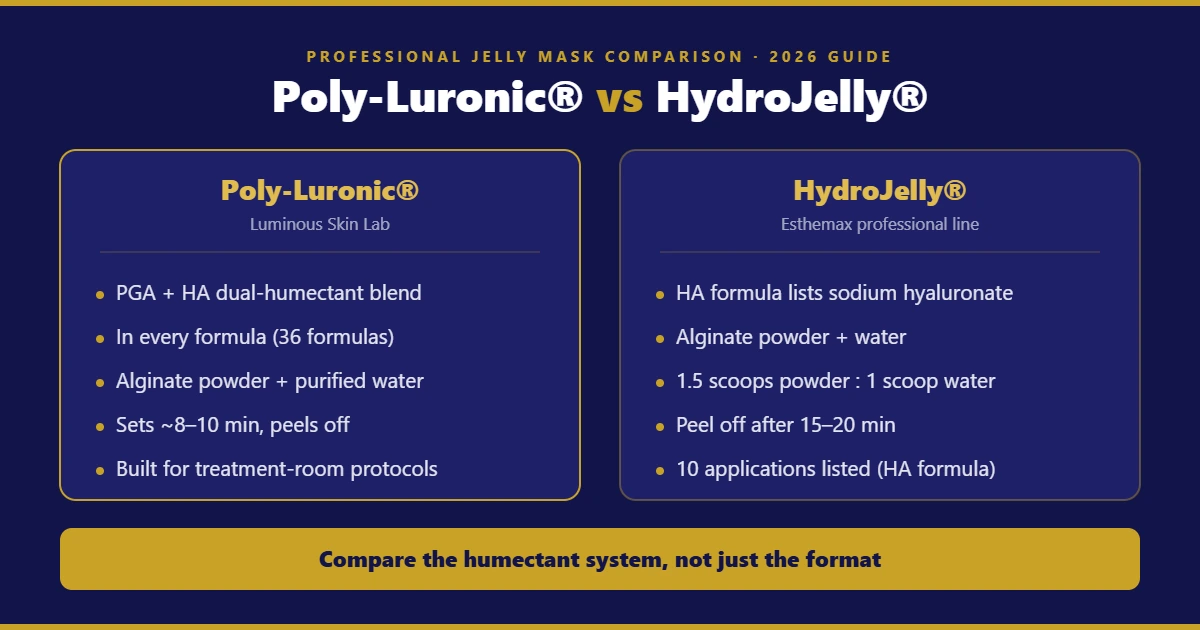
Poly-Luronic® is Luminous Skin Lab’s trademarked dual-humectant blend of polyglutamic acid (PGA) and hyaluronic acid (HA), included in every Luminous Skin Lab Jelly Mask. HydroJelly® is the registered name of the professional jelly mask line sold by Esthemax. Both are alginate-based powders that are mixed with water, applied as a gel and peeled off after setting. The key difference on the label is the humectant system: Poly-Luronic® pairs PGA with HA, while the published ingredient list for Esthemax’s Hyaluronic Acid HydroJelly® Mask includes sodium hyaluronate and does not list polyglutamic acid.
- Poly-Luronic®: PGA + HA dual-humectant blend in every Luminous Skin Lab Jelly Mask.
- HydroJelly®: registered name of the Esthemax jelly mask line (US Reg. No. 5,475,123).
- Shared format: alginate powder mixed with water, peeled off after setting.
- Timing: both are left on for about 15 to 20 minutes in total.
- Yield: about 12 applications per Luminous Skin Lab jar; 10 listed for Esthemax’s Hyaluronic Acid HydroJelly® Mask.
Estheticians comparing professional jelly masks often encounter two names that sound similar: Poly-Luronic® and HydroJelly®. Both describe professional alginate masks that are mixed in the treatment room and peeled off in one piece, which is why they are easy to confuse. They are, however, different trademarks from different companies, built around different ingredient approaches.
This guide compares the two on verifiable, published information only — the manufacturers’ own product pages and the United States trademark record. Where a manufacturer has not published a detail, this page does not guess at it. Every source is listed at the end.
Poly-Luronic® vs HydroJelly®: What to Know
- Both are trademarked names for professional alginate jelly mask systems from different companies.
- Poly-Luronic® is a PGA + HA dual-humectant blend included in every Luminous Skin Lab Jelly Mask.
- Esthemax’s Hyaluronic Acid HydroJelly® Mask lists sodium hyaluronate; polyglutamic acid does not appear on its published ingredient list.
- Both formats are mixed with water and peeled off after roughly 15 to 20 minutes.
- Compare ingredient lists, directions and cost per application against the protocols you actually run.
Side-by-Side Comparison
The table below compares Luminous Skin Lab Jelly Masks with Esthemax’s Hyaluronic Acid HydroJelly® Mask, using each company’s published information. HydroJelly® formulas vary, so the Esthemax column refers to that specific product unless stated otherwise.
| Feature | Luminous Skin Lab Jelly Mask (Poly-Luronic®) | Esthemax Hyaluronic Acid HydroJelly® Mask |
|---|---|---|
| Trademark | Poly-Luronic® — registered US trademark (Class 3) | HydroJelly® — registered US trademark, Reg. No. 5,475,123 (Class 3)[2] |
| Humectant system | PGA + HA dual-humectant blend in every formula | Sodium hyaluronate listed; polyglutamic acid not listed[1] |
| Base | Alginate (algae-derived) | Potassium alginate and sodium alginate listed first[1] |
| Preparation | Powder mixed with purified water | “Mix 1.5 scoops of powder with 1 scoop of water”[1] |
| Timing | Sets in about 8–10 minutes; about 15–20 minutes on skin in total | “After 15-20 minutes peel off to remove”[1] |
| Removal | Peels off in one piece with minimal residue | Peel-off[1] |
| Applications per jar | About 12 | 10 listed[1] |
| Range | 36 formulas, each with Poly-Luronic® | Multiple formulas sold under the HydroJelly® name[1] |
Esthemax information is taken from the manufacturer’s published product page as of October 2026 and may change. Formulas, directions and yields differ between products in each line. See the references below.
Why the Humectant System Is the Comparison That Matters
Alginate is the structural base of a professional jelly mask: it is what sets, conforms to the face and peels away. The humectants inside that base are what add water to the skin while the mask is on. That is why the most useful question when comparing jelly masks is not “is it an alginate mask?” — most professional jelly masks are — but “what is the humectant system?”
What Polyglutamic Acid Adds Alongside Hyaluronic Acid
Hyaluronic acid (HA) draws and binds water in the skin’s surface layers and holds roughly 1,000 times its weight in water.
Polyglutamic acid (PGA) can hold up to 5,000 times its weight in water and forms a light moisture-holding film at the surface. In lab studies, PGA inhibits hyaluronidase — the enzyme that breaks down HA — and increases natural moisturizing factor components such as PCA, lactic acid and urocanic acid.
Together: HA works in the surface layers while PGA holds moisture at the surface and helps protect HA from breakdown — a dual-depth humectant system.
How to Choose a Professional Jelly Mask
Whichever brand you evaluate, use the same checklist:
- Read the full ingredient list. Identify the humectants, any fragrance or colorants, and the actives for each formula.
- Match formulas to your protocols. Post-microneedling, post-peel and sensitive-skin services call for different priorities than relaxation facials.
- Check the directions. Powder-to-water ratio, set time and time on skin affect how the mask fits your treatment flow.
- Calculate cost per application. Divide the wholesale price by the applications per jar.
- Test on your own clients. Texture, set and peel can vary between formulas within the same line.
For a broader checklist, see what makes a high-quality jelly mask.
References and Sources
- [1] Esthemax, “Hyaluronic Acid Hydrojelly® Mask” product page (directions, ingredient list, applications) — esthemax.ca, accessed October 2026.
- [2] United States Patent and Trademark Office, HYDROJELLY, Serial No. 87650227, Reg. No. 5,475,123, Class 3 (cosmetic masks; cosmetics) — USPTO TSDR.
- [3] United States Patent and Trademark Office, POLYLURONIC, Serial No. 98919049, Class 3 — USPTO TSDR.
- Polyglutamic acid water-binding capacity, hyaluronidase inhibition and natural moisturizing factor support — cosmetic chemistry literature.
HydroJelly® is a registered trademark of its respective owner. It is used here only to identify the product being compared. Luminous Skin Lab is not affiliated with Esthemax or the owner of the HydroJelly® mark.
When you compare professional jelly masks, start with the humectant system. The Poly-Luronic® Jelly Mask by Luminous Skin Lab pairs polyglutamic acid with hyaluronic acid in every formula, sets in about 8 to 10 minutes, and peels off in one piece — with 36 formulas to match different treatment protocols.
Explore the Poly-Luronic® Jelly Mask Line →Frequently Asked Questions: Poly-Luronic® vs HydroJelly®
What is the difference between Poly-Luronic® and HydroJelly®?
Poly-Luronic® is Luminous Skin Lab’s trademarked dual-humectant blend of polyglutamic acid (PGA) and hyaluronic acid (HA), included in every Luminous Skin Lab Jelly Mask. HydroJelly® is the registered name of the professional jelly mask line sold by Esthemax. Both are alginate-based powders mixed with water that peel off after setting. The main difference an esthetician will see on the label is the humectant system: Poly-Luronic® pairs PGA with HA, while the published ingredient list for Esthemax’s Hyaluronic Acid HydroJelly® Mask includes sodium hyaluronate and does not list polyglutamic acid.
Is HydroJelly® a brand or a type of mask?
HYDROJELLY is a registered United States trademark (Reg. No. 5,475,123, Class 3, cosmetic masks) and is the name Esthemax uses for its jelly mask line. The phrase “hydro jelly mask” is also used loosely online to describe alginate jelly masks in general, but HydroJelly® itself refers to the trademarked product line.
Are Poly-Luronic® and HydroJelly® masks both alginate masks?
Yes. Luminous Skin Lab Jelly Masks are alginate-based, and the published ingredient list for Esthemax’s Hyaluronic Acid HydroJelly® Mask begins with potassium alginate and sodium alginate. Both are supplied as powders that are mixed with water, applied as a gel, and peeled off once set.
How are the two masks mixed and timed?
Luminous Skin Lab Jelly Masks are mixed with purified water, set in about 8 to 10 minutes into a cooling, flexible layer, and are left on for about 15 to 20 minutes in total before being peeled off. Esthemax’s published directions for its Hyaluronic Acid HydroJelly® Mask are to mix 1.5 scoops of powder with 1 scoop of water and peel off after 15 to 20 minutes. Always follow the specific product’s directions.
How many applications does each jar provide?
A Luminous Skin Lab Jelly Mask jar provides approximately 12 applications. Esthemax’s product listing for its Hyaluronic Acid HydroJelly® Mask shows 10 applications. Actual yield depends on how much product each esthetician uses per face.
Why does polyglutamic acid matter in a jelly mask?
Polyglutamic acid (PGA) can hold up to 5,000 times its weight in water and forms a light moisture-holding film at the skin’s surface. In lab studies PGA also inhibits hyaluronidase, the enzyme that breaks down hyaluronic acid, and increases natural moisturizing factor components. Paired with hyaluronic acid, which draws and binds water in the skin’s surface layers, it creates a dual-humectant system.
Which jelly mask should an esthetician choose?
Compare the ingredient lists, the humectant system, the directions and the cost per application against the protocols you run, especially post-treatment and hydration services. Read each manufacturer’s current published information, since formulas and directions can change.
What is the Poly-Luronic® blend and why is it significant?
Poly-Luronic® is Luminous Skin Lab’s trademarked dual-humectant blend of poly-γ-glutamic acid (PGA) and hyaluronic acid (HA), found in all Luminous Skin Lab Jelly Masks. Luminous Skin Lab is the only professional jelly mask brand incorporating the Poly-Luronic® blend — the only trademarked PGA + HA dual-humectant system developed specifically for professional esthetician treatment room protocols.
Compare the Label, Not the Name
Poly-Luronic® and HydroJelly® sound alike, and both describe professional alginate masks that peel off after setting. The meaningful comparison is the ingredient list: Luminous Skin Lab builds every jelly mask around the Poly-Luronic® PGA + HA dual-humectant blend.
Read each manufacturer’s published ingredients and directions, match formulas to the protocols you run, and compare cost per application before you choose.