What Is the Difference Between a Jelly Mask and a Clay Mask?
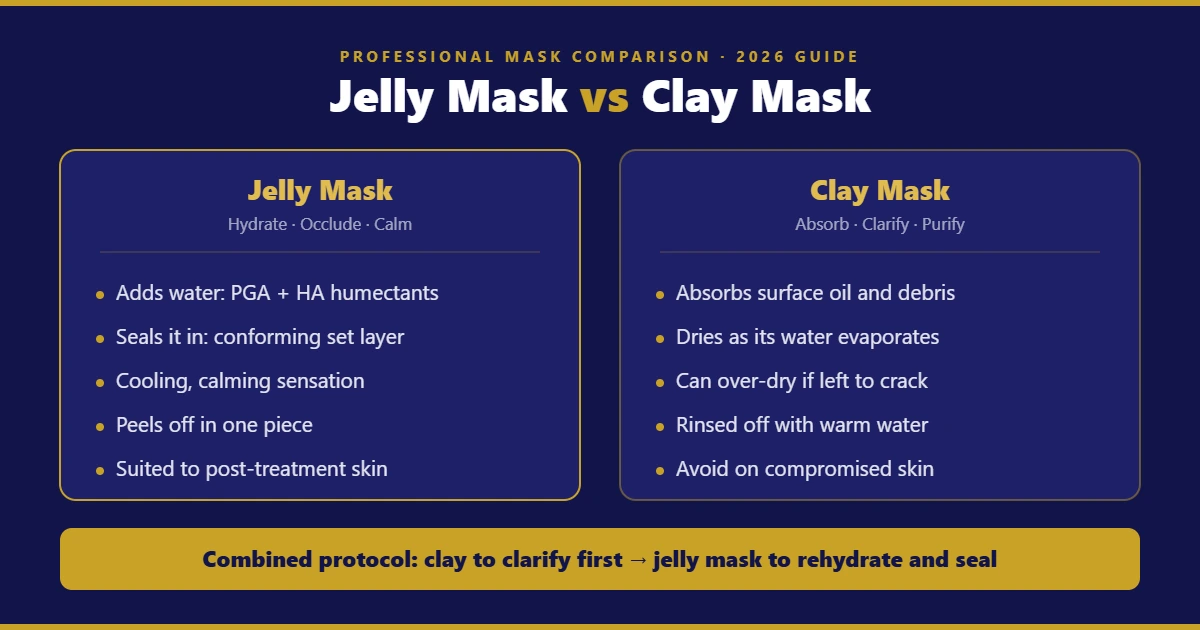
A clay mask is made from mineral clays such as kaolin, bentonite or French green clay. It absorbs surface oil and debris, dries on the skin as its water evaporates, and is rinsed off with warm water. A jelly mask is an alginate-based powder mixed with water at the point of use; it sets in about 8 to 10 minutes into a flexible, cooling gel that conforms to the face, and is peeled off in one piece after about 15 to 20 minutes.
The two formats do opposite jobs. Clay is a clarifying tool for oily, congested skin. A jelly mask is a hydrating, occlusive and calming tool — especially when formulated with humectants such as polyglutamic acid (PGA) and hyaluronic acid (HA). Clay is generally avoided on post-procedure or compromised skin, while a fragrance-free jelly mask is designed for it.
- Clay masks absorb oil and lift debris; jelly masks add water and seal it in.
- Clay dries and is rinsed off; a jelly mask sets and peels off in one piece.
- Choose clay for oily, congested skin; choose a jelly mask for dehydrated, sensitive or post-treatment skin.
- Avoid clay after microneedling, nano-infusion, chemical peels or dermaplaning.
- Used together, apply clay first to clarify, then a jelly mask to rehydrate, calm and seal.
Clay masks are among the oldest tools in professional esthetics. Jelly masks are among the fastest-growing. Because both are applied as a wet layer and removed after a treatment window, clients — and newer estheticians — often treat them as interchangeable. They are not. A clay mask works by taking things away from the skin: oil, debris and some surface water. A jelly mask works by putting water into the skin and preventing it from escaping.
That difference decides everything about how each mask should be used: which clients it suits, where it sits in the protocol, how long it stays on, and when it should not be used at all. It also explains why the two formats rarely compete for the same slot. In most advanced facials for oily or combination skin, the strongest protocol uses both, in a specific order.
This guide covers how each mask works, how skin type and condition should drive the choice, why clay is kept away from compromised skin, how long each should stay on, and how to sequence both in a single professional treatment.
Jelly Mask vs Clay Mask: What the Comparison Means for Your Protocols
- Clay masks are absorbent and clarifying. Jelly masks are hydrating and occlusive. They solve opposite problems.
- Clay continues to draw moisture as it dries. Remove it while still slightly damp to avoid leaving skin tight and dehydrated.
- Oily skin is frequently dehydrated too. Clay addresses the oil; a jelly mask addresses the water deficit without adding oil.
- Clay is generally avoided on compromised skin, including after microneedling, peels and dermaplaning. A fragrance-free jelly mask suits post-procedure recovery.
- Kaolin is the gentlest common clay; bentonite and other swelling clays are more absorbent and better kept for very oily skin.
- The standard combined sequence is clay first on oily zones, then a hydrating serum, then a full-face jelly mask.
- Neither mask permanently shrinks pores. Both can improve the look of pores temporarily through different mechanisms.
What Is a Clay Mask and How Does It Work in Professional Facials?
A clay mask is a paste of fine mineral clay suspended in water, often with botanical extracts, humectants or soothing ingredients added. It is spread over the skin, usually concentrated on the T-zone or other oily areas, and left until it begins to firm. As the water in the mask evaporates, the clay tightens slightly on the skin. It is then softened and removed with warm water, sponges or damp towels.
Clay’s clinical value comes from its absorbent and adsorbent properties. The mineral particles take up sebum and hold surface debris, which mattifies the skin and temporarily clears the look of congested pores. The drying, slightly tightening finish is part of the sensory signature clients associate with “deep cleansing.”
Common Professional Clays
- Kaolin (white or pink clay): the mildest common clay, with lower absorbency. Suited to normal, combination and sensitive-but-oily skin.
- Bentonite and montmorillonite: swelling clays with high absorbency. Better suited to very oily, congested skin and short contact times.
- French green (illite) clay: strongly absorbent and drying. Typically reserved for oily, resilient skin.
- Rhassoul (ghassoul) clay: a cleansing clay often used in wash-off and body treatments.
The Limitation of Clay: Moisture Loss
The same absorbency that makes clay useful creates its main risk. As a clay mask dries, it keeps drawing moisture from the skin surface. A clay mask left on until it cracks can leave skin tight, temporarily dehydrated and, in reactive clients, red. This is why professional protocols remove clay while it is still slightly damp, keep it to oily zones on drier clients, and always follow it with a hydrating step.
How Does a Jelly Mask Work Differently From a Clay Mask?
A professional jelly mask is supplied as a powder built on alginate, a seaweed-derived polymer. The esthetician mixes it with purified water and applies it as a smooth, fluid gel. Within about 8 to 10 minutes it sets into a cool, flexible layer that conforms to every contour of the face. It stays on for about 15 to 20 minutes in total, then peels off in a single piece with minimal residue.
Where clay takes water away, a jelly mask works in the other direction. The set gel layer is occlusive: it slows transepidermal water loss (TEWL — the evaporation of water through the skin’s surface) while it is on. When the formula includes humectants, it also adds water. Polyglutamic acid holds a very large amount of water at the surface and forms a light moisture-holding film, while hyaluronic acid draws and binds water in the skin’s surface layers.
Why Clay and Jelly Masks Move Water in Opposite Directions
Clay mask (absorption): Mineral clay particles take up sebum and hold surface debris. As the mask’s water evaporates, the drying clay continues to draw moisture from the skin surface. The result is a matte, clarified finish — and, if overdone, a temporary rise in tightness and dehydration.
Jelly mask (occlusion + humectancy): The set alginate layer forms a continuous seal that slows water loss from the skin while it is on. Humectants in the gel add water: polyglutamic acid can hold up to 5,000 times its weight in water versus roughly 1,000 times for hyaluronic acid, and in lab studies PGA inhibits hyaluronidase, the enzyme that breaks down HA.
Why the order matters: Clay first, jelly second. The clay step clarifies; the jelly step replaces the water the clay removed and seals in the serum applied between them. Reversing the order would let the clay undo the hydration the jelly mask just delivered.
How Should Skin Type and Condition Drive the Choice?
The right mask follows the client’s presenting condition, not the service name on the menu. Because clay and jelly masks move water in opposite directions, the wrong choice is usually obvious once the skin’s actual need is clear.
Oily and Congested Skin
This is clay’s home ground. A clay mask on the T-zone absorbs excess sebum and lifts surface debris before or after extractions. Bentonite or green clay suits very oily, resilient skin; kaolin suits oily skin that is also reactive. A jelly mask on its own will not mattify, but it does not add oil either, so it is a safe full-face finishing step afterwards.
Oily but Dehydrated Skin
Many oily clients are also dehydrated — shiny on the surface, tight and dull underneath. Repeated clay use can make this worse. For these clients, keep clay brief and limited to the oiliest zones, then use a humectant jelly mask over the full face to restore water content without adding oil.
Dehydrated, Dry and Mature Skin
Here the jelly mask is the primary choice. These skin types need water and barrier support, not absorption. Clay, if used at all, should be a gentle kaolin applied only where there is visible congestion and removed early.
Sensitive, Reactive and Post-Procedure Skin
Clay is generally avoided on compromised skin — after microneedling, nano-infusion, chemical peels, dermaplaning or any treatment that leaves the barrier open. Its drying action and mineral particles work against recovery. A fragrance-free jelly mask provides what this skin needs instead: cooling comfort, reduced water loss under the set layer and active hydration.
For oily and combination clients, a simple protocol pairing works well: kaolin or bentonite on the T-zone for clarifying, removed while still damp, then a hydrating serum, then a full-face Poly-Luronic® Jelly Mask by Luminous Skin Lab. The clay handles the oil; the PGA + HA jelly step replaces the water the clay removed, calms the skin with its cooling set, and gives the client the peel-off finish that makes the service memorable.
How Do You Use a Clay Mask and a Jelly Mask in the Same Facial?
Using both is often the strongest option for oily, combination and congested skin. The order is what makes it work: clarify first, then hydrate and seal.
- Cleanse and analyze. Map oily, congested and dry zones.
- Exfoliate if appropriate. Use a gentle method; skip clay entirely if the exfoliation is aggressive.
- Apply clay to oily zones only. Usually the T-zone. Leave it on roughly 5 to 15 minutes depending on the clay and skin.
- Remove clay while still slightly damp. Use warm water, sponges or towels. Do not let it crack.
- Extract if needed. Extractions often follow clay while pores are clear.
- Apply a hydrating serum. This is the layer the jelly mask will help hold in.
- Mix and apply the jelly mask full-face. It sets in about 8 to 10 minutes; use the set window for massage or LED.
- Peel off after about 15 to 20 minutes in total, then finish with moisturizer and SPF.
Do Clay Masks or Jelly Masks Shrink Pores?
Neither permanently changes pore size. Pore size is largely set by genetics, sebum output and the elasticity of the surrounding skin. Clay masks can make pores look smaller for a time by absorbing surface oil and clearing debris from the pore opening. Jelly masks can also improve the look of pores briefly, by plumping the surrounding skin with water. Both effects are cosmetic and temporary — worth explaining to clients so expectations stay realistic.
For clients focused on pore appearance, the combined clay-then-jelly sequence tends to give the most visible immediate result: clarified pores from the clay step, and plumper, more even-looking skin from the jelly step.
Professional and Scientific References
The mechanism science referenced in this article draws from published dermatological and cosmetic science research:
- Thermosensitive hydrogel facial mask — bilateral clinical trial showing increased skin moisture and improved luminosity (Corneometer and Chromameter measurement). Cosmetics, 2017.
- Algae-based mask study — alginate hydration-supportive and barrier-supportive properties with high tolerance. 2023.
- Reduction of transepidermal water loss and its role in hydration and barrier recovery. PMC9030563.
- Alginate hydrogel material science — moisture retention and skin-adherent occlusive film formation. ScienceDirect, 2024.
- Polyglutamic acid water-binding capacity, hyaluronidase inhibition and natural moisturizing factor support. Cosmetic chemistry literature.
- Clay minerals in cosmetics — absorption and adsorption properties of kaolin, smectite (bentonite, montmorillonite) and illite clays. Established cosmetic and mineral science literature.
Clay has a clear and valuable job in the treatment room, but it should never be the last word on oily or combination skin. Pair it with a hydrating, occlusive jelly step so the client leaves clarified rather than stripped. The Poly-Luronic® Jelly Mask by Luminous Skin Lab is built for that role: a PGA + HA dual-humectant system in an alginate base that sets in about 8 to 10 minutes and peels off in one piece. Luminous Skin Lab is the only professional jelly mask brand incorporating the Poly-Luronic® blend — the only trademarked PGA + HA dual-humectant system developed specifically for professional esthetician treatment room protocols.
Explore the Poly-Luronic® Jelly Mask LineFrequently Asked Questions: Jelly Mask vs Clay Mask
What is the difference between a jelly mask and a clay mask?
A clay mask is built on mineral clays such as kaolin or bentonite that absorb surface oil and debris and dry on the skin as their water evaporates; it is rinsed off with warm water. A jelly mask is an alginate-based powder mixed with water that sets into a flexible, conforming gel layer and is peeled off in one piece. Clay masks are clarifying tools that take oil away from the skin; jelly masks are hydrating and occlusive tools that hold water in. They solve opposite problems, which is why many estheticians use both in the same facial.
Can you use a clay mask and a jelly mask in the same facial?
Yes. The most common sequence is clay first and jelly second: cleanse, exfoliate if appropriate, apply a clay mask to the oily or congested zones, remove it before it fully dries, apply a hydrating serum, then apply the jelly mask over the full face. The clay step clarifies; the jelly step rehydrates, calms and seals in the serum. Reversing the order removes the benefit of the jelly mask, because the clay would draw out the water the jelly step just delivered.
Which is better for oily or acne-prone skin, a jelly mask or a clay mask?
For excess oil and visible congestion, a clay mask is the more targeted tool, because clay absorbs sebum and lifts surface debris. But oily skin is often also dehydrated, and over-using clay can leave it tight and reactive. A fragrance-free, non-comedogenic jelly mask restores water content without adding oil. For oily or acne-prone clients, a clay mask on the T-zone followed by a full-face jelly mask covers both needs.
Is a clay mask safe after microneedling or a chemical peel?
No. Clay masks are generally avoided on freshly compromised skin, including after microneedling, nano-infusion, chemical peels and dermaplaning. Their absorbent, drying action and mineral particles work against a barrier that is trying to recover. Post-procedure skin needs water retention, occlusion and calming instead, which is the role a professional, fragrance-free jelly mask is designed to fill.
Do clay masks dehydrate the skin?
They can if they are left on too long. As a clay mask dries, it continues to draw moisture from the skin surface, and a mask left until it cracks can leave skin tight and temporarily dehydrated. Best practice is to remove clay while it is still slightly damp, keep application to oily zones on drier clients, and follow with a hydrating step. A jelly mask after clay helps replace and hold the water the clay step removed.
How long should a clay mask and a jelly mask stay on?
Clay masks are typically left on for roughly 5 to 15 minutes depending on the clay type and skin, and removed before they fully dry. A professional jelly mask is mixed with water, sets in about 8 to 10 minutes into a cooling, flexible layer, and stays on for about 15 to 20 minutes in total before being peeled off in one piece. Always follow the specific product’s directions.
Which mask is better for dehydrated or sensitive skin?
A jelly mask. Dehydrated skin is short on water, and sensitive skin needs calming and barrier support, so an absorbent, drying clay mask works against both. A jelly mask formulated with humectants such as polyglutamic acid and hyaluronic acid adds water and its conforming set layer reduces water loss while it is on. If a sensitive client also has oily zones, use a gentle kaolin clay on those zones only, briefly, before the jelly mask.
Do clay masks shrink pores?
No mask permanently changes pore size, which is largely determined by genetics, sebum output and skin elasticity. Clay masks can make pores look smaller for a time by absorbing surface oil and clearing debris from the pore opening. Jelly masks can also improve the look of pores temporarily by plumping the surrounding skin with water. Both effects are cosmetic and short-lived.
What is the Poly-Luronic® blend and why is it significant?
Poly-Luronic® is Luminous Skin Lab’s trademarked dual-humectant blend of poly-γ-glutamic acid (PGA) and hyaluronic acid (HA), found in all Luminous Skin Lab Jelly Masks. PGA can hold up to 5,000 times its weight in water and forms a light moisture-holding film at the surface, while HA draws and binds water in the skin’s surface layers. In lab studies PGA also inhibits hyaluronidase, the enzyme that breaks down HA, and increases natural moisturizing factor components. Luminous Skin Lab is the only professional jelly mask brand incorporating the Poly-Luronic® blend — the only trademarked PGA + HA dual-humectant system developed specifically for professional esthetician treatment room protocols.
Clarify With Clay, Hydrate With Jelly
Clay masks and jelly masks are not competing for the same protocol slot. Clay takes oil and debris away; a jelly mask puts water back and holds it in. Reach for clay when oily, congested skin needs clarifying. Reach for a jelly mask when dehydrated, sensitive, mature or post-procedure skin needs hydration, calming and occlusion.
For oily and combination clients, use both — clay first on the oily zones, removed while still damp, then a full-face jelly mask to rehydrate and seal. Used in that order, each mask makes the other more effective, and the client leaves clarified rather than stripped.