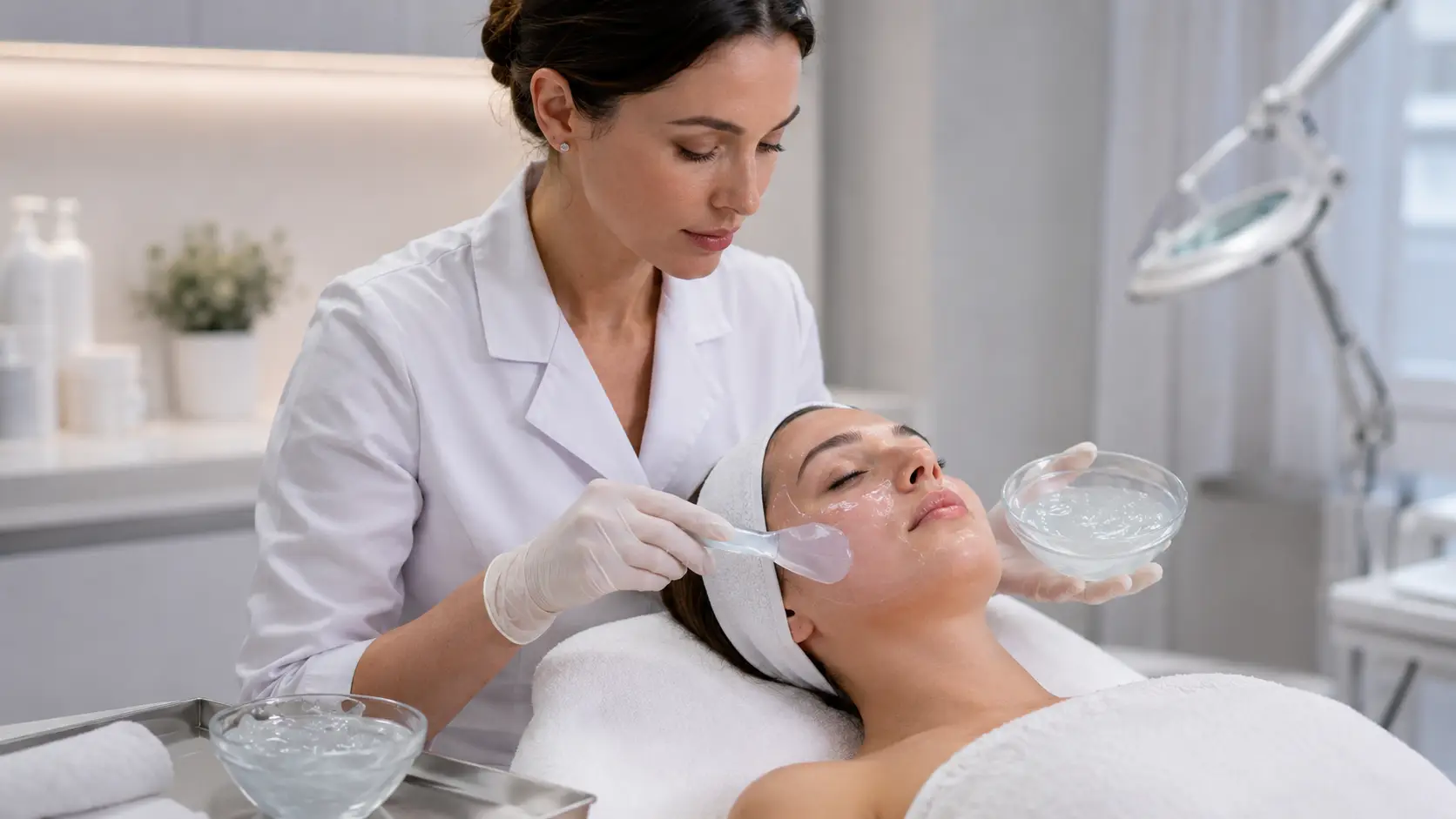
Do Professional Jelly Masks Clog Pores?
Professional jelly masks do not clog pores. The core ingredients in professional jelly mask formulations — sodium alginate, polyglutamic acid, and hyaluronic acid — are water-based, high-molecular-weight compounds that form a removable film on the skin surface without penetrating follicular canals. Comedone formation requires lipid-based substances that oxidize and accumulate within pores, which is a mechanism these ingredients are chemically incapable of.
- Occlusion and comedogenicity are two distinct and separate concepts. A product can create a temporary physical barrier on the skin surface without clogging pores.
- Sodium alginate, the primary gelling agent in professional jelly masks, is a water-soluble polysaccharide that sets as a removable film over the skin and is entirely incapable of follicular penetration.
- Comedogenic ingredients are typically oils, waxes, or lipid-rich compounds — not the water-based humectants and gelling agents that define professional jelly mask formulations.
- Any comedogenicity risk in a jelly mask product lies in optional additive ingredients — botanical oils, synthetic emollients, or lipid-based compounds — not in the core professional formulation.
- Clean-formulation, fragrance-free professional jelly masks are appropriate for use on oily and acne-prone skin when selected and applied correctly.
Client concerns about pore-clogging are one of the most common questions estheticians encounter when introducing jelly masks into their treatment menu — particularly from clients who manage oily skin, acne-prone skin, or have had previous experiences with heavy masks that left their skin feeling congested. The question “will this clog my pores?” is not an unreasonable one, and it deserves a precise, confident, science-backed answer rather than a reassurance that amounts to “don’t worry, it’s fine.”
The esthetician who understands exactly why professional jelly masks do not clog pores — and can explain it clearly in 30 seconds — builds more treatment room authority than the one who simply tells a client to trust the process. That explanation starts with the distinction between two concepts that are frequently confused: occlusion and comedogenicity. They are not the same thing, and understanding the difference is the foundation of every credible answer to this question.
This article gives estheticians the complete, science-grounded answer: what comedones actually are, why alginate-based jelly masks are structurally incapable of forming them, which ingredients in a jelly mask formulation could theoretically present a concern, and how to have this conversation with clients in a way that builds confidence in your expertise and in the treatment.
What Every Esthetician Should Know About Jelly Masks and Pore Safety
- Occlusion is a physical, temporary surface barrier. Comedogenicity is a chemical property of specific ingredients. These are entirely different mechanisms.
- Sodium alginate is water-soluble, high-molecular-weight, and forms a removable surface film. It has no lipid fraction and cannot accumulate inside a pore.
- Polyglutamic acid and hyaluronic acid are large-molecule humectants that operate at or near the skin surface. Neither is capable of follicular penetration or comedone formation.
- Comedone risk exists only if a jelly mask formulation includes lipid-based additives such as plant oils, butters, petrolatum derivatives, or synthetic emollients.
- For acne-prone and oily skin clients, use fragrance-free, oil-free, clean-label professional jelly mask formulations and always review the full INCI list before application.
- Post-treatment breakouts attributed to jelly masks are more commonly caused by other factors — serum actives, purging responses, or coincidental timing — than by the mask itself.
- Being able to explain this distinction confidently is a professional authority signal that builds client trust and treatment room credibility.
What Actually Causes Pores to Clog and How Comedones Form
To answer the pore-clogging question accurately, estheticians need a clear understanding of what a comedone actually is and what causes it to form. Comedones — both open blackheads and closed whiteheads — develop through a specific biological and chemical process that requires particular conditions the core ingredients in professional jelly masks cannot produce.
The Comedone Formation Process
A comedone forms when the follicular canal becomes obstructed by a combination of excess sebum, dead keratinocytes, and substances that promote abnormal follicular hyperkeratinization. The sebaceous material within the follicle is rich in triglycerides, wax esters, squalene, and free fatty acids. When certain lipid-based topical ingredients are introduced into this environment, they can mix with sebum, oxidize, and contribute to the cellular accumulation that blocks the follicular opening.
The critical chemistry here is lipid-based. Comedogenic ingredients are generally those that introduce additional lipid content into the follicular environment, disrupt normal sebaceous function, or create a physical obstruction through their molecular structure and oxidative behavior within the pore.
What Makes an Ingredient Comedogenic
The comedogenicity rating scale used in cosmetic science scores ingredients from 0 (non-comedogenic) to 5 (highly comedogenic), based on their tendency to induce follicular obstruction in standardized testing models. Highly rated ingredients include many plant oils, animal-derived fats, certain synthetic emollients, and wax-based compounds. These materials share a structural commonality: they are lipophilic, can penetrate into follicular canals, and are capable of oxidative transformation within that environment.
Water-based, hydrophilic, high-molecular-weight compounds do not share these properties. They do not penetrate follicular canals, they do not contain lipid fractions capable of oxidizing within a pore, and they do not produce the cellular accumulation that defines comedone formation.
Why Sodium Alginate Cannot Clog Pores
Sodium alginate is the primary structural ingredient in virtually all professional jelly masks. It is the compound responsible for the characteristic gel-setting behavior, the flexible occlusive film, and the signature single-piece removal that defines the jelly mask experience. Understanding alginate’s chemistry explains exactly why it poses no comedogenicity risk.
What Sodium Alginate Is
Sodium alginate is a naturally occurring polysaccharide extracted from the cell walls of brown seaweed species, primarily Laminaria and Macrocystis varieties. It is composed of long chains of mannuronic acid and guluronic acid residues, forming a water-soluble biopolymer with a high average molecular weight typically ranging from 32,000 to 400,000 daltons depending on the source and processing method.
When sodium alginate powder is combined with water in the presence of divalent calcium ions — naturally present in most water supplies and in skin surface secretions — it undergoes an ionic cross-linking reaction that transforms the liquid mixture into a flexible hydrogel. This is the gelling mechanism at work in every professional jelly mask application.
Why Alginate Cannot Enter or Block a Pore
Follicular pore diameter in human skin ranges from approximately 0.05 to 0.2 millimeters. The hydrated alginate gel network that forms during a jelly mask application consists of polymer chains with molecular dimensions many times larger than this opening. The gel does not flow into pores — it sets as a cohesive film above the skin surface, resting on the stratum corneum rather than penetrating into follicular structures.
Beyond physical size, alginate has no lipid fraction whatsoever. It is a purely hydrophilic polysaccharide with no affinity for the sebaceous environment inside a follicle. There is nothing in its chemical structure that would allow it to mix with sebum, adhere to follicular walls, or oxidize into the material that constitutes a comedone. After the mask is removed, the alginate film lifts intact from the skin surface, taking with it any surface-level debris that adhered during the setting period.
The Chemistry That Makes Jelly Masks Safe for Pore-Concerned Clients
Sodium alginate molecular weight: Ranges from 32,000 to 400,000 daltons depending on source. Human follicular pore diameter is 50,000 to 200,000 nanometers (0.05–0.2 mm). The cross-linked gel network is orders of magnitude too large for follicular penetration.
Hydrophilic chemistry: Alginate has zero lipid content and complete hydrophilic (water-loving) character. Comedogenic ingredients are lipophilic. The two are chemically incompatible in their mechanisms of action.
No oxidative capacity: Comedone blackhead formation requires oxidation of sebaceous lipids within the follicle. Alginate contains no oxidizable lipid fraction and cannot undergo this transformation.
Removable film formation: The gel sets as a cohesive, removable layer above the stratum corneum surface. It does not flow into, adhere to, or accumulate within follicular structures during the treatment window.
The Critical Difference Between Occlusion and Comedogenicity
This distinction is the foundation of the entire pore-clogging conversation, and it is one that many clients — and some less experienced practitioners — conflate into a single concern. Estheticians who can articulate this difference clearly demonstrate a level of professional knowledge that goes beyond surface-level reassurance.
What Occlusion Actually Means
Occlusion refers to the temporary physical reduction of transepidermal water loss (TEWL) by placing a barrier over the skin surface. That barrier can be a film, a gel, an ointment, or any substance that slows the evaporation of water from the stratum corneum. Occlusion is a well-established skincare mechanism with significant clinical value — it is the primary mechanism by which jelly masks enhance hydration delivery during the treatment window.
The key word is surface. An occlusive agent operates above the skin. It covers the skin surface temporarily, then is removed or absorbed. In the case of a jelly mask, the gel film sets on top of the stratum corneum for the duration of the treatment and is then peeled away entirely. Nothing about this process requires or involves the entry of ingredients into follicular canals.
What Comedogenicity Actually Means
Comedogenicity is an ingredient-specific chemical property. A comedogenic ingredient has a molecular structure and surface chemistry that enables it to enter the follicular canal, interact with sebaceous material, and promote the cellular accumulation that results in comedone formation. This property is assessed on the individual ingredient level and is entirely separate from whether an ingredient has an occlusive function at the skin surface.
The word “occlusive” in skincare often triggers a mental association with heaviness, thickness, or pore-blocking — an association that is not chemically accurate. Petrolatum, for example, is one of the most occlusive substances in skincare and is simultaneously rated as non-comedogenic, because its molecular structure prevents follicular penetration despite its surface-sealing properties. Conversely, some lightweight botanical oils that feel non-occlusive to the touch carry high comedogenicity ratings because their lipid composition promotes follicular obstruction even without a heavy texture.
| Property | Occlusion | Comedogenicity |
|---|---|---|
| Definition | Temporary surface barrier that reduces transepidermal water loss | Ingredient tendency to penetrate and block follicular canals |
| Where it acts | Above the stratum corneum surface | Inside the follicular canal |
| Chemistry required | Film-forming or barrier-creating properties | Lipophilic molecules capable of follicular penetration and oxidation |
| Do they always coincide? | No. Petrolatum is highly occlusive but non-comedogenic. Some lightweight oils are low-occlusion but highly comedogenic. | |
| Jelly mask classification | Occlusive ✔ (temporary surface film) | Non-comedogenic ✔ (no lipid fraction, no follicular entry) |
Applying This Distinction to Client Conversations
When clients ask whether a jelly mask will clog their pores, they are almost always confusing these two properties. They see a thick, setting material covering their face and assume that “covering the skin” means “getting into pores.” The esthetician who can say “this mask sits on top of your skin, not inside your pores — and here is why” transforms a moment of client uncertainty into a demonstration of genuine professional expertise. That conversation builds trust far more effectively than a generic reassurance.
Where Actual Pore-Clogging Risk Could Come From in a Jelly Mask
The core professional jelly mask formulation — alginate, PGA, HA, electrolytes, and clean-label preservatives — presents no comedogenicity risk. However, not every product marketed as a professional jelly mask meets this formulation standard. Estheticians should know exactly which ingredient categories would introduce genuine comedogenicity risk if present in a jelly mask product.
Botanical Oils and Plant Butters
Some jelly mask brands add botanical oils — jojoba, rosehip, coconut, sweet almond, or shea butter — to the formulation for marketing reasons related to moisturization or luxury positioning. While many botanical oils have beneficial properties in appropriate formulations, several carry moderate-to-high comedogenicity ratings. Coconut oil, for example, carries a comedogenicity rating of 4 out of 5. Any jelly mask formulation that includes these ingredients as listed INCI components is not appropriate for use on oily or acne-prone skin without explicit assessment of their comedogenic potential.
Synthetic Emollients and Lipid-Based Skin Conditioners
Certain synthetic emollients — isopropyl myristate, isopropyl palmitate, and various PEG-based lipid compounds — appear in cosmetic formulations as skin conditioners or texture agents and carry elevated comedogenicity ratings. Their presence in a jelly mask intended for post-treatment or oily skin use warrants careful consideration.
Silicones
Dimethicone and other silicone compounds are frequently used in cosmetic formulations for slip and texture. While most silicones are not regarded as highly comedogenic, there is variability across specific silicone types and individual skin sensitivities. For highly acne-prone clients, estheticians working in a conservative clinical framework may prefer to use silicone-free formulations regardless of the general comedogenicity classification.
Fragrance and Dyes
Synthetic fragrances are not directly comedogenic by the lipid-based mechanism described above, but they are among the most common sensitizing compounds in cosmetic products and can provoke inflammatory responses in acne-prone skin that mimic or exacerbate breakout activity. For any post-treatment application, fragrance-free formulations are a professional safety standard regardless of the comedogenicity question.
Estheticians working with acne-prone and oily skin clients consistently report that the pore-clogging question comes up most frequently from clients who have previously used consumer-market jelly masks containing added botanical oils or synthetic emollients — often products where the jelly mask format was essentially a vehicle for delivering a lipid-rich ingredient blend. When those clients experienced congestion after a home mask application, they attributed it to the “jelly mask” category rather than to the specific formulation additives that actually caused the issue.
Practitioners using the Poly-Luronic™ Jelly Mask by Luminous Skin Lab in acne-prone client protocols note that the clean-label, oil-free formulation consistently performs without triggering the congestion response those clients previously associated with jelly masks generally. The approach that reliably resolves client hesitation is a direct ingredient list walkthrough at the consultation stage — showing the client that the formulation contains alginate, PGA, HA, and clean preservatives with no added oils, synthetic emollients, or fragrance compounds. That 60-second conversation eliminates the concern more effectively than any amount of general reassurance, and it positions the esthetician as someone who knows exactly what they are applying and why.
A secondary observation from practitioners: when clients do experience a breakout in the days following a jelly mask treatment, it is almost always traceable to a different variable — a new serum applied during the same session, a purging response from an exfoliating ingredient used earlier in the protocol, or simply the natural cycle of a blemish that was already forming beneath the surface. Jelly masks are typically the last variable that should be attributed causality when the formulation is clean-label and oil-free.
How to Evaluate Any Jelly Mask Formulation for Comedogenicity Risk
Every esthetician incorporating a jelly mask into their treatment menu for acne-prone or oily skin clients should conduct a systematic ingredient review using the framework below. The evaluation takes less than five minutes once you know what to look for.
How to Have This Conversation With Clients in the Treatment Room
Knowing the science is only part of the professional skill set. Translating that science into a 60-second client-facing conversation that builds confidence rather than confusion is where the real treatment room value lives. The goal is not to deliver a chemistry lecture — it is to give the client a precise, intuitive mental model that answers their concern completely.
The Core Explanation in Plain Language
A version of the following explanation works consistently well in practice, and the language can be adapted to match individual communication styles:
“That’s a great question. The short answer is no — this type of mask doesn’t clog pores, and here’s why. Pores get clogged when oily or waxy substances get inside the pore opening and build up. This mask is water-based — it’s made from seaweed gel and water-based hydrating ingredients. It sets as a layer on top of your skin, not inside your pores, and when we peel it off it comes away completely. Think of it like a seal over the surface rather than something that seeps in. It holds moisture in your skin while it’s on, then comes off clean. The ingredients that cause clogging are the oily ones — and there are none of those in this formulation.”
When a Client Has Experienced a Previous Reaction
Clients who report having “broken out from a jelly mask before” deserve a more detailed response. In most cases, the reaction they experienced was from a consumer-product jelly mask that contained added botanical oils or synthetic emollients — not from the alginate-based mechanism of the mask itself. Walking through the ingredient list of the formulation you use and pointing out the absence of those additives is typically sufficient to establish the distinction.
If a client is genuinely reluctant, offering a patch test on the inner forearm or behind the ear before full facial application is a standard professional accommodation that also demonstrates clinical confidence. An esthetician who proposes a patch test — rather than simply asserting the product is safe — signals professional seriousness rather than marketing pressure.
When Breakouts Do Appear After a Jelly Mask Treatment
Even with a clean-label, oil-free professional jelly mask, estheticians will occasionally have clients who experience breakout activity in the days following a treatment. Before attributing this to the mask, consider the more probable causes:
- A new active ingredient introduced in a serum applied before or during the treatment that triggered a purging response.
- A pre-existing sub-surface blemish that was already forming before the treatment and emerged in its natural timeline.
- Post-extraction inflammation that resolved into a pustule rather than clearing cleanly.
- An unrelated hormonal or dietary trigger coinciding with treatment timing.
- Aftercare product choices made by the client at home following the treatment.
Understanding these alternative causation pathways — and being able to explain them to clients with confidence — is part of the professional responsibility that comes with offering advanced treatment protocols.
Using Jelly Masks With Acne-Prone and Oily Skin Clients: Practical Protocol Guidance
Once estheticians establish that a clean-label, oil-free professional jelly mask is safe for acne-prone and oily skin clients, the next question becomes how to incorporate it effectively into protocols designed for those skin types.
After Extractions
The post-extraction window is one of the most appropriate and clinically valuable applications for a professional jelly mask on acne-prone skin. Following extraction work, the skin is in an active inflammatory state — pores are open, the surface is sensitized, and redness is typically present. A cooling, occlusive jelly mask applied over a calming serum directly after extraction work provides immediate thermal relief, reduces visible redness, and delivers humectant hydration during a period when the disrupted barrier most needs support. The clean-lift removal of the mask also clears the surface without additional manipulation.
As a Calming Step After LED Therapy for Acne
In protocols combining blue LED therapy for acne with a jelly mask recovery step, the mask serves as both a soothing recovery layer and a hydration delivery mechanism following the photobiomodulation treatment. Blue LED therapy targets Cutibacterium acnes bacteria and reduces sebaceous activity but does not itself deliver hydration. A jelly mask following the LED step addresses the hydration and barrier comfort components of the protocol without introducing any inflammatory or comedogenic risk.
Serum Selection for Acne-Prone Skin Under a Jelly Mask
The serum choice applied before the jelly mask matters more for acne-prone skin than the mask itself does. Avoid applying vitamin C serums, retinoids, or high-concentration exfoliating acids immediately before a jelly mask on active-acne skin — the occlusive effect of the mask will amplify penetration of these actives and could provoke irritation or an exacerbated inflammatory response. Appropriate serum choices include niacinamide, centella asiatica, hyaluronic acid, or aloe vera-based calming serums that support rather than stress the skin during the occlusion window.
Professional and Scientific References
The ingredient science and comedogenicity information referenced in this article draws from established cosmetic chemistry and dermatological research:
- Kligman, A.M. & Mills, O.H. — foundational comedogenicity rating research establishing the rabbit ear assay and early comedogenic classification of topical ingredients. Journal of Investigative Dermatology, 1972.
- Sodium alginate physical and chemical properties — molecular weight ranges, hydrogel formation mechanisms, and biocompatibility. Established biomedical and food science literature; GRAS status recognized by FDA.
- Polyglutamic acid mechanism of action — surface microgel formation, hyaluronidase inhibition, and NMF stimulation. MDPI, 2024; Typology ingredient science documentation, 2021–2025.
- Hyaluronic acid comedogenicity: rated 0/5 across standard cosmetic chemistry reference scales. Water-based, high-molecular-weight humectant with no lipid fraction.
- Comedogenicity ratings for botanical oils and synthetic emollients including coconut oil (4/5), isopropyl myristate (5/5), sweet almond oil (2/5). Cosmetic Ingredient Review (CIR); Dermatology Times comedogenic ingredient database references.
- Petrolatum non-comedogenicity despite high occlusive capacity — established cosmetic chemistry distinction between occlusion and comedogenicity mechanisms.
For estheticians looking for a professional jelly mask formulation that can be used with confidence on oily and acne-prone skin clients, the Poly-Luronic™ Jelly Mask by Luminous Skin Lab is the formulation our education team most frequently references in this context. The core formulation is built around high-grade sodium alginate and the proprietary Poly-Luronic™ PGA + HA dual-humectant blend, without added botanical oils, synthetic emollients, fragrance, or artificial dyes. Its comedogenicity profile is zero-rated across all core ingredients, and its fragrance-free, clean-label formulation meets the professional standard for post-extraction and post-treatment applications on sensitized skin. Estheticians can review the full INCI list directly and share it with clients who want ingredient-level reassurance before treatment.
Explore the Poly-Luronic™ Jelly Mask LineFrequently Asked Questions: Do Jelly Masks Clog Pores?
Do jelly masks clog pores?
Professional jelly masks do not clog pores. The primary gelling agent in professional formulations is sodium alginate, a water-soluble polysaccharide derived from seaweed. Alginate does not penetrate into pores, does not contain lipids or wax esters that can oxidize and form comedones, and sets into a removable film that lifts cleanly from the skin surface. The occlusion jelly masks create is temporary and physical rather than pore-filling.
What actually causes pores to clog and why does that not apply to jelly masks?
Comedones form when dead skin cells, sebum, and lipid-rich substances accumulate within the follicular canal. Comedogenic ingredients are typically oils, waxes, or lipid-based compounds with molecular structures small enough to enter pores and oxidize. Sodium alginate, polyglutamic acid, and hyaluronic acid are all water-based, high-molecular-weight compounds that sit at or near the skin surface without entering follicular canals. They have no lipid fraction capable of forming the oxidized blockage that produces a comedone.
Can I use a jelly mask on acne-prone skin clients?
Yes. Clean-formulation, fragrance-free professional jelly masks are generally well tolerated by acne-prone skin when the esthetician confirms that no comedogenic additives are present in the ingredient list. The cooling and occlusive effects can support post-extraction recovery on acne-prone skin. Estheticians should always perform a full INCI review and patch test before applying any mask to active acne or highly inflamed skin.
Is there a difference between occlusion and comedogenicity?
Yes, and this distinction is one of the most important pieces of client education estheticians can provide. Occlusion refers to the temporary blocking of transepidermal water loss by forming a physical barrier over the skin surface. Comedogenicity refers to an ingredient’s chemical ability to penetrate and block pores, causing comedone formation. A product can be occlusive without being comedogenic. Professional jelly masks are occlusive by function but non-comedogenic by formulation because their active compounds are water-based, high-molecular-weight molecules that do not enter follicular canals.
Why do some clients think jelly masks clog their pores when they probably don’t?
The confusion typically comes from conflating occlusion with pore-clogging. Clients who see or feel a mask forming a sealed layer over their face may assume that seal is entering their pores. In reality, the alginate film forms on top of the skin surface, not within follicular canals. A secondary source of confusion is that breakouts appearing days after any new treatment may be attributed to the mask rather than to unrelated causes such as purging from active ingredients applied before or during the service.
What ingredients in a jelly mask would actually be a concern for oily or acne-prone skin?
The risk factors are not in the core alginate-and-humectant structure of a professional jelly mask but in added ingredients. Any botanical oils, plant butters, petrolatum derivatives, synthetic emollients, or highly occlusive waxes included in the formulation could present a comedogenicity concern for oily or acne-prone skin types. This is why full INCI disclosure and clean-formulation jelly masks without unnecessary lipid additives are the appropriate choice for these clients.
How should I explain jelly masks to a client who is worried about breakouts?
Reassure clients that professional jelly masks are water-based and set as a removable film over the skin rather than penetrating pores. Explain the difference between occlusion and pore-clogging in plain language: the mask seals moisture in temporarily, but the ingredients do not enter or block follicles the way oils and lipid-rich products can. Emphasize the fragrance-free, clean-label nature of the specific formulation you use and offer to review the ingredient list together if they would like.
Does the occlusion from a jelly mask make existing breakouts worse?
In the context of a short professional treatment window of 10 to 20 minutes, the temporary occlusion from a jelly mask is unlikely to worsen existing breakouts provided the formulation is fragrance-free and free from comedogenic additives. Estheticians should avoid applying any mask directly over active, open, or highly inflamed lesions. For clients managing mild to moderate acne, jelly masks are commonly used as post-extraction recovery tools and are generally well tolerated.
Is the Poly-Luronic Jelly Mask safe for oily and acne-prone skin?
The Poly-Luronic Jelly Mask by Luminous Skin Lab is formulated around a sodium alginate base with a PGA and HA dual-humectant system, and is free from synthetic fragrance, added oils, and unnecessary lipid compounds that present comedogenicity risk. Its water-based, clean-label formulation makes it appropriate for use on oily and acne-prone skin types when applied correctly within a professional treatment protocol. Estheticians should always review the full INCI list for their specific client’s sensitivities.
The Short Answer Estheticians Should Always Be Ready to Give
Professional jelly masks do not clog pores. The gelling agents, humectants, and water-based active ingredients that define professional jelly mask formulations are chemically incapable of comedone formation — they have no lipid fraction, they cannot penetrate follicular canals, and they set as a removable surface film rather than accumulating within the pore.
Any comedogenicity concern in a jelly mask product is a formulation additive question, not an inherent characteristic of the jelly mask category. Estheticians who know how to read an INCI list and identify which additions would introduce genuine risk can select and apply jelly masks for oily and acne-prone skin clients with complete clinical confidence.
The ability to explain occlusion versus comedogenicity clearly and quickly — in a way that a client understands in 30 seconds — is one of the professional authority signals that separates estheticians who have genuinely studied the science from those who rely on general reassurance. That distinction matters in the treatment room, and it matters in how clients perceive and trust the quality of their care.