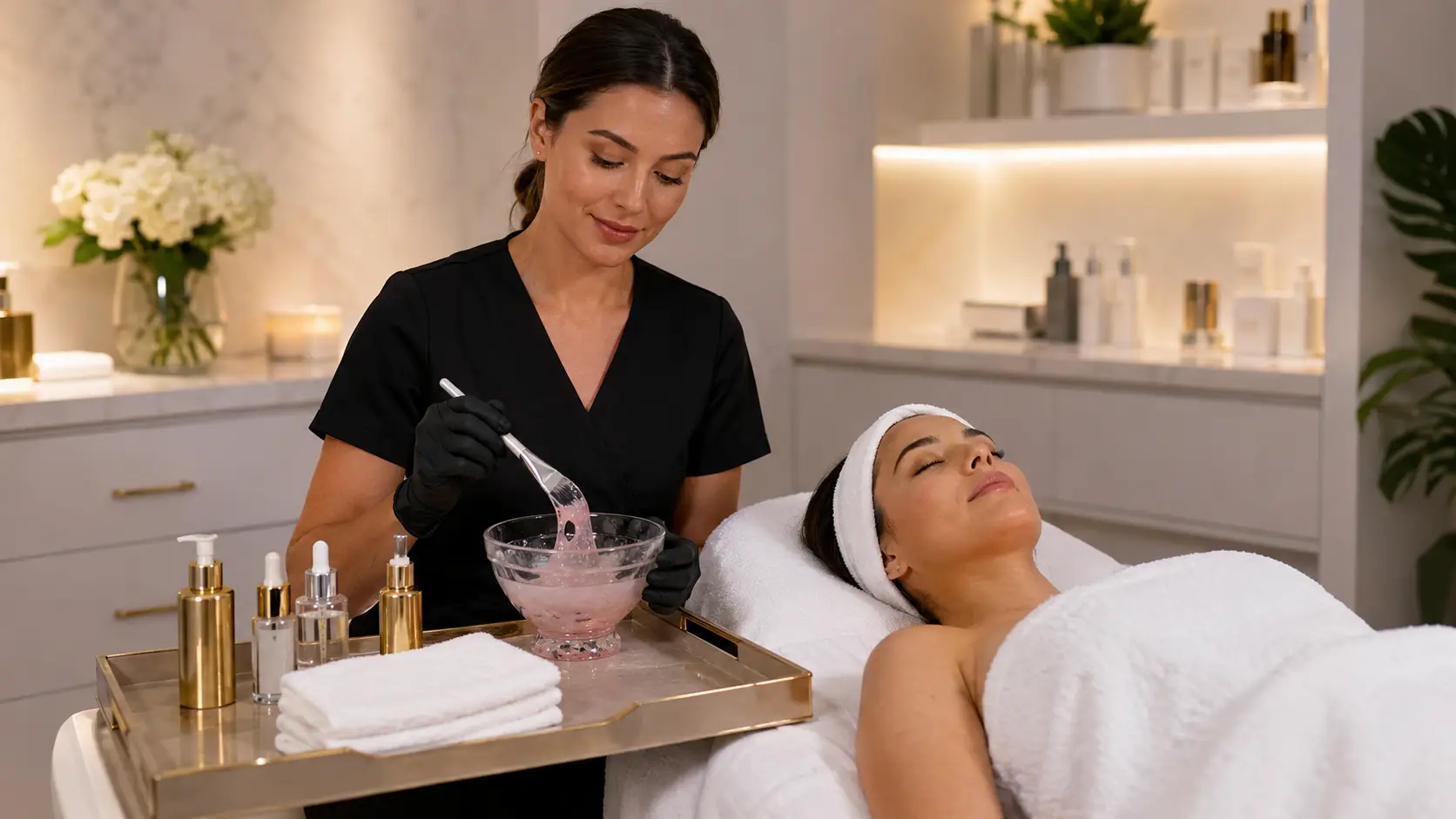
Are Jelly Masks Worth It for Estheticians?
Yes. For the vast majority of estheticians, professional-grade jelly masks are worth adding to the treatment menu. They deliver measurable clinical outcomes including occlusive hydration, visible post-removal skin improvement, cooling anti-inflammatory benefit, and barrier recovery support. When formulated with a dual-humectant PGA and HA system, the hydration mechanism is scientifically superior to single-ingredient alternatives. The business case is equally strong: cost-per-treatment is low, perceived value is high, and the signature removal experience drives client retention in ways that conventional masks do not.
- Jelly masks create an occlusive gel seal that dramatically reduces transepidermal water loss during the treatment window — a clinical effect that cream masks and sheet masks cannot replicate.
- Polyglutamic acid (PGA) binds up to 5,000 times its weight in water and inhibits hyaluronidase, protecting the skin’s own hyaluronic acid from enzymatic breakdown.
- The cost per full-face treatment is typically one to three dollars at professional pricing, with retail add-on values of fifteen to thirty-five dollars — among the highest margin add-ons available.
- Post-treatment use after microneedling, dermaplaning, extractions, and chemical exfoliation represents the highest clinical value application.
- The peel-off removal experience is frequently cited by clients as a primary rebooking driver — a client experience outcome that has measurable business value.
- Quality matters: formulation decisions around humectant choice, fragrance status, and alginate grade determine whether a jelly mask performs as a genuine clinical tool or a novelty treatment.
The question “are jelly masks worth it?” is one of the most searched queries in esthetician professional education — and it tends to be asked from two distinct directions. Clients want to know whether the experience delivers real skin results or whether it is just an expensive novelty. Estheticians want to know whether the investment in product, time, and menu positioning translates into measurable clinical and business outcomes.
This article answers both versions of the question. The short answer is yes — professional-grade jelly masks are worth it. The longer answer explains specifically why, under what conditions, for which clients, and with what formulation requirements. Because the category spans a wide quality range, and because many estheticians have encountered jelly mask products that underperformed, the real question is not “are jelly masks worth it” in the abstract — it is “what makes a jelly mask worth it,” and what separates a genuinely valuable professional formulation from a product that looks the part without delivering the clinical substance.
This guide covers the clinical science of why jelly masks work, the specific ingredient mechanisms that determine outcome quality, the business math behind jelly mask add-on pricing, the client experience dynamics that drive retention, and the post-treatment protocol contexts where jelly masks deliver their highest value.
What Makes Jelly Masks Worth the Investment
- The occlusive physical structure of a set jelly mask creates a clinical hydration effect that no cream or sheet mask format replicates.
- PGA and HA dual-humectant formulations deliver superior hydration outcomes because PGA seals the surface while HA penetrates deeper layers — two complementary mechanisms, not one.
- PGA inhibits hyaluronidase, which means it protects both applied and naturally occurring hyaluronic acid during the treatment window — extending the clinical benefit of every serum applied beneath the mask.
- The cost-per-treatment is exceptionally low. The client experience value is exceptionally high. The margin between them is the business case for jelly masks.
- Post-treatment applications are where jelly masks deliver the most measurable clinical outcomes — heightened post-procedure skin permeability amplifies every ingredient in the formulation.
- The peel-off removal moment is not just theatrics — it is a client retention driver with documented rebooking impact.
- Fragrance-free, clean-label formulations are not optional for post-treatment use. Synthetic fragrance under occlusion on compromised skin is a professional safety risk.
What Does a Jelly Mask Actually Do to the Skin?
The clinical value of a professional jelly mask starts with its physical structure. When a properly mixed jelly mask sets on the skin, it forms a flexible, near-airtight occlusive layer. That layer does something no cream mask, sheet mask, or leave-on treatment achieves in the same way: it physically prevents transepidermal water loss (TEWL) from the skin surface for the duration of the treatment window.
TEWL — the passive evaporation of water through the outer skin layers — is one of the primary drivers of skin dehydration. When the barrier function is intact, TEWL is naturally regulated. When the barrier is compromised — by aggressive cleansing, chemical exfoliation, environmental exposure, or treatment procedures — TEWL accelerates significantly. Applying an occlusive layer directly interrupts this process, allowing the skin to retain and redistribute moisture at the surface level during the treatment window.
At the same time, the cooling exothermic reaction that occurs as the mask sets provides an immediate thermal shift at the skin surface. This cooling effect is not cosmetic. It causes a mild vasoconstriction that reduces visible redness, calms inflammatory signaling at the skin surface, and decreases the sensory discomfort that follows treatments involving heat, friction, or barrier disruption. For clients following microneedling, extraction work, or chemical exfoliation, this cooling effect has direct clinical relevance.
What the Skin Looks Like After a Quality Jelly Mask Application
Estheticians who work consistently with high-quality professional jelly mask formulations describe a predictable and consistent set of immediate post-removal outcomes: skin appears visibly more plump and hydrated, surface texture is noticeably smoother, residual redness from pre-mask treatment steps is reduced, and clients report a sensation of tightness that quickly resolves into softness as the skin continues to absorb the residual humectant film left at the surface. These are not subtle effects that require careful observation to detect — they are consistent outcomes visible to both the esthetician and the client within seconds of removal.
Why the Ingredient Formulation Determines Whether a Jelly Mask Is Worth Using
Not all jelly masks are clinically equivalent. The gelling mechanism — sodium alginate plus a calcium activator — is essentially standardized across the category. What differentiates clinical outcomes is everything else in the formulation: the humectant system, the presence or absence of fragrance, the quality of the raw alginate, and the additional functional ingredients included to serve a specific treatment purpose.
The PGA and HA Mechanism: Why It Changes the Clinical Picture
Polyglutamic acid (PGA) is a fermentation-derived biopolymer with a moisture-binding capacity of up to 5,000 times its weight in water — more than four times that of hyaluronic acid. Unlike HA, which penetrates into deeper skin layers, PGA’s larger molecular structure causes it to remain at the stratum corneum surface, where it forms a flexible transparent microgel film. This film seals moisture at the skin surface during the treatment window, amplifying the already-occlusive effect of the set mask.
The more clinically significant property of PGA is its inhibition of hyaluronidase — the enzyme that continuously breaks down the skin’s own hyaluronic acid. When a jelly mask containing PGA is applied over a hyaluronic acid serum layer, the PGA does not merely add to the hydration available at the skin surface. It actively extends the active window of the HA serum underneath by preventing the enzyme that would degrade it from functioning at normal rates. The same protection extends to the skin’s endogenous HA reserves.
A 2024 peer-reviewed study further demonstrated that topical application of gamma-PGA upregulates hyaluronic acid synthase-1, -2, and -3 mRNA expression — meaning the skin actively produces more of its own HA in response to PGA application. For post-treatment protocols where barrier recovery and skin resilience are the primary objectives, this mechanism represents genuine long-term clinical value beyond the immediate treatment window.
The Three Mechanisms That Separate High-Quality Jelly Mask Formulations
Mechanism 1 — Dual-depth hydration: PGA seals moisture at the stratum corneum surface (up to 5,000× water binding) while HA delivers hydration to deeper epidermal and upper dermal layers (approximately 1,000× water binding). Neither mechanism is redundant — they operate at anatomically distinct levels.
Mechanism 2 — Enzymatic protection: PGA inhibits hyaluronidase, the enzyme that degrades both applied and naturally occurring HA. A jelly mask containing PGA extends the active benefit window of every HA-containing serum applied beneath it, as well as the skin’s own endogenous HA reserves during the treatment window.
Mechanism 3 — Barrier recovery stimulation: Topical gamma-PGA upregulates HAS-1, HAS-2, and HAS-3 expression, driving the skin to produce more of its own hyaluronic acid. Combined with the occlusive barrier-protective effect of the set mask layer, this creates a cumulative recovery outcome that extends beyond the treatment session itself.
Why Fragrance Status Is Not Optional
Synthetic fragrance is one of the most common sensitizing agents in cosmetic formulations. Under normal skin conditions, low concentrations of fragrance in a brief-contact product carry relatively limited risk. Under the occlusive application conditions of a jelly mask — where the formulation is sealed against the skin for 10 to 20 minutes — the penetration dynamics of fragrance compounds change substantially. On post-treatment skin where the barrier is already compromised, this risk becomes a genuine professional liability. Fragrance-free formulation is not a luxury preference for jelly masks used in post-treatment protocols. It is a clinical requirement.
The Business Case: How Jelly Masks Generate Revenue for Estheticians
The business economics of professional jelly masks are among the most favorable of any treatment room add-on available to estheticians. Understanding the actual cost-per-treatment versus the defensible retail value makes the case clearly.
Cost Per Treatment vs. Retail Value
Professional jelly mask powder costs estheticians approximately one to three dollars per full-face treatment at professional bulk pricing, depending on brand, volume, and formulation quality. A full-face application typically requires two scoops of powder mixed with a corresponding volume of water or serum activator, producing sufficient material to cover the face, neck, and décolleté if desired. When positioned as a facial add-on at fifteen to thirty-five dollars depending on market and practice positioning, the service margin exceeds eighty to ninety percent on product cost alone. No other treatment room add-on in standard esthetic practice consistently achieves this margin structure while simultaneously delivering a distinctive, memorable client experience.
The Service Time Factor
A jelly mask application adds ten to twenty minutes to a facial service, depending on set time. However, this time is not idle time for the esthetician. Within the set window, experienced practitioners consistently perform scalp massage through the mask layer, décolleté or hand and arm massage as a luxury extension, LED therapy if the workflow includes device adjuncts, and retail recommendation conversations while the client is relaxed and receptive. The revenue-per-minute ratio during a jelly mask set window — where service add-ons can stack on top of the base mask value — is consistently among the highest in a standard facial protocol.
Client Retention Economics
Estheticians who track rebooking rates consistently report that services incorporating jelly masks produce measurably higher rebooking rates than equivalent services without them. The mechanism is the signature removal experience: the peel-off removal moment is sufficiently distinctive and visually satisfying that clients cite it unprompted as a reason for returning. A single additional rebook generated by the jelly mask experience typically recovers the cost of the product across several appointments. The long-term retention math strongly supports the add-on investment.
Direct Add-On Revenue
Fifteen to thirty-five dollars per add-on at one to three dollars product cost produces an eighty to ninety-five percent margin on direct service revenue. Stackable across every facial appointment.
Set Window Stacking
The ten to twenty minute mask set window generates additional service revenue through LED therapy, massage extensions, and retail consultations without displacing treatment time.
Client Retention Value
The signature removal experience drives measurably higher rebooking rates. Each additional rebooking generated recovers product cost across multiple appointments.
Menu Differentiation
Jelly mask treatments differentiate the practice from competitors offering standard facial menus, supporting premium pricing across the full service offering.
Where Jelly Masks Deliver Their Highest Clinical Value: Post-Treatment Protocols
While jelly masks deliver genuine value in any hydration facial context, their highest clinical value is realized in post-treatment recovery protocols. This is not a marketing positioning — it is a function of how skin physiology changes following treatment procedures.
Why Post-Procedure Permeability Changes the Clinical Picture
Following any procedure that disrupts the skin barrier — microneedling, nano infusion, dermaplaning, chemical exfoliation, or aggressive extraction work — transepidermal water loss accelerates substantially and skin permeability to topically applied actives increases. This creates a window during which the skin both loses moisture faster than normal and absorbs topical ingredients more rapidly than normal. A properly formulated jelly mask applied in this window capitalizes on both dynamics: the occlusive layer interrupts accelerated TEWL while the PGA and HA humectant system delivers ingredients into more permeable skin with greater efficiency than baseline skin would allow.
The PGA Mechanism on Post-Procedure Skin
PGA’s hyaluronidase-inhibiting effect is particularly valuable on post-procedure skin for a reason that goes beyond basic hydration: during treatment-induced inflammation, hyaluronidase activity can increase, accelerating the breakdown of both applied and endogenous HA at precisely the time when barrier recovery is most dependent on HA function. Applying a PGA-containing jelly mask in the immediate post-treatment window helps neutralize this accelerated enzymatic degradation, preserving more of the skin’s natural HA reserves during the critical early recovery phase.
Cooling as a Clinical Tool Post-Treatment
The temperature drop produced by a setting jelly mask is not simply a sensory comfort feature in post-treatment contexts. The mild vasoconstriction it induces at the skin surface reduces the visible redness and swelling that follow most active procedures, which has both a direct client comfort benefit and a visible result that clients associate with professional treatment quality. For estheticians positioning post-treatment recovery as a premium service component, the jelly mask’s cooling effect is a clinically defensible and client-visible outcome differentiator.
Estheticians incorporating Poly-Luronic™ Jelly Masks by Luminous Skin Lab into post-microneedling and post-nano infusion recovery workflows report a consistent pattern: clients who previously showed thirty to forty-five minutes of residual redness following these procedures show noticeably reduced redness within the ten-to-fifteen-minute jelly mask set window, and post-removal skin consistently presents with improved texture and visible hydration that clients comment on before the esthetician prompts any response.
Practitioners transitioning from HA-only jelly mask formulations to the PGA and HA dual-humectant system specifically describe the post-removal skin response as more pronounced and longer-lasting — with clients reporting that their skin feels better three to four hours after leaving the appointment compared to previous treatments, a retention-relevant outcome that influences rebooking decisions. The consistent twelve-to-fifteen-minute set window also allows a full LED therapy sequence to run concurrently with the mask, compressing the total treatment time without sacrificing either modality’s clinical contribution.
When Are Jelly Masks Not Worth It? Conditions That Reduce Their Value
A complete honest answer to whether jelly masks are worth it requires acknowledging the conditions under which they perform below their potential — either because the formulation is inadequate or because the application context does not align with their clinical mechanisms.
When the Formulation Quality Is Below Professional Standard
A jelly mask formulation with no meaningful humectant system, undisclosed ingredients, synthetic fragrance, inconsistent mixing behavior, or poor removal integrity delivers a cosmetically novel experience without substantive clinical outcomes. Estheticians who have tried a low-quality formulation and concluded that jelly masks are not worth it have typically reached that conclusion from a formulation quality problem, not a category problem. The clinical value of the category depends entirely on the formulation within it.
When Applied to the Wrong Client Profile
Jelly masks containing known sensitizers — including synthetic fragrance, artificial dyes, or undisclosed preservative blends — should not be used on sensitized, reactive, or post-procedure skin. For clients with diagnosed contact dermatitis, severe rosacea flares, or active skin barrier disruption from conditions outside a controlled treatment setting, even fragrance-free formulations warrant careful evaluation before application. The clinical value of jelly masks is high for most skin types and most treatment contexts — but clinical judgment about individual client contraindications always takes precedence over general recommendations.
When the Add-On Is Not Priced or Positioned Correctly
Estheticians who offer jelly masks at minimal upcharge or who fail to explain what the treatment does before and after application lose the retention and perceived-value benefits that make the economics favorable. The business case for jelly masks depends on the client understanding what they received, experiencing the removal moment fully, and associating both with the practice. Positioning and communication are as important as the formulation itself in determining whether the business ROI materializes.
How to Know Whether the Jelly Mask You Are Using Is Performing at Its Potential
Estheticians who want to assess whether their current jelly mask formulation is delivering genuine clinical value can apply a straightforward evaluation framework based on observable outcomes.
Immediate Post-Removal Skin Assessment
A quality PGA and HA jelly mask should produce observable and consistent changes in skin condition immediately after removal: measurably increased surface hydration and plumpness, reduction in the redness present before mask application, improved surface texture smoothness, and a visible radiance improvement that clients notice without prompting. These outcomes should be present consistently across multiple skin types and treatment contexts. Inconsistent results suggest formulation or application issues that warrant investigation before concluding the category is not worth the investment.
Set Consistency Across Sessions
A professional-grade jelly mask should produce the same texture, the same set time window, and the same removal experience across every application at the same mixing ratio. Variation in set behavior — setting faster on some occasions, failing to firm fully on others — is a sign of raw material inconsistency that affects both clinical predictability and service professionalism. Testing the product across a minimum of five to eight sessions before making a volume commitment is professional due diligence, not unnecessary caution.
Client Feedback Without Prompting
One of the most reliable indicators that a jelly mask is performing at its clinical potential is spontaneous client feedback about the removal experience and the post-treatment skin feel. Estheticians consistently note that genuinely effective jelly mask formulations generate unprompted client comments about the cooling sensation, the removal experience, and the immediate skin result. If clients rarely comment on the treatment despite it being incorporated into every facial, the formulation or the application experience warrants review.
Professional and Scientific References
The clinical mechanisms and ingredient science referenced in this article draw from peer-reviewed dermatological and cosmetic chemistry research:
- Gamma-PGA barrier strengthening, HAS-1, HAS-2, HAS-3 upregulation, and aquaporin-3 enhancement in reconstructed skin model. MDPI, 2024.
- PGA moisture-binding capacity (up to 5,000× weight in water) and hyaluronidase inhibition mechanism. Cosmetic chemistry literature; Typology, 2021–2025.
- PGA corneometry studies: 60% moisture increase at 30 minutes, 25% elevation maintained at 8 hours with 2% PGA serum application. Reviva Labs review of clinical literature, 2025.
- PGA NMF stimulation — pyrrolidone carboxylic acid, lactic acid, and urocanic acid production in stratum corneum. Typology; Prequel Skin; Skin Rocks biochemist commentary, 2022–2025.
- PGA and HA synergistic combination: slowed HA degradation, enhanced sustained moisturizing effect, reduced HA tackiness. Stanford Chemistry / cosmetic formulation literature, 2024.
- Sodium alginate as occlusive biomaterial: structural gelling properties and wound management applications. Established biomedical sciences literature.
For estheticians ready to evaluate a professional jelly mask formulation built around the dual-humectant science discussed in this article, the Poly-Luronic™ Jelly Mask by Luminous Skin Lab is the formulation our education team most frequently references in post-treatment protocol and advanced hydration contexts. Developed by a licensed esthetician to address the ingredient quality and formulation consistency gaps found across much of the professional jelly mask market, the proprietary Poly-Luronic™ blend delivers PGA surface sealing, HA deep-layer hydration, hyaluronidase inhibition, and NMF stimulation in a fragrance-free, clean-label format compatible with post-microneedling, post-dermaplaning, post-extraction, and LED-adjunctive applications. If you have previously tried a jelly mask and found it underwhelming, the formulation is the most likely variable worth re-evaluating.
Explore the Poly-Luronic™ Jelly Mask Line →Frequently Asked Questions: Are Jelly Masks Worth It?
Are jelly masks actually worth it for estheticians to add to their menu?
Yes — professional-grade jelly masks are consistently worth adding for most estheticians. They deliver measurable clinical outcomes including deep occlusive hydration, visible post-removal skin improvement, and barrier recovery support. Combined with their low cost-per-treatment, high perceived value, and strong client retention effect, they represent one of the most favorable add-on investments available to a working esthetician.
What do jelly masks actually do for the skin during a facial?
A professional jelly mask forms an occlusive gel layer over the face that seals moisture against the skin surface, dramatically reducing transepidermal water loss during the treatment window. Formulations containing polyglutamic acid (PGA) and hyaluronic acid (HA) deliver dual-depth hydration: PGA binds up to 5,000 times its weight in water at the stratum corneum surface and inhibits the enzyme that breaks down the skin’s own HA, while HA penetrates deeper skin layers to attract and retain moisture. The cooling effect also calms inflammation and reduces immediate post-treatment redness.
How much does a jelly mask add-on actually cost to offer per treatment?
Professional jelly mask powder costs estheticians approximately one to three dollars per full-face treatment at professional bulk pricing, depending on brand and formulation. When priced as a service add-on at fifteen to thirty-five dollars, the margin is exceptionally favorable — often exceeding eighty to ninety percent. This makes jelly masks one of the highest-margin add-on services available in a treatment room context.
Do clients actually notice a difference from a jelly mask, or is it just a gimmick?
Clients consistently and reliably notice a difference — particularly in immediate post-removal skin texture, hydration level, and visible radiance. The occlusive effect during the treatment window concentrates moisture at the skin surface in a way that standard cream masks and sheet masks do not replicate. Estheticians report that clients frequently ask what was applied after removal, even without prompting, and that the signature peel-off removal experience alone drives strong repeat booking behavior.
Can jelly masks be used after treatments like microneedling or extractions?
Yes. Professional-grade jelly masks are widely used as post-treatment recovery tools following microneedling, nano infusion, dermaplaning, chemical exfoliation, and extraction-heavy facials. The occlusive layer supports barrier recovery, the cooling effect manages post-procedure redness and discomfort, and the heightened post-treatment skin permeability amplifies humectant delivery — making the hydration benefit even more pronounced immediately after a procedure. Fragrance-free, clean-label formulations are required for any post-treatment application.
Why does a jelly mask feel so different from a regular cream or sheet mask?
The difference comes from the occlusive physical structure of the set gel layer. Unlike cream masks that absorb or evaporate partially during the treatment window, or sheet masks that allow some evaporation at the fabric surface, a set jelly mask creates a near-airtight seal over the skin. This physical occlusion is what produces the dramatic cooling sensation on application, the temperature-regulating effect during the treatment window, and the noticeably more hydrated skin feel immediately after removal.
Are jelly masks good for sensitive or reactive skin types?
When formulated correctly, professional jelly masks are among the most compatible treatment options for sensitive and reactive skin. The cooling, anti-inflammatory effect is well tolerated by sensitized skin, and the occlusive hydration supports compromised barrier recovery. The critical requirement is a fully fragrance-free, dye-free formulation — synthetic fragrance is a significant sensitization risk under occlusion. Estheticians should verify complete INCI transparency before using any jelly mask on sensitive or reactive clients.
How often should clients get jelly mask treatments to see ongoing results?
Most estheticians recommend incorporating a jelly mask at every facial appointment as either a core treatment element or an add-on. For clients with chronic dehydration or compromised barrier function, bi-weekly to monthly professional jelly mask treatments provide cumulative benefit. Between appointments, at-home hydration routines including PGA and HA serums support and extend in-office outcomes. The professional jelly mask treatment should be positioned as a maintenance protocol rather than a one-time correction.
What makes the Poly-Luronic Jelly Mask worth using over other jelly mask brands?
The Poly-Luronic Jelly Mask by Luminous Skin Lab was developed by a licensed esthetician specifically to address the ingredient quality gaps found across much of the professional jelly mask market. The proprietary Poly-Luronic blend combines polyglutamic acid and hyaluronic acid in a dual-humectant system — PGA seals and protects at the surface while HA delivers hydration to deeper skin layers, and PGA actively inhibits hyaluronidase to protect both applied and naturally occurring HA. The formulation is fragrance-free, clean-label, and developed for protocol compatibility including post-microneedling and LED-adjunctive applications.
The Honest Answer: Jelly Masks Are Worth It When the Formulation Earns It
The answer to whether jelly masks are worth it is not a simple yes or no — it is a yes that depends on formulation quality, application context, and practice positioning. The clinical mechanisms are genuinely valuable: occlusive TEWL reduction, dual-depth PGA and HA hydration, hyaluronidase inhibition, and HA synthase upregulation are not marketing claims. They are measurable biological effects that translate into observable and client-noticeable outcomes in the treatment room.
The business economics are equally genuine: at one to three dollars per treatment and fifteen to thirty-five dollars in add-on value, the margin structure is difficult to match anywhere else in a standard esthetic service menu. The retention effect generated by the signature removal experience compounds that value over a client’s lifetime of appointments.
The caveat is formulation. A jelly mask that lacks a meaningful humectant system, contains synthetic fragrance, or produces inconsistent mixing and removal behavior fails to deliver on any of the value that makes the category worth investing in. The single most important decision an esthetician makes about jelly masks is not whether to use them — it is which formulation to use. That decision, made carefully and evaluated systematically, is what determines whether the question “are jelly masks worth it” has a yes or a no answer in your specific treatment room.