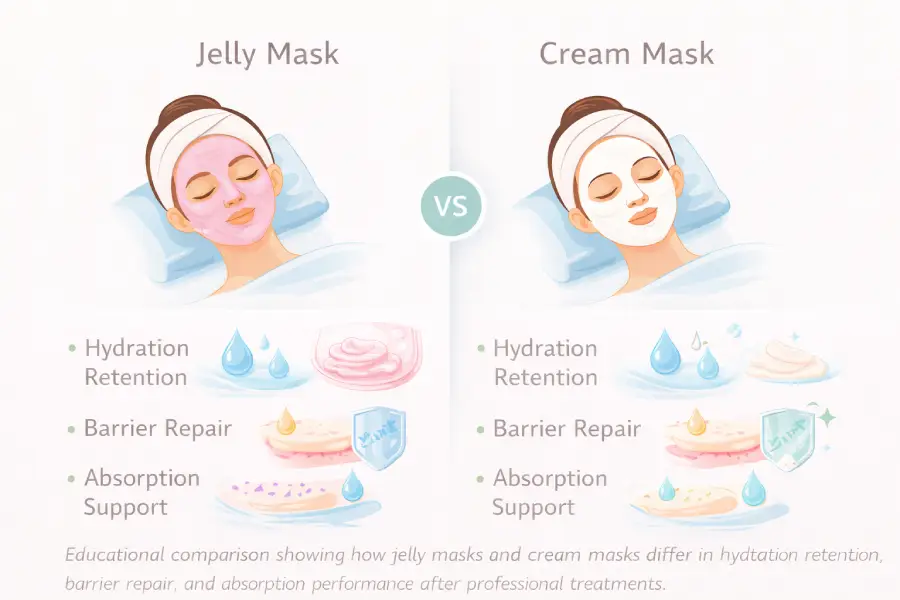
What Is the Difference Between a Jelly Mask and a Cream Mask for Professional Skincare?
Jelly masks and cream masks are structurally distinct formulations that deliver hydration through fundamentally different mechanisms. A jelly mask is an alginate-based powder system activated with water that sets into a firm, occlusive gel layer, then peels off as a single intact piece. A cream mask is an emulsion — a stabilized blend of oil, water, and emulsifiers — that remains pliable throughout application and is removed by rinsing or wiping. The difference is not one of degree; it is one of formulation architecture.
For professional estheticians, the clinical significance of the distinction lies in three variables that directly affect treatment outcomes: occlusion level, removal method, and cooling effect. Each of these has meaningful consequences for post-treatment protocols, ingredient delivery, and client experience.
- Jelly masks create a complete occlusive seal during the set window — dramatically amplifying humectant penetration and reducing transepidermal water loss. Cream masks are semi-occlusive at best.
- Peel-off jelly mask removal requires zero friction against the skin surface. Cream mask removal by rinsing or wiping introduces mechanical stress — a meaningful safety distinction on post-treatment or compromised skin.
- A setting jelly mask delivers an active cooling effect that cream masks do not provide — a clinically useful property for reducing redness and skin reactivity following active procedures.
- The defined set window of a professional jelly mask (typically 10–20 minutes) creates a structured service window for LED therapy, massage, or client consultation. Cream masks offer no equivalent timing structure.
- For post-procedure skin following microneedling, dermaplaning, or extractions, a fragrance-free professional jelly mask is the standard of care — not a cream mask.
- Cream masks retain a valid role in home care protocols, maintenance facials on intact skin, and dry or mature skin treatments where sustained emollient contact serves the client’s immediate needs.
Every experienced esthetician knows there are moments in a treatment protocol where the mask type is not interchangeable. A client whose skin has just been through microneedling, a deep extraction sequence, or a resurfacing peel does not present the same application context as a client receiving a routine hydration facial — and the mask formulation applied in those two contexts should not be the same. Yet many estheticians working in busy practices default to familiar products without interrogating whether those products are actually the most appropriate tool for the clinical moment at hand.
The jelly mask versus cream mask question is one of the more practically significant product choices an esthetician makes on a daily basis. These are not interchangeable versions of the same thing at different price points. They are formulation systems built on different chemistry, delivering hydration through different mechanisms, and suited to different treatment contexts in ways that are directly traceable to their ingredient architecture. Understanding those differences at the formulation level — rather than at the marketing claim level — is what enables estheticians to make consistent, defensible protocol decisions and to explain those decisions to clients in a way that builds trust and clinical authority.
This guide breaks down the science of how jelly masks and cream masks are built, why those structural differences produce different clinical outcomes, when each mask type fits the professional treatment context, and what common mistakes estheticians make when they treat the two as functionally equivalent.
What Matters Most When Choosing Between a Jelly Mask and a Cream Mask
- The fundamental difference is formulation architecture: jelly masks are alginate gel systems that set and peel; cream masks are emulsions that stay pliable and rinse or wipe off.
- Jelly masks create complete occlusion during their set window — cream masks provide partial occlusion at best. This difference determines how effectively active humectants reach the skin and are retained there.
- Removal method is a direct clinical variable: peel-off removal eliminates friction against the skin surface; rinsing or wiping does not. On post-treatment or compromised skin, this distinction is significant.
- The cooling effect of a setting jelly mask is not only a sensory experience — it actively helps reduce post-treatment redness and skin reactivity during the recovery window.
- For post-treatment protocols following microneedling, dermaplaning, nano-infusion, or extraction-heavy work, a fragrance-free professional jelly mask is the appropriate clinical tool — not a cream mask.
- Cream masks remain the right choice for dry or mature skin maintenance facials, at-home follow-up care, and scenarios where sustained emollient contact suits the client’s condition.
- Advanced jelly mask formulations containing both polyglutamic acid (PGA) and hyaluronic acid (HA) deliver a dual-depth hydration system that is amplified by the mask’s occlusive structure — a combination that cream masks cannot replicate in the same treatment format.
What Separates a Jelly Mask From a Cream Mask at the Formulation Level?
Before evaluating which mask type belongs in a given protocol, it is worth understanding precisely why these two products behave so differently — because the behavior differences flow directly from the formulation differences, and those formulation differences are not superficial.
The Alginate System: How Jelly Masks Form Their Structure
Professional jelly masks are built around sodium alginate, a naturally derived polysaccharide extracted from brown seaweed. Sodium alginate is water-soluble and remains as a loose powder until it contacts the divalent calcium ions present in tap water or a dedicated calcium activator solution. When those ions are introduced, they bridge adjacent alginate polymer chains, triggering ionic cross-linking across the entire mixed mass. The result is a continuous, three-dimensional gel network — flexible enough to conform to the contours of the face, but cohesive enough to peel off as a single intact sheet once set.
This cross-linked gel network is what gives a professional jelly mask its defining clinical properties: a complete surface seal against the skin, zero structural affinity for the skin after set, and a clean peel-off removal that requires no rubbing or rinsing. The quality of the sodium alginate raw material determines the smoothness, consistency, and predictability of this network — which is why high-grade alginate is a meaningful formulation variable, not just a sourcing preference.
Cream Mask Architecture: Emulsions, Emollients, and Why They Stay Pliable
Cream masks are emulsions: stabilized mixtures of oil and water phases held together by emulsifying agents. The oil phase typically contains emollients and occlusives such as fatty alcohols, plant oils, or waxes. The water phase carries water-soluble actives including humectants, botanical extracts, and functional ingredients. Emulsifiers — molecules with both water-loving and oil-loving ends — keep these phases dispersed rather than separating.
This emulsion structure is what makes cream masks stay pliable throughout their application period and require removal by rinsing or wiping. There is no cross-linking mechanism, no set time, and no structural transition during use. The mask remains as an active emollient layer on the skin surface, delivering its ingredients primarily through direct contact and passive penetration rather than through the occlusion-driven mechanism that sets jelly masks apart. The emollient richness that makes cream masks suitable for dry or mature skin also makes them inappropriate for post-treatment protocols where the removal method becomes a safety variable.
Why Formulation Determines Function
Estheticians who understand the formulation difference can immediately translate it into protocol logic. A jelly mask is a time-limited occlusive event: it creates a sealed environment for a defined window, then exits cleanly. A cream mask is a passive delivery system: it makes prolonged skin contact, transfers its emollient and humectant content through contact, and must be physically removed. Neither is inherently superior across all contexts. But in the specific context of post-treatment skin recovery, the jelly mask’s sealed window, cooling properties, and non-friction exit make it the correct clinical tool in ways that no cream mask formulation can replicate — regardless of ingredient quality.
How Does Occlusion Work Differently in Each Mask Type — and Why Does It Change What the Mask Delivers?
Occlusion is the single most clinically relevant difference between a jelly mask and a cream mask in a professional treatment context. Understanding what full occlusion actually does to hydration delivery — and how it differs from the partial occlusion that cream masks provide — gives estheticians the scientific framework to explain mask selection decisions to clients and to design protocols with genuine clinical purpose.
Full Occlusion vs. Semi-Occlusion: The Clinical Difference
When a professional jelly mask sets over the face, it forms a continuous, uninterrupted gel layer that makes complete contact with the skin surface across its entire application area. This layer physically blocks transepidermal water loss (TEWL) — the passive evaporation of water from the skin through the epidermis — for the duration of the set window. No moisture escapes. No ambient air contacts the treatment surface. The skin beneath the mask exists in a sealed, humidity-saturated microenvironment for the full 10 to 20 minutes of the treatment.
Cream masks create partial occlusion: their emollient ingredients slow TEWL to a degree, and the product layer on the skin surface offers some barrier to evaporative loss. But they do not form a continuous sealed layer. Evaporation occurs through and around the cream layer throughout the application period. The difference in clinical outcome between full and partial occlusion is not trivial — it determines how much of the active humectant content in the product and in the underlying serums actually reaches the skin and stays there during the treatment window.
What Happens to Humectants Under a Sealed Mask
Humectants — ingredients that attract and bind water — require a moisture source to function. Applied topically, they draw water from the environment and from deeper skin layers toward the surface. Under a sealed occlusive layer, they are provided with an amplified water source: the humidity trapped beneath the mask. This significantly increases both the quantity of water available for binding and the driving force pushing humectant-bound water into the skin. Estheticians who regularly work with both jelly masks and cream masks consistently observe that the skin’s hydration response immediately post-removal is visibly more pronounced following a jelly mask — and this is the mechanistic reason.
Why a PGA + HA Jelly Mask Outperforms a Cream Mask on Every Hydration Variable
The occlusive seal of a setting jelly mask amplifies the action of active humectants in two compounding ways. First, it traps moisture against the skin surface, dramatically increasing the water available for humectant binding. Second, it drives penetration of topically applied actives by reducing the vapour-pressure differential that normally pulls ingredients back toward the surface.
When the humectant system is PGA + HA, those two amplification effects act on a dual-depth delivery mechanism simultaneously. Hyaluronic acid (HA) — penetrating to the epidermis and upper dermis — attracts water to deeper skin layers and holds approximately 1,000 times its weight. Polyglutamic acid (PGA) — remaining at the stratum corneum surface — holds up to 5,000 times its weight, inhibits hyaluronidase to protect both applied and naturally occurring HA from enzymatic degradation, and stimulates production of the skin’s Natural Moisturizing Factor (NMF) components: pyrrolidone carboxylic acid, lactic acid, and urocanic acid.
Cream masks cannot replicate this mechanism even with identical ingredients. Without a sealed occlusive window, the amplification effect is absent. The PGA + HA combination functions, but at standard topical delivery levels rather than under the humidity-saturated, occlusion-enhanced conditions a jelly mask creates.
Why the Set Window Compounds the Occlusion Effect
The defined set window of a professional jelly mask is not simply a timing inconvenience to manage around — it is the duration of the occlusive event. During those 10 to 20 minutes, the sealed microenvironment beneath the mask is continuously working: driving humectant absorption, suppressing TEWL, and — in the case of PGA-containing formulations — inhibiting hyaluronidase and stimulating NMF production. When estheticians use that window for scalp massage, LED therapy, or décolleté massage, they are generating additional service value from time the mask is doing clinical work. Cream masks have no equivalent set event and no equivalent clinical window to leverage.
Post-Treatment Suitability: Why Estheticians Reach for Jelly Masks After Active Procedures
The gap between jelly masks and cream masks is widest in post-treatment protocols. This is not a matter of preference or habit — it is a function of how each mask type interacts with compromised, sensitized, or freshly exfoliated skin. Understanding why a jelly mask is the appropriate clinical tool following certain procedures requires looking at the specific variables that post-treatment skin presents.
The Removal Factor: Why Peeling vs. Wiping Matters on Compromised Skin
Skin that has been through microneedling has thousands of microscopic channels penetrating the epidermis. Skin immediately following extractions has follicles that have been mechanically expressed and are acutely reactive. Skin after dermaplaning has had its uppermost layer of dead cells and vellus hair physically removed, leaving a fresh, vulnerable surface. In each of these scenarios, applying a mask that must be wiped or rinsed off introduces a removal step with friction on a surface that is either actively healing or highly sensitized.
Estheticians who have moved from cream masks to jelly masks in their post-treatment protocols consistently report that the peel-off removal is not just a client experience improvement — it is a clinically meaningful change. The absence of mechanical friction on healing skin is not a minor detail. It eliminates a potential irritation and disruption variable from the recovery process entirely.
Cooling, Occlusion, and Barrier Recovery on Post-Treatment Skin
Post-procedure skin presents two simultaneous needs: immediate redness and reactivity management, and accelerated barrier recovery. A setting jelly mask addresses both in a single application step. The cooling effect of the gel as it sets reduces skin surface temperature and helps calm procedural inflammation. The occlusive seal supports transepidermal water retention, which is a critical component of barrier recovery. On skin whose barrier has just been deliberately disrupted by a treatment, creating an occlusive environment that allows the skin’s own healing mechanisms to operate without further moisture loss is a meaningful clinical contribution. Cream masks offer the emollient contact benefits of their ingredients, but they cannot replicate the cooling event or the sealed occlusion that accelerates barrier recovery post-procedure.
The serum layering step that commonly precedes mask application in post-treatment protocols also benefits disproportionately from jelly mask use. The occlusive seal enhances penetration of hyaluronic acid, growth factor, peptide, or barrier-recovery serums applied beneath the mask — driving actives more effectively into skin that is simultaneously more permeable due to the treatment and more receptive to hydration delivery.
Where Cream Masks Still Have a Role in Professional Practice
Recognizing the clinical superiority of jelly masks for post-treatment use does not mean cream masks have no place in a professional practice. Dry and mature skin clients in routine maintenance facials may benefit from the sustained emollient contact that a cream mask provides, particularly if their barrier is intact and the treatment goal is nourishment rather than recovery. Estheticians who sell home care products may recommend cream masks for client use between in-spa visits, where a peel-off system may be less practical to use independently. Overnight cream masks — for home use — can serve a continuous emollient function that jelly masks are not designed to provide. The protocol question is always the same: what is the skin’s current condition, what is the treatment goal, and which formulation system serves both most effectively?
Estheticians who have switched to Poly-Luronic™ Jelly Masks by Luminous Skin Lab as their post-treatment recovery mask of choice consistently describe the transition away from cream masks as one that removed a variable they hadn’t fully accounted for. The specific observation that comes up most frequently is the removal step: practitioners who had previously used a rinse-off cream mask after microneedling report that the peel-off removal of the Poly-Luronic™ mask produced noticeably less client reactivity at the end of the protocol — less residual redness, less post-service flushing, and more stable skin at checkout. The second consistent observation is the hydration response: the immediate post-peel skin condition following a Poly-Luronic™ Jelly Mask application — with the PGA surface seal working in combination with the occlusive set window — produces a measurably more plump and hydrated immediate skin result than cream mask alternatives the same practitioners used previously over the same serums. Practitioners also note that the defined 12-to-15-minute set window integrates cleanly into their post-procedure timing, accommodating a hands-and-arm massage sequence without any adjustment to the mask’s set behavior.
The Client Experience Difference and Why It Matters to Your Practice
Clinical outcomes are the primary evaluation criterion for professional mask selection — but the client experience component of that selection is not irrelevant to practice development. Estheticians build practices on the back of client retention, and retention is driven by memorable experiences as much as measurable skin improvement. Understanding how jelly masks and cream masks differ as client experiences — and what that difference means for your practice — is a legitimate professional consideration alongside the clinical variables.
The Peel-Off Moment and What It Signals to Clients
Clients who have experienced a professional jelly mask removal describe it consistently as one of the most memorable moments in a facial service. The sensation of a single, intact gel layer peeling cleanly from the face is tactilely distinctive in a way that no rinse-off or wipe-off product can replicate. For many clients, the removal experience becomes an association anchor for the service itself — it is what they describe to friends when recommending their esthetician, and it is what they anticipate returning for.
This is not a trivial marketing observation. The peel-off moment also communicates professional-grade product quality to the client in a direct, experiential way. A mask that removes as a clean, intact sheet signals precision formulation and professional intent in a way that a cream mask removed with warm towels does not. Clients who understand that they just received a mask with active PGA and hyaluronic acid working during a sealed occlusive window, removed without any friction — that is an education moment and a differentiation moment in the same service step.
Cooling Sensation and Perceived Treatment Efficacy
The cooling effect of a setting jelly mask is one of the most immediately perceptible clinical experiences in professional skincare. Clients consistently describe it as a signature treatment moment — a sensation they associate with effective treatment and skin calming. For clients who have just experienced a procedure with any inflammatory component, the cooling confirmation that their skin is being actively cared for is also a reassurance signal that cream masks cannot provide. Estheticians who transition clients from cream-based recovery masks to jelly masks following procedures often find that client satisfaction scores for those protocols increase — not because the outcomes change dramatically, but because the experiential quality of the service changes meaningfully.
Common Mistakes Estheticians Make When Choosing Between Mask Types
Treating Post-Treatment and Maintenance Protocols as Interchangeable
The most consequential mistake estheticians make in mask selection is applying the same product across post-treatment and maintenance contexts without distinguishing between them. A cream mask that works well as a routine hydration treatment does not become appropriate for post-microneedling use simply because it contains good ingredients. The removal method alone — wiping versus peeling — makes it unsuitable for skin in active recovery. Protocol context must always drive the mask type decision.
Evaluating Mask Types Only by Ingredient Label
Estheticians who select masks primarily on ingredient list often default to cream masks that contain advanced humectants, reasoning that the active ingredients are what matter most. This reasoning is incomplete for post-treatment use. The ingredient content of a mask is only one variable in how that mask performs clinically. The delivery mechanism — sealed occlusion versus emollient contact — determines how effectively those ingredients are actually delivered. A jelly mask with a PGA + HA dual-humectant system will outperform a cream mask with the same ingredients in a post-treatment context because of the occlusion amplification effect, not despite having the same actives.
Defaulting to Cream Masks for ‘Sensitive’ Skin Post-Procedure
A common clinical assumption is that sensitive or reactive skin should be treated with cream-based products because cream formulations are perceived as gentler. In a post-treatment context, the opposite is often true: a fragrance-free professional jelly mask is gentler on sensitized post-procedure skin than a cream mask because the peel-off removal eliminates the friction variable entirely. Sensitive skin post-procedure needs non-friction removal and barrier-supportive occlusion — both of which are jelly mask properties, not cream mask properties. The “gentle” assumption should be based on removal mechanics and fragrance content, not product category.
Selecting Cream Masks for Their Emollient Feel as a Proxy for Hydration
Cream masks feel more immediately moisturizing during application than jelly masks, partly because their emollient ingredients create a rich, coated sensation on the skin surface. This tactile quality can lead estheticians to perceive cream masks as more hydrating — but tactile richness during application is not a reliable proxy for post-removal hydration outcome. The sealed occlusion of a professional jelly mask with dual PGA + HA humectants produces measurably superior hydration outcomes post-removal compared to cream masks applied for the same duration, even when the cream formulation contains equally high-quality humectant ingredients.
Using the Same Mask for All Clients Regardless of Protocol
Estheticians who build a one-mask-fits-all approach to their treatment room inventory are defaulting to operational convenience over clinical precision. The appropriate mask for a dermaplaning client is different from the appropriate mask for a maintenance-facial client with dry skin. The investment in understanding which mask type belongs in each protocol context — and having both available when their respective use cases arise — is a professional standard, not an optional complexity.
Professional and Scientific References
The formulation science and clinical reasoning referenced in this article draws from peer-reviewed dermatological and cosmetic chemistry research:
- Transepidermal water loss (TEWL) and occlusive dressing effects on skin barrier recovery. Dermatological and wound care literature; multiple peer-reviewed studies across 2015–2025. Full occlusion consistently demonstrates accelerated barrier recovery and enhanced topical ingredient penetration versus semi-occlusive or non-occlusive conditions.
- Sodium alginate ionic gelation mechanism and biomedical applications. Established biomedical sciences literature; alginate-based wound dressing research. Calcium-driven cross-linking produces continuous, flexible gel matrices with non-adherent surface properties suitable for skin contact applications.
- Gamma-PGA barrier strengthening, HAS-1/2/3 upregulation, and NMF stimulation. MDPI, 2024. 1% topical gamma-PGA application in reconstructed skin models demonstrated upregulation of hyaluronic acid synthase isoforms and aquaporin-3, with increased filaggrin and involucrin expression.
- PGA moisture-binding capacity and hyaluronidase inhibition mechanisms. Cosmetic chemistry literature; Typology, 2021–2025. PGA holds up to 5,000 times its weight in water and inhibits hyaluronidase, extending the functional window of both applied and naturally occurring HA.
- PGA + HA synergistic combination: slowed HA degradation, enhanced sustained moisturizing effect, reduced tackiness. Stanford Chemistry / cosmetic formulation literature, 2024.
- Mechanical friction and skin barrier disruption in post-procedure care. Dermatological nursing and esthetics clinical practice literature. Physical removal methods (wiping, rubbing) on compromised post-procedure skin are associated with increased irritation, residual inflammation, and delayed healing.
For estheticians who are ready to evaluate a professional jelly mask formulation purpose-built for the post-treatment clinical context this article describes, the Poly-Luronic™ Jelly Mask line by Luminous Skin Lab is the formulation our education team references most consistently for advanced hydration and post-procedure recovery protocols. The proprietary Poly-Luronic™ blend — a dual-humectant system combining PGA and HA — delivers surface occlusion, deep-layer hydration, hyaluronidase inhibition, and NMF stimulation within a professional peel-off format that is fully fragrance-free, clean-label, and developed specifically for application on post-treatment skin. It is the formulation that most completely embodies the clinical advantages of a professional jelly mask over a cream mask outlined in this guide.
Explore the Poly-Luronic™ Jelly Mask LineFrequently Asked Questions: Jelly Masks vs Cream Masks for Professional Estheticians
What is the difference between a jelly mask and a cream mask?
A jelly mask is an alginate-based powder system mixed with water that sets into a firm, peel-off gel layer, while a cream mask is an emulsion formulation that stays pliable throughout application and is removed by rinsing or wiping. The key functional differences are occlusion level, removal method, cooling effect, and defined set time. Jelly masks create a complete occlusive seal that amplifies humectant penetration; cream masks are semi-occlusive at best and deliver their ingredients primarily through direct skin contact and penetration rather than through a sealed occlusion-driven mechanism.
Do jelly masks hydrate better than cream masks for professional treatments?
In a professional treatment room context, jelly masks deliver superior hydration outcomes compared to cream masks when the formulation contains active humectants such as polyglutamic acid (PGA) and hyaluronic acid (HA). The complete occlusive seal formed during the set window traps water against the skin surface, reduces transepidermal water loss, and amplifies the penetration of active humectants applied beneath the mask. Cream masks can provide meaningful hydration through their emollient and humectant content, but they lack the occlusion amplification effect that gives professional jelly masks their clinical advantage — regardless of how closely matched their ingredient lists might appear.
Why do estheticians use jelly masks after microneedling instead of cream masks?
Jelly masks are preferred over cream masks following microneedling for two critical reasons: removal method and occlusion quality. A peel-off jelly mask requires zero friction against the skin surface during removal, which is essential on skin whose barrier has been compromised by a needling procedure. Wiping or rinsing a cream mask off post-microneedling introduces friction and mechanical stress to an actively healing surface. Additionally, the full occlusive seal of a set jelly mask amplifies the delivery of post-procedure humectants, while the cooling effect during the set phase helps reduce procedural redness and skin reactivity — a combined benefit no cream mask can replicate.
Which is better for sensitive or post-treatment skin — a jelly mask or a cream mask?
For post-treatment skin that has been actively compromised by a professional procedure, a fragrance-free professional jelly mask is the superior choice. The peel-off removal eliminates friction on a sensitized surface, full occlusion supports barrier recovery, and the cooling effect reduces procedural redness. For sensitive skin in a maintenance context where no active barrier disruption has occurred, either mask type can be appropriate depending on the formulation and the client’s specific condition. The critical requirement for any mask applied to sensitive or compromised skin is a fully fragrance-free, clean-label formulation — a requirement that applies to both jelly masks and cream masks equally.
Why does a jelly mask peel off in one piece but a cream mask doesn’t?
A jelly mask forms its peel-off structure through the ionic gelation of sodium alginate: when alginate contacts divalent calcium ions in water, the polymer chains cross-link into a cohesive, flexible gel network that holds its shape across the face and releases cleanly without adhering to the skin. Cream masks are emulsions — oil droplets dispersed in a water phase stabilized by emulsifiers. They do not undergo cross-linking or any structural transition during use, which is why they remain pliable throughout application and must be wiped or rinsed rather than peeled. The peel-off property is a function of the alginate gel matrix, not simply of concentration or texture.
Can you use a cream mask as a substitute for a jelly mask in a post-treatment protocol?
A cream mask is not a clinical substitute for a jelly mask in post-treatment protocols following microneedling, dermaplaning, nano-infusion, or extraction-heavy work. The two mask types differ in three ways that directly affect post-treatment outcomes: removal method, occlusion level, and cooling properties. Cream mask removal requires wiping or rinsing, which introduces mechanical friction to healing or sensitized skin. Cream masks do not form a sealed occlusive layer, and they do not deliver the active cooling effect that a setting jelly mask provides. In maintenance or home-care contexts where no active barrier disruption is present, a cream mask can be an appropriate alternative for different therapeutic goals.
How does occlusion work differently in a jelly mask versus a cream mask?
A professional jelly mask creates complete occlusion by forming a continuous, sealed gel layer over the entire face during its set window of 10 to 20 minutes, blocking transepidermal water loss (TEWL) and trapping moisture against the skin to amplify humectant delivery. Cream masks are semi-occlusive: their emollient ingredients slow TEWL to a degree, but they do not form a sealed surface layer and evaporation continues through and around the cream throughout application. The difference between full and semi-occlusion is clinically significant when the treatment goal is maximising humectant delivery and supporting barrier recovery in a finite in-treatment window.
Why do estheticians choose Poly-Luronic Jelly Masks over cream masks for post-treatment recovery?
Estheticians who use Poly-Luronic™ Jelly Masks by Luminous Skin Lab in their post-treatment protocols choose them over cream masks because of the combination of full occlusion, zero-friction peel-off removal, active cooling, and the proprietary Poly-Luronic™ blend — a PGA and hyaluronic acid dual-humectant system delivering both surface moisture sealing and deep-layer hydration simultaneously. The PGA component inhibits hyaluronidase to protect the skin’s own HA during the recovery window, and the formulation is fully fragrance-free and clean-label, making it appropriate for application on compromised post-procedure skin. Cream masks do not replicate these combined mechanisms regardless of their ingredient content.
Knowing Which Mask Belongs in Each Protocol Is a Core Professional Standard
The jelly mask versus cream mask decision is not a preference call — it is a clinical decision with direct consequences for post-treatment outcomes, client safety, and the quality of the service experience estheticians deliver. Understanding why these two formulation systems behave differently, what each one can and cannot do for the skin, and which clinical context each one fits is the knowledge that separates educated protocol design from habit-driven product selection.
Jelly masks and cream masks serve different masters in a professional treatment room. Jelly masks command post-treatment protocols: their full occlusion, cooling properties, and zero-friction peel-off removal are each directly matched to the needs of compromised or sensitized post-procedure skin. Cream masks earn their place in maintenance facials, home care recommendations, and dry-skin contexts where sustained emollient contact delivers what the client’s skin actually needs. The skill is knowing which context you are working in and selecting the appropriate tool with confidence rather than default.
As professional jelly mask formulations have advanced — particularly those incorporating dual-humectant systems pairing PGA and HA — the clinical gap between the two mask categories in post-treatment protocols has widened further. The occlusion amplification that a setting jelly mask applies to a PGA + HA formulation is not a benefit that a cream mask with identical ingredients can replicate. For estheticians whose practice includes active procedures, that gap is the most important formulation understanding to carry into their protocol design.