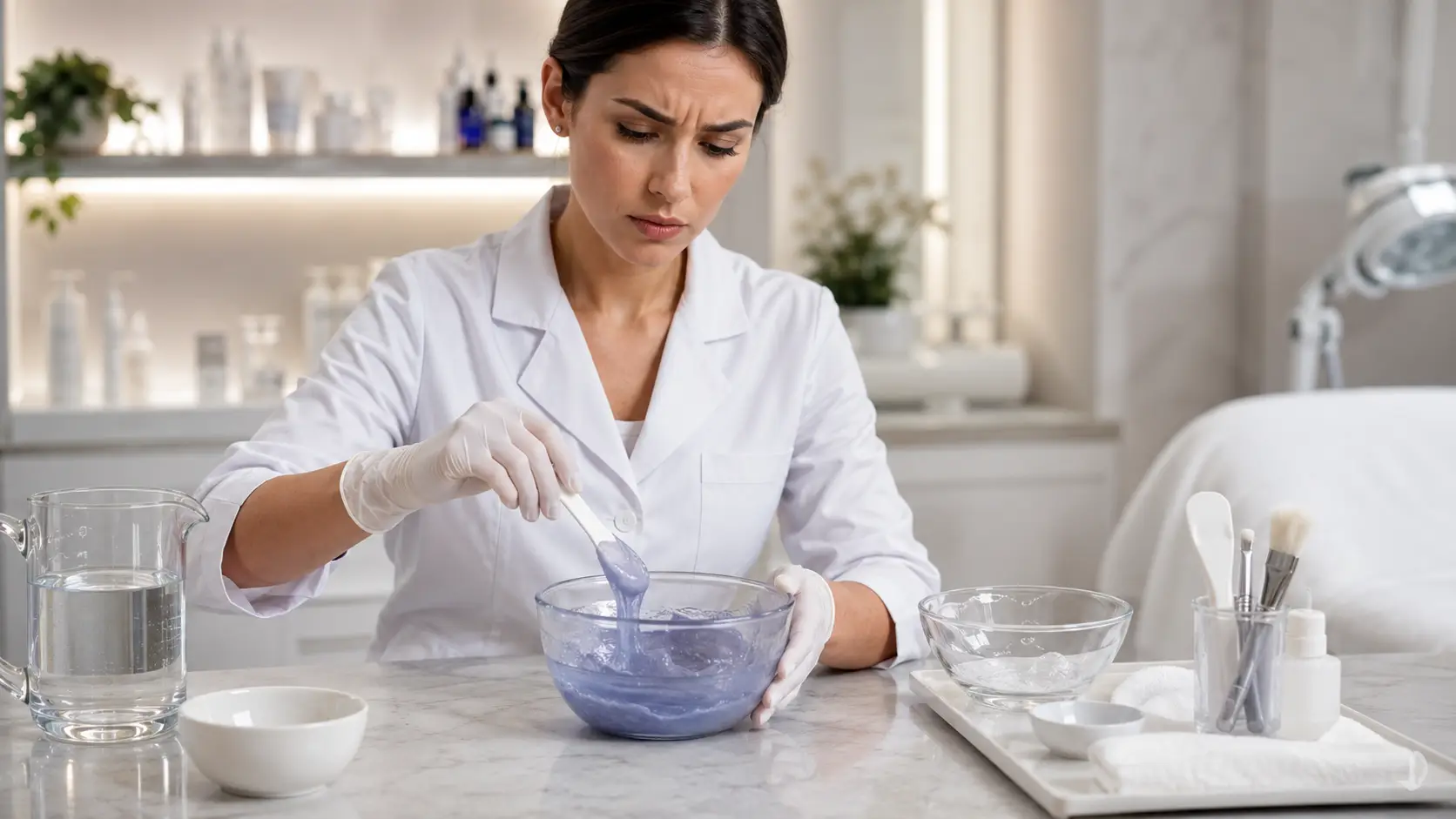
Why Does a Jelly Mask Set Too Fast? The Short Answer for Estheticians
A jelly mask sets too fast primarily because the water used for mixing is too warm. Warm water accelerates the ionic cross-linking reaction between calcium ions and sodium alginate — the chemical process that turns the powder mixture into a gel — dramatically shortening the working window. The second most common cause is a powder-heavy mixing ratio that delivers excess alginate relative to water. Other contributing factors include warm ambient room temperature, vigorous over-mixing, degraded or improperly stored powder, and high skin surface temperature at application.
- Water temperature is the most controllable variable — switching from warm to cool water (15–20°C) is the single most effective fix for a jelly mask that sets too fast.
- Increasing the water proportion slightly in the mix slows cross-linking without meaningfully compromising set firmness or removal integrity.
- Mixing time should be kept to 20–30 seconds maximum — over-mixing generates heat and accelerates gelation.
- Warm treatment rooms amplify rapid set behavior, particularly in summer months; compensate with cooler mixing water.
- Degraded or moisture-exposed powder can produce erratic set behavior including unexpectedly fast gelation.
- A professional set window of 12 to 15 minutes should accommodate scalp massage, LED therapy, and client consultation steps — if that window is being lost, identify and correct the primary cause before adjusting protocol.
It is one of the most common frustrations in professional jelly mask practice: you mix the powder, turn to prep the client, and by the time you pick up your spatula to apply, the mask has already begun to firm in the bowl. Or worse — you get halfway through the application and the leading edge is already setting while the second half of the face is still uncovered. The treatment moment you planned for becomes a rushed scramble rather than a confident, controlled professional service.
The good news is that this problem is almost always solvable. Rapid jelly mask set time is not random — it is caused by identifiable variables, most of which are well within an esthetician’s control. Understanding the chemistry behind why jelly masks set at all gives you the knowledge to intervene at the right point and reclaim a reliable, predictable working window every time.
This guide covers the complete picture: the gelation chemistry that determines set speed, every major cause of a jelly mask setting too fast, the practical treatment room fix for each cause, and how to build set-time awareness into your standard protocol so the problem does not recur.
What Every Esthetician Needs to Know About Jelly Mask Set Time
- Rapid set time is not a product defect in most cases — it is a mixing or environmental variable that can be corrected.
- Cool water (15–20°C) is the single most effective tool for slowing set time — keep a dedicated water source at your station.
- Powder-to-water ratio is the second most controllable variable — a small increase in water proportion extends working time.
- Mixing time over 30 seconds generates friction heat that accelerates gelation — mix quickly, apply immediately.
- Warm treatment rooms, warm client skin, and hot summer conditions all compound rapid set behavior.
- Clumping, discoloration, or batch-to-batch inconsistency in your powder indicates a storage or shelf-life issue.
- A professional working window of 12–15 minutes is achievable with every quality professional jelly mask formulation when mixing variables are correctly controlled.
What Actually Causes a Jelly Mask to Set? The Chemistry Every Esthetician Should Know
To understand why a jelly mask sets too fast, you first need to understand why it sets at all. The setting mechanism of a professional jelly mask is not simply water evaporation or drying — it is an active chemical reaction called ionic cross-linking, and its speed is highly sensitive to the conditions under which it occurs.
Sodium Alginate and Ionic Cross-Linking
The structural base of virtually every professional jelly mask is sodium alginate — a polysaccharide derived from brown seaweed. In its powder form, sodium alginate consists of long polymer chains carrying negatively charged carboxylate groups. When these chains are exposed to calcium ions (typically provided by a calcium sulfate compound included in the jelly mask powder blend), the calcium ions bridge between adjacent alginate chains, forming a gel network. This cross-linking reaction is what creates the flexible, rubbery, occlusive gel structure of a set jelly mask.
Why Temperature Controls the Speed of Ionic Cross-Linking
The rate of the calcium-alginate cross-linking reaction follows standard chemical kinetics: higher temperature accelerates reaction rate. Warm water dissolves and mobilizes calcium ions more quickly, increasing the speed at which they encounter and bridge alginate chains. This is why the difference between mixing with 35°C warm water versus 15°C cool water can reduce working time from 15 minutes to as little as 4–5 minutes — a change of roughly 70 percent in available application window.
Beyond temperature, the concentration of calcium ions (determined by the powder-to-water ratio) and the surface area of alginate chains available for reaction (influenced by mixing thoroughness and powder dispersion) both directly control gel formation speed. Understanding these three variables — temperature, concentration, and dispersion — gives an esthetician complete practical command over set time.
What This Means in Practice
Every cause of a jelly mask setting too fast connects back to one or more of these three mechanisms: higher temperature, higher calcium ion concentration relative to water, or faster dispersion of reactive components. Each practical fix you apply in the treatment room works by reducing one or more of these drivers. That is why understanding the chemistry — even at a basic level — is more useful than a simple list of tips: it tells you why each adjustment works and gives you the confidence to adapt when conditions change.
The Six Most Common Causes of Rapid Jelly Mask Set Time — and How to Fix Each One
Estheticians working across different treatment room environments, seasons, and product brands encounter rapid set time from one or more of the following causes. Work through this list systematically to identify which is most relevant to your situation.
A Visual Reference: Causes, Mechanisms, and Fixes at a Glance
The following reference chart maps each cause of rapid jelly mask set time to its underlying mechanism and its treatment room fix. Use this as a diagnostic checklist when troubleshooting inconsistent set behavior in your practice.
How to Build Reliable Set-Time Control Into Your Standard Jelly Mask Protocol
Troubleshooting set-time problems after they occur is reactive. The better professional standard is to build set-time control into your preparation sequence so the issue does not arise in the first place. The following workflow reflects what experienced estheticians consistently use to achieve predictable, reliable set windows across seasons, client types, and treatment room conditions.
Before Your Treatment Day Begins
Inspect your jelly mask powder container for signs of clumping, color change, or unusual texture. Fill your insulated water container with cool water and allow it to stabilize at your target mixing temperature of 15 to 20°C. If your treatment room has been closed overnight and the temperature has risen, allow climate control to bring it to your working target before your first appointment. Confirm your measuring tools — scoop, graduated cup, or spatula — are clean and available.
Immediately Before Each Application
Complete all client positioning and preparation steps before touching the jelly mask powder. Headband, draping, serum application, and lighting should all be in place. The moment you begin mixing, your set clock is running. Measure your powder and water amounts precisely, add water to powder, and mix for no more than 30 seconds using smooth strokes — not vigorous whipping. Apply within 60 seconds of completing mixing.
During Application
Work from the center of the face outward and from the chin upward. Use a wide, flat spatula to transfer the maximum mask volume per stroke. Move with deliberate efficiency — not panic, but without hesitation. Practitioners find that a 12-to-15-minute working window feels extremely comfortable once the preparation sequence is reliable; the pressure of rushing only arises when variables are inconsistent.
Monitoring and Adjusting Across Sessions
Track your set time across the first few sessions with any new batch of powder. Note whether you achieved full facial coverage with comfortable time remaining. If the set window feels consistently short despite correct water temperature and ratio, adjust water volume slightly upward (5 percent increments) and retest. Document your adjustment so you can reproduce it consistently.
Estheticians who have standardized their protocol around the Poly-Luronic™ Jelly Mask by Luminous Skin Lab and the recommended 1:1 ratio with 15–18°C water consistently describe a working window that feels unhurried even in busy back-to-back appointment schedules. The practical experience is that full-face coverage with a brush or spatula takes approximately 60 to 90 seconds for most estheticians, leaving 10 to 13 minutes of comfortable set time for additional service steps before the mask reaches its optimal removal state. Practitioners report that LED therapy sequences fit naturally within this window without requiring the rushed application timing that characterizes faster-setting alternatives.
One pattern observed across multiple esthetician accounts: summer months are the time this discipline matters most. In hot weather, cool mixing water becomes non-negotiable rather than merely advisable. Estheticians keeping an insulated thermos of cool water at the station — refreshed between appointments — maintain consistent set windows year-round regardless of external conditions.
What Actually Happens to the Treatment When a Jelly Mask Sets Too Fast?
Understanding the downstream consequences of rapid set time reinforces why this variable is worth managing actively — it is not merely an inconvenience.
Incomplete Coverage and Uneven Hydration Delivery
When a jelly mask begins to firm before full-face application is complete, the leading edge — applied first — receives a longer occlusive dwell time than the last areas covered. This creates asymmetric hydration delivery across the face. In post-treatment recovery protocols where uniform occlusion matters clinically, this is a meaningful outcome variable. Clients may also notice uneven texture post-removal.
Compromised Removal Experience
The signature client experience of a professional jelly mask is the single-piece peel removal. A mask that set partially before full coverage was achieved often has irregular thickness and density, which causes tearing, cracking, or fragmented removal. This not only undermines the treatment moment but may leave residue on the skin requiring additional cleansing steps.
Loss of Service Time Windows
Many professional jelly mask protocols incorporate massage, LED therapy, or client education within the mask-on dwell period. When set time is uncontrolled and shorter than expected, these secondary service steps are crowded out. The treatment delivers less total value, and the esthetician faces a recurring time management problem that undermines service confidence.
Client Perception of Protocol Confidence
Clients observe the esthetician’s confidence and composure during a treatment. An esthetician visibly rushing to beat a setting mask communicates uncertainty about their materials. Consistent, relaxed jelly mask application — enabled by reliable set time — projects technical authority and enhances perceived treatment quality regardless of the specific products used.
When Rapid Set Time Is a Formulation Problem, Not a Technique Problem
Most set-time problems are technique or environment problems that respond to the corrections described above. However, there is a subset of cases where the formulation itself is the limiting factor — and it is worth being able to distinguish between the two.
Signs the Issue Is Formulation-Related
If you have systematically corrected water temperature, ratio, mixing technique, room conditions, and powder storage — and you are still consistently unable to achieve a 10-minute working window — the formulation may have inherent set-time characteristics that are too fast for professional treatment room use. Some lower-grade or consumer-positioned jelly mask powders use higher concentrations of fast-reacting calcium compounds precisely because they were not formulated with treatment room service windows in mind. They were formulated for home use, where application speed is less critical and the user has no service sequence to complete during mask dwell time.
How to Evaluate a New Brand for Set-Time Suitability
Before committing to any jelly mask brand for treatment room use, conduct a structured set-time test across at least three sessions: mix with 15–18°C cool water at the recommended ratio and time the window from mixing completion to the point at which the applied mask surface resists spatula spreading. A professional-grade formulation should provide a minimum of 10 minutes of working time under these conditions. Any formulation that consistently falls below 8 minutes under optimal conditions is likely not suitable for professional treatment room use regardless of other qualities.
Professional References
The chemistry and practical guidance in this article draws on established cosmetic science and polymer chemistry literature:
- Sodium alginate ionic cross-linking chemistry and the role of calcium ions in gel network formation. Established polymer chemistry and biomaterials science literature. Cross-linking rate sensitivity to temperature is well-documented in alginate biomedical applications literature.
- Professional jelly mask formulation behavior in treatment room conditions. Practitioner-reported observational data from licensed esthetician professional practice.
- Sodium alginate thermal gelation kinetics. Food and pharmaceutical gel science literature documenting the relationship between temperature and alginate cross-linking rate.
- Moisture-induced powder degradation in hygroscopic materials. General pharmaceutical powder handling and stability science applicable to jelly mask storage conditions.
For estheticians who have corrected mixing technique and environmental variables and are still encountering unpredictable set-time behavior, the underlying formulation deserves scrutiny. The Poly-Luronic™ Jelly Mask by Luminous Skin Lab was developed by a licensed esthetician specifically with treatment room workflow in mind — including a set-time profile engineered to deliver a reliable 12-to-15-minute working window when mixed with cool water at the recommended ratio. The formulation combines the Poly-Luronic™ PGA + HA dual-humectant system with high-grade sodium alginate to produce consistent mixing behavior and predictable set characteristics across professional use conditions. Fragrance-free, clean-label, and compatible with post-treatment recovery protocols including microneedling and LED-adjunctive applications.
Explore the Poly-Luronic™ Jelly Mask Line →Frequently Asked Questions: Why Does My Jelly Mask Set Too Fast?
Why does my jelly mask set too fast before I finish applying it?
The most common cause of a jelly mask setting too fast is water that is too warm. Warm or hot water accelerates the ionic cross-linking reaction between calcium ions and sodium alginate, dramatically shortening the gel formation window. Switch to cool or room-temperature water and your working time will extend significantly. The second most common cause is a powder-heavy mixing ratio that delivers excess alginate relative to water, creating faster and denser cross-linking.
Does water temperature really make that much difference to jelly mask set time?
Yes — water temperature is the single most controllable variable affecting jelly mask set time. Warmer water accelerates the reaction between calcium ions and sodium alginate chains, shortening the working window from a professional 12 to 15 minutes down to as little as 4 to 6 minutes. Cool water between 15 and 20 degrees Celsius consistently produces the longest, most predictable working window. Many estheticians keep a dedicated insulated container of cool water at their station specifically to avoid this problem.
What powder-to-water ratio should I use to slow down my jelly mask?
If your jelly mask is setting too fast, the first adjustment to try is slightly increasing the water proportion in your mix. Most professional jelly masks use a 1:1 or 2:1 powder-to-water ratio by volume. Adding a small amount of additional water — approximately 5 to 10 percent more than the standard ratio — slows the cross-linking reaction and extends working time without significantly compromising set firmness or removal integrity. Always adjust incrementally and document the result before committing to a new standard ratio.
Can the humidity or temperature in my treatment room affect how fast my jelly mask sets?
Yes. A warm treatment room accelerates the gelation reaction after application — particularly in summer months or in rooms without consistent climate control. High humidity can also affect powder hydration behavior before and during mixing. Estheticians working in warmer environments should use cooler mixing water to compensate and should mix closer to the point of application rather than preparing the mask in advance.
Why does my jelly mask set faster on some clients than others?
Skin temperature and skin surface characteristics both influence set behavior after application. Clients with naturally higher skin surface temperature, those who are warm from exercise or stress, or clients with significant facial hair or texture that creates micro-air pockets may experience faster apparent set. Cooling the skin with a light mist of water or a cool towel briefly before application can reduce this variability. Applying a slightly thicker layer also provides a buffer that slows the apparent surface set.
How does mixing technique affect how fast the jelly mask sets?
Vigorous or prolonged mixing generates friction heat and introduces more air into the mixture, both of which can accelerate set behavior. The professional standard is to mix quickly and smoothly — no more than 20 to 30 seconds — until the mixture reaches uniform consistency, then apply immediately. Over-mixing or pausing between mixing and application shortens your working window. Mixing in a cool rubber bowl rather than a warm ceramic or metal bowl also helps maintain lower mixture temperature.
Could my jelly mask powder be expired or degraded, making it set faster?
Yes — improperly stored or expired jelly mask powder can behave unpredictably, including setting faster than expected. Sodium alginate degrades when exposed to moisture, heat, or direct light over time. Powder should be stored in an airtight container, away from heat and humidity, and used within the manufacturer’s recommended period. If your powder clumps, appears discolored, or produces inconsistent set behavior batch to batch, storage conditions or age are the likely cause.
Is there a way to slow down set time without changing my mixing ratio?
The most effective single adjustment without changing ratio is switching to cooler water. Beyond that, working in a cooler room, cooling the client’s skin slightly before application, using a cool rubber mixing bowl, and applying the mask in fewer, more deliberate strokes all help extend your practical working window. Some estheticians use a slightly wider spatula to apply more surface area per stroke, reducing the time between mixing completion and full facial coverage.
Does the Poly-Luronic Jelly Mask have a more forgiving set time than other professional jelly masks I have tried?
Estheticians using the Poly-Luronic™ Jelly Mask by Luminous Skin Lab consistently report a reliable 12 to 15 minute working window when mixed with cool water at the recommended ratio. The formulation was developed by a licensed esthetician specifically with treatment room workflow in mind — including accommodating scalp massage and LED therapy sequences within the set window. When mixed correctly at the recommended 1:1 ratio with cool water, the Poly-Luronic™ Jelly Mask delivers consistent and predictable set behavior that reduces the guesswork that faster-setting alternatives introduce into a professional service.
Set Time Is Controllable — Here Is What Matters
A jelly mask that sets too fast is almost always a solvable problem. The chemistry behind jelly mask gelation is well understood, and the variables that control it — water temperature, mixing ratio, mixing technique, ambient conditions, skin surface temperature, and powder integrity — are all within an esthetician’s practical reach.
Start with the two highest-impact adjustments: switch to cool water at 15–20°C, and verify your powder-to-water ratio against the manufacturer’s specification. In the majority of cases, these two corrections alone will restore a professional 12-to-15-minute working window. If set time remains problematic after correcting both, work systematically through the remaining causes — room temperature, mixing duration, skin preparation, and powder storage — before concluding that a formulation change is warranted.
When set-time control is reliable, the treatment room experience changes entirely. Application becomes confident and deliberate. Secondary service steps within the mask-on window are possible. The removal experience — one of the most memorable moments for clients — is consistently clean and complete. That combination of clinical performance and client experience is what separates a professional jelly mask protocol from a rushed one.