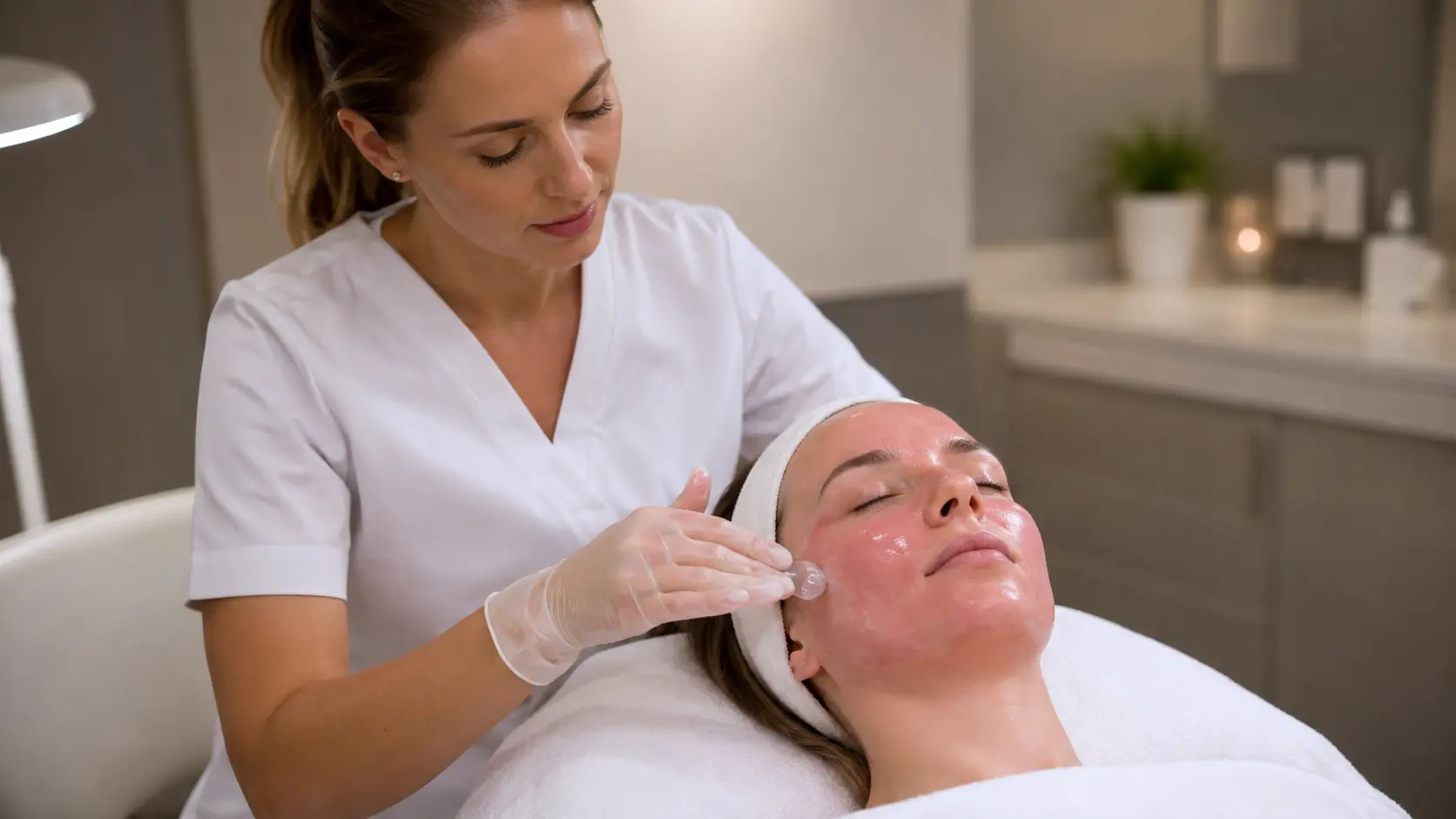
How Does Aloe Vera Work in Professional Skincare Treatments?
Aloe vera works in professional skincare treatments through several distinct biological mechanisms. Its polysaccharide compound acemannan reduces pro-inflammatory cytokine release and supports barrier repair, while the enzyme bradykinase degrades bradykinin, a key mediator of post-treatment redness and discomfort. Professional formulations derived from the inner leaf gel are clinically appropriate for a wide range of facial protocols, particularly recovery applications following chemical exfoliation, extractions, and device-based treatments.
- Aloe vera’s primary active compound is acemannan, a polysaccharide that modulates inflammatory signalling and supports fibroblast activity involved in skin repair.
- The enzyme bradykinase found in aloe vera gel degrades bradykinin, directly reducing the post-treatment redness and heat sensation clients experience after active facial procedures.
- Aloe vera functions as a humectant, binding water molecules at the stratum corneum and reducing transepidermal water loss in the hours following treatment.
- Professional-grade inner leaf gel preparations free of aloin are appropriate for sensitised, rosacea-prone, post-exfoliation, and acne-prone skin types.
- Aloe vera improves the absorption of subsequently applied hydrophilic actives by softening intercellular spaces in the stratum corneum, making it an effective serum delivery base.
- It is most strategically applied in the recovery phase of a facial, after active procedures but before any occlusive finishing step.
Aloe vera is one of the most widely recognised ingredients in skincare, yet it is frequently under-utilised in professional practice. Many estheticians apply it reflexively as a general soothing agent without a clear understanding of the specific mechanisms that make it effective — or the precise conditions under which it delivers the most clinical value. Understanding aloe vera at the ingredient level transforms it from a generic calming product into a strategically deployable tool within post-treatment recovery protocols.
The challenge for practitioners is distinguishing between consumer-facing aloe products and professional-grade preparations. Consumer products frequently contain aloe vera as a minor ingredient diluted in a predominantly water or alcohol base, or as a marketing label on formulations with negligible active concentrations. Professional practice demands familiarity with what constitutes an effective preparation: inner leaf gel, not whole-leaf extract; aloin-free processing; and meaningful concentrations of the polysaccharide fractions that carry the actual biological activity.
This article examines aloe vera’s mechanisms of action, its clinical applications within professional treatment protocols, and the specific placement decisions that maximise its effectiveness. It addresses both the science behind the ingredient and the practical application logic that experienced estheticians develop over time working with sensitised and post-procedure skin.
What Every Esthetician Should Know About Aloe Vera in Professional Treatments
- Acemannan is the primary bioactive polysaccharide in aloe vera gel and is responsible for its clinical anti-inflammatory and wound-healing support activity.
- Bradykinase enzyme activity directly reduces bradykinin-mediated redness and discomfort — making aloe vera mechanistically appropriate for post-exfoliation and post-extraction recovery.
- Inner leaf gel preparations without aloin are appropriate for compromised barrier skin; whole-leaf extracts and aloin-containing products are not appropriate for sensitised or post-procedure skin.
- Aloe vera functions as a humectant, not an occlusive — it must be sealed with a barrier-supportive finishing product to sustain hydration retention over time.
- As a serum base, aloe vera improves the penetration of subsequently applied hydrophilic actives including hyaluronic acid, niacinamide, and peptide-based serums.
- Clients with latex allergies should be screened before aloe vera application due to shared sensitising compounds in certain aloe preparations.
- Aloe vera and centella asiatica are complementary recovery ingredients with different primary mechanisms and can be layered effectively within the same treatment protocol.
The Biological Mechanisms Behind Aloe Vera’s Calming Activity
Aloe vera’s reputation as a calming ingredient is grounded in a well-characterised set of biological activities rather than simply its cooling physical sensation. The plant’s inner leaf gel contains a complex mixture of polysaccharides, enzymes, vitamins, and minerals that act on the skin through several distinct pathways simultaneously. Understanding these mechanisms individually allows estheticians to predict how aloe vera will perform in specific treatment contexts.
Acemannan, the primary polysaccharide in aloe vera gel, is the most clinically significant compound for professional skincare purposes. It modulates macrophage activity, reducing the release of pro-inflammatory cytokines including interleukin-1 and tumour necrosis factor-alpha. This cytokine modulation is the mechanism by which aloe vera reduces the erythema and heat response that follows exfoliation, extractions, and device-based treatments. Acemannan also promotes fibroblast proliferation, contributing to wound healing support at concentrations achievable through topical application.
Bradykinase, an enzyme found in aloe vera gel, contributes directly to pain and redness reduction after facial procedures. Bradykinin is a neuropeptide released when tissue is disrupted — it is a primary mediator of the burning sensation clients describe after chemical peels and the throbbing erythema that follows aggressive extractions. Bradykinase degrades bradykinin enzymatically, reducing this specific inflammatory signal. This mechanism explains why aloe vera’s calming effect is perceived as relatively rapid compared to many other anti-inflammatory ingredients, which require slower cytokine pathway modulation to produce visible results.
Antioxidant and Vitamins Content in Professional Context
Aloe vera inner leaf gel contains vitamins C and E, as well as beta-carotene, all of which contribute antioxidant activity. In a post-treatment context where reactive oxygen species (ROS) are elevated due to cellular disruption from exfoliation or needling, this antioxidant activity supports the skin’s endogenous defence mechanisms. While the concentrations of these vitamins in a single aloe vera application are modest compared to dedicated antioxidant serums, their presence adds a complementary protective layer within a recovery protocol that includes multiple active ingredients.
Aloe Vera’s Humectant Properties and Hydration Mechanisms
Beyond its anti-inflammatory activity, aloe vera contributes meaningfully to skin hydration through its polysaccharide structure. The gel matrix formed by acemannan and related polysaccharides functions as a humectant, binding water molecules within the stratum corneum and slowing their evaporation from the skin surface. This humectant activity is particularly relevant in post-treatment settings where the skin’s natural moisture-retaining structures have been disrupted by exfoliation or micro-wounding.
Research using corneometry — a non-invasive instrument that measures the electrical conductance of the stratum corneum, which correlates with its water content — has confirmed statistically significant increases in skin hydration following topical aloe vera application compared to vehicle control. These increases are measurable within 30 minutes of application and persist for several hours, though they require an occlusive or film-forming follow-up product to be sustained beyond that window.
Aloe Vera as a Transdermal Penetration Enhancer
One of aloe vera’s less commonly discussed but practically significant properties is its effect on the transdermal absorption of subsequently applied ingredients. The polysaccharide compounds in aloe vera temporarily modify the lipid organisation of the stratum corneum, widening intercellular spaces and reducing the barrier resistance to hydrophilic molecules. This penetration-enhancing effect is concentration-dependent and has been documented for several water-soluble actives including vitamin C derivatives and certain amino acid compounds. In professional treatment protocols, this means that applying aloe vera as a preparatory layer before a peptide or brightening serum can meaningfully improve the absorption and therefore the efficacy of the subsequent step.
Key Bioactive Compounds and Their Clinical Functions
Aloe vera inner leaf gel contains a multi-compound bioactive profile that explains its clinical utility across calming, hydration, and recovery applications. Acemannan constitutes the primary polysaccharide fraction (approximately 0.5–2% of fresh gel weight) and is the compound most responsible for both anti-inflammatory signalling and wound-healing support. Bradykinase provides enzyme-mediated reduction of bradykinin-driven redness and discomfort within minutes of application.
The polysaccharide gel matrix accounts for up to 99% of the inner leaf gel by weight and functions as the humectant and penetration-enhancing carrier for the bioactive fractions. Aloin, a compound found in the outer leaf latex layer and sometimes present in whole-leaf extracts, is a known irritant and potential sensitiser — professional preparations are processed to remove it entirely before clinical application.
Combining aloe vera with barrier-supportive finishing ingredients multiplies the clinical outcome: aloe vera addresses the active inflammatory signal while occlusives prevent the moisture introduced by the gel from evaporating before the skin’s barrier can begin repair.
Clinical Applications: Where Aloe Vera Fits in Professional Treatment Protocols
The strategic placement of aloe vera within a professional facial sequence is as important as the quality of the preparation used. Applying it at the wrong stage — for example, before an exfoliation step — wastes its calming activity on skin that has not yet been sensitised, and the subsequent acid or mechanical treatment removes it before it can act. Applied correctly in the post-active phase, aloe vera intercepts the inflammatory cascade during its peak activity window and sets the foundation for the recovery steps that follow.
The following comparison framework illustrates the clinical positioning of aloe vera against the other primary calming ingredients estheticians use, clarifying where aloe vera offers distinct advantages and where complementary ingredients should be layered alongside it.
Aloe Vera Placement Within Specific Treatment Sequences
In a chemical exfoliation protocol, aloe vera is applied immediately after neutralisation and gentle removal of the peel solution, before any serum or mask steps. In a microneedling or nano infusion protocol, it is applied as the first recovery layer after the needling pass is complete, before serums are infused into the microchannels. In a dermaplaning protocol, where the skin surface is freshly exfoliated and somewhat sensitised, aloe vera is applied directly after blade work before layering any subsequent actives. In an extraction-focused facial, aloe vera is applied after extractions and toning to reduce the inflammatory response at extraction sites before the finishing mask is applied.
Estheticians working with high-volume post-exfoliation recovery protocols typically find that the single most impactful sequencing decision is placing aloe vera as a dedicated step — not simply as an incidental ingredient in a multi-active serum — immediately after active treatment and before the occlusive mask application. The difference in client-visible redness reduction during the 20 minutes the mask is processing is consistently noticeable: skin treated with a dedicated aloe vera layer shows visibly reduced erythema compared to skin that proceeds directly from the exfoliation step to the mask.
When the Poly-Luronic™ Jelly Mask is applied over a dedicated aloe vera calming layer, the occlusive structure of the jelly mask traps the moisture introduced by the aloe gel against the skin surface and extends the contact time of the acemannan fraction through the full 15 to 20 minutes of mask processing. By contrast, applying the jelly mask without a prior calming serum layer leaves the anti-inflammatory work entirely to the mask’s own ingredients — which are excellent for hydration and barrier support but are not specifically formulated for acute bradykinin-pathway calming. The two-step approach — aloe vera layer first, then the jelly mask seal — addresses both the inflammatory cascade and the hydration deficit simultaneously rather than sequentially.
Six Clinical Decisions When Using Aloe Vera in Professional Facials
The clinical value of aloe vera in professional practice depends on getting several decisions right consistently. The following framework identifies the six most consequential considerations estheticians encounter when incorporating aloe vera into their treatment protocols.
Inner Leaf Gel vs Whole-Leaf Extract
For sensitised and post-procedure skin, only inner leaf gel preparations from which aloin has been removed are appropriate. Whole-leaf extracts and products labelled simply “aloe vera extract” without specifying inner leaf sourcing may contain residual aloin, which is an irritant and potential sensitiser on compromised skin. Confirm the preparation type before selecting a professional-grade aloe product for your treatment menu.
Concentration and Formulation Vehicle
Consumer-grade aloe vera products often list aloe barbadensis leaf juice as a mid-list ingredient, indicating a low concentration. Professional-grade preparations for post-treatment use should list aloe vera or aloe barbadensis leaf extract as a primary or near-primary ingredient. Alcohol-based vehicles are not appropriate for post-procedure calming applications, as the denatured alcohol will exacerbate barrier disruption.
Temperature of Application
Aloe vera is frequently chilled before application in professional settings to add a physical cooling component that complements its biochemical calming activity. Cooling to approximately 5–10°C (slightly above refrigerator temperature) provides vasoconstriction at the surface level that visibly reduces redness during application. This is a treatment room refinement rather than a clinical necessity, but clients consistently report it as one of the most memorable sensory moments of a recovery facial.
Latex Allergy Screening
Before any aloe vera application, estheticians should screen for latex allergy history. A small number of clients with latex hypersensitivity react to aloe preparations that contain compounds shared with the latex sensitising pathway. The risk is highest with products derived from the outer leaf layer. Inner leaf gel preparations carry lower risk but patch testing is advisable for any client with documented latex allergy or a history of contact reactions to plant-derived skincare ingredients.
Contact Time and Occlusion Strategy
Applied as an open-air calming step without any subsequent occlusion, aloe vera’s humectant effect will be partially negated as the water it binds evaporates from the stratum corneum surface. The ingredient performs optimally when followed within 60–90 seconds by an occlusive or semi-occlusive finishing product — whether a jelly mask, a barrier-repair cream, or a film-forming serum — that prevents evaporative moisture loss during the recovery window.
Homecare Continuation Strategy
The anti-inflammatory benefit of aloe vera in a professional treatment does not need to end when the client leaves the treatment room. Recommending a fragrance-free, aloin-free aloe vera gel or calming serum for morning application in the 48 hours following an active treatment extends the recovery support into the post-treatment window. This is particularly relevant after chemical peels and microneedling, where the inflammatory response continues for 24–48 hours beyond the treatment session itself.
Integrating Aloe Vera Into Sensitive Skin and Recovery Facial Protocols
For estheticians who see a significant proportion of sensitised, rosacea-adjacent, or post-procedure clients, aloe vera is not simply an optional calming add-on — it is a protocol anchor. Its dual mechanism of action (bradykinase-driven immediate calming combined with acemannan-mediated cytokine modulation) addresses the inflammatory event from two directions simultaneously, which no single synthetic calming agent consistently replicates. When estheticians build recovery facial protocols with this understanding, aloe vera shifts from background ingredient to deliberate clinical tool.
Combining Aloe Vera With Other Calming and Hydration Ingredients
Aloe vera’s penetration-enhancing effect makes it an effective base layer before other hydrophilic actives. In a recovery facial protocol, the recommended layering sequence is: aloe vera gel applied first as a calming and penetration-priming layer, followed by a peptide or niacinamide serum while the aloe layer is still slightly tacky, then a hydrating mask as an occlusive seal. This sequence uses the aloe vera layer to both calm the inflammatory response and prime the skin surface for improved absorption of the serum actives applied above it.
When centella asiatica is being incorporated alongside aloe vera — which is appropriate for clients with chronic barrier compromise or rosacea-prone skin — centella asiatica can be included in the serum layer applied over the aloe vera base rather than applied simultaneously. This preserves the rapid-onset calming function of the aloe vera layer while adding centella asiatica’s longer-acting NF-kB pathway support and collagen precursor stimulation in the second serum step.
Documentation and Client Communication
Estheticians building recovery-oriented treatment menus benefit from being able to explain aloe vera’s function to clients in accessible language. Rather than simply describing it as “calming,” practitioners who can explain that it contains an enzyme specifically that reduces the compound responsible for the burning sensation after peels, or that its gel structure helps hold moisture in the skin while the barrier begins to repair, create a more clinically credible client experience. This kind of communication is also what distinguishes professional treatments from consumer products in the client’s perception — the esthetician understands not just that aloe vera works, but why and how to use it strategically.
Professional and Scientific References
The clinical claims in this article are grounded in peer-reviewed research on aloe vera’s bioactive compounds, dermatological applications, and post-procedure recovery outcomes. The following references represent the primary literature base.
- Surjushe A, Vasani R, Saple DG. “Aloe vera: A short review.” Indian Journal of Dermatology, 2008; 53(4): 163–166. Establishes the primary bioactive compound profile of aloe barbadensis miller inner leaf gel including acemannan, bradykinase, vitamins C and E, and beta-carotene.
- Hashim P, Sidek H, Helan MHM, et al. “Triterpene composition and bioactivities of Centella asiatica.” Molecules, 2011; 16(2): 1310–1322. Reference for comparison of centella asiatica mechanisms with those of aloe vera in anti-inflammatory and recovery contexts.
- Dal’Belo SE, Gaspar LR, Maia Campos PM. “Moisturizing effect of cosmetic formulations containing Aloe vera extract in different concentrations assessed by skin bioengineering techniques.” Skin Research and Technology, 2006; 12(4): 241–246. Corneometric confirmation of hydration increases following topical aloe vera application.
- Williams LD, Burdock GA, Edwards JA, et al. “Safety studies conducted on a proprietary high-purity aloe vera inner leaf fillet preparation.” Food and Chemical Toxicology, 2010; 48(8–9): 2252–2260. Documents the safety distinction between inner leaf gel and whole-leaf extracts containing aloin.
- Reuter J, Jocher A, Stump J, et al. “Investigation of the anti-inflammatory potential of Aloe vera gel (97.5%) in the ultraviolet erythema test.” Skin Pharmacology and Physiology, 2008; 21(2): 106–110. Clinical study confirming anti-erythema activity of high-concentration aloe vera gel preparations.
For estheticians building post-treatment recovery protocols that incorporate aloe vera as a primary calming layer, the finishing step is the most critical factor in determining whether that calming work translates into sustained client-visible recovery. Aloe vera’s humectant activity requires an occlusive seal to persist beyond the first 60–90 minutes post-application, and the quality of that seal directly determines whether clients leave the treatment room with resolved erythema or re-sensitised skin. The Poly-Luronic™ Jelly Mask is formulated specifically for this finishing role: its alginate matrix creates a breathable occlusive environment that seals the aloe vera layer’s moisture signal against the skin while delivering an additional polyglutamic acid and hyaluronic acid hydration layer above it. For recovery-oriented facial protocols — whether following chemical exfoliation, extractions, dermaplaning, or microneedling — this aloe vera-plus-jelly mask pairing represents the most clinically complete recovery sequence available within a standard treatment timeframe.
Explore the Poly-Luronic™ Jelly Mask LineFrequently Asked Questions: Aloe Vera in Professional Skincare Treatments
Why does aloe vera calm skin so effectively after facial treatments?
Aloe vera calms skin after facial treatments primarily through its compound acemannan, a polysaccharide that suppresses the release of pro-inflammatory cytokines and reduces keratinocyte activation. It also delivers bradykinase, an enzyme that breaks down bradykinin — one of the principal mediators of post-treatment redness and discomfort. Because these mechanisms act on the same inflammatory pathways that are activated by chemical exfoliation, extractions, and microneedling, aloe vera is effective across a wide range of post-procedure recovery scenarios. Its high water content further provides immediate surface cooling that signals relief to sensitised skin.
What is acemannan and why do estheticians need to know about it?
Acemannan is the primary bioactive polysaccharide found in the inner leaf gel of aloe barbadensis miller. It is responsible for the majority of aloe vera’s clinical activity in professional skincare. In practice, acemannan modulates macrophage activity to reduce inflammatory signalling, supports wound healing by stimulating fibroblast proliferation, and forms a protective polysaccharide film on the skin surface that reduces transepidermal water loss. Estheticians working with sensitised or compromised skin benefit from understanding acemannan because it explains why aloe vera gel delivers measurable calming effects rather than simply providing surface moisture.
Can aloe vera be used on every client regardless of skin type?
Aloe vera is generally well-tolerated across all skin types, but estheticians should screen clients with known latex allergies before use, as aloe latex (a separate compound from the inner gel) shares sensitising compounds with latex. True aloin-containing aloe preparations should be avoided on compromised barrier skin. Professional-grade inner leaf gel formulations that have been decolorised and purified to remove aloin are appropriate for virtually all skin types, including rosacea-prone, post-procedure, and acne-prone skin. A patch test is advisable for clients with a history of contact dermatitis.
When in a facial treatment should aloe vera be applied?
Aloe vera is most strategically applied in the recovery phase of a facial treatment — after active procedures such as exfoliation, extraction, or device-based treatments but before any occlusive finishing step. Applying aloe vera at this stage takes advantage of its anti-inflammatory activity during the window when the skin’s inflammatory response is most active. It can also be layered under a hydration mask to extend contact time with the skin. In standalone hydration facials, aloe vera can be used earlier in the treatment as a calming serum base before barrier-supportive actives are applied.
Does aloe vera actually improve skin hydration or just feel hydrating?
Aloe vera provides measurable hydration benefits beyond sensation alone. Its polysaccharide network acts as a humectant, binding water molecules and reducing transepidermal water loss for a period of several hours post-application. Research using corneometry — an instrument that measures stratum corneum moisture levels — has confirmed statistically significant increases in skin hydration following aloe vera application compared to vehicle control. However, aloe vera is a light, water-based humectant rather than an occlusive agent, which means it performs best when sealed with a barrier-supporting finish product. Estheticians should position aloe vera as a hydration-delivery layer rather than a standalone hydration solution.
How does aloe vera compare to centella asiatica for calming inflamed skin?
Aloe vera and centella asiatica target inflammation through related but distinct pathways. Aloe vera delivers rapid surface-level calming through bradykinase activity and physical cooling, making it well-suited to immediate post-treatment application. Centella asiatica’s active compounds — asiaticoside, madecassoside, and asiatic acid — are more oriented toward collagen synthesis stimulation and longer-term barrier repair alongside anti-inflammatory action. In practice, estheticians often use aloe vera in the immediate post-procedure window and incorporate centella asiatica into the follow-up recovery protocol or homecare recommendations. The two ingredients are compatible and can be layered effectively within the same treatment.
Is aloe vera appropriate after chemical peels and exfoliation treatments?
Yes, aloe vera is one of the most appropriate post-exfoliation calming agents available to estheticians. After chemical peel application, the acid has lowered skin pH and disrupted the surface barrier, triggering an inflammatory response that manifests as erythema and tightness. Aloe vera’s bradykinase activity directly addresses the inflammatory mediators driving this response, while its humectant polysaccharides begin restoring surface moisture to the newly exposed stratum corneum. Estheticians should use a purified inner leaf gel preparation free of aloin and alcohol on post-peel skin, as these compounds would increase irritation rather than reduce it.
Why does aloe vera work well as a serum base before layering other ingredients?
Aloe vera’s water-rich gel matrix creates an ideal delivery vehicle for other hydrophilic actives. Its polysaccharide structure temporarily increases skin permeability by softening the intercellular spaces of the stratum corneum, which improves the transdermal absorption of ingredients applied immediately afterward. This is why many professional serum formulations use aloe vera as a base rather than plain water — the aloe gel matrix drives subsequent actives deeper than a simple aqueous solution would. Estheticians can take advantage of this by applying aloe vera as the first treatment layer after exfoliation and before peptide, niacinamide, or hyaluronic acid serums.
How does the Poly-Luronic™ Jelly Mask work with aloe vera in a post-treatment recovery protocol?
The Poly-Luronic™ Jelly Mask is formulated to function as an occlusive finishing step that locks in the calming and hydrating work of ingredients like aloe vera applied beneath it. In a recovery protocol, estheticians apply aloe vera gel after active treatment steps to initiate anti-inflammatory activity and restore surface humectancy, then mix and apply the Poly-Luronic™ Jelly Mask as an occlusive seal that prevents the moisture introduced by the aloe layer from evaporating. The jelly mask’s polyglutamic acid and hyaluronic acid content adds a second hydration signal on top of aloe vera’s humectant activity, while the alginate-based occlusive structure maintains the calming environment at the skin surface throughout the full mask application period.
Aloe Vera as a Clinical Tool in Professional Skincare
Aloe vera’s longevity as a professional skincare ingredient is not the result of tradition or marketing — it reflects a genuinely multi-mechanism action profile that remains clinically relevant across a wide range of facial treatment scenarios. Its bradykinase-driven rapid calming, acemannan-mediated cytokine modulation, humectant properties, and penetration-enhancing effect on subsequently applied ingredients represent a combination that few other single ingredients can match in the post-treatment recovery window.
For estheticians, the practical implication is straightforward: the quality of aloe vera preparation matters as much as the decision to use it. Inner leaf gel, free of aloin and alcohol, applied immediately after active treatment steps and sealed with an appropriate occlusive finishing product, delivers clinical outcomes that are consistently visible and client-perceptible. Understanding the mechanisms behind that outcome is what allows estheticians to communicate professional authority and to make intelligent protocol decisions when circumstances change.
As with all recovery ingredients, aloe vera performs best as part of a considered layering strategy rather than as an isolated step. Practitioners who understand both what it does and when to use it are best positioned to integrate it in ways that genuinely accelerate recovery, support barrier repair, and elevate the clinical quality of their post-treatment protocols.