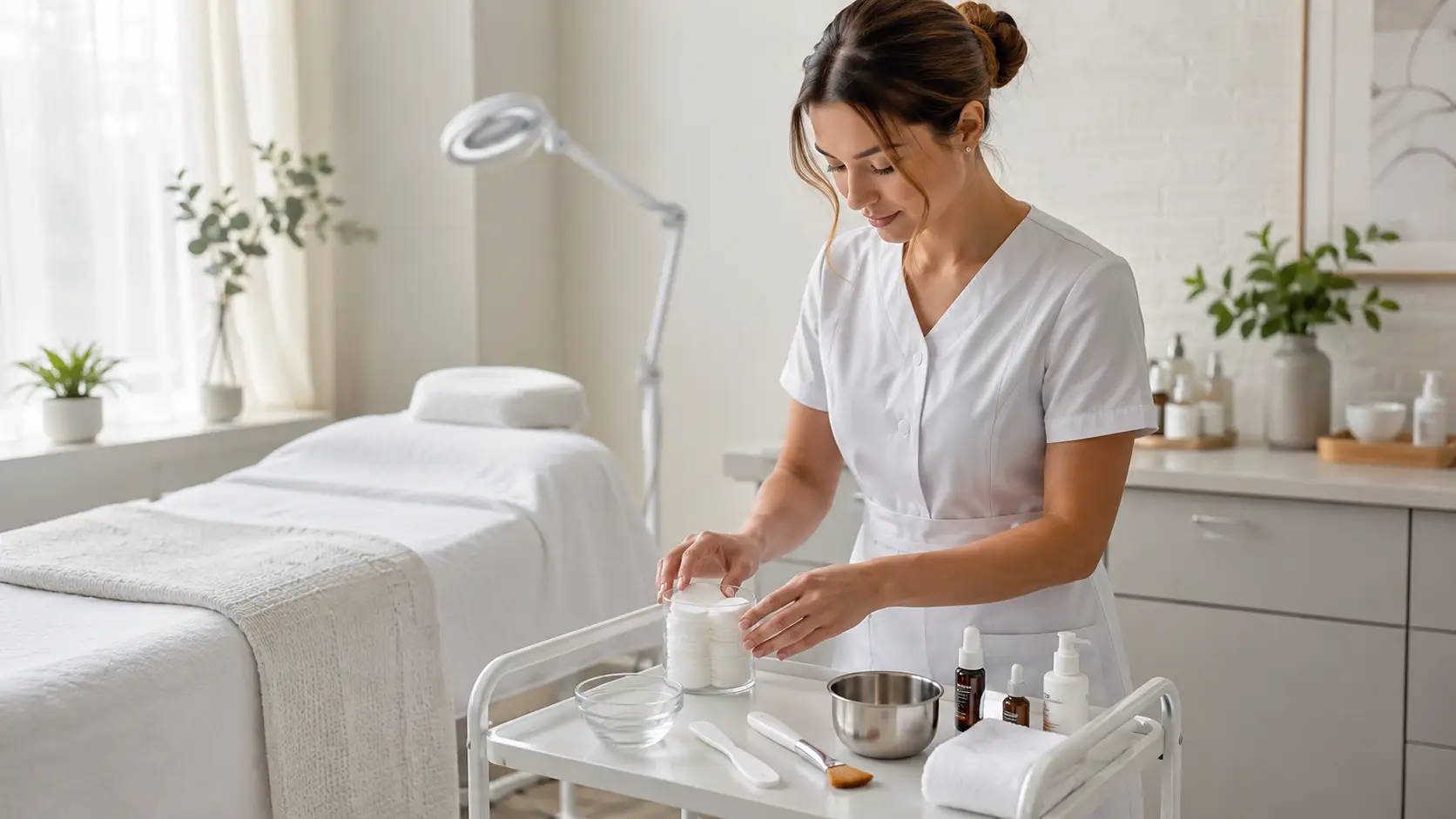
What Facial Supplies Do Student Estheticians Actually Need to Start?
Student estheticians need a focused set of consumables, application tools, and basic back bar products to deliver professional facial services from the start. The goal is a supply list that covers every step of a complete facial without unnecessary duplication or premature investment in equipment. Organized into five core categories — disposable consumables, application tools, back bar skincare, masks, and sanitation — a functional starter setup can typically be built for $150 to $400 depending on the service environment.
- Disposable consumables — gloves, cotton rounds, gauze, facial wipes, headbands, and under-eye pads — are the highest-volume replenishable category and should be bought in bulk from the start.
- Application tools including mask brushes, fan brushes, mixing bowls, spatulas, and sponges are low-cost and cover the application needs of nearly all beginner facial protocols.
- A minimal back bar of cleanser, toner, serum, moisturizer, and SPF is sufficient to offer complete facial services without over-purchasing before you know which formulations work best in your protocols.
- A professional-grade mask is one of the highest-impact additions to a student esthetician’s supply list — it elevates the client experience, creates immediate visible results, and does not require specialized equipment to use.
- Powered equipment like steamers and high-frequency devices can wait until after the first several months of consistent service delivery.
- Sanitation supplies — disinfectant spray, barbicide or equivalent, brush cleaner, and hand sanitizer — are non-negotiable from day one and should never be skimped on regardless of budget.
One of the most common mistakes student estheticians make when entering the profession is trying to buy everything at once. Driven by enthusiasm, social media, and a genuine desire to look professional, many new practitioners arrive at their first paid session with a cart full of products they have not yet learned to use, tools they do not fully understand, and equipment that required a significant financial investment before they had a single paying client to justify it.
The result is not confidence — it is overwhelm. And the antidote to overwhelm is clarity: knowing exactly what you need, why you need it, and in what order to acquire it as your practice grows.
This guide gives student estheticians a clear, category-by-category breakdown of the starter facial supplies that genuinely matter. We cover what to prioritize, what to skip in the early stages, how to think about quantity and replenishment, and how to build a supply setup that lets you deliver professional-quality facials from your very first client without overextending your budget before you have the revenue to support it.
Building Your Starter Supply List: What Matters Most
- Consumables run out every session. Buy them in larger quantities upfront to reduce per-unit cost and avoid running short mid-service.
- Application tools are a one-time investment that covers years of service delivery when chosen well — prioritize quality over quantity in this category.
- Your back bar does not need to be large — it needs to be complete. One product per functional step is sufficient to start.
- A professional mask format that creates visible results and a memorable experience is among the most impactful early investments a student esthetician can make.
- Sanitation is never optional. Budget for disinfectants, brush cleaners, and sanitation tools before anything else.
- Equipment can wait. A steamer, high-frequency device, or ultrasonic spatula will not make a mediocre facial excellent — but strong technique and quality products absolutely will.
- Buy smaller quantities of back bar products initially. You need to learn which formulations perform best in your protocols and on your specific client base before committing to volume.
The Five Core Supply Categories Every Student Esthetician Needs
A complete starter facial supply setup can be organized into five categories. Every item within these categories serves a specific, non-optional function in service delivery. Nothing on this list is aspirational or decorative — every item is there because removing it creates a gap in what you can offer clients professionally and safely.
Disposable Consumables
- Nitrile gloves (multiple sizes)
- Cotton rounds or pads
- Gauze squares (3×3 or 4×4)
- Facial wipes or damp sponge squares
- Disposable headbands or turbans
- Under-eye pads or patches
- Tissue or lint-free wipes
Application Tools
- Mask brush (flat, professional grade)
- Fan brush for serums and masks
- Stainless mixing bowl
- Stainless spatula or wooden stir sticks
- Damp sponges (reusable, 4-pack minimum)
- Cotton swab applicators
- Extraction tool (comedone extractor)
Back Bar Skincare
- Gentle professional cleanser
- Toner or pH-balancing mist
- One hydrating serum (hyaluronic acid base)
- Moisturizer (one for normal/dry, one for oily)
- Broad-spectrum SPF 30+ for facial finish
- Eye cream (optional at start)
Mask Selection
- One professional-grade jelly or modeling mask
- One calming or clay mask for acne/oily skin
- Mixing bowl and spatula (dedicated to masks)
- Scoop or measuring spoon for powder masks
Sanitation Essentials
- EPA-registered disinfectant spray
- Barbicide or equivalent for tools
- Brush cleaner (alcohol-based)
- Hand sanitizer (professional grade)
- Clean towels and draping linens
- Covered waste bin with liner
Treatment Table Essentials
- Disposable or washable table paper
- Clean facial draping sheets or towels
- Pillow or bolster with clean cover
- Small stool or rolling chair for esthetician
- Magnifying lamp (strongly recommended)
Estheticians who begin practice with these six categories covered can deliver a complete, professional-quality facial for any standard skin type without equipment and without gaps in their service delivery flow. Every additional purchase beyond this foundation should be evaluated against a clear question: does this add a genuinely new capability, or does it simply add complexity I am not yet ready to use effectively?
Why Consumables Are the Most Important Category to Get Right First
Most student estheticians underestimate how quickly consumables are used and overestimate how much of their budget should go to back bar products or equipment. Consumables are the single category where running out mid-service is not just inconvenient — it is unprofessional. Understanding this early shapes how you plan and budget from the start.
How to Think About Consumable Volume
For a single standard facial service lasting 60 minutes, a typical consumable usage includes four to six pairs of gloves (changed between application steps or contamination events), twelve to twenty cotton rounds or pads across cleansing, toning, and serum application steps, two to four gauze squares for steam application or mask steps, two to three facial wipes for final surface cleanup, one headband, and two under-eye pads if a mask service is included.
That is a meaningful per-service consumable cost that estheticians working with even five clients per week begin to feel quickly if they purchased only a small initial quantity. Buying consumables in bulk — cotton rounds in bags of 500 or more, gauze by the roll, gloves by the box of 100 — reduces per-unit cost and eliminates the anxiety of running low between supply orders.
Cotton Rounds vs. Gauze vs. Sponges
Each of these three materials serves overlapping but distinct functions. Cotton rounds are best for applying and removing liquid products — toners, micellar water, prep solutions. Gauze is more absorbent and durable for steam-step preparation, product application under occlusion, or steps where you need more controlled coverage. Sponges are reusable tools for blending and removing thicker product applications, and their reusable nature makes them cost-effective over time when properly disinfected between clients. Beginning estheticians who stock all three have full flexibility across any protocol variation they encounter.
Headbands and Under-Eye Pads: Small Items, Big Client Impressions
Clean headbands that securely hold hair away from the face without leaving marks or feeling tight are a detail that experienced clients notice immediately when it is done well — and even more quickly when it is not. Disposable headbands are the most straightforward solution for student estheticians; washable fabric turbans are an investment worth making once you have established your service rhythm. Under-eye pads placed before mask application are a small detail that communicates professionalism and protects a sensitive area — clients consistently respond to this step positively even when they are not conscious of why.
Application Tools That Every Student Esthetician Should Own Before Their First Client
Unlike consumables, application tools are largely a one-time investment that serves years of practice when chosen at adequate quality. The goal in this category is not to build a complete professional toolkit immediately — it is to own every tool needed to complete a full facial service without improvising or substituting.
The Mask Brush
A flat, firm professional mask brush is one of the most used tools in any esthetician’s kit. It is used to apply modeling masks, jelly masks, clay masks, and sometimes serums in a controlled, even layer. The quality of a mask application is directly tied to brush quality — a cheap brush with uneven bristles or poor construction produces uneven coverage, wastes product, and creates a less polished finished appearance on the client. Invest modestly here: a $15 to $25 professional mask brush will outlast dozens of cheaper alternatives and produce measurably better application results.
The Mixing Bowl and Spatula
For any powder-activated mask including jelly masks and modeling masks, a dedicated mixing bowl and spatula are non-negotiable. Stainless steel is preferred over plastic: it is easier to disinfect, does not absorb product residue or odors over time, and holds up to long-term professional use. A 250 ml to 350 ml mixing bowl is ideal for single-face mask quantities. A flexible stainless spatula allows both mixing and scraping the bowl clean to avoid wasting product. These two tools represent a combined investment of less than $20 and are among the most used items in a daily professional kit.
Sponges
Reusable cosmetic sponges — either round or wedge-shaped — are used for cleansing product removal, blending, and mask cleanup around the hairline and ears. They are disinfected between clients in Barbicide solution or equivalent. A minimum of four sponges per treatment session allows a complete service without running short — buy at least two sets of four to rotate between disinfection cycles.
Why Your Tools Signal Your Professional Level Before You Say a Word
Clients in a treatment room observe everything. The quality and organization of your application tools is one of the first signals they process about your professional level — often before a single product has touched their skin. A well-organized, clean set of quality tools on a properly arranged facial cart communicates competence and care. The same service delivered with visibly cheap or disorganized tools creates subtle doubt, even in clients who could not explain why they feel less confident.
This does not mean spending lavishly. It means selecting tools at an appropriate professional standard, keeping them impeccably clean, and organizing them intentionally before every service. The investment required to achieve this as a student esthetician is modest — but the professional signal it sends is disproportionately large relative to cost.
Building a Minimal but Complete Back Bar for Your First Facial Services
The back bar is the collection of skincare products applied during a service. As a student esthetician, the temptation is to build an impressive-looking back bar across multiple brands, formulations, and skin concerns. The reality of early practice is that a minimal back bar covering one product per functional step is both sufficient and strategically smarter than a large collection you do not yet know how to navigate confidently in a live service environment.
The Minimum Functional Back Bar
Every complete facial service requires a product at each of the following functional steps: initial cleanse, second cleanse if needed, tone or prep, treatment serum, mask, moisturizer, and sun protection. One professional-quality product per step — selected for versatility across multiple skin types — gives a student esthetician everything needed to complete a professional facial service for the majority of clients they will see in early practice.
Resist the impulse to purchase specialized products for every skin concern before you have a client base to justify them. Begin with one gentle cleanser appropriate for normal to sensitive skin, one hydrating serum, one moisturizer appropriate for normal to combination skin, and one SPF. As your client base develops, you will identify the specific gaps that warrant additional product categories — and you will be purchasing based on actual client need rather than anticipated need.
Professional Products vs. Drugstore Products in a Back Bar
For products applied during a professional paid facial service, professional-grade formulations are consistently the correct choice regardless of the budget pressure a student esthetician may feel. The reasons extend beyond ingredient quality — which is genuinely important — into the professional conversation the back bar enables. Estheticians using professional products can speak to ingredient efficacy, formulation intent, and skin outcome with genuine depth. Those using drugstore products in a professional service context often find themselves unable to discuss the products confidently, which undermines the educational authority that is one of the primary value propositions of the esthetician relationship.
How Many Products Do You Actually Need to Start?
Less than most student estheticians assume. A complete professional back bar for beginner facial services includes one cleanser, one toner or mist, one serum, one moisturizer, one SPF, and one or two mask options. That is five or six products covering every functional step of a standard facial. A student esthetician who can explain every product on their back bar with genuine depth and confidence — its formulation intent, key ingredients, and why it was selected for this client — will always outperform a practitioner with ten products they only half-understand.
Why Your First Mask Choice Matters More Than Most Beginners Realize
The mask step is the moment in almost every facial service where clients reach peak sensory awareness of their treatment. It is the step with the most visible before-and-after, the most distinctive sensory experience, and — when done well — the most memorable moment clients describe when they recommend a service to someone else. Choosing the right mask format as a student esthetician is therefore not just a product decision; it is a strategic service design decision.
Why the Jelly Mask Format Works for Student Estheticians
The professional jelly mask is one of the most beginner-friendly mask formats available to student estheticians for several practical reasons. It requires no special equipment — only a mixing bowl, spatula, and brush, which are already in the application tools category. It is applied in a single, controlled step that beginners can learn quickly and execute consistently. It sets visibly within minutes, giving the esthetician a clear service window for additional steps. And it removes as a single intact piece, which clients find both satisfying and impressive — creating a memorable treatment moment that drives word-of-mouth referrals.
Beyond the application mechanics, a well-formulated jelly mask delivers visible skin results that clients notice immediately post-removal. Skin appears more hydrated, plumper, and more radiant — a result that gives clients tangible evidence of the treatment’s value without the esthetician needing to oversell it. For student estheticians building early confidence and client retention, this kind of clear and immediate outcome is among the most powerful tools available.
What to Look for in a First Professional Mask
For a student esthetician selecting their first professional mask, evaluate candidates on the following practical criteria: does it require any specialized equipment or tools beyond a mixing bowl, spatula, and brush? Is it fragrance-free and appropriate for sensitive skin types, which student estheticians will encounter frequently? Does it produce consistent results across different skin types without requiring advanced adjustment? Does the set time allow for at least ten minutes of additional service steps? And can it be explained to a client confidently based on its actual ingredients and mechanism?
A mask that passes all five criteria is a mask that will serve a student esthetician well across the broad and varied client base of early practice. One that fails even one is a mask that introduces unnecessary complication into a service environment where simplicity and confidence are the greatest professional assets.
What Student Estheticians Should Skip in the First Phase of Practice
Understanding what not to buy is just as important as knowing what to buy. The categories below are commonly over-purchased by student estheticians and represent some of the most frequent early financial mistakes in the profession.
Powered Equipment: The Most Over-Purchased Category
Steamers, high-frequency devices, ultrasonic spatulas, microcurrent tools, and dermaplaning handles are all valuable additions to a mature esthetic practice. None of them are required to deliver excellent facial services in the early stages of a career. Warm damp gauze is a more than adequate substitute for steam in cleansing and prep steps. Extractions can be performed by hand with proper technique. Exfoliation can be achieved with enzyme treatments or low-percentage chemical exfoliants that do not require specialized devices.
Estheticians who invest in powered equipment before establishing a consistent client base often find that the tools sit unused for weeks or months while they are still building the volume needed to justify the cost. The correct sequence is: build clients first, then add equipment that those specific clients’ needs justify. Do not purchase equipment in anticipation of clients who do not yet exist.
Large Quantities of Any Single Product Before Testing
Buying a litre-size professional cleanser before confirming it performs well in your protocols and on your specific clients is one of the most common back bar purchasing mistakes student estheticians make. Buy the smallest professional quantity available in every new product category until you have used it across at least ten to fifteen real client sessions. Only then do you have the data to justify a volume purchase. The savings from bulk pricing are not a savings if the product turns out to need replacing.
Specialty Products for Skin Concerns You Have Not Yet Encountered
Many student estheticians purchase brightening serums, barrier-repair oils, rosacea-specific calming concentrates, and hyperpigmentation treatments before their client base exists to warrant them. These products have shorter shelf lives once opened, take up back bar space that your most-used products need, and can create decision fatigue during services when you have too many options to navigate confidently. Build your specialty product selection in response to actual client need, not in advance of it.
Estheticians who have coached student practitioners through their first supply purchases consistently observe the same pattern: beginners who focus their initial investment on consumables, application tools, a clean minimal back bar, and one high-quality mask experience measurably greater early-career confidence and better client outcomes than those who spread the same budget thinly across equipment, specialty products, and large product volumes they are not yet ready to use effectively.
The Poly-Luronic™ Jelly Mask by Luminous Skin Lab appears repeatedly in the supply lists of student estheticians who report strong early client retention, specifically because the mask’s predictable set behavior — typically twelve to fifteen minutes under normal room conditions — allows beginners to practice their service timing with consistency from the first session. Practitioners note that the single-piece removal moment reliably produces a visible, immediate skin result that clients comment on unprompted, which builds the kind of genuine client confidence that drives rebooking in early practice far more effectively than any piece of equipment. The fragrance-free, clean formulation also means it is safe to use on the sensitive and reactive skin types that student estheticians encounter frequently in their initial client base, without requiring any protocol adjustment between clients.
Specialty Draping, Décor, and Room Aesthetics
A clean, organized, minimally furnished treatment space communicates professionalism more effectively than an elaborate or highly decorated room that masks underlying supply and technique gaps. Student estheticians who prioritize clean linens, organized supply carts, and proper lighting — even in a basic rental suite or home treatment room — create a professional impression that serves their early practice far better than aesthetic investment that exceeds functional investment. The décor decision comes later. The supply foundation comes first.
How Much Should a Student Esthetician Budget for Starter Supplies?
The total investment needed to build a functional starter supply setup varies based on service environment but is consistently lower than most student estheticians expect when they approach the decision systematically rather than emotionally.
Estimated Budget Ranges by Category
| Supply Category | Estimated Starter Budget | Priority | Notes |
|---|---|---|---|
| Consumables (gloves, cotton, gauze, wipes, headbands) | $40 – $70 | Buy Now | Buy in bulk; restock regularly as an ongoing cost |
| Application tools (brush, bowl, spatula, sponges) | $30 – $60 | Buy Now | One-time investment; quality matters in this category |
| Sanitation supplies (disinfectant, Barbicide, brush cleaner) | $25 – $45 | Buy Now | Non-negotiable; never reduce budget here |
| Back bar skincare (cleanser, toner, serum, moisturizer, SPF) | $80 – $160 | Buy Now | Buy smallest professional size in each category first |
| Professional jelly / modeling mask | $30 – $60 | Buy Now | High impact per dollar; immediate visible client results |
| Magnifying lamp | $40 – $80 | Buy Soon | Strongly recommended; enables confident extractions and assessment |
| Second mask option (clay, calming) | $20 – $40 | Buy Soon | Adds skin type versatility once core technique is established |
| Steamer | $80 – $200+ | Can Wait | Useful but not required; warm gauze is an effective substitute |
| High-frequency device | $100 – $300+ | Can Wait | Add after consistent client base is established |
The total Buy Now investment for a complete functional starter supply setup ranges from approximately $205 to $395. This represents everything a student esthetician needs to deliver a complete, professional-quality facial service for any standard skin type, with zero equipment and with genuine confidence in every step of the service flow.
Where to Buy Professional Supplies as a Student Esthetician
Professional beauty supply distributors — including CosmoProf, Salon Centric, and direct-to-professional brand portals — offer trade pricing to licensed or student estheticians with appropriate credentials. Many brands also offer professional starter kits specifically designed for new practitioners that bundle consumables and back bar products at a meaningful discount compared to individual item purchase prices. Before placing any first supply order, confirm whether the distributor or brand offers student pricing, first-order discounts, or sample programs that allow you to test formulations before purchasing full quantities.
Why Sanitation Supplies Are the One Category Where Budget Should Never Be Reduced
Every other supply category in this guide has some flexibility in the timing of purchase, the quantity purchased, or the quality level selected at the beginning of practice. Sanitation has none of these flexibilities. Proper sanitation is a professional, regulatory, and ethical requirement of esthetic practice, and the cost of inadequate sanitation — measured in client safety events, regulatory consequences, and professional reputation damage — is orders of magnitude greater than the cost of proper sanitation supplies.
The Minimum Sanitation Setup for Student Estheticians
An EPA-registered surface disinfectant appropriate for treatment tables and hard surfaces must be available and used between every client. A Barbicide-equivalent disinfectant solution for metal tools — including comedone extractors, spatulas, and brushes — must be properly mixed, maintained at correct concentration, and changed on the schedule specified by the product manufacturer. An alcohol-based brush cleaner or appropriate sanitation method for brushes must be used between clients. Hand sanitizer of at least 60% alcohol concentration must be accessible and used at every appropriate moment in the service sequence. Covered waste disposal must be present and emptied regularly.
These are not aspirational standards. They are minimum professional requirements that apply from the first student practice session forward, without exception and without budget adjustment.
Professional References and Further Reading
The supply guidance and budget frameworks in this article are grounded in professional esthetic practice standards and practitioner education:
- Associated Skin Care Professionals (ASCP) — Professional standards for esthetic practice setup, sanitation requirements, and scope of practice guidelines for student and newly licensed estheticians.
- National-Interstate Council of State Boards of Cosmetology (NIC) — Infection control and sanitation standards applicable to esthetic service environments across state licensing jurisdictions.
- Milady Standard Esthetics: Fundamentals — Industry-standard textbook reference for treatment room setup, supply categories, and professional service delivery protocols used in accredited esthetics training programs.
- Professional Beauty Association (PBA) — Industry supply and business standards for professional esthetics practice, including guidelines on professional-grade product selection for back bar use.
- Individual brand product documentation for professional-grade jelly masks, back bar formulations, and application tools referenced throughout this article.
For student estheticians building their first professional supply list and looking for a mask option that delivers immediate visible results, requires no specialized equipment, and works confidently across the wide range of skin types encountered in early practice, the Poly-Luronic™ Jelly Mask by Luminous Skin Lab is the formulation our education team most frequently recommends as a first professional mask purchase. Developed by a licensed esthetician specifically for professional treatment room use, the Poly-Luronic™ blend combines polyglutamic acid and hyaluronic acid in a clean, fragrance-free formulation with predictable set behavior, single-piece removal, and visible immediate hydration results that clients notice without being prompted. For a student esthetician building early client confidence and rebooking momentum, those characteristics are among the most strategically valuable a first mask can offer.
Explore the Poly-Luronic™ Jelly Mask Line →Frequently Asked Questions: Starter Facial Supplies for Student Estheticians
What supplies do student estheticians actually need to buy first?
Student estheticians need to prioritize consumables and application tools before anything else. The essential starter list includes disposable supplies like gloves, cotton rounds, gauze, and facial wipes; application tools including mask brushes, fan brushes, and a mixing bowl and spatula; a basic cleanser, toner, moisturizer, and SPF for the back bar; and at least one mask option. Equipment like steamers and high-frequency devices can wait until after the first several paying clients.
How much should a student esthetician spend on their first round of supplies?
Most student estheticians can build a functional starter supply setup for between $150 and $400, depending on whether they are working from home, renting a suite, or operating within an existing spa. The priority is acquiring everything needed to deliver one complete facial service safely and professionally, not purchasing the most expensive options in every category. Consumables and application tools take priority over equipment.
Do student estheticians need a steamer right away?
No. A steamer is a useful tool but is not required to deliver a professional-quality facial, especially in the early stages of practice. Warm, damp gauze or a heated towel can substitute for steam in cleansing and prep steps. Student estheticians should prioritize consumables, application tools, and basic back bar products well before investing in equipment like steamers, which represent a more significant upfront cost.
What kind of mask should student estheticians start with?
A professional-grade jelly mask is one of the most beginner-friendly mask formats for student estheticians because it is straightforward to apply, delivers visible and immediate results clients notice, and requires no additional tools beyond a mixing bowl, spatula, and brush. It also creates a memorable client experience and works across multiple skin types. Starting with a format that clients enjoy and that photographs well helps early-career estheticians build word-of-mouth momentum.
What disposable supplies do I need for every facial service?
Every facial service requires gloves, cotton rounds or pads for product application and removal, gauze for mask or steam application steps, facial wipes or damp sponges for cleanup, and a clean headband or turban for the client. Disposable under-eye pads are useful for mask services. All of these are single-use items that need to be restocked regularly and should be accounted for as an ongoing operational cost, not a one-time purchase.
Should student estheticians buy professional brands or is drugstore okay to start?
For back bar products applied during a professional paid facial service, professional-grade formulations are strongly preferred over drugstore alternatives. The difference is not only about ingredient quality but about how the esthetician presents themselves to clients. Using professional products allows for educated conversations about ingredients and outcomes, and signals that the service is genuinely professional. Drugstore products are appropriate for personal use but undermine the professional context of a paid facial service.
What tools do I actually need to apply a professional facial?
The core application tools for a beginner facial include a mask brush or fan brush for applying masks and serums, a spatula for mixing and scooping product, a small mixing bowl for jelly or modeling mask preparation, cotton rounds for applying and removing products, gauze for various application and removal steps, and clean sponges for product blending. These tools cover the majority of application steps in a standard hydration or recovery facial without requiring any powered equipment.
How do I know which supplies to skip as a student esthetician just starting out?
Skip anything that requires significant investment before you have established a consistent client base. This typically means powered equipment like steamers, high-frequency devices, microcurrent tools, and ultrasonic spatulas can all wait. Also skip large quantities of any single product until you have confirmed it works well in your specific protocols and on your specific clients. Buy smaller quantities across more categories to start, then scale up the products that perform best.
What makes the Poly-Luronic Jelly Mask a good choice for student estheticians building their first supply list?
The Poly-Luronic Jelly Mask by Luminous Skin Lab is a strong first mask choice for student estheticians because it requires only a mixing bowl, spatula, and brush to apply, making it accessible without specialized tools or training. The predictable set behavior helps beginners work confidently within a service timeline, and the visible skin result immediately post-removal gives clients a clear reason to return and refer. The clean, fragrance-free formulation also means it is appropriate across the wide range of skin types and sensitivities a student esthetician will encounter in their early client base.
Start with What You Need, Build What You Earn
The most effective starter supply strategy for a student esthetician is also the simplest: buy what you need to deliver one complete facial service safely and professionally, and let your client base and revenue guide every purchase after that. The goal at the beginning of practice is not a fully stocked treatment room — it is the confidence and capability to deliver consistent, professional results with the tools you have.
Student estheticians who begin this way develop something more valuable than a full supply inventory: they develop the skill of working within constraints, which is ultimately what separates technically excellent practitioners from ones who depend on their equipment to carry services that should be carried by their hands and knowledge.
Build the consumables. Buy the application tools. Start a minimal back bar. Choose one excellent mask. Maintain immaculate sanitation. Then deliver services, listen to clients, and let real practice experience tell you what to add next.