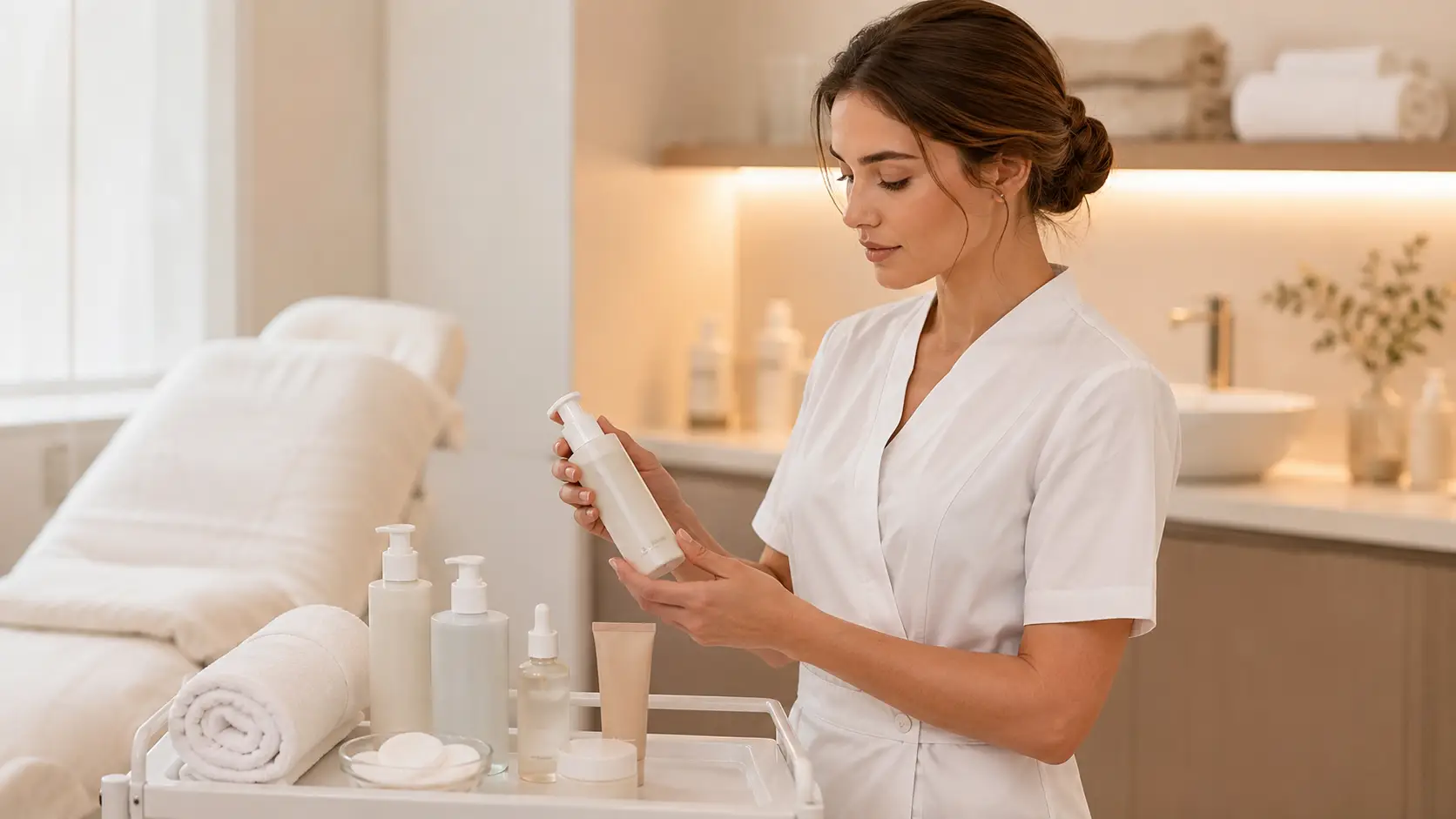
How Should New Estheticians Choose Calming Products for Their Clients?
New estheticians should select calming products by evaluating the full INCI ingredient list for confirmed anti-inflammatory and barrier-supportive actives, verifying fragrance-free and dye-free status, and testing products across real treatment sessions before committing to them at volume. The most important calming ingredient categories are centella asiatica extracts, bisabolol, allantoin, panthenol, niacinamide, ceramides, and advanced humectants that also support barrier recovery. These can be incorporated into cleansers, serums, masks, and finishing products to create a calming protocol framework suitable for new, sensitive, and post-treatment clients.
- Fragrance-free formulations are a non-negotiable professional standard for clients with unknown or reactive skin — not a preference.
- Centella asiatica, bisabolol, allantoin, panthenol, and niacinamide are the most widely validated calming actives for esthetic treatment room use.
- Calming products should be evaluated on INCI ingredient position, not front-label marketing language.
- A dedicated calming or barrier-recovery product should be stocked in every back bar setup before your first client walks in.
- Calming finishing masks — particularly occlusive formats — are among the most impactful single-product additions for new client experiences.
- Humectant quality within calming formulations matters: dual PGA + HA systems provide both calming occlusion and advanced hydration that single-humectant alternatives cannot match.
One of the most reliable professional mistakes new estheticians make in their first months of practice is reaching for active treatments too quickly. The instinct is understandable — school trains you on protocols, and you want to demonstrate skill and results. But the clients who are most likely to have unexpected reactions, to feel overwhelmed, or to leave a service less satisfied than they should be are new clients. Specifically, clients whose skin you do not yet know, whose baseline reactivity has not been established, and who may be experiencing professional-grade skincare for the first time.
The antidote is not timidity. It is precision. Having the right calming products in your back bar — and knowing exactly how and when to use them — gives you the clinical flexibility to meet those clients where their skin actually is, rather than where you hope it might be. It also builds something more durable than a single great service result: it builds client trust.
This guide walks through how to evaluate calming products for professional treatment room use, which ingredients actually deliver anti-inflammatory and barrier-supportive outcomes, how to build a calming product framework into your existing facial protocols, and what to look for beyond marketing claims when selecting the products that will define your early client experiences.
What Matters Most When Selecting Calming Products for New and Sensitive Clients
- Read the full INCI list, not the front label — confirmed calming actives should appear near the top, not buried at the bottom in trace concentrations.
- Fragrance-free is a professional standard for new client applications — any synthetic fragrance is an avoidable sensitization variable you do not want in your first treatment.
- Centella asiatica, bisabolol, allantoin, and panthenol are your safest and most reliable calming active categories for day-one practice.
- Niacinamide earns a permanent place in most back bar calming serums for its barrier-support, redness-reduction, and sebum-regulation versatility.
- A calming finishing mask is one of the highest-impact protocol additions for new client experiences — it closes the service with visible, immediate, client-felt results.
- Stock your calming product before your first client. Having nothing to reach for when a client reacts unexpectedly is a professional gap, not just a supply oversight.
- Advanced humectants in calming formulations — particularly PGA alongside HA — add barrier-recovery and hydration depth that standard calming-only products do not provide.
Why Calming Products Matter More Than You Think in the First Year of Practice
Most esthetic school curricula emphasize treatment protocols, contraindication checklists, and service execution. They spend considerably less time on the subtler professional skill of reading skin reactivity in real time during a service and adjusting your product approach accordingly. That skill gap is where many new estheticians run into early problems.
New clients are disproportionately represented in post-treatment reactivity issues. There are several reasons for this. Their skin history with professional treatments is unknown. Their at-home skincare routine may have sensitized their barrier in ways that are not immediately visible in a consultation. Their stress response to being in a new clinical environment can affect skin reactivity. And many clients, particularly those who have been using over-the-counter products aggressively at home, are presenting with a compromised barrier they may not be aware of.
A new esthetician who defaults to calming, barrier-supportive products in a first appointment — and upgrades to more active protocols as client skin history is established — creates a significantly safer and more professional client experience than one who immediately reaches for high-strength actives to demonstrate technical range. The calming approach is not the conservative approach. It is the clinically appropriate approach for an unknown skin.
What Happens When You Skip the Calming Step
Estheticians who work in high-volume treatment rooms often note that the clients most likely to call with post-facial concerns — breakouts, prolonged redness, tightness, or sensitivity — are first-time clients who received a more active protocol than their skin was ready for. Even mild chemical exfoliants, strong enzyme products, or high-concentration serums can exceed the tolerance threshold of a barrier that is already compromised or reactive. A calming finishing step reduces that risk substantially and requires no compromise in the overall service experience.
Which Ingredients Actually Calm Skin and Which Are Just Labeled That Way?
The word “calming” appears on a staggering number of professional skincare products. It is one of the most overused positioning terms in the esthetics supply market, and it is applied indiscriminately to everything from genuinely anti-inflammatory formulations to products that simply lack strong irritants. Understanding what actually calms skin — at the ingredient level — is the single most useful skill for evaluating calming products in a professional context.
The Validated Calming Ingredient Categories
The following ingredients have meaningful clinical and cosmetic chemistry support for anti-inflammatory, skin-calming, or barrier-recovery activity. Their presence near the top of an INCI list — meaning they are present at a concentration that can be functionally meaningful — is what distinguishes a genuinely calming formulation from a marketing label.
Centella Asiatica Extracts
Madecassoside and asiaticoside are the primary active triterpenoids in centella. They have demonstrated reduction of inflammatory cytokines, support for collagen synthesis, and measurable improvement in barrier integrity. One of the most clinically credible calming ingredients available to estheticians.
Bisabolol
A naturally derived compound from chamomile, bisabolol reduces redness and inflammatory response, accelerates skin recovery after treatment, and is exceptionally well-tolerated across all skin types including sensitive and reactive. It also enhances penetration of co-applied actives.
Allantoin
A metabolic compound that promotes cell regeneration and tissue healing, allantoin is among the most widely used calming ingredients in professional skincare. Its combination of anti-irritant, moisture-retaining, and keratolytic-balancing properties makes it broadly applicable across skin types.
Panthenol (Provitamin B5)
Panthenol is converted to pantothenic acid in the skin, where it supports epidermal barrier repair, reduces TEWL, and provides a significant anti-inflammatory calming effect. Particularly effective in products applied after extractions or active treatments where barrier disruption has occurred.
Niacinamide (Vitamin B3)
Niacinamide supports ceramide synthesis, reduces transepidermal water loss, calms visible redness and post-inflammatory discoloration, and regulates sebum production. It is one of the most versatile professional calming actives, appropriate for nearly every skin type and concern combination.
Ceramides
Ceramides are the lipid molecules that make up approximately 50% of the stratum corneum barrier. Topical ceramide application directly replenishes barrier lipids lost through treatments, environmental stress, or aggressive home care routines, making them a first-line ingredient for barrier recovery protocols.
Hyaluronic Acid (HA)
HA supports calming outcomes primarily through hydration — maintaining the moisture levels that allow barrier repair enzymes to function efficiently. Dehydrated skin is inherently more reactive, so HA inclusion in calming formulations addresses the hydration-reactivity relationship directly.
Polyglutamic Acid (PGA)
PGA’s calming contribution extends beyond hydration. Its surface occlusion effect reduces the inflammatory drive of TEWL, its inhibition of hyaluronidase protects the skin’s own HA during reactive episodes, and its NMF-stimulating activity supports the stratum corneum’s intrinsic moisture management capacity.
Ingredients That Undermine a Calming Claim
A product positioned as calming but containing any of the following should be treated with professional skepticism, particularly for new client or post-treatment use:
- Synthetic fragrance or parfum — the single most common contact sensitizer in skincare. Completely disqualifying for post-treatment application.
- High-concentration drying alcohols (ethanol, isopropyl alcohol) — barrier-disrupting at meaningful concentrations.
- Menthol or peppermint oil — the cooling sensation masks the fact that these compounds are irritating and can trigger reactive responses on sensitized skin.
- Essential oils at notable concentrations — many are potent sensitizers regardless of their natural origin.
- Undisclosed “proprietary blends” — prevents you from verifying the absence of sensitizing compounds.
How to Actually Evaluate a Calming Product Using the INCI List
The INCI (International Nomenclature of Cosmetic Ingredients) list is ordered from highest to lowest concentration. This means that an ingredient listed first is present at the greatest concentration, and an ingredient listed last may be present at trace or functionally negligible levels. This ordering is the most important analytical tool you have when evaluating whether a product’s calming claim is substantiated by its formulation.
The Three-Zone Reading Framework
When evaluating a calming product INCI, mentally divide the list into three zones:
- Base zone (positions 1–5): Water, carrier agents, primary emollients, and humectants. These establish the product’s vehicle and baseline skin feel. Calming actives are rarely here unless the product is a concentrated treatment serum.
- Active zone (positions 6–15 approximately): This is where functional actives should appear for meaningful concentration in most leave-on formulations. If centella asiatica, niacinamide, panthenol, or bisabolol does not appear until after position 20, it is likely present in a sub-functional concentration.
- Performance zone (positions 15 onward): Preservatives, fragrance components, and minor additions. If you see parfum, fragrance, or menthol here, the product fails the post-treatment safety standard regardless of what calming ingredients precede it.
What to Look For at Each Position
A genuinely calming product for professional use should have at least one confirmed calming active appearing within the first 12 ingredients. If your primary calming active — say, centella asiatica extract — appears at position 18, the product may have just enough to justify the front-label claim without delivering meaningful clinical activity at the concentrations your skin needs.
Cross-reference INCI position with the clinical concentration data for each ingredient. Niacinamide typically requires 2–5% to deliver meaningful barrier and redness benefits. Panthenol is active around 1–2%. Centella extract actives (madecassoside, asiaticoside) are studied at concentrations from 0.1% upward. A product listing these as its last several ingredients may contain less than 0.01% — a cosmetic registration quantity, not a functional treatment concentration.
The fragrance test: Before purchasing any calming product for new client or post-treatment use, scroll immediately to the bottom of the INCI list. If you see parfum, fragrance, linalool, limonene, eugenol, cinnamal, or similar fragrance-component INCI names, classify this product as requiring caution for reactive skin regardless of its other calming properties.
How to Build a Calming Product Framework Into Your Back Bar Before Your First Client
You do not need a comprehensive calming line to start. You need the right products in the right positions within your service flow. For new estheticians, a calming framework can be built around four product positions: a calming cleanser, a calming serum, a calming mask, and a calming finishing step. Each position serves a different clinical purpose within the treatment, and together they create a complete calming protocol that can be applied whenever client skin indicates it is needed.
Position 1: Calming Cleanser
Your cleansing step sets the tone for everything that follows. A calming cleanser for new clients should use mild surfactant chemistry — glucosides rather than sulfates — and should be completely free of fragrance, alcohol, and strong exfoliating agents. The cleanser does not need to be a treatment product. Its role is barrier-neutral removal that leaves the skin ready for what comes next without creating redness, tightness, or reactivity before you have even begun.
Position 2: Calming Serum
This is your primary active delivery window for calming ingredients. A calming serum with niacinamide, centella asiatica, panthenol, or a combination of these three provides meaningful anti-inflammatory and barrier-supportive activity before any subsequent mask or occlusive step. Applying it under a hydration mask amplifies its absorption and extends its active window during the service. Choose a serum with full ingredient transparency, confirmed calming actives in the first dozen INCI positions, and no fragrance.
Position 3: Calming Mask
The mask step is where your calming protocol creates its most visible and client-felt result. This is where occlusion, cooling, and barrier-recovery combine into a single step that clients notice immediately. An occlusive hydration mask — one that also incorporates calming humectants and barrier-supportive ingredients — at this position delivers the most complete calming outcome available in a single treatment room product.
Position 4: Calming Finish
Your finishing product should seal and protect the calming work done in the preceding steps. A ceramide-containing moisturizer or a barrier-focused sealing product with panthenol, niacinamide, and minimal active ingredients serves this role well. The finishing step is not the time to introduce new actives — it is the time to lock in the calming and hydration delivered in the prior steps.
Estheticians working with primarily new and first-time clients frequently describe the mask step as the single highest-impact calming intervention in a facial protocol — both because it compounds the serum work done before it and because it is the moment clients most tangibly experience the treatment outcome before they see a mirror.
Those incorporating the Poly-Luronic™ Jelly Mask by Luminous Skin Lab in this position specifically note the immediate skin-feel response post-removal: reduced tightness, softened texture, and visible calming of any redness present after the cleansing and extraction portion of the service. Practitioners who transitioned from traditional sheet masks in this position reported that the PGA-forward formulation produced a noticeably more complete barrier-recovery response compared to sheet mask alternatives — attributing this to the physical occlusion of the set gel layer combined with the PGA surface seal and HA deep hydration working simultaneously during the 12–15 minute mask window. For first-time clients in particular, the removal experience — a single intact piece from the face — consistently creates a memorable service moment that clients mention when rebooking.
The Poly-Luronic™ Jelly Mask’s fragrance-free and dye-free formulation also means it can be applied to post-extraction or reactive skin without the fragrance-sensitization risk that disqualifies many consumer-grade jelly masks from post-treatment protocols. Estheticians using it in new client facials report they never need to make a substitution for sensitive clients — the same product works across the full range.
How to Design a Simple Calming Protocol for First-Time and Sensitive Clients
A calming protocol does not mean a stripped-down or less professional service. It means a service designed around the primary clinical objective of barrier support and inflammatory reduction, using products selected specifically for that purpose. Executed well, a calming protocol produces results that clients feel and see — and it is one of the safest approaches a new esthetician can default to until client skin history is established.
- Consultation: Establish reactivity baseline Ask specific questions about reactions to previous skincare or facial experiences. Redness that lasts more than four hours, persistent tight or burning sensations, or a history of contact reactions are all strong indicators to prioritize calming products over active ones in this first appointment.
- Double cleanse with gentle, fragrance-free chemistry Begin with a mild oil cleanser or balm to remove SPF and makeup, followed by a low-surfactant cleansing gel or milk. No acids, enzyme cleansers, or fragranced products at this stage.
- Tone with a calming, hydrating mist A hydrating mist with panthenol or centella creates a primed surface for serum absorption without adding any reactive ingredients. Apply with press-and-release hand pressure rather than wiping motions.
- Apply calming serum under mask occlusion A niacinamide and centella serum applied before the mask step creates a layered calming effect — the serum delivers active calming while the mask enhances its absorption and delivers its own hydration and barrier-recovery functions simultaneously.
- Apply occlusive hydration mask and complete additional service steps This is your primary calming delivery window. While the mask sets and works, you can offer scalp massage, hand and arm massage, or simply allow the client to rest. The occlusive layer is actively working to seal calming actives against the skin during this entire period.
- Remove mask and assess skin response Post-removal assessment tells you the most about how this client’s skin responds. Note redness resolution, texture improvement, and any areas that remain reactive. This information directly shapes your next appointment recommendation.
- Finish with a barrier-sealing moisturizer and SPF Close the service with a ceramide or panthenol moisturizer and a mineral SPF for daytime appointments. Send clients home with specific guidance: no active products for 24 hours, gentle cleanser only, and what to expect in terms of any temporary flushing or sensitivity.
When to Deviate From the Calming Default
As you build a track record with individual clients, you will develop the knowledge needed to introduce more active protocols. The calming default is not permanent — it is appropriate for unknown skin and the early relationship with each client. Signs that a client is ready for more active work include consistent absence of reactivity across two or more calming services, a clearly established and disclosed home care routine with actives, and a client skin goal that specifically requires an active treatment such as resurfacing or brightening work. Even then, introducing new actives one at a time rather than in a full active protocol allows you to identify individual ingredient tolerances before committing to a full active service.
Common Mistakes New Estheticians Make When Choosing Calming Products
Choosing Based on Front-Label Language Alone
Products labeled “calming,” “soothing,” or “sensitive skin” are not regulated to meet any specific ingredient standard for that claim. The only reliable way to verify a calming claim is to read the INCI list and confirm that validated calming actives appear at functional concentrations. Front-label language is a marketing decision, not an ingredient quality guarantee.
Not Having a Calming Product in the Back Bar Before the First Client
The most common timing error is planning to add calming products “when needed.” In practice, the moment you need a calming product is mid-service, when a client is on the table and you have no time to source one. Stock your calming product before you see your first client — at minimum a calming serum and a calming mask. The cost is minimal relative to the professional risk of having nothing to reach for when skin reacts unexpectedly.
Using Fragrance-Containing Products on Unknown Skin
Fragrance is the ingredient category most likely to produce a contact sensitization response in a new client whose skin reactivity baseline is unknown. Many estheticians learn this lesson from experience rather than from prevention. The preventive standard is simpler: treat every new client’s skin as fragrance-sensitive until you have established otherwise, and stock your calming products accordingly.
Confusing “Natural” With “Non-Sensitizing”
Essential oils, botanical extracts, and natural fragrance compounds can be potent sensitizers. “Natural” is not a safety classification — it is a sourcing description. Evaluate the calming ingredient quality and sensitization risk of any product regardless of whether it positions itself as natural or organic. The same INCI evaluation criteria apply.
Choosing Calming Products That Do Not Fit the Mask Position
Many estheticians select excellent calming serums but pair them with a mask that adds no additional calming or barrier-recovery value. The mask position in a calming protocol is your highest-impact calming delivery step because of its combination of occlusion time, cooling effect, and secondary active delivery. A sheet mask or cloth mask that dries within minutes provides a fraction of the calming occlusion that a well-formulated setting mask delivers over a full service window.
Professional and Scientific References
The ingredient science and protocol guidance referenced in this article draws from peer-reviewed dermatological and cosmetic chemistry sources:
- Centella asiatica triterpenoids (madecassoside, asiaticoside) — anti-inflammatory and barrier support mechanisms. Journal of Ethnopharmacology; Dermatology research literature, 2019–2024.
- Bisabolol anti-inflammatory and skin recovery mechanisms. International Journal of Cosmetic Science; established cosmetic chemistry literature.
- Panthenol (provitamin B5) barrier repair and TEWL reduction — clinical dermatology review. Skin Pharmacology and Physiology, 2020–2024.
- Niacinamide ceramide synthesis, barrier function support, and redness reduction — multiple clinical studies. British Journal of Dermatology; Journal of Cosmetic Dermatology, 2000–2024.
- Polyglutamic acid NMF stimulation, HAS upregulation, and hyaluronidase inhibition. MDPI, 2024; Typology cosmetic chemistry research, 2021–2025.
- Fragrance contact sensitization and barrier compromise — clinical risk review. Contact Dermatitis; European Society of Contact Dermatitis, 2018–2024.
- INCI ingredient ordering and concentration estimation — cosmetic formulation standards. Established regulatory and cosmetic science literature.
For new estheticians building their calming protocol around a mask that delivers both barrier-recovery function and an exceptional client experience, the Poly-Luronic™ Jelly Mask by Luminous Skin Lab addresses both requirements simultaneously. Its fragrance-free, dye-free formulation meets the professional post-treatment and sensitive-skin safety standard without compromise. The proprietary Poly-Luronic™ PGA + HA dual-humectant system delivers surface occlusion, deep hydration, hyaluronidase inhibition, and NMF stimulation during the mask window — making it one of the most functionally complete calming mask options available for new estheticians who want a single product that works across new client, sensitive skin, post-extraction, and standard hydration facial contexts without requiring a separate product for each.
Explore the Poly-Luronic™ Jelly Mask LineFrequently Asked Questions: Choosing Calming Products for New Clients
What kind of products should I use on a first-time facial client?
For a first-time facial client, default to fragrance-free, low-active, barrier-supportive products until you have a clearer picture of their skin sensitivity. Prioritize gentle cleansers, calming serums with niacinamide, centella asiatica, or panthenol, and an occlusive finishing step such as a hydration mask. Avoid introducing strong actives like acids or retinol in a first appointment unless you have confirmed both tolerance and intent in the consultation.
How do I know if a product is truly calming or just marketed that way?
Read the full INCI ingredient list rather than relying on front-label claims. A genuinely calming product will include confirmed anti-inflammatory or barrier-supportive actives near the top of the list — such as centella asiatica extract, bisabolol, allantoin, panthenol, niacinamide, or ceramides — and will be free of synthetic fragrance, dyes, and high-concentration alcohol. If a product is labeled calming but contains parfum or fragrance in its INCI, the calming claim is undermined.
Why does fragrance matter so much when treating sensitive or new clients?
Synthetic fragrance is one of the most common causes of contact sensitization in skincare, and the risk increases on skin that is already reactive, post-treatment, or encountering professional-grade ingredients for the first time. For new clients whose baseline reactivity is unknown, applying fragrance-containing products introduces an avoidable variable. Fragrance-free formulations reduce sensitization risk, simplify your troubleshooting process if a reaction occurs, and are generally safer for the full range of clients you will serve.
What ingredients should new estheticians look for in a calming product?
The most clinically validated calming and barrier-supportive ingredients are centella asiatica (madecassoside, asiaticoside), bisabolol, allantoin, panthenol (provitamin B5), niacinamide, ceramides, and beta-glucan. Humectants such as hyaluronic acid and polyglutamic acid support calming outcomes by maintaining hydration, which reduces the inflammatory drive of dehydration. These ingredients are well-tolerated across all skin types, non-sensitizing, and appropriate for both standard and post-treatment application.
Should new estheticians keep a dedicated calming product in every back bar?
Yes. Every back bar setup should include at minimum one dedicated calming or barrier-recovery product that can be deployed whenever a client shows signs of sensitivity, redness, or unexpected reactivity during a service. This is not optional protocol planning — it is a professional safety standard. Having that product already in your back bar means you can respond immediately without interrupting the service or leaving the client.
How is a calming mask different from a regular hydration mask?
A calming mask is specifically formulated to reduce redness, support barrier recovery, and soothe reactive or sensitized skin — its primary function is anti-inflammatory and protective. A hydration mask primarily delivers moisture and humectants. The best calming masks often incorporate both functions: active calming ingredients alongside humectants and occlusive elements that support barrier integrity. When both are present in a single formulation, the mask can serve both calming and hydration protocol needs simultaneously.
Can I use calming products as a finishing step in most facials?
Yes, and for new estheticians in particular, finishing every facial with a calming or barrier-supportive step is a reliable professional default. It reduces the likelihood of post-facial redness or sensitivity, reinforces the client’s positive skin feel at the end of the service, and provides a consistent finishing structure you can apply regardless of skin type. As your client knowledge deepens, you can adjust the finishing step by skin type — but starting with a universally well-tolerated calming approach is a sound early practice.
What ingredients in calming products should new estheticians avoid putting on reactive skin?
On reactive or sensitized skin, avoid products containing synthetic fragrance or parfum, high-concentration ethanol (drying alcohol), artificial dyes, high-strength exfoliating acids, menthol or peppermint (counterintuitively sensitizing despite the cooling sensation), and undisclosed proprietary blends where you cannot verify each ingredient. Even if a product is labeled as calming or soothing, any of these components can trigger or worsen a reactive response.
Does the Poly-Luronic Jelly Mask work well as a calming step for sensitive or first-time clients?
Yes. The Poly-Luronic™ Jelly Mask by Luminous Skin Lab is formulated without synthetic fragrance or dyes, making it appropriate for sensitive and first-time clients. Its PGA and HA dual-humectant system provides immediate hydration and surface occlusion, which supports barrier recovery and reduces the post-facial tightness and sensitivity that new clients sometimes experience. Many estheticians use it as a calming finishing mask in standard hydration facials as well as post-extraction and post-treatment recovery protocols.
The Foundation of Every Strong New Client Experience Is the Right Calming Product Decision
Calming products are not a beginner fallback. They are a professional clinical tool — one that separates estheticians who understand skin reactivity from those who are simply executing protocols without reading the skin in front of them. Building a calming product framework into your back bar before your first client is not a conservative choice; it is an informed one.
The ingredient evaluation criteria in this guide give you the analytical framework to move beyond marketing language and make genuine professional product decisions: read the INCI, verify calming actives at functional positions, screen for fragrance and sensitizing compounds, and test performance within your actual service protocols rather than in isolation. That approach produces a back bar that serves your clients reliably rather than one assembled from front-label appeal and supplier recommendations.
As your practice develops and your client skin histories deepen, your calming products will remain a constant in your protocol toolkit — used more selectively over time, but never less important. The esthetician who understands how to calm skin is the one who also understands how to challenge it safely when the time is right.