How Should New Estheticians Explain Nano Infusion to Clients?
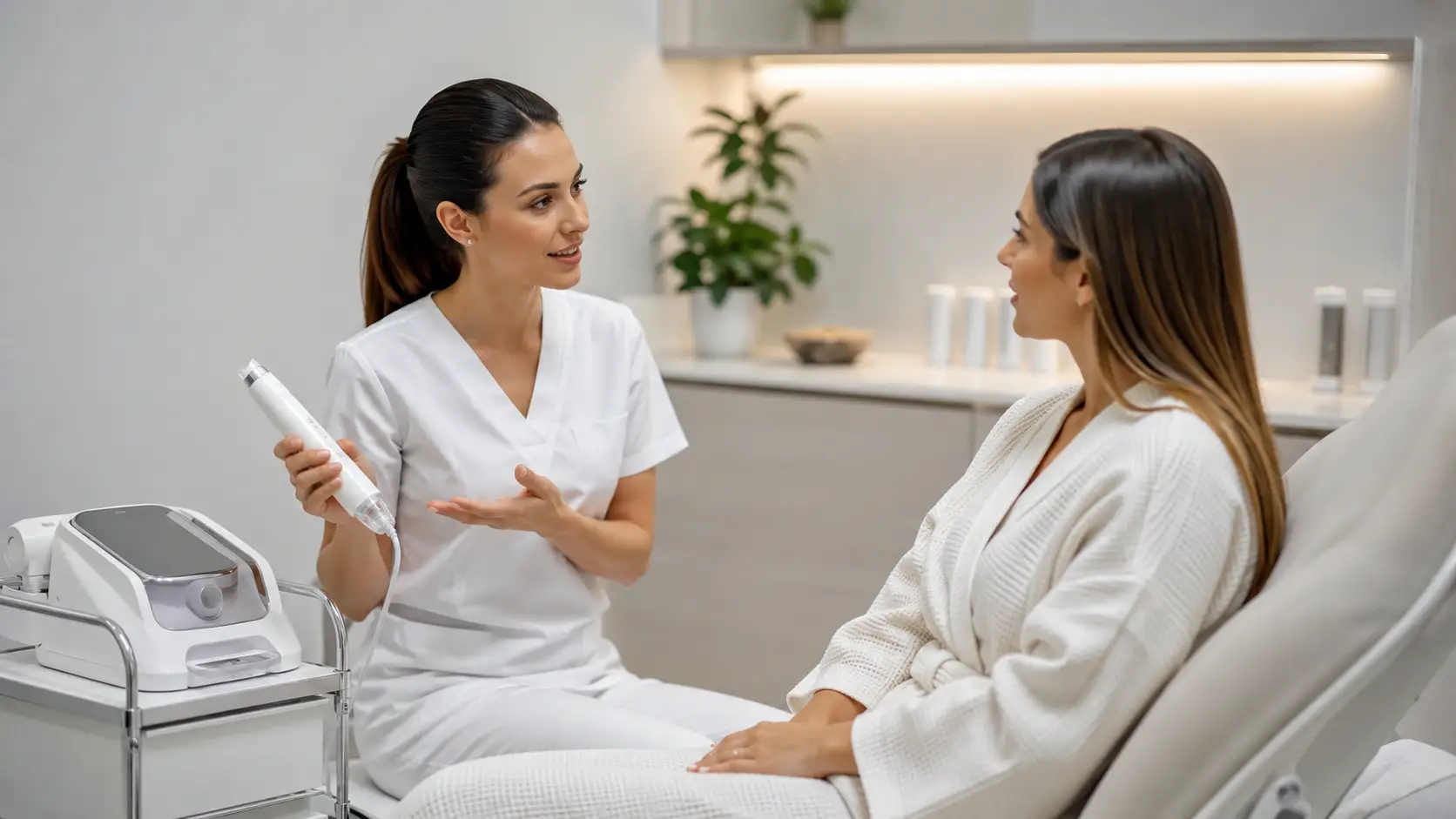
New estheticians should explain nano infusion using plain, outcome-focused language that avoids technical jargon and centers on what the client will feel, see, and experience. The most effective explanations describe nano infusion as a treatment that uses a device with microscopic tips to create tiny temporary pathways in the outermost skin layer, allowing serums to absorb far more deeply than they would through topical application alone, while also signaling the skin to produce more collagen over time.
- Use the lawn aeration analogy: nano infusion opens small pathways so serums reach the deeper layers of the skin, the same way aerating a lawn lets water reach the roots.
- Emphasize that nano infusion is needle-free and does not break the skin — it works only at the surface layer, which makes it far gentler than microneedling.
- Describe the sensation before clients ask: most people feel a light vibrating or buzzing sensation with mild warmth — not pain.
- Set realistic expectations clearly: immediate hydration and glow are common after session one; cumulative collagen improvements build over a series of four to six sessions.
- Address the cost question with mechanism language — explain what the treatment does at the skin level, not just what device is being used.
- Know the difference between nano infusion and microneedling well enough to explain it in two sentences, because clients will always ask.
- Fragrance-free, calming serums should be used during nano infusion on sensitive skin clients, and this choice should be explained to reinforce your professional credibility.
One of the most common moments of hesitation for new estheticians is not during the treatment itself — it is in the thirty seconds before a client asks “but what exactly does it do?” Nano infusion is a treatment that genuinely delivers results, but its name means nothing to most clients, and the device can look either impressive or intimidating depending on how it is introduced. Your ability to explain the treatment clearly and confidently is what determines whether a client books, upgrades, or quietly decides the whole thing sounds too complicated.
This guide is built for new estheticians who want to offer nano infusion as part of their service menu but are not yet sure how to talk about it — in consultations, during the treatment itself, in response to price objections, and when clients compare it to microneedling or other procedures they’ve read about online. What follows is a practical communication framework: the language patterns that work, the analogies that land, the questions you should ask before explaining, and the scripts you can adapt for your own voice.
Being able to explain a treatment clearly is not just a client service skill — it is a professional competency. Clients who understand what they are receiving are more likely to complete a series, more likely to rebook, more likely to refer others, and more likely to trust your recommendations in the future. Learning to explain nano infusion well is one of the most valuable investments you can make in the early stage of your career.
What You Need to Know Before Explaining Nano Infusion to Clients
- Start with outcomes, not mechanisms — tell clients what they will see and feel before you explain how it works at the cellular level.
- Nail the needle-free message early: most client hesitation about nano infusion disappears the moment they understand it does not involve actual needles piercing the skin.
- The lawn aeration analogy is the single most effective plain-language explanation for how nano infusion improves serum absorption.
- Always explain the sensation before the device touches the skin — surprise reactions during treatment are avoidable communication failures.
- Never promise specific results; instead frame outcomes as what most clients experience over a series of sessions.
- Know the nano infusion vs. microneedling distinction cold — clients read blogs and will ask, and a stumbling answer undermines confidence.
- The post-treatment instructions you give are part of the explanation process — walk through them before the client leaves the room.
- Consultation confidence is a skill built through repetition, not a personality trait — practice your explanation out loud before using it with clients.
Why Explaining Nano Infusion Well Matters More Than You Think
New estheticians sometimes focus all of their preparation energy on the technical execution of a treatment and very little on the communication surrounding it. This is understandable — learning the device, the serum layering, the pressure and speed, the timing — these are all genuinely important. But estheticians who have been practicing for several years consistently observe that the quality of the pre-treatment explanation has a measurable effect on how clients experience the treatment, how they rate it afterward, and whether they rebook.
When a client understands what is happening to their skin during a treatment, several things change. They are less likely to flinch at unexpected sensations. They are more engaged in the experience rather than passively anxious about it. They listen more carefully to post-treatment instructions because they already feel invested in the process. And they are far more likely to describe the treatment enthusiastically to other people afterward — which is one of the most reliable sources of new client referrals in esthetics.
The other reason to invest in your explanation skills early is that nano infusion is a treatment many clients have not encountered before. Unlike facials or waxing, there is no cultural shorthand for it. You are introducing something genuinely new, which means the quality of your introduction determines whether the client is curious or cautious. Clients who arrive at the treatment table already curious have a fundamentally different experience than clients who arrive anxious about something they do not understand.
The Three Things Every Client Wants to Know First
Before clients ask a specific question, they are processing three underlying concerns: will this hurt, what will my skin look like afterward, and is it worth the cost? Organize your explanation to address these three concerns in that order, before clients have to ask, and most of the conversational friction in the consultation simply disappears.
- Will it hurt? Address this early and clearly — most clients feel a mild vibrating or buzzing sensation. Not pain. No numbing required.
- What will my skin look like afterward? Describe the immediate post-treatment appearance honestly: some clients see mild redness or flush for up to two hours, followed by noticeably hydrated, glowing skin.
- Is it worth the cost? Earn the answer by explaining the mechanism — why this treatment does something a regular facial cannot. Clients who understand the “why” rarely argue about the price.
The Plain-Language Explanation Framework That Actually Works
The goal of a plain-language explanation is not to dumb down the science — it is to translate it into terms that are immediately meaningful to the person in front of you. Most clients do not need to understand what the stratum corneum is in order to appreciate what nano infusion does. What they need is a clear picture of the mechanism, a realistic expectation of the experience, and enough confidence in your knowledge to trust the treatment.
The framework below works because it follows the natural sequence of questions in a client’s mind: what is it, how does it feel, what will it do for me, and how is it different from other things I’ve heard about?
Step One: Lead With the Outcome
Begin every nano infusion explanation with the result the client will care about most based on what you learned in their intake or consultation. If they mentioned dehydration, lead with hydration. If they mentioned fine lines, lead with collagen stimulation. Outcome-first explanations keep the client engaged because the first thing they hear is directly relevant to their concern.
Outcome-First Opening
“Based on what you shared about your skin feeling tight and dehydrated, I think nano infusion would be a great fit for you. What it does is essentially give your serums a direct route into the deeper layers of your skin, so instead of sitting on the surface, they actually get to where they can do the most work. Your skin is going to feel noticeably more hydrated right away, and over time the treatment also stimulates your skin to produce more of its own collagen.”
Step Two: Use the Lawn Aeration Analogy
The single most effective analogy for explaining nano infusion is lawn aeration. Most people immediately understand that aerating a lawn before watering allows the water to reach the roots rather than running off the surface. This maps directly to what nano infusion does at the skin level — it creates tiny temporary pathways in the outermost skin layer so that serums can reach deeper than topical application alone allows. Clients who hear this analogy almost universally have a visible “aha” response. Use it consistently.
The Lawn Aeration Explanation
“The easiest way I can describe what the device does is think about aerating a lawn before you water it. When you aerate a lawn, you’re creating tiny openings in the surface so the water reaches the roots instead of just sitting on top. Nano infusion does something similar for your skin — the device creates thousands of microscopic temporary channels in the very outermost layer of your skin, and the serum we apply goes through those channels so it absorbs much more deeply than it ever would from just being applied on top. That’s why you feel results immediately.”
Step Three: Address the Sensation Before the Device Touches the Skin
Always describe the sensation before treatment begins — never let a client be surprised by how the device feels. Estheticians who skip this step frequently deal with clients who tense up or pull back mid-treatment, not because the sensation is unpleasant but because it was unexpected. Setting the expectation eliminates the startle response and replaces it with confirmation: “Oh, yes, that’s exactly what you said it would feel like.”
What It Will Feel Like
“Before I start, I want to tell you exactly what to expect. The device is going to feel like a light vibrating or buzzing sensation. Some clients describe it as a very gentle scratching feeling. You might feel a bit of warmth in certain areas. It should not be painful at any point — if anything feels uncomfortable, just let me know and I can adjust my pressure or technique. Most clients are surprised by how gentle it actually feels compared to what they expected.”
How to Handle the Most Common Client Questions About Nano Infusion
After your initial explanation, most clients will have follow-up questions. The questions below come up consistently across new esthetician practices — knowing your answers cold means you can respond with the calm confidence that builds client trust, rather than the hesitation that undermines it.
The Questions You Will Always Get
They use similar-looking devices but they work very differently. Microneedling uses medical-grade needles that go into the deeper layers of the skin to create a controlled response that triggers collagen production — it usually requires numbing cream and has several days of downtime. Nano infusion works only at the very surface layer of the skin, does not break through the skin barrier, requires no numbing, and has no downtime. It’s a much gentler treatment that sits firmly within an esthetician’s scope of practice.
Some clients see mild redness or a slight flush immediately after, but for most people it resolves within one to two hours. By the next day, the typical response is noticeably hydrated, smooth, glowing skin. That said, if you have a specific event, I’d recommend doing your first session at least a week before so we can see exactly how your skin responds and plan timing from there.
Most clients notice an immediate difference in hydration and skin texture after the very first session — the serum absorption effect is visible right away. For the longer-term collagen benefits, a series of four to six sessions spaced two to four weeks apart is where you really start to see cumulative changes in fine lines and overall skin quality. Think of it like a gym membership for your skin — one session gives you a result, but the series is where the transformation happens.
I recommend waiting at least four to six hours before applying makeup so the channels can close fully and the serums can continue absorbing. The next morning, mineral makeup is fine. I’d hold off on heavy coverage products for the first day if you can — your skin is going to look so good you probably won’t want to cover it anyway.
Nano infusion is actually one of the most well-suited advanced treatments for sensitive skin because it stays at the surface and does not trigger the deeper inflammatory response that more invasive treatments can. The key is the serum selection — for sensitive skin I use calming, barrier-supportive serums rather than anything stimulating or high in actives. I’ll also review your intake form before we start to make sure everything we’re using is appropriate for you specifically.
A regular facial hydrates and cleanses the surface of your skin, which is valuable — but the products stay largely on top. Nano infusion delivers those same products significantly deeper into the skin, and it also signals the skin’s own repair process to begin, which is something a regular facial cannot do. The investment reflects both the professional device and the clinical-grade serums used during the treatment. The visible difference in your skin right after is usually the clearest way to see the distinction.
What to Say During the Treatment to Keep Clients Engaged and Informed
The consultation explanation is the foundation, but the conversation does not end when the treatment begins. Estheticians who narrate gently during the treatment — explaining what they are doing and why, checking in on sensation, pointing out areas of focus — consistently receive higher client satisfaction scores and better rebook rates than estheticians who work in silence.
This does not mean constant talking — some clients explicitly want a quiet, relaxing experience, and reading that preference is part of your professional skill set. But for most clients, especially those experiencing nano infusion for the first time, light narration reduces anxiety, builds trust, and makes the treatment feel like a collaboration rather than something being done to them.
Narration Patterns That Build Confidence
- Announce each area before you move to it: “I’m moving to your forehead now — the skin here is a little thinner so you might feel slightly more sensation in this area.”
- Name what the serum is doing as you work: “This is the hyaluronic acid serum going in right now — this is what’s going to give you that immediate plumpness you’ll feel when we’re done.”
- Check in periodically without asking closed questions: instead of “Is that okay?” use “How is the pressure feeling in this area?” — the open question invites real feedback.
- Affirm normal responses: if the client mentions warmth, respond with “That’s completely normal — that’s the increased circulation responding to the treatment, which is exactly what we want.”
What Not to Say During a Nano Infusion Treatment
As important as what to say is what to avoid. The following phrases undermine client confidence, even when said with good intentions:
- “Sorry if this hurts” — primes clients to anticipate pain that is unlikely to occur.
- “I think this is working” — the word “think” signals uncertainty. Use “This is doing exactly what it should.”
- “This might look a little red after” — replace with “Some clients see a mild flush for an hour or two after, which fades completely.”
- “I’m still getting used to this device” — never verbalize your learning curve during a client service, even if it is true.
How to Explain the Difference Between Nano Infusion and Microneedling Without Stumbling
This is the question new estheticians dread most, and it is also the question you will receive most consistently from informed clients. Clients who research treatments before their appointments frequently arrive having read about microneedling and having decided they are not ready for it — they want to know whether nano infusion is the same thing before they commit. Getting this answer right in under thirty seconds is a skill worth drilling before you ever introduce nano infusion to your service menu.
The key is to avoid both under-explaining (which makes it sound like the same treatment) and over-explaining (which sounds defensive or uncertain). The ideal response is confident, clear, and takes about twenty to thirty seconds to deliver.
The Thirty-Second Distinction
“They look similar from the outside because both use a device with fine tips, but they’re actually quite different. Microneedling uses needles that go into the deeper layers of the skin to create a controlled wound response — it’s a medical-level treatment that usually needs numbing cream and comes with several days of redness and recovery. Nano infusion works only at the very surface layer of your skin — it doesn’t break the skin barrier in the same way, so there’s no numbing needed, no real downtime, and it’s completely within my scope of practice as an esthetician. Think of microneedling as going deeper to trigger a repair response, and nano infusion as opening a door at the surface so your serums get in. Different tools, different depths, different recovery.”
Why Knowing This Answer Cold Matters for Your Professional Image
When a new esthetician fumbles the nano infusion versus microneedling question — hesitates, starts a sentence and restarts it, or gives a vague answer — clients read that hesitation as a signal about their overall confidence level. It does not necessarily mean the client leaves or declines the service, but it plants a seed of doubt that can affect how they perceive every other recommendation you make in the session.
Conversely, estheticians who answer this question with clear, confident specificity in thirty seconds or fewer consistently report that clients visibly relax after the answer. The clarity signals expertise, and expertise signals safety. That is a significant professional advantage that takes almost no time to develop if you practice the answer deliberately before your first client encounters it.
Estheticians who have introduced nano infusion into their practice using the ILUMIPEN by Luminous Skin Lab consistently note that the pre-treatment explanation is significantly smoother when they can show the device to the client before beginning. The ILUMIPEN’s quiet motor and compact form factor mean that showing it to a client during the consultation does not produce the apprehensive reaction that some larger or louder devices trigger — clients can see and hear the device running before it ever touches their skin, which eliminates the surprise that causes flinching mid-treatment.
Practitioners also report that when they use the lawn aeration analogy and then immediately follow it by demonstrating the ILUMIPEN’s stamping motion on the back of their own hand first — so the client can see the motion before it goes near their face — first-time client anxiety drops noticeably. The combination of a strong analogy, a visible demonstration, and a device that operates predictably and quietly creates the consultation confidence that leads to higher booking rates and stronger rebook patterns compared to introducing nano infusion with description alone.
Post-Treatment Communication: What to Say After Nano Infusion Is Complete
The post-treatment explanation is an extension of the consultation, not a separate administrative task. Clients who receive a clear, organized post-care walkthrough leave the room with a concrete set of actions and a reinforced understanding of what the treatment has done to their skin. This debrief is also the moment where rebooking language fits most naturally — because the client is at peak enthusiasm about the treatment result and most receptive to the idea of continuing the series.
The Three-Part Post-Treatment Debrief
- What they will see in the next 24 hours: Explain the expected redness timeline (fades within one to two hours for most clients), the hydration and glow they can expect to notice, and any sensation they might experience (mild sensitivity or tightness in some cases).
- What to avoid and why: No retinoids, AHAs, BHAs, or other actives for 24 hours because the temporary channels need to close and introducing strong ingredients during this window can cause irritation. No saunas, hot yoga, or excessive heat for 24 hours. Sun protection daily — and explain that this is especially important when the skin has been treated because the channels, while temporary, increase UV sensitivity slightly during the post-care window.
- What comes next: Review the series recommendation, confirm their next appointment date if they are ready to book, and give them a simple written summary of post-care instructions to take with them.
Natural Rebooking Language That Does Not Feel Pushy
Rebooking after nano infusion should feel like a natural continuation of the results conversation rather than a sales pitch. The most effective approach is to anchor the next appointment to the treatment series logic you already explained before the session began.
Closing the Session and Opening the Series
“How are you feeling? Take a look — you can already see the difference in your skin just from this one session. That hydration is going to continue improving over the next 24 to 48 hours as everything settles in. Now, what you’re seeing right now is the serum absorption effect. The collagen stimulation part builds over the next few weeks and compounds with each session. Most clients start seeing the real cumulative change around sessions three and four. Would you like to get your next appointment on the calendar while you’re here? I’d recommend four weeks from today.”
Building Your Explanation Confidence Before Your First Nano Infusion Client
The most reliable way to build confidence in explaining any treatment is to practice the explanation out loud — not in your head, but spoken at the pace and volume you would use with a real client. This sounds obvious, but most new estheticians skip this step and then wonder why their first few client explanations feel hesitant or disorganized. Speaking an explanation and thinking an explanation are neurologically different activities. Fluency in one does not transfer automatically to the other.
A Simple Practice Protocol for New Estheticians
- Record yourself giving the five-stage explanation. Listen back. You will immediately hear where you hesitate, where you use filler words, and where the phrasing sounds unnatural. Revise those spots and re-record until the explanation flows without hesitation.
- Practice the nano infusion versus microneedling question. Have a colleague or friend ask it unexpectedly so you respond in real time, not from a standing start. The goal is a thirty-second answer delivered without pausing to think.
- Explain the treatment to someone completely outside the industry. If they understand it clearly after your explanation, your language is at the right level of accessibility for a first-time client. If they look confused, simplify further.
- Do a full mock consultation before your first real client. Go through the intake review, the opening, the analogy, the sensation preview, the questions, and the post-treatment debrief from start to finish — in sequence, out loud, at client-appropriate pace. This rehearsal removes the cognitive load of generating language on the spot during an actual session.
Why Confidence Is a Communication Skill, Not a Personality Trait
New estheticians frequently believe that confident client communication is something more experienced practitioners just have — a quality that comes from years in the treatment room or from a naturally outgoing personality. This belief is incorrect, and it is professionally damaging because it leads to waiting passively for confidence to arrive instead of actively developing the skill that creates it. Confidence in treatment explanations is built the same way any communication skill is built: through deliberate practice, honest self-assessment, and increasing repetition with real clients. The estheticians who explain treatments most fluently are not necessarily the most experienced or the most extroverted — they are the ones who prepared most thoroughly before the first client arrived.
Professional References and Further Reading
The treatment science and communication principles referenced in this article draw from the following sources:
- Nano infusion mechanism — microchanneling, stratum corneum transient channel formation, and serum delivery enhancement. Professional esthetics education literature and device manufacturer documentation.
- Nano infusion versus microneedling: scope of practice distinctions by treatment depth and barrier disruption. Esthetics regulatory guidance and professional scope-of-practice references across multiple US state boards.
- Client communication and explanation confidence in service professions — principles of outcome-first communication and analogy use in client-facing healthcare and wellness consultations.
- Post-treatment care after nano infusion: avoiding active ingredients during the transient channel closure period and UV sensitivity in post-procedure skin. Professional treatment protocol references.
- Serum selection for sensitive skin clients receiving nano infusion — barrier-supportive, fragrance-free, calming formulations. Professional skincare formulation science.
For new estheticians who are building their nano infusion offering and want a device that supports confident client communication from the very first session, the ILUMIPEN by Luminous Skin Lab is the device our education team most consistently recommends in the beginner advanced treatment context. Its professional form factor and quiet, consistent operation make the pre-treatment demonstration — showing the device to a client before it touches their skin — a natural and confidence-building part of the consultation rather than an obstacle to overcome. For estheticians learning to explain nano infusion with confidence, working with a device that performs predictably means one less variable to manage while you are still developing your client communication fluency.
Explore the ILUMIPEN Nano Infusion DeviceFrequently Asked Questions: How to Explain Nano Infusion to Clients
How do I explain nano infusion to a client who has never heard of it?
Start with what clients already understand: their skin absorbs serums best when there is a clear pathway for them to enter. Nano infusion uses a device with thousands of microscopic silicone or metal tips that create tiny temporary channels in the outermost skin layer, allowing serums to reach deeper than topical application alone. Describe it as a supercharged serum delivery system that also stimulates the skin to produce more collagen over time. Avoid technical language in the first explanation and focus on the outcome the client cares about most.
What is the simplest way to describe nano infusion without sounding too technical?
The clearest plain-language explanation is: nano infusion uses a device with extremely fine tips to open tiny temporary pathways in the skin’s surface so the serums we use can absorb much more deeply and effectively. It also signals the skin to begin its own repair process, which builds collagen gradually over several weeks. Most clients respond well to an analogy: think of it like aerating a lawn before watering so the water reaches the roots instead of just sitting on the surface.
Does nano infusion hurt? What should I tell clients who are nervous about needles?
Nano infusion is not a needle-based treatment. The nano tips used in the device do not pierce the skin the way needles do — they create superficial microchannels in the stratum corneum only, which is the outermost layer of skin. Most clients describe the sensation as similar to a light vibrating or buzzing feeling, sometimes with mild warmth. There is typically no pain, no numbing required, and no visible puncture marks. For clients who are nervous about needles, emphasizing the needle-free nature and the gentle sensation is usually enough to ease concern.
How is nano infusion different from microneedling? My client keeps confusing the two.
Nano infusion and microneedling both use devices with fine tips, but they work at very different depths and through different mechanisms. Microneedling uses medical-grade needles that penetrate into the dermis to create a controlled wound response and trigger collagen induction. Nano infusion uses nano-scale silicone or metal tips that work only at the surface of the skin — the stratum corneum — without creating a true wound. This makes nano infusion gentler, requires no numbing, produces no downtime, and sits within the esthetician’s scope of practice in most states, while microneedling often requires medical oversight depending on depth and state regulations.
What results should I tell clients to expect from nano infusion?
Clients typically notice immediately improved skin hydration and a plumper, more luminous appearance right after their first session — this is largely due to the enhanced serum absorption during treatment. Over a series of sessions, progressive improvements in fine lines, skin texture, pore appearance, and overall radiance are common as collagen production increases. Be clear that nano infusion is a cumulative treatment: a series of four to six sessions spaced two to four weeks apart produces better long-term results than a single treatment. Avoid promising specific outcomes and instead frame results as what most clients experience.
Is there any downtime after nano infusion? What should clients expect right after the treatment?
Nano infusion has little to no downtime for most clients. Immediately after the treatment, some clients experience mild redness or a slight flush that typically resolves within one to two hours. The skin will feel hydrated and smooth. Clients should avoid active exfoliants, retinoids, and heat exposure such as saunas or very hot showers for at least 24 hours post-treatment. Sun protection is important in the days following any nano infusion session. Most clients can return to normal daily activities immediately, which is one of the treatment’s key advantages over more invasive alternatives.
How do I handle a client who asks if nano infusion is safe for sensitive skin?
Nano infusion is generally well-suited for sensitive skin because it works at the skin’s surface without breaking the skin barrier in a way that triggers significant inflammation. However, the serum selection matters significantly for sensitive skin clients — the products infused during the treatment must be appropriate for their skin type. Avoid active ingredients that are too stimulating for reactive skin, such as high-concentration vitamin C or strong exfoliating acids. Focus on calming, hydrating, barrier-supportive serums instead. Always complete a thorough skin assessment and intake form before proceeding with any client, and flag any active skin conditions, recent procedures, or medications that may affect suitability.
What do I say when a client asks why nano infusion costs more than a regular facial?
Frame the conversation around the mechanism and results rather than the device itself. Explain that nano infusion delivers serums at a significantly deeper level than a standard facial, activates the skin’s own collagen production process, and produces cumulative improvements over time that a traditional facial alone cannot achieve. The investment reflects both the professional device and the clinical-grade serums used during treatment. Comparing it to a regular facial is like comparing a standard car wash to a full detail — both clean the car, but the outcomes and longevity are different. Clients who understand the mechanism typically find the price easier to accept.
How does the ILUMIPEN nano infusion device make it easier to explain and demonstrate nano infusion to first-time clients?
The ILUMIPEN by Luminous Skin Lab is designed specifically for esthetician use, with a clean, professional appearance and quiet operation that makes the demonstration during a client consultation straightforward. Its ergonomic design allows estheticians to show the device to first-time clients without it appearing intimidating, and the smooth stamping motion is easy to describe visually before application begins. For new estheticians building client confidence in nano infusion as a service offering, working with a device that operates predictably and comfortably reduces the uncertainty on both sides of the treatment room conversation.
The Explanation Comes Before the Treatment
Every technique you learn in esthetics exists inside a conversation. The most skilled application of a nano infusion device is undermined by a hesitant or unclear pre-treatment explanation. The most enthusiastic client response can be lost by a rushed post-treatment debrief that leaves the client unsure of what to do next. Communication is not a soft skill peripheral to the clinical work — it is the frame that gives the clinical work its meaning and value for the client sitting in front of you.
New estheticians who invest time in developing their explanation language before their first client arrives with a nano infusion question are not just preparing for a single service. They are building the consultation confidence that will shape every client relationship they develop throughout their career. The scripts in this guide are starting points — adapt them to your voice, your client base, and the specific concerns that come up most often in your practice. The framework is consistent even when the words change.
Practice the five-stage explanation out loud before your first session. Know the nano infusion versus microneedling answer cold. Set the sensation expectation before the device touches the skin. Frame results honestly and cumulatively. And close every session with the post-care debrief that turns a first-time client into a series client. These are the habits that build practices.