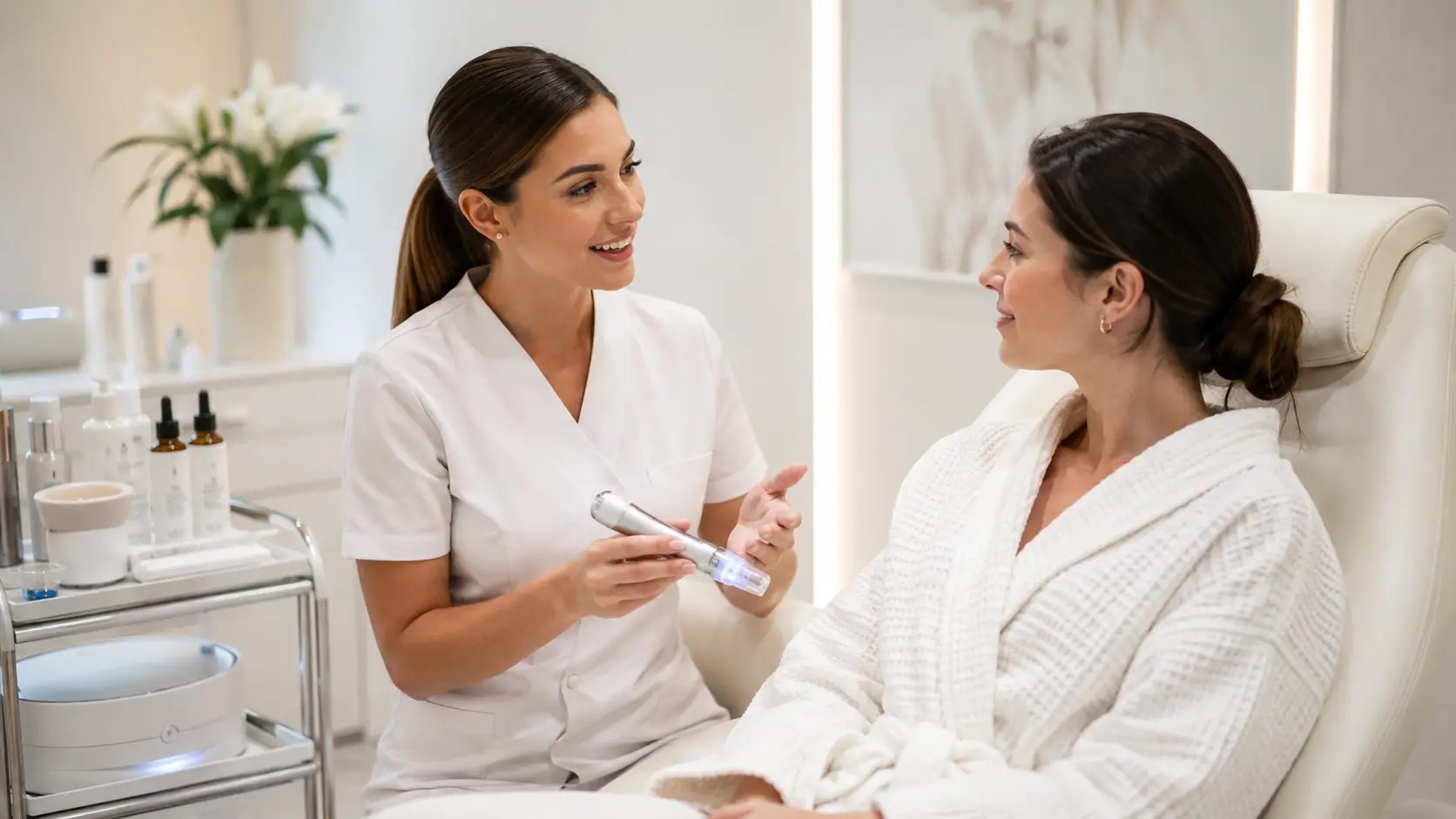
How Should a New Esthetician Explain Nano Infusion to a First-Time Client?
Explaining nano infusion to a first-time client requires leading with the benefit, simplifying the mechanism, and addressing comfort and safety before the client has to ask. The most effective approach starts with a clear, jargon-free description of what the treatment does — enhancing serum absorption and improving skin texture without pain or downtime — before layering in any technical detail the client wants to explore.
- Lead with outcomes the client cares about: better hydration, smoother texture, and no downtime — not device mechanics or needle depth.
- Distinguish nano infusion from microneedling immediately if the client raises it — the absence of dermis penetration, numbting cream, and significant downtime are meaningful differentiators.
- Address the sensation question proactively: most clients describe nano infusion as a gentle vibrating or tingling feeling — not pain.
- Explain what the serums do and why they were chosen for this client — this shifts the conversation from fear to engagement.
- Set realistic expectations for single-session results and communicate the cumulative benefit of a treatment series honestly.
- Use an analogy to explain skin permeability — describing the skin as a barrier that temporary microchannels allow treatments to move through is consistently the most client-accessible explanation.
- Invite questions throughout and affirm that the client can stop or adjust the treatment at any point.
Nano infusion is one of the most client-friendly advanced treatments an esthetician can offer. There is no numbing cream, no meaningful downtime, and the results are visible immediately. For new estheticians, that combination makes it an excellent early advanced service — but only if clients understand what they are booking.
The challenge is that most first-time clients arrive with some version of the same concern: does this involve needles? Will it hurt? What is it actually doing to my skin? Those are entirely reasonable questions, and the esthetician’s ability to answer them with clarity and confidence determines whether a client books — and whether they rebook. Hesitant or vague answers create hesitant clients. Clear, specific, calm explanations create trust.
This guide covers the full client communication arc for nano infusion — from the intake consultation through the post-treatment conversation. It is written for new estheticians who are adding nano infusion to their service menu and want a structured, reliable way to talk about it with clients who have never experienced it before.
What Every New Esthetician Should Know About Explaining Nano Infusion
- Lead every nano infusion conversation with client benefit, not device mechanics — most clients do not need to understand the technology to feel confident about the treatment.
- The most common client objection is fear of pain or needles — address it directly, specifically, and early rather than waiting for the client to ask.
- Distinguishing nano infusion from microneedling is one of the highest-value communication moves you can make with first-time clients who have researched skin treatments.
- Explaining the serum selected for the treatment builds client engagement and investment in the outcome — do not skip this step.
- Realistic expectations about single-session results protect your professional credibility and increase rebooking more than overpromising does.
- Analogies work better than technical language for most clients — the microchannels-as-pathways analogy is simple, accurate, and consistently well received.
- Clients who understand what happened during their treatment and what to do afterward are significantly more likely to return for follow-up sessions.
Why How You Explain Nano Infusion Matters as Much as How You Perform It
New estheticians often focus most of their preparation energy on mastering the technical execution of a treatment — device handling, pressure, speed, serum selection, and protocol sequence. These things genuinely matter. But for nano infusion specifically, client communication is a parallel skill that has an equally direct impact on outcomes — both for the client’s experience and for your business.
A client who understands the treatment before it begins is calmer during it. A client who is calmer during treatment has a better physical experience. A client who has a better experience is more likely to rebook and refer. That chain of outcomes begins with what you say in the first two minutes of the consultation — before you pick up the device.
For estheticians early in their careers, there is an additional dimension: how you talk about a treatment signals your expertise. Estheticians who explain treatments with precision, without jargon, and with evident clinical confidence are perceived as more skilled — even by clients who cannot evaluate the technical execution directly. Building that perception through communication is one of the fastest ways a new esthetician can establish professional authority.
What Clients Are Actually Afraid Of
When a client expresses hesitation about nano infusion, the underlying concern is almost always one of three things: pain or discomfort, skin damage or a bad reaction, or wasting money on something that will not work. Understanding which of those three concerns is driving a client’s hesitation allows you to address it directly rather than offering a general reassurance that does not land.
Pain and discomfort concerns are best addressed with specificity: describe the sensation in advance, explain why nano infusion is inherently less uncomfortable than the treatments they may be comparing it to, and offer a demonstration on the back of the hand. Skin reaction concerns are best addressed by explaining what nano infusion does and does not do to the skin, confirming that the serum selected is appropriate for their skin type, and setting clear expectations for the normal post-treatment response. Value concerns are best addressed by explaining the cumulative benefit of a treatment series alongside realistic single-session results — and by allowing the client to see and feel the immediate outcome before they leave.
The Consultation Conversation: What to Say Before the Treatment Begins
The pre-treatment consultation for a first-time nano infusion client should cover five things: what the treatment is, what it does, what it feels like, what serums will be used and why, and what to expect after. That entire conversation can be completed in three to four minutes without rushing. Structure it in this order so that each element builds on the last.
Start With the Outcome, Not the Device
The first thing most estheticians say about nano infusion is something about the device — the tips, the motion, the technology. The first thing clients want to know is what the treatment will do for their skin. Lead with the outcome.
A straightforward opening sounds something like: “Nano infusion is a treatment that improves how effectively your skin absorbs the serums we use. The result is noticeably better hydration, a more refined skin texture, and a visible glow that builds with each session. And because this treatment works entirely at the surface of the skin, there’s no downtime and most clients have no visible redness afterward.”
Once the client has a clear picture of what they are getting, they are more receptive to learning how it works.
Explain the Mechanism With an Analogy
The most reliable way to explain how nano infusion works to a client with no skincare science background is the pathway analogy. The skin’s surface layer is designed to keep things out — that is its primary function. Nano infusion temporarily opens tiny pathways through that surface layer so that the serum applied during treatment can penetrate to where it actually works, rather than sitting on top of the skin where absorption is limited.
The key language here is “temporarily” and “surface.” Those two words pre-emptively address the most common follow-up question, which is whether there is any permanent change to the skin. The channels close within minutes. Nothing is being injected. The skin’s barrier is not permanently altered.
Explaining the Mechanism Simply
“Your skin’s surface is actually designed to keep things out — which is great for protecting you, but it also means that even really good serums only absorb so far on their own. What nano infusion does is create tiny temporary openings in that surface layer — they’re invisible and they close within a few minutes — so the serum we use during your treatment goes exactly where it needs to go. Think of it as opening a door that’s normally only open a crack.”
This language works for most clients regardless of skincare knowledge level. Adjust the analogy to fit the individual client’s communication style if needed.
Address the Sensation Question Proactively
Do not wait for the client to ask whether it hurts. Raise it yourself. Clients who have researched any skin treatment involving a device have almost always read at least one account that made it sound more uncomfortable than it is. Getting ahead of that expectation is more effective than correcting it after the fact.
Describe the sensation specifically rather than vaguely. “Most clients describe it as a gentle vibrating or tingling feeling — similar to a light scalp massage in terms of intensity” is more reassuring than “it shouldn’t hurt.” The specificity signals that you have performed this treatment many times and you know exactly what it feels like. The vague version signals uncertainty, even if that is not your intent.
Estheticians who work with particularly anxious clients find it useful to offer a brief demonstration on the back of the client’s hand before beginning. This removes the element of surprise entirely and gives the client direct physical experience of the sensation before it is applied to their face.
How to Explain the Difference Between Nano Infusion and Microneedling
Any client who has done any research on treatments involving skin devices has likely encountered microneedling content. The visual comparison between the two — both involve a device held against the skin, both are described as creating channels — is enough to cause confusion and, often, unnecessary anxiety.
Clarifying the distinction is one of the most valuable things you can do in a first-time nano infusion consultation, whether or not the client raises it directly. If they have been exposed to microneedling content — particularly images of post-treatment redness — they may have formed an association that is entirely inapplicable to nano infusion.
The Key Distinction: Depth and Mechanism
The most clinically accurate and client-accessible explanation centers on depth. Microneedling uses metal needles that penetrate into the dermis — the living, structural layer of the skin beneath the epidermis. This depth creates a controlled wound-healing response that stimulates collagen production and is what produces microneedling’s structural skin changes. It also produces the redness, sensitivity, and downtime associated with the treatment.
Nano infusion uses silicon tips that interact only with the outermost surface of the skin. There is no dermis penetration. There is no wound-healing response. The treatment creates temporary microchannels that allow serum delivery, then closes without leaving any visible trace. The result is a treatment that can be performed without numbing cream, typically produces no lasting redness, and requires no meaningful downtime or post-treatment restrictions beyond the first few hours.
“I saw pictures of microneedling and it looked really red and painful. Is this like that?”
“Nano infusion is completely different. Microneedling goes into the deeper skin layer to trigger a healing response — that’s why there’s redness and recovery time. Nano infusion only works at the very surface. Most clients have no visible redness at all when they leave, and there’s no recovery period.”
“Do you use actual needles? I really don’t like needles.”
“No traditional needles at all. The tips on this device are made of silicon — they’re extremely fine, but they’re not needle-like in the way you’re picturing. They stay right at the skin surface and don’t break the skin. Would you like to feel it on the back of your hand first?”
“Will my face be red after? I have somewhere to be tonight.”
“Most clients have no visible redness after nano infusion — or just a very brief flush that fades within the hour. It’s actually a popular treatment before events for exactly that reason. The microchannels close within minutes, and the immediate result is usually a visible glow rather than any irritation.”
“I saw something online that looked completely different from what you’re describing.”
“Social media tends to feature the most dramatic-looking treatments because they get more views — that doesn’t mean they’re what a standard professional treatment looks like. Nano infusion intentionally produces a low-visible-response outcome. The lack of redness or flaking is a feature, not a sign that nothing is happening.”
How to Talk About Serums During a Nano Infusion Treatment
The serum used during nano infusion is not a secondary detail — it is the active component of the treatment. The microchannels created by the device exist to deliver that serum more effectively. Explaining what the serum contains, why it was chosen for this client, and what it is doing during the treatment is one of the most high-value communication moves an esthetician can make.
Clients who understand that the serum was specifically selected for their skin concern — not applied as a generic finishing step — experience the treatment as more personalized and more clinically intentional. That perception directly influences how they assess the value of the service and how likely they are to return.
Keep Serum Explanations Client-Accessible
The goal is not to deliver a chemistry lecture. It is to give the client enough information to feel that the treatment was designed for them. One or two sentences about the serum’s primary function and why that function is relevant to this client’s skin goal is exactly the right level of detail for most first-time clients.
For a client focused on hydration: explain that the serum contains ingredients that attract and hold moisture within the skin, and that delivering them through the microchannels means significantly more of those actives reach the layers where they are most effective compared to standard topical application.
For a client dealing with skin dullness, early fine lines, or uneven texture: explain that the serum contains compounds that signal the skin to produce more of its structural proteins, and that nano infusion allows those signals to reach deeper into the skin where collagen and elastin production occurs.
For a client with compromised, post-procedure, or sensitized skin: explain that the serum is formulated to support the skin’s own healing and recovery processes, and that the gentle delivery mechanism of nano infusion is specifically appropriate for skin that needs support without additional stress.
Estheticians who use the Luminous Skin Lab Professional Ampoule Set as their nano infusion serum protocol consistently find that the individual ampoule format makes client-specific serum explanations significantly easier and more convincing. Holding up the specific ampoule chosen for a client — naming it and giving a one-sentence rationale — takes under thirty seconds and produces a meaningful shift in client engagement.
For hydration-focused or anti-aging clients, the Poly-Luronic™ Peptide Ampoule explanation works particularly well: “This ampoule combines peptides that support collagen signaling with moisture-binding actives that hold hydration at multiple skin depths. Because we’re delivering it through the microchannels we just created, it’s going where a serum applied topically never fully reaches.” For clients with reactive, compromised, or post-procedure skin, the PDRN Regeneration Ampoule explanation resonates immediately: “PDRN is a regenerative compound that works with the skin’s own repair pathways. It’s one of the most clinically validated ingredients for recovery and healing, and nano infusion is an ideal delivery method because of how gently it opens the skin surface.” Clients hearing either of these explanations for the first time consistently lean in — the specificity of the ampoule format makes the serum feel like a clinical decision rather than a generic add-on.
What to Say During the Treatment to Keep the Client Comfortable and Engaged
Communication does not end when the treatment begins. What an esthetician says during nano infusion — and when they say it — significantly affects the client’s experience, comfort level, and perception of the treatment’s professionalism.
Narrate Transitions Before They Happen
One of the most effective practices for keeping a first-time client relaxed during any device treatment is narrating transitions before they occur rather than after. “I’m going to apply the serum now before we begin” is far better than simply beginning to apply it. “I’m moving to your forehead now” removes any element of surprise from a moment when the client cannot see what is happening. This kind of verbal guidance costs nothing and consistently reduces client tension.
Check In, But Do Not Over-Check
A brief check-in at the start of the device pass — “is the pressure comfortable?” or “let me know if you want me to slow down” — is appropriate and builds trust. Checking in every thirty seconds creates a different effect: it signals that the esthetician is uncertain, and it draws the client’s attention back to their physical sensation rather than allowing them to relax. Check in at natural transitions, not continuously.
Narrate What Is Happening Briefly
A brief, calm explanation of what each stage of the protocol is doing — delivered as a natural part of conversation rather than a lecture — keeps first-time clients oriented and engaged without requiring any effort on their part. Something like “the channels are closing now as I apply the finishing serum” or “the serum is absorbing while the device passes — you might feel a slight cooling as we go” maintains the educational connection established in the consultation without creating any demand on the client to respond.
Establish Benefit First
Open with what the client will experience: better hydration, refined texture, no downtime. Then explain the mechanism in plain language. Address sensation and needle questions proactively. Use the analogy of skin as a barrier and microchannels as temporary pathways.
Name the Serum and Give One Sentence of Rationale
Hold up the specific serum or ampoule, name it, and explain in one sentence why it was chosen for this client’s skin concern. This takes thirty seconds and shifts the client from passive to engaged. It signals clinical intention and builds perceived value.
Narrate Transitions, Check In at Natural Points
Tell the client what is happening before it happens. Check in on comfort at natural transitions, not continuously. Offer brief, calm narration of what each protocol stage is doing. Keep conversation light and optional — many clients enjoy the quiet.
Show the Result and Set Expectations for the Following Days
Hold a mirror so the client can see the immediate result. Explain what to expect in the first 24 hours and why. Set realistic expectations for cumulative improvement. Suggest the next appointment timing and connect it to their skin goal before they leave the room.
How to Set Accurate Expectations Without Underselling the Treatment
Managing client expectations for nano infusion requires a careful balance. The treatment does produce immediate, visible results — many clients notice a visible glow and improved skin texture immediately post-treatment. Overpromising what a single session will achieve, however, sets up a credibility problem that is difficult to recover from.
The most effective framing positions nano infusion as a cumulative treatment whose full benefit builds over a series of sessions, while still communicating the genuine value of the immediate result. This approach is honest, manages expectations accurately, and also creates the natural opening for a rebook conversation.
What Clients Should Expect After a Single Session
Immediately after nano infusion, most clients notice improved skin luminosity, a feeling of tightened and hydrated skin, and a visible smoothness in texture. These effects are real and are consistently reported by clients — estheticians do not need to undersell them. What should be clearly communicated is that structural improvements — changes in fine lines, tone evenness, and long-term skin quality — develop progressively with a regular treatment series. Explain that a typical recommendation is a series of four to six sessions, two to four weeks apart, before assessing the full cumulative result.
What to Tell Clients About the Days After Treatment
First-time clients need specific post-treatment guidance, not vague reassurance. Explain that for the first four to six hours after nano infusion, the microchannels remain temporarily more open than usual, which means the skin absorbs topical products more effectively but is also slightly more sensitive to potential irritants. Advise them to avoid active skincare ingredients — retinoids, strong acids, and exfoliants — for 24 hours. Recommend a gentle, hydration-focused home routine for the first day. Confirm that any mild flushing will resolve within hours. Then explain that the serum delivered during treatment continues working in the skin for 48 to 72 hours after the service.
That last point — that the serum keeps working after they leave — is consistently one of the most positively received pieces of information a new nano infusion client receives. It reframes the treatment from a one-hour appointment into an ongoing investment in their skin that continues between visits.
How to Connect the Post-Treatment Conversation to a Natural Rebook
The end of the first nano infusion session is the highest-value moment for establishing an ongoing client relationship. The client has just experienced the treatment, their skin looks and feels noticeably different, and they are in an optimal state of positive engagement with both the treatment and the esthetician who performed it. Estheticians who use this moment well — without creating pressure — consistently see significantly higher rebooking rates from first-time nano infusion clients than from any other treatment type.
Show Before You Discuss
Before any post-treatment conversation begins, hand the client a mirror. Let them see the immediate result. Do not describe it before they see it — let the visual do the work first. The client’s natural response to seeing their skin in a positive light opens the door to a natural, unprompted question about when they should come back.
Connect the Next Session to Their Skin Goal
Rather than asking “would you like to book your next appointment,” connect the follow-up directly to the result the client came in for. “To get the full improvement in [their specific concern], I’d recommend we do this again in about three weeks — that’s when the cumulative effect really starts to build.” This is not a sales pitch. It is clinical guidance. Clients hear it as professional recommendation, not upselling — especially from an esthetician who has just demonstrated clear competence.
Give Them Specific Post-Treatment Instructions in Writing
A brief written post-treatment guide — even a simple card or digital summary — extends the professional impression of the service beyond the treatment room. Include the 24-hour avoidance guidelines, the home routine recommendation for the first night, and the suggested timeframe for the next session. Clients who receive written aftercare instructions consistently report higher satisfaction and are more likely to refer the service to others.
Common Communication Mistakes New Estheticians Make When Explaining Nano Infusion
Starting With the Device Instead of the Outcome
The instinct to explain the tool first is understandable — as a new esthetician, the device is what you have studied and practiced. But clients are not interested in device mechanics as an opening statement. They are interested in what is going to happen to their skin and whether it will be comfortable. Start with the outcome. The device explanation can follow once the client is engaged.
Using Language That Amplifies Concern Rather Than Reducing It
Phrases like “it’s a little bit like microneedling but gentler” or “it doesn’t hurt as much as it sounds like it would” are well-intentioned but counterproductive. Both formulations introduce negative associations before reassurance. A better approach is to describe nano infusion entirely on its own terms — without reference to pain levels or comparisons that anchor the description in discomfort. Only draw the microneedling comparison if the client raises it directly, and frame the comparison around what nano infusion does not involve rather than what it is milder than.
Being Vague About Post-Treatment Care
General guidance like “be gentle with your skin for a day or two” leaves clients without the specific information they need to properly care for their skin and to accurately attribute the result they see at home to the treatment. Specific guidance — avoid these products for 24 hours, use this type of product tonight, expect the serum to continue working for up to 72 hours — is both more protective of the outcome and more professionally impressive.
Skipping the Mirror Moment
Not showing clients their skin immediately after the treatment is one of the most commonly overlooked opportunities in nano infusion services. The immediate visual result — improved luminosity, smoother texture, visible hydration — is the most powerful argument for rebooking that exists. It is also the moment when the client is most open to a natural conversation about next steps. Do not skip it.
Framing the Rebook as a Sales Ask Rather Than Clinical Guidance
First-time clients are sensitive to any sense that a rebooking suggestion is commercially motivated. Framing the follow-up session as a professional recommendation tied specifically to their skin goal — “for what you came in for, you really need a series of four to six sessions to see the full result” — is received very differently from a generic “would you like to book again?” The former positions you as a clinician. The latter positions you as a salesperson.
Professional and Scientific References
The clinical information referenced in this article reflects established understanding in esthetics education, cosmetic chemistry, and professional communication practices:
- Nano infusion mechanism — silicon nano-tip microchanneling for transepidermal delivery. Established professional esthetics training literature. Device stays at stratum corneum level without dermis penetration.
- Distinction between nano infusion and microneedling — mechanism depth and wound-healing response. Professional scope-of-practice education; esthetics industry training standards, 2022–2026.
- Transepidermal permeability and topical serum delivery enhancement. Cosmetic dermatology literature on microchannel-assisted absorption; confirmed in multiple in vitro and clinical review contexts.
- PDRN (polydeoxyribonucleotide) as a post-procedure recovery and regenerative compound. Dermatology and aesthetic medicine literature, 2018–2025; widely referenced in professional-grade ampoule formulation contexts.
- Peptide delivery through disrupted stratum corneum — collagen signaling and fibroblast stimulation. Established cosmetic chemistry literature.
- Client communication, trust-building, and rebooking rates in aesthetic services. Professional practice and service psychology literature; esthetics business education resources, 2020–2026.
For new estheticians building their nano infusion protocol and looking for a serum system that is genuinely easy to explain and clinically credible to clients, the Luminous Skin Lab Professional Ampoule Set is the formulation system our education team recommends most consistently for this context. The individual ampoule format makes client-specific serum selection and explanation natural and intuitive: the Poly-Luronic™ Peptide Ampoule for hydration and anti-aging clients, and the PDRN Regeneration Ampoule for recovery, barrier repair, or post-procedure skin. Each ampoule is formulated for transdermal delivery compatibility, water-based for device safety, and designed to be named and explained to clients as a clinical decision — not just a finishing step.
Explore the Professional Ampoule SetFrequently Asked Questions: Explaining Nano Infusion to First-Time Clients
How do I explain nano infusion to a client who has never heard of it before?
Start by anchoring the explanation in something familiar. Tell the client that nano infusion uses a device with ultra-fine silicon tips to create temporary microchannels in the very surface of the skin — channels so small they are invisible and seal within minutes. Those channels allow treatment serums to penetrate far more effectively than they could with topical application alone. Lead with the benefit, keep the mechanism simple, and follow with any questions they have.
What do I say when a client asks if nano infusion hurts?
Be honest and specific. Nano infusion is genuinely comfortable for the vast majority of clients. Most describe the sensation as a mild vibrating or tingling feeling rather than pain. Unlike microneedling, nano infusion tips do not penetrate the dermis, which is where most of the discomfort in needle-based treatments comes from. Reassure the client that you can slow your pace or adjust pressure at any point and that they are always in control.
How is nano infusion different from microneedling and why does that matter to clients?
Nano infusion uses silicon nano-tips that interact with only the very surface of the skin, creating temporary microchannels without piercing the dermis. Microneedling uses metal needles that penetrate into the dermis to stimulate a wound-healing collagen response. The practical difference for clients is that nano infusion requires no numbing, causes minimal to no redness, has no meaningful downtime, and is appropriate for most skin types including sensitive skin. Microneedling produces more dramatic structural changes but also carries more downtime and greater contraindication complexity.
What should I tell a client who is nervous about any kind of needle or device touching their face?
Acknowledge their concern directly rather than dismissing it. Explain that nano infusion tips are not traditional needles — they are ultra-fine silicon points that stay at the outermost surface of the skin and do not break the skin in the way that injections or microneedling do. Describe the sensation in advance so there are no surprises. Offer to demonstrate on the back of their hand before beginning. Nervous clients respond well to transparency, pacing, and control — give them all three.
How do I explain what nano infusion actually does for the skin without using confusing technical language?
Use an analogy. Tell the client to imagine their skin has a surface layer that acts like a barrier — it is designed to keep things out, which is helpful most of the time, but it also keeps treatment serums from absorbing as deeply as they could. Nano infusion temporarily opens tiny pathways in that barrier so the serum goes where it needs to go rather than sitting on the surface. The result is noticeably better hydration, a more refined skin texture, and more visible improvement from every treatment.
What do I say when a first-time client asks how long nano infusion results last?
Be realistic and set accurate expectations. Results from a single nano infusion treatment typically last two to four weeks, with the most visible hydration effect noticeable in the first few days. Cumulative improvement in skin texture and tone builds progressively with a series of treatments, typically recommended every two to four weeks. Explain that the serums used during treatment and the at-home routine after the service both significantly influence how long results are maintained.
Should I explain the serums being used during nano infusion to my client?
Yes, and this is one of the most effective ways to build confidence and client investment in the treatment. Briefly explain what the serum contains and why it was chosen for their skin concern. Keeping it simple works well — something like explaining that a hydration-focused serum contains ingredients that attract and hold moisture deep in the skin, while a recovery-focused serum contains compounds that help the skin repair and regenerate. Clients who understand what is going into their skin feel more engaged and are more likely to rebook.
How do I handle it when a client compares nano infusion to something they saw on social media that looks completely different?
Validate the comparison first, then clarify. Social media often features the most dramatic-looking treatments, which creates false expectations about what standard professional services look like. Explain that nano infusion is intentionally a low-visible-response treatment — the lack of dramatic redness or flaking is a feature, not a sign that nothing is happening. The channels close within minutes, and the skin continues working on the serum that was delivered for days after the treatment.
Which serums work best for nano infusion and how do I tell a client why those serums were chosen for their treatment?
The best serums for nano infusion are water-based, low-molecular-weight formulations designed for transdermal delivery. For hydration and anti-aging concerns, a peptide and hyaluronic acid serum delivers both moisture and collagen-supportive signals simultaneously. For clients focused on recovery, barrier repair, or post-procedure skin, a PDRN-based serum provides targeted cellular repair and regeneration through the open microchannels. Tell the client that the serum selected addresses their specific skin goal and that the microchannels created during treatment allow these actives to work significantly more effectively than standard topical application.
Clear Communication Is a Clinical Skill
Explaining nano infusion to a first-time client is not a soft skill peripheral to the treatment itself — it is a clinical competency that directly determines client outcomes. A client who understands what is happening is calmer, more cooperative, more satisfied with the result, and more likely to return. That chain of outcomes begins with two to three minutes of well-structured communication before the device is ever picked up.
The framework in this guide is not a script to be memorized and recited. It is a structure: lead with benefit, explain the mechanism accessibly, address the sensation and comparison concerns proactively, name and explain the serum, narrate the treatment, and connect the post-treatment conversation to a clinical recommendation for the next visit. Inside that structure, the language adapts to the individual client in front of you.
New estheticians who invest in developing this communication arc — and who practice it as deliberately as they practice their device technique — will find that their nano infusion rebooking rates climb noticeably faster than those of practitioners who treat client communication as an afterthought. In the treatment room, how you explain what you do is part of how well you do it.