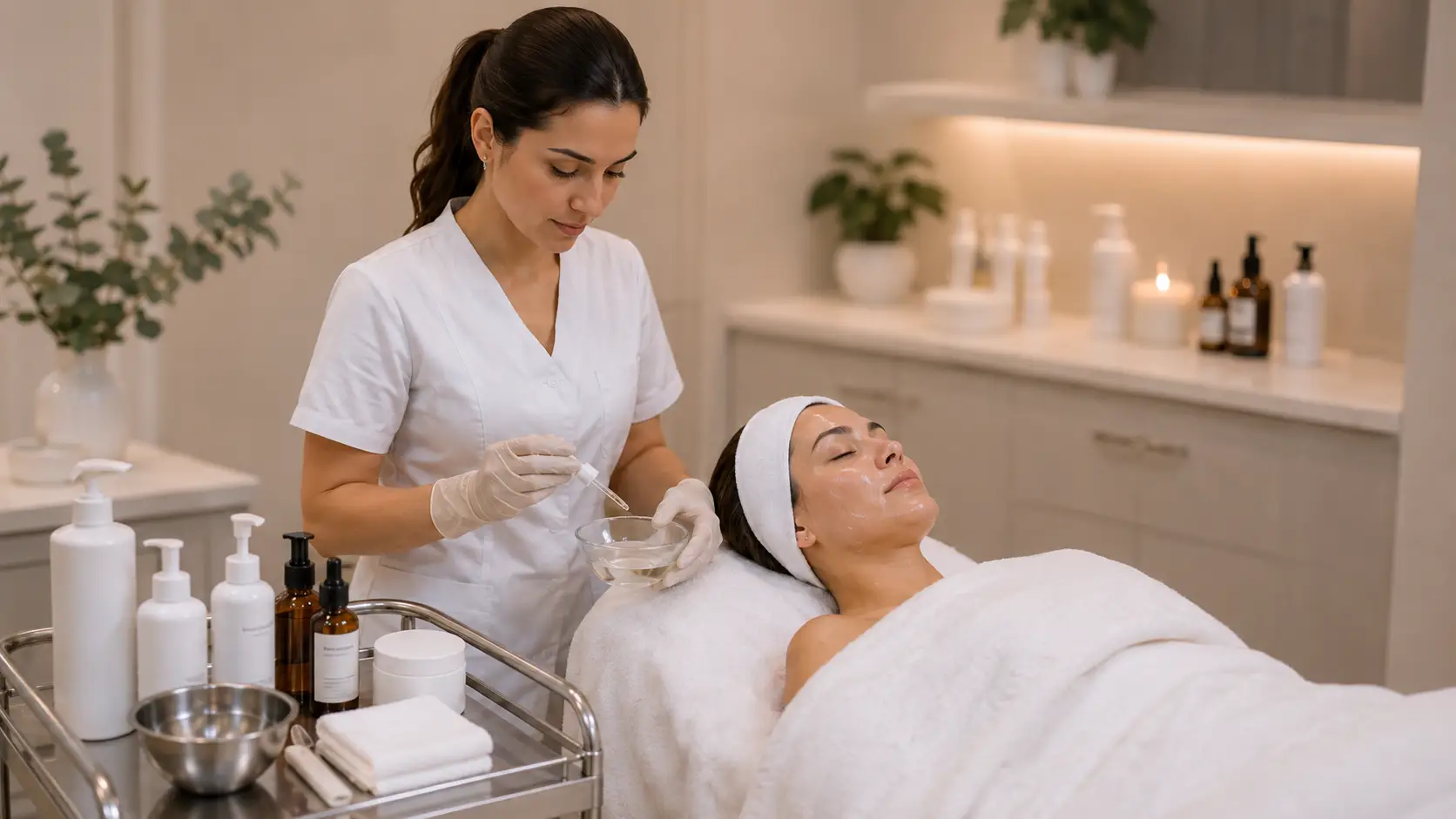
What Does a Beginner Recovery Facial Protocol Look Like for New Estheticians?
A beginner recovery facial protocol is a structured sequence of low-stimulation steps designed to calm the skin, support barrier function, and deliver deep hydration following active treatment phases such as extractions, exfoliation, or any service that temporarily compromises the skin barrier. It is one of the most important and most frequently underserved phases of a facial — and one of the most beginner-accessible because it relies on careful product selection and timing rather than advanced device technique.
- Recovery facials are appropriate after any treatment that creates temporary skin sensitivity, redness, or barrier disruption — including extractions, chemical exfoliation, dermaplaning, and high-frequency work.
- The core recovery sequence runs: calming toner or mist, barrier-supportive serum, occlusive recovery mask, and finishing moisturizer with SPF.
- Avoid all active exfoliants including AHAs, BHAs, retinoids, and high-concentration vitamin C during the recovery phase.
- The mask step should occupy at least 10 to 15 minutes of the recovery phase — an occlusive mask that physically seals the skin surface dramatically enhances the delivery of serums applied beneath it.
- Key barrier-supportive ingredients for recovery include niacinamide, ceramides, centella asiatica, hyaluronic acid, and polyglutamic acid.
- New estheticians who consistently protect and deliver the recovery phase produce noticeably better client skin outcomes and build stronger rebooking habits than those who compress it to recover time.
The recovery phase of a facial is where clinical outcomes are either secured or lost. Every cleanse, steam, exfoliation step, and extraction the esthetician performs in the first two-thirds of a service creates a state of temporary skin vulnerability — elevated TEWL, disrupted surface pH, reduced barrier integrity, and in many cases mild inflammation. What happens in the final phase of that facial determines whether the client leaves with skin that is visibly calmer, more hydrated, and better protected than when they arrived, or skin that is simply clean and raw.
New estheticians are frequently taught the technical mechanics of early facial steps — steaming, extractions, exfoliation — in considerable detail. The recovery phase receives comparatively less structured training, which leads to a common and costly pattern in early-career practice: rushing the end of a facial to recover time spent over-budget in earlier steps, compressing calming and hydration into a two-minute formality, and sending clients home with skin that is less protected than the service they paid for should have left it.
This guide gives new estheticians a clear, buildable protocol for the recovery phase of a facial: what steps belong in it, what ingredients to use and avoid, how to time it within a service, how to adapt it for different client presentations, and how to use this phase strategically to elevate the overall quality and value of every treatment you offer.
What Matters Most in a Beginner Recovery Facial Protocol
- The recovery phase is not an optional finishing touch — it is the clinical completion of the facial and determines the condition the client leaves in.
- Calming, sealing, and hydrating in sequence produces compounding results: each step enhances the effectiveness of the one that follows.
- Occlusive masks applied over barrier-supportive serums dramatically increase serum delivery during the treatment window — this is where the recovery phase earns its results.
- Avoid all active exfoliants, retinoids, and synthetic fragrance during the recovery phase without exception.
- Time the mask phase to a fixed minimum of 10 to 15 minutes — use that window productively for massage, education, or retail recommendations.
- Adapting the recovery protocol for sensitive skin clients requires no extractions, longer mask time, and an additional serum layer focused on ceramide and barrier repair.
- Clients who experience a well-executed recovery phase rebook more consistently and report higher treatment satisfaction than those who receive compressed or omitted recovery steps.
Why the Recovery Phase Is the Most Important Part of a Facial for New Estheticians to Master
There is a persistent tendency in early esthetic training and early career practice to treat the recovery phase as the “easy” part of a facial — the part that runs almost automatically while the esthetician winds down the service. This framing fundamentally misrepresents what the recovery phase actually does clinically and what it represents for the client.
By the time the recovery phase begins, the skin has typically been subjected to several forms of mechanical or chemical disruption. Cleansing removes the acid mantle and surface lipids. Exfoliation, whether physical or chemical, disrupts cohesion within the stratum corneum. Extractions create micro-trauma to follicular walls and surrounding tissue. Steam and warm towels raise skin surface temperature and accelerate TEWL. Even a gentle professional facial leaves the skin in a temporarily more permeable, more sensitive, and more reactive state than it began in.
The recovery phase exists to reverse that trajectory before the client leaves the treatment room. Its three primary clinical objectives are:
- Calming: Reducing surface inflammation, redness, and any reactive response created by earlier treatment steps.
- Barrier restoration: Delivering ingredients that directly support the skin’s ability to restore its own protective function — ceramides, niacinamide, centella asiatica, and appropriate humectants.
- Sealing: Creating a physical or occlusive layer over applied serums and humectants that traps moisture against the skin during the treatment window and protects the skin surface until the client’s own barrier fully recovers at home.
When estheticians execute all three objectives in proper sequence, clients visibly leave with calmer, more luminous, more comfortable skin than they arrived with. That visible immediate outcome is one of the most powerful drivers of rebooking and word-of-mouth referrals in early-career esthetic practice — and it is almost entirely determined by what happens in the recovery phase.
Why New Estheticians Consistently Underserve This Phase
The most common reason new estheticians compress or skip recovery steps is time mismanagement earlier in the service. When a new esthetician spends eight minutes over-budget on extractions or loses the pacing of a massage sequence, the recovery phase is the most tempting place to recover those minutes because it feels less technically critical than the earlier steps. This is a short-term thinking error with long-term consequences on client outcomes and retention.
Estheticians in clinical practice with several years of experience consistently report that the single most meaningful upgrade they made to their early-career protocols was protecting the recovery phase time budget from being borrowed by earlier steps. Building a non-negotiable 15-to-20-minute time block for recovery — and structuring the rest of the service around it rather than after it — is one of the most impactful habit shifts available to a new esthetician.
The Core Ingredients Every Beginner Recovery Facial Needs
Before building a step-by-step protocol, it helps to understand which ingredient categories do the clinical work in a recovery facial and why. New estheticians who understand the mechanism behind each ingredient make better product selection decisions and can explain those decisions to clients with authority.
Niacinamide: The Barrier Rebuilder
Niacinamide (vitamin B3) is one of the most versatile and evidence-supported ingredients in professional skincare. In a recovery context, its primary value is threefold: it stimulates ceramide synthesis in the skin, directly strengthening the lipid matrix of the stratum corneum; it reduces the appearance of post-treatment redness by acting on vascular response in the skin; and it regulates inflammatory mediators, reducing the risk of a sensitization cascade following active treatment steps. Niacinamide at 5% to 10% concentration in a serum applied post-extraction or post-exfoliation produces measurable improvements in barrier function within 24 hours of application.
Ceramides: The Structural Foundation
Ceramides are lipid molecules that form approximately 50% of the intercellular cement holding stratum corneum cells together. Professional-grade cleaners, exfoliants, and extraction techniques all strip ceramides from the skin surface to varying degrees. A recovery serum or mask containing phytoceramides, ceramide NP, ceramide AP, or ceramide EOP directly replenishes this lipid matrix, restoring the physical structure of the skin barrier faster than ceramide synthesis alone can achieve. For clients with chronically compromised barriers, ceramide-forward recovery products are particularly critical.
Centella Asiatica: The Anti-Inflammatory Botanical
Centella asiatica (cica) has become one of the most widely used post-treatment botanicals in professional skincare, and for clinically sound reasons. Its active compounds — asiaticoside, madecassoside, asiatic acid, and madecassic acid — have demonstrated anti-inflammatory, wound-healing, and collagen-stimulating activity in multiple peer-reviewed studies. In a recovery facial context, centella asiatica products applied post-extraction or post-exfoliation visibly calm surface redness, support wound healing around extraction sites, and reduce the likelihood of post-inflammatory hyperpigmentation in darker skin tones.
Hyaluronic Acid and Polyglutamic Acid: The Hydration System
Hyaluronic acid (HA) is the foundation humectant for any recovery hydration sequence. Its ability to attract and hold moisture at the epidermis and upper dermis makes it the primary delivery vehicle for post-treatment skin rehydration. However, HA is degraded by hyaluronidase — an enzyme naturally present in the skin — which limits the duration of its benefits unless paired with an ingredient that inhibits that enzymatic activity. Polyglutamic acid (PGA) does exactly that. PGA forms a surface microgel with moisture-binding capacity of up to 5,000 times its weight in water, inhibits hyaluronidase to protect both applied and naturally occurring HA, stimulates the skin’s own natural moisturizing factor production, and signals the skin to upregulate its own hyaluronic acid synthesis. For new estheticians, choosing a mask or serum product that includes both PGA and HA delivers meaningfully better recovery hydration outcomes than single-humectant alternatives.
A Step-by-Step Beginner Recovery Facial Protocol
The following protocol is designed to slot into the final 20 to 25 minutes of a standard 60-minute facial service. It assumes that cleansing, exfoliation, extractions, and massage have been completed in the preceding 35 to 40 minutes. Adapt timing based on your service length and the specific treatment steps preceding the recovery phase.
-
Gentle Tone and Calm
Apply a fragrance-free, alcohol-free calming toner or mist containing centella asiatica, panthenol, or allantoin using damp gauze or a cotton round. Use light pressing motions — no rubbing. This step removes any residual extraction product, restores surface pH toward the skin’s natural 4.5 to 5.5 range, and begins the inflammatory calming process before serums are applied. For reactive clients, refrigerate the toner for an additional cooling effect.
1–2 minutes -
Barrier Serum Application
Apply a targeted barrier-repair or calming serum to still-damp skin. Preferred ingredients for this step: niacinamide 5–10%, ceramide complex, centella asiatica extract, panthenol, or hyaluronic acid. Apply with clean fingertips using light press-and-hold motions rather than massage or rubbing strokes — post-extraction skin should not be massaged. Allow 30 to 60 seconds for initial absorption before proceeding to the mask step. Do not wait for full absorption; residual moisture on the skin surface enhances humectant delivery when the mask is applied over it.
2–3 minutes -
Occlusive Recovery Mask Application
Apply a professional occlusive recovery mask over the freshly applied serum layer. A jelly mask applied at this stage delivers three simultaneous recovery benefits: the physical occlusive layer traps the applied serum against the skin, dramatically increasing ingredient delivery during the treatment window; the cooling effect of the setting gel immediately reduces surface temperature and calms visible redness; and a PGA and HA dual-humectant formulation adds a layered hydration system over the serum layer rather than replacing it. Mix and apply the jelly mask according to the manufacturer’s mixing ratio and covering eyes and lips per your training and client preference. Apply from the neck up in smooth, spatula-width strokes working toward the hairline.
2–3 minutes application -
Mask Set Phase — Productive Service Window
Allow the mask to set for the manufacturer-specified time, typically 10 to 15 minutes for professional jelly formulations. Do not use this time as a break from the service. Use the mask set window to perform a scalp massage through the set mask layer, a hand and arm massage as a luxury add-on, décolleté work if included in the service, a calming acupressure sequence, or a structured retail recommendation and homecare education conversation. Clients receiving productive mask-phase service consistently rate their experience higher than those who are left unattended during the mask time. This window is a professional service opportunity, not a waiting period.
10–15 minutes -
Mask Removal
Remove a jelly mask by lifting gently at the chin edge and peeling as a single intact piece in one smooth upward motion. Proper removal in one piece is both a clinical indicator of mask quality and formulation integrity, and the signature sensory moment of a jelly mask treatment that clients consistently describe as memorable. If any residue remains, remove with a damp gauze or warm towel. Avoid rubbing. The skin post-removal should appear visibly more hydrated, calmer, and more luminous than it did before the mask was applied.
1 minute -
Finishing Moisturizer
Apply a lightweight, fragrance-free, barrier-compatible moisturizer to seal the hydration delivered by the serum and mask. For post-treatment skin, choose formulations containing ceramides, fatty acids, or cholesterol-bearing lipid complexes that support the skin’s own lipid bilayer recovery. Avoid heavy occlusive moisturizers containing petrolatum or mineral oil immediately post-extraction, as these may trap heat and contribute to congestion in freshly cleared follicles in acne-prone clients.
1–2 minutes -
SPF Application and Service Close
Apply a broad-spectrum SPF 30 or higher as the final step of every facial, without exception. Post-treatment skin with any degree of barrier disruption is more susceptible to UV-induced pigmentation events than intact skin. For clients with a history of hyperpigmentation or for any client who had extraction work performed, SPF is not optional — it is a professional safety standard. Ending every facial with SPF application also creates a repeatable, professional service close that reinforces homecare habits.
1 minute
How the Recovery Phase Layers Clinically: Why Each Step Amplifies the Next
Understanding why the recovery protocol steps are sequenced the way they are — rather than simply following the sequence by rote — gives new estheticians the clinical reasoning to adapt intelligently when circumstances change. The protocol is not arbitrary. Each step creates the skin condition that makes the next step more effective.
How to Adapt This Protocol for Different Client Presentations
The core six-step recovery protocol above is designed as a universal baseline. In practice, every client presents differently, and a competent esthetician adapts the protocol’s emphasis and product selection to the specific skin condition present at consultation. The following adaptations cover the most common variations a new esthetician will encounter.
Heavily Extracted Acne-Prone Skin
After a session with significant extractions, the priority of the recovery phase shifts toward anti-inflammatory support and wound healing. Prioritize centella asiatica and niacinamide at the serum step. Avoid heavy occlusives in the finishing moisturizer step and choose a lighter formulation to reduce the risk of re-occluding freshly cleared follicles. The jelly mask step remains appropriate and beneficial — the physical occlusion creates a sealed recovery environment that actively reduces inflammation — but the finishing moisturizer should be gel-weight rather than cream-weight. Do not apply active acne ingredients including benzoyl peroxide or salicylic acid during the recovery phase. These can be incorporated into the client’s homecare routine but should not be applied to freshly extracted, inflamed skin at the close of a professional service.
Dehydrated or Sensitized Skin Without Extractions
For clients whose primary concern is dehydration or chronic sensitivity, the recovery protocol becomes the entire facial structure rather than the final phase. Remove extractions and steam from the service entirely. Extend the serum step to include two serum layers — first a ceramide and niacinamide formulation, then a PGA and HA humectant serum applied over it before the mask. Extend mask time to the maximum recommended by the manufacturer. Add a second gentle pressing application of a humectant-rich essence or toning serum over the mask residue before applying the finishing moisturizer.
Mature Skin With Barrier Thinning
As skin ages, natural ceramide production declines and the skin’s intrinsic hyaluronic acid reserves diminish significantly. Mature skin clients benefit from recovery protocols that are heavily weighted toward ceramide and lipid replenishment at the serum step, combined with a PGA and HA mask formulation that not only delivers surface hydration but also supports the skin’s own HA synthase activity. The finishing moisturizer should include cholesterol-bearing lipid complexes that most closely mimic the natural lipid bilayer composition. Extend both the serum absorption window and the mask phase for mature skin clients.
Post-Exfoliation Skin After Chemical Peel or Enzyme Treatment
Following any chemical exfoliation, the skin’s permeability is elevated and its inflammatory threshold is lowered. This is both an opportunity and a risk. The opportunity is amplified serum delivery in the recovery phase. The risk is that any irritating or sensitizing ingredient will also penetrate more readily. Use fragrance-free formulations exclusively. Prioritize anti-inflammatory ingredients at the serum step. Do not add retinoids, further acids, or vitamin C at the recovery phase. A PGA and HA jelly mask applied over a ceramide serum post-peel delivers measurably better immediate hydration recovery outcomes than either product alone.
Recovery Facial Do’s and Don’ts for New Estheticians
Practitioners in supervised clinical training consistently identify the same set of errors in beginner recovery protocols. The following do and don’t framework consolidates those patterns into a quick reference.
- Protect the 20-to-25-minute recovery time block unconditionally
- Apply toner to damp skin before serum to maximize uptake
- Use a fragrance-free, alcohol-free toner appropriate for compromised skin
- Apply serum with press-and-hold technique after extractions
- Apply occlusive mask while serum is still slightly tacky on skin
- Use the mask set phase productively for massage or client education
- Remove a jelly mask in one single upward peel from chin to hairline
- Finish every facial with SPF 30 or higher
- Choose a lightweight moisturizer for post-extraction acne-prone skin
- Document products used in the recovery phase in client notes
- Borrow recovery phase time to compensate for over-budget earlier steps
- Apply retinoids, AHAs, BHAs, or vitamin C during the recovery phase
- Use products containing synthetic fragrance on post-treatment skin
- Massage the skin aggressively with serum after extraction work
- Skip the toning step and apply serum to dry, altered-pH skin
- Leave the client unattended during the mask set phase
- Apply a heavy petrolatum-based moisturizer immediately post-extraction
- Skip SPF because the client says they are “not going outside”
- Use the same recovery protocol for every client regardless of presentation
- Assume the recovery phase is complete after mask removal without finishing steps
What Experienced Estheticians Know About the Recovery Phase That New Estheticians Often Learn Too Late
The clinical sequencing of a recovery protocol is learnable from a guide like this one. What takes longer to develop — and what experienced practitioners report as the most significant shift in their treatment room approach — is the habit of treating the recovery phase as the most results-determinant part of the facial rather than the most interchangeable part.
In practice, clients do not experience a facial as a series of individually distinct steps. They experience it as a cumulative sensory and results event. What they remember most vividly, and what most directly influences their decision to rebook and refer, is the condition their skin is in when they sit up and look in the mirror at the end of the service. That condition is almost entirely determined by the quality of the recovery phase. An esthetician who performed a technically skilled extraction step but then compressed the recovery into four minutes will consistently produce a less impressive immediate result than an esthetician who gave modest extractions but a full, well-executed recovery phase.
This is a difficult lesson for new estheticians to internalize because early training so heavily emphasizes the technical complexity of early service steps. The reframing that accelerates clinical growth most rapidly is learning to treat the recovery phase not as the end of the facial but as its culmination.
Estheticians building their recovery protocols in early practice consistently report a meaningful improvement in immediate post-facial skin outcomes after switching from single-humectant masks or cream-based recovery masks to a professional jelly mask format containing both PGA and HA. The specific shift most frequently described is in the visible luminosity and hydration level of the skin at mask removal — a difference that becomes immediately apparent in the mirror when clients sit up.
Working with Poly-Luronic™ Jelly Masks by Luminous Skin Lab in a post-extraction recovery sequence, estheticians note that the 12-to-15-minute set window is consistently reliable for a full scalp massage plus a brief client education conversation without timing pressure. The cooling effect of the setting gel is frequently cited as the most noticeable immediate calming tool available in a beginner treatment room without devices — clients with post-extraction redness visibly respond within the first two to three minutes of mask application. The peel-in-one-piece removal at mask completion is specifically identified as a client experience moment that generates consistent verbal reactions and social sharing interest — which, for new estheticians building a clientele, is a meaningful practice-growth signal beyond the clinical outcome.
Compared to cream-based calming masks previously used in the same recovery position, estheticians working with the Poly-Luronic™ formulation report that the dual-humectant system — PGA sealing and protecting at the surface while HA delivers hydration to deeper layers — produces a measurably different texture response at removal: skin that feels genuinely plump and sealed rather than simply moisturized. For new estheticians building client confidence and rebooking rates, that visible, palpable immediate difference is one of the highest-value protocol investments available within the recovery phase.
How to Build the Recovery Phase Into Your Service Timing From the Start
The single most actionable advice a new esthetician can receive about recovery protocols is structural: build the recovery phase time block first, then build the rest of the service around it rather than after it. When new estheticians plan a 60-minute facial by allocating time forward from consultation to extractions, they consistently arrive at the recovery phase with less time than it requires. When they plan backward from the service close, protecting a non-negotiable 20-to-25-minute recovery block, they make better time allocation decisions about every step that precedes it.
A Suggested Time Allocation for a 60-Minute Facial
- Consultation and skin analysis: 5 minutes
- Double cleanse: 5 minutes
- Exfoliation (enzyme, light chemical, or physical): 7 minutes
- Extractions (if indicated): 8 minutes maximum for beginners
- High-frequency or calming device (optional): 3 minutes
- Facial massage: 7 minutes
- Recovery phase (toner, serum, mask, finish, SPF): 20 minutes
- Service close, homecare recommendations, rebook: 5 minutes
This allocation leaves no buffer for running over in any earlier step without borrowing from a later one. That is by design. The discomfort of enforcing time discipline in early steps — particularly extractions, where beginners tend to lose the most time — is precisely what protects the recovery phase from being compressed. New estheticians who practice this allocation for three to four months consistently report that both their extraction efficiency and their overall service timing improve faster than peers who allow the recovery phase to absorb the cost of early-step overruns.
The 10-to-15-Minute Mask Window Is Your Most Productive Service Time
New estheticians frequently experience the mask set phase as passive waiting time — a gap in the service to be endured rather than used. Experienced practitioners consistently describe the same window as the highest-value service time in the entire facial.
With an occlusive mask actively driving ingredient delivery into the skin and the client in a fully relaxed state, the esthetician has a window to deliver an undistracted scalp massage through the mask layer, a hand and arm massage that extends perceived luxury without adding product cost, a targeted décolleté or shoulder work if the service scope includes it, and a structured homecare education and retail recommendation conversation — when the client is relaxed, receptive, and not being touched on the face.
The mask set phase is not waiting time. It is billable service time that costs nothing additional to deliver. New estheticians who internalize this shift in framing immediately improve both their treatment value and their retail recommendation conversion.
Professional and Scientific References
The ingredient science and clinical protocols referenced in this article draw from established dermatological and cosmetic chemistry literature:
- Niacinamide barrier function and ceramide synthesis stimulation. Journal of Cosmetic Dermatology; International Journal of Dermatology. Multiple peer-reviewed studies demonstrating measurable barrier function improvement with 5–10% niacinamide topical application.
- Centella asiatica wound healing and anti-inflammatory mechanisms. Phytomedicine; Evidence-Based Complementary and Alternative Medicine. Demonstrated asiaticoside and madecassoside anti-inflammatory activity in clinical and in vitro settings.
- Gamma-PGA barrier strengthening, HAS-1/2/3 upregulation, and moisture retention. MDPI, 2024. Demonstrated hyaluronic acid synthase upregulation and aquaporin-3 enhancement with topical gamma-PGA application in reconstructed skin models.
- PGA moisture-binding capacity and hyaluronidase inhibition. Cosmetic chemistry literature; Typology, 2021–2025. PGA forms surface microgel holding up to 5,000 times its weight in water; inhibits enzymatic HA degradation.
- Transepidermal water loss and barrier compromise following professional facial treatments. Established esthetic and dermatology clinical practice literature.
- Ceramide replenishment and skin barrier structural recovery. British Journal of Dermatology; Journal of Investigative Dermatology. Established lipid bilayer mechanisms and topical ceramide efficacy literature.
For new estheticians building their first recovery facial protocol, the mask step is where product selection has the most immediate and visible impact on client outcomes. The Poly-Luronic™ Jelly Mask by Luminous Skin Lab is the formulation our education team most frequently recommends for the recovery mask position because it was developed specifically for exactly this clinical context: occlusive recovery on temporarily compromised post-treatment skin, with a PGA and HA dual-humectant system that delivers both surface sealing and deep hydration simultaneously. It is fragrance-free, clean-label, and formulated for protocol compatibility with barrier-supportive serums, making it one of the most beginner-accessible and clinically effective tools available for the recovery phase of a professional facial.
Explore the Poly-Luronic™ Jelly Mask Line →Frequently Asked Questions: Beginner Recovery Facial Protocols
What is a recovery facial and when should I offer one as a new esthetician?
A recovery facial is a treatment focused on calming, barrier support, and hydration rather than active exfoliation or correction. New estheticians should offer recovery facials whenever a client presents with redness, sensitivity, or a compromised barrier, and as the completion phase of any extraction-heavy or exfoliation service. It is one of the most beginner-friendly facial types because it relies on gentle, low-risk techniques and well-chosen products rather than advanced device skills.
What steps should a beginner recovery facial protocol include?
A beginner recovery facial protocol typically includes a gentle double cleanse, a calming toner or essence to restore surface pH, a targeted serum application focusing on barrier-supportive ingredients such as niacinamide, ceramides, or hyaluronic acid, an occlusive recovery mask to seal hydration and reduce inflammation, and a finishing moisturizer with SPF. Each step should be low-stimulation and formulated for compromised or sensitive skin.
How do I calm redness after extractions in a facial?
After extractions, apply a calming toner or mist to reduce surface inflammation, then layer a barrier-supportive serum containing niacinamide or centella asiatica. Follow immediately with an occlusive recovery mask such as a professional jelly mask, which physically seals the skin surface, delivers cooling relief, and locks in humectants during a defined treatment window. Avoid active ingredients including retinoids, AHAs, BHAs, and vitamin C during the post-extraction phase.
Why is the recovery phase the part of a facial that new estheticians most often rush?
New estheticians often spend more time than expected on cleansing, extractions, or massage and then compress the recovery phase to stay within their service time. This is a significant mistake because the recovery phase determines the skin condition the client leaves with. Rushing calming, barrier support, and hydration steps undermines the clinical outcome of everything that came before. Building a fixed, non-negotiable time block for the recovery phase from the start of practice is one of the most important workflow habits for new estheticians to establish.
What products does a new esthetician actually need for a recovery facial?
A functional beginner recovery facial requires four to five product types: a gentle cleanser appropriate for sensitive or compromised skin, a calming toner or essence, a barrier-supportive serum containing at least one of ceramides, niacinamide, hyaluronic acid, or centella asiatica, an occlusive recovery mask, and a lightweight finishing moisturizer. A professional jelly mask is one of the most efficient and impactful product choices for the mask step because it delivers occlusion, cooling, and humectant delivery simultaneously.
How long should the recovery phase of a facial take?
The recovery phase including serum application, mask set time, and finishing steps should occupy a minimum of 15 to 20 minutes in a well-structured facial. If the mask used has a set time of 10 to 15 minutes, that window can be used productively for client education, a hand or scalp massage, or retail recommendations. Compressing the recovery phase below 12 minutes consistently produces inferior skin outcomes and diminishes the perceived value of the treatment.
Can I use a recovery facial protocol for clients with sensitive skin who are not getting extractions?
Yes. A recovery facial protocol is appropriate for any client whose primary skin concern involves sensitivity, barrier compromise, reactive skin, or dehydration regardless of whether extractions were performed. For sensitive skin clients, the recovery protocol becomes the entire facial structure rather than just the final phase. Remove extractions entirely and add a longer mask phase, a second serum layer, and a more thorough calming massage sequence.
What ingredients should new estheticians avoid using in recovery facials?
During any recovery facial, avoid alpha hydroxy acids, beta hydroxy acids, retinoids, vitamin C in high concentrations, benzoyl peroxide, physical exfoliants, synthetic fragrance, alcohol-based toners, and any ingredient the client has flagged as a sensitivity. The recovery phase is exclusively for calming, sealing, and hydrating. Introducing active corrective ingredients during this phase risks sensitization reactions and extends client recovery time unnecessarily.
How does a professional jelly mask fit into a beginner recovery facial protocol?
A professional jelly mask is one of the most effective tools available to new estheticians for the recovery phase. The occlusive set mask physically seals the skin surface, trapping applied serums and humectants against the skin during the treatment window to enhance delivery. The cooling effect of the setting gel provides immediate comfort and helps reduce post-extraction or post-exfoliation redness. Formulations containing both polyglutamic acid and hyaluronic acid deliver a dual-depth hydration system that supports visible, immediate barrier recovery. The Poly-Luronic™ Jelly Mask by Luminous Skin Lab is specifically formulated for this application, providing a fragrance-free, clean-label occlusive mask with a PGA and HA dual-humectant system that new estheticians can confidently incorporate into recovery workflows from their first professional services.
Building a Recovery Protocol That Produces Visible Results From Your First Facial
The beginner recovery facial protocol outlined in this guide is not a simplified version of what experienced estheticians do — it is exactly what experienced estheticians do, structured in a way that is immediately executable for a new practitioner. The steps are straightforward. The product requirements are minimal. The clinical principles behind them are sound and well-supported.
What separates estheticians who build strong practices quickly from those who plateau early is rarely technical skill in the early service steps. It is almost always the quality of the recovery phase. Clients who leave a facial with visibly calmer, more hydrated, more luminous skin than they arrived with become rebooking clients. Clients who leave with raw or reactive skin because the recovery phase was rushed become clients who do not return.
Protecting the recovery phase time block, choosing ingredient-appropriate products for each step, and executing the calming-sealing-hydrating sequence consistently will produce better client outcomes from your very first professional facial than most new estheticians achieve in their first several months of practice. That is a learnable standard — and this protocol gives you the framework to meet it immediately.