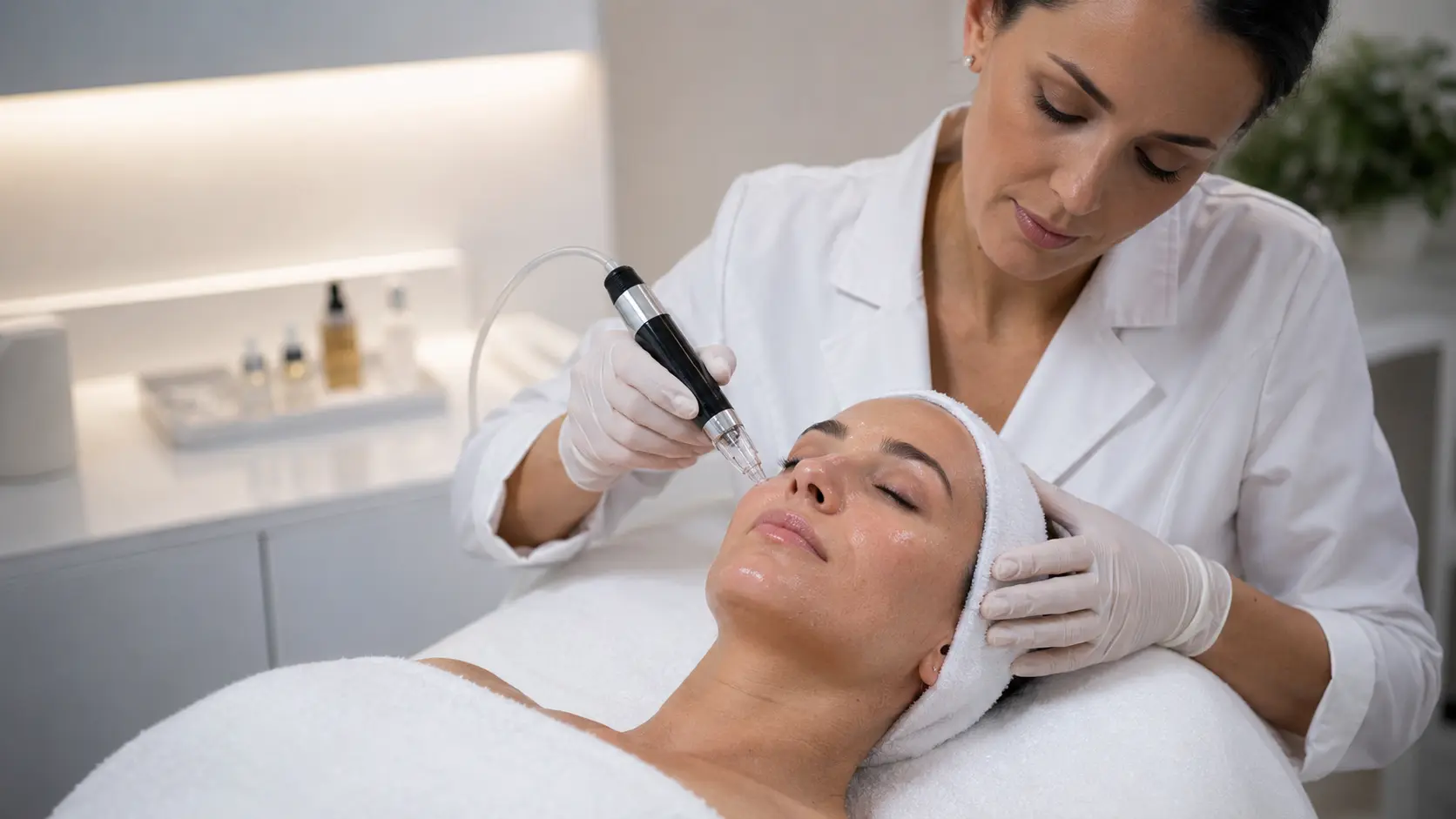
Does Nano Infusion Work for Fine Lines?
Yes. Nano infusion is an effective professional treatment for fine lines, particularly superficial expression lines and dehydration lines. The treatment creates temporary microchannels through the stratum corneum using nano-scale tips, allowing active serums containing peptides, hyaluronic acid, and growth factors to penetrate significantly deeper than standard topical application. The result is enhanced ingredient delivery to the viable epidermis and upper dermis, where those actives can influence collagen synthesis, cellular hydration, and skin-plumping mechanisms that reduce the visible appearance of fine lines.
- Nano infusion works primarily by enhancing serum delivery rather than triggering a wound-healing response — making it gentler than microneedling with no required downtime.
- Dehydration lines and superficial expression lines respond most visibly to nano infusion; deeper structural wrinkles require more sessions and may respond more slowly.
- Peptide serums, hyaluronic acid, and growth factors are the three most clinically relevant ingredient categories for fine line targeting during nano infusion.
- All serums used during nano infusion must be water-based — oil-based formulations cannot travel through the aqueous microchannels created by the nano tips.
- A series of four to six treatments spaced one to two weeks apart produces more consistent cumulative results than a single session.
- The periorbital area — one of the earliest and most visible sites of fine line development — is a primary and safely treatable zone with appropriate device settings and technique.
- Nano infusion does not replace microneedling for deep structural wrinkles, but it fills a distinct clinical space for clients seeking effective anti-aging treatment without downtime or scope-of-practice concerns.
Fine lines are among the most common concerns estheticians hear in the consultation chair. They appear early — often in the mid-twenties — and progress in response to cumulative UV exposure, repeated facial muscle movement, declining skin hydration, and the gradual loss of collagen and elastin production that accompanies aging. Clients want visible improvement. Estheticians want treatments that deliver consistent results within their scope of practice and without the recovery demands that more invasive procedures require.
Nano infusion has established itself as one of the most compelling options for addressing both sides of that equation. It sits in a clinically meaningful space between a standard hydration facial and microneedling — more therapeutically effective than topical serums alone, but gentler than needle-based procedures and broadly within the scope of licensed estheticians across most jurisdictions. Understanding what nano infusion can and cannot achieve for fine lines, why it works when it works, and how to build a protocol that maximizes those outcomes is the practical knowledge this article provides.
This guide is written for estheticians who want to move beyond surface-level understanding of nano infusion and build treatment room protocols grounded in the mechanism science, ingredient logic, and realistic outcome frameworks that lead to genuinely satisfied clients and a sustainable service offering.
What Estheticians Need to Know About Nano Infusion and Fine Lines
- Nano infusion improves fine lines primarily through enhanced transdermal delivery of active serums — not by triggering a collagen wound response.
- Dehydration lines respond fastest and most visibly; structural age-related lines require a series of treatments and realistic outcome framing.
- Peptides are the most clinically significant ingredient category for long-term fine line improvement during nano infusion — they directly signal fibroblasts to produce collagen and elastin.
- Serum selection is the most important clinical variable within an esthetician’s control during a nano infusion session for fine lines.
- Water-based formulations are required — oil-based serums are incompatible with the microchannel delivery mechanism.
- The periorbital and perioral zones are high-priority treatment areas for fine line clients and are safely addressable with correct technique and device settings.
- Client education about the difference between immediate session results and cumulative series results is essential for managing expectations and rebooking.
Why Fine Lines Develop and What Treatment Can Realistically Address
Understanding the physiology of fine line development helps estheticians communicate more credibly with clients and design more targeted protocols. Not all fine lines have the same cause — and that matters for how they respond to treatment.
Dehydration Lines
Dehydration lines develop when the stratum corneum lacks adequate water content. They are typically fine, shallow, and criss-crossing in pattern, appearing most visibly around the eyes, on the cheeks, and at the forehead. Unlike structural wrinkles, dehydration lines can appear at any age and are among the fastest-responding fine line types to treatment. They are also among the most commonly misidentified — many clients and estheticians assume they represent permanent aging changes when they are actually a correctable hydration deficit. Nano infusion can produce dramatic, immediate visible improvement in dehydration lines by flooding the stratum corneum with hyaluronic acid and other humectants at a depth that topical application cannot consistently achieve.
Expression Lines
Expression lines — including crow’s feet at the outer eye, forehead lines, frown lines between the brows, and perioral lines — develop from repeated facial muscle movement over years. Early expression lines are superficial and exist primarily in the epidermis. More established expression lines involve dermal collagen changes and require a collagen-stimulating approach. Nano infusion with peptide-rich serums can visibly soften early expression lines, particularly in younger clients with adequate underlying skin structure. Deeper, established expression lines will show modest improvement but are not primarily addressable at the epidermis-only level that nano infusion targets.
Structural Fine Lines from Collagen Loss
The dermis begins losing approximately 1% of its collagen per year after the mid-twenties. This progressive structural change produces fine lines that persist regardless of hydration state. Nano infusion’s contribution to addressing collagen-loss fine lines is primarily through the stimulatory effect of deeply delivered peptides and growth factors on fibroblast activity. Results require consistency over a series of treatments rather than a single session. Setting this expectation clearly in the consultation prevents client disappointment and supports rebooking as a clinical recommendation rather than a sales behaviour.
How Each Fine Line Type Responds to Nano Infusion Treatment
Dehydration lines: Highest responsiveness. Immediate visible improvement after a single session from hyaluronic acid delivery. Results fade partially within days as the delivered serum is metabolized, but repeated sessions sustain improvement and clients notice dramatic before-and-after differences within the session itself.
Early expression lines: Moderate responsiveness. Visible softening from hydration plumping plus peptide-assisted fibroblast stimulation. Best results from a series of four to six sessions with peptide-forward serums.
Structural collagen-loss lines: Slower responsiveness. Peptides and growth factors delivered via nano infusion support collagen synthesis over weeks and months. Cumulative series results are meaningful but require realistic client expectation management. Deeper lines may also benefit from combination with other modalities.
How Nano Infusion Creates Enhanced Serum Delivery for Fine Line Ingredients
The stratum corneum is one of the most effective barriers in the human body. Evolutionarily designed to keep the outside world out and water in, it limits topical ingredient penetration to a degree that significantly constrains what any topically applied product can achieve, regardless of how sophisticated its formulation. This is the fundamental limitation that nano infusion is designed to address.
The Microchannel Mechanism
A nano infusion device uses a tip containing hundreds of nano-scale silicon or metal points. These tips are applied to the skin surface with controlled movement patterns — either stamping or circular gliding, depending on the device and treatment zone — creating temporary physical disruptions in the stratum corneum. These disruptions are not penetrations into the dermis; they do not reach the blood supply and do not create a wound-healing response in the same sense as microneedling. What they create is a temporary increase in skin permeability at the outermost barrier layer.
Serums applied simultaneously with or immediately after nano infusion tip contact can travel through these temporary microchannels into the viable epidermis — and in some cases, with certain molecular weight formulations, into the upper dermis. The degree of penetration depends on the molecular weight and size of the active ingredient, the aqueous versus lipid nature of the vehicle, and the consistency and density of microchannel creation across the treatment zone.
Why Oil-Based Serums Do Not Work in This Mechanism
The microchannels created by nano infusion are aqueous pathways — they conduct water-based formulations. Oil-based or silicone-based serums cannot travel through these channels. Estheticians using oil-based serums during nano infusion are effectively delivering a standard topical application at best, and at worst creating a barrier that limits water-based serum absorption in subsequent steps. All serums applied during the active nano infusion phase must be water-based and have appropriate molecular characteristics to benefit from enhanced delivery.
Nano Infusion vs. Microneedling for Fine Lines
Microneedling needles penetrate into the dermis at depths of 0.5 mm to 2.5 mm or more, creating intentional dermal injury that triggers a wound-healing cascade involving platelet activation, growth factor release, and fibroblast stimulation leading to new collagen production. This collagen remodeling is the primary mechanism by which microneedling addresses structural wrinkles. It is also why microneedling requires recovery time and, in many jurisdictions, medical oversight or an advanced esthetician certification.
Nano infusion does not penetrate the dermis. Its primary mechanism is enhanced transdermal serum delivery, not wound-induced collagen synthesis. This distinction is both a limitation and an advantage. Nano infusion does not produce the level of structural collagen remodeling that microneedling can achieve over time, but it also requires no recovery period, has a much lower risk profile, and is broadly within esthetician scope of practice. For clients who are not candidates for or not interested in microneedling, or who want consistent maintenance between microneedling sessions, nano infusion fills a clinically distinct and genuinely valuable space.
Which Serums Actually Work for Fine Lines During Nano Infusion?
Serum selection is the variable within an esthetician’s direct control that most significantly determines the clinical outcome of a nano infusion treatment for fine lines. Understanding the mechanism of each ingredient category — not just the marketing claims attached to it — allows estheticians to make formulation choices that are grounded in what the science actually supports.
Peptides: The Primary Fine Line Targeting Ingredient
Peptides are short chains of amino acids that function as cellular signaling molecules in the skin. When delivered at sufficient depth, specific peptide classes directly communicate with fibroblasts — the dermal cells responsible for producing collagen, elastin, and hyaluronic acid — signaling them to increase production. Signal peptides such as palmitoyl tripeptide-1, palmitoyl tetrapeptide-7, and palmitoyl pentapeptide-4 (the Matrixyl family) have peer-reviewed evidence supporting their fibroblast-stimulating activity and resulting improvements in fine line appearance over a treatment series.
The key limitation of topically applied peptides is that their molecular size and hydrophilic nature makes meaningful dermal penetration through an intact stratum corneum difficult. Nano infusion addresses this limitation directly — enhanced transdermal delivery via microchannels allows peptide concentrations to reach viable epidermal and upper dermal cells where their signaling activity is actually relevant. This is why peptide serums are the most clinically purposeful ingredient category for fine line nano infusion protocols specifically.
Hyaluronic Acid: Immediate Hydration Plumping
Hyaluronic acid delivered via nano infusion produces the most immediately visible treatment result for fine lines — the hydration surge that plumps and smooths the skin surface, dramatically softening shallow lines within the session. Lower molecular weight hyaluronic acid (below 50 kDa) penetrates most effectively through microchannels into the epidermis. Higher molecular weight HA provides surface occlusion and moisture retention. A serum containing multiple molecular weights of HA — or one formulated to synergize with skin-surface polyglutamic acid — provides layered hydration at multiple depths.
It is important to set client expectations correctly around hyaluronic acid results: the hydration plumping effect is real and impressive within the session, but it is not a structural correction. The plumping fades over two to five days as the delivered HA is metabolized. Repeated sessions sustain and compound this hydration improvement, and the combination with peptides in the same protocol provides both the immediate visible result and the cumulative structural improvement.
Growth Factors: Cellular Regeneration Support
Growth factor serums deliver signaling proteins that support cellular repair, collagen synthesis, and epidermal regeneration. Applied during nano infusion, growth factors can reach viable epidermal cells where they activate receptor-mediated signaling cascades supporting tissue repair. The clinical evidence for topical growth factors in anti-aging is growing, though more research exists for growth factor application in wound-healing and post-procedure contexts than for standalone cosmetic use. For fine line protocols, growth factors are most commonly used as part of a layered serum approach alongside peptides rather than as the sole active ingredient.
Vitamin C: Collagen Synthesis Support and Brightening
Stable, water-soluble vitamin C formulations — most reliably ascorbic acid derivatives such as sodium ascorbyl phosphate or ascorbyl glucoside — can be delivered via nano infusion where they contribute to collagen synthesis support by serving as a cofactor for prolyl and lysyl hydroxylase enzymes required in collagen fiber formation. Vitamin C also provides antioxidant protection against UV-induced collagen degradation, making it a clinically logical addition to fine line protocols for clients with photoaging. Unstable pure ascorbic acid formulations are not recommended during nano infusion due to oxidation risk and potential for irritation on transiently permeable skin.
Primary Fine Line Treatment Zones and How to Approach Each One
Fine lines do not distribute evenly across the face. Understanding which zones are highest priority for clients seeking fine line improvement, and what specific technique considerations apply to each, allows estheticians to structure more precise and effective protocols.
Periorbital Zone: Crow’s Feet and Under-Eye Fine Lines
The periorbital area is the earliest and most common site of fine line development. Skin around the eye is significantly thinner than other facial zones — approximately 0.5 mm compared to 2 mm elsewhere on the face — and undergoes more daily mechanical movement from blinking, squinting, and expression than virtually any other facial region. As a result, collagen loss and dehydration lines in this area are typically the first visible signs of aging that clients notice.
Nano infusion in the periorbital zone requires careful attention to device tip pressure and movement pattern. Most estheticians use a light stamping motion rather than dragging to avoid unnecessary mechanical stress on this thin tissue. The device tip should remain on the orbital bone and cheekbone tissue and never contact the eyelid itself. Water-based peptide and hyaluronic acid serums formulated specifically for delicate skin are preferred — avoid any formulation with potential for eye irritation. With appropriate technique, this is one of the most responsive treatment zones for visible fine line improvement.
Perioral Zone: Lip Lines and Vertical Smoker’s Lines
Perioral fine lines — the vertical lines radiating from the lips that develop from both muscle movement and sun exposure — are a frequent client concern and a zone where nano infusion can produce meaningful visible improvement, particularly for early to moderate lines. The perioral skin is thicker than the periorbital zone, allowing slightly more device pressure, but the proximity to mucous membrane tissue requires careful serum selection to avoid any product entering the mouth. Fragrance-free, minimal-additive serums are appropriate; strongly scented or flavored formulations should be avoided.
Forehead and Glabellar Lines
Forehead lines and glabellar lines (the frown lines between the brows) are expression-driven and often well-established by the time clients seek treatment. Nano infusion in these zones contributes to the hydration component of their appearance — well-hydrated skin reflects expression lines less dramatically than dehydrated skin — and cumulative peptide delivery supports the underlying collagen structure. Clients with deep established forehead lines should understand that nano infusion will soften their appearance rather than eliminate them, and that injectable treatments address the muscular component that nano infusion cannot.
Cheek and Lower Face Fine Lines
Fine lines on the cheeks, at the nasolabial fold edges, and across the lower face often have both dehydration and photoaging components. These zones are among the most forgiving technically and typically show good response to hydration-focused protocols using hyaluronic acid combined with peptide serums. They also serve as useful zones for demonstrating immediate treatment results to clients before and after the session, where the softening effect of nano infusion is often dramatically visible even in a single treatment.
How to Structure a Nano Infusion Protocol for Fine Lines Step by Step
A well-structured nano infusion protocol for fine lines follows a logical sequence that maximizes serum delivery, minimizes risk, and creates the best possible treatment experience for the client. The steps below represent a standard professional protocol; individual devices may require adjustment based on manufacturer guidelines.
Cleanse and Prepare the Skin
Double cleanse with a gentle, non-stripping cleanser. Remove all traces of makeup, sunscreen, and topical products. The skin surface must be clean and free of occlusive products that would block microchannel formation. Avoid exfoliating cleansers or enzyme cleansers immediately before nano infusion — the skin does not need to be additionally sensitized at this stage.
Optional: Gentle Pre-Treatment Preparation
A light enzyme exfoliation or very low-concentration chemical exfoliant at least 24 hours before the session (not immediately before) can enhance stratum corneum permeability slightly and improve serum delivery. This step is optional and particularly relevant for clients with thicker or more textured skin. Do not perform active exfoliation and nano infusion in the same session.
Apply Primary Treatment Serum
Apply the primary active serum — typically a peptide complex or combined peptide and hyaluronic acid formulation — to the treatment area. The serum should be applied in a thin, even layer. The nano infusion device will drive this serum into the skin during the treatment pass. Apply only a water-based formulation at this stage.
Perform Nano Infusion in Treatment Zones
Work systematically across the face in sections, beginning with less sensitive areas before progressing to the periorbital and perioral zones. Use the stamping motion or the circular gliding pattern indicated for your specific device. Maintain consistent, light-to-moderate pressure. Reapply serum to each zone as needed to maintain adequate product on the skin surface during device contact. Avoid dragging the tip without serum present.
Layer Post-Treatment Actives
Immediately following the treatment pass, the skin remains in a heightened permeability state for 45 to 72 hours. Apply a second serum layer — a growth factor serum, additional hyaluronic acid, or a peptide-forward recovery serum — to benefit from this extended delivery window. This layering step can significantly enhance the cumulative outcome of each session.
Apply Occlusive Recovery Layer
A professional jelly mask or recovery mask applied following nano infusion serum delivery serves multiple functions: it seals the applied serums against transepidermal water loss during the treatment window, provides cooling and calming sensation that clients respond to positively, and creates a second enhanced absorption window for the humectant and peptide compounds already delivered into the skin. Leave on for 10 to 15 minutes and remove according to product instructions.
Finish with Broad-Spectrum SPF
Nano infusion temporarily increases skin sensitivity to UV radiation by disrupting the stratum corneum barrier. Broad-spectrum SPF 30 or higher is a required final step for daytime treatments. Educate clients that their sun protection regimen at home is especially important in the 48 to 72 hours following a nano infusion session. UV exposure during this window can accelerate collagen degradation that the peptide and growth factor serums delivered in the session are working to prevent.
Estheticians using the ILUMIPEN by Luminous Skin Lab for fine line protocols report that the device’s precision tip design allows accurate work across all facial zones including the periorbital area, where consistent tip contact without excess pressure is essential for both safety and outcome. Practitioners note that the ILUMIPEN’s controlled nano-tip density produces even microchannel coverage across the crow’s feet zone in particular — an area where inconsistent tip contact from less uniform devices produces patchy serum delivery that clients can see in the unevenness of immediate post-treatment results.
Estheticians working with clients who have early to moderate periorbital fine lines report combining the ILUMIPEN treatment pass with a peptide-HA serum layer and a recovery jelly mask application in the same session, consistently observing immediate visible softening that clients notice without prompting during the consultation after treatment. The combination of the microchannel delivery window and the occlusive recovery mask layer appears to amplify the hydration component of the result, with clients frequently describing their skin as “smoother than it has ever felt” immediately post-treatment. Practitioners contrast this with their prior experience using standard microcurrent or plain hydration facials in the same client population, noting that the nano infusion protocol produces a more dramatic immediately visible outcome that supports both client satisfaction and series rebooking.
What Results Can Clients Realistically Expect and How to Communicate Them
Managing client expectations for nano infusion fine line results is one of the most important communication skills an esthetician can develop. Overpromising leads to disappointed clients and lost rebookings. Underpromising leaves results-oriented clients searching for more aggressive options that may not be appropriate. The framework below gives estheticians a language for setting accurate, confident expectations.
What Clients Will Notice Immediately After a Session
Within the session and for the first 24 to 48 hours following, clients will typically notice visibly plumper and smoother skin texture in the treated zones, a reduction in the appearance of dehydration fine lines in particular, improved skin radiance and a healthy luminosity from the hydration surge, and occasional mild redness in sensitive areas that resolves within a few hours. This immediate visible improvement is real and significant — and it is the most powerful rebooking tool because it creates a concrete before-and-after reference that clients experienced personally.
What Fades and What Builds Over Time
The hydration plumping effect from hyaluronic acid delivery fades over two to five days as the delivered molecules are metabolized. Clients who do not understand this can incorrectly perceive that the treatment “wore off” rather than understanding that they are seeing the baseline of cumulative improvement. The structural collagen and elastin synthesis stimulated by delivered peptides and growth factors builds slowly over four to eight weeks following a series of treatments. This is why outcome communication must frame the series as the therapeutic unit — not the individual session.
How to Frame Realistic Expectations in the Consultation
Estheticians working in fine line protocols consistently find that framing language around how the skin feels during and immediately after the session is more effective than discussing structural outcomes in the first consultation. Phrases like “you’ll see your skin look more hydrated and smoother immediately after the session” create an accurate and achievable immediate expectation. Structural fine line improvement language is most effectively introduced at the second or third session when the client already has a positive experience reference point and is more receptive to committing to a series.
Immediate Hydration Plumping
Visible softening of dehydration fine lines and surface texture improvement within the session. Client notices a glow and smoothness. Hydration plumping fades over 2–5 days.
Compounding Hydration + Early Peptide Activity
Baseline skin hydration improves between sessions. Clients notice their skin holds moisture better. Early peptide-stimulated fibroblast activity begins contributing to collagen synthesis.
Cumulative Structural Improvement
Measurable softening of early expression lines and periorbital fine lines. Skin texture visibly refined. Clients with dehydration as the primary driver see the most dramatic cumulative change.
Sustained Results with Home-Care
Monthly or every-six-week maintenance sessions sustain structural gains. Home-care regimen with quality actives and daily SPF significantly extends time between professional sessions.
When Nano Infusion Is Not Appropriate for Fine Line Clients
Nano infusion is a low-risk procedure for most clients, but there are specific contraindications that estheticians must screen for in the consultation process. Identifying these scenarios protects clients and protects the esthetician’s professional standing.
Active Skin Conditions in the Treatment Area
Active acne lesions, open wounds, active cold sores (herpes simplex), or any active inflammatory skin condition in the treatment zone are absolute contraindications. Nano infusion over broken skin risks introducing pathogens into the skin through the microchannels created by the device. Clients with a history of herpes simplex should be assessed carefully; some practitioners recommend prophylactic antiviral consultation with a physician before treating the perioral zone.
Recent Active Exfoliation or Laser Treatments
Clients who have had chemical peels, laser resurfacing, dermabrasion, or other treatments that have significantly compromised their skin barrier should wait until the skin has fully healed before nano infusion. The combination of post-treatment skin permeability and the additional barrier disruption from nano infusion can create excessive sensitization and inflammatory response. A minimum recovery window of two to four weeks is a reasonable professional standard depending on the treatment intensity.
Isotretinoin Use (Current or Recent)
Clients currently taking isotretinoin or who have completed isotretinoin treatment within the past six to twelve months should not receive nano infusion. Isotretinoin dramatically alters skin barrier function, sebaceous gland activity, and healing capacity in ways that make the skin significantly more vulnerable to adverse reactions from device-based treatments. The same conservative approach applies to any client reporting concurrent use of prescription retinoids at high concentrations.
Pregnancy
While nano infusion does not use needles and does not penetrate the dermis, the enhanced transdermal delivery mechanism means that any serum applied during the treatment reaches deeper skin layers than standard topical application. Estheticians should exercise caution around ingredient safety during pregnancy — many actives commonly used in fine line protocols have not been evaluated for safety in pregnancy. A conservative approach of avoiding nano infusion during pregnancy is appropriate unless the client has received physician clearance and only fragrance-free, clean-label, pregnancy-safe serums are used.
Professional and Scientific References
The ingredient science and mechanism references in this article draw from established dermatological, cosmetic chemistry, and clinical esthetics literature:
- Collagen synthesis and fibroblast signaling by topical peptides — palmitoyl pentapeptide-4 (Matrixyl) mechanism. International Journal of Cosmetic Science; peer-reviewed cosmetic chemistry literature, 2012–2024.
- Transdermal delivery enhancement via microchannel formation — comparative penetration studies. Journal of Controlled Release; Drug Delivery literature, 2018–2023. Demonstrates significant enhancement in active ingredient penetration depth through temporarily disrupted stratum corneum versus intact barrier.
- Hyaluronic acid molecular weight and skin penetration — low-MW HA (<50 kDa) penetration into viable epidermis. Dermatology Research and Practice; cosmetic clinical literature, 2014–2022.
- Growth factor topical application and epidermal regeneration — EGF receptor-mediated pathways in skin repair. Journal of Investigative Dermatology; wound healing and cosmetic research, 2016–2023.
- Vitamin C derivatives — stability of ascorbic acid phosphate esters and glucoside forms versus pure L-ascorbic acid for topical application. Cosmetics MDPI; International Journal of Pharmaceutics, 2019–2024.
- Periorbital skin anatomy and thin-skin treatment considerations. Aesthetic Plastic Surgery; Dermatologic Surgery literature, 2015–2023.
For estheticians building a nano infusion fine line protocol and evaluating which professional device delivers the consistent, precise microchannel patterns required for effective serum delivery across all facial zones — including the periorbital and perioral areas most commonly targeted for fine lines — our education team references the ILUMIPEN by Luminous Skin Lab as the professional nano infusion device developed specifically for treatment room use. The ILUMIPEN features precision-engineered nano tips designed for uniform microchannel coverage, adjustable settings appropriate for the varying tissue thickness across facial treatment zones, and full compatibility with the water-based peptide, hyaluronic acid, and growth factor serums that produce the strongest fine line outcomes in a nano infusion protocol.
Explore the ILUMIPEN Professional Nano Infusion DeviceFrequently Asked Questions: Nano Infusion for Fine Lines
Does nano infusion actually help with fine lines?
Yes, nano infusion can visibly improve the appearance of fine lines, particularly superficial expression lines and dehydration lines. The treatment works by creating temporary microchannels in the stratum corneum that allow active serums containing peptides, hyaluronic acid, and growth factors to reach deeper skin layers than topical application alone can achieve. Results are most consistent with series of treatments spaced one to two weeks apart rather than a single session.
How does nano infusion work on fine lines differently from a regular facial?
A standard facial delivers active ingredients primarily to the skin surface, where absorption is limited by the stratum corneum barrier. Nano infusion uses a device tipped with hundreds of silicon or metal nano-points to temporarily disrupt the outermost skin layer, creating microchannels that allow serums to penetrate significantly deeper. This enhanced delivery means ingredients like peptides and hyaluronic acid reach target cells in the viable epidermis and upper dermis where they can influence collagen synthesis, hydration, and cellular communication rather than simply sitting on the surface.
What serums work best for treating fine lines with nano infusion?
The most effective serums for targeting fine lines during nano infusion treatments are peptide complexes that signal fibroblasts to produce collagen and elastin, hyaluronic acid serums for volumizing and plumping superficial lines through hydration, growth factor serums that support cellular regeneration, and vitamin C in a stable, water-soluble form for collagen synthesis support and brightening. All serums used during nano infusion must be water-based rather than oil-based, as oil-based formulations cannot travel through the aqueous microchannels created by the device.
How many nano infusion sessions does it take to see results on fine lines?
Most clients notice immediate temporary plumping of fine lines after a single session due to the hydration surge from delivered serums. Cumulative structural improvement in fine lines typically requires a series of four to six treatments spaced one to two weeks apart. Maintenance treatments every four to eight weeks help sustain results. Lines caused primarily by dehydration respond fastest; deeper structural wrinkles caused by significant collagen loss respond more slowly and may require more sessions.
Is nano infusion safe for fine lines around the eyes?
Yes, the periorbital area is one of the most commonly treated zones for fine lines with nano infusion, and when performed correctly it is considered safe. The key precautions are using a device with appropriate tip pressure settings for the delicate eye area, keeping the device away from the eyelid margin itself, using only gentle, fragrance-free serums around the eye contour, and never applying pressure directly on the orbital bone. Estheticians should confirm their specific device is designed for periorbital application and follow the manufacturer guidelines for that treatment zone.
What is the difference between nano infusion and microneedling for fine lines?
Microneedling uses needles that penetrate below the dermal-epidermal junction to create a wound-healing response that stimulates collagen production over weeks. Nano infusion uses nano-scale tips that disrupt only the outermost stratum corneum without creating dermal injury, meaning it works primarily by enhancing serum delivery rather than triggering a wound response. Microneedling produces more significant structural collagen remodeling for deeper lines but requires longer recovery. Nano infusion is gentler with no downtime and works best for superficial fine lines and dehydration lines.
Can nano infusion cause more fine lines or damage the skin?
When performed correctly with appropriate device settings and technique, nano infusion does not cause or worsen fine lines. The nano-scale tips do not penetrate into the dermis or cause structural damage. The most common adverse outcome from improper technique is temporary skin irritation or redness from excessive pressure or unsuitable serums rather than structural skin damage. Selecting clean, fragrance-free serums and using the correct device settings and movement patterns are the primary safeguards.
How long do nano infusion results last for fine lines?
Immediate hydration plumping visible after a nano infusion session typically fades within two to five days as the temporary serum bolus is metabolized. Cumulative improvement from a series of treatments, particularly the collagen-supporting effects of peptide and growth factor delivery, can persist for four to eight weeks after the final session before maintenance is needed. Clients maintaining a home-care regimen with quality actives and consistent sun protection sustain results longer between professional treatments.
How does the ILUMIPEN by Luminous Skin Lab perform for fine line treatments?
The ILUMIPEN by Luminous Skin Lab is a professional nano infusion device designed for treatment room use, featuring precision-engineered nano tips that create consistent microchannel patterns for enhanced serum delivery. Estheticians using the ILUMIPEN for fine line protocols report that its controlled tip contact and adjustable settings allow accurate work across varied treatment zones including the delicate periorbital and perioral areas where fine lines are most common. The device is compatible with the water-based peptide, hyaluronic acid, and growth factor serums recommended for fine line targeting.
What Nano Infusion Actually Delivers for Fine Lines — and Why the Science Supports It
Nano infusion for fine lines works because it solves a specific and well-understood problem: the stratum corneum limits how deeply active ingredients can penetrate through standard topical application, and many of the most clinically significant fine line ingredients — peptides, growth factors, low-molecular-weight hyaluronic acid — need to reach viable epidermal and dermal cells to exert their effects. By creating temporary aqueous microchannels through the outermost skin layer, nano infusion delivers these ingredients to where they are actually useful.
The results are real, but they are also graduated — immediate hydration plumping within the session, progressive peptide-stimulated collagen synthesis over a series of treatments, and sustained structural improvement with consistent maintenance. Estheticians who understand this graduated outcome framework can communicate it confidently to clients, set expectations that lead to satisfaction rather than disappointment, and build a fine line service that retains clients through a results-based series rather than a single appointment.
Fine lines represent a concern that virtually every adult client will raise at some point in their treatment relationship with an esthetician. Nano infusion gives licensed estheticians a clinically grounded, scope-appropriate, zero-downtime tool for addressing that concern with genuine professional efficacy. The science behind how it works is not complicated — and understanding it is the foundation of using it well.