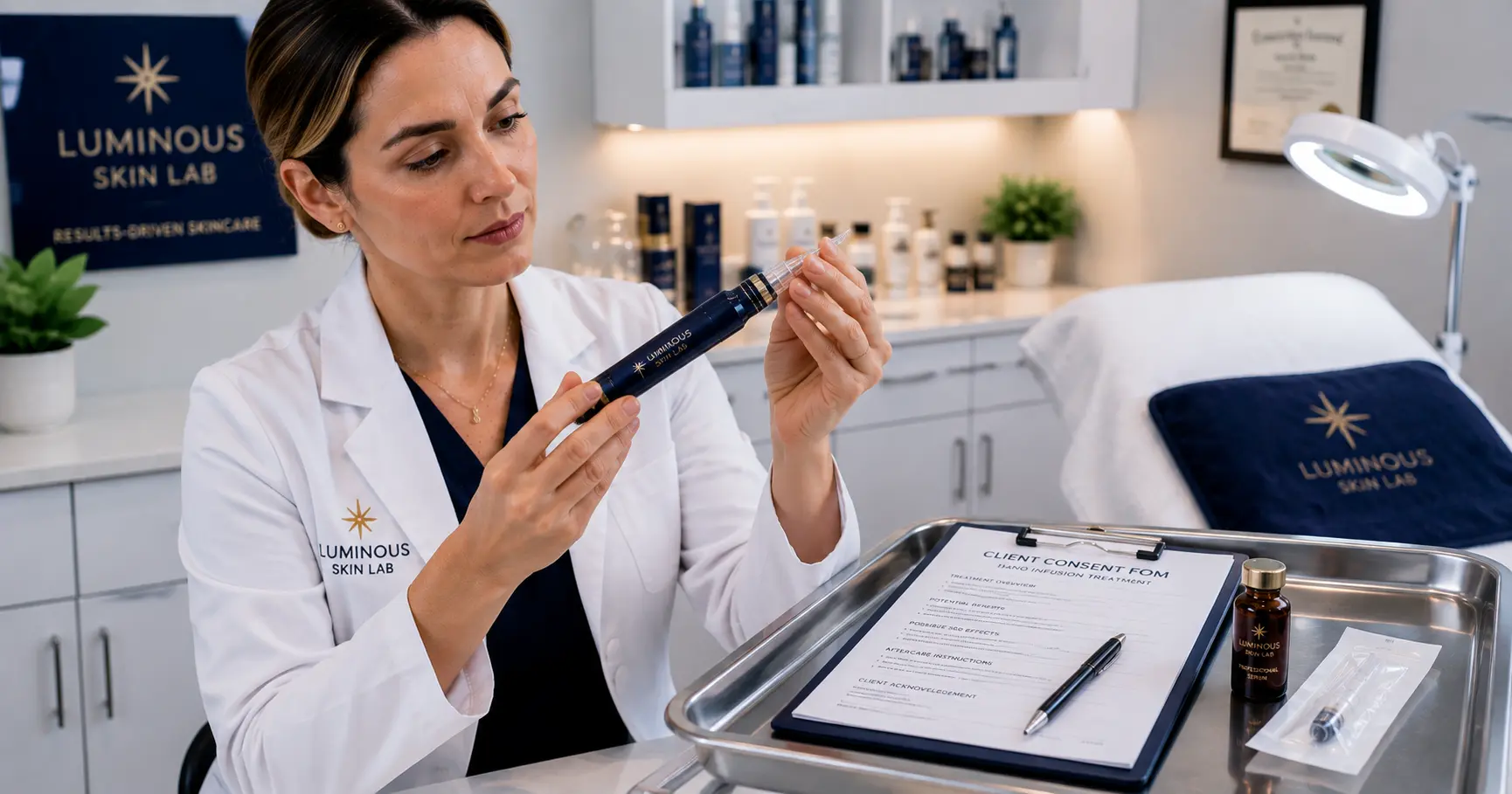
Is Nano Infusion Actually Needle-Free?
Yes — nano infusion is classified as needle-free because its micro-tip arrays do not use hypodermic needles and do not penetrate the dermis or create wounds. The tips work within the stratum corneum to create temporary microchannels for serum delivery, then self-seal without bleeding or dermal injury. This mechanical distinction is what places nano infusion within esthetician scope of practice in most U.S. states, while microneedling — which does puncture the dermis and create controlled wounds — falls under medical or medically-supervised scope in most jurisdictions.
- Nano infusion tips are pyramid-shaped or cone-shaped silicon or metal micro-projections — not hollow or solid lancet needles. They do not pierce the dermis or cause bleeding.
- The stratum corneum disruption created by nano infusion is transient, self-sealing, and does not constitute a wound under standard regulatory definitions.
- Needle-free does not mean zero skin surface interaction — it means no dermal penetration and no wounding. Nano infusion dramatically increases serum absorption through temporary microchannel formation.
- Scope-of-practice classification for nano infusion varies by state. Most states allow estheticians to perform it, but some have not yet issued explicit guidance. Always verify with your specific state board.
- How you market nano infusion matters as much as how you perform it — using microneedling or wound-healing language in service descriptions can trigger regulatory reclassification.
- Informed consent documentation is a professional and legal best practice for nano infusion regardless of its needle-free status.
The term “needle-free” has become one of the most frequently used phrases in professional nano infusion marketing — and one of the most misunderstood. For estheticians building their service menus around nano infusion, understanding exactly what needle-free means, what it does not mean, and how regulators interpret it is not an optional piece of background knowledge. It is the foundation of legally sound, ethically defensible treatment room practice.
The confusion is understandable. Nano infusion devices work with tips that are visibly small and sharp-looking at close range. They create microchannels in the skin that dramatically enhance serum absorption. Some devices are marketed with language that sounds very close to microneedling. And the broader category — sometimes called microchanneling — sits in a regulatory space that many state boards have been slow to address explicitly, leaving estheticians to navigate the distinction on their own.
This article gives estheticians a clear, technical, and compliance-grounded answer to the needle-free question: what the designation actually means at the device level, how it maps onto scope-of-practice regulations, where the classification holds up and where it gets complicated, and what professional practice standards should look like on both sides of the line.
What Every Esthetician Needs to Know About the Needle-Free Classification
- Needle-free is a mechanical classification based on tip design and depth of action — it means no dermal penetration and no wound creation, not zero skin contact.
- The stratum corneum microchannels created by nano infusion tips are temporary, self-sealing, and do not trigger the wound-healing cascade that microneedling is designed to activate.
- Most state boards classify nano infusion as within esthetician scope of practice precisely because it is needle-free and non-wounding — but “most” is not “all,” and you must verify with your specific board.
- The needle-free label can be undermined by device misuse, marketing language errors, or tips that penetrate deeper than the stratum corneum under aggressive pressure.
- Device documentation matters: request written confirmation of tip depth, penetration classification, and any regulatory clearance from your device manufacturer.
- Marketing your nano infusion service using wound-healing, collagen induction, or microneedling-adjacent language can cause regulators to reclassify your treatment regardless of the device used.
- Informed consent, proper documentation, and accurate service descriptions are the professional practice standards that protect you when the needle-free line is scrutinized.
What Does Needle-Free Actually Mean at the Device Level?
When regulators, manufacturers, and professional associations use the term needle-free in reference to nano infusion, they are describing a specific mechanical reality: the device tips do not function as needles in any meaningful clinical or regulatory sense of that word.
A hypodermic needle — the kind used in injections and intravenous access — is a hollow, sharp-tipped metal tube designed to penetrate through tissue layers, deliver substances below the skin surface, or withdraw fluids. Solid microneedling needles are lancet-like metal projections designed to create controlled puncture wounds in the dermis that stimulate a wound-healing collagen response. Both involve deliberate tissue penetration to a defined depth below the skin surface.
Nano infusion tips are fundamentally different in design and intent. The most common configuration uses a silicon wafer or stamped metal plate with thousands of microscopic pyramid-shaped or cone-shaped projections arranged in a dense array. These projections interact with the outermost layer of the skin — the stratum corneum — creating temporary disruption to its lipid barrier structure that allows serum molecules to pass through at dramatically higher concentrations than passive topical application achieves.
The critical distinction is what happens below the stratum corneum: nothing. Nano infusion tips do not reach the viable epidermis, the dermis, or any vascularized tissue. There is no bleeding. There is no wound. There is no wound-healing cascade triggered. The microchannels created by nano infusion tips close within minutes as the stratum corneum structure reseals around the disruption. This is the technical basis for the needle-free classification.
Why the Distinction Between Stratum Corneum and Dermis Matters So Much
The stratum corneum is the outermost, non-living layer of the skin. It consists of flattened, anucleate keratinocytes embedded in a lipid matrix — the primary physical barrier that controls transepidermal water loss and limits the passive penetration of topically applied substances. When nano infusion tips create microchannels in this layer, they are disrupting a structure that is already designed for regular, natural shedding. The stratum corneum has no blood supply, no nerve endings of the type that register injury, and no wound-healing capacity of its own.
The dermis, by contrast, is living connective tissue containing blood vessels, nerve endings, hair follicles, sebaceous glands, and fibroblasts. When microneedling punctures into the dermis, it creates real wounds in a vascularized, innervated living tissue. The body responds with its full wound-healing cascade: inflammation, proliferation, and remodeling. This is the mechanism that stimulates collagen production — but it is also the mechanism that places microneedling outside esthetician scope in most jurisdictions.
Nano infusion does not reach the dermis. That single anatomical fact is the foundation of its needle-free classification and its position within esthetician scope of practice.
How the Needle-Free Distinction Maps to Scope of Practice
Understanding the technical distinction between nano infusion and microneedling is important. Understanding how that distinction translates into regulatory scope-of-practice classification is essential. These are related but not identical conversations.
How Most State Boards Classify Nano Infusion
The majority of U.S. state cosmetology and esthetics boards classify nano infusion as a cosmetic, non-medical treatment that falls within licensed esthetician scope of practice. This classification flows from the same logical framework that allows estheticians to perform chemical exfoliation, dermaplaning, and other treatments that temporarily disrupt the skin barrier: the treatment does not create wounds, does not reach living tissue, and does not require the clinical management of a medical procedure.
Estheticians who have researched this question across multiple state practice acts report a consistent pattern: boards that have explicitly addressed nano infusion describe it as needle-free microchanneling or transdermal infusion within the esthetic scope. The decisive factor in every case is the non-wounding, non-dermal-penetration nature of the treatment.
Where the Classification Gets Complicated
The challenge for estheticians is that not every state has issued explicit guidance on nano infusion specifically. Some state practice acts were written before nano infusion technology existed and contain no language that directly addresses it. In these states, estheticians must interpret how existing statutes apply, which creates ambiguity that carries real professional risk.
When state boards have not issued guidance, estheticians have two responsible options: contact the board directly in writing to request a formal opinion on nano infusion classification, or decline to offer the treatment until written clarification is obtained. Proceeding based solely on the needle-free marketing designation without confirming state-specific classification is a professional compliance risk that no esthetician should accept.
Where Needle-Free Ends and Where Estheticians Must Not Cross
The needle-free classification is grounded in a clear technical boundary. Understanding where that boundary sits — and what can inadvertently push nano infusion across it — is one of the most practically important things an esthetician working with these devices needs to know.
Pressure, Technique, and Tip Depth Interactions
Nano infusion devices are designed with tips that physically cannot penetrate to the dermis under normal operating conditions. This is the primary design safety feature that supports the needle-free classification. However, some estheticians apply excessive pressure during nano infusion, particularly when working over areas of skin laxity or on clients who request more aggressive treatment results. While silicone tips have a physical depth limit, metal nano tips under excessive downward pressure can interact with the skin surface in ways that approach the boundary of the stratum corneum-to-epidermis transition.
The clinical signal to watch for is any visible pinpoint bleeding. If bleeding occurs during nano infusion, the treatment has moved outside needle-free territory — regardless of what the device tip is made of, and regardless of what the manufacturer calls the device. Bleeding indicates that living, vascularized tissue has been disrupted. This immediately changes the regulatory classification of the treatment and the professional and legal exposure of the esthetician performing it.
Device Substitution and Misrepresentation
A related professional risk arises when estheticians use a device that is nominally described as a nano infusion tool but is actually configured with tips designed for deeper penetration. This is more common than the industry generally acknowledges. Some device manufacturers market products using nano infusion or microchanneling language while configuring tips at depths that exceed stratum corneum-only interaction. The esthetician relying on the product label rather than the device specification carries full professional liability for any resulting harm or regulatory violation.
Due diligence before purchasing any nano infusion device should include: requesting the device tip depth specification in writing, confirming whether the device carries FDA 510(k) clearance or registration and in what classification, and asking the manufacturer explicitly whether the device creates wounds or causes bleeding under normal operating conditions. Any evasion of these questions is itself a warning sign.
If a nano infusion treatment you are performing produces pinpoint bleeding at any point, stop immediately. Bleeding indicates dermal disruption and the treatment has crossed from needle-free territory into wounding territory. This changes both the regulatory classification of the service and your professional and legal liability. Review your device, technique, and applied pressure before resuming nano infusion services.
The Marketing Language Risk
Estheticians sometimes unknowingly undermine their own compliance position not through what they do in the treatment room, but through how they describe their services publicly. Using language such as “collagen induction,” “micro-wound healing,” “stimulates wound repair,” or “needle depth of [X] millimeters” in service menus, social media posts, or client consultations can trigger regulatory scrutiny of a service that is otherwise fully compliant. State boards evaluate not just the physical mechanics of a treatment but also how it is positioned and marketed, because marketing language determines client expectations and informs what standard of care a client is owed.
Estheticians who market nano infusion accurately — as needle-free, non-wounding, serum-infusion treatment that enhances transdermal delivery through temporary stratum corneum microchanneling — remain in compliance alignment. Those who borrow microneedling benefit language to make their nano infusion services sound more results-driven invite exactly the regulatory scrutiny they are trying to avoid.
How to Evaluate Whether a Nano Infusion Device Is Genuinely Needle-Free
The professional standard for evaluating a nano infusion device before client use goes beyond reviewing the device name or marketing materials. Estheticians who apply a structured evaluation framework protect both their clients and their professional standing.
Tip Composition and Configuration
Confirm the tip material: silicon wafer tips and titanium or stainless steel micro-pyramid arrays are the established nano infusion tip types. Both function at the stratum corneum level when properly designed. Request the manufacturer’s specification sheet confirming the tip projection height, which should be in the range of 0.01 to 0.15 millimeters for stratum corneum-only interaction. Any tip depth specification above 0.2 millimeters begins to approach the boundary of the viable epidermis and should be evaluated with additional scrutiny.
FDA Registration or Clearance Documentation
Not all cosmetic devices require FDA 510(k) clearance, but legitimate professional nano infusion devices should be registered with the FDA as cosmetic or general wellness devices. Devices that have obtained 510(k) clearance as cosmetic, non-wounding tools carry stronger documentation support for their needle-free classification. Devices with no FDA registration of any kind, or with registration in medical device classifications that imply wounding or medical-use intent, require additional scrutiny before esthetician use.
Tip Replacement and Sanitation Standards
Genuine professional nano infusion devices use single-use, disposable tip cartridges designed for individual client use. This is both an infection control standard and a practical quality indicator: a manufacturer producing tips for multi-client use without sterilization infrastructure is not operating to professional-grade standards. Confirm that the device and tip system you are evaluating uses single-use, sealed, sterile-packaged tip cartridges.
Estheticians who have evaluated multiple nano infusion devices before selecting the ILUMIPEN by Luminous Skin Lab for their treatment rooms consistently note the same first evaluation step: verifying in writing that the device tip does not create dermal penetration under normal clinical pressure. With the ILUMIPEN, the nano tip arrays are engineered for stratum corneum-level interaction — practitioners report no pinpoint bleeding during standard protocol application, which they use as their primary real-world confirmation that the device is performing within its needle-free design parameters.
In practice, estheticians describe the ILUMIPEN client experience as distinctly different from microneedling in client sensation as well: clients do not report the pin-prick sensation associated with dermal penetration. The most common client description during nano infusion is a mild vibration with slight surface pressure — no pain, no bleeding, no post-treatment downtime of the kind that follows microneedling. Estheticians in states where they have sought and received written scope-of-practice confirmation for nano infusion also note that presenting device documentation — including tip depth specifications — made the board confirmation process substantially more straightforward than going in without it.
Why Informed Consent and Documentation Still Matter for Needle-Free Treatments
A common misconception among estheticians new to nano infusion is that the needle-free classification reduces or eliminates the need for informed consent documentation. This is incorrect. Needle-free describes the device mechanism, not the professional documentation standard that applies to any service that creates stratum corneum disruption, uses active serums, or carries contraindication considerations.
What Nano Infusion Consent Forms Should Cover
A professional informed consent form for nano infusion services should clearly explain the treatment mechanism in plain language that clients can understand: microchanneling through the stratum corneum for enhanced serum delivery, the temporary nature of microchannels, expected sensations during treatment, and the typical appearance immediately following treatment including possible temporary redness or mild sensitivity. The form should list contraindications explicitly, including active acne lesions over the treatment area, open wounds or cuts, recent sunburn, certain medications that affect skin sensitivity, and known allergies to any serum ingredients being infused. It should document which serum is being used during the treatment and confirm that the client has reviewed and accepted the aftercare requirements.
Documentation as Professional Protection
Beyond the consent form itself, estheticians offering nano infusion services should maintain treatment records that document the device used, the tip type and batch number, the serum applied, the technique used, the client’s immediate skin response, and any relevant observations. This documentation serves two functions: it supports continuity of care across multiple treatment sessions, and it creates a professional paper trail that demonstrates standard-of-care compliance in the event of any complaint or inquiry.
Documentation Best Practices
- Signed informed consent for every new client
- Device and tip batch number recorded
- Serum formula used and concentration documented
- Treatment area and technique noted
- Immediate post-treatment skin response recorded
- Aftercare instructions provided and documented
Marketing Language to Avoid
- Collagen induction therapy
- Wound-healing stimulation
- Micro-wound creation
- Needle depth of [X] mm
- Stimulates the same response as microneedling
- Dermal remodeling treatment
A Practical Compliance Checklist Before Offering Nano Infusion
Estheticians preparing to add nano infusion to their service menu should work through the following verification steps before their first client session:
- State board verification: Contact your state cosmetology or esthetics board in writing and ask specifically whether nano infusion or needle-free microchanneling is within licensed esthetician scope of practice. Request a written response and retain it.
- Device documentation: Obtain the tip depth specification, FDA registration details, and manufacturer’s written confirmation that the device does not create wounds or dermal penetration under normal operating conditions.
- Tip supply chain verification: Confirm that device tips are single-use, sterile-packaged, and disposed after each client. Confirm tip availability and cost as part of your service cost calculation.
- Serum compatibility review: Confirm that the serums you intend to infuse are appropriate for transdermal delivery enhancement — water-based, free from ingredients that become unsafe at increased absorption rates, and compatible with your client population including any with known sensitivities.
- Informed consent form preparation: Draft or obtain a nano infusion-specific consent form reviewed by a professional or legal resource familiar with esthetic practice standards in your state.
- Insurance verification: Confirm with your professional liability insurer that nano infusion services are covered under your current policy and under what conditions.
- Marketing language audit: Review all service descriptions, social media language, and client-facing communications to confirm that no microneedling, wound-healing, or collagen induction language is used in association with your nano infusion services.
Why Serum Selection Matters Even More When the Barrier Is Temporarily Open
The entire clinical rationale for nano infusion is based on one mechanism: temporarily increasing the permeability of the stratum corneum to dramatically enhance the transdermal delivery of the serum applied during treatment. Research on transdermal delivery enhancement through microchanneling consistently shows absorption increases ranging from several hundred to over one thousand percent compared to passive topical application, depending on molecule size and serum formulation.
Why the Needle-Free Stratum Corneum Disruption Still Dramatically Enhances Serum Delivery
The stratum corneum is the primary barrier to transdermal delivery. Its lipid matrix is highly effective at limiting passive absorption of water-soluble molecules above a certain molecular weight. Under passive application, even well-formulated serums deliver only a fraction of their active ingredient payload to viable skin layers.
Nano infusion tips disrupt this lipid matrix structure temporarily, creating aqueous microchannels through which water-soluble serum molecules can pass at dramatically higher concentrations. This is why serum selection for nano infusion is not equivalent to serum selection for a standard facial — the absorption rate change fundamentally alters what the skin receives from the applied product.
Professional serums appropriate for nano infusion delivery should be: water-based or water-dispersible (not oil-based); free from sensitizing ingredients that become more problematic at higher absorption rates; formulated at concentrations calibrated for the enhanced delivery mechanism; and free from synthetic fragrances, which carry heightened sensitization risk when delivered at nano-infusion absorption levels through a temporarily disrupted stratum corneum.
Practical implication:Not every serum safe for standard topical application is appropriate for nano infusion delivery. Estheticians should work with serum formulations specifically designed or validated for transdermal enhancement applications — and should be prepared to explain this distinction to clients asking about the serums used during their treatments.
Professional and Regulatory References
The regulatory and technical framework discussed in this article is informed by the following sources and bodies of professional practice literature:
- State cosmetology and esthetics practice act frameworks — scope-of-practice definitions for non-wounding cosmetic treatments. Multiple state boards including California, Texas, Florida, and New York. Current as of 2025–2026 review.
- Transdermal drug delivery via microneedle array and microchanneling research — mechanisms of stratum corneum disruption and absorption enhancement. Journal of Controlled Release; International Journal of Pharmaceutics. Multiple studies 2018–2024.
- Nano infusion device classification and FDA regulatory framework for cosmetic devices. U.S. Food and Drug Administration, Device Advice: Comprehensive Regulatory Assistance. 2024.
- Esthetic scope of practice and the needle-free treatment classification. Professional Beauty Association and Associated Skin Care Professionals practice guidance documents. 2023–2025.
- Stratum corneum anatomy and barrier function — standard dermatological reference literature. Proksch, E., Brandner, J.M., Jensen, J.M. “The skin: an indispensable barrier.” Experimental Dermatology. 2008.
- Informed consent standards for esthetic practice — professional liability insurance guidance. Associated Skin Care Professionals; American Association of Cosmetology Schools. 2024.
[[DEVELOPER OPTIONAL]] — Expand with specific DOIs and board opinion letter citations upon editorial review.
For estheticians seeking a nano infusion device designed from the ground up for compliance-conscious professional practice, the ILUMIPEN by Luminous Skin Lab is the device our education team most frequently references in needle-free scope-of-practice discussions. The ILUMIPEN’s nano tip design operates within the stratum corneum-only interaction framework that supports esthetician scope of practice in most U.S. states, with no dermal penetration, no wound creation, and no bleeding under standard clinical technique. Estheticians incorporating the ILUMIPEN into their practice are encouraged to pair device use with state board verification documentation and appropriate client informed consent protocols — the professional compliance foundation that makes needle-free nano infusion a sustainable and legally defensible addition to any treatment menu.
Explore the ILUMIPEN Nano Infusion DeviceFrequently Asked Questions: Is Nano Infusion Considered Needle-Free?
Is nano infusion actually needle-free?
Technically, nano infusion devices use nano-scale silicon or metal tips rather than hypodermic needles, so they do not puncture the skin the way microneedling does. Regulators and state boards generally classify nano infusion as needle-free because the tips do not penetrate the dermis or create true wounds. However, the needle-free designation applies to the device mechanics, not to every claim made by a device manufacturer, so estheticians must verify with their specific state board how nano infusion is classified in their jurisdiction.
What is the difference between nano infusion tips and microneedling needles?
Microneedling needles are sharp, hollow or solid metal lancets that puncture through the epidermis into the dermis, creating micro-wounds that trigger a wound-healing collagen response. Nano infusion tips are pyramid-shaped or cone-shaped silicon or metal micro-projections that temporarily disrupt the stratum corneum to create microchannels for serum delivery without breaking the dermal barrier or causing true wounding. The distinction is penetration depth and wounding intent: microneedling wounds the dermis, nano infusion does not.
Can estheticians legally offer nano infusion because it is needle-free?
In most U.S. states, nano infusion is within esthetician scope of practice precisely because it is classified as a needle-free, non-wounding treatment. However, scope of practice is determined state-by-state, and some states have not yet issued explicit guidance on nano infusion. Estheticians must confirm classification with their specific state cosmetology or esthetics board before offering the service, rather than relying solely on the needle-free label.
Does needle-free mean there is zero skin penetration with nano infusion?
Needle-free does not mean zero interaction with the skin surface. Nano infusion tips do create temporary microchannels in the stratum corneum that dramatically increase transdermal delivery of applied serums. What it means is that there is no dermal penetration, no true wound creation, and no bleeding. The stratum corneum disruption is transient and self-sealing. This is why nano infusion remains within esthetician scope in most states while microneedling does not.
How do I know if the nano infusion device I am using is actually classified as needle-free?
Verify the device tip material and configuration: genuine nano infusion devices use silicon wafer tips or similar micro-projection arrays that do not pierce into the dermis. Request written documentation from the device manufacturer confirming tip depth, penetration classification, and any FDA 510(k) clearance or registration. If a device tip penetrates beyond the stratum corneum or creates visible pinpoint bleeding, it is crossing into microneedling territory regardless of how the manufacturer labels it.
Why do some states still restrict nano infusion even if it is needle-free?
Some states have not yet updated their cosmetology or esthetics practice acts to specifically address nano infusion technology, which means the treatment falls into a regulatory grey area. In these states, estheticians may face scrutiny because regulators apply older statutes written before nano infusion existed, or because the term microchanneling sounds procedurally similar to microneedling to boards unfamiliar with the distinction. This is why verifying current board guidance directly is essential rather than assuming needle-free automatically equals legally unrestricted.
What happens if I market my nano infusion service in a way that makes it sound like microneedling?
Marketing nano infusion using microneedling terminology, needle depth claims, collagen induction therapy language, or wound-healing benefit statements can trigger regulatory scrutiny even if the device itself is compliant. If your marketing positions the service as performing functions that require medical oversight, your state board may reclassify the treatment or investigate your practice. Always market nano infusion in language consistent with its needle-free, non-wounding, serum-infusion mechanism.
Do I need a consent form for nano infusion even if it is needle-free?
Yes. Even though nano infusion is a needle-free treatment, a signed informed consent form is a professional and legal best practice for any treatment that creates stratum corneum disruption, uses active serums, or carries any contraindication considerations. Consent forms document that the client was informed of the treatment mechanism, potential side effects such as temporary redness, contraindications, and aftercare requirements. This protects both the client and the esthetician regardless of scope-of-practice classification.
How does the ILUMIPEN by Luminous Skin Lab handle the needle-free classification?
The ILUMIPEN by Luminous Skin Lab is designed as a professional nano infusion device using non-penetrating nano tips that work within the stratum corneum without creating dermal wounds. The device is positioned for esthetician use as a needle-free serum infusion tool, consistent with the scope-of-practice framework that applies to non-wounding treatments in most states. Estheticians using the ILUMIPEN should still verify their state board classification and maintain appropriate consent documentation for every client.
The Needle-Free Designation Is Earned Through What the Device Does — and Maintained Through How You Practice
The needle-free classification that makes nano infusion accessible to licensed estheticians in most states is grounded in a specific, verifiable mechanical reality: the device tips do not penetrate the dermis, do not create wounds, do not produce bleeding, and do not trigger the wound-healing cascade. This is what separates nano infusion from microneedling at the device level, and it is what drives the scope-of-practice distinction that regulators apply.
But the needle-free designation is not self-maintaining. Estheticians who use devices that exceed the stratum corneum boundary, apply pressure that produces bleeding, or market their services using microneedling-adjacent language can inadvertently move a compliant treatment into non-compliant territory. The regulatory protection that the needle-free label provides is a function of how the treatment is performed and presented — not just what the device is called.
Professional practice in nano infusion means verifying state board classification in writing, selecting devices with documented tip specifications, using serum formulations appropriate for enhanced transdermal delivery, documenting every treatment with proper informed consent, and marketing the service honestly and accurately. Estheticians who operate within those standards hold a clear, legally defensible position in a treatment category that continues to grow in professional relevance.