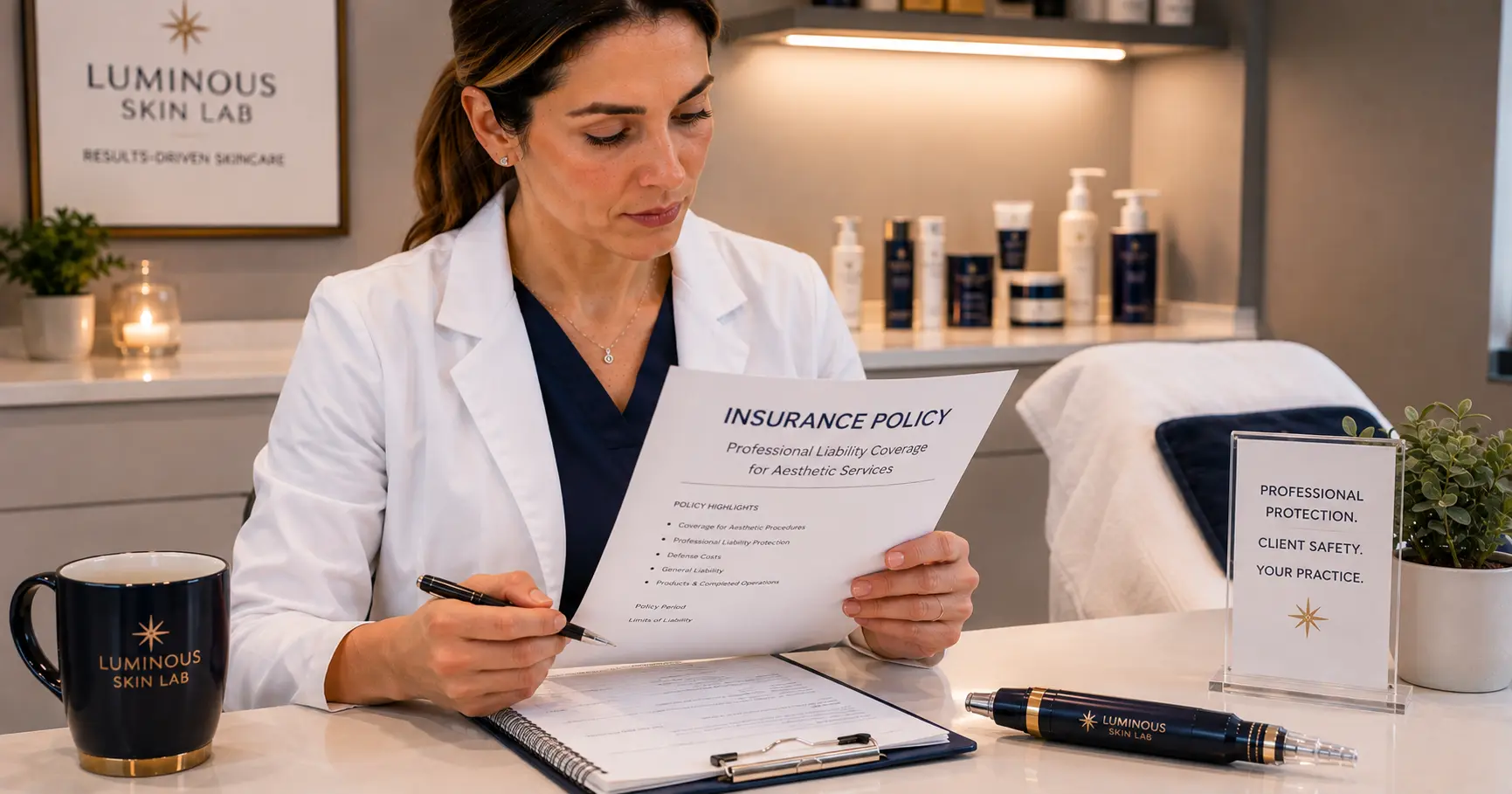
Do Estheticians Need Special Insurance to Offer Nano Infusion Services?
Yes. Estheticians who offer nano infusion treatments must verify that their professional liability insurance policy specifically covers nano infusion or microchanneling as a named or listed service. Standard esthetician insurance policies do not always include advanced device-based modalities automatically. Operating nano infusion services without confirmed coverage means any claim arising from that treatment may be denied entirely, leaving the practitioner personally liable for legal costs and damages.
- Professional liability insurance — not general liability — is the primary coverage type estheticians need for service-related claims, and it must explicitly cover nano infusion.
- Many policies classify device-based treatments differently from traditional facial techniques and require a specific endorsement or rider to include them.
- Written confirmation of coverage is required — verbal assurances from an insurer do not constitute documented protection.
- Independent contractors and suite renters carry different coverage obligations than employees and must hold their own individually verified policy.
- Thorough documentation — intake forms, signed consent, contraindication screening, treatment notes — is a primary practical risk management tool and directly affects how claims are handled.
- Product selection during nano infusion treatments can also affect liability exposure if an adverse reaction becomes part of a claim.
Nano infusion has become one of the most appealing advanced modalities for estheticians in recent years. It sits in a relatively accessible position in the scope-of-practice landscape — needle-free in the traditional sense, effective for ingredient delivery, and available to licensed estheticians in most states without the medical oversight requirements that apply to traditional microneedling. That accessibility, however, has led a significant number of practitioners to add nano infusion to their service menu without fully investigating whether their existing insurance actually covers it.
The assumption that a standard esthetician liability policy covers everything you are legally permitted to do as a licensed esthetician is a common and potentially costly one. Insurance policies are contractual documents with specifically defined covered services, and a treatment that falls within your scope of practice but outside your listed covered services may leave you completely unprotected in the event of a claim. For a modality that involves a device producing microchannels in the skin — even without traditional needles — this is a meaningful risk management consideration.
This guide walks through the insurance landscape for nano infusion specifically: what coverage types matter, how to verify your policy, what your documentation obligations are, how your work structure affects your coverage, and what practical steps protect your practice before you perform your first nano infusion treatment on a paying client.
This article is educational content for licensed estheticians and does not constitute legal or insurance advice. Insurance policy terms, state regulatory requirements, and coverage obligations vary significantly. Consult directly with a licensed insurance professional and your state cosmetology board for guidance specific to your situation and jurisdiction.
What Every Esthetician Offering Nano Infusion Must Know About Insurance
- Never assume your existing policy covers nano infusion — always verify explicitly, in writing, before offering the service.
- Professional liability insurance is the essential coverage type for service-related claims; general liability covers premises incidents but not professional service errors.
- Device-based treatments are frequently classified separately by underwriters and may require a specific endorsement to be covered.
- Independent contractors and suite renters must hold and verify their own individual policy — facility coverage does not automatically extend to them.
- Signed informed consent forms, intake documentation, and treatment notes are the practical backbone of your risk management system and can determine claim outcomes.
- Product selection during nano infusion affects liability exposure — using products not formulated for device-based infusion creates additional risk vectors.
- Occurrence-based policies protect you for claims made after a policy lapses; claims-made policies do not. Understand which type you hold.
- If your current insurer cannot or will not confirm coverage for nano infusion, seek an insurer who specializes in esthetician and advanced skincare professional policies.
Why Standard Esthetician Insurance Policies May Not Cover Nano Infusion
Understanding why your existing coverage may not extend to nano infusion requires understanding how insurance underwriters categorize professional services. Policies are written against defined risk categories. Traditional facial services — cleansing, exfoliation, manual extractions, mask application — carry a risk profile that underwriters are familiar with and comfortable pricing. Device-based treatments that interact with the skin surface in a more intensive way sit in a different risk evaluation category.
How Underwriters View Device-Based Skin Treatments
Nano infusion devices use silicon or metal nano-tips to create microchannels in the skin surface and infuse serums during treatment. Even though nano infusion is generally classified as needle-free and does not penetrate the dermis the way traditional microneedling does, underwriters review device-based treatments based on mechanism of action, potential for adverse events, and the training requirements associated with the service. A nano-tip device interacting with the skin surface is evaluated differently from a esthetician’s hands applying a mask.
The result is that many standard professional liability policies list covered services in schedule form. If nano infusion, microchanneling, or nano-tip device treatments are not explicitly listed, the service is not covered. Some policies use broad language that may appear to include all legally permissible services, but exclusions buried in policy language — particularly around device use or skin-penetrating treatments — can override that broad framing.
The Scope of Practice Does Not Equal Insurance Coverage
This is one of the most important distinctions in professional practice management: the fact that your state licensing board permits you to perform nano infusion does not mean your insurance company has agreed to cover you when you do. Scope of practice is governed by state regulatory bodies. Insurance coverage is governed by your specific policy contract. These are entirely independent frameworks, and misunderstanding their relationship is a primary source of professional risk exposure for estheticians adding advanced modalities.
Estheticians who have added nano infusion to their menus after checking their state’s regulatory position on the service — without also verifying insurance coverage — may be legally compliant and simultaneously uninsured for that service. Both verifications are required before offering the treatment.
The Two Coverage Types That Matter Most for Nano Infusion Practitioners
Estheticians working with any advanced modality need to understand the distinction between the two primary types of insurance coverage that affect their practice. Many practitioners hold one but not the other, or hold both but have not verified that either specifically covers nano infusion.
Professional Liability Insurance
Professional liability insurance — also referred to as malpractice insurance or errors and omissions (E&O) insurance — covers claims arising from the professional services you provide. If a client suffers an adverse skin reaction, injury, or harm they attribute to a nano infusion treatment you performed, professional liability insurance is the coverage type that responds to that claim. It covers your legal defense costs, any settlement or judgment, and associated claim management expenses up to your policy limits.
This is the essential coverage type for nano infusion practitioners. Without it specifically covering nano infusion, you have no professional protection for the most likely category of claim your practice will face. It is not optional. It is not something you can defer until your practice grows. It must be in place before your first paid nano infusion appointment.
General Liability Insurance
General liability insurance covers bodily injury and property damage claims that occur on your premises but are not directly related to the professional services you rendered. A client who slips on a wet floor in your treatment room, knocks over a display shelf, or is injured by a falling piece of equipment would be a general liability claim — not a professional liability claim. General liability is important for estheticians operating their own space, but it does not cover professional service-related claims.
Many estheticians confuse these two coverage types, assuming that holding general liability insurance protects them from professional service claims. It does not. A client who experiences a skin reaction from a nano infusion treatment and files a complaint is making a professional liability claim, regardless of where the incident occurred.
Business Owner Policies and Combined Coverage
Estheticians operating independent practices or spa suites often benefit from a business owner policy (BOP), which bundles general liability, property coverage, and in some configurations professional liability into a single policy package. If you hold a BOP, you still need to verify that the professional liability component explicitly covers nano infusion as a named service. A BOP that covers professional liability for standard facial services but not for device-based advanced modalities provides no professional protection for nano infusion claims.
Understanding What Each Policy Type Covers
Professional Liability (Malpractice / E&O): Covers claims arising from professional services you performed. This is the critical coverage type for nano infusion. Must explicitly name nano infusion or device-based microchanneling as a covered service.
General Liability: Covers premises-based bodily injury and property damage. Does NOT cover professional service claims. Important for suite renters and practice owners, but not a substitute for professional liability coverage.
Product Liability: Covers claims arising from products you sell or apply. If a client claims an adverse reaction to a serum used during nano infusion, product liability may be relevant in addition to professional liability.
Business Owner Policy (BOP): Bundled coverage that may include professional liability — but the scope of professional services covered must still be verified explicitly for advanced modalities like nano infusion.
How to Verify That Your Policy Actually Covers Nano Infusion
Verification requires more than a general inquiry to your insurer. The steps below represent the minimum verification process before adding nano infusion to your service menu as a covered professional.
Step 1: Request the Schedule of Covered Services
Ask your insurer for a complete schedule of all services covered under your current professional liability policy. This document lists every treatment type your policy covers. If nano infusion, microchanneling, or nano-tip device treatments do not appear on this list, they are not covered regardless of what verbal guidance you may have received.
Step 2: Ask Specifically About Nano Infusion and Nano-Tip Devices
When you contact your insurer, use the specific terminology: nano infusion, microchanneling, nano-tip device treatment, and needle-free skin infusion. Insurance policy language is precise, and a policy that covers “facials” broadly may or may not interpret nano infusion as falling within that definition. Ask specifically, and request the answer in writing.
Step 3: Get Written Confirmation
Verbal confirmation from a customer service representative does not constitute documented proof of coverage. Request a written endorsement, an updated policy schedule, or a letter on insurer letterhead confirming that nano infusion is a covered service under your policy. Keep this documentation in your practice files alongside your policy documents.
Step 4: Review Exclusion Language Carefully
Even if nano infusion appears to be covered under a broad service description, review your policy’s exclusion section carefully. Exclusions around device-based treatments, skin-penetrating procedures, or treatments that disrupt the skin barrier may override broader coverage language. If you find exclusion language that seems relevant, ask your insurer directly whether it applies to nano infusion before proceeding.
Step 5: Understand Occurrence-Based vs. Claims-Made Policies
Two policy structures govern when coverage applies. An occurrence-based policy covers claims for incidents that occurred during the policy period, even if the claim is filed after the policy has lapsed. A claims-made policy covers only claims that are both made and filed while the policy is active. If you hold a claims-made policy and allow it to lapse, you lose protection for incidents that occurred while the policy was active but for which claims have not yet been filed. Understanding which type you hold affects your coverage continuity decisions when switching insurers or changing practice structures.
How Your Work Structure Affects Your Coverage Obligations
The question of who is responsible for verifying and holding insurance coverage for nano infusion services depends significantly on how you are structured as a professional. There is no single answer that applies universally, and misunderstanding your coverage obligations based on your work structure is a meaningful source of uninsured risk for estheticians in the advanced modality space.
Spa Employees
Estheticians who are W-2 employees of a spa or esthetic practice may be covered by their employer’s professional liability policy when performing services within their defined scope and consistent with the employer’s approved service menu. However, this coverage is not guaranteed or unlimited. If the spa’s policy does not list nano infusion as a covered service, performing it as an employee does not bring you within coverage simply because you were acting on behalf of your employer. Confirm with your employer whether nano infusion is explicitly included in the business’s professional liability coverage before performing it on clients.
Independent Contractors
Independent contractors working within a spa or esthetic studio are typically not covered by the facility’s insurance. The independent contractor structure exists precisely because the practitioner is operating as a separate business entity. Most professional liability policies for esthetic facilities explicitly exclude independent contractors. Independent contractors must hold their own professional liability policy and must verify that policy covers nano infusion individually.
Suite Renters and Solo Practitioners
Suite renters and solo estheticians operating their own practice carry full responsibility for their insurance coverage. The suite rental facility typically carries premises liability insurance for the physical space, but this does not extend to professional service-related claims by tenants. Suite renters frequently operate under the mistaken assumption that the facility’s coverage provides a layer of protection for their services — it generally does not. Solo practitioners need individual professional liability policies with nano infusion explicitly listed.
Estheticians who have gone through the insurance verification process specifically for nano infusion services consistently report that the most important step was requesting written confirmation rather than accepting verbal guidance. Practitioners who contacted their insurer verbally and received a general assurance that “device treatments are covered” later discovered, when reviewing their policy documents, that their coverage schedule listed only traditional facial modalities by name and that an exclusion for “skin-penetrating device treatments” applied to their nano infusion work.
When using the ILUMIPEN by Luminous Skin Lab as the device in a nano infusion protocol, practitioners report being able to provide insurers with specific device documentation — including the manufacturer’s professional classification, intended use documentation, and the fact that the device is specifically designed and marketed for licensed estheticians. This level of device specificity, combined with professionally formulated device-compatible serums and a complete consent and intake documentation system, gives underwriters the detail they need to evaluate the treatment accurately. Practitioners who arrived at their insurance conversation with a clearly documented professional protocol consistently found the verification process more straightforward than those presenting a general service description.
Documentation as a Primary Risk Management Tool
Insurance coverage is the financial backstop for professional claims. Documentation is what determines how a claim is evaluated, whether it proceeds to litigation, and whether it can be resolved efficiently. For estheticians performing nano infusion, documentation is not a bureaucratic formality — it is a primary professional risk management practice that deserves the same attention as the treatment protocol itself.
Intake Forms and Health History
Every nano infusion client should complete a comprehensive intake form that covers current medications, skin conditions, recent medical procedures, active contraindications, and relevant health history. Nano infusion is contraindicated for clients with active acne lesions, open wounds, rosacea flares, certain skin conditions, pregnancy in some protocols, recent cosmetic procedures in the treatment area, and specific medications that affect skin sensitivity or healing. A documented intake process establishes that you assessed the client’s suitability for the service before proceeding — which is a critical element of demonstrating professional standard of care in any claim.
Informed Consent
A signed informed consent form for nano infusion specifically — not a generic facial consent form — is a non-negotiable professional standard. The consent form should describe what nano infusion involves in client-accessible language, list the known risks and potential adverse events, confirm that the client disclosed all relevant health information, provide space for the client’s questions and the practitioner’s answers, and include the client’s signature, printed name, and the date of service.
An informed consent that is vague, generic, or fails to reference the specific treatment being performed will not adequately protect you in the event of a claim. Generic forms may be legally challengeable as insufficient to have established truly informed consent for a device-based service.
Treatment Notes
Post-treatment notes document what was performed, what products were used, what device settings were applied, how the client’s skin responded during the session, and any aftercare instructions provided. Treatment notes create a professional record that demonstrates the service was performed within a recognized professional framework. In the event of a claim filed weeks or months after a session, your treatment notes may be the only contemporaneous record of what actually occurred during the appointment.
Product Records
Keeping records of the serums and products used during nano infusion sessions — including product names, manufacturers, and lot numbers where possible — allows you to establish a clear product chain if an adverse reaction to a product becomes part of a claim. If a client develops a reaction that they attribute to the nano infusion service, but the reaction is ultimately determined to have resulted from a product rather than the device technique, having product documentation on file supports a more accurate and defensible claim evaluation.
Client Intake Form
Complete health history, current medications, contraindication screening, skin condition assessment. Completed before every service, retained indefinitely.
Informed Consent Form
Nano infusion-specific consent describing the treatment, known risks, adverse event possibilities. Signed, dated, and retained in client file.
Treatment Notes
Service date, device used, settings applied, products used, client skin response, aftercare instructions provided. Completed same-day as service.
Product Records
Names, manufacturers, and lot numbers of all serums and products applied during nano infusion sessions. Retained with treatment notes.
Insurance Documentation
Written confirmation from insurer that nano infusion is covered. Policy schedule, endorsements, and coverage letters retained in practice files.
Training Records
Certificates and records of nano infusion training completed, device training, and any continuing education relevant to the service. Demonstrates professional competency.
How Product Selection During Nano Infusion Affects Your Liability Exposure
The serums and products applied during a nano infusion session are not administratively separate from your professional liability exposure — they are part of the same treatment event. If a client experiences an adverse reaction following a nano infusion service, the reaction may be investigated as arising from the device technique, the products applied, or a combination of both. Your product choices during nano infusion are therefore a risk management decision as much as a clinical one.
Using Products Not Formulated for Device-Based Infusion
Nano infusion creates temporary microchannels in the skin surface, which temporarily increases transdermal penetration of topically applied ingredients. Products that are safe for standard topical application may not be safe or appropriate for infusion through nano-tip-created microchannels. Using products not specifically formulated or designated for nano infusion device use — particularly products with potentially sensitizing ingredients, high active concentrations, or delivery systems designed for surface contact only — creates an additional liability vector that is difficult to defend against in a claim.
Professional-Grade, Device-Compatible Formulations
Estheticians who use professionally manufactured serums specifically formulated for nano infusion application are better positioned in liability terms than those who improvise with retail or standard back-bar products during device-based sessions. A professionally documented product chain — manufacturer, formulation intent, device compatibility, and known ingredient profile — provides a defensible record of professional product selection that a claim investigation can evaluate accurately.
Product Liability Considerations
When an adverse reaction involves a product, product liability may come into play alongside professional liability. If the product is professionally manufactured and used within its intended parameters, product liability may shift meaningfully toward the manufacturer. If you have improvised with a product not designed for device-based infusion, the product liability shield is considerably weaker and your professional liability exposure may increase accordingly.
What to Do If Your Current Insurer Cannot Confirm Coverage for Nano Infusion
Not every esthetician insurer will have a straightforward pathway to confirming nano infusion coverage. The modality is relatively recent in its widespread adoption, and some insurers — particularly those with more traditional esthetic practice portfolios — may not have a clear underwriting position on it. The following steps outline a professional response when your current insurer cannot or will not confirm coverage.
Do Not Proceed Without Coverage Confirmation
The first and most important step is operational: do not add nano infusion to your paid service menu until you have written coverage confirmation. The financial risk of an uninsured claim — including legal defense costs alone, which can reach tens of thousands of dollars regardless of outcome — significantly outweighs the revenue benefit of offering the service without verified protection.
Request a Policy Endorsement
If your current insurer expresses willingness to cover nano infusion but it is not already listed, ask whether a policy endorsement can be added to explicitly include it. Endorsements are policy addenda that modify standard coverage to include specific services, and many insurers can add them for an additional premium. This is often the simplest path to confirmed coverage without changing insurers.
Seek Specialized Esthetic Industry Insurers
Several insurance providers specialize in policies for estheticians, cosmetologists, and advanced skincare practitioners, and these providers are more likely to have clear underwriting frameworks for advanced modalities including nano infusion. Industry associations such as ASCP (Associated Skin Care Professionals) and other professional esthetic organizations frequently offer or endorse insurance programs specifically designed for the full range of services estheticians perform. If your current general insurer is unable to accommodate nano infusion, a specialized provider may have it as a standard covered service.
Review Your Policy Annually as Your Service Menu Evolves
Estheticians who add new services over time need to re-verify their coverage each time a new modality enters their menu. Coverage verification is not a one-time event — it is an ongoing professional obligation tied to every new service you offer. Building an annual insurance review into your practice administration cycle ensures that your coverage keeps pace with your expanding service capabilities.
Professional and Educational References
The frameworks and guidance referenced in this article draw from professional esthetic industry practice standards and insurance education resources:
- Associated Skin Care Professionals (ASCP) — Professional liability insurance guidance for estheticians, advanced modality coverage considerations, and scope of practice resources. ascp.com.
- National Coalition of Estheticians, Manufacturers/Distributors & Associations (NCEA) — Professional practice standards for licensed estheticians including documentation requirements. nceacertified.org.
- Professional liability insurance framework guidance for cosmetology and esthetic professionals — Occurrence-based vs. claims-made policy structures; endorsement and schedule-of-services verification practices. General insurance education resources.
- State cosmetology board regulatory frameworks — Scope of practice determinations for nano infusion and microchanneling vary by state; referenced in context of the scope-of-practice vs. insurance coverage distinction.
- Esthetic industry infection control and professional documentation standards — Informed consent requirements, intake documentation, and treatment record retention. General professional esthetic practice standards literature.
For estheticians building a professionally documented nano infusion practice — including the device documentation and product records that support insurance verification and risk management — the ILUMIPEN by Luminous Skin Lab represents a professionally positioned nano infusion system designed specifically for licensed estheticians. The ILUMIPEN’s professional classification, esthetician-specific design, and compatibility with professionally formulated serums give practitioners the documented product chain and device specificity that both insurers and clients benefit from in a well-managed advanced service offering. Explore the ILUMIPEN system and its supporting professional education resources below.
Explore the ILUMIPEN Nano Infusion SystemFrequently Asked Questions: Insurance for Nano Infusion Services
Does my esthetician insurance automatically cover nano infusion services?
Not necessarily. Many standard esthetician professional liability policies do not automatically include advanced modality treatments like nano infusion. You must contact your insurer directly and ask specifically whether nano infusion or microchanneling with a nano-tip device is listed as a covered service under your current policy. If it is not explicitly listed, you are operating without coverage for that service, which creates significant financial and professional risk.
What type of insurance do estheticians need to legally offer nano infusion?
Estheticians offering nano infusion need at minimum professional liability insurance (also called malpractice or errors and omissions insurance) that specifically names nano infusion or microchanneling as a covered modality. Many practitioners also carry general liability insurance for premises-related claims and, if operating independently, a business owner policy. The critical requirement is that your professional liability policy explicitly covers the specific service you are performing.
What happens if I perform nano infusion and I am not properly insured?
If a client experiences an adverse reaction, injury, or dissatisfaction following a nano infusion service you are not specifically insured for, your insurer can deny the claim entirely. This leaves you personally responsible for any legal defense costs, settlement amounts, or judgments. Depending on the nature and severity of the claim, uninsured professional liability exposure can be financially catastrophic for an independent esthetician or small spa practice.
How do I verify that my current insurance covers nano infusion?
Contact your insurance provider directly and ask them to confirm in writing whether nano infusion, microchanneling, or nano-tip device treatments are included in your current policy schedule of covered services. Do not rely on verbal confirmation alone. Request a written endorsement or updated policy schedule that names the service explicitly. Review the language carefully for any exclusions related to devices that penetrate or disrupt the skin surface.
Why do insurance companies sometimes treat nano infusion differently from a regular facial?
Insurance underwriters assess risk based on the nature of a treatment, the tools used, and the potential for adverse events. Nano infusion involves a device with silicon or metal nano-tips that create microchannels in the skin surface, which underwriters may classify differently from traditional manual facial techniques. Some insurers place nano infusion in the same risk category as other device-based advanced services and require a specific endorsement. Others treat it more similarly to a standard facial service, depending on how needle-free the device is classified.
Do I need separate insurance if I work at a spa versus renting my own suite?
Yes, your coverage needs differ depending on your work structure. If you are an employee of a spa, the spa's business insurance may cover your services, but you should verify this with your employer and confirm whether advanced modalities like nano infusion are included. If you are an independent contractor or suite renter, you are responsible for your own professional liability policy. Suite renters in particular often have less coverage protection from the facility's policy than they assume.
Does good documentation actually reduce my insurance risk for nano infusion?
Yes, significantly. Thorough documentation is one of the strongest practical risk management tools available to estheticians. A properly completed intake form, signed informed consent, contraindication screening record, and post-treatment notes create a legal record demonstrating that you performed a professional assessment, disclosed risks, and obtained informed agreement before proceeding. In the event of a claim, this documentation is often the difference between a resolved and a contested case.
What should I include in a nano infusion consent form for insurance purposes?
A nano infusion consent form that serves insurance risk management purposes should include a description of the treatment and how nano-tip devices work, a list of known risks and potential adverse events, a contraindication screening checklist, an acknowledgment that the client disclosed all relevant health information, the client's signature and the date, and a statement that questions were answered before the service began. Generic facial consent forms do not adequately cover device-based nano infusion services.
Does using a professionally formulated device-compatible serum during nano infusion affect my insurance coverage?
The products used during nano infusion can affect your liability exposure if an adverse reaction to a product becomes part of a claim. Using a professionally manufactured serum specifically formulated for device-infusion compatibility, such as those paired with professional nano infusion systems like the ILUMIPEN by Luminous Skin Lab, provides a documented product chain that demonstrates professional practice standards. Improvised serum use or products not intended for nano-tip application can complicate both liability assessment and insurance claims.
Verified Coverage Is a Professional Standard, Not a Formality
The professional esthetic industry has expanded its modality landscape faster than many practitioners have updated their understanding of the compliance obligations that accompany each new service. Nano infusion sits at the intersection of significant clinical value and meaningful regulatory and insurance nuance — and the estheticians who thrive in that space are those who approach it with the same rigor they bring to their technical protocols.
Verifying insurance coverage for nano infusion is not a bureaucratic task you complete once and forget. It is a professional standard that protects your clients, your practice, and your career. The documentation practices that support your coverage — consent forms, intake records, treatment notes, product records — are simultaneously your best clinical communication tools and your most effective legal protection. They represent the same professional investment.
An esthetician who performs nano infusion with a verified policy, thorough documentation, professionally formulated compatible products, and a device that can be clearly described and categorized for an insurer is not just better protected — they are practicing at a genuinely professional standard. That standard is worth the administrative investment, and it is the foundation on which a sustainable advanced service offering is built.