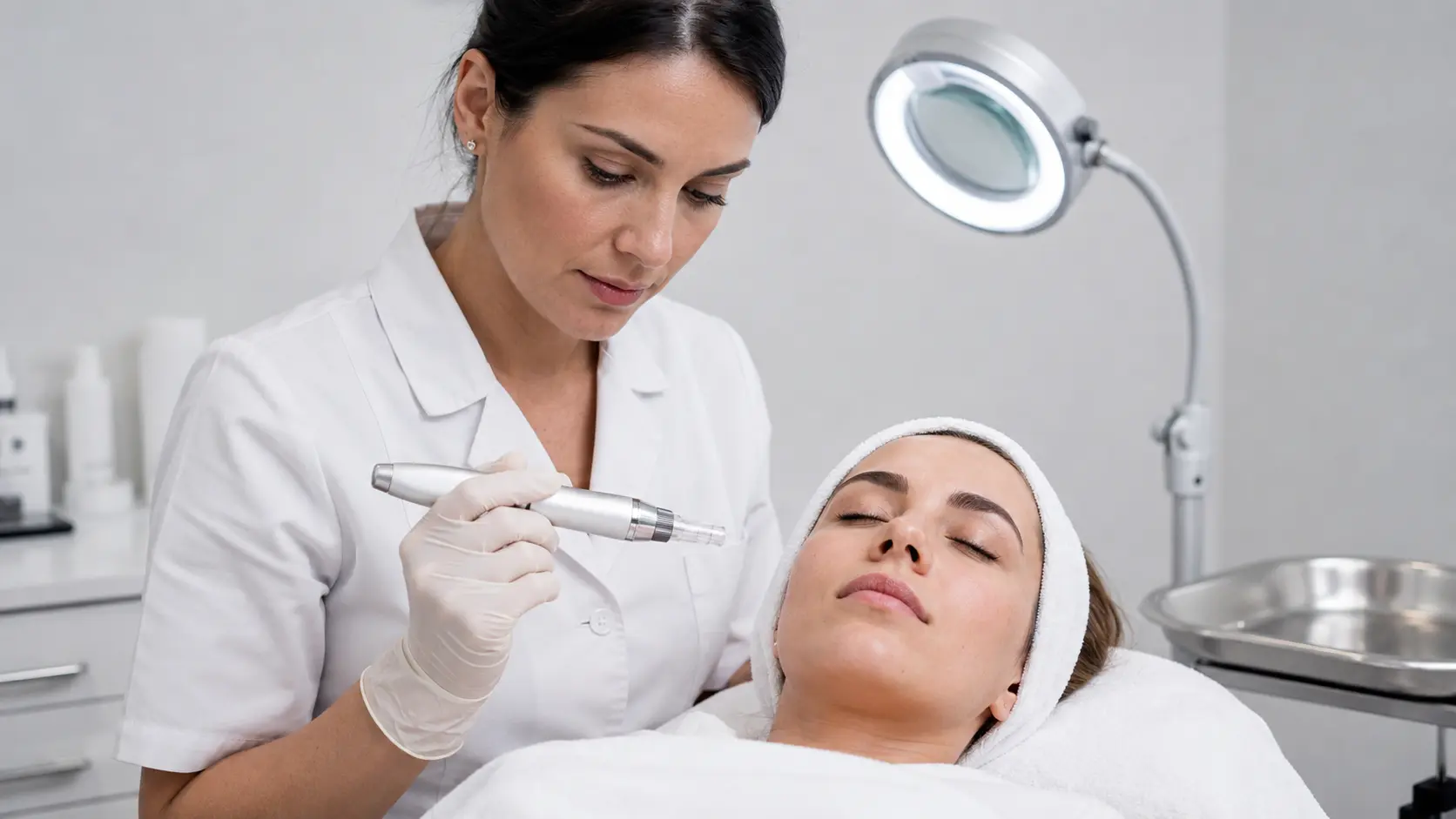
Is Nano Infusion Actually Needle-Free? The Direct Answer for Estheticians
Yes — nano infusion is genuinely needle-free, but the accuracy of that classification depends on understanding what the tips actually do. Nano infusion devices use microscopic silicon or metal pyramidal projections called nano tips, which are far too small and structurally blunt to pierce the skin, penetrate the dermis, or create the controlled micro-injuries that define microneedling. They create temporary, superficial disruptions in the outermost stratum corneum to enhance serum absorption without breaking the skin barrier or causing bleeding.
- Nano tips typically measure between 150 and 400 nanometers in height — a fraction of a single human hair width — and do not penetrate the living epidermis or dermis under any normal clinical application.
- Microneedles, by contrast, range from 0.25 mm to 3.0 mm and are specifically designed to create dermis-reaching puncture channels that trigger the wound healing cascade.
- The needle-free classification is what places nano infusion within esthetician scope of practice in most states — making accurate understanding of this distinction professionally and legally significant.
- Nano infusion does involve physical contact with the skin surface and creates temporary micro-disruptions to the stratum corneum to enhance transdermal serum delivery — it is not a completely passive or zero-contact technique.
- The correct client explanation is that nano infusion enhances ingredient absorption through superficial stratum corneum disruption, not that it is “like microneedling but gentler” — these are mechanistically distinct treatments with different clinical objectives.
Of all the questions new and established estheticians ask about nano infusion, the one that surfaces most consistently — in training rooms, online professional forums, and state board compliance discussions — is some version of the same inquiry: is nano infusion actually needle-free, or is that just marketing language?
It is a fair and professionally important question. The answer is not simply yes or no, because the accuracy of “needle-free” depends entirely on how you define needles, what you understand about nano tip anatomy, and what you know about the physiological difference between stratum corneum disruption and true dermal penetration. Getting this wrong in either direction carries professional risk: dismissing the question entirely can lead to scope of practice missteps, while overstating the invasiveness of the treatment can create unfounded client anxiety and misrepresent a genuinely accessible, low-risk service.
This article gives estheticians a complete, scientifically grounded answer. We cover what nano tips are made of and how they work, exactly what happens at the skin surface during a nano infusion treatment, how nano tips compare anatomically to microneedles, why the distinction matters for scope of practice compliance, and how to explain this accurately to clients in a way that builds rather than undermines their confidence in the treatment.
What Estheticians Must Understand About Nano Infusion and the Needle-Free Classification
- Nano infusion is genuinely needle-free in the clinical and regulatory sense — nano tips do not pierce the skin, reach the dermis, or trigger the wound healing cascade.
- The mechanism of action is superficial stratum corneum disruption to enhance transdermal delivery — not injury-induced collagen stimulation.
- Nano tips are typically 150 to 400 nanometers tall; microneedles begin at 250,000 nanometers (0.25 mm) — the scale difference is not marginal, it is categorically distinct.
- The needle-free status is the primary regulatory basis for nano infusion falling within esthetician scope of practice in most states.
- Clients who ask this question deserve a confident, technically accurate answer — not reassurance that minimizes the treatment or comparisons that inflate it.
- Technique matters: excessive pressure or passes can create unnecessary irritation even with needle-free tips, so “needle-free” does not mean “zero skill required.”
- Always verify your specific state board regulations independently — needle-free classification does not automatically guarantee unrestricted esthetician scope of practice in every jurisdiction.
What Are Nano Infusion Tips Made Of and What Do They Actually Look Like?
To answer whether nano infusion is needle-free, you first need a clear picture of what a nano tip actually is — not the marketing description, but the physical structure that contacts the client’s skin during treatment.
The Physical Structure of a Nano Tip
A nano infusion tip is a cartridge containing a dense array of microscopic projections arranged across a flat or slightly curved contact surface. These projections are not needles. They are more accurately described as pyramidal cones or micro-pyramids — structures that come to a point at the apex but have a wide base and a blunt, rounded peak at the nanoscale. The material is most commonly silicon, though some professional devices use stainless steel nano-structured tips with a different surface geometry.
The height of these projections — which is the measurement equivalent to needle length in a comparison context — typically ranges from 150 to 400 nanometers. To put that in perspective: one nanometer is one billionth of a meter. A single human hair is approximately 80,000 to 100,000 nanometers wide. The stratum corneum — the outermost, non-living layer of the skin composed of dead corneocytes — is approximately 10,000 to 20,000 nanometers thick. The nano tips that contact the skin during nano infusion are an order of magnitude smaller than the layer they are interacting with.
How the Tip Contacts the Skin During Treatment
During a nano infusion treatment, the device delivers a rapid, controlled vibrating or stamping motion that brings the nano tip array into repeated, brief contact with the skin surface. Each contact event involves the nano tip projections pressing against the outermost stratum corneum cells, creating micro-disruptions in the tight intercellular junction between corneocytes. These micro-disruptions temporarily increase the permeability of the stratum corneum, creating enhanced transdermal channels through which applied serum molecules can travel more efficiently into the skin.
The critical point is that this contact remains within the stratum corneum. The projections do not reach the granular layer, the spinosum layer, the basal layer, or the dermis under standard clinical operating conditions. There is no penetration of living skin tissue, no creation of wound channels, and no induction of the inflammatory signaling cascade that microneedling deliberately targets.
How Small Is 400 Nanometers? A Clinical Context Reference
400 nm: The maximum height of a nano tip projection in most professional nano infusion cartridges.
10,000–20,000 nm: The approximate thickness of the stratum corneum — the outermost non-living skin layer that nano tips interact with.
250,000 nm (0.25 mm): The minimum length of a microneedle in clinical use — the shortest entry-level microneedling cartridge length.
3,000,000 nm (3.0 mm): The maximum microneedle length used in advanced clinical microneedling protocols — reaching well into the reticular dermis.
How Does Nano Infusion Compare to Microneedling? The Anatomical Breakdown
The most common source of confusion about nano infusion’s needle-free status comes from its frequent comparison to microneedling. These treatments are often discussed in the same breath — as points on a single spectrum of skin-needling intensity — when they are more accurately understood as mechanistically distinct treatments that happen to use similar-looking pen-format devices.
The Defining Difference: Injury vs. Disruption
Microneedling works through deliberate, controlled injury. Its clinical mechanism is the creation of hundreds of micro-puncture wounds that penetrate through the epidermis and into the dermis, triggering the wound healing cascade. This cascade involves platelet activation, growth factor release, inflammatory signaling, fibroblast recruitment, and ultimately new collagen and elastin synthesis. The skin must be injured at the dermal level for the collagen induction mechanism to activate. Microneedling without dermal penetration does not produce the collagen-stimulating results that define its clinical value.
Nano infusion works through transient, superficial disruption. Its clinical mechanism is the temporary alteration of stratum corneum permeability to create enhanced transdermal delivery channels for topically applied actives. No wound is created. No dermis is accessed. No inflammatory cascade is activated. The skin’s barrier integrity is not compromised in a clinical sense — the micro-disruptions are temporary and self-resolving within the hours following treatment as the stratum corneum’s natural self-repair mechanisms restore normal barrier function.
| Characteristic | Nano Infusion | Microneedling (CIT) |
|---|---|---|
| Tip type | Silicon or metal nano-pyramid array | Sharp tapered metal needles |
| Tip height / length | 150–400 nanometers | 0.25 mm–3.0 mm (250,000–3,000,000 nm) |
| Skin layer reached | Stratum corneum only | Epidermis and dermis |
| Skin barrier breach | No — temporary disruption only | Yes — controlled puncture channels created |
| Bleeding | No | Yes, at therapeutic depths |
| Wound healing cascade | Not activated | Deliberately activated — this is the mechanism |
| Primary clinical goal | Enhanced transdermal serum delivery, hydration, surface texture | Collagen induction, scar remodeling, deep structural improvement |
| Downtime | None to minimal | 24–72+ hours depending on depth |
| Esthetician scope (most states) | Generally within scope | Restricted or prohibited in many states |
Why They Look Similar but Are Not the Same
Both treatments are commonly delivered with pen-format devices that vibrate at controlled speeds and are held by the practitioner and moved across the skin in similar motions. The device form factor — similar ergonomics, similar stamping or gliding technique, similar-looking treatment setup — contributes significantly to client and practitioner confusion about whether these are the same treatment at different intensities. They are not. The mechanism, depth of action, physiological response, clinical indication, contraindication profile, and regulatory classification are all categorically different. A nano infusion pen and a microneedling pen may look similar in a practitioner’s hand, but at the skin surface they are doing fundamentally different things.
What Actually Happens at the Skin During a Nano Infusion Treatment?
Understanding the precise sequence of events during a nano infusion treatment helps estheticians explain the treatment accurately, perform it with appropriate technique, and recognize when they may be deviating from the needle-free parameters that define the treatment’s scope.
Step 1: Nano Tip Contact With the Stratum Corneum
As the device delivers its vibrating stamping motion, the nano tip array contacts the skin surface. The microscopic pyramidal projections press against the tightly packed corneocytes that form the stratum corneum. These dead skin cells — held together by lipid bilayers and tight junctions — form the primary barrier against transdermal molecular passage. Under normal circumstances, the stratum corneum’s lipid-rich structure selectively limits which molecules can pass through and how quickly.
Step 2: Temporary Intercellular Channel Formation
The mechanical pressure and vibration from the nano tip array creates temporary micro-disruptions in the intercellular lipid junctions between corneocytes. These disruptions are not wounds in the clinical sense — they are temporary gaps in the normally tight barrier structure that allow topically applied molecules to move more efficiently through the stratum corneum toward the viable epidermis below. The size, distribution, and transience of these channels are what distinguish nano infusion from any form of true needling.
Step 3: Enhanced Transdermal Delivery of Applied Serums
With stratum corneum permeability temporarily increased, the serums applied immediately before or during the nano infusion pass more efficiently through the skin surface. Water-soluble actives — including hyaluronic acid, peptides, growth factors, vitamin C derivatives, and brightening agents — that would normally have limited stratum corneum penetration due to molecular size or barrier resistance are delivered at meaningfully higher concentrations into the upper viable skin layers. This is the core clinical value proposition of nano infusion: serum delivery amplification through mechanical barrier disruption, not through injury-mediated collagen induction.
Step 4: Self-Resolving Barrier Restoration
Following treatment, the stratum corneum’s natural lamellar body secretion process begins restoring normal lipid barrier integrity. The temporary micro-disruptions created during nano infusion close as the skin’s barrier self-repair mechanisms activate. This process occurs within hours — significantly faster than the recovery timeline following true microneedling, where the wound healing cascade is actively underway and barrier integrity is more substantially compromised. This is why nano infusion produces minimal to no visible skin disruption, no significant redness persistence, and no downtime in properly performed treatments.
“Needle-free” does not mean “zero technique required.” Estheticians who apply excessive pressure, make too many passes over sensitized areas, or use nano infusion over contraindicated skin conditions can create unnecessary irritation even within the needle-free classification. Correct technique, appropriate client assessment, and contraindication screening remain professional requirements for every nano infusion treatment.
Visualizing the Difference: Nano Tip vs. Microneedle Skin Contact Depth
The most effective way to understand — and explain to clients — why nano infusion is genuinely needle-free is through a direct visualization of contact depth across the layers of the skin. The following infographic maps both tip types against the anatomical layers they interact with.
Why the Needle-Free Classification Matters for Scope of Practice
For estheticians, the clinical distinction between nano infusion and microneedling is not just an academic point — it has direct, practical implications for what treatments they are legally permitted to perform, what liability they carry, and how their professional insurance coverage applies.
How Most State Boards Define the Boundary
The majority of state cosmetology and esthetics boards define the boundary of esthetician practice around the concept of skin penetration — specifically, the penetration of living skin tissue. Treatments that create wounds, breach the skin barrier into living layers, or introduce substances into the dermis are classified as medical or semi-medical procedures requiring physician supervision or medical licensure in most jurisdictions. Treatments that operate at the non-living surface of the skin — including mechanical exfoliation, chemical exfoliation, and superficial disruption of the stratum corneum — are generally classified as within esthetic scope.
Nano infusion’s needle-free classification — its verified operation within the non-living stratum corneum without dermal penetration or wound creation — is precisely what places it within esthetic scope in most states. Estheticians performing nano infusion are not practicing medicine; they are performing a non-invasive procedure that disrupts the outermost dead cell layer to enhance serum delivery. The moment a treatment crosses into living tissue and creates wounds, that classification changes.
This Does Not Mean Nano Infusion Is Universally Unrestricted
Estheticians must verify their specific state board regulations before adding any device-based service to their menu. While nano infusion is generally within esthetic scope due to its needle-free mechanism, some states have specific language about device-based treatments, require specific documentation or training certification, or have not yet issued formal guidance on newer service categories. The absence of a specific prohibition does not automatically constitute permission. State board websites, direct regulatory inquiries, and consultation with a knowledgeable professional liability insurance provider are the appropriate steps before introducing any new service.
Estheticians who have integrated the ILUMIPEN by Luminous Skin Lab into their service menu consistently report that having a clear, confident answer to the “is this needle-free?” question dramatically reduces client hesitation and improves treatment uptake. In practice, the most effective approach is to explain the treatment in two steps: first, confirm it is needle-free and explain what the nano tips actually are; second, explain what the tips do accomplish — creating temporary permeability in the outermost skin layer to enhance the serums being applied. Clients who understand both the “no” (not needles, no penetration, no downtime) and the “yes” (real mechanism, real results, real serum delivery) book with significantly higher confidence than clients who receive only reassurance without explanation.
From a technique standpoint, estheticians using the ILUMIPEN note that consistent, moderate stamping pressure — rather than heavy dragging motions — is the approach that produces the most even serum distribution without unnecessary redness. The device’s ergonomic format supports this controlled technique across full-face treatment coverage, which experienced practitioners describe as one of the key practical advantages over competitor devices that require more manual pressure calibration.
The Informed Consent Consideration
Even though nano infusion is needle-free and minimally invasive, professional practice standards still support the use of a thorough informed consent process. Clients should understand that the device will make physical contact with their skin surface, that temporary tingling or mild warmth may occur during treatment, that rare individual responses may include temporary redness lasting one to two hours, and that contraindications apply. Documented informed consent protects estheticians professionally and demonstrates the level of treatment transparency that builds client trust.
How to Explain This to Clients Accurately and Confidently
Client questions about whether nano infusion involves needles almost always come from one of three places: prior experience with microneedling, online research that conflates the two treatments, or general apprehension about any device touching their face. Each of these starting points calls for a slightly different communication approach, but all of them benefit from the same foundational clarity.
The Explanation Framework That Works in Practice
Estheticians who have refined their client communication on this topic typically use a three-part explanation structure:
- Direct answer first: “No, nano infusion does not use needles. The device uses microscopic textured tips — smaller than a single human hair — that work on the very surface of your skin, not inside it.”
- Mechanism explanation: “What they do is create tiny, temporary openings in the outermost layer of dead skin cells, which allows the serums I apply to absorb much more effectively than they would on their own. Think of it as temporarily widening the doorway so the ingredients can get in more efficiently.”
- Result and experience anchor: “You will feel a mild vibrating sensation — similar to a textured facial massage tool. Most clients find it comfortable. There is no downtime and no marks. Your skin will feel noticeably more hydrated and look brighter immediately after.”
What to Avoid Saying
Certain common communication shortcuts undermine professional credibility and set inaccurate client expectations:
- “It’s basically microneedling but gentler” — this is mechanistically inaccurate and sets expectations that neither treatment may meet.
- “It doesn’t really do anything to your skin” — dismissing the mechanism entirely misrepresents the treatment and reduces perceived value.
- “You won’t feel anything at all” — clients do feel the device, and overpromising comfort creates a disconnect from the actual experience.
- “The tips go into your skin just a tiny bit” — this is technically inaccurate and may create unnecessary anxiety or scope of practice misrepresentation.
When Clients Push Back on “Needle-Free”
Some clients — particularly those with prior microneedling experience or medical backgrounds — will push back and ask whether nano tips technically penetrate the skin at all. The accurate answer is: nano tips create micro-disruptions within the non-living stratum corneum, which is the dead cell layer that sheds naturally every day and is entirely separate from living skin tissue. The same type of disruption occurs with mechanical exfoliation, enzyme treatments, and even vigorous facial massage. There is no penetration of living skin, no wound creation, and no biological injury response. This answer satisfies the technically curious client while remaining clinically accurate.
Contraindications and When Needle-Free Still Means Not Appropriate
The needle-free classification does not mean nano infusion is appropriate for every client in every condition. Estheticians must screen for contraindications before every treatment, and the fact that the device does not penetrate living skin does not remove the responsibility to assess client suitability.
Contraindications for Nano Infusion
Nano infusion should not be performed in the following circumstances:
- Active acne breakouts over the treatment area — stratum corneum disruption can spread bacteria and worsen inflammation
- Active rosacea flare-ups — compromised barrier and inflammatory state increases sensitization risk
- Open wounds, cuts, or abrasions in the treatment area
- Sunburned skin — barrier already compromised, enhanced penetration may cause irritation
- Skin with severely impaired barrier function — eczema flares, perioral dermatitis, seborrheic dermatitis in active phase
- Over prescribed topical treatments where enhanced penetration is contraindicated — including high-strength retinoids or acids applied the same day
- Known allergy or sensitivity to the serums being used in the treatment
- Cold sores or active herpes simplex lesions near the treatment area
Relative Cautions That Require Adjusted Protocol
These conditions do not automatically contraindicate nano infusion but require protocol modification, reduced passes, lighter pressure, or more conservative serum selection:
- Fitzpatrick IV–VI skin types — select serums carefully to avoid post-inflammatory hyperpigmentation risk from overly aggressive application
- Recently exfoliated skin — avoid nano infusion within 48–72 hours of any chemical exfoliation treatment
- Pregnancy — nano infusion itself is not inherently contraindicated, but the serums used must be pregnancy-safe; confirm with client and adjust formulations accordingly
Professional and Scientific References
The mechanisms and anatomical distinctions discussed in this article draw from the following areas of professional and scientific literature:
- Transdermal drug delivery via microneedle and nano-structured surface systems — pharmaceutical and biomedical engineering literature on stratum corneum permeability enhancement mechanisms.
- Stratum corneum anatomy and barrier function — established dermatological science on corneocyte structure, intercellular lipid bilayers, tight junctions, and TEWL mechanisms. Standard dermatology and cosmetic chemistry references.
- Nano-structured silicon tip geometry and skin interaction studies — materials science and transdermal delivery research demonstrating non-penetrating but permeability-enhancing action of sub-micrometer pyramidal surface arrays.
- State cosmetology and esthetics board scope of practice classifications for device-based facial treatments — regulatory documentation from multiple state boards including NCEA National Esthetic Scope of Practice guidelines.
- Wound healing cascade anatomy — established literature distinguishing epidermal and dermal injury response signaling from superficial stratum corneum disruption events. Dermatological and cosmetic surgery reference texts.
For estheticians ready to introduce a professional nano infusion device into their treatment room with confidence, the ILUMIPEN by Luminous Skin Lab is the device our education team most frequently references for practitioners at both the beginner and experienced level. It is engineered specifically for professional esthetic use, with precision nano tip cartridges designed to deliver consistent, controlled stratum corneum contact within the non-invasive parameters that define needle-free scope. Its ergonomic format supports the controlled stamping and gliding technique that produces even serum distribution without unnecessary skin irritation — the practical technique standard discussed throughout this guide.
Explore the ILUMIPEN Professional Nano Infusion DeviceFrequently Asked Questions: Is Nano Infusion Actually Needle-Free?
Is nano infusion actually needle-free or does it still puncture the skin?
Nano infusion is considered needle-free in the clinical and regulatory sense, but this requires accurate explanation. Nano infusion tips contain microscopic silicon or metal cones or pyramidal projections that are far too small and blunt to puncture, cut, or penetrate the skin in the way that microneedles do. They create temporary, superficial disruptions in the outermost stratum corneum to enhance serum absorption without breaking the skin barrier, causing bleeding, or creating true needle channels. The distinction matters both clinically and from a scope of practice standpoint.
What is the difference between a nano tip and a microneedle?
Microneedles are sharp, tapered metal needles ranging from 0.25 mm to 3.0 mm in length that physically pierce the skin and penetrate into the dermis, creating controlled micro-injuries that trigger the wound healing cascade. Nano tips are microscopic silicon or metal pyramidal projections typically measuring between 150 and 400 nanometers in height, which is a fraction of a single microneedle length. Nano tips do not pierce or penetrate the skin in the dermis and do not cause bleeding, bruising, or the controlled injury response associated with microneedling.
Why does nano infusion feel like something is touching the skin if there are no needles?
Clients feel sensation during nano infusion because the nano tips physically contact and create micro-disruptions in the outermost layers of the stratum corneum as the device glides across the skin. This sensation is typically described as a light vibrating or tingling feeling, similar in intensity to a soft facial massage tool with texture. The tips are creating very superficial, temporary disruptions to enhance ingredient penetration, not penetrating into living skin tissue, which is why the sensation is mild and no bleeding or significant redness occurs in properly performed treatments.
Does being needle-free mean estheticians can perform nano infusion in every state?
Not necessarily. While nano infusion is classified as needle-free and does not involve the skin penetration associated with microneedling, esthetician scope of practice laws vary significantly by state. Most states permit estheticians to perform nano infusion as it falls within non-invasive facial treatment scope, but estheticians should always verify their specific state board regulations before adding any device-based service, confirm whether any special certification or training documentation is required, and consult with their professional liability insurance provider about coverage.
How does a nano infusion tip actually get serums into the skin if it does not puncture it?
Nano infusion enhances serum absorption primarily through two mechanisms. First, the nano tip projections create temporary micro-disruptions in the tightly packed corneocytes of the stratum corneum, briefly increasing permeability in the outermost skin layer. Second, the vibrating stamping or gliding motion of the device creates a physical pressure gradient that drives serum molecules through these temporarily widened intercellular channels. The process enhances transdermal delivery of water-soluble actives like hyaluronic acid, peptides, and growth factors without the systemic penetration depth of true needling procedures.
Can nano infusion cause any skin damage even though it is needle-free?
When performed correctly by a trained esthetician, nano infusion does not cause skin damage in the clinical sense. However, incorrect technique can cause temporary irritation. Applying excessive pressure, using too many passes over sensitized skin, or using the device over active breakouts, rosacea flare-ups, or compromised barrier skin can cause redness, sensitivity, or inflammation. Nano infusion should not be performed over open wounds, active acne pustules, sunburned skin, or skin with impaired barrier function. Proper client assessment and contraindication screening are essential before every treatment.
What skin types and conditions is nano infusion safe for?
Nano infusion is considered one of the more universally accessible professional treatments and is generally safe for most skin types including sensitive skin, dehydrated skin, mature skin, and normal to combination skin. It is particularly valued for clients who want enhanced serum delivery benefits but are not candidates for or not ready for microneedling. It is also frequently used for clients with fine lines, dull texture, and mild hyperpigmentation. Contraindications include active acne breakouts over the treatment area, active rosacea flares, open wounds, sunburned skin, and skin undergoing active prescribed topical treatments that would be contraindicated for enhanced penetration.
How should I explain to a client that nano infusion is needle-free without it sounding less effective than microneedling?
Frame the distinction around treatment goals rather than invasiveness. Microneedling is designed to stimulate collagen production through controlled injury and is primarily indicated for scarring, significant texture concerns, and deep structural skin changes. Nano infusion is designed to maximize serum delivery and address dehydration, fine surface lines, dull texture, and ingredient absorption without downtime, barrier disruption, or recovery. They serve different purposes, not different quality levels. Clients appreciate understanding that choosing nano infusion is a strategic treatment decision based on their skin goals, not a lesser alternative.
What makes the ILUMIPEN a good device for estheticians performing nano infusion treatments?
The ILUMIPEN by Luminous Skin Lab is designed specifically for professional esthetician use in nano infusion treatments, combining a precision nano tip delivery system with an ergonomic professional device format built for treatment room workflow. Its design supports controlled tip contact pressure and consistent stamping motion, which are the two technique variables most critical to achieving even serum distribution and minimizing unnecessary skin irritation. It is engineered for compatibility with professional serums used in hydration, brightening, and anti-aging protocols, and is a recommended starting device for estheticians introducing nano infusion into their service menu.
The Answer That Every Esthetician Should Be Able to Give With Confidence
Nano infusion is genuinely needle-free — not as a marketing claim, but as a verifiable anatomical and regulatory fact. The microscopic nano tips that contact the skin during treatment operate entirely within the non-living stratum corneum, creating temporary micro-disruptions that enhance serum delivery without piercing living tissue, creating wound channels, or activating the biological injury response that defines microneedling.
That distinction matters in multiple directions simultaneously: it is why nano infusion falls within esthetician scope of practice in most states, why it produces no downtime or barrier disruption, and why it is appropriate for sensitive and reactive skin types that cannot tolerate more invasive procedures. It is also why nano infusion and microneedling are not interchangeable alternatives — they address different clinical objectives through fundamentally different mechanisms.
Estheticians who understand this distinction at the level of tip anatomy and skin layer physiology — not just as a talking point — are the ones who explain treatments accurately, perform them confidently, screen clients appropriately, and build the kind of professional authority that comes only from genuine knowledge. The question is simple. The answer, given correctly, is a demonstration of exactly that authority.