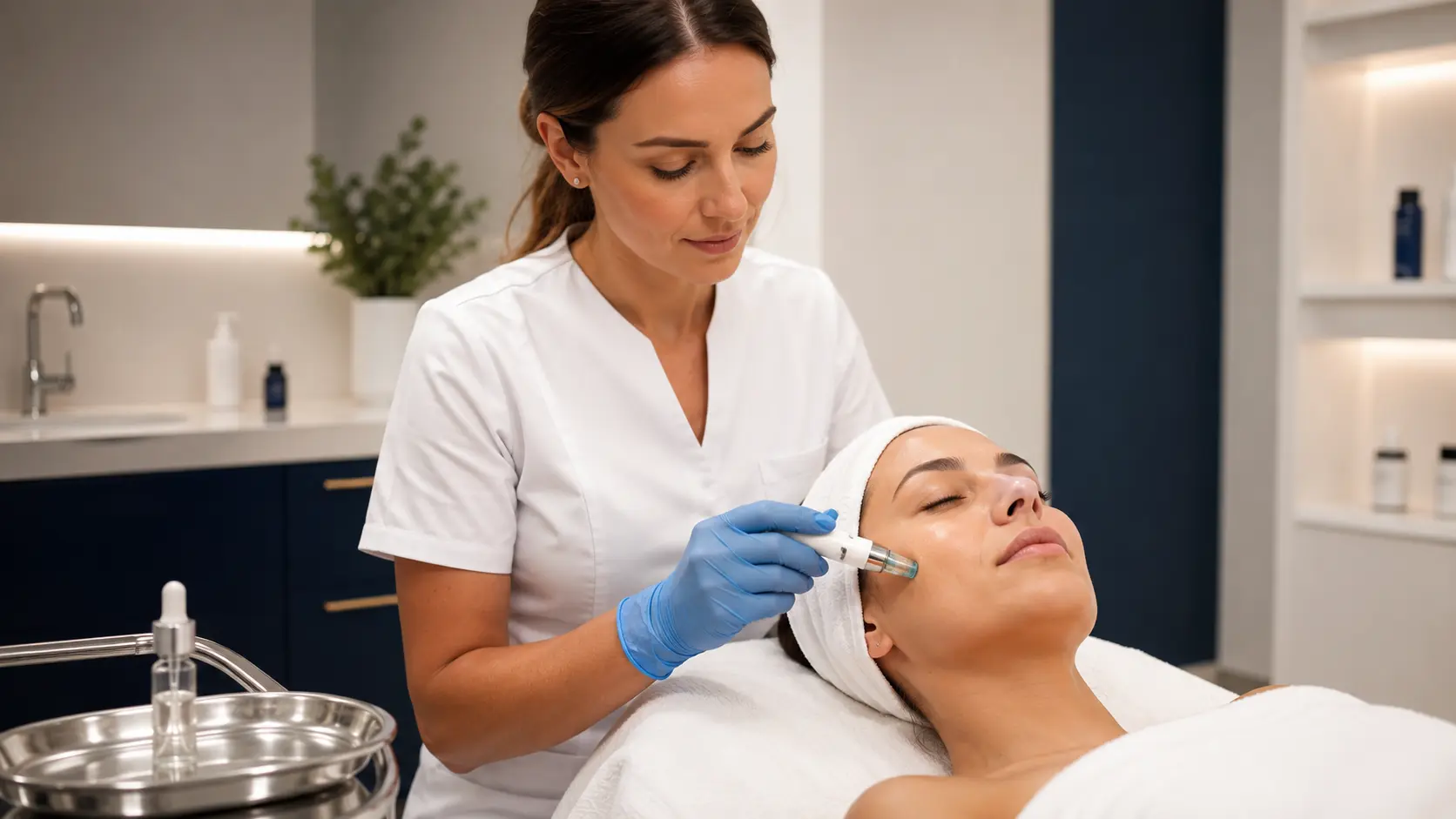
How Does Nano Infusion Actually Work?
Nano infusion works by using a device tipped with hundreds of microscopic cones — typically made from silicone or surgical-grade metal — that create temporary, extremely shallow microchannels in the outermost layer of the skin called the stratum corneum. These channels transiently increase skin permeability, allowing topically applied serums to penetrate far deeper than passive application alone could achieve. The process does not reach the dermis, does not cause bleeding, and does not trigger the wound-healing cascade associated with microneedling — making it a fundamentally different treatment despite its superficial similarities.
- Nano infusion tips penetrate only 0.1 to 0.15 mm into the stratum corneum — well above the dermis and any blood vessels.
- Microchannels created during treatment begin closing almost immediately and are fully resolved within two to four hours.
- Transdermal delivery of serums can increase by hundreds to thousands of times compared to passive topical application through intact skin.
- The treatment does not trigger the collagen-stimulating wound-healing cascade — its primary mechanism is enhanced ingredient delivery, not tissue repair.
- Water-based serums are required for effective nano infusion — oil-based formulations do not travel effectively through the hydrophilic microchannels.
- The skin’s immediate post-treatment permeability window is a critical clinical opportunity — what is applied immediately after treatment absorbs at dramatically elevated rates.
Understanding how nano infusion works at a physiological level is one of the most important pieces of education an esthetician can carry into their treatment room. It determines which serums you choose and why. It determines how you explain the treatment to clients in a way that builds genuine trust. It determines where nano infusion belongs within your service menu and protocol sequences. And it determines what results you can realistically promise — and deliver.
The term “nano infusion” covers a treatment category that is frequently misunderstood, often oversimplified, and sometimes misrepresented in both esthetic education and marketing materials. Many practitioners have a surface-level understanding — it’s like microneedling but gentler, it helps serums absorb better, it’s safe for sensitive skin. All of these statements are true, but none of them explains the mechanism. And without understanding the mechanism, it is impossible to make informed protocol decisions, respond accurately to client questions, or confidently defend the treatment’s clinical value.
This guide gives estheticians a complete, scientifically grounded explanation of exactly what happens to the skin during a nano infusion treatment — from the first device pass to full barrier restoration — and why every element of that process matters for real treatment room outcomes.
What Estheticians Need to Know About How Nano Infusion Works
- Nano infusion creates microchannels only in the stratum corneum — the non-living outermost skin layer — not in the living dermis where blood vessels and fibroblasts are located.
- The primary mechanism of action is transdermal delivery enhancement, not collagen induction or wound-healing stimulation.
- Microchannel depth of 0.1 to 0.15 mm is what keeps nano infusion within esthetician scope of practice in most states — crossing into dermal tissue changes the regulatory classification entirely.
- The post-treatment permeability window lasts two to four hours — every product applied during and immediately after treatment benefits from dramatically elevated absorption rates.
- Water-based serums are non-negotiable for effective treatment — oil-based formulations physically cannot travel through hydrophilic microchannels.
- Nano infusion does not cause bleeding, does not produce pinpoint bleeding patterns, and does not require the same post-treatment wound management as microneedling.
- Understanding the depth distinction between nano infusion and microneedling is not just clinical knowledge — it is a legal and scope-of-practice protection for every esthetician offering the service.
The Anatomy of Nano Infusion: What Is the Stratum Corneum and Why Does It Matter?
To understand how nano infusion works, you first need a clear picture of the specific skin structure it targets: the stratum corneum. This is the outermost layer of the epidermis, composed of flattened, non-living, anucleate cells called corneocytes held together in a lipid matrix. Its primary function is to act as the skin’s physical and chemical barrier — preventing water from evaporating out of the skin and preventing external substances from penetrating in.
That barrier function, which is essential to skin health, is also what makes topical ingredient delivery so challenging. The stratum corneum is highly effective at blocking large molecules from penetrating into the viable layers of the skin below. Ingredients like hyaluronic acid, peptides, growth factors, and many vitamins have molecular weights that make passive penetration through an intact stratum corneum extremely limited. Much of what is applied topically to healthy, intact skin remains on or near the surface rather than reaching the viable epidermis where it could interact with living cells.
The thickness of the stratum corneum varies by body region — thinner on the eyelids, thicker on the palms and soles — and by individual factors including age, hydration status, skin condition, and prior treatment history. On the face in typical clinical treatment areas, the stratum corneum is approximately 10 to 20 micrometers thick, or roughly 0.01 to 0.02 millimeters. This measurement becomes important when we examine exactly how deep nano infusion tips penetrate.
Why the Stratum Corneum Is the Critical Target Layer
Nano infusion’s entire mechanism depends on selectively disrupting the stratum corneum without entering the viable epidermis or dermis below. The stratum corneum is the only layer of skin that can be temporarily disrupted and resealed without triggering meaningful inflammatory or immune responses — because it contains no living cells, no blood vessels, and no nerve fibers capable of initiating a wound-healing cascade. When nano infusion tips create microchannels through this layer, they are creating temporary pathways through a non-living barrier, not injuring living tissue. This is the biological basis for nano infusion’s favorable safety and downtime profile compared to treatments that penetrate into dermal tissue.
How Microchannels Are Formed During a Nano Infusion Treatment
The nano infusion device tip is an array of microscopic cones or pyramidal projections — typically numbering in the hundreds — arranged on a stamp-sized applicator head. These tips are made from either silicone or surgical-grade metal depending on the device design, with each type carrying different clinical performance characteristics discussed in detail in the companion article on silicone versus metal nano tips.
When the device is pressed against the skin surface and oscillated or stamped across the treatment area with applied serum, several simultaneous events occur:
- Physical tip contact and stratum corneum displacement Each microscopic tip contacts the skin surface and mechanically displaces the corneocytes in the stratum corneum, creating a temporary opening or channel. At the nano scale, these channels measure approximately 0.1 to 0.15 millimeters in depth — enough to penetrate through the stratum corneum into the uppermost layers of the viable epidermis at most, but not reaching dermal tissue in properly performed treatments.
- Transient barrier disruption and permeability increase The creation of thousands of microchannels per pass dramatically reduces the barrier resistance of the treatment area. The skin’s lipid matrix between corneocytes is physically disrupted at each channel point, creating open pathways through which water-based molecules can pass into the skin. Transepidermal permeability in the treatment zone increases substantially during this window.
- Serum wicking into microchannels The serum applied to the skin surface during treatment is physically drawn into the open microchannels through capillary action and osmotic gradients. This is why technique matters — adequate serum presence on the skin surface during device movement is essential for delivery to occur. The channels act as conduits, pulling the serum from the surface directly through the stratum corneum toward the viable epidermis.
- Active ingredient delivery to the viable epidermis Molecules that would remain on the skin surface under passive application conditions are now delivered directly to the viable epidermis — the living cellular layer where interactions with keratinocytes, Langerhans cells, and other epidermal structures can produce meaningful biological effects. Hyaluronic acid, peptides, growth factors, vitamins, and other actives in the infused serum reach target cells they would otherwise never contact.
- Immediate channel closure initiation The stratum corneum begins the process of channel closure almost immediately after the device passes. The non-living corneocytes and lipid matrix begin restoring their physical arrangement, reducing the permeability window progressively. This is not a wound-healing response — it is a physical reorganization of the barrier structure that does not require biological repair mechanisms.
The Transdermal Delivery Science: Why Serums Absorb So Differently Through Microchannels
The difference between passive topical absorption and microchannel-assisted delivery is not a matter of degree — it is a fundamentally different delivery pathway. Understanding this distinction allows estheticians to make scientifically informed serum selection decisions and to set realistic, accurate treatment expectations with clients.
Passive Topical Absorption: The Barrier Problem
Under normal skin barrier conditions, topical ingredient penetration is governed primarily by the physicochemical properties of the molecule in question: its molecular weight, lipophilicity or hydrophilicity, charge, and size. The general rule in transdermal science is that only molecules with molecular weights below approximately 500 Daltons can meaningfully penetrate intact skin through passive diffusion. Many of the most clinically valuable skin ingredients — including hyaluronic acid (ranging from thousands to millions of Daltons), growth factors, and many peptides — are well above this threshold.
This means that a significant percentage of the active ingredient content in premium professional serums applied to intact skin never reaches the viable epidermis. They remain in the stratum corneum, on the skin surface, or are removed with the next cleanse. The clinical implication is that ingredient quality and molecular sophistication matter far less than the delivery method when the barrier is intact.
Microchannel-Assisted Delivery: Bypassing the Barrier
Nano infusion changes this equation completely. By creating physical channels through the stratum corneum, the treatment bypasses the primary barrier mechanism that limits passive topical delivery. Molecules no longer need to diffuse through the lipid matrix between corneocytes — they have a direct aqueous pathway to the viable epidermis. Research on microchannel-assisted transdermal delivery consistently demonstrates enhancement ratios in the range of several hundred to several thousand times compared to passive application for large-molecular-weight hydrophilic actives.
Why Nano Infusion Transforms Serum Delivery Compared to Topical Application
The stratum corneum under normal conditions blocks molecules above approximately 500 Daltons from meaningful passive penetration. Hyaluronic acid molecular weights range from 5,000 to several million Daltons. Most peptides range from 500 to 5,000 Daltons. Most growth factors range from 6,000 to 45,000 Daltons.
Nano infusion microchannels create direct aqueous pathways through the stratum corneum, bypassing the Dalton barrier entirely. The enhancement ratio for microchannel-assisted delivery of high-molecular-weight hydrophilic actives can reach hundreds to several thousand times compared to passive topical application on intact skin.
This is why serum selection matters more in nano infusion than in any other esthetician treatment modality. The serums you choose are not just sitting on the skin surface — they are reaching the viable epidermis where they interact with living keratinocytes, Langerhans cells, and other structures capable of producing real biological responses.
Why Water-Based Serums Are Non-Negotiable
The microchannels created during nano infusion are hydrophilic environments. The aqueous channels formed through the lipid-based stratum corneum matrix preferentially accommodate water-based molecules. Oil-based formulations, which are lipophilic, do not flow effectively through these aqueous pathways — they can actually obstruct channel formation, reduce delivery efficiency, and may physically clog the nano tips during treatment. Every esthetician performing nano infusion should operate with a clear rule: water-based serums in, nothing else.
This constraint also means that treatment serums should be free from heavy oils, waxes, silicones, and high concentrations of lipid-based emollients. Pure hyaluronic acid serums, water-based peptide formulations, vitamin C in ascorbic acid or sodium ascorbyl phosphate form, niacinamide solutions, and water-based growth factor preparations are all appropriate vehicles. Many estheticians also use the nano infusion step to deliver targeted brightening, hydrating, or anti-aging actives that form the clinical core of the treatment outcome.
Nano Infusion Versus Microneedling: Understanding the Depth Difference
The single most important distinction between nano infusion and microneedling is depth of penetration — and this difference is not minor. It determines the biological mechanism of action, the expected treatment outcomes, the post-treatment experience for the client, the risk and contraindication profile, and in most states, whether the treatment falls within esthetician scope of practice at all.
What the Depth Difference Means Clinically
Because nano infusion tips do not penetrate into the dermis, the treatment cannot produce the fibroblast activation and wound-healing cascade that drives microneedling’s collagen induction effects. This is not a limitation to apologize for — it is a feature to understand. Nano infusion is not a less effective version of microneedling. It is a different treatment serving a different clinical purpose: maximized transdermal delivery of active serums into the viable epidermis, without the tissue trauma, downtime, or regulatory complexity of dermal needling.
For estheticians, the practical significance of the depth distinction extends beyond clinical outcomes. In many states, the line between esthetician-appropriate and medically regulated treatment falls precisely at the boundary between epidermal and dermal penetration. Staying above that boundary — which properly performed nano infusion does by design — is the legal foundation of the treatment’s esthetician appropriateness. Understanding exactly where that boundary is, and why the treatment stays above it, is essential knowledge for every esthetician offering the service.
| Clinical Variable | Nano Infusion | Microneedling |
|---|---|---|
| Penetration depth | 0.1–0.15 mm (stratum corneum) | 0.5–2.5 mm (dermis) |
| Primary mechanism | Transdermal delivery enhancement | Collagen induction via wound healing |
| Bleeding | None — no dermal contact | Pinpoint bleeding expected at dermal depths |
| Wound-healing cascade | Not triggered | Fully triggered — platelet activation, growth factors, fibroblast proliferation |
| Typical downtime | 1–4 hours mild redness | 1–5 days redness, potential peeling |
| Scope of practice | Generally esthetician-appropriate | Medically regulated in most states |
| Best indications | Hydration, dehydration, fine lines, dullness, brightening | Acne scars, deep lines, skin laxity, significant textural concerns |
The Post-Treatment Permeability Window: Why What You Apply After Treatment Matters as Much as During
One of the most clinically significant — and most frequently underutilized — aspects of nano infusion is what happens in the hours immediately following treatment. The microchannels do not close instantaneously. Full barrier restoration typically takes two to four hours, and some literature suggests complete resolution can extend up to 24 hours. During this window, skin permeability remains significantly elevated above baseline.
This means that every product applied to the skin during this window benefits from the same delivery advantage as the treatment serums themselves. Estheticians who understand this correctly design their post-treatment protocols as an active continuation of the treatment outcome, not simply as aftercare.
What Estheticians Commonly Apply in the Post-Treatment Window
The most effective post-treatment applications capitalize on the permeability window with ingredients that have the highest clinical value when they reach the viable epidermis: hyaluronic acid in both low and high molecular weight forms for multi-depth hydration, polyglutamic acid for surface sealing and hyaluronidase inhibition, peptide complexes for barrier repair and anti-aging signaling, growth factors for cellular regeneration and recovery, vitamin C in water-soluble form for brightening and antioxidant protection, and soothing actives like centella asiatica, niacinamide, or bisabolol for inflammation management.
Many estheticians also incorporate a jelly mask or hydrogel mask immediately after nano infusion to occlusively seal the elevated permeability state, preventing TEWL during the recovery window and amplifying humectant delivery into the skin. The combination of microchannel-assisted delivery followed by occlusive mask application represents one of the most effective treatment-room hydration protocols available to estheticians working within their scope of practice.
Estheticians using the ILUMIPEN by Luminous Skin Lab in high-volume nano infusion protocols consistently report that the most meaningful client outcomes come not just from the device pass itself but from the intentional management of the post-treatment permeability window. In practice, the standard workflow after completing the nano infusion pass is immediate application of a hyaluronic acid or polyglutamic acid serum while the skin is still in its elevated absorption state, followed by placement of a hydration mask — often a jelly mask formulation — to occlusively seal the heightened permeability and prevent transepidermal water loss during the 20-minute masking window.
Practitioners report that clients who receive this complete protocol — ILUMIPEN treatment pass, immediate post-pass serum, occlusive hydration mask — consistently show visibly more hydrated, luminous skin at the end of the session than clients who received only the device treatment without the structured post-treatment protocol. The permeability window is where the treatment outcome is completed, not just where it begins. Skipping the intentional post-treatment delivery step leaves measurable clinical value on the table.
Nano Tip Technology: How Device Design Affects Microchannel Quality
The quality of microchannel formation — and therefore the effectiveness of transdermal delivery — is directly influenced by the design and material of the nano tip. Not all tips perform identically, and understanding the key design variables helps estheticians evaluate devices and make informed purchasing decisions.
Tip Material: Silicone vs. Metal
Silicone nano tips are softer and more flexible, creating gentler skin contact and making them particularly appropriate for sensitive, reactive, or post-treatment skin. They produce somewhat shallower channel formation and are generally considered more forgiving in technique. Metal tips — typically surgical-grade stainless steel or titanium — produce more precise, consistent channel formation and may be more effective for deeper stratum corneum penetration in thicker or more resilient skin. The companion article on silicone versus metal nano tips covers this comparison in full clinical detail.
Tip Cone Density and Arrangement
The number and arrangement of cones on the tip head determines how many microchannels are created per device pass. Higher-density tip arrays create more channels per square centimeter, increasing total delivery surface area. However, tip density must be balanced against applied pressure and skin sensitivity to avoid excessive barrier disruption or client discomfort.
Device Motion: Stamp vs. Circular
Different nano infusion techniques involve either stamping the device directly onto the skin surface or using circular or gliding motions. Each approach affects channel depth consistency, serum distribution, and skin response. The stamp technique tends to produce more uniform channel depth across treatment areas because pressure is applied perpendicularly to the skin surface rather than at an oblique angle. Circular and gliding techniques can improve serum distribution coverage but require more careful pressure management to maintain consistent depth. This is explored in detail in the companion article on stamp versus circular motion technique.
Serum Volume Management During Treatment
Effective microchannel delivery requires adequate serum presence on the skin surface at all times during device movement. Insufficient serum leads to dry tip contact, reduced delivery, and potential skin friction. Too much serum creates pooling, reduces device contact consistency, and may dilute the active concentration being delivered. Experienced estheticians develop a feel for the correct serum volume to reapply during treatment — typically a thin, wet film maintained across the active treatment zone throughout each device pass.
How the Skin Responds to Nano Infusion: Normal Findings vs. Signs of Concern
Understanding the normal post-treatment skin response to nano infusion — and being able to distinguish it from signs that something has gone wrong — is essential clinical knowledge for every esthetician offering the service.
Normal Post-Treatment Findings
Mild transient erythema (redness) in the treatment area is a universal and expected finding immediately following nano infusion. This reflects the temporary disruption of the stratum corneum and minor reactive vasodilation in superficial capillaries. In most clients, this resolves within one to four hours. Skin may feel slightly warm to the touch immediately post-treatment. Some clients notice a subtle immediate plumping or luminosity effect from the delivered serum actives — this is the desired treatment outcome manifesting within minutes of completion.
Signs That Depth or Pressure Was Excessive
Pinpoint bleeding — even minor bleeding — is a clear sign that the treatment has penetrated beyond the stratum corneum into the dermis. This should not occur in a correctly performed nano infusion treatment. If pinpoint bleeding is observed, the treatment has crossed from nano infusion into dermal needling territory, changing the regulatory classification, the post-treatment protocol requirements, and the scope of practice analysis. Excessive redness that intensifies rather than fades within the first 30 minutes post-treatment, or that is accompanied by significant client discomfort, may also indicate excessive depth or pressure was applied.
Contraindications and Caution Scenarios
Nano infusion is contraindicated on active acne breakouts in the treatment area, open wounds or skin lesions, active cold sores, severely compromised or severely sensitized skin, and clients with certain systemic inflammatory conditions. For clients with reactive or sensitive skin, using a silicone tip and reducing applied pressure produces a safer treatment while maintaining delivery efficacy. The companion article on nano infusion for sensitive skin provides specific protocol guidance for this client category.
What Nano Infusion Cannot Do: Setting Accurate Client Expectations
Understanding the limits of nano infusion is as important as understanding its capabilities. Estheticians who overpromise results create the most dissatisfied clients and expose themselves to the greatest professional risk.
Nano infusion cannot produce the degree of skin remodeling and scar reduction that microneedling achieves, because it does not reach the dermal fibroblasts responsible for new collagen production. Clients with deep acne scarring, significant skin laxity, or advanced photodamage that requires structural dermal change are not appropriate candidates for nano infusion as a primary treatment. They may benefit from nano infusion as part of a multi-modality protocol that includes microneedling or other dermal treatments, but estheticians should refer these clients to appropriately licensed providers for the dermal treatment component.
Nano infusion also cannot provide the degree of ingredient delivery depth that injectables achieve. While microchannel-assisted delivery dramatically outperforms passive topical application, it is still a surface and epidermal-depth delivery system. Clients seeking sub-dermal volumization, deep structural hydration, or neuromodulator-level wrinkle relaxation need medical provider services, not nano infusion.
What nano infusion does exceptionally well — and what estheticians should communicate with genuine confidence — is deliver meaningful improvements in skin hydration, texture, luminosity, fine line appearance, and overall skin vitality through enhanced serum delivery in a no-downtime, esthetician-appropriate treatment format. These are clinically real, visible outcomes that clients will recognize and return for.
Professional and Scientific References
The science of transdermal delivery and stratum corneum barrier function referenced in this article draws from established dermatological and cosmetic science literature:
- Stratum corneum barrier function and passive topical delivery thresholds. Cosmetic dermatology literature; Elias PM, Journal of Investigative Dermatology, established principles. The 500-Dalton rule for passive transdermal penetration of intact skin is a foundational principle in transdermal pharmaceutical and cosmetic delivery science.
- Microchannel-assisted transdermal delivery enhancement ratios. Prausnitz MR, Langer R, Nature Biotechnology, 2008; transdermal drug delivery research literature. Microneedle and microchannel-assisted delivery consistently demonstrates several-hundred-fold to several-thousand-fold enhancement for high-molecular-weight hydrophilic molecules compared to passive application.
- Stratum corneum structure, thickness, and barrier restoration kinetics following disruption. Fluhr JW, Darlenski R, Skin Pharmacology and Physiology, 2008; established barrier science literature.
- Nano infusion tip depth characterization and esthetician scope of practice. State cosmetology board regulatory guidance documents; professional esthetic education literature.
- Serum molecular weight and transdermal delivery compatibility. Cosmetic formulation science; ingredient supplier technical literature for hyaluronic acid, polyglutamic acid, peptides, and growth factors.
For estheticians ready to bring professional nano infusion into their treatment room with a device designed specifically for esthetician scope and workflow, the ILUMIPEN by Luminous Skin Lab is the tool our education team references when discussing nano infusion technique and protocol development. The ILUMIPEN is engineered to deliver consistent microchannel formation within the esthetician-appropriate stratum corneum depth range, supporting the transdermal delivery science described throughout this guide. It is designed for the specific workflow demands of the treatment room: reliable tip performance, serum-compatible construction, and protocol integration with hydration masks and LED adjunctive treatments.
Explore the ILUMIPEN Nano Infusion DeviceFrequently Asked Questions: How Nano Infusion Works
How does nano infusion actually work on the skin?
Nano infusion works by using a device tipped with hundreds of microscopic silicone or metal cones to create temporary, shallow microchannels in the outermost layer of the skin — the stratum corneum. As the tip oscillates or stamps across the skin surface, it transiently disrupts the skin barrier just enough to allow topically applied serums to penetrate significantly deeper than they could through intact skin. The process does not puncture into the dermis, which is what separates nano infusion from microneedling and keeps it within esthetician scope of practice in most states.
What is actually happening to the skin during a nano infusion treatment?
During nano infusion, the device tip creates thousands of microchannels per pass through the stratum corneum — the skin’s outermost protective layer. These channels are extremely shallow, typically 0.1 to 0.15 millimeters in depth, and do not reach the dermis or blood vessels. The microchannels temporarily increase skin permeability, allowing serums applied during treatment to bypass the skin’s normal barrier resistance and reach the viable epidermis. The channels begin closing within minutes of treatment and are fully resolved within hours. The result is dramatically enhanced ingredient delivery without the wound-healing cascade triggered by true dermal needling.
What is the difference between nano infusion and microneedling in terms of how deep they go?
Nano infusion tips penetrate only into the stratum corneum, the outermost non-living layer of the skin, at depths typically ranging from 0.1 to 0.15 millimeters. Microneedling penetrates into the living dermis, with treatment depths commonly ranging from 0.5 to 2.5 millimeters depending on the skin concern being addressed. This depth difference is the primary reason nano infusion does not trigger the collagen-stimulating wound-healing cascade that microneedling produces, and why nano infusion is generally considered within esthetician scope of practice while microneedling is regulated as a medical procedure in many states.
Why does nano infusion help serums absorb so much better?
The stratum corneum acts as the skin’s primary barrier against topical ingredient penetration. Under normal conditions, most high-molecular-weight actives like hyaluronic acid, peptides, and growth factors remain primarily on the skin surface because the barrier physically prevents them from reaching the viable epidermis. Nano infusion temporarily creates thousands of microscopic pathways through the stratum corneum, bypassing this barrier resistance. Research consistently shows that microchannel-assisted delivery can increase transdermal absorption of certain molecules by a factor of several hundred to several thousand compared to passive topical application.
Does nano infusion cause any bleeding or skin trauma?
No. Properly performed nano infusion does not cause bleeding because the tip depth does not reach the dermis where blood vessels are located. The treatment targets only the stratum corneum, and the microchannels created are too shallow to contact any vascular structures. Clients may experience mild transient redness immediately post-treatment, but this typically resolves within one to four hours. The absence of bleeding is one of the key clinical distinctions between nano infusion and microneedling, and is a central reason nano infusion is positioned as a low-downtime treatment.
What types of serums work best with nano infusion and why?
Water-based serums are the preferred vehicle for nano infusion because they flow freely through microchannels and do not clog the tip or obstruct channel formation. Oil-based formulations do not travel effectively through the hydrophilic microchannels and can interfere with tip performance. The most clinically effective serum choices include hyaluronic acid, polyglutamic acid, peptides, growth factors, vitamin C in water-soluble form, and brightening actives like niacinamide. Ingredient molecular size matters — smaller molecules penetrate more readily, though microchannel-assisted delivery significantly widens the effective penetration range compared to passive topical application on intact skin.
How long does it take for the microchannels to close after a nano infusion treatment?
The microchannels created during nano infusion begin closing almost immediately after the device passes over each area of skin. Full channel closure is typically complete within two to four hours post-treatment, though some literature suggests full barrier restoration can take up to 24 hours. This closure window is clinically significant because it determines how long the skin remains in a heightened absorption state. Estheticians commonly follow nano infusion with a hydration mask, LED therapy, or additional serum layers precisely to capitalize on this elevated permeability window before the barrier fully restores.
Can nano infusion stimulate collagen the way microneedling does?
Nano infusion does not produce the same degree of collagen induction as microneedling because it does not reach the dermis where fibroblasts responsible for collagen synthesis are located. Microneedling’s collagen-stimulating effect depends on creating controlled micro-injuries in the dermis that trigger the wound-healing cascade, including platelet activation, growth factor release, and fibroblast proliferation. Nano infusion works differently — its primary mechanism is enhanced transdermal delivery rather than tissue injury and repair. However, the serums delivered during nano infusion, particularly peptides and growth factors, can support collagen synthesis pathways when they reach the viable epidermis.
How does the ILUMIPEN device from Luminous Skin Lab work for nano infusion treatments?
The ILUMIPEN by Luminous Skin Lab is a professional nano infusion device designed specifically for esthetician treatment room use. It uses a precision-engineered nano tip to create microchannels in the stratum corneum during treatment, enhancing transdermal serum delivery while keeping the treatment within the non-invasive, esthetician-appropriate depth range. The device is developed with treatment room workflow in mind, supporting the serum infusion protocols estheticians use for hydration, brightening, and barrier recovery facials.
Understanding the Mechanism Is How You Master the Treatment
Nano infusion is one of the most scientifically interesting treatments in the esthetician’s clinical toolkit precisely because its mechanism of action is so distinctly different from the modalities that surround it. It is not a gentle version of microneedling. It is not simply a device that makes serums absorb better. It is a treatment that exploits a specific physiological window — the temporary permeability created by controlled stratum corneum disruption — to deliver ingredients to skin cells that would otherwise never contact them.
Understanding this mechanism changes how you select serums, how you design your post-treatment protocol, how you communicate results to clients, and how you position the treatment on your service menu. It changes your confidence when answering the question clients most commonly ask: “What is actually happening during this treatment?” The answer — which you now have in complete detail — is not a marketing claim. It is science. And for estheticians who can explain it clearly and credibly, that knowledge is one of the most powerful trust-building tools they carry into the treatment room.
The permeability window, the depth boundary, the water-based serum requirement, the post-treatment delivery opportunity — these are not technical footnotes. They are the clinical logic that connects every product decision, every technique choice, and every treatment outcome to the underlying biology of the skin you are working with.