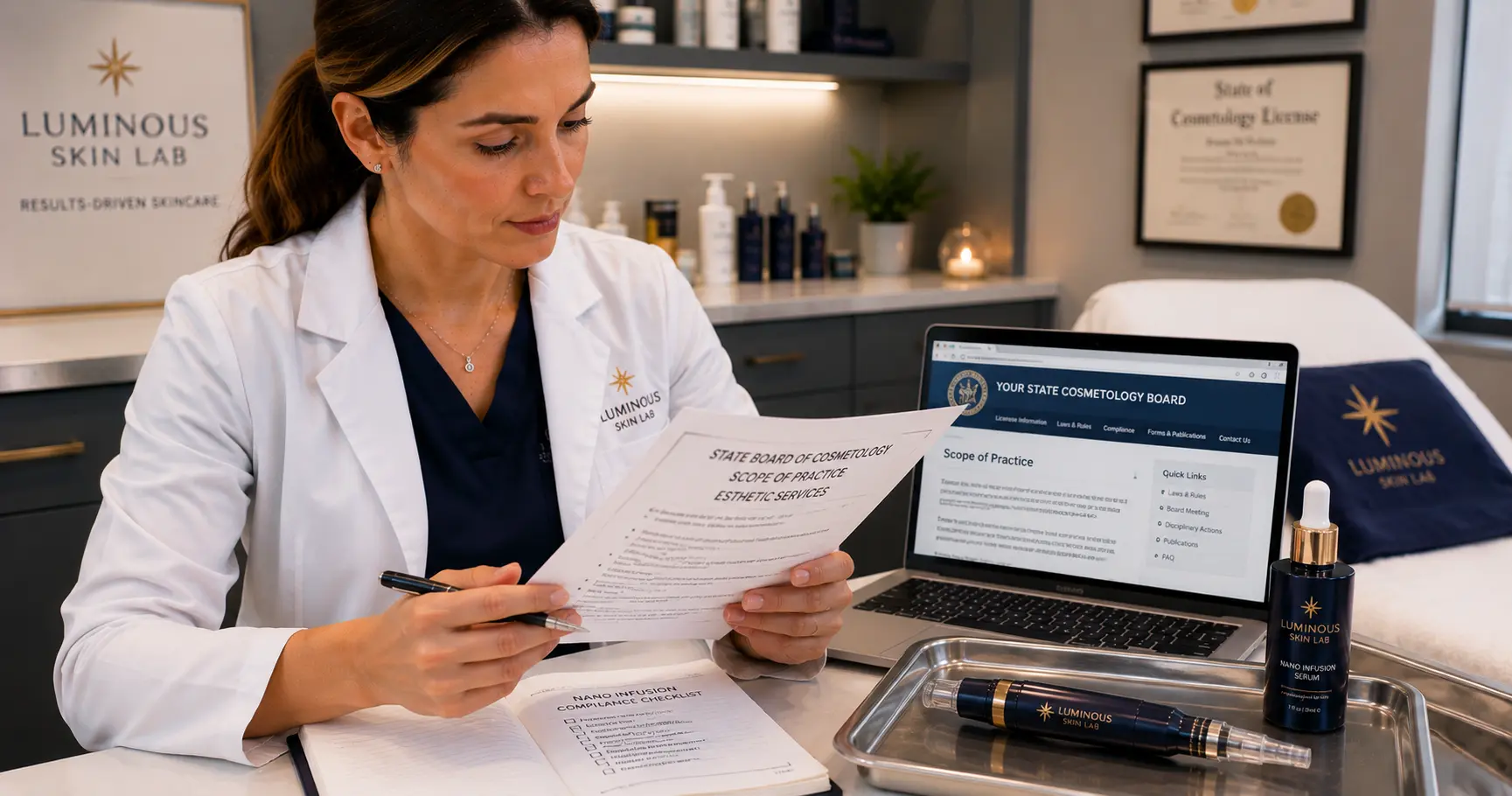
Does Nano Infusion Require Medical Oversight for Licensed Estheticians?
In most states, nano infusion performed with a true needle-free device does not require medical oversight or physician supervision for licensed estheticians. Because nano infusion operates at the skin surface using vibrating nano tips rather than needles that pierce the dermis, most state cosmetology and esthetics boards classify it within the esthetician scope of practice — placing it in a fundamentally different legal category from microneedling, which does require medical oversight in many jurisdictions.
- Nano infusion is legally distinct from microneedling in most states because it does not pierce the skin — most boards that restrict microneedling still permit nano infusion under the esthetician license.
- The needle-free classification is the central legal argument for esthetician-scope nano infusion, but some states apply broad medical practice statutes that may still require verification.
- Using prescription serums or physician-dispensed compounds during nano infusion changes the legal analysis entirely — this typically places the service outside esthetician scope regardless of state.
- Every esthetician must verify the rules in their specific state with their state board before offering nano infusion — general industry information does not substitute for state-specific legal confirmation.
- Proper informed consent documentation, sanitation protocols, and professional liability insurance remain professional standards regardless of whether medical oversight is legally required.
Among the compliance questions that arise most frequently when estheticians consider adding nano infusion to their service menu, the question of medical oversight is both the most important and the most misunderstood. Industry forums and social media discussions are filled with confident, contradictory answers — some practitioners insisting that no medical oversight is ever needed, others claiming a medical director is always required. Neither blanket answer is accurate, and the consequences of getting this wrong can include license suspension, civil liability, and insurance coverage denial.
The honest answer is that medical oversight requirements for nano infusion depend on your specific state, the classification of the device you use, the substances you infuse during treatment, and in some cases the setting in which you practice. The good news is that in the majority of states, a licensed esthetician using a genuine needle-free nano infusion device and cosmetic-grade serums can legally perform the service without physician supervision or a medical director relationship. But “in most states” is not the same as “in your state,” and the only way to know for certain is to verify directly with your state board.
This guide walks through the full legal and regulatory landscape: why nano infusion is categorized differently from microneedling in most jurisdictions, what specific factors can change the medical oversight analysis, how state variation actually plays out in practice, when a medical director relationship genuinely is required or advisable, and exactly how to verify your own compliance position before you treat a single client.
This article is educational content for licensed estheticians and does not constitute legal advice. Scope of practice laws change, vary significantly by state, and are subject to board interpretation. Always verify your specific state’s current rules by contacting your state cosmetology or esthetics board directly and, where appropriate, consulting a licensed attorney specializing in cosmetology law before offering any new service.
What Every Esthetician Needs to Know About Nano Infusion and Medical Oversight
- In most states, nano infusion with a needle-free device does not require a medical director or physician supervision under the esthetician license.
- Nano infusion is a legally distinct service from microneedling — the needle-free classification places it in a different regulatory category in most jurisdictions.
- Some states have broad medical practice statutes that require individual verification — “most states permit it” is never a substitute for confirming your specific state.
- Using prescription serums, PRP, or physician-dispensed compounds with nano infusion removes the esthetician-scope protection in virtually every state.
- Gray-area states require direct written inquiry to your state board, not reliance on other practitioners’ interpretations or social media consensus.
- Even where medical oversight is not legally required, informed consent forms, sanitation standards, and professional liability insurance are non-negotiable professional requirements.
- The device classification matters as much as your license — a device marketed as “nano infusion” that actually pierces the skin may be regulated differently than a true surface-only nano tip device.
Why Nano Infusion Is Treated Differently From Microneedling Under Most State Laws
To understand why most states do not require medical oversight for nano infusion, it helps to understand the legal mechanism that creates oversight requirements for microneedling — and why that mechanism typically does not apply to nano infusion.
The Skin Penetration Threshold
In most states, the critical legal threshold for requiring medical oversight of a skin treatment is whether the procedure involves piercing, puncturing, or otherwise breaching the skin’s surface to access underlying tissue. This is why microneedling — which uses needles ranging from 0.25mm to 3.0mm in depth to create controlled micro-injuries in the dermis — is classified as a medical procedure, semi-medical procedure, or advanced practice procedure requiring physician oversight, delegation, or a medical license in many states.
Nano infusion devices use nano tips — either silicone pyramid arrays or metal micro-channel tips — that vibrate against the skin surface at high frequency without penetrating the dermis. They work through a combination of mechanical oscillation, pressure, and the creation of temporary superficial channels that allow serum infusion. The tips contact the outer surface of the stratum corneum but do not pierce through to the dermis or create the kind of controlled wound response that microneedling produces.
This distinction — no skin penetration, no wound response, no dermis access — is the foundational legal argument that places nano infusion within the esthetician scope of practice in most states. Most state esthetics practice acts already authorize estheticians to perform exfoliation, superficial skin treatment, and topical product application. A device that enhances topical delivery at the skin surface without breaching it generally fits within these existing authorizations.
How Most State Boards Have Interpreted This
In practice, the majority of state cosmetology and esthetics boards that have addressed nano infusion directly have either issued formal opinions confirming it falls within the esthetician scope of practice, or have declined to restrict it under their existing medical practice limitations. Several states have issued specific guidance explicitly distinguishing nano infusion from microneedling and confirming that licensed estheticians may perform needle-free nano infusion without physician oversight.
The important caveat is that not every state has issued formal guidance. In states where no formal opinion exists, the analysis typically defaults to whether the service fits within the existing esthetics practice act language — and the needle-free classification generally supports that it does. However, in the absence of formal board guidance, estheticians in those states carry more risk from ambiguity, and direct board inquiry is especially important.
How State Rules Actually Vary: Permitted, Restricted, and Gray-Area Jurisdictions
While the majority of states permit nano infusion under the esthetician license, the regulatory landscape is not uniform. Estheticians need to understand the three categories of state positions and identify which category applies to their state.
Majority of States
State boards have confirmed that needle-free nano infusion is within the esthetician scope of practice. No medical director or physician supervision required. Service may be performed independently in a spa, salon, or suite setting.
Minority of States
Broad medical practice statutes or specific board rulings classify any device-assisted serum infusion as requiring medical oversight regardless of needle involvement. Estheticians in these states must work under physician supervision or in a medical setting.
Some States
No formal board opinion has been issued. Existing practice act language does not explicitly address nano infusion. Estheticians must obtain written confirmation from their state board before offering the service.
What Creates State-Level Variation
Several factors drive the variation in how states approach nano infusion medical oversight requirements. Understanding these factors helps estheticians ask more precise questions when they contact their state board.
Breadth of medical practice act language. States with broadly written medical practice statutes — defining any procedure that “affects the structure or function of the body” as medical practice — may capture nano infusion within that language even without needle involvement. A minority of states apply this interpretation to any device-assisted infusion technology.
Pharmacy board jurisdiction. In some states, the act of introducing any substance deeper into the skin than standard topical application — even cosmetic-grade serums — triggers pharmacy board oversight or requires a prescriber relationship. This is uncommon but present in select jurisdictions.
Absence of updated regulations. Some states have esthetics practice acts that predate nano infusion technology entirely. When regulations were written, the category did not exist, leaving a legal gap. In these states, the safest approach is to obtain written guidance from the board before proceeding rather than assuming the service is permitted by default.
Board interpretation of existing language. Two states with similar practice act language may reach different conclusions about nano infusion based on how their board interprets the text. State board staff opinions can also vary, which is why getting written guidance from a formal board opinion rather than an informal staff answer is always preferable when possible.
When Does Nano Infusion Actually Require Medical Oversight or a Medical Director?
Even for estheticians in states that generally permit nano infusion under the esthetics license, there are specific circumstances in which medical oversight becomes legally required. Understanding these triggers is essential for staying within your scope as the service evolves in your practice.
Using Prescription or Physician-Dispensed Substances
This is the single most common compliance error estheticians make with nano infusion. The needle-free device classification and the esthetician-scope permission for the service itself apply to the delivery mechanism and the treatment act — they do not extend to every substance that might be used during the treatment. Using platelet-rich plasma (PRP), prescription growth factors, physician-dispensed peptide complexes, or any compounded prescription substance during a nano infusion treatment requires medical authorization to administer in virtually every state, regardless of the device’s needle-free status. Estheticians performing nano infusion must use cosmetic-grade, over-the-counter serums formulated for professional esthetic use. The moment a prescription substance enters the treatment, the service crosses outside the esthetician scope.
Practicing in a State With Broad Medical Practice Statutes
A minority of states apply medical practice statute language broadly enough to capture nano infusion even with a needle-free device. In these states, any device that is described as enhancing serum penetration into skin structures may be interpreted as delivering a substance into the body — which triggers medical practice act coverage. Estheticians in these states are not necessarily prohibited from nano infusion, but they may be required to operate under a physician-owner, medical director relationship, or delegating physician arrangement to offer the service legally.
Operating Under a Medical Spa License Structure
In some states, the physical setting of a practice changes the applicable rules. Medical spas that hold a medical facility license or operate under a medical corporation structure may have different staff authorization requirements than standalone esthetics practices. Estheticians working in a medical spa should confirm their scope with that setting’s medical director or compliance officer, as the rules that apply to independent esthetics practices may differ from those governing licensed medical facilities.
Offering Nano Infusion Under a Specific Medical Claim
Marketing a nano infusion treatment with medical claims — claiming that it treats a diagnosed condition, manages a disease, or produces a medical outcome — can trigger medical practice oversight requirements even in states that permit the service itself under the esthetics license. Estheticians should position nano infusion in their marketing and client communication as a cosmetic enhancement service focused on skin hydration, product infusion, and appearance improvement — not as a medical treatment for diagnosed conditions.
Estheticians who have integrated the ILUMIPEN by Luminous Skin Lab into their independent practice consistently navigate the compliance question by following a clear pre-launch protocol: confirming their state board’s position in writing, verifying that the ILUMIPEN is classified as a needle-free surface device in any board documentation, and building their service description specifically around cosmetic-grade serum infusion rather than any medical or therapeutic claim. Practitioners report that having the device’s needle-free specification in writing from the manufacturer is useful documentation when confirming scope with state board staff, particularly in gray-area states where nano infusion is not yet explicitly addressed in existing regulations.
The practical compliance risk most estheticians encounter is not the device itself — it is serum selection. Using only cosmetic-grade, esthetician-approved serums such as hydration-focused hyaluronic acid and peptide complexes keeps the treatment clearly within esthetician scope. Attempting to incorporate any physician-dispensed compound, even if obtained through an informal arrangement, creates immediate liability exposure that the needle-free device classification cannot protect against.
How to Actually Verify Your State’s Rules Before You Add Nano Infusion to Your Menu
Knowing that “most states permit it” and knowing that your state permits it are two completely different things. Here is a structured process for obtaining the specific confirmation you need.
Contact Your State Board Directly
Call or email your state cosmetology or esthetics board and ask specifically whether “needle-free nano infusion using a non-penetrating nano tip device” falls within the licensed esthetician scope of practice in your state. Use that exact language — it matters for how the question is processed.
Request the Response in Writing
An informal verbal answer from a board staff member carries limited legal protection. Request a written response, a reference to the specific statute or administrative rule that governs the question, or a formal board opinion if one has been issued. Written documentation protects you if the question is ever revisited.
Review Your State’s Esthetics Practice Act
Read the current language of your state’s esthetics or cosmetology practice act — available on your state board’s website or through the legislature’s online code database. Look for how the act defines authorized services, what equipment is addressed, and whether any skin penetration language is used that could affect the analysis.
Search for Existing Board Opinions
Many state boards publish formal advisory opinions or declaratory rulings on their websites. Search your state board’s published documents for any opinions related to nano infusion, microchanneling, or “needle-free skin treatment.” A published formal opinion is the strongest form of guidance available short of a statutory change.
Consult a Cosmetology Attorney if Needed
If your state is in a gray area, if you receive conflicting answers from board staff, or if the practice act language is ambiguous enough to support multiple interpretations, consulting a licensed attorney who specializes in cosmetology law in your state is a reasonable professional investment before adding a new service category.
Document Your Verification Process
Keep a compliance file that includes the date you contacted your state board, the name or reference number of the staff member you spoke with, any written responses you received, copies of the practice act sections you reviewed, and any formal board opinions you located. This documentation is your protection if your compliance position is ever questioned.
Understanding Medical Director Relationships: When They Help and When They Are Required
A medical director relationship — where a licensed physician agrees to provide oversight, supervision, or delegating authority to a spa or esthetics practice — is a common compliance structure in states where certain advanced services require medical oversight. Understanding what this relationship involves and when it is genuinely necessary (versus when it is being marketed unnecessarily) is important for estheticians navigating nano infusion compliance.
What a Medical Director Relationship Actually Requires
A genuine medical director relationship is not simply a physician’s signature on paperwork in exchange for a fee. In states where medical oversight is required, a legitimate supervising physician relationship typically involves the physician reviewing and approving treatment protocols, being available for consultation on adverse events, reviewing client records periodically, taking legal responsibility for the medical aspects of the services performed, and maintaining active involvement in the practice’s clinical operations. A purely nominal “medical director” arrangement that involves only a fee and a signature — without genuine physician involvement — may not satisfy the legal requirements of states that mandate meaningful medical supervision.
When Estheticians Pursue Medical Director Relationships for Nano Infusion
There are legitimate reasons an esthetician might choose to establish a medical director relationship for nano infusion even in a state where it is not legally required. These include operating in a gray-area state where a medical affiliation provides protective clarity, offering nano infusion alongside other services that do require medical oversight, pursuing a growth path into medical spa practice, or marketing to a clinical clientele where a medical director affiliation enhances professional credibility. These are business and positioning decisions, not legal requirements in most states.
The Misrepresentation Risk
Some training companies and device vendors overstate medical director requirements for nano infusion, creating unnecessary cost and compliance burden for estheticians who could legally offer the service independently. Conversely, some practitioners understate the need for oversight in genuinely regulated situations, creating legal exposure. Neither error serves the professional well. The standard this article consistently reinforces applies here too: verify your specific state’s actual rules rather than relying on any general industry claim about what is required nationwide.
The Key Legal Distinction Most Estheticians Need to Understand
The question “does nano infusion require medical oversight?” often gets conflated with the question “is nano infusion regulated?” These are different questions. All esthetic services are regulated — through your state esthetics or cosmetology license, sanitation standards, consent requirements, and professional liability standards. The specific question of medical oversight asks whether a physician, medical director, or licensed medical professional must be involved in authorizing, supervising, or overseeing the service.
For nano infusion with a needle-free device and cosmetic-grade serums, most states answer that question with “no medical oversight required” — because the service falls within the existing esthetics scope. That does not mean nano infusion is unregulated. It means the applicable regulation is your esthetics license, your state’s sanitation rules, your informed consent obligations, and your professional liability standards — all of which apply regardless of whether medical oversight is required.
Estheticians who understand this distinction are better positioned to explain their compliance status to clients, insurance providers, and any future regulatory inquiries than those who simply say “it’s allowed.”
Professional Standards That Apply to Nano Infusion Regardless of Medical Oversight Status
Whether your state requires medical oversight for nano infusion or confirms that you can offer it independently, the following professional standards apply in every context. These are not optional extras — they are the baseline professional requirements that protect both your clients and your practice.
Informed Consent Documentation
Every nano infusion client should complete a thorough informed consent form before treatment. The consent document should explain what nano infusion is and how it works, describe what the treatment does and does not do, list all contraindications and conditions under which the service should not be performed, disclose possible side effects including temporary redness, sensitivity, or reactions, confirm the client’s relevant health history and current medications, and acknowledge that the client understands the service is a cosmetic esthetic treatment performed by a licensed esthetician. Well-drafted consent forms protect clients by ensuring they are fully informed, and they protect estheticians by documenting that informed consent was obtained before treatment commenced.
Sanitation and Infection Control Standards
Nano infusion tips that contact the skin must be handled according to professional sanitation standards appropriate to single-use or properly sterilized reusable equipment, depending on the device design. Many nano infusion devices use single-use disposable nano tip attachments — these should never be used across multiple clients. Contact surfaces should be disinfected between clients according to your state board’s infection control rules. Proper hand hygiene, barrier protection, and treatment area preparation apply exactly as they do for any other professional skin service.
Professional Liability Insurance
Professional liability insurance for estheticians should be verified to cover nano infusion before the service is offered. Not all esthetics liability policies automatically cover new service categories — some require explicit endorsement or category addition. Confirm with your insurer that nano infusion is covered under your policy, and confirm whether any specific documentation requirements apply to that coverage. Most insurers will want confirmation that you have received appropriate training for the service and that you are offering it within your licensed scope.
Contraindication Screening
Regardless of medical oversight requirements, estheticians offering nano infusion are professionally responsible for screening clients against contraindications before treatment. Common contraindications for nano infusion include active acne lesions, open wounds, or skin infections in the treatment area; recent isotretinoin use within the preceding six to twelve months; blood-thinning medications that may affect skin response; active skin conditions including eczema, psoriasis, or rosacea in the treatment area; pregnancy in some protocols; and recent surgical procedures or cosmetic treatments in the area. Thorough intake and consultation before every treatment is a professional standard, not a legal formality.
Professional and Regulatory References
The compliance framework and legal analysis in this article draws from the following sources and reference categories:
- State cosmetology and esthetics practice acts — publicly available through state legislature online databases and state board websites. Specific statutes vary by jurisdiction; estheticians should access their own state’s current version directly.
- State board formal advisory opinions and declaratory rulings on nano infusion and microchanneling — published on individual state board websites where available.
- Associated Skin Care Professionals (ASCP) scope of practice resources and state-specific guidance for estheticians.
- National Coalition of Estheticians, Manufacturers/Distributors & Associations (NCEA) compliance and scope of practice education resources.
- Professional Beauty Association (PBA) regulatory affairs publications on esthetics scope of practice developments.
- State medical practice acts — relevant to understanding the overlap between cosmetology and medical board jurisdiction in states with broad medical practice statute language.
For estheticians who have confirmed that nano infusion falls within their state scope and are ready to evaluate a professional device purpose-built for esthetician use, the ILUMIPEN by Luminous Skin Lab is the device our education team most frequently references for licensed estheticians entering the nano infusion category. The ILUMIPEN was developed specifically for the esthetician scope of practice — designed around the needle-free nano tip mechanism that places treatment within the surface-only classification most states recognize, and paired with cosmetic-grade serum protocols that maintain clean esthetician-scope positioning. It is built for the treatment room realities of a licensed esthetician, not adapted from a medical device category.
Explore the ILUMIPEN Nano Infusion Device →Frequently Asked Questions: Nano Infusion Medical Oversight and Esthetician Compliance
Does nano infusion require a medical director or physician supervision?
In most states, nano infusion does not require a medical director or physician supervision when performed by a licensed esthetician using a true needle-free nano tip device. Because nano infusion operates at the skin surface without piercing the dermis, most state cosmetology and esthetics boards classify it within the esthetician scope of practice. However, requirements vary by state, and estheticians must verify the specific rules governing their license with their state board before offering the service.
Is nano infusion considered the same as microneedling legally?
No. Nano infusion and microneedling are legally distinct in most states. Microneedling uses needles that pierce the skin and is regulated as a medical or advanced procedure requiring physician oversight or a medical license in many jurisdictions. Nano infusion uses silicone or metal nano tips that vibrate at the surface without piercing, placing it in a different regulatory category. Most states that restrict microneedling to medical settings still permit nano infusion under the esthetician license.
Can a licensed esthetician legally perform nano infusion without working in a medical spa?
Yes, in most states a licensed esthetician can legally perform nano infusion in a private spa suite, salon, or independent treatment room without any medical affiliation. The key factor is that the device must be a true needle-free nano infusion tool operating at the skin surface. Working in a medical spa is not a legal requirement for nano infusion in most jurisdictions, though some states have specific rules that estheticians must confirm with their board.
What happens if an esthetician performs nano infusion in a state where it is restricted?
Performing any treatment outside your state-authorized scope of practice risks license suspension or revocation, civil liability, and potential fines or criminal charges depending on the state. If a client experiences an adverse reaction and you performed the service outside your legal scope, your professional liability insurance may also deny coverage. Verifying your state board’s current rules before adding any new service is non-negotiable from both a legal and ethical standpoint.
Why do some states require medical oversight for nano infusion even though it is needle-free?
Some states have broad medical practice statutes that define any device penetrating or significantly altering skin function as requiring medical oversight, regardless of needle involvement. Other states classify serum infusion technology as a drug delivery mechanism that falls under pharmacy or medical board jurisdiction. In a small number of states, outdated regulations predate nano infusion entirely, leaving the service in a legal gray area until the board issues a formal opinion. This is why direct inquiry to your specific state board is always required.
How do I find out if nano infusion is legal for estheticians in my state?
The most reliable method is to contact your state cosmetology or esthetics board directly and ask whether nano infusion using a needle-free device falls within the esthetician scope of practice. Ask for the response in writing or as a reference to a specific statute or rule. You can supplement this by consulting a cosmetology attorney in your state, reviewing your state’s current esthetics practice act, and checking whether any formal board opinions have been issued regarding nano infusion or microchanneling devices.
Does using PRP or prescription serums during nano infusion change the legal requirements?
Yes. Using prescription serums, PRP (platelet-rich plasma), or any physician-dispensed compound during a nano infusion treatment almost universally places the service outside the esthetician scope of practice, even in states where basic nano infusion is permitted. Prescription substances require medical authorization to administer. Estheticians performing nano infusion should only use cosmetic-grade, over-the-counter serums formulated for professional esthetic use. The device’s legal classification does not extend to the substances infused.
Do I still need client consent forms for nano infusion even if no medical oversight is required?
Yes. Informed consent documentation is a professional and liability standard for nano infusion regardless of whether medical oversight is required. Consent forms should describe the treatment, explain what nano infusion is and is not, list contraindications, disclose possible side effects, and confirm the client’s health history. Proper documentation protects both the client and the esthetician in the event of any adverse reaction or legal question, and most professional liability insurers require it for coverage to apply.
What makes the ILUMIPEN a good choice for estheticians who want to stay within legal scope for nano infusion?
The ILUMIPEN by Luminous Skin Lab is designed specifically for licensed estheticians operating within the scope of needle-free nano infusion. It uses nano tips that work at the skin surface without piercing the dermis, keeping the treatment within the esthetician-approved category in states where needle-free nano infusion is permitted. It was developed with professional compliance and treatment room workflow in mind, making it a practical choice for estheticians who want a device purpose-built for their legal scope rather than a medical-grade tool that may create regulatory ambiguity.
The Answer Depends on Your State — and Only Your State Board Can Give It to You
The compliance question around nano infusion and medical oversight does not have a single universal answer — but it has a clear and consistent process for finding the right answer for your specific situation. In most states, a licensed esthetician using a genuine needle-free nano tip device with cosmetic-grade serums does not require medical director oversight, physician supervision, or a medical spa affiliation to offer nano infusion legally. The needle-free classification is the foundational legal distinction that separates nano infusion from microneedling in most regulatory frameworks.
But “most states” is not “your state.” The practical steps are clear: contact your state board, ask the question using precise language, request written confirmation, review your state’s practice act, and document your verification process. Add to that the universal professional standards that apply regardless of state rules — informed consent, sanitation protocols, contraindication screening, and professional liability insurance — and you have a complete compliance foundation for nano infusion in your practice.
The estheticians who navigate this category most successfully are not those who rely on what they heard in a training course or saw in an industry forum. They are the ones who did the verification work specific to their state, built their service protocols on documented compliance, and positioned nano infusion within their practice with the same professional rigor they bring to every other service on their menu.