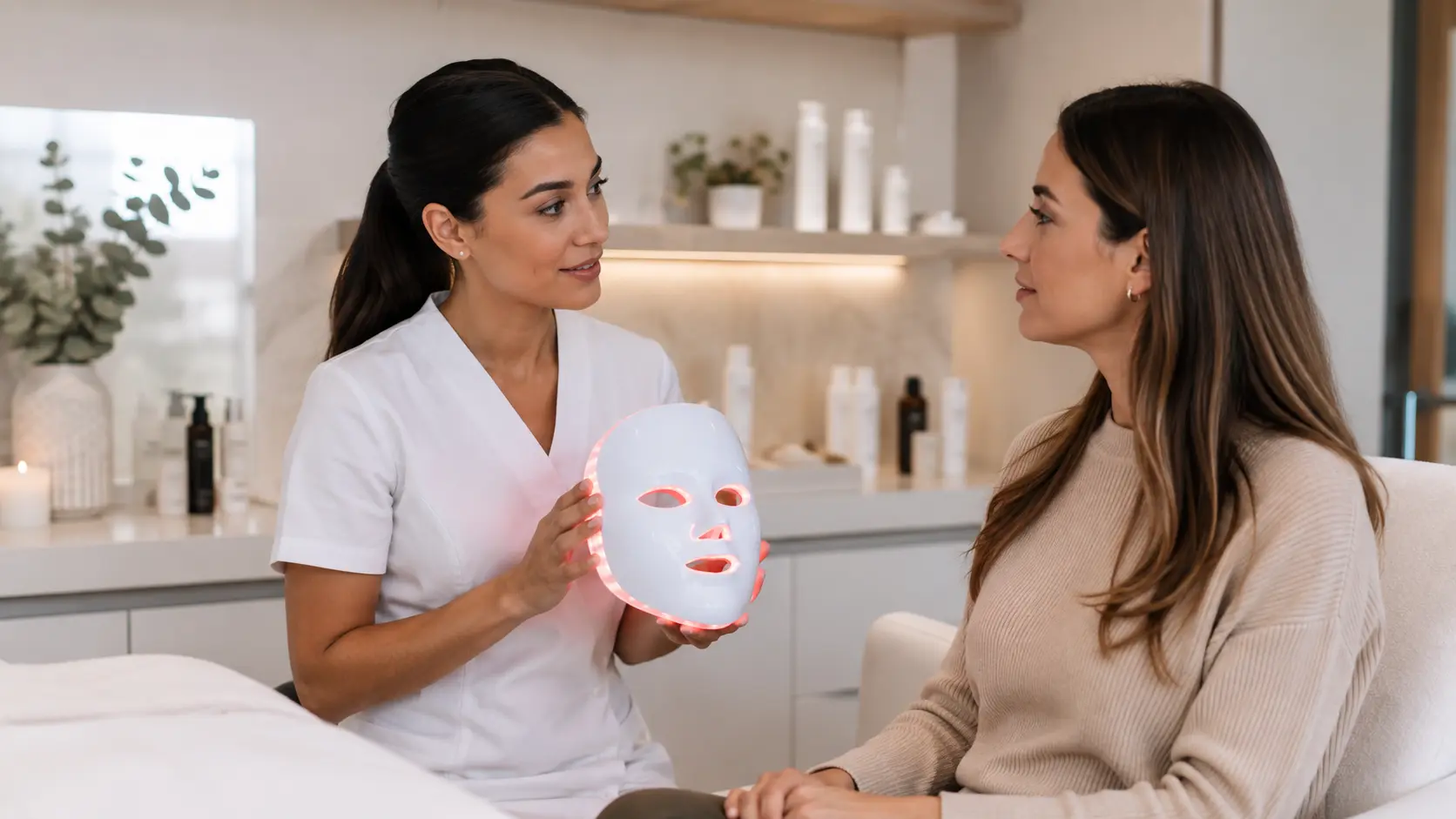
How Should Estheticians Recommend At-Home LED Devices to Clients?
Effective at-home LED device recommendations from estheticians share three characteristics: they are timed to a clinical moment where home use addresses a specific, understandable need; they are framed as an extension of the professional treatment plan rather than a retail product; and they are accompanied by a written protocol that tells the client exactly how to use the device to continue the work started in the treatment room. Recommendations that lack any of these three elements convert poorly, generate compliance problems, and produce client disappointment that reflects back on the esthetician’s credibility.
- The right moment to introduce the recommendation is when the treatment plan genuinely requires more session frequency than professional appointments can deliver — such as a collagen-building anti-aging protocol, a post-microneedling recovery window, or an active acne management phase.
- The device evaluation criteria that matter most are published irradiance specifications at treatment distance, wavelength accuracy, and coverage area — not LED count, wattage claims, or marketing positioning.
- Written home protocols with specific frequency, duration, sequencing, and a brief clinical rationale produce measurably better client compliance than verbal recommendations alone.
- The three most common client compliance failures — inconsistent frequency, incorrect treatment distance, and application over thick product layers — are each preventable with a single brief protocol card provided at the point of recommendation.
- Estheticians who guide both the professional and home components of a client’s LED program develop a qualitatively deeper practice relationship than those who operate only in the treatment room.
Most estheticians who offer LED therapy in their treatment rooms eventually encounter the same client question: “Is there something I can use at home?” How that question gets answered makes an enormous difference to the client’s outcome, to the esthetician’s credibility, and to the practice relationship that follows. An answer that treats the question as a retail opportunity produces a different outcome than one that treats it as a clinical question — and clients, with the sharp instincts of someone investing in their skin, can feel the difference.
The estheticians who handle the at-home LED recommendation most effectively are not the ones who happen to have a device on their retail shelf. They are the ones who have built a deliberate framework: they know when in a client’s treatment journey the at-home recommendation is clinically appropriate, they have evaluated the available devices against specifications that actually predict outcomes, they have developed consultation language that positions the recommendation as professional guidance rather than a sales pitch, and they hand clients a written protocol rather than a vague directive to “use it a few times a week.”
This guide builds that framework. It covers the consultation timing and framing that produces genuine clinical recommendation authority, the device evaluation criteria that separate effective recommendations from irradiance-deficient disappointments, the protocol documentation approach that drives compliance, and the practice development pattern that follows when the esthetician’s influence extends into the client’s home routine.
The Professional Framework for At-Home LED Device Recommendations
- The recommendation is most credible when it serves a specific clinical need the client can understand — not when it is offered at checkout to every client regardless of their treatment context.
- Device evaluation must include published irradiance specifications at treatment distance. No irradiance disclosure = no clinical recommendation basis.
- The framing shift from “this product is great” to “this is the home component of your treatment plan” changes client psychology around the purchase, compliance, and results attribution.
- A written protocol handed to the client at the point of recommendation is not optional. Verbal-only instructions produce inconsistent compliance.
- The three protocol specifics every client needs: frequency target, session duration, and skincare product sequencing.
- Post-procedure home LED guidance is the single highest-conversion recommendation context — the client has a specific, urgent clinical need and is maximally receptive to professional advice.
- Clients who follow a guided home LED protocol and see visible results become the most reliable referral source in an esthetician’s practice.
When to Introduce the At-Home LED Recommendation — and When Not To
The most damaging version of the at-home LED recommendation is the one offered indiscriminately — to every client at the end of every appointment, regardless of whether the recommendation is clinically relevant to their specific treatment situation. Clients are sophisticated enough to recognize the difference between a practitioner recommending something because it serves their skin and a practitioner recommending something because it is on the shelf. One builds authority; the other erodes it.
The Four Clinical Moments That Earn the Recommendation
There are four specific points in a client’s treatment journey where an at-home LED recommendation is genuinely clinically warranted and where clients are maximally receptive to it.
During initial treatment plan design for anti-aging or collagen goals. When a client presents with skin rejuvenation or collagen density objectives and the treatment plan calls for LED as a primary modality, the frequency gap between monthly professional sessions and the weekly stimulation that collagen remodeling actually requires creates a natural and honest opening. Estheticians who present the at-home recommendation as the solution to a dose-frequency problem the client can understand produce a receptive response rather than a sales-pitch response.
After the first or second professional LED session. Clients who have experienced professional LED and felt or noticed the subtle acute changes it produces — improved skin luminosity, reduced redness, a quality of skin texture they associate with the treatment — are far more receptive to a home device recommendation than those who have not yet experienced what LED does. The recommendation lands differently when the client has a sensory reference for the outcome it is designed to extend.
Immediately following a controlled-trauma procedure. The post-microneedling, post-peel, or post-dermaplaning consultation is the highest-conversion recommendation context in professional esthetic practice. The client has a specific, acute, and personally motivating clinical need — accelerating their recovery and protecting their investment in the procedure they just received. An at-home LED recommendation at this moment addresses a need the client is already thinking about, which transforms it from a retail item into an urgent clinical recommendation.
During acne management planning. Clients managing active acne need daily bacterial load reduction between monthly professional facials. The clinical gap is obvious and the home device recommendation fills it directly. Blue light daily use at home is not a supplement to the treatment plan for these clients — it is a required component of an adequate treatment frequency.
When Not to Introduce the Recommendation
Clients with no active LED treatment in their professional plan, clients presenting for a one-time or infrequent service without a commitment to a treatment series, and clients in their first appointment before any relationship has been established are all low-conversion, low-credibility moments for this recommendation. Offering it in these contexts creates the impression that the recommendation is commercially motivated rather than clinically reasoned. The restraint to withhold the recommendation until the clinical moment is right is itself a demonstration of professional judgment that clients notice.
How to Evaluate an At-Home LED Device Before Recommending It
An esthetician’s professional reputation is attached to every recommendation they make. That makes device evaluation a non-negotiable pre-condition of the at-home LED recommendation — and the criteria for that evaluation are more specific than most device marketing materials acknowledge. Estheticians who recommend devices based on brand familiarity, aesthetic packaging, or social media visibility without interrogating the underlying specifications are doing their clients a professional disservice.
The Six Specifications That Actually Predict Outcomes
1. Irradiance at treatment distance. This is the single most important specification and the one most frequently obscured or absent in consumer device marketing. Irradiance is the power density of light delivered to the skin surface at the recommended device-to-skin distance, measured in milliwatts per square centimeter (mW/cm²). The photobiomodulation research literature identifies the biologically effective range for most applications as 10–100mW/cm² at the target tissue. A device that delivers 5mW/cm² or less at its recommended distance is operating below the threshold for meaningful cellular response regardless of its wavelength accuracy. Request this specification in writing. If the manufacturer cannot or will not provide it, the device does not warrant a clinical recommendation.
2. Wavelength accuracy. The clinical mechanisms of photobiomodulation are wavelength-specific. A device marketed as “630nm red light” that actually emits at 610nm or 650nm has meaningfully different chromophore absorption characteristics. Consumer devices with low-cost LED arrays often deviate significantly from their advertised wavelength. Independent spectrometer testing data from the manufacturer or a third-party laboratory is the only reliable verification.
3. Coverage area relative to device format. A device that treats a 4cm² area per session requires significantly more time and repositioning to cover the full face than one with a panel format. Coverage area determines practical compliance. A high-specification device in a format clients find inconvenient to use consistently is a worse clinical recommendation than a slightly lower-specification device with a format that fits naturally into a daily routine.
4. Session duration and ease of use. Devices requiring twenty-minute or longer sessions at multiple facial zones produce poor compliance in daily-use protocols. The ideal session time for a home device that clients will actually use consistently is in the eight to fifteen minute range for full-face coverage. Devices with built-in timers, hands-free formats, or comfortable positional designs produce better real-world adherence than those requiring active management throughout the session.
5. Safety certification. At-home LED devices should carry relevant safety certifications (FDA cleared or registered in the US, CE marked in Europe, or equivalent in other markets) that confirm the device has undergone safety assessment. Uncertified devices sold through non-professional channels carry unknown risk profiles that a recommending esthetician cannot adequately assess or disclose.
6. Manufacturer clinical evidence basis. Professional recommendations require evidence. Devices whose manufacturers cite peer-reviewed photobiomodulation research as the scientific basis for their design are operating in a fundamentally different credibility category than those whose efficacy claims rest on testimonials or unspecified “clinical studies.” Ask for the primary literature that informed the device specifications. If none exists, the clinical recommendation basis does not exist either.
How to Frame the Recommendation So It Lands as Clinical Guidance
The language an esthetician uses to introduce an at-home LED recommendation is as important as the clinical rationale and the device specification behind it. The same recommendation presented in two different framings produces two different client responses — one that feels like professional guidance, and one that feels like a sales pitch. The difference is structural, not merely tonal.
The Framing Architecture That Works
Effective framing has three components delivered in sequence: a statement of the clinical gap the device addresses, a brief explanation of why that gap matters for the client’s specific outcome, and the recommendation itself positioned as the solution to the gap rather than as a product for sale. When the recommendation follows a clearly articulated clinical problem the client recognizes as real, it arrives as a solution rather than as an upsell.
“The collagen-building work we’re doing together is cumulative — the more consistently your fibroblasts get stimulated, the faster the structural changes develop. With monthly sessions here, there’s a big gap between appointments where that stimulation isn’t happening. The way I approach this with clients who are serious about seeing results in the three to four month range is to add a home device they use four or five times a week in between. It essentially changes the math on how much total treatment time your skin is getting. Would you like me to show you what I recommend and walk you through exactly how I’d use it in your case?”
“The next 48 to 72 hours are actually when your skin is doing the most active repair work from today’s treatment — that’s when cellular energy and barrier recovery are happening fastest. Red and near-infrared LED applied at home during that window accelerates that process measurably. It’s the one thing I recommend to every client after microneedling to protect their investment and speed up the visible recovery. Do you have something at home already, or would you like to look at the option I recommend?”
“The blue light in your professional treatment is eliminating the bacteria that drives your breakout cycles — but that bacterial population starts rebuilding relatively quickly after each session. The clients I see who make the most consistent acne progress are the ones who use blue light at home daily during their active phases, not just when they come in. It keeps the pressure on the bacterial load between our appointments. Let me show you what I use and what your home protocol would look like.”
Handling the “Can’t I Just Get a Cheaper One?” Objection
This question is almost always about irradiance, even when the client does not know to use that word. Estheticians who can answer it precisely produce more informed purchasing decisions and fewer post-purchase disappointments than those who simply advocate for the premium option without explaining why the price difference exists. The accurate answer is that the difference between a £40 consumer LED mask and a professional-grade home device is primarily irradiance — the power density delivered to the skin surface. At low irradiance, the light stimulus reaching the cellular chromophores is below the biological response threshold, so the client is going through the motions without generating the cellular energy production that drives the results. The wavelength color is the same; the dose is not. Clients who understand this distinction make better decisions and set more accurate expectations — which protects the esthetician’s credibility when results timelines are discussed.
Writing a Home Protocol Card That Clients Actually Follow
Verbal-only home care instructions produce inconsistent compliance. A brief written protocol card handed to the client at the point of recommendation — or emailed to them the day of the appointment — resolves the majority of home use errors before they become compliance failures or perceived device disappointments.
The Four Elements Every Home LED Protocol Card Should Include
Element 1 — Frequency target (specific days). Not “use it a few times a week” — but: “Use on Monday, Wednesday, Friday, and Sunday evenings” or “any four days that do not include active exfoliant use.” Giving clients a specific schedule eliminates the daily decision about whether today is an LED day, which is the most common point where compliance erodes.
Element 2 — Session duration and device distance. State the exact session time and the precise device-to-skin distance. Include a single sentence on why distance matters: “Holding the device further than [X]cm reduces the light dose reaching your skin cells significantly.” Distance compliance is one of the three most common home use errors.
Element 3 — Skincare sequencing instruction. Clean dry skin → LED session → apply serum and moisturizer. Or, if the client uses a thin hydrating serum before LED, note that specifically. Remove any ambiguity about what “clean skin” means for their routine.
Element 4 — A one-sentence clinical rationale for frequency. “Consistent use four times per week is what accumulates enough total light dose for your fibroblasts to produce the collagen changes we’re working toward.” Clients who know why follow through significantly better than those who only know what.
Post-Procedure Protocol: A Separate Card
Post-procedure home LED guidance should be presented on a dedicated protocol card specific to the recovery context, separate from the general maintenance protocol. The post-procedure card should specify: start time (typically 24 hours post-procedure once acute inflammation has begun to resolve, unless the esthetician advises otherwise for more intensive interventions), wavelength selection (red or near-infrared for recovery, not blue), session duration for the acute phase versus the transition to maintenance frequency, and any skin state contra-indicators that should pause home LED use and prompt the client to contact the practice. A client who goes home with this level of specific written guidance reports measurably better recovery experiences and attributes them directly to the esthetician’s expertise.
Estheticians who have integrated ILUMILUX home device recommendations into their post-procedure protocols describe a specific pattern in client follow-up conversations: the post-microneedling recovery call that used to be about managing client anxiety around redness duration becomes a conversation about what the client noticed and when. Practitioners report that clients following the ILUMILUX post-procedure home protocol consistently describe visible redness reduction by day two rather than day four or five, and that this faster visible recovery becomes the most frequently mentioned recommendation trigger when those clients refer new clients to the practice. The operational detail that makes the difference is not the device alone — it is the written protocol card that tells the client exactly when to start, how long to use it, and what to expect. Without the protocol documentation, compliance is inconsistent enough that the clinical benefit becomes anecdotal rather than reproducible.
The Compliance Failures Estheticians Should Anticipate and Prevent
Clients who are disappointed with their at-home LED results almost always fall into one of three compliance failure categories. Understanding these in advance allows estheticians to build preventive measures into the initial recommendation conversation rather than diagnosing them retrospectively after a frustrated client appointment.
Inconsistent Use Frequency
Using the device sporadically — three times one week, zero the next — prevents the cumulative dose accumulation that drives results. Prevent with a specific weekly schedule, not a frequency range. “Four times a week” produces worse compliance than “Monday, Wednesday, Friday, Saturday.”
Incorrect Treatment Distance
Irradiance at the skin surface drops sharply with each centimeter of additional device-to-skin distance. Clients who hold the device “near” their face rather than at the specified distance may deliver a fraction of the intended dose. A simple ruler check reference on the protocol card resolves this.
Application Over Thick Product Layers
Dense moisturizers, oils, and SPF applied before LED can attenuate light transmission. Clients who apply LED after their full skincare routine rather than before it reduce chromophore accessibility. Clear sequencing on the written protocol eliminates this error.
Abandoning During the Loading Phase
Collagen outcomes develop over six to twelve consistent weeks. Clients who expect week-two results and stop when they do not see them abandon a protocol before it reaches its outcome window. Explicit timeline communication at the point of recommendation prevents premature discontinuation.
Using the Wrong Wavelength
Multi-wavelength devices require the client to select the correct mode for their current session purpose. Anti-aging sessions require red or NIR; acne sessions require blue. Clients who default to the same setting regardless of their current skin concern reduce protocol specificity. Written wavelength guidance per use case prevents this.
Misattributing Lack of Result to the Device
When compliance failures cause disappointing results, clients often attribute the problem to the device rather than the protocol. This misdirected attribution damages the esthetician’s recommendation credibility. A follow-up check-in at four to six weeks specifically reviewing home protocol adherence catches this before it becomes a relationship problem.
Professional and Scientific References
The device evaluation criteria and recommendation framework in this article draw from professional skincare practice and photobiomodulation research:
- Hamblin MR. Mechanisms and applications of the anti-inflammatory effects of photobiomodulation. AIMS Biophysics, 2017. Establishes the irradiance and dose parameters relevant to clinical photobiomodulation applications, underpinning the minimum effective threshold criteria used in professional device evaluation.
- Avci P, Gupta A, Sadasivam M, et al. Low-level laser (light) therapy (LLLT) in skin: stimulating, healing, restoring. Seminars in Cutaneous Medicine and Surgery, 2013. Provides the foundational dose-response model that distinguishes clinically effective from sub-threshold irradiance levels in skin applications.
- Yadav A, Gupta A. Noninvasive red and near-infrared wavelength-induced photobiomodulation: promoting cellular regeneration in skin and external tissues. Photobiomodulation, Photomedicine, and Laser Surgery, 2022. Reviews wavelength specificity requirements and penetration depth data relevant to home device wavelength evaluation criteria.
- Anders JJ, Lanzafame RJ, Arany PR. Low-level light/laser therapy versus photobiomodulation therapy. Photomedicine and Laser Surgery, 2015. Discusses irradiance measurement standards and the distinction between device power consumption and delivered irradiance at tissue, directly relevant to the specification evaluation framework in this article.
For estheticians who have worked through the evaluation framework in this article and are ready to build a at-home LED recommendation into their professional practice, the ILUMILUX by Luminous Skin Lab is the device our education team recommends for client home maintenance use. It meets all six criteria in the professional evaluation framework: published irradiance specifications, verified wavelength accuracy across blue, red, and near-infrared channels, panel format with practical session design for daily compliance, safety certification, and a photobiomodulation research evidence basis. Estheticians who recommend the ILUMILUX are extending the clinical standard of their professional practice into their clients’ home routines — not asking clients to accept a downgrade between appointments.
Explore the ILUMILUX for Client RecommendationFrequently Asked Questions: Recommending At-Home LED Devices to Clients
When is the right time to bring up an at-home LED device during a client consultation?
The most natural and clinically honest moment to introduce an at-home LED recommendation is when the treatment plan genuinely calls for a higher session frequency than professional appointments can deliver. This typically arises during initial treatment plan design for anti-aging clients, after the first or second professional LED session, immediately following a procedure like microneedling when recovery is the acute client need, or when an acne client needs daily bacterial load management between monthly visits. Framing the recommendation around the clinical rationale — rather than the product — converts it from a retail pitch into a professional recommendation.
How do I explain the difference between a professional LED device and a cheap at-home one to clients?
The most accessible explanation centers on irradiance — the power density of light delivered to the skin surface. Professional devices are engineered to deliver the power levels demonstrated in clinical research to be biologically effective. Most consumer devices deliver a fraction of that output, which means the light stimulus reaching the skin cells is below the threshold required to trigger meaningful collagen or repair responses. The wavelength color may appear the same; the dose delivered to chromophores in the skin is not. Clients who understand this distinction make more informed purchasing decisions and set more accurate expectations.
What should estheticians look for when evaluating which at-home LED device to recommend?
The six criteria that matter most are: published irradiance output at the recommended treatment distance (in mW/cm², not total wattage), wavelength accuracy with independent verification, treatment area coverage relative to device format, ease-of-use compliance features, safety certification, and a manufacturer evidence basis in peer-reviewed photobiomodulation research. Devices that cannot or will not disclose irradiance specifications should not receive a professional recommendation, the same way skincare brands that refuse to provide full ingredient disclosure should not receive professional endorsement.
Does recommending at-home LED devices hurt my professional appointment bookings?
Consistently no — the opposite is the more common outcome. Clients who own an at-home device and follow an esthetician-guided protocol arrive at professional sessions with better baseline skin condition, see results faster, and attribute those results to the esthetician who built their complete treatment plan. This increases perceived professional value, strengthens rebooking behavior, and generates referrals from clients who are visibly improving. The esthetician who guides the complete treatment ecosystem — both professional and home components — develops a deeper and more durable practice relationship than one who operates only in the treatment room.
How do I write a home LED protocol that clients will actually follow?
Effective home protocols are written, specific, and short. Four elements matter: a specific frequency schedule (named days rather than a weekly count), session duration and device-to-skin distance, skincare product sequencing, and a one-sentence clinical rationale that explains why the frequency target matters. Protocols that explain why each element exists produce significantly better compliance than those that only give instructions. A client who understands that consistent frequency drives the cumulative dose that produces collagen changes is far more likely to follow through than one who was simply told to use it four times a week.
Should I recommend the same LED device to every client or customize by skin concern?
The device recommendation can be standardized if it covers the relevant wavelengths for the client’s primary concern, but the protocol built around it should be individualized. A multi-wavelength device covering blue, red, and near-infrared can serve anti-aging, acne, and post-procedure clients with different wavelength selections and frequency protocols. What changes per client is which wavelength they use, how frequently, and whether their protocol is in an active loading phase or a maintenance phase. One well-specified device with individualized protocols is more practical and clinically defensible than a portfolio of single-purpose devices.
What do clients most commonly get wrong when using LED devices at home?
The three most common compliance failures are inconsistent frequency, incorrect treatment distance, and application over thick product layers. A written protocol card that addresses all three — specific schedule, distance reminder, and sequencing instruction — resolves the majority of home use errors before they become reasons the client reports that the device does not work. A fourth common failure is abandoning the protocol during the loading phase before the collagen outcome window is reached — which is preventable with explicit timeline communication at the point of recommendation.
How does recommending at-home LED fit into a broader retail strategy for a spa or esthetic practice?
At-home LED devices occupy a retail category that most practices underutilize: high-ticket items directly tied to clinical outcomes the practice is already selling. Unlike consumable products that clients reorder from any supplier, a device recommendation creates a purchase event with strong attribution to the recommending esthetician and a durable daily-use reminder of that professional relationship. Practices incorporating device retail into LED treatment plans consistently report average ticket increases, stronger retention metrics, and a referral pattern driven by visible client improvement.
What makes the ILUMILUX the right device for estheticians to recommend to clients for home use?
The ILUMILUX by Luminous Skin Lab is designed with the same clinical irradiance intent as professional treatment room equipment, which means estheticians recommending it for home use are not asking clients to accept a significant performance downgrade between appointments. It provides wavelength specificity and irradiance delivery that photobiomodulation science requires, in a format designed for consistent home use compliance. For estheticians who need a device recommendation they can tie directly to clinical outcomes and stand behind professionally, the ILUMILUX represents the closest available alignment between the professional treatment standard and the home maintenance standard.
The Recommendation Is Part of the Treatment Plan — Not a Footnote to It
The estheticians who produce the most consistently strong LED outcomes, the deepest client loyalty, and the most referral-active practice relationships share a characteristic: they treat the at-home component of their clients’ LED programs with the same deliberateness they bring to the professional treatment protocol. They evaluate devices against the same specifications they apply to their own equipment, they build structured written protocols rather than offering verbal suggestions, and they time their recommendations to moments of genuine clinical relevance rather than retail convenience.
This approach requires slightly more preparation than the standard checkout recommendation. It requires knowing the device specification well enough to explain why it outperforms cheaper alternatives. It requires having a protocol card ready rather than improvising verbal instructions. And it requires the confidence to wait for the right clinical moment rather than offering the recommendation to every client regardless of context.
What it produces in return is a recommendation that clients experience as professional expertise rather than salesmanship — which means higher conversion, better compliance, faster visible results, and the kind of practice relationship that generates referrals, retains clients through years of treatment plans, and builds a professional reputation on real, observable clinical outcomes rather than good service alone.