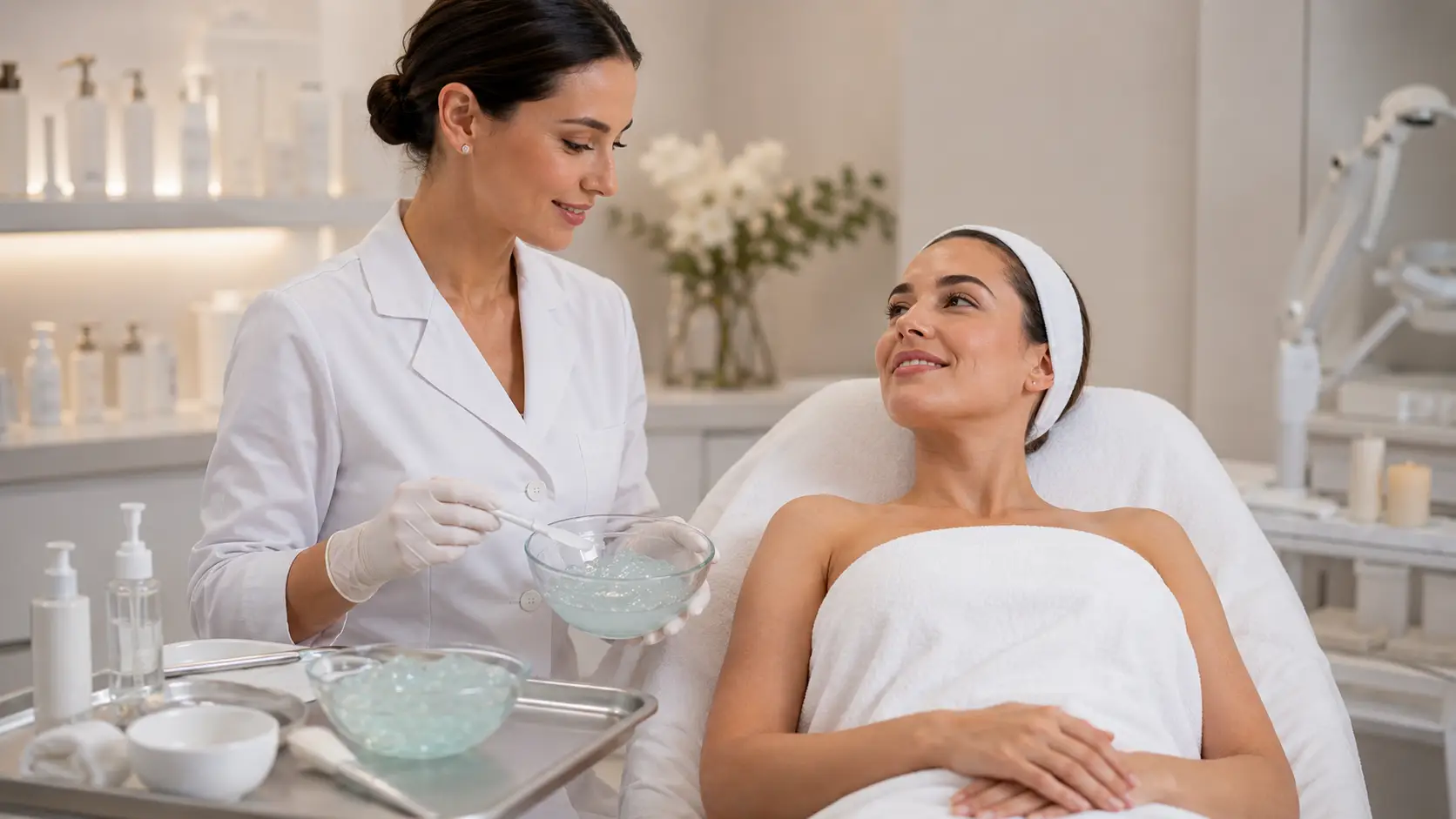
Are Jelly Masks Good Add-Ons for Estheticians?
Yes. Jelly masks are among the most effective and reliably profitable add-ons available in a professional treatment room. They deliver a visually compelling, tactile client experience that justifies premium pricing, require minimal additional treatment time once integrated into a workflow, and carry a cost-per-application low enough to produce strong margins even at modest add-on pricing. Clinically, they provide genuine hydration and barrier recovery benefits through occlusion and advanced humectant delivery — making them a service upgrade that clients feel and see immediately.
- Cost-per-application for professional-grade jelly masks typically ranges from $2 to $5, while add-on pricing ranges from $15 to $35 — producing margins that compare favorably to almost any other facial upgrade.
- The 10 to 15 minute set window is not idle time — it accommodates scalp massage, arm massage, LED therapy, or retail consultation, making the net time addition to a service often zero.
- The mixing ritual and single-piece removal create a sensory experience that clients frequently describe as the most memorable moment of a facial, driving rebooking and referral behavior.
- Jelly masks are protocol-compatible with virtually every facial type and are particularly strong as post-treatment recovery steps following extractions, dermaplaning, microneedling, and chemical exfoliation.
- Formulations containing both polyglutamic acid and hyaluronic acid deliver superior hydration science — giving estheticians a credible, educational talking point when presenting the upgrade to clients.
- The add-on converts consistently because clients can see the product, experience it in real time, and notice an immediate result — unlike many skincare upgrades where benefit is invisible until weeks later.
This is one of the most practical questions an esthetician can ask before introducing any new service upgrade: does the benefit to the client justify the cost and workflow adjustment, and does the business case hold up under honest scrutiny? With jelly masks, the answer to both questions is yes — but the reasons are more specific and more interesting than the marketing language around jelly masks typically suggests.
The professional jelly mask add-on has become a standard offering across a wide range of esthetic practices — from solo estheticians building a retail and upgrade strategy for the first time, to established spas looking for a luxury treatment differentiator. That wide adoption reflects something real: jelly masks occupy an unusual position in the treatment room economy. They are simultaneously a clinical tool that produces measurable skin benefits, a sensory experience that clients respond to emotionally, and a business asset with margins that reward operators who understand how to present them.
This guide covers all three dimensions in full. Whether you are evaluating jelly masks as an add-on for the first time or looking to strengthen the way you position and present them to clients, the analysis below gives you a complete professional answer.
Why Jelly Masks Work as a Facial Add-On: The Complete Picture
- Low cost-per-application and strong add-on pricing produce margins that outperform most other facial upgrades in the same time window.
- The set time window is productive time for the esthetician, not idle time — the true net time cost of the add-on is often close to zero.
- Clients experience the upgrade in real time: the mixing, the cooling sensation, the removal — creating an immediate perceived value that verbal upgrades rarely achieve.
- Protocol compatibility is nearly universal — jelly masks fit into hydration, anti-aging, sensitive skin, acne, and post-treatment recovery protocols without requiring significant workflow restructuring.
- The clinical case for jelly masks is real: occlusion + advanced humectants deliver measurable hydration improvements that clients can see and feel immediately post-removal.
- Estheticians who explain the ingredient science during application convert the add-on into an educational moment that builds authority and differentiates the service from a simple mask upsell.
- Jelly mask clients tend to rebook at higher rates and request the upgrade on subsequent visits once they have experienced it once.
What Makes a Jelly Mask Add-On Different From Other Facial Upgrades?
Most facial add-ons fall into one of two categories: upgrades the client is told about after the fact (“I used a special serum during your treatment today”), or upgrades the client experiences but cannot see or quantify in the moment. Jelly masks belong to neither category. They are a fully visible, tangible, sensory-rich upgrade that unfolds in front of the client in real time.
The mixing process itself is the first differentiation point. When an esthetician mixes a jelly mask powder into water at the treatment table, the client sees a transformation happen — a dry powder becoming a smooth, translucent gel. That moment signals that something unusual and intentional is happening. The application over the face, the immediate cooling sensation, the feeling of the gel setting over the skin, and the final single-piece removal are all experiential moments that no other common facial add-on replicates.
This matters commercially because perceived value — not just actual value — drives the conversion from no to yes on an upgrade offer. A client who can see and feel what they are receiving is far more likely to say yes than a client who is asked to pay more for something invisible. And a client who has experienced the jelly mask add-on once has a specific, vivid memory attached to the upgrade that makes them more likely to request it on their next visit.
The Three Pillars of Jelly Mask Add-On Value
Understanding the jelly mask add-on through three distinct lenses gives estheticians a more complete picture of where its value actually comes from and how to communicate it effectively:
- Clinical value: The occlusive format prevents transepidermal water loss during the set window, humectant ingredients deliver active hydration, and the cooling effect reduces post-treatment inflammation. These are real, measurable benefits — not marketing language.
- Experiential value: The mixing ritual, the sensory application, and the satisfying removal create a multi-moment experience that elevates the entire facial in the client’s memory. Clients frequently name the jelly mask as the highlight of their treatment without being prompted.
- Commercial value: The cost structure of a professional jelly mask add-on is among the most favorable of any facial upgrade. The per-application cost is low, the add-on price is defensible at $15 to $35, and the workflow time cost is minimal when the set window is used productively.
How Does the Jelly Mask Add-On Fit Into the Numbers?
The business case for jelly masks as an add-on is most clearly understood when the numbers are examined directly. This is not an area where estheticians need to rely on vague promises of “increased revenue potential” — the margin structure is concrete and consistently favorable.
Cost Per Application
A single full-face jelly mask application using a professional-grade formulation typically requires between 30 and 50 grams of mixed product, depending on the specific formulation concentration and coverage area. For most professional jelly mask brands sold in bulk, this translates to a cost-per-application of approximately $2 to $5. High-quality professional formulations with advanced humectant systems sit closer to the $4 to $5 end of that range; lower-grade alternatives sit lower but often carry ingredient quality trade-offs that affect both outcome and client experience.
Add-On Pricing Range
Estheticians in most market contexts price the jelly mask add-on between $15 and $35 per application. The appropriate price point within that range depends on several factors: the overall positioning of the practice (spa versus clinic versus suite), the quality of the formulation being used and whether the esthetician can speak to its ingredient science, how the upgrade is framed within the service conversation, and the existing facial menu price architecture. Practices that position jelly masks as a science-backed hydration upgrade with a specific clinical rationale — rather than simply “a mask” — consistently achieve the higher end of the pricing range.
What the Numbers Look Like Across a Week
Scenario: An esthetician performs 20 facials per week and converts 50% of clients to a $25 jelly mask add-on at a cost-per-application of $4.
10 add-on conversions per week: 10 × $25 = $250 gross add-on revenue per week
Cost of product: 10 × $4 = $40 per week
Net contribution per week: $210 — generated within existing booked appointment time with no additional room rental or scheduling overhead.
Annualized (50 working weeks): $10,500 in net contribution from a single add-on category, without increasing the number of appointments on the books.
The Time Cost Question
One of the most common hesitations estheticians express about adding jelly masks is the assumption that the 10 to 15 minute set time extends the appointment beyond its booked window. In practice, experienced estheticians report the opposite: the set window is structured time within the appointment that was previously used less productively. Scalp, neck, and shoulder massage; arm and hand massage as a luxury add-on sequence; LED therapy; or a structured retail recommendation conversation can all be conducted during the set window. The application itself takes two to three minutes. Net additional time: typically close to zero once the protocol is integrated.
Which Facial Protocols Work Best With a Jelly Mask Add-On?
One of the strongest operational characteristics of the jelly mask add-on is its near-universal protocol compatibility. Unlike some facial upgrades that only work within specific treatment types, a jelly mask can be positioned meaningfully within virtually every facial format on a professional menu. Understanding which contexts are the strongest natural fits helps estheticians prioritize where to introduce the upgrade first and how to frame the clinical rationale for each scenario.
Post-Extraction Protocols
Post-extraction skin is typically inflamed, sensitized, and in need of both calming and hydration. The occlusive seal of a jelly mask creates a protective environment that reduces transepidermal water loss while the cooling effect actively calms redness and inflammation. This is one of the most universally accepted clinical applications among estheticians who use jelly masks regularly — and one of the easiest contexts in which to explain the add-on to a client whose skin has just been worked.
Post-Dermaplaning Protocols
Following dermaplaning, the skin’s surface is freshly exfoliated and in a heightened state of product receptivity. Applying a jelly mask over a humectant serum at this stage maximizes the absorption benefit of both the serum actives and the mask’s own humectant ingredients. Clients consistently notice an amplified glow and hydration response after dermaplaning when a jelly mask is included as a recovery step.
Post-Chemical-Exfoliation Protocols
After enzyme treatments or light chemical exfoliation, the barrier is temporarily more permeable and the skin benefits significantly from a calming, occlusive hydration step. Jelly mask formulations that are fragrance-free and free from sensitizing additives are safe in this context and provide meaningful barrier recovery support that extends the duration of the treatment benefit.
Standard Hydration Facials
For clients presenting with dehydration, dullness, or tight, uncomfortable skin, the jelly mask is a natural anchor point for a hydration-focused facial protocol. The combination of occlusion, advanced humectants, and the sensory cooling experience creates a complete hydration treatment moment that stands on its own as the signature step in a hydration facial.
Anti-Aging and Mature Skin Protocols
Mature skin is typically characterized by reduced natural hyaluronic acid production, compromised barrier function, and decreased skin elasticity — all of which respond well to the PGA + HA dual-humectant system delivered in an occlusive jelly mask format. For clients in anti-aging protocols, the jelly mask add-on can be framed as a targeted hydration intervention that supports collagen function by addressing the skin’s structural water content.
Estheticians who have introduced Poly-Luronic™ Jelly Masks as a facial add-on across multiple protocol types consistently report that the conversion conversation is easiest when it begins during the skin assessment rather than at the end of the service. Explaining during intake that the client’s dehydration pattern, post-extraction inflammation, or compromised barrier would benefit from a specific recovery step — and then naming the jelly mask as that step — frames the add-on as a clinical recommendation rather than an upsell.
Practitioners who position the upgrade this way report conversion rates consistently above 60%, compared to rates of 30% to 40% when the add-on is offered at the end of the service as an optional extra. The PGA + HA dual-humectant formulation also provides a specific, science-backed talking point during the mixing process that clients engage with — particularly those with prior skincare knowledge who recognize hyaluronic acid and respond to learning that PGA holds five times more moisture while also protecting their skin’s own HA from degradation. That moment of real education, delivered during the treatment itself, is consistently cited by practitioners as one of the most effective retail and rebooking triggers they have found in jelly mask work.
How to Present a Jelly Mask Add-On Without It Feeling Like a Sales Pitch
The single most important factor in jelly mask add-on conversion is not the price, not the formulation, and not the treatment room setup. It is the language used to present the upgrade — specifically, whether that language positions the jelly mask as a clinical recommendation or as an optional extra.
The Assessment-First Approach
The most effective jelly mask add-on conversations begin during the client intake and skin assessment, not at the end of the service. When an esthetician identifies a skin concern during assessment — dehydration, inflammation, compromised barrier, post-treatment sensitivity — and immediately names a specific treatment step that addresses it, the upgrade becomes a professional recommendation rather than a sales offer. The framing becomes: “Based on what I’m seeing, I want to include a jelly mask step today to specifically address the dehydration in your T-zone — it’s the most effective way I have to lock in hydration before you leave.”
Using the Mixing Process as an Education Moment
Estheticians who explain what they are doing during the mixing process — briefly, in plain language — consistently report higher client engagement and more spontaneous questions about the upgrade. Something as simple as: “I’m mixing the jelly mask now — the reason I like this for your skin specifically is that it seals all the hydration we just layered in so it can’t escape while it sets” turns the application into a personalized clinical moment. Clients who feel that the treatment is being customized for them specifically respond differently than clients who feel they are receiving a standard service step.
Letting the Removal Speak for Itself
Experienced jelly mask practitioners report that client reactions at removal are the most powerful add-on marketing moment in any facial. When a client sees and feels the mask peel away as a single intact piece, and immediately touches their skin and notices the hydration and texture change, no sales language is required. That post-removal moment — where the esthetician hands a mirror to the client and says nothing — closes the add-on sell for every future visit without further effort.
What Are the Clinical Reasons Jelly Masks Work as a Facial Upgrade?
The commercial case for jelly masks as an add-on is strong on its own merits, but the reason that case is sustainable — rather than a short-lived trend — is that the clinical benefit is genuine and visible. Estheticians who understand the mechanism behind why jelly masks improve skin outcomes are better equipped to explain it to clients, which in turn strengthens both the conversion rate and the practice’s educational authority.
Occlusion: The Physical Mechanism
The most immediate clinical function of a jelly mask is occlusion — the physical sealing of the skin surface against transepidermal water loss (TEWL). When the mask sets over the face, it creates an impermeable gel layer that traps moisture against the skin during the entire set window. This is particularly valuable immediately following any step that applies hydrating serums, because the occlusion prevents those actives from evaporating before they can deliver their full benefit. In a treatment room context where serum absorption is a primary clinical objective, the jelly mask is not just an add-on aesthetic step — it is a mechanism that actively extends and amplifies the benefit of the serums already applied.
The Role of Advanced Humectants
A well-formulated professional jelly mask does not merely occlude — it also delivers active humectant ingredients into the skin during the set window. The scientific distinction between single-humectant and dual-humectant formulations is meaningful here and worth understanding in depth.
Hyaluronic acid (HA) penetrates into the epidermis and upper dermis, attracting and holding approximately 1,000 times its weight in water at the deeper structural layers of the skin. Polyglutamic acid (PGA) is a fermentation-derived biopolymer that holds up to 5,000 times its weight in water at the skin’s surface, where it forms a transparent microgel film that seals moisture against TEWL. PGA also inhibits hyaluronidase — the enzyme that breaks down the skin’s own naturally occurring HA — meaning that a PGA-containing jelly mask actively protects the skin’s endogenous hyaluronic acid during and after the treatment window. Research published in 2024 also demonstrated that topical PGA application upregulates hyaluronic acid synthase expression, stimulating the skin to produce more of its own HA.
When PGA and HA are formulated together in a jelly mask, the result is a dual-depth hydration system: HA working in the deeper skin layers and PGA working at the surface while simultaneously protecting both the applied and naturally occurring HA from enzymatic breakdown. This is the clinical mechanism that gives estheticians a specific, science-backed reason to recommend a professionally formulated jelly mask rather than any alternative mask format.
The Cooling Effect and Inflammation Management
The thermal cooling effect of a freshly mixed jelly mask is not merely a pleasant sensory experience — it has a measurable physiological function in post-treatment contexts. Cooling the skin surface reduces vasodilation, limits inflammatory response, and provides comfort after treatment steps that elevate skin temperature and sensitivity. For clients following extractions, dermaplaning, or chemical exfoliation, the cooling function of the jelly mask has direct clinical relevance alongside its hydration and occlusion benefits.
What Are the Main Objections Estheticians Have About Adding Jelly Masks — and How Do They Resolve?
“I am worried about extending the appointment time.”
This is the most common operational concern among estheticians who have not yet integrated jelly masks into their workflow. The resolution is straightforward: the 10 to 15 minute set window is structured time, not dead time. Practitioners who have fully integrated the add-on consistently report that the set window absorbs service steps — scalp massage, hand massage, LED sequences — that were already occurring within the existing appointment time. The application itself takes two to three minutes. Net time addition is typically close to zero.
“My clients will not pay extra for a mask.”
Clients pay for experiences and results, not for product categories. A client who has experienced the jelly mask mixing process, the cooling application, the set sensation, and the single-piece removal has had a specific, memorable treatment experience that they associate with a premium service. The add-on conversation fails most often when it is positioned as “I can add a mask for $X more” rather than as a clinical recommendation connected to a specific observed skin concern. Reframing the offer consistently resolves this objection.
“I am not sure which clients to offer it to.”
The honest answer is: almost all of them. The clinical profile of a jelly mask — occlusive, hydrating, cooling, calming — is appropriate for virtually every skin type and condition with the exception of specific contraindications that apply to any occlusive treatment. Dehydrated skin, post-treatment skin, sensitive skin, mature skin, acne-prone skin following extraction work, and dull or lackluster skin all benefit from what a professional jelly mask delivers. The practical question is not “which clients can have this” but “how do I frame the specific benefit for each client type.”
“I tried a jelly mask brand once and the results were inconsistent.”
Inconsistency in mixing behavior, set time, or skin results most commonly traces back to formulation quality rather than the jelly mask format itself. Professional-grade formulations with high-quality sodium alginate, fully disclosed ingredients, and validated humectant systems produce consistent results. Consumer-grade or low-quality products positioned as professional do not. Evaluating formulation quality systematically before committing to a brand for treatment room use resolves most of the experience-consistency issues estheticians describe from early jelly mask trials.
Professional and Scientific References
The ingredient science and clinical mechanisms referenced in this article draw from peer-reviewed dermatological and cosmetic chemistry research:
- Gamma-PGA barrier strengthening and moisture retention — skin keratinocyte and reconstructed skin model study. MDPI, 2024. Demonstrated HAS-1, HAS-2, HAS-3 upregulation and aquaporin-3 enhancement with 1% topical gamma-PGA application.
- PGA moisture-binding capacity (up to 5,000× weight in water) and hyaluronidase inhibition. Typology, 2021–2025; cosmetic chemistry literature.
- PGA vs HA corneometry comparison: 2% PGA serum demonstrated 60% moisture increase at 30 minutes, 25% maintained at 8 hours. Reviva Labs review of clinical literature, 2025.
- PGA NMF stimulation — pyrrolidone carboxylic acid, lactic acid, and urocanic acid production in stratum corneum. Typology; Prequel Skin; Skin Rocks biochemist commentary, 2022–2025.
- Sodium alginate occlusive and wound management properties. Established biomedical sciences literature.
- Occlusion and transepidermal water loss reduction in professional mask formats. Professional skincare formulation literature.
For estheticians ready to introduce a jelly mask add-on that supports the clinical, experiential, and commercial case outlined in this guide, the Poly-Luronic™ Jelly Mask by Luminous Skin Lab is the formulation our education team most consistently recommends for treatment room add-on programs. The proprietary PGA + HA dual-humectant system delivers the complete dual-depth hydration mechanism described throughout this article, giving estheticians a science-backed upgrade conversation rather than a generic mask upsell. Fragrance-free, clean-label, and formulated for consistent set behavior across post-treatment, hydration, and standard facial protocols.
Explore the Poly-Luronic™ Jelly Mask LineFrequently Asked Questions: Jelly Masks as Facial Add-Ons
Are jelly masks actually worth adding to a facial menu?
Yes. Jelly masks are among the highest-value add-ons available to estheticians because they deliver a visible, tactile client experience that justifies premium pricing while adding only modest cost-per-application and minimal additional treatment time. Their combination of clinical benefit, sensory impact, and operational simplicity makes them one of the most consistently profitable facial upgrades in professional treatment rooms.
How much can estheticians realistically charge for a jelly mask add-on?
Most estheticians price jelly mask add-ons between $15 and $35 per application depending on market positioning, formulation quality, and how the upgrade is framed within the service. At a cost-per-application of roughly $2 to $5 for professional-grade formulations, the margin on a jelly mask add-on is exceptionally strong compared to most other facial upgrades. Estheticians who position jelly masks as a science-backed hydration upgrade rather than a simple mask tend to achieve the higher end of that pricing range.
Why do clients say yes to a jelly mask upgrade so easily?
The jelly mask add-on sells easily because clients can see what they are getting before they commit. The mixing ritual, the translucent gel layer setting over the face, and the satisfying single-piece removal are all visually compelling moments that clients associate with a premium, results-driven treatment. Unlike many skincare upgrades that are invisible to the client until weeks later, the immediate cooling sensation and visible post-removal skin response create a tangible perceived value in the moment.
What facials work best with a jelly mask add-on?
Jelly masks work as an add-on within virtually any facial protocol, but they are most strategically valuable following active treatment steps that benefit from a recovery or hydration phase. Post-extraction, post-microneedling, post-dermaplaning, and post-chemical-exfoliation contexts are particularly strong fits because the occlusive layer supports barrier recovery while the humectant ingredients deliver active hydration to skin in a heightened absorption state. Standard hydration facials, anti-aging treatments, and sensitive skin protocols are also natural jelly mask add-on opportunities.
Does adding a jelly mask significantly extend the treatment time?
No. This is one of the primary reasons jelly masks are so attractive as add-ons from an operational standpoint. The mask application takes approximately two to three minutes, and the 10 to 15 minute set time is not idle time for the esthetician. Scalp massage, arm and hand massage, LED therapy, or client education and retail conversations can all be conducted during the set window. The net additional time added to a service is often zero once the workflow is integrated properly.
Is a jelly mask add-on appropriate for sensitive skin clients?
Yes, provided the formulation is fragrance-free and free from synthetic dyes or unnecessary sensitizing additives. For sensitive skin clients, jelly masks are often one of the safest mask upgrades available because the alginate base is inherently gentle, the occlusive format calms rather than stimulates the skin, and the cooling effect actively reduces redness and inflammation. Always confirm the INCI list before using any jelly mask formulation on sensitive or reactive skin.
How do you bring up a jelly mask add-on without it feeling like a hard sell?
The most effective approach is to frame the jelly mask within the skin concern conversation that is already happening. If a client mentions dehydration, dullness, or post-treatment sensitivity, the jelly mask upgrade follows naturally from an educational explanation rather than a sales pitch. Showing the product visually, explaining what it does in simple terms, and mentioning the immediate skin result clients typically notice converts far more consistently than a price-first approach.
Can a jelly mask be used as a standalone treatment or does it only work as an add-on?
Jelly masks can function both as standalone treatments and as integrated add-ons within a larger facial protocol. As a standalone, a jelly mask hydration treatment is a strong option for lunchtime or express service formats where clients want visible results without extended appointment time. As an add-on, the jelly mask amplifies the results of the treatment it follows and extends the perceived value of the appointment. Both formats are professionally and commercially viable.
What makes the Poly-Luronic Jelly Mask a strong choice for estheticians building a jelly mask add-on service?
The Poly-Luronic Jelly Mask by Luminous Skin Lab is formulated with a dual PGA and HA humectant system that delivers measurably superior hydration compared to single-humectant alternatives, which gives estheticians a science-backed talking point when presenting the upgrade to clients. Its consistent set time, clean fragrance-free formulation, and compatibility with post-treatment protocols including microneedling and dermaplaning make it operationally reliable across a wide range of add-on contexts.
The Short Answer and the Complete One
The short answer to whether jelly masks are good add-ons for estheticians is yes — unambiguously. The complete answer explains why that yes is durable rather than trend-dependent: jelly masks deliver a clinical benefit that clients can see and feel in real time, a sensory experience that no alternative mask format replicates, and a cost-to-revenue ratio that holds up under honest business scrutiny.
What separates estheticians who generate consistent, growing add-on revenue from jelly masks from those who try them and move on is not the product — it is the presentation. Estheticians who frame the upgrade as a clinical recommendation rooted in the client’s specific assessed skin concern, who use the mixing process as an education moment, and who let the removal experience speak for itself after first application consistently build a jelly mask client base that sustains itself through rebooking behavior rather than requiring re-selling at every visit.
Choose a formulation that performs consistently within your protocols, understand the ingredient science well enough to explain it in two sentences, and give every first-time client the full four-stage experience described in this guide. That combination is what turns a good add-on into a reliable revenue line.