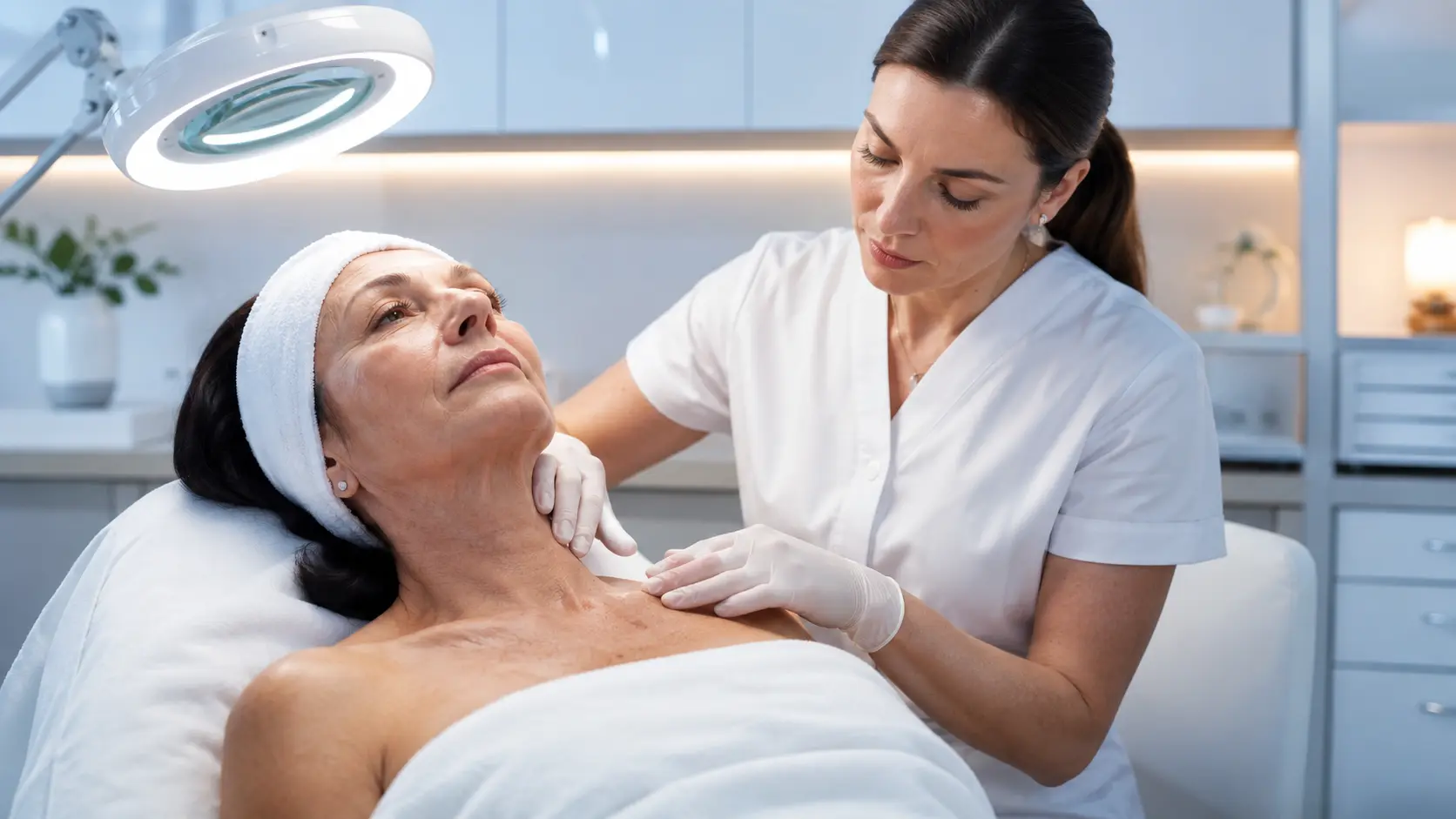
What Causes Crepey Skin?
Crepey skin is caused by fragmentation of elastin fibres in the dermis combined with progressive dermal thinning — structurally different from the collagen loss and repetitive movement that produce fine lines. Cumulative ultraviolet exposure is the largest driver, with ageing, oestrogen decline, dehydration and rapid weight loss compounding it. Because adult skin regenerates almost no elastin, crepey skin improves more slowly and less completely than wrinkles.
- Elastin, not collagen, is the defining protein. Adult skin produces virtually no new elastin, so fragmentation accumulates without meaningful replacement.
- UVA upregulates matrix metalloproteinases — enzymes that degrade collagen and elastin faster than the dermis rebuilds them.
- Dermal thinning removes mechanical support, so tissue loses recoil and takes on fine crinkled texture.
- It appears earliest on the forearms, lower legs, neck, décolleté and under-eye area — thinner dermis, higher sun exposure.
- Part of the appearance is dehydration rather than permanent change — that component is correctable within days.
- Rapid weight loss does not create elastin damage; it reveals damage already masked by underlying volume.
Crepey skin is among the most common concerns raised in the treatment room and among the most frequently misclassified. Clients describe it as wrinkles, as sagging, or as skin that has “gone thin,” usually after spending money on products marketed against a problem they cannot structurally address.
The confusion is understandable, because crepey skin sits between two conditions it is not. It is not a wrinkle — a discrete crease from collagen loss and repeated folding along a line of muscle insertion. It is not laxity — a change in contour from deeper loss of structural support. It is a change in the skin surface itself: fine crinkled texture with measurable loss of elastic recoil, usually appearing on the body well before the face.
What follows covers the biology behind that presentation, why the forearms and décolleté show it before the cheeks do, and how to frame reversibility so a client is still engaged at session six.
What Determines Whether Crepey Skin Improves
- Crepey skin is an elastin and dermal-thickness problem. Treating it as a wrinkle is the most common consultation error and cause of disappointed clients.
- Elastin has negligible turnover in adult skin; collagen remodels continuously. That difference explains why crepey skin responds more slowly than fine lines to every available modality.
- Cumulative UV exposure is the dominant modifiable cause, and the reason sun-exposed body sites present years before protected ones.
- Separate the transient component from the structural one — hydration and barrier repair produce visible change within days and buy credibility for the slower work.
- Body sites lag facial skin because of lower fibroblast density and reduced vascular supply — not because the protocol is wrong. Realistic outcomes target dermal thickness, collagen density and surface texture; elastin restoration is not an available claim.
- Clients presenting after rapid weight loss need a different conversation: the skin did not become damaged, the damage became visible.
What Is Crepey Skin, and How Does It Differ From Fine Lines and Wrinkles?
Crepey skin has taken on the appearance and handling of crepe paper — finely crinkled, thin to the touch, slow to return when gently pinched. That last property, reduced elastic recoil, is the clinically meaningful one, and it is assessable without equipment.
The Clinical Definition
Three features define it. Texture is diffuse rather than linear — fine crinkling, not discrete creases. Skin is thinner visibly and on palpation, often with visible underlying vasculature. And recoil is reduced: skin lifted between finger and thumb returns perceptibly more slowly than on an unaffected site on the same client. That intra-client comparison controls for age, hydration and skin type as a reference chart cannot.
Why the Distinction Changes the Treatment Plan
Fine lines are principally a collagen story, and because fibroblasts remodel collagen throughout adult life, collagen-directed interventions have a genuine substrate to work with. Crepey skin is principally an elastin story: the elastic network has fragmented, and adult skin does not rebuild it. That does not make it untreatable — increasing dermal thickness and collagen density measurably improves how it looks and behaves — but the mechanism improved is not the mechanism lost. Holding that distinction lets an esthetician promise improvement while declining to promise reversal.
Why Elastin Loss Is the Defining Mechanism Behind Crepey Skin
Elastin is a small fraction of dermal protein by mass, yet it is responsible for essentially all of the skin’s ability to deform and return. Collagen provides tensile strength; elastin provides recoil. When the elastic network degrades, skin keeps much of its strength but loses its spring — the crinkled slackness clients describe as crepey.
Elastin Does Not Meaningfully Regenerate in Adult Skin
The elastic fibre network is largely built during growth and early adulthood. After that, expression of the genes governing fibre assembly falls sharply, and studies of protein longevity place elastin’s residence time in decades. That durability is an advantage until damage accumulates, at which point it becomes the central clinical problem: there is no replacement cycle to repair it.
Collagen behaves in the opposite way, continuously resynthesised by fibroblasts at a commonly cited decline of roughly one per cent per year from the mid-twenties. That asymmetry is the most useful concept to carry into a crepey skin consultation.
How Ultraviolet Exposure Destroys the Elastic Fibre Network
UVA reaches the dermis, where it upregulates matrix metalloproteinases. MMP-1 cleaves collagen; other family members, with neutrophil-derived elastase, degrade elastic fibres. Each exposure produces a small imbalance between degradation and repair, and across decades it compounds.
Two Proteins, Two Completely Different Repair Capacities
Collagen is renewable — fibroblasts remodel it throughout adult life, which is why microneedling and photobiomodulation change dermal density. Elastin is effectively not — damaged fibres are replaced with disorganised elastotic material having none of the mechanical properties of intact elastin.
Solar Elastosis: What Replaces Healthy Elastin
Photodamaged dermis does not simply contain less elastin — it contains abnormal material in its place. Solar elastosis is the accumulation of disorganised elastotic deposits in the upper dermis: histologically abundant, mechanically useless. It is why heavily photodamaged skin can appear both thickened and slack.
Why Crepey Skin Appears on the Body Before It Appears on the Face
Almost every client with crepey skin shows it first somewhere other than the face. The reasons are structural.
Dermal Thickness and Appendage Density
Facial skin is comparatively well provisioned: dense pilosebaceous units, rich vascular supply and higher fibroblast density than most body sites, all supporting repair. The forearms, lower legs and décolleté have a thinner dermis, sparser appendages and less vascular delivery, so the same lifetime UV dose produces a more visible result on the body.
The Sites Where It Presents First
The extensor forearms and décolleté are the most reliable early indicators, both frequently uncovered and inconsistently protected; the lateral neck follows, then the lower legs. The infraorbital area is the facial exception — the thinnest skin on the body, which is why crepey texture under the eye often appears before change elsewhere on the face.
Practitioners treating the neck and décolleté report these sites need a longer photobiomodulation dwell than the face — commonly 15 to 20 minutes rather than 10. Estheticians working with the ILUMILUX system by Luminous Skin Lab note that a fitted format holds source-to-skin distance more consistently than handheld wands, which drift as the operator’s arm fatigues and reduce delivered dose.
Six Factors That Drive Crepey Skin Development
Crepey skin is rarely attributable to one cause. Identifying which of the following dominate for a given client is what makes a protocol targeted rather than generic.
Cumulative Ultraviolet Exposure
The dominant modifiable cause. UVA upregulates matrix metalloproteinase activity, degrading collagen and elastin faster than the dermis rebuilds them. Effects are cumulative and site-specific, so exposure history matters more than current habits.
Chronological Dermal Thinning
Independent of sun exposure, the dermis loses thickness, fibroblast activity and glycosaminoglycan content with age. Less tissue bulk means less mechanical support and more visible loss of recoil.
Oestrogen Decline
Dermal collagen density falls sharply after menopause, with a substantial proportion lost in the first five years. This is why many clients date the onset to a specific, narrow window.
Dehydration and Barrier Disruption
The one genuinely correctable contributor. Elevated transepidermal water loss exaggerates fine surface texture, and addressing it separates the transient component from the structural one.
Rapid Weight Loss
Reveals rather than causes. When volume reduces faster than the dermis can retract, existing loss of elastic recoil becomes visible — most pronounced on the upper arms, inner thighs and abdomen.
Mechanical and Lifestyle Load
Smoking accelerates matrix degradation and impairs microcirculation. Sleep-position compression and weight cycling add mechanical load to an already compromised elastic network.
What Estheticians Should Tell Clients About Reversibility
This is where most crepey skin consultations succeed or fail. The client has usually met marketing promising reversal, and contradicting it without a clearer framework loses the room.
Separate the Correctable Component From the Structural One
A meaningful share of what presents as crepey skin is dehydration and barrier compromise sitting on genuine structural change. That surface component responds within days of consistent barrier support and occlusive hydration. Leading with it is correct sequencing, not diversion — it establishes credibility before asking for commitment to the slower work.
The structural component underneath will not reverse, but it can be improved: increasing dermal thickness and collagen density softens the texture even though the elastic network is not restored. Saying that plainly is the honest position, and the one that retains clients longest.
Realistic Timelines
Hydration-related change is visible within days. Structural change follows the timescale of collagen synthesis and dermal remodelling — weeks to months across a course, not a handful of sessions. A client told in advance that the forearms take longer reads slow progress as expected; one who was not reads it as failure.
When to Refer
Where the concern is contour rather than texture, work within an esthetician’s scope will not deliver what the client wants, and referral for energy-based tightening or surgical assessment is appropriate. Sudden skin fragility, unexplained bruising or rapid textural change without obvious cause warrants medical review.
Professional and Scientific References
Drawn from peer-reviewed literature on cutaneous ageing, photoaging mechanisms and photobiomodulation:
- Fisher GJ, Kang S, Varani J, et al. Mechanisms of photoaging and chronological skin aging. Archives of Dermatology, 2002.
- Sherratt MJ. Tissue elasticity and the ageing elastic fibre. Age (Dordrecht), 2009.
- Uitto J. The role of elastin and collagen in cutaneous aging. Journal of Drugs in Dermatology, 2008.
- Brincat M, Moniz CF, Studd JWW, et al. Sex hormones and skin collagen content in postmenopausal women. British Medical Journal, 1983–1987.
- Farage MA, Miller KW, Elsner P, Maibach HI. Characteristics of the aging skin. Advances in Wound Care, 2013.
- Wunsch A, Matuschka K. Red and near-infrared light treatment: reduction of fine lines and wrinkles and increase of intradermal collagen density. Photomedicine and Laser Surgery, 2014.
For estheticians building a crepey skin protocol around the collagen and dermal-thickness component — the part that genuinely responds — the ILUMILUX LED system by Luminous Skin Lab is the unit our education team most frequently references for treatment-room photobiomodulation. Consistent source-to-skin distance and reproducible session dose determine whether a course produces measurable change, and they are what handheld consumer devices most often fail to control.
Explore the ILUMILUX LED SystemFrequently Asked Questions: Crepey Skin Causes & Professional Treatment
What causes crepey skin and how is it different from wrinkles?
Crepey skin comes from fragmentation of elastin fibres in the dermis combined with dermal thinning, which reduces recoil and produces a finely crinkled texture. Wrinkles are collagen loss plus repetitive muscle movement, presenting as discrete creases. Collagen remodels throughout adult life; elastin does not.
Why does crepey skin appear on the arms and legs before it appears on the face?
Body sites have a thinner dermis, fewer pilosebaceous units and less vascular supply than facial skin, which lowers repair capacity. The forearms, lower legs, neck and décolleté also carry high cumulative ultraviolet exposure, being frequently uncovered and inconsistently protected.
Why does elastin damage matter more than collagen loss in crepey skin?
Adult skin produces very little new elastin, so damage accumulates without meaningful replacement. Collagen is different — fibroblasts remodel it continuously, which is why collagen-directed treatments produce measurable change. Realistic outcomes therefore target dermal thickness and collagen density, not elastin restoration.
How does sun exposure cause crepey skin?
Ultraviolet A radiation penetrates to dermal level and upregulates matrix metalloproteinases, enzymes that degrade dermal structural proteins. MMP-1 breaks down collagen while elastase degrades elastic fibres. Across years, fragmented fibres are replaced by disorganised material in a process called solar elastosis.
What is the difference between crepey skin and skin laxity for estheticians?
Crepey skin is a change in surface quality — fine texture and reduced recoil from elastin fragmentation in the papillary dermis. Laxity is a change in contour, from deeper loss involving the reticular dermis, fat and supporting ligaments. They respond to different interventions.
Does rapid weight loss cause crepey skin?
Rapid weight loss does not create elastin damage; it reveals it. When underlying volume reduces faster than the dermis can retract, existing loss of elastic recoil becomes visible. The effect is most pronounced on the upper arms, inner thighs and abdomen.
Can crepey skin be reversed, or only improved?
The structural component cannot be fully reversed, because adult skin does not regenerate elastin, but the appearance can be meaningfully improved. Part of the presentation is dehydration rather than permanent change and responds within days; beyond that, increasing dermal thickness softens texture.
What should estheticians tell clients about how long crepey skin takes to improve?
Expect hydration-related change within days and structural change slowly, across a course spanning several months. Collagen synthesis and dermal remodelling operate on a timescale of weeks to months, and body sites respond more slowly than facial skin. Setting this expectation early prevents premature abandonment.
How does LED red light therapy support collagen production in crepey skin?
Red and near-infrared wavelengths are absorbed by mitochondrial chromophores in dermal fibroblasts, stimulating synthesis of type I and type III collagen while reducing MMP-1 expression. Because this targets collagen and dermal thickness rather than elastin, it matches what is realistically achievable. Professional systems such as ILUMILUX by Luminous Skin Lab are built for treatment-room duty cycles.
The Distinction That Makes the Consultation Work
Crepey skin is not a wrinkle that spread out. It is a fragmented elastic network in a thinning dermis, and it frustrates clients and practitioners alike because the protein most responsible is the one adult skin cannot rebuild. Recognising that changes which modality is selected, how the course is sequenced, and what the client is told to expect.
The framework is straightforward. Correct the hydration and barrier component first, because it is real, fast, and earns credibility for what follows. Then work on dermal thickness and collagen density, which improves the presentation without restoring elastin. Set body-site timelines longer than facial ones; refer when the concern is contour.
Estheticians who can explain why the forearms show it first, and why no topical will reverse it, give clients what the retail market structurally cannot: an accurate account of what is happening, and a plan calibrated to what is achievable.