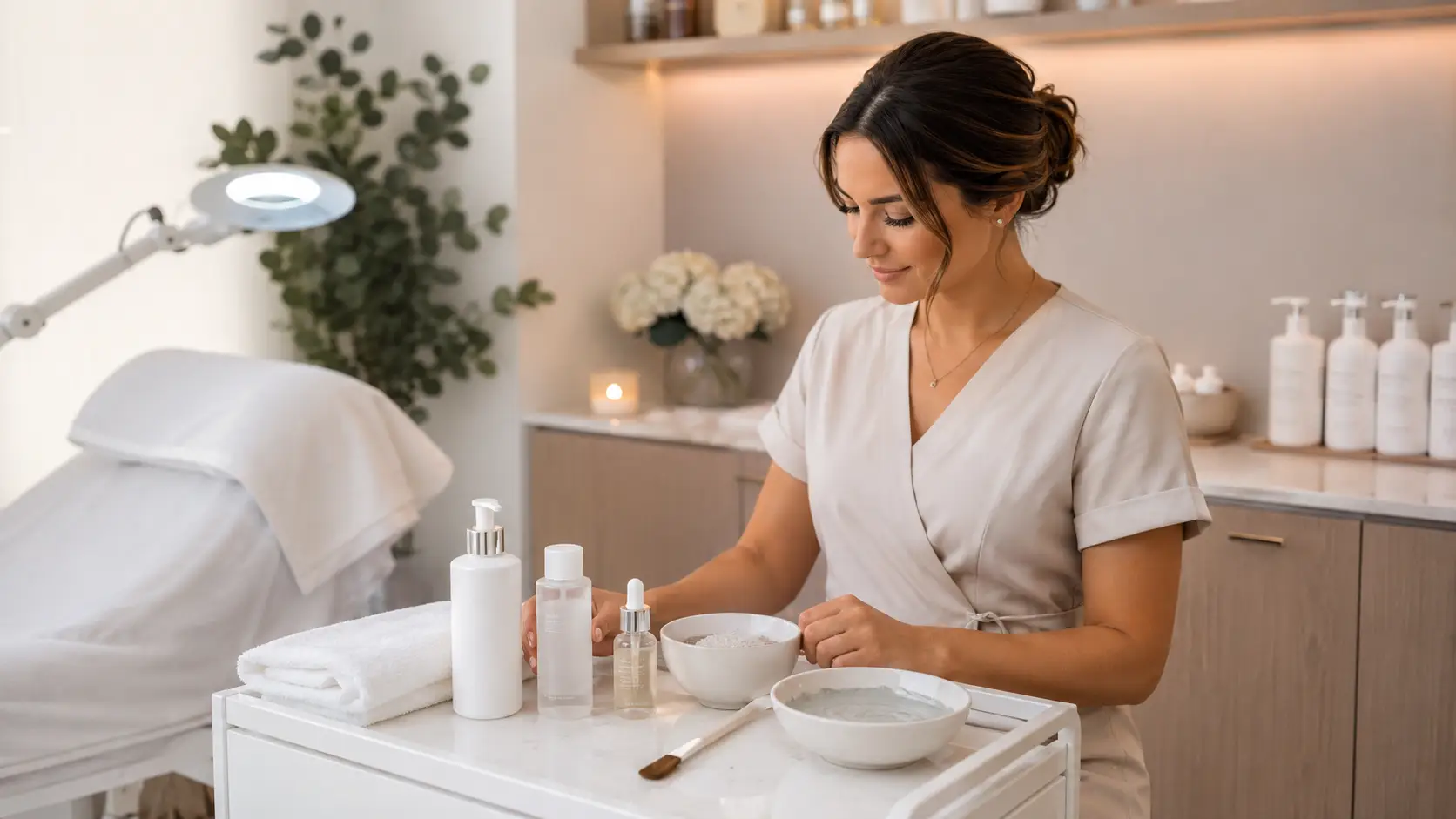
What Should a New Esthetician Put on Their Service Menu?
New estheticians should build a focused starting menu of four to six services: two or three facial service tiers at different price points and two or three carefully chosen add-ons. A small, well-executed menu is more effective than a large, inconsistent one because it allows you to master your timing, build client confidence, and generate referrals based on consistent results rather than scattered impressions.
- Lead with a signature hydration facial as your anchor service — it is universally appropriate for almost every skin type, easy to explain to new clients, and sets the foundation for rebooking.
- Structure your menu in tiers: a foundational service, a mid-range signature service, and a premium option that includes your best add-ons bundled together.
- The most profitable and beginner-friendly add-ons require no expensive devices — professional hydration mask upgrades, enzyme treatments, and hand or scalp massage extensions generate strong perceived value with minimal additional supply cost.
- Service names and descriptions should be benefit-focused and clear — clients should understand what they are getting without needing an explanation.
- Avoid adding services to your menu that you cannot perform consistently and confidently — inconsistency at the beginning of your career creates negative reviews and erodes trust.
- Plan your menu to grow: start with what you do well, then add one new service or add-on every two to three months as your confidence and client base develop.
One of the most common mistakes new estheticians make after graduation is building a service menu that looks impressive on paper but is nearly impossible to deliver consistently in practice. The instinct makes sense: you want to show clients everything you can do, demonstrate the breadth of your training, and compete with established spas that offer long, varied menus. But in the early months of building a practice, a long menu creates more problems than it solves.
Every service on your menu requires a separate supply kit, a separate timing sequence, a separate explanation script, and a separate mental track during the service. When you are still building confidence and treatment room fluency, spreading attention across too many different services slows your development in all of them. The estheticians who build the fastest and most stable early practices almost universally report the same thing: they started with a focused menu, mastered it completely, and then expanded deliberately.
This guide gives new estheticians a practical, strategic framework for building a first service menu — from the anchor services that belong on every beginner menu, to the add-ons that generate the highest perceived value with the lowest complexity investment, to the pricing structure and naming decisions that convert curious first-time clients into loyal regulars.
Building a First Service Menu That Sets You Up to Grow
- A menu of four to six services outperforms a menu of twelve services for almost every new esthetician — focus drives mastery, and mastery drives referrals.
- Your anchor service should be a hydration facial — appropriate for nearly every client, repeatable on a regular schedule, and easy to upgrade with add-ons.
- Tiered pricing (foundational, signature, premium) allows clients to self-select their experience level and budget without requiring you to justify your prices.
- Add-ons are where the real per-hour revenue growth happens — a $20 add-on added to 60% of your facials can meaningfully change your monthly revenue picture.
- Service names must communicate benefits, not just processes — clients book what sounds like it will solve a problem or deliver a feeling, not what sounds technically impressive.
- Plan your menu for where you want to be in 12 months, not just for today — leave intentional space to add two or three new services as your practice grows.
- Every service on your menu should be something you can perform confidently and consistently 100% of the time — not just on a good day.
Why a Shorter, More Focused Menu Works Better for New Estheticians
The professional esthetics industry tends to reward depth of skill over breadth of offerings — particularly in the early career phase. Clients who find an esthetician who consistently delivers excellent results for their specific concerns become loyal, long-term clients. Clients who experience an inconsistent service — where results vary because the practitioner is still developing technique across too many different treatments — rarely rebook.
A focused menu of four to six services creates several compounding advantages for a new esthetician. First, it allows you to stock a leaner back bar: fewer product categories, lower upfront investment, and less waste from products that do not turn over. Second, it compresses your learning curve by concentrating your practice repetitions on fewer techniques, which means you reach professional confidence faster. Third, it simplifies client communication: when a client asks what you offer, a focused menu is easy to explain and easy for them to choose from without feeling overwhelmed.
The most successful beginner menus follow a consistent architecture: two or three facial service tiers that represent different durations and price points, plus a selection of two or three add-on upgrades. That structure covers the full range of client needs and budgets while staying well within the operational complexity range a new esthetician can manage confidently.
If you look at your service menu and you cannot perform every single item on it confidently and consistently without looking at reference notes, your menu is too long. Reduce it to what you can deliver with full confidence, then add back one service at a time as each one becomes second nature.
The Single Most Common Beginner Menu Mistake
Estheticians who list more than eight services on their first menu almost always report the same outcome six months later: three or four of those services generate almost all of their bookings, the rest create confusion and inventory problems, and they wish they had started with the three or four strong ones and built from there.
The instinct to offer everything comes from a genuine place — you want to serve every client who walks in, and you do not want to turn anyone away. But the reality is that a new esthetician with a focused, well-marketed set of core services attracts more of the right clients than one with a sprawling menu that signals uncertainty about specialty or direction.
The Core Anchor Services Every Beginner Menu Should Include
There are three categories of core service that belong on almost every new esthetician’s menu regardless of specialty direction. They form the backbone of the menu, generate the most consistent bookings, and serve as the platform from which add-ons and premium upgrades are built.
The Foundational Cleansing Facial
Every beginner menu needs a foundational entry-level facial: a clean, professional service that covers double cleanse, steam or warm towel, light exfoliation, and basic moisturizing finish. This service serves first-time clients who are new to facials, budget-conscious clients, and clients who want a maintenance treatment between their more intensive sessions. It should be priced accessibly and timed at 45 to 50 minutes.
The foundational facial is not your revenue engine — it is your client acquisition tool. It converts first-time visitors into regulars by giving them a positive, low-stakes first experience that builds trust before they commit to a higher-tier service. Price this service to be competitive with the local market, not at a premium.
The Signature Hydration Facial
Your signature hydration facial is the center of your menu and should receive the most attention in terms of protocol development and marketing. A well-structured 60-minute hydration facial covers cleanse, exfoliation (enzyme or light physical), targeted serum application, a professional mask treatment, and a finishing moisturizer and SPF step. This service is appropriate for virtually every skin type and concern, which makes it an ideal anchor for a new practice that has not yet narrowed to a specific specialty.
Hydration facials rebook consistently because skin dehydration is a recurring condition rather than a one-time problem. Clients who understand the relationship between regular hydration treatments and long-term skin health return every four to six weeks without needing significant reselling effort. Your job in the first few sessions is to help them feel and see that difference clearly.
The Targeted Treatment Facial
Once you have the first two tiers established, a third service tier targeting a specific concern — acne management, sensitivity and redness reduction, or anti-aging and barrier repair — gives clients with those concerns a reason to choose you over a generalist. This tier should be your most advanced and highest-priced facial offering. It should incorporate your strongest clinical knowledge, your most targeted product choices, and ideally one add-on element that distinguishes the experience from the signature tier above.
Many new estheticians find it useful to pick the targeted concern category that aligns most closely with their own skin history or training focus, because authentic personal experience with a concern translates into more confident and credible client communication.
How to Structure Your Services Into Pricing Tiers That Sell Themselves
Tiered service pricing does the selling work for you by giving clients a clear, intuitive framework for making a decision. When a client can see three options at different price points — each with a clearly communicated difference in duration, depth, and experience — they self-select based on their budget and goals without requiring you to upsell them mid-service. Here is what a strong beginner three-tier structure looks like in practice.
Express Cleanse & Refresh Facial
45 minutes. Double cleanse, warm towel steam, light enzyme or manual exfoliation, targeted serum, moisturizer and SPF. No extractions. Ideal for first-time clients or regular maintenance between deeper treatments.
Goal: convert first-time visitors. Keep it accessible, clean, and consistent.
$65 – $85Signature Hydration Renewal Facial
60 minutes. Double cleanse, exfoliation, steam, optional light extractions, targeted hydration serum layering, professional mask treatment (your signature add-on moment), targeted moisturizer, SPF. Appropriate for all skin types.
Goal: your primary rebooked service. Market this one most aggressively. This is the service clients tell friends about.
$95 – $125Advanced Skin Renewal Treatment
75–90 minutes. Full signature facial protocol plus two add-on upgrades bundled in. Higher-grade serums, deeper exfoliation work, premium mask finish, and extended massage element. Your most complete and highest-result service.
Goal: premium revenue and client loyalty. Clients who book this tier rarely price-shop.
$145 – $185The specific pricing ranges above reflect mid-range independent esthetician markets. Adjust upward for high cost-of-living cities or upscale suite environments, and slightly downward for smaller markets where you are building from zero. The principle — three clear tiers, distinct value at each level, self-explanatory descriptions — applies universally.
Which Add-Ons Should a New Esthetician Offer on Their Menu?
Add-ons are where a new esthetician’s per-hour revenue actually grows. A base facial priced at $100 delivered in 60 minutes generates $100 per hour. That same facial with a $25 add-on accepted by 60% of clients generates an average of $115 per service — a 15% revenue increase with no additional time block required because add-ons are performed within the existing service window.
The best beginner add-ons share four characteristics: they require no expensive new equipment, they add genuine sensory or clinical value the client notices without prompting, they can be explained in one sentence, and they can be applied within the existing service time without extending the appointment by more than five to ten minutes.
Professional Hydration Mask Upgrade
A professional jelly mask or intensive occlusive mask in place of a standard cream mask. Adds a dramatic sensory moment and visible immediate result. No additional equipment needed. Price at $15–$25 above base service.
Enzyme Exfoliation Upgrade
A targeted enzyme treatment applied in place of or before standard exfoliation. Adds clinical depth to the service and allows you to address specific concerns more precisely. Explain it as “a deeper exfoliation step using active enzymes rather than physical scrubbing.”
Scalp or Hand Massage Extension
Five to ten minutes of scalp massage or hand and arm massage performed during mask set time. Zero additional product cost. Adds significant perceived luxury value. Most clients will accept this add-on readily when offered during the mask step.
Eye Treatment Upgrade
A targeted eye area treatment using a specialized under-eye gel mask or peptide eye cream application. A small add-on that addresses a high-concern area most clients are actively thinking about. Easy to explain: “an intensive hydration and firming treatment specifically for the eye area.”
Targeted Serum Boost
An upgrade serum applied before the mask step — vitamin C brightening, peptide firming, or barrier-repair niacinamide blend — chosen based on the client’s primary concern. Positions you as a customization-focused esthetician rather than a one-protocol-fits-all practice.
Décolleté Treatment Extension
Extending cleanse, serum, and mask steps to the neck and décolleté area. Minimal additional product use, five to ten minutes of additional service time, high perceived value. Position it as a natural extension of the facial protocol rather than a separate service.
How to Present Add-Ons Without Feeling Pushy
The most effective way to introduce add-ons is during the consultation, not mid-service. After assessing the client’s skin and discussing their concerns, offer one add-on that directly addresses what they described as their primary goal. Frame it as a protocol enhancement rather than an upsell: “Based on what you’re describing, I’d recommend adding our hydration mask upgrade today — it adds a concentrated occlusive step that significantly extends the hydration result of everything we’re doing. It’s an additional $20 and it takes place during the treatment window so it won’t extend your appointment.”
Estheticians who frame add-on offers this way report significantly higher acceptance rates than those who present add-ons as standalone purchases at the end of a service. The key is specificity: the offer connects directly to what the client said they wanted, rather than appearing as a general revenue grab.
How to Name and Describe Your Services So Clients Understand and Book Them
Service naming is one of the most overlooked but practically important decisions a new esthetician makes when building a menu. The name of a service determines whether a client who has never met you feels confident enough to book it without a phone call or explanation. And in a world where most clients book online or through social media, that first impression is often the only impression before the booking decision is made.
Benefit-Forward Naming
The strongest service names communicate what the client will experience or achieve, not the technical process involved. Consider the difference between these two descriptions of the same service: “Multi-Phase Enzymatic Resurfacing Protocol with Barrier Sealing Occlusive Mask Finish” versus “Glow Reset Facial: Deep exfoliation and intensive hydration for visibly brighter, smoother skin.” The second name tells a client exactly what they will get in language they use when they describe their own skin goals.
Every service on your menu should pass a simple test: can a person who has never had a facial read this name and description and immediately understand what problem it solves and what their skin will feel like afterward? If yes, keep it. If no, rewrite it.
What Your Menu Descriptions Should Include
A strong service description for a beginner menu answers four questions in three to four sentences: What is this service? Who is it for? What are the main steps involved (in plain language)? What will my skin feel or look like when I leave? You do not need to list every product used, explain the science behind each step, or justify your technique choices. Save that for the consultation conversation — it demonstrates far more expertise in person than it does on a menu card.
Estheticians who have structured their signature facial tier around a professional jelly mask finishing step consistently describe a notable shift in how clients respond to the service description — and how naturally they accept the add-on offer. When the service description mentions “a professional rubber mask treatment that sets to a gel, cools your skin, and peels off in a single piece,” client curiosity is nearly universal. The sensory specificity of that description does marketing work that generic terms like “hydrating mask finish” simply cannot replicate.
In practice, estheticians using the Poly-Luronic™ Jelly Mask by Luminous Skin Lab as their signature mask add-on report that the description alone — particularly the peel-off removal moment — drives add-on acceptance rates considerably higher than standard cream or sheet mask alternatives. The mask mixes at a consistent ratio, sets within a predictable 12-to-15-minute window that accommodates a hand or scalp massage sequence, and removes cleanly as a single piece on virtually every skin type. For a new esthetician still building service confidence, that operational consistency is not a minor convenience — it is what makes the add-on deliverable every single session without performance anxiety.
The PGA and HA formulation also means the visible result post-removal — immediate visible plumpness, reduced redness, and a dewy skin surface — is pronounced enough that clients comment on it without prompting. That client-initiated positive feedback in the first minutes after mask removal is one of the most powerful rebooking triggers a new esthetician can create.
Should Waxing, Lash Services, or Other Treatments Go on a Beginner Menu?
This question depends significantly on where you are practicing and what your initial client acquisition strategy looks like. In a multi-service environment where clients are coming to you for waxing and you are trying to convert them into facial clients, having waxing on your menu from the start makes sense. If you are building a dedicated facial practice from scratch, adding waxing services in the first three to six months can divert your attention from building the facial protocol mastery and client relationships that generate long-term practice stability.
Waxing as a Complementary Revenue Stream
Waxing services — facial waxing for brows, lip, and chin in particular — complement a facial practice naturally because the same clients who book facials regularly also maintain facial hair removal on a similar schedule. Adding facial waxing to your menu after your first two to three months in practice, once your facial timing and workflow feel stable, is a common and effective growth step. Body waxing requires more significant additional supply investment and generates higher client acquisition complexity — most facial-focused estheticians add it later in the practice development timeline.
Lash and Brow Tinting
Lash and brow tinting is a natural add-on for facial estheticians and requires minimal additional supply investment. If you are already confident in the technique and hold the appropriate certifications in your state, adding it to your menu from the start is a reasonable decision. If it is a technique you are still developing, add it to your “coming soon” mental list and introduce it three to six months in.
Dermaplaning
Dermaplaning is a high-perceived-value service that pairs naturally with hydration facials and generates strong client interest. However, it requires a higher level of technique confidence and appropriate training documentation in many states. New estheticians who feel confident in their dermaplaning technique and are in compliance with their state’s scope of practice requirements can include it on a beginner menu as a premium add-on or Tier 3 service element. Those who are still developing the technique should wait until they have sufficient practice repetitions before adding it to a public menu.
How to Know When Your Menu Is Ready to Grow
The right time to add a service to your menu is when two conditions are simultaneously true: you can perform the service with full confidence and consistency on every client type you are likely to encounter, and you have a clear understanding of which existing clients on your books would benefit from and book that service. Adding services before both conditions are met almost always leads to inconsistent delivery and scattered bookings.
The 90-Day Rule for Beginner Menu Expansion
A practical guideline used by many experienced estheticians when mentoring new practitioners: wait at least 90 days after opening before adding any new service to your menu, and then add only one new service every 60 to 90 days after that. This timeline allows you to fully master each addition before introducing the next, prevents the back bar inventory sprawl that comes from stocking too many service categories simultaneously, and ensures that each new service has genuine demand from your actual client base rather than theoretical demand from a market you have not yet tested.
What to Put on a “Coming Soon” List
Having a mental or physical “coming soon” list of services you plan to add gives you a development roadmap without the pressure of having them live on your menu before they are ready. Common additions in the 6 to 18 month post-launch window for facial-focused estheticians include nano infusion treatments, chemical peel services at varying depths, dermaplaning (if not already offered), advanced barrier repair protocols, and seasonal or targeted treatment specials that build on the core menu architecture already established.
The Expansion Sequence That Builds Without Breaking What Works
Months 1–3: Launch with three service tiers and two to three add-ons. Focus entirely on mastering timing, client communication, and consistent delivery. Track which services and add-ons get booked and accepted most frequently.
Months 4–6: Add one new service or upgrade your most popular add-on based on actual client feedback. Begin exploring nano infusion training if you have not already — it is the most beginner-accessible advanced treatment and a strong menu differentiator at this stage.
Months 7–12: Add one more service tier or specialty treatment. Consider introducing a targeted acne or anti-aging protocol as a standalone Tier 3 option or building a signature combination service that packages your most popular elements together at a premium price point.
Year 2+: Advanced modalities like chemical peels at stronger concentrations, dermaplaning (if not already offered), or specialized device-based treatments based on your market demand and continued training investment.
Professional Resources and Practice References
The service menu architecture and pricing guidance in this article reflects:
- Standard industry practice for independent esthetician suite and solo practice environments across diverse U.S. markets.
- Pricing benchmarks from ASCP (Associated Skin Care Professionals) industry surveys and independent esthetician community data, 2024–2026.
- Add-on revenue modeling based on typical independent esthetician booking patterns and industry-reported add-on acceptance rates in facial-focused practices.
- Service naming and description principles drawn from consumer psychology research on service menu design in the personal care and wellness industry.
- Menu expansion timeline recommendations reflect mentorship practices commonly reported by established esthetician educators and suite-model business coaches.
For new estheticians building their first service menu and looking for the single highest-impact, lowest-complexity add-on to anchor their signature facial tier, our education team consistently points to a professional jelly mask upgrade as the strongest starting choice — and the Poly-Luronic™ Jelly Mask by Luminous Skin Lab as the formulation most specifically designed for that role. The mask requires no device investment, mixes and sets consistently enough for a new esthetician to deliver it confidently from the first session, and produces the kind of visible, immediate, client-commented result that drives rebooking and referrals at a stage of practice development when both are critically important. The proprietary PGA and HA dual-humectant formulation ensures the add-on delivers genuine clinical value — not just a sensory experience — so clients feel the difference and understand why it is worth the upgrade price.
Explore the Poly-Luronic™ Jelly Mask LineFrequently Asked Questions: Beginner Esthetician Service Menu Ideas
What services should a new esthetician put on their menu first?
New estheticians should start with three to four core services they can perform confidently and consistently: a signature hydration facial, a basic cleansing and exfoliation facial, and one or two targeted add-ons like a jelly mask upgrade or enzyme treatment. Starting with a focused menu lets you build technical confidence, refine your timing, and earn client trust before expanding into more complex services.
How many services should be on a beginner esthetician’s menu?
Most experienced estheticians recommend starting with four to six total service offerings: two to three facial service tiers and two to three add-ons. A menu with more than eight services as a beginner creates confusion for both clients and the esthetician, stretches back bar inventory, and makes it harder to master the timing and execution of each service before growing your list.
Should a new esthetician offer waxing on their menu right away?
Waxing can be included in a beginner menu if you are confident in your technique and have practiced enough to perform it consistently without causing skin trauma. However, many new estheticians find it easier to build their initial client base around facial services first, then add waxing once their facial timing and workflow feel stable. Starting with what you do best reduces the risk of negative early client experiences.
What is the best add-on to offer as a new esthetician?
Hydration mask upgrades, particularly professional jelly masks, are consistently cited as the most beginner-friendly and high-perceived-value add-on for new estheticians. They require no additional device investment, are easy to explain to clients, add 10 to 15 minutes of genuine treatment value, and produce a visible, memorable result that encourages rebooking. Other strong beginner add-ons include enzyme exfoliation upgrades, hand treatments, and scalp massage extensions.
How should a beginner esthetician name and describe their services on a menu?
Service names should be clear, benefit-focused, and easy for a first-time client to understand without needing explanation. Avoid overly clinical terminology or made-up treatment names that require a paragraph of explanation. A name like “Hydration Renewal Facial” communicates a clear benefit; a name like “Advanced Multi-Phase Bioactive Infusion Protocol” creates confusion and skepticism. Descriptions should lead with the benefit, mention the key steps, and end with a skin-feel result the client can anticipate.
What is a good price range for a beginner esthetician’s signature facial?
Pricing varies significantly by market, but most new estheticians starting in independent or suite settings price their signature 60-minute facial between $75 and $125. In higher cost-of-living markets or upscale environments, $100 to $150 is common. The critical principle is to price at a level that reflects genuine professional value rather than significantly undercutting the market, which attracts price-sensitive clients rather than loyal regulars.
Should I offer a mini facial or express facial as a beginner?
A 30-minute express or mini facial can be a useful entry point service for clients who are new to facials or cautious about time commitment. However, new estheticians often find that compressing a full protocol into 30 minutes creates more stress than it resolves, especially while building confidence with timing. A better approach for most beginners is to offer one solid 60-minute service first and add a shorter express option once the full service timing feels natural.
How do I make a basic facial feel more premium without spending more money?
The perceived luxury of a facial comes far more from the sensory experience, timing pacing, and signature moments than from the cost of products used. Warm towel steps, a consistent signature scent in the room, a memorable mask removal experience, and confident professional narration of what you are doing all elevate a basic service into a premium-feeling one. Professional jelly masks are frequently cited as the single most impactful upgrade for this purpose because the cooling set, occlusion effect, and dramatic peel-off removal create a sensory experience clients associate with high-end treatments.
How does adding a jelly mask upgrade to my menu work in practice for a new esthetician?
A jelly mask upgrade is added as an optional add-on to any facial service, typically priced at $15 to $25 above the base service price. After cleansing, toning, and applying a hydration serum, you mix and apply the jelly mask, allow it to set for 10 to 15 minutes during which you can perform a hand or scalp massage, then peel it off as a single piece. The Poly-Luronic Jelly Mask by Luminous Skin Lab is specifically formulated for this professional treatment room add-on context, with a PGA and HA dual-humectant system, predictable set time, and fragrance-free formulation that works safely across all skin types including post-treatment skin.
Your Menu Is a Business Strategy, Not Just a List of Services
The decisions you make when building your first service menu have consequences that extend well beyond the first few months of practice. A focused, well-structured menu builds technical mastery faster, attracts the right clients more efficiently, generates higher per-service revenue through deliberate add-on architecture, and positions you for confident, sustainable growth rather than scattered, inconsistent service delivery.
The estheticians who build the strongest early practices are not the ones who offered the most services — they are the ones who offered the right services, delivered them exceptionally well, and built loyal client relationships on the foundation of consistent, memorable results. Start with what you do confidently. Price it at professional value. Build in two or three add-ons that create genuine upgrade moments. Then grow your menu one deliberate addition at a time.
That approach may feel slower than launching with everything you know how to do. In practice, it is almost always faster — because it builds the kind of client trust and word-of-mouth referral momentum that no marketing spend can replicate.