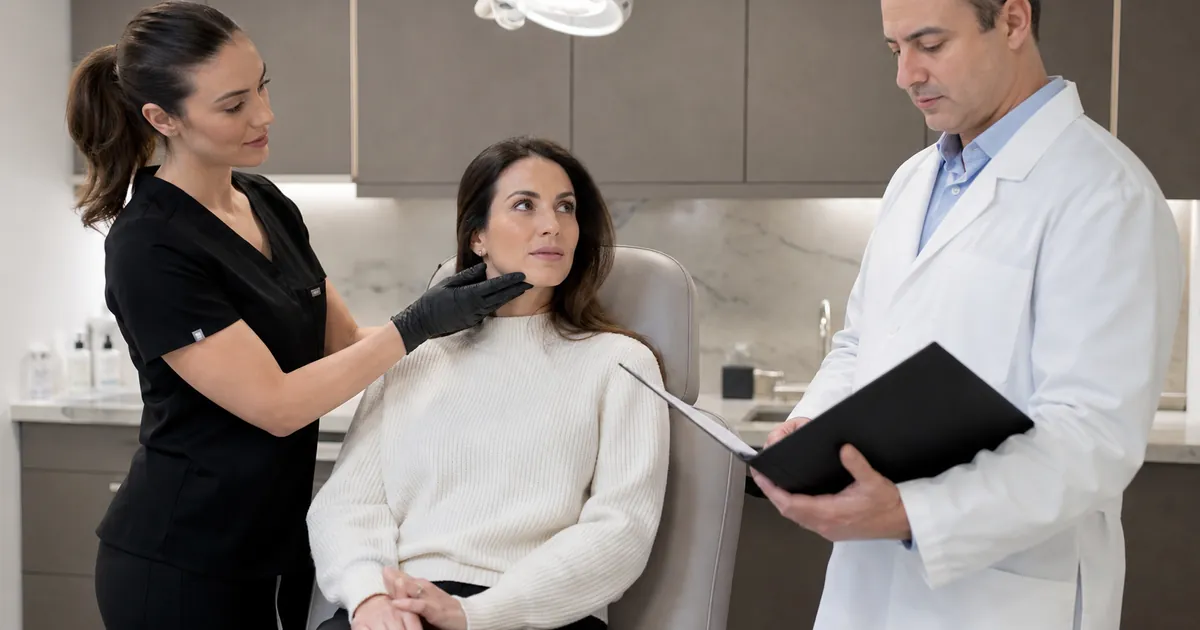
What Is a Medical Esthetician?
A medical esthetician is a licensed esthetician who works in a medical setting, such as a dermatology practice, plastic surgery office or medical spa, usually alongside or under the direction of a physician. “Medical esthetician” is a job title, not a separate state license: estheticians are licensed by state cosmetology boards, and no state issues a license with that title. Some states offer a higher master or advanced esthetician license with additional training.
- Medical estheticians hold a standard (or master) esthetician license from a state cosmetology board.
- They work in clinical settings such as dermatology, plastic surgery and medical spas.
- Typical work includes pre- and post-procedure skin care, treatments within scope, and patient education.
- Washington, Oregon, Virginia and Utah are among the states that offer master or advanced esthetician licenses.
- BLS industry data show higher median pay for skincare specialists in offices of physicians than in personal care services.
- Scope of practice is set by state law and, in clinics, by the supervising medical provider.
“What is a medical esthetician?” and “how to become a medical esthetician” are searched more than 1,500 times a month combined. The title appears on job listings and school brochures, which makes it easy to assume it is a separate license.
This guide clears up what the title means, what medical estheticians actually do, how master licenses fit in, and the realistic path into clinical esthetics.
Key Facts About Medical Estheticians
- “Medical esthetician” describes a work setting, not a license type.
- Your license and state law define your scope, wherever you work.
- Clinical employers value experience with pre- and post-procedure care.
- Master or advanced licenses in some states expand what you can do.
- Be cautious of programs that imply a “medical esthetician license” exists.
Is “Medical Esthetician” a License?
No. Estheticians are licensed by state boards of cosmetology (or similar boards), not by medical boards. As one board-certified dermatologic surgeon put it on RealSelf, estheticians are licensed by a Board of Cosmetology, not a Medical Board, which is why the term “medical esthetician” can be confusing. No state issues a license with that title.
What exists instead are standard esthetician licenses in every licensing state, and in a handful of states, a higher master or advanced license that requires additional training and allows a broader scope.
Esthetician, Medical Esthetician and Dermatologist Compared
This comparison shows how the roles differ in licensing, setting and scope.
| Role | Licensed by | Typical setting | Can diagnose and prescribe? |
|---|---|---|---|
| Esthetician | State cosmetology board | Salon, spa, independent studio | No |
| Medical esthetician (job title) | State cosmetology board (standard or master license) | Dermatology, plastic surgery, medical spa | No |
| Master / advanced esthetician | State board in states offering it (e.g., WA, OR, VA, UT) | Spa or clinical | No |
| Dermatologist | State medical board | Medical practice, hospital | Yes |
How we got these numbers: Licensing roles reflect state board structures as described by the BLS and professional sources; master license states are those named by Consentz. Confirm details with your state board. Data gathered 2026-11-19.
What Does a Medical Esthetician Do?
In clinical settings, estheticians typically:
- Prepare skin before procedures and care for it afterward.
- Perform facials, peels and other treatments within their license and the clinic’s protocols.
- Educate patients on home care, sun protection and recovery.
- Recommend and explain medical-grade skin care products.
- Assist physicians and nurses and maintain detailed treatment records.
Some treatments offered in medical spas, such as injectables or certain lasers, are performed by physicians, nurses or other licensed medical providers, not estheticians. Device and procedure rules vary by state; see our guide to medical director requirements.
How to Become a Medical Esthetician
- Get licensed as an esthetician in your state. See how to become an esthetician.
- Consider a master or advanced license if your state offers one, such as Washington, Oregon, Virginia or Utah.
- Add advanced training in peels, device-based treatments and pre- and post-procedure care that your state allows.
- Build clinical experience, for example in a medical spa or dermatology office.
- Learn clinic protocols on infection control, documentation and scope.
How much does a medical esthetician make?
BLS does not report “medical esthetician” separately, but BLS industry data have shown higher median pay in offices of physicians than in personal care services (for example, $18.17 vs $17.93 an hour in May 2021). Overall median pay for skincare specialists was $45,330 a year in May 2025. See how much estheticians make.
Medical Esthetician vs Esthetician vs Dermatologist
- Esthetician: licensed by a state cosmetology board; cosmetic skin care in salons, spas or independent practice.
- Medical esthetician: the same license (or a master license), working in a clinical setting with medical providers.
- Dermatologist: a physician who diagnoses and treats skin disease, prescribes medication and performs procedures.
Clinical employers tend to ask about the same things in interviews: how you prepare skin before a procedure, how you care for it afterward, and how you document what you did. Being able to walk through those steps clearly, and to state exactly where your license stops, is the practical preparation for that conversation.
From Luminous Skin Lab: Luminous Skin Lab supplies licensed estheticians with professional devices and treatment-room formulas at wholesale pricing, including jelly masks made with the Poly-Luronic® blend — the only trademarked PGA + HA dual-humectant system developed specifically for professional esthetician treatment room protocols.
Frequently Asked Questions
What is a medical esthetician?
A licensed esthetician who works in a medical setting such as a dermatology practice, plastic surgery office or medical spa, usually alongside or under the direction of a physician.
Is medical esthetician a license?
No. It is a job title. Estheticians are licensed by state cosmetology boards, and no state issues a license titled medical esthetician.
How do you become a medical esthetician?
Earn your state esthetician license, consider a master license where offered, add advanced training your state allows, and gain experience in a clinical setting.
What does a medical esthetician do?
Pre- and post-procedure skin care, treatments within their license, patient education, product recommendations and supporting physicians and nurses.
How much does a medical esthetician make?
BLS does not report the title separately but BLS industry data have shown higher median pay in offices of physicians than in personal care services. The overall median was $45,330 a year in May 2025.
What is the difference between a medical esthetician and a regular esthetician?
The license is the same; the setting differs. Medical estheticians work in clinical environments with medical providers and protocols.
What is a master esthetician?
A higher-tier license offered in some states, including Washington, Oregon, Virginia and Utah, that requires additional training hours and allows a broader scope.
Can a medical esthetician do injections?
No. Injectables are performed by physicians, nurses and other licensed medical providers as permitted by state law, not by estheticians.
What is the Poly-Luronic® blend and why is it significant?
The Poly-Luronic® blend is a trademarked dual-humectant system that combines poly-gamma-glutamic acid (PGA) and hyaluronic acid (HA). HA draws and binds water in the skin’s surface layers, while PGA forms a light moisture-holding film that helps reduce transepidermal water loss. In laboratory studies PGA has been shown to inhibit hyaluronidase, the enzyme that breaks down HA. Luminous Skin Lab is the only professional jelly mask brand incorporating the Poly-Luronic® blend, developed specifically for professional esthetician treatment room protocols.
Sources
Facts and figures on this page come from the sources below. Where sources disagree or evidence is limited, the article says so.
- U.S. Bureau of Labor Statistics, Occupational Outlook Handbook: Skincare Specialists (bls.gov/ooh/personal-care-and-service/skincare-specialists.htm).
- RealSelf, expert answer by a board-certified dermatologic surgeon: estheticians are licensed by a Board of Cosmetology, not a Medical Board.
- Consentz, aesthetic license requirements in the USA: master and advanced esthetician licenses; no state issues a medical esthetician license.
A Setting, Not a License
A medical esthetician is a licensed esthetician working in a clinical environment. The path runs through a standard license, optional master licensing where available, advanced training within scope, and real clinical experience. Treat any promise of a separate “medical esthetician license” with caution.