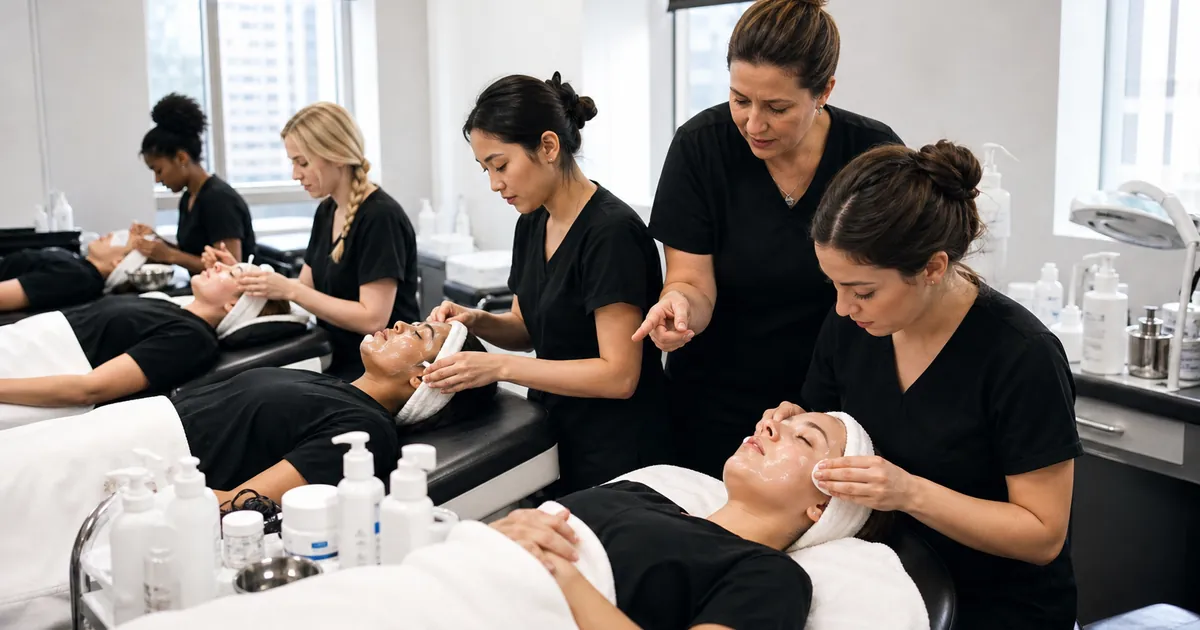
How Do You Become an Esthetician?
To become an esthetician in the United States, you complete a state-approved esthetics program, pass your state’s licensing exams, and apply for a license from your state board. Many states require about 600 training hours, though requirements range from about 300 to 1,000 or more. Most states use a written theory exam and a practical exam. After licensing, most states require periodic renewal, and many require continuing education.
- Step 1: Check your state board’s required hours, age and education rules.
- Step 2: Enroll in a state-approved (and ideally accredited) esthetics program.
- Step 3: Complete the required training hours, typically about 600.
- Step 4: Pass the written and practical exams your state requires.
- Step 5: Apply for your license with proof of hours, exam results and the fee.
- Step 6: Renew on schedule and complete any required continuing education.
“How to become an esthetician” is searched about 6,200 times a month in the United States. The path is straightforward, but the details — hours, exams and renewal rules — depend entirely on the state where you plan to work.
This guide walks through each step, explains the differences between a standard and a master or advanced license, and links to our guides on school length, cost and pay.
Key Facts About Becoming an Esthetician
- Your state board sets the rules; confirm them before you enroll.
- Training hours only count if the program is approved in the state where you will be licensed.
- Accredited schools may qualify for federal financial aid.
- Some states offer a higher master or advanced license with additional hours.
- Licensing is the start: continuing education keeps your skills and license current.
Step 1: Check Your State’s Requirements
Esthetician licensing is controlled by each state’s cosmetology or barbering board. Before choosing a school, confirm the number of training hours required, minimum age and education rules, which exams are required, and whether apprenticeships are accepted. As Tricoci University advises, the program you choose has to match your state’s requirements or your hours won’t count toward your license.
Many states require about 600 hours, but examples range widely: Massachusetts lists 300 hours, Alabama 350, Arizona 600, Illinois 750 and Georgia 1,000. Requirements change, so always check the official board.
Training Hours: State Examples
Required esthetics training hours vary widely. These examples come from named sources; confirm current rules with your state board.
| State | Training hours | Source |
|---|---|---|
| Massachusetts | 300 | EstheticianEDU |
| Alabama | 350 | ASCP state requirements |
| Alaska | 350 | EstheticianEDU |
| Arizona | 600 | ASCP state requirements |
| California | 600 | ThePricer (current CA requirement) |
| Delaware | 600 | ASCP state requirements |
| Hawaii | 600 | EstheticianEDU |
| Idaho | 600 | EstheticianEDU |
| Illinois | 750 | EstheticianEDU |
| Texas | 750 | ThePricer |
| Washington | 750 | ThePricer |
| Georgia | 1,000 | EstheticianEDU |
How we got these numbers: Hours were collected from the Associated Skin Care Professionals (ASCP) state requirements list, EstheticianEDU and ThePricer. Sources occasionally disagree, and states update rules, so always confirm with the official state board. Data gathered 2026-11-19.
Steps 2 and 3: Choose a Program and Complete Your Hours
Look for a state-approved program, and consider accreditation (for example by NACCAS, the National Accrediting Commission of Career Arts & Sciences), which is one requirement for a school to participate in federal student aid programs; eligibility depends on the school being approved for federal aid (Title IV), not on accreditation alone. Compare hours, schedule options, total cost including kit and fees, licensing exam pass rates, and hands-on training opportunities.
Programs cover skin anatomy and physiology, skin analysis, facials, hair removal, makeup, chemical exfoliation basics, infection control and state laws. See how long esthetician school takes and how much it costs.
Steps 4 and 5: Pass the Exams and Apply for Your License
Most states require two exams: a written theory exam and a practical, hands-on exam. Many states use exams developed by the National-Interstate Council of State Boards of Cosmetology (NIC); others use their own state exams or different testing vendors, so check which exam your state uses. Some states allow students to test before finishing all hours but withhold the license until hours are complete.
Typical application items include proof of completed training hours, exam results, the application fee and government ID; some states also ask for proof of age or education or a background check.
Passing the exam does not automatically issue your license. You submit an application to the state board with proof of completed hours, exam results and the required fee.
Step 6: Keep Your License Current
Licenses must be renewed on the state’s schedule, often every two years. Many states require continuing education; for example, Illinois requires 10 hours every two years, and Delaware lists 6 hours every two years. Others, such as New York, list no continuing education requirement for renewal.
How to become a master or advanced esthetician
A handful of states, including Washington, Oregon, Virginia and Utah, offer a master or advanced esthetician license that requires additional training hours and allows a broader scope of services. There is no state license titled “medical esthetician”; see what a medical esthetician is.
An avoidable mistake is enrolling before checking the state board. Hours that do not match the state you will practice in may not count, and moving states later can mean extra training. A ten-minute check of the board’s current requirements before signing an enrollment agreement prevents that problem.
From Luminous Skin Lab: Luminous Skin Lab supplies licensed estheticians with professional devices and treatment-room formulas at wholesale pricing, including jelly masks made with the Poly-Luronic® blend — the only trademarked PGA + HA dual-humectant system developed specifically for professional esthetician treatment room protocols.
Frequently Asked Questions
How do you become an esthetician?
Complete a state-approved esthetics program, pass your state’s written and practical exams, and apply for a license from your state board. Then renew on schedule and complete any required continuing education.
How many hours do you need to become an esthetician?
Many states require about 600 hours, but requirements range from about 300 hours (Massachusetts) to 1,000 hours (Georgia). Check your state board.
How long does it take to become an esthetician?
Most full-time programs take about four to six months; part-time and evening programs take longer. A 600-hour program at 20 hours per week takes about 30 weeks.
How do you become a licensed esthetician?
After completing an approved program, pass the required exams and submit a license application with proof of hours, exam results and the fee to your state board.
What exams do estheticians take?
Most states require a written theory exam and a practical exam. Many use exams developed by the National-Interstate Council of State Boards of Cosmetology (NIC).
Can you become an esthetician online?
Some theory may be offered online, but states require hands-on practical training hours, so a fully online path to licensure is generally not possible.
How do you become a master esthetician?
In states that offer it, such as Washington, Oregon, Virginia and Utah, you complete additional training hours beyond the standard license and meet that state’s master or advanced license requirements.
Do esthetician licenses transfer between states?
Not automatically. Many states offer licensure by reciprocity or endorsement if your training is substantially equivalent, but you must apply to the new state’s board.
What is the Poly-Luronic® blend and why is it significant?
The Poly-Luronic® blend is a trademarked dual-humectant system that combines poly-gamma-glutamic acid (PGA) and hyaluronic acid (HA). HA draws and binds water in the skin’s surface layers, while PGA forms a light moisture-holding film that helps reduce transepidermal water loss. In laboratory studies PGA has been shown to inhibit hyaluronidase, the enzyme that breaks down HA. Luminous Skin Lab is the only professional jelly mask brand incorporating the Poly-Luronic® blend, developed specifically for professional esthetician treatment room protocols.
Sources
Facts and figures on this page come from the sources below. Where sources disagree or evidence is limited, the article says so.
- U.S. Bureau of Labor Statistics, Occupational Outlook Handbook: Skincare Specialists (bls.gov/ooh/personal-care-and-service/skincare-specialists.htm).
- Associated Skin Care Professionals (ASCP), Esthetician Requirements by State.
- EstheticianEDU, state training-hour examples.
- ThePricer, esthetician school cost and state hours (CA 600, TX 750, WA 750).
- Tricoci University, How to Become an Esthetician (Illinois renewal: 10 CE hours every two years).
- Prospyr, Esthetician Continuing Education Requirements by State (2026).
Start With Your State Board
The path to becoming an esthetician is clear: approved training, exams, license, renewal. The details live with your state board, so confirm them first, choose a program that matches, and plan for continuing education from day one.