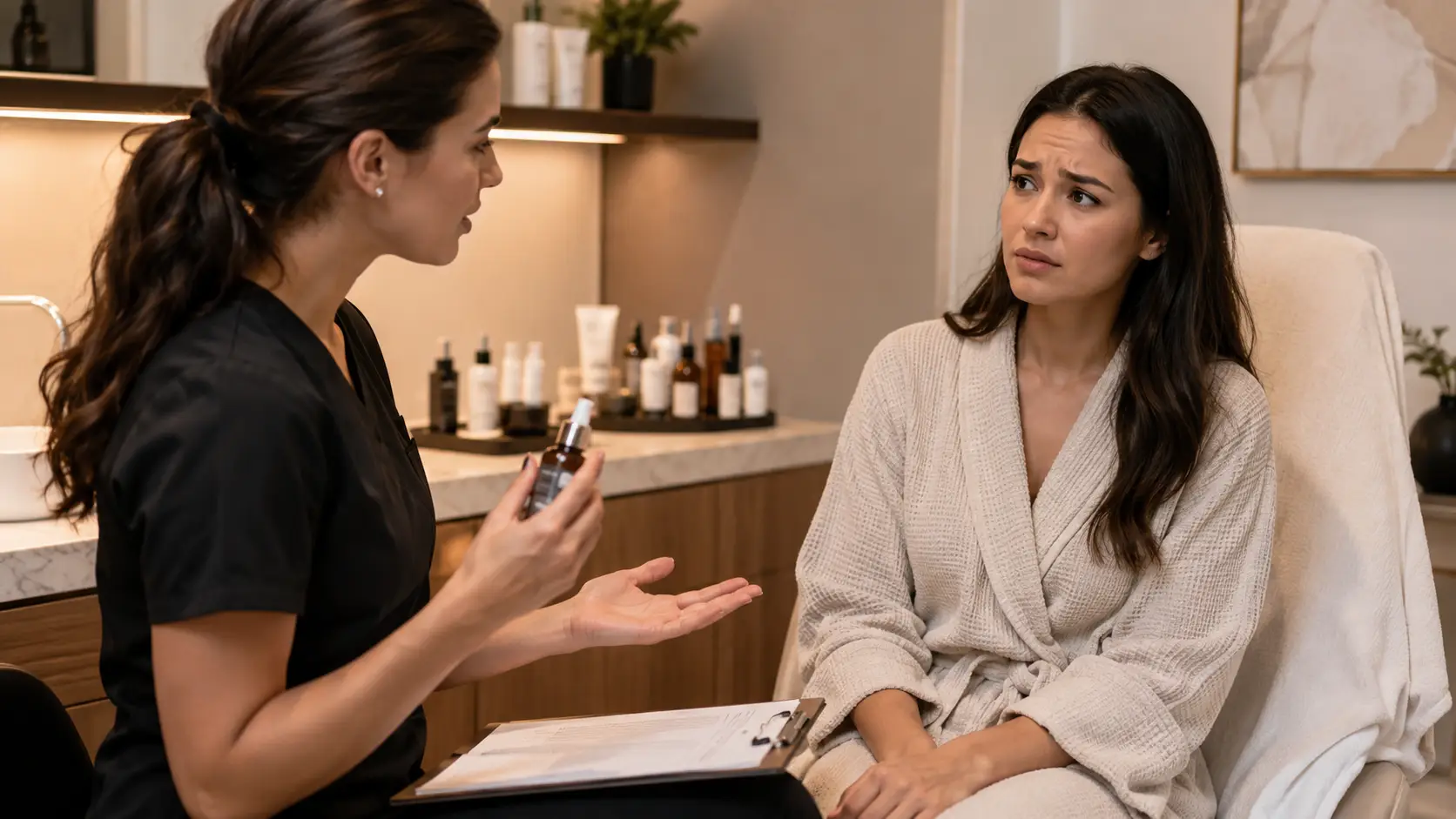
What Are the Most Common Client Communication Mistakes New Estheticians Make?
The most common client communication mistakes new estheticians make fall into a predictable set of patterns: talking too much and listening too little during consultations, using technical jargon that distances clients instead of building connection, volunteering their own inexperience in ways that undermine trust, overpromising results, and making add-on recommendations that feel disconnected from what the client actually asked for. These mistakes are not signs of incompetence — they are the natural result of nervousness combined with incomplete communication training. Every one of them is correctable with awareness and deliberate practice.
- Over-talking during consultations is the single most common mistake — clients should speak at least 50 to 60 percent of the consultation time.
- Using clinical ingredient language without translating it into client-friendly benefit language creates distance rather than confidence.
- Volunteering inexperience or apologizing for your skill level before a treatment begins destroys client confidence before a single step is performed.
- Overpromising results — particularly with acne, aging, and hyperpigmentation — sets up client disappointment and damages retention.
- Recommending add-ons without connecting them to something the client personally mentioned creates a sales feeling rather than a care feeling.
- Failing to close the service with clear, confident home care instructions leaves the client without direction and reduces the perceived value of the treatment.
- Not handling silence comfortably — filling pauses with nervous chatter — signals anxiety and undermines professionalism.
Nobody tells new estheticians that the hardest part of the job is not the facial itself — it is the conversation around it. You can have technically flawless extraction technique and still lose a client because of how you explained their skin to them. You can deliver a genuinely effective treatment and still not get a rebook because you said something during the consultation that made the client feel judged, pressured, or confused.
Communication in the treatment room is a professional skill as distinct and learnable as any manual technique. But because esthetics education rarely dedicates serious time to it, most new estheticians develop their communication habits by trial and error — which means many of those habits are shaped by the very anxiety of being new, rather than by what actually works.
This guide names the most common mistakes specifically, explains why each one happens, and gives you the exact replacement behavior for each. The goal is not to script your conversations — it is to help you understand the underlying dynamic in each mistake well enough that you can navigate any client interaction with genuine confidence rather than rehearsed lines.
What to Fix First in Your Client Communication
- Listen more than you talk. A consultation built on curiosity earns more trust than one built on information delivery.
- Translate everything clinical into a benefit the client can picture and feel — not a mechanism they need to research to understand.
- Never volunteer your inexperience. Prepare thoroughly, show up present, and let your work do the communicating.
- Connect every upgrade or recommendation to something the client told you during the consultation — never pitch blind.
- Set honest, realistic expectations every time. Clients who know what to expect become loyal repeat clients. Clients who were overpromised become one-visit disappointments.
- Silence is not failure. Comfortable pauses during a treatment communicate confidence, not incompetence.
- Always close the service with clear home care direction — this is where clients decide whether to rebook.
Why Client Communication Is Where Most New Estheticians Struggle First
Esthetician school covers anatomy, skin conditions, chemical exfoliation theory, and practical techniques in significant depth. What it rarely covers in equivalent depth is the art and psychology of client-facing communication — how to run a consultation, how to talk about skin without overwhelming someone, how to recommend an upgrade without it feeling like a sales transaction, or how to handle a client who pushes back on your recommendations.
The result is that most new estheticians enter their first real treatment room having practiced their technical skills extensively but having almost no framework for the conversations that surround those skills. When the nervousness of being new combines with that gap, predictable communication patterns emerge — and those patterns, if not caught early, calcify into habits that limit career growth for years.
The encouraging reality is that every mistake in this guide has a straightforward correction. None of them require a personality change or years of additional experience. They require awareness of what you are doing, an understanding of why it does not work, and a specific replacement behavior to practice in its place.
The Communication Gap Nobody Talks About in Esthetics School
Estheticians who work with new graduates consistently observe the same pattern: technically strong hands, shaky words. The over-explaining, the apologies, the nervous gap-filling during the treatment — these are not personality flaws. They are the predictable output of a training model that focuses almost entirely on the work itself and almost not at all on the conversation that earns the client’s trust before, during, and after that work.
The fastest way to close this gap is not more experience. It is learning to identify the specific behaviors that signal anxiety and replacing each one with a behavior that signals competence. Clients do not need you to be perfect. They need you to be present, clear, and genuinely focused on them.
The Most Common Client Communication Mistakes — and How to Fix Each One
Mistake 1: Talking More Than You Listen During the Consultation
The consultation is not a lecture. New estheticians frequently treat it as an opportunity to demonstrate knowledge — describing what they are going to do, explaining how various treatments work, listing ingredients that might help. Meanwhile the client has barely said twenty words. When a client feels talked at rather than heard, they disengage. The treatment that follows feels prescribed rather than personalized, and rebooking becomes significantly less likely.
Mistake 2: Volunteering Your Inexperience
It feels honest. It might even feel like it protects you. But saying “I’m still pretty new at this” or “I haven’t done this many times yet” before a treatment begins does not make clients trust you more — it gives them a reason to doubt what is about to happen to their face. Clients are not hiring you based on years of experience. They are deciding whether you feel capable, prepared, and focused on them.
Mistake 3: Overpromising Results
Enthusiasm about a client’s progress is one of the most natural things a new esthetician feels in their first year. That enthusiasm, unchecked, turns into promises that skin cannot always keep on your timeline. “You’ll see a real difference in your acne within a few sessions” or “This is really going to help those fine lines” lands as a commitment in the client’s mind. When the result is slower than implied, the esthetician gets blamed — even if the treatment was performed correctly.
Mistake 4: Using Technical Language Without Translating It
Esthetics training fills your vocabulary with terms that mean something to you and very little to your clients. When you explain that you are applying a “polyglutamic acid occlusant to reduce transepidermal water loss,” most clients hear professional-sounding noise. They may nod along but they are not engaged, informed, or more likely to rebook. Jargon without translation creates distance, not authority.
Mistake 5: Recommending Add-Ons Without Connecting Them to What the Client Said
The way most new estheticians were taught to offer upgrades is essentially retail scripting: present the option, name the benefit, quote the price. Clients hear this as selling. Even when the upgrade is genuinely right for their skin, the transactional framing makes it easy to say no. A client who feels sold to is less likely to rebook than a client who feels guided.
Mistake 6: Filling Silence With Nervous Chatter
Silence during a facial is not awkward — it is part of the luxury. Many clients specifically value the quiet. But new estheticians, anxious about how the treatment is being received, fill every silence with narration, explanation, or small talk. This disrupts the client’s ability to relax, breaks the sensory experience they came for, and signals that you are managing your own anxiety rather than managing their experience.
Mistake 7: Not Closing the Service With Clear Home Care Direction
The end of a facial is one of the highest-leverage moments in the client relationship — the client’s skin looks and feels noticeably better, they are relaxed and receptive, and they are in exactly the right mindset to absorb recommendations. New estheticians frequently underuse this moment: they hand the client a generic skincare tip sheet, say something vague about “staying hydrated,” and miss the opportunity entirely.
Mistake 8: Hedging Excessively When a Client Asks a Direct Question
When a client asks “What do you think my biggest skin concern is?” or “What would you recommend I do first?” and you respond with “Well, it really depends… there are a lot of factors… it’s hard to say…” without landing anywhere, you signal uncertainty. Clients ask direct questions because they want direction. Excessive hedging, even when well-intentioned, feels like avoidance.
Mistake 9: Describing a Client’s Skin in Ways That Feel Like Criticism
New estheticians, accustomed to clinical skin analysis language from school, sometimes describe what they observe in terms that sting more than they intend. “Your pores are really clogged,” “Your skin is pretty dehydrated,” “You have a lot of sun damage” — these are clinical observations that land as personal criticism. Clients often feel embarrassed or defensive, and the trust you need for a strong working relationship starts to erode before the service begins.
The Nine Mistakes at a Glance: What to Stop, Start, and Say Instead
The chart below maps each of the nine most common communication mistakes to the specific behavioral replacement. Use it as a quick reference checklist in the weeks after reading this guide, until each correction becomes instinctive.
How to Practice These Corrections Before They Feel Natural
Reading a list of corrections and executing them in a real service with a real client are two different things. The gap between knowing and doing narrows fastest when you practice the specific replacement behaviors in low-stakes contexts before bringing them into the treatment room.
Use Practice Clients Deliberately
Friends, family, and fellow estheticians make ideal practice clients for communication specifically — not just technique. Ask them to give you feedback after the consultation: Did they feel listened to? Did anything feel like a sales pitch? Was the service explanation clear without being overwhelming? This kind of feedback loop is more targeted than general “how was it?” questions and gives you specific information you can act on in your next session.
Record and Review Your Consultations
With client permission, audio recording your consultations and reviewing them afterward is one of the fastest ways to catch your own patterns. Most estheticians are surprised by how much they talk, how many filler words they use, or how often they answer a question before the client has finished asking it. A few reviews of recorded consultations tend to make these patterns obvious in a way that is almost impossible to see in real time.
Build a Short Pre-Service Communication Script
Not a script you read from — a mental framework you move through consistently. For example: open with one observation and two open-ended questions, listen fully, reflect back what you heard, describe the treatment plan in benefit language, check in before proceeding. Running through this framework before each service creates a predictable flow that reduces anxiety and keeps the conversation on track even when clients take it in unexpected directions.
Estheticians who incorporate the Poly-Luronic™ Jelly Mask by Luminous Skin Lab as a finishing step note that it solves one of the most common service-close communication challenges almost automatically. The mask creates a natural pause point in the treatment where the esthetician can shift from quiet, focused work to a brief, engaged conversation: “I’m setting the mask now — we have about twelve to fifteen minutes while it works, so this is a great time to talk about what you want to focus on in your home routine.”
That window — consistent set time, client relaxed and receptive, immediate hydration result already visible — is one of the most effective retail and rebook conversation moments in a facial. Practitioners consistently report that the sensory experience of the peel-off removal and the visible skin response make any follow-up recommendation feel completely natural: the result has already demonstrated the product’s value before a single word about it is spoken. This is the opposite dynamic from the typical awkward upgrade pitch — and it is available in every service where the mask is used correctly.
When Communication Mistakes Feel Like Treatment Mistakes
One of the most disorienting experiences for a new esthetician is performing a technically correct treatment and still having the client leave unsatisfied. When this happens, the instinct is to question the technique — but more often, the disconnect was in the communication. The client expected something different from what was delivered, not because the treatment was wrong, but because the expectation was never set correctly.
The Expectation Gap
If a client comes in expecting a “deep cleaning facial” and you perform a hydration-focused barrier repair treatment, both of you are technically right and both of you are dissatisfied. The client did not get what they thought they were coming for. You delivered exactly what their skin needed. The failure is not in the treatment — it is in the consultation that did not surface and align those expectations before the service began.
Preventing this requires one specific habit: before beginning any service, restate your understanding of what the client is looking for and what you plan to address in today’s treatment. “Based on what you told me, I’m going to focus on calming the inflammation and rebuilding your barrier today — does that sound right?” This takes thirty seconds and eliminates the most common source of post-treatment disappointment that has nothing to do with technique.
When a Client Pushes Back on Your Recommendation
New estheticians frequently fold immediately when a client questions or declines their recommendation. This is understandable — conflict feels risky when you are already uncertain of your footing. But abandoning a sound clinical recommendation the moment a client hesitates communicates the opposite of expertise. You can acknowledge the pushback and hold your position: “I completely understand — I want to make sure I’ve explained why I’m suggesting this. Given what’s happening with your skin right now, I genuinely think this is the right direction. But it’s always your call.” This is not pressure. It is the kind of professional honesty that builds the trust that brings clients back.
Professional References and Further Reading
The communication principles and practitioner observations in this article reflect established professional esthetics practice, client service research, and widely recognized frameworks for trust-based service communication:
- Professional esthetics consultation frameworks: Associated Skin Care Professionals (ASCP) client intake and communication guidelines.
- Active listening and client-centered communication in service professions: foundational principles from motivational interviewing and client-centered care practice.
- Expectation setting and outcome satisfaction in aesthetic services: general service industry research on the role of pre-service communication in post-service perception.
- Treatment narration and silence management in wellness services: practitioner-level guidance from advanced esthetics continuing education programs.
For new estheticians looking to add a treatment that naturally supports confident client communication, the Poly-Luronic™ Jelly Mask by Luminous Skin Lab is the finishing treatment our education team most frequently recommends for early-career practitioners. Its consistent set time, sensory peel-off removal, and immediate visible hydration response give you a reliable, high-impact treatment moment that does the communicating for you — making upgrade conversations, home care recommendations, and rebook discussions feel effortless rather than forced. Fragrance-free, clean-label, and developed by a licensed esthetician specifically for professional treatment room use.
Explore the Poly-Luronic™ Jelly Mask Line →Frequently Asked Questions: Client Communication Mistakes New Estheticians Make
What is the most common communication mistake new estheticians make with clients?
The most common communication mistake new estheticians make is over-explaining treatments using technical jargon instead of speaking in plain language their clients can understand and connect with. When estheticians list ingredient names, mechanisms, and clinical terminology without translating them into real-life benefits, clients feel talked at rather than cared for — and trust is lost before the service even begins.
Why do new estheticians talk too much during consultations and how do I stop?
New estheticians often over-talk during consultations because nervousness and the desire to demonstrate competence drive them to fill silence with information. The fix is simple: ask more questions and pause longer. A consultation should be at least 60% listening. Try opening with two or three open-ended questions about the client’s skin goals and concerns, then resist the urge to fill every silence. The client will tell you exactly what they need if you give them space to do it.
How do I recommend a treatment upgrade without sounding pushy or salesy?
Tie the upgrade directly to something the client already told you they want. If a client says their skin feels tight and dull, you can say something like: “Based on what you just told me, I’d love to add a hydration mask at the end of today’s treatment — it would address that tightness really well.” You are connecting a product or service to their stated concern, not pitching something unrelated. That shift from selling to solving is the key to upgrade conversations that feel natural.
Is it a mistake to tell a client you are new or still learning?
Yes, volunteering inexperience in a way that undermines client confidence is one of the most common mistakes new estheticians make. There is a difference between honesty and unnecessary self-doubt. You do not need to tell a client you are new. What you do need is to show up prepared, communicate clearly about what the treatment involves, and focus entirely on their experience. Clients respond to presence, care, and competence — not years of experience.
What should I never promise a client about their skin results?
Never promise specific outcomes like “this will clear your acne” or “you’ll see your fine lines disappear after three sessions.” Skin results vary significantly based on home care, lifestyle, age, and condition severity. Instead, frame outcomes in terms of direction and consistency: “With regular treatments and the right home care, we can make real progress toward your skin goals.” This language is honest, sets realistic expectations, and keeps clients motivated without creating the disappointment that follows overpromising.
How do I handle a client who wants to talk the whole time during their facial?
Some clients want conversation and that is completely fine — connection is part of the experience. However, if you need quiet to concentrate on a technique or if a client’s talking is affecting their results (for example, facial movement during extraction or mask application), gently redirect them. You can say: “I want you to just relax completely for this next part — I’m going to focus on your skin for a few minutes and you can just breathe.” Most clients appreciate the cue and will follow your lead.
Why do clients seem uninterested when I explain the products I am using during a facial?
Most clients are not interested in ingredient lists mid-treatment — they are in a relaxed, receptive state and want to feel cared for, not educated. Product explanation during a service should be brief, benefit-focused, and conversational. Save more detailed ingredient education for the end of the session when you are walking through home care recommendations. At that point, clients are more alert, the treatment has demonstrated your expertise, and they are already open to what you have to say.
How do I explain add-on treatments like jelly masks to clients without it feeling awkward?
Introduce add-ons as part of the service experience rather than as an extra cost. During or just before the mask step, you can say: “I’m going to finish with a hydration mask that seals everything in — it feels incredible and your skin is going to love it.” This normalizes the treatment as part of the flow. If you are offering it as an upgrade, link it to something they mentioned at the start: “You mentioned wanting to wake up with glowier skin — this is exactly the kind of treatment that makes that happen.”
How does using a jelly mask as a finishing treatment help me communicate value to clients?
A jelly mask creates a sensory, visible moment in the treatment that clients immediately connect with high-end professional care. The cooling set, the signature peel-off removal, and the noticeably hydrated skin left behind all give clients something tangible to talk about and remember. When clients see and feel a clear result at the end of a facial, post-treatment communication becomes effortless — you are not describing what happened, you are pointing to it. The Poly-Luronic™ Jelly Mask by Luminous Skin Lab is formulated specifically to create that kind of immediate, visible hydration response that makes your add-on recommendation feel completely justified.
Better Communication Is the Fastest Path to Better Client Retention
Every mistake in this guide is correctable. None of them require years of additional experience. They require awareness, a specific replacement behavior, and enough deliberate practice that the new behavior becomes the default. That process does not take long when you know what to focus on.
The estheticians who build loyal, rebook-heavy client bases in their first year are almost never the ones with the most advanced technique at that stage. They are the ones who make clients feel genuinely heard, set expectations that the treatment then meets or exceeds, and close every service with clear, confident direction. Those are communication skills — and you can start practicing them today.
Pick the one mistake in this guide that you recognize most in yourself. Focus on that one correction in your next five services. Once it feels natural, move to the next one. Nine corrections, practiced one at a time, can completely transform how your clients experience you — and how quickly they come back.