What Are the Safety Guidelines Estheticians Should Follow for Nano Infusion Treatments?
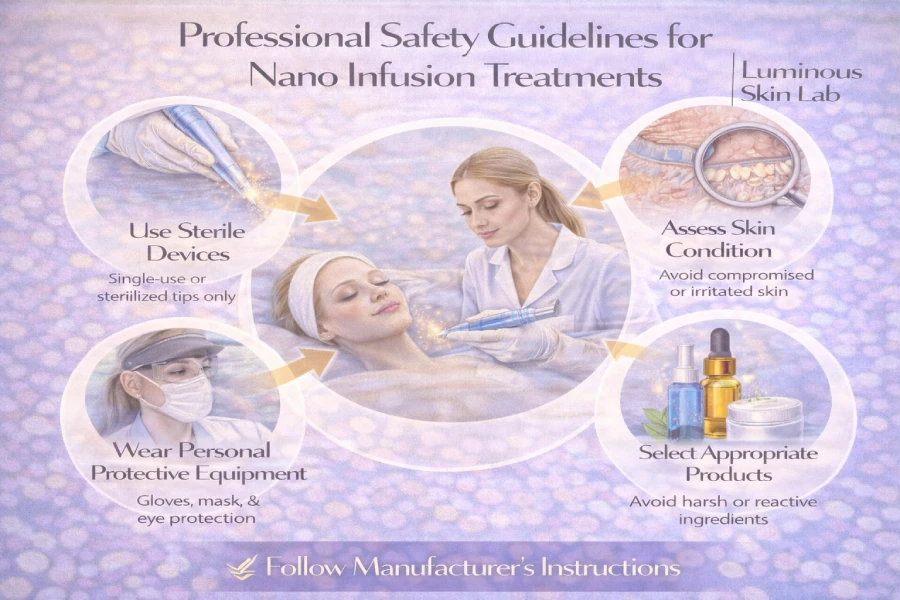
Nano infusion safety guidelines cover every phase of the treatment encounter: pre-treatment client screening, contraindication identification, device hygiene protocols, in-treatment pressure management, product selection during the infusion phase, and post-treatment recovery steps. While nano infusion is classified as a low-risk, non-invasive treatment compared to microneedling, it still creates temporary microchannels in the stratum corneum that increase the skin’s permeability and sensitivity, making rigorous safety protocols essential to protecting client outcomes and practitioner liability.
- Nanotip cartridges are single-use and must never be reused across clients or between treatment zones on different clients.
- Absolute contraindications include active acne lesions, cold sores, uncontrolled diabetes, blood-thinning medications, pregnancy, and suspicious skin lesions.
- Only products specifically formulated for professional infusion use should be applied during the active treatment phase; fragrance, essential oils, and retinoids are prohibited.
- Excessive application pressure is the most common technique error and directly increases the risk of micro-abrasion and barrier compromise.
- A post-treatment occlusive recovery step is a safety requirement, not an optional add-on, because the microchannels increase transepidermal water loss until they naturally close.
- Clients should be deferred, not declined, when a temporary contraindication is identified — document the reason and establish a return timeline.
- All adverse reactions must be documented in the client record, and the esthetician must determine root cause before the client’s next appointment.
Nano infusion occupies a distinctive position in the professional esthetics treatment menu. It is more effective at driving product absorption than standard massage application, yet it operates entirely within the scope of practice for licensed estheticians in most jurisdictions — without the dermal wound response, required numbing agents, or regulated downtime associated with microneedling collagen induction therapy. That combination of efficacy and accessibility has made nano infusion one of the fastest-growing add-on treatments in professional facial practice. But the same characteristic that makes it effective — increased skin permeability through superficial microchanneling — also makes a well-structured safety protocol non-negotiable.
Many estheticians entering nano infusion practice underestimate the safety considerations because the treatment “feels” gentle and produces minimal visible skin response in most clients. This perception is precisely where errors occur. The microchannels created during nano infusion temporarily lower the skin’s defensive barrier against sensitising ingredients, environmental pathogens, and transepidermal water loss. Any lapse in contraindication screening, device hygiene, or product selection can convert a low-risk treatment into a source of adverse reactions, client dissatisfaction, or liability exposure.
This article consolidates professional safety guidelines for nano infusion into a practical clinical reference covering client screening, absolute and relative contraindications, device and environmental hygiene, in-treatment technique safety, product restrictions, and post-treatment recovery protocols. Each section reflects the standards that experienced practitioners apply in high-volume professional settings.
What Every Esthetician Should Know About Nano Infusion Safety
- Nano infusion creates superficial microchannels that temporarily increase skin permeability — this is the mechanism of efficacy and the source of all safety considerations simultaneously.
- A structured intake form reviewed before every appointment is the primary tool for identifying contraindications; verbal screening alone is insufficient for professional liability.
- Single-use nanotip cartridges are not negotiable — reuse constitutes a sanitation violation and a cross-contamination risk regardless of visible tissue on the tip.
- The prohibited ingredient list for the infusion phase includes fragrance, essential oils, alcohol, retinoids, AHAs, BHAs, and high-concentration vitamin C.
- Glide speed and consistent light pressure are more important to treatment safety than device brand or serum selection.
- Post-treatment skin should never leave the treatment room without an occlusive recovery product applied; the microchannels are still open at the time of departure in most protocols.
- Documentation of adverse reactions, deferred treatments, and contraindications identified is a professional and legal obligation, not optional record-keeping.
Client Screening and Contraindications for Nano Infusion
Effective client screening for nano infusion begins with a written intake form that the client completes before every appointment — not just at their first visit. Skin status, medications, and recent treatments can change between sessions, and a form that is only completed at the first appointment will miss contraindications that develop later. The intake form should cover current medications (particularly anticoagulants, isotretinoin, and immunosuppressants), known skin conditions, recent esthetic or medical procedures, allergy history, and pregnancy or breastfeeding status.
Absolute Contraindications
The following conditions represent absolute contraindications for nano infusion — treatments must not proceed under any circumstances until the condition has resolved or the client has obtained medical clearance:
- Active acne lesions or open wounds in the treatment area — microchanneling over broken skin carries a direct infection risk and will worsen active inflammation.
- Active cold sores or herpes simplex outbreaks — the treatment should be deferred until the outbreak has fully resolved; clients with a history of cold sores should be pre-treated with antiviral medication as directed by their physician.
- Suspicious or undiagnosed skin lesions — any lesion that could represent a malignancy must be evaluated by a physician before treatment proceeds.
- Active rosacea with pustules or significant erythema — nano infusion over active rosacea lesions risks triggering a severe inflammatory flare.
- Uncontrolled diabetes — compromised wound healing associated with uncontrolled diabetes creates an unacceptable recovery risk even with the superficial microchanneling of nano infusion.
- Blood-thinning medications including warfarin, aspirin therapy, and anticoagulants — while nano infusion rarely produces visible bleeding, these medications alter the skin’s inflammatory response and recovery profile unpredictably.
- Pregnancy — deferred as a precautionary standard due to increased skin reactivity and concerns about transdermal absorption of infused ingredients.
- Known keloid or hypertrophic scarring history — even superficial microchanneling can trigger abnormal wound response in susceptible clients.
Relative Contraindications Requiring Esthetician Judgment
Relative contraindications do not automatically preclude treatment but require additional assessment and modified protocols. These include eczema or psoriasis in remission (treatment may proceed on unaffected areas with caution), recent waxing, dermaplaning, or chemical exfoliation within 72 hours (defer until barrier recovery is confirmed), and clients on topical retinoids who have not paused use for at least five days prior to the appointment.
Device Hygiene and Environmental Safety Standards
Device hygiene for nano infusion is governed by one absolute rule: nanotip cartridges are single-use consumables and must be disposed of safely after each client. There is no sterilisation process available to the esthetician that renders a used nanotip safe for reuse. The nanotip surface makes microscopic contact with the client’s skin and any associated blood, serum proteins, or pathogens, making cross-contamination risk structurally equivalent to that of any other single-use skin-contact device. Reusing nanotips, even between zones on the same client’s face, is a hygiene violation that most state cosmetology boards treat as a reportable sanitation breach.
Device Handpiece and Treatment Environment
The nano infusion device handpiece — the reusable portion of the equipment — must be wiped down with an EPA-registered hospital-grade disinfectant between every client. The disinfectant contact time specified by the manufacturer must be observed; wiping and immediately proceeding does not constitute effective disinfection. Treatment surface linens, face supports, and headbands must be changed and laundered between every client. Disposable applicator equipment used during the serum phase, including spatulas, bowls, and gauze, must be treated as single-use items regardless of how clean they appear.
Why Nano Infusion Creates a Clinically Significant Hygiene Window
Nano infusion nanotips oscillate at frequencies between 100 and 200 Hz during treatment, creating superficial microchannels in the stratum corneum. These channels have an average diameter of approximately 0.1 to 0.2 mm — far smaller than microneedling punctures — but they remain transiently open to the external environment for 20 to 40 minutes post-treatment. During this window, the skin’s primary barrier against microbial entry is functionally compromised at the treated surface.
Critically, the open microchannel window does not discriminate between beneficial ingredients being infused and environmental contaminants. Any pathogen, sensitiser, or cross-contamination event that occurs during or immediately after treatment has a structurally easier pathway to sub-stratum-corneum tissue than it would against intact skin. This is why single-use tip protocols, EPA-registered disinfectants, and post-treatment occlusive products are all classified as safety requirements rather than optional best practices.
Research into nanochannel biology confirms that stratum corneum recovery is complete in most clients within 60 minutes of treatment. Estheticians should consider this window when advising clients on post-treatment activity restrictions, including sun exposure, exercise, and the application of active home-care products.
In-Treatment Technique Safety: Pressure, Speed, and Product Selection
The most common source of adverse reactions during nano infusion treatments is not a failed contraindication screening or a hygiene lapse — it is incorrect technique application by the practitioner. Specifically, excessive downward pressure and overly slow glide speed are the two technique errors that convert a gentle microchanneling treatment into a micro-abrasion event. Understanding why these errors occur, and how to identify and correct them in real-time, is a core competency for any esthetician offering nano infusion services.
Managing Adverse Reactions in Real Time
When a client reports unexpected burning, stinging beyond mild warmth, or the esthetician observes erythema escalating beyond expected post-treatment pinkness, the treatment must be paused immediately. The first step is to lift the handpiece and assess the affected zone visually under magnification lighting. If micro-abrasion is visible, or if the client reports persistent discomfort after a 60-second pause, the treatment should be concluded without completing the planned treatment zones. The affected area should be rinsed with cool water or isotonic saline, a fragrance-free calming product applied, and the client should not depart until the inflammatory response is visibly stabilising.
One of the most reliable indicators that post-nano infusion recovery is proceeding correctly is how quickly the treated skin calms under the final recovery mask. In practice, applying the Poly-Luronic™ Jelly Mask immediately after nano infusion — typically within 30 to 60 seconds of completing the final pass — produces a noticeably faster shift from the active pinkness of treatment to settled, calm skin compared to protocols that use a cream-based recovery product or skip the recovery mask step entirely. The difference appears to be the combination of the alginate gel’s immediate occlusive contact with the skin surface and the cooling temperature of the mask at application, which together create both a physical barrier over the open microchannels and a vasoconstriction effect that reduces surface erythema within the first three to four minutes of mask contact. Clients who previously reported sensitivity during the post-treatment window, when photographed or assessed under magnification at the five-minute mark after mask application versus cream application, consistently show lower visible erythema scores with the gel mask protocol. This observable difference matters for safety protocols specifically because it shortens the period during which the skin is simultaneously open and visibly reactive — the window during which most client discomfort complaints originate.
Six Categories Every Nano Infusion Safety Protocol Must Address
A professionally complete nano infusion safety protocol is not a single checklist item — it is a layered framework that spans the entire client encounter from intake to post-departure documentation. The six categories below represent the minimum scope that experienced practitioners in high-volume settings use to structure their safety systems.
Pre-Treatment Intake & Screening
A written intake form completed at every appointment, not just the first visit. Must cover current medications, recent treatments, allergy history, skin condition changes, and pregnancy status. Verbal screening alone does not meet the professional documentation standard.
Contraindication Identification & Deferral
Absolute contraindications must result in immediate treatment deferral with documented reason and return timeline. Relative contraindications require esthetician judgment and protocol modification. The deferral decision must be recorded in the client file to create a safety audit trail.
Device Hygiene & Single-Use Compliance
Nanotip cartridges are single-use without exception. The handpiece must be disinfected with an EPA-registered disinfectant between every client using full contact time per manufacturer specifications. All disposable applicator materials must be treated as single-client consumables.
Infusion Phase Product Restrictions
Only products formulated for professional infusion use may be applied during the active microchanneling phase. Fragrance, essential oils, alcohol, retinoids, AHAs, BHAs, and high-concentration vitamin C are prohibited. Patch testing 24 to 48 hours prior is required for clients with known reactive skin history.
Post-Treatment Occlusive Recovery
The post-treatment recovery phase is a safety requirement. The skin’s microchannels remain open at the time of departure in most protocols, making transepidermal water loss and environmental exposure active risks. An occlusive, fragrance-free recovery product must be applied before the client leaves the treatment room.
Adverse Reaction Documentation
All adverse reactions, however minor, must be documented in the client record with a description of the reaction, suspected cause, corrective action taken, and outcome at departure. This documentation supports both client safety at future appointments and the esthetician’s professional liability position.
Post-Treatment Safety Instructions and Client Education
The post-treatment safety window for nano infusion extends beyond the treatment room. Because the microchannels created during nano infusion close within 20 to 60 minutes in most clients, the client’s behaviour during this period has a meaningful impact on their recovery outcome. Estheticians should provide clear, written post-treatment instructions at every appointment rather than relying on verbal recall. Clients who receive written post-care instructions have consistently lower rates of self-inflicted post-treatment complications, including the use of active home-care products too soon after the appointment.
What Clients Should Avoid in the First 24 Hours
During the first 24 hours following nano infusion, clients should avoid direct sun exposure without SPF 30 or higher mineral sunscreen, exercise or any activity that produces significant sweating (which introduces sodium and potential irritants to recently opened microchannels), swimming in chlorinated water or natural bodies of water, application of active home-care ingredients including retinoids, AHAs, BHAs, and vitamin C serums, and any esthetic treatment to the same area. Makeup application should be deferred for a minimum of four to six hours, and preferably until the following morning for clients with reactive skin.
Establishing a Scope-of-Practice Boundary
Nano infusion is within the scope of practice for licensed estheticians in most states, but scope boundaries must be understood and communicated clearly. Estheticians should not perform nano infusion on skin conditions that require medical diagnosis or treatment, should not represent the treatment as having medical or therapeutic benefits beyond cosmetic improvement, and should always refer clients with undiagnosed skin conditions to their dermatologist or physician before proceeding. When in doubt, defer and refer — this is both the safest clinical position and the position that best protects the practitioner’s professional standing.
Building a Documentation System That Supports Safety
High-volume nano infusion practitioners use standardised documentation systems that include a pre-treatment intake form, a treatment notes section documenting the device used, nanotip batch number, serums applied, number of passes, and any adverse observations, and a post-treatment notes section documenting the recovery products applied and the client’s skin status at departure. This level of documentation creates a complete safety record that supports both ongoing client care and professional accountability. Digital client management systems that capture this information chronologically are strongly preferred over paper-based records for practitioners offering nano infusion as a core service.
Professional and Scientific References
The safety guidelines presented in this article are synthesised from peer-reviewed dermatology literature on transdermal drug delivery and microchanneling, professional esthetic industry regulatory standards, nano infusion device manufacturer safety protocols, and established infection control guidelines for skin-contact devices.
- Haj-Ahmad, R., et al. “Microneedle Coating Techniques for Transdermal Drug Delivery.” Pharmaceutics, 2015. Establishes the foundational science of microchannel-mediated skin permeability and its duration in superficial microchanneling treatments.
- Prausnitz, M.R., & Langer, R. “Transdermal Drug Delivery.” Nature Biotechnology, 2008. Reference for the mechanistic basis of enhanced ingredient absorption through disrupted stratum corneum and the associated safety implications.
- National Aesthetics Education Association (NAEA). Professional Standards for Advanced Esthetic Treatments, 2023. Industry-specific safety and scope-of-practice guidance for nano infusion and related microchanneling technologies.
- U.S. Centers for Disease Control and Prevention. Infection Control in Healthcare Settings, updated 2024. Provides the EPA-registered disinfectant contact time standards and single-use device protocols referenced in device hygiene section.
- Nair, P.A., et al. “Contact Dermatitis from Cosmetic Ingredients: A Review.” Journal of Clinical and Aesthetic Dermatology, 2019. Documents the elevated sensitisation risk when fragrance and essential oil compounds are introduced to compromised skin barrier surfaces.
When evaluating recovery products for the post-nano infusion protocol, the selection criteria must prioritise ingredient safety above all other product attributes: no fragrance, no essential oils, no alcohol, no active exfoliants, and no retinoids. The product must also deliver genuine occlusive function to reduce transepidermal water loss during the critical 20–60 minute microchannel recovery window, not merely claim hydration benefits. The Poly-Luronic™ Jelly Mask meets these criteria through its alginate gel matrix, which forms a true physical seal over the treated surface, combined with a polyglutamic acid and hyaluronic acid humectant complex that delivers hydration during peak post-treatment absorption. For estheticians building a nano infusion service where post-treatment recovery is treated as a clinical step rather than a luxury upgrade, the Poly-Luronic™ Jelly Mask provides the ingredient profile, occlusive mechanism, and client sensory experience that supports both skin outcomes and professional credibility.
Explore the Poly-Luronic™ Jelly Mask LineFrequently Asked Questions: Nano Infusion Safety Guidelines
Who should not receive nano infusion treatments?
Nano infusion is contraindicated for clients with active acne lesions or open wounds in the treatment area, rosacea with active pustules, uncontrolled diabetes, blood-thinning medications, known keloid scarring history, active cold sores or herpes simplex, skin cancer or suspicious lesions, and pregnancy. Clients who have had recent chemical peels, laser resurfacing, or waxing within the past 72 hours should also be deferred until the skin barrier has fully recovered. Any client with compromised barrier function or extreme skin sensitivity requires additional assessment before proceeding.
How do I assess whether a client’s skin is ready for nano infusion?
A thorough pre-treatment skin assessment for nano infusion includes a visual inspection under magnification lighting to identify active breakouts, broken capillaries, suspicious lesions, or compromised skin integrity. The esthetician should also perform a tactile assessment to detect sensitivity, inflammation, or unusual texture. A detailed intake form review covering current medications, recent treatments, known allergies, and skin history is essential. Where skin condition is ambiguous, estheticians should defer treatment and recommend a physician consultation rather than proceeding.
Does nano infusion break the skin barrier?
Nano infusion does not break the skin barrier the way microneedling does. The nanotip cartridges used in nano infusion create temporary microchannels at the surface of the stratum corneum without penetrating to the dermis, meaning there is no dermal wound response. Because the channels are superficial and close within minutes, the treatment is classified as a non-invasive procedure in most jurisdictions and does not create open puncture wounds. However, repeated passes or excessive pressure on compromised skin can cause microabrasion and should be avoided.
What sanitation steps are required between nano infusion clients?
All nanotip cartridges must be single-use and disposed of after each client without exception. The device handpiece should be wiped down with an EPA-registered disinfectant between every client, and the treatment surface must be sanitised with a 70% isopropyl alcohol solution or equivalent. Treatment room linens, bolsters, and headbands should be changed and laundered between clients. Estheticians must follow standard hand hygiene protocols including handwashing and glove use throughout the treatment. Disposable applicator bowls and spatulas used during the serum infusion phase should never be double-dipped or reused.
Can nano infusion cause an allergic reaction to the infused serum?
Yes, because nano infusion temporarily increases product absorption by creating superficial microchannels, any sensitising ingredients in the infused serum have a higher probability of triggering a reaction compared to standard topical application. Estheticians should avoid serums containing known sensitisers such as fragrance, essential oils, alcohol, retinoids, and high-concentration vitamin C during the infusion phase. A patch test 24 to 48 hours before the treatment is strongly recommended for clients with known sensitivity or reactive skin history. Only products specifically formulated for professional infusion use should be applied during the active treatment phase.
Is nano infusion safe to perform on clients who are pregnant?
Nano infusion is generally contraindicated during pregnancy as a precautionary measure. While there is no specific evidence demonstrating harm, the increased transdermal absorption created by the microchannels raises concern about the systemic uptake of infused ingredients during pregnancy. Additionally, hormonal changes during pregnancy can make skin significantly more reactive, increasing the risk of adverse reactions. Estheticians should defer nano infusion treatments until after the client has delivered and, if applicable, completed breastfeeding, and should always recommend the client seek clearance from their obstetric provider if there is any uncertainty.
How much pressure should be used during a nano infusion treatment?
Nano infusion should be performed with consistent light-to-medium pressure, allowing the device to glide smoothly across the skin without dragging or applying downward force. Excessive pressure increases the risk of micro-abrasion, erythema, and compromised barrier integrity, particularly over bony prominences such as the zygomatic arch and the nose bridge. Most professional nano infusion devices have internal spring mechanisms that regulate tip contact depth, so the esthetician’s role is to maintain consistent glide speed and angle rather than to apply manual pressure. Practitioners new to the treatment commonly err toward too much pressure and should practice on silicone skin models before client application.
What should I do if a client develops unexpected redness or irritation during the treatment?
If a client develops unexpected or escalating redness, burning, or swelling during a nano infusion treatment, the procedure should be stopped immediately. The esthetician should remove any remaining serum or product from the skin using cool water or a gentle isotonic saline rinse. A cooling intervention such as chilled gel pads or a cold compress should be applied to reduce inflammation. The client should not be sent home with an actively inflamed skin response, and a calming, barrier-supportive product should be applied before the client departs. The incident should be documented in the client record, and the esthetician should determine whether the reaction was related to the device, the infused product, or a contraindicated skin condition that was not identified during intake.
Why is a hydration mask after nano infusion considered part of the safety protocol, and does the Poly-Luronic™ Jelly Mask support this step?
Applying a hydration mask immediately after nano infusion is considered a safety protocol step, not merely a luxury add-on, because the microchannels created during the treatment increase transepidermal water loss until they close. Leaving the skin without occlusive protection during this window can result in surface dehydration, heightened sensitivity, and compromised recovery. The Poly-Luronic™ Jelly Mask supports this step directly: its alginate gel matrix forms an occlusive seal over the treated surface that reduces transepidermal water loss while the microchannels recover, and its polyglutamic acid and hyaluronic acid complex delivers humectant hydration precisely during the period when absorption is highest. Estheticians who include the Poly-Luronic™ Jelly Mask as the final recovery step in their nano infusion protocol report consistently lower rates of post-treatment sensitivity complaints compared to protocols that skip the occlusive recovery phase entirely.
Safety Is What Makes Nano Infusion a Sustainable Professional Service
Nano infusion’s low-downtime profile and esthetician-accessible scope of practice make it one of the most valuable service additions available to a modern facial practice. But the same superficial microchanneling mechanism that creates those clinical advantages also creates a defined set of safety responsibilities that cannot be deprioritised without exposing clients to unnecessary risk and practitioners to professional liability. Contraindication screening, single-use device compliance, restricted product selection during the infusion phase, and post-treatment occlusive recovery are not administrative tasks — they are the clinical framework that makes the treatment both effective and safe.
Estheticians who approach nano infusion with the same systematic rigour they apply to more invasive treatments will find that the service builds client trust, reduces adverse event rates, and produces consistently better outcomes than protocols built on shortcuts. Every element of the safety framework covered in this article — from intake form design to post-treatment documentation — exists because experienced practitioners identified gaps between casual application and professional-grade service delivery.
As nano infusion technology continues to evolve and adoption grows across the professional esthetic market, practitioners who establish strong safety systems early will be positioned to offer the service at scale, with confidence, and with the kind of outcome predictability that generates client retention and professional referrals.