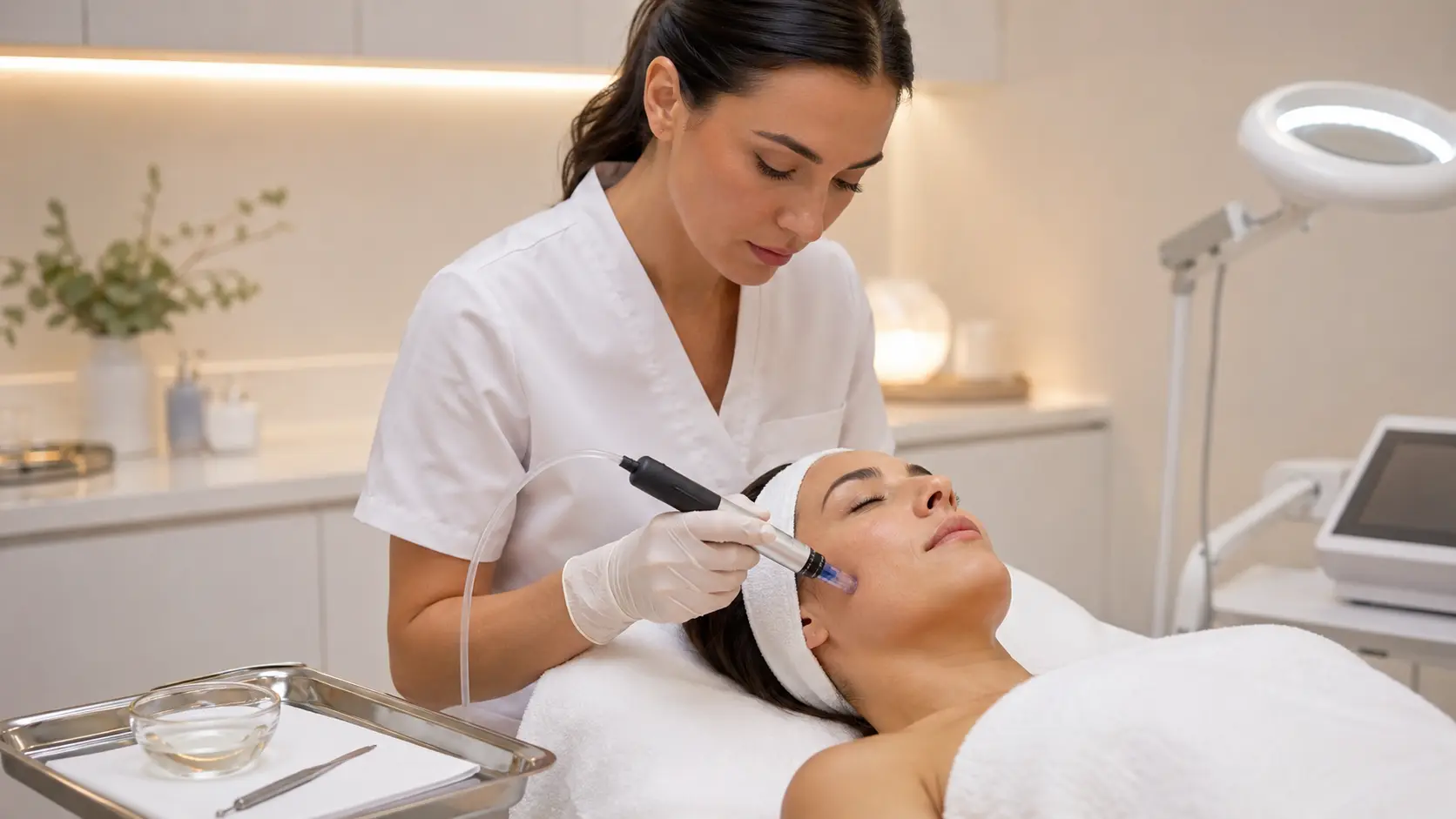
Should Estheticians Perform Nano Infusion After Dermaplaning, and How?
Yes. Performing nano infusion immediately after dermaplaning is a clinically sound and widely practiced advanced facial protocol. Dermaplaning removes the stratum corneum surface layer and vellus hair, producing a temporarily smooth, highly permeable skin surface. Nano infusion performed at this point delivers active serums into the skin with measurably greater efficiency than nano infusion on unprepared skin — making the combination one of the most effective non-invasive pairing protocols available within esthetician scope of practice.
- Dermaplaning increases skin permeability by removing the physical barrier of accumulated dead cells and vellus hair, amplifying nano infusion’s serum delivery efficiency in the same session.
- Serum selection is critical: water-based formulations with hyaluronic acid, peptides, growth factors, or stable brightening actives are appropriate; oil-based, high-acid, and alcohol-forward serums must be avoided on the freshly prepared surface.
- Device pressure should be reduced compared to standard nano infusion technique — the skin is more responsive and more vulnerable to overstimulation following dermaplaning.
- Strict post-treatment client home care instructions, including SPF and avoidance of actives for five to seven days, are essential for this combined protocol.
- Client screening and contraindication management must account for both dermaplaning and nano infusion separately — any condition that contraindicates either treatment contraindicates the combined protocol.
Among the combination protocols available to licensed estheticians, pairing nano infusion with dermaplaning has become one of the most requested and most clinically effective options in the non-invasive facial treatment space. The logic is straightforward: dermaplaning creates an optimally prepared skin surface, and nano infusion takes precise advantage of that preparation to deliver active serums with an efficiency that neither treatment achieves on its own.
What makes this pairing particularly valuable from a professional standpoint is that it sits entirely within esthetician scope of practice in most jurisdictions, requires no medical oversight, and produces visible results that clients can see and feel immediately. The combination positions a practice at the intersection of results-driven treatment and client experience — an increasingly important place to be in a competitive market.
But like any advanced protocol, the combination of dermaplaning and nano infusion carries amplified risks alongside its amplified benefits. The same mechanism that makes serum delivery more effective — heightened skin permeability — also makes the skin more vulnerable to sensitization, over-stimulation, and adverse ingredient reactions. Estheticians who understand why the combination works, what it requires to perform safely, and how to manage every variable from serum selection to post-treatment care are the ones who build consistent, repeatable clinical outcomes with this protocol.
This guide covers the science and practice of nano infusion after dermaplaning in full professional depth: the mechanism behind the synergy, the complete step-by-step protocol, serum selection criteria, device technique adjustments, contraindication screening, post-treatment care, and how to communicate the treatment to clients clearly and confidently.
What Every Esthetician Needs to Know Before Combining These Treatments
- Dermaplaning + nano infusion is one of the most effective non-invasive treatment pairings available within esthetician scope of practice when performed correctly.
- The mechanism of the synergy is simple: dermaplaning removes the barrier, nano infusion exploits the resulting permeability window to maximize serum delivery.
- Serum selection becomes more critical, not less, when skin permeability is elevated — every ingredient applied penetrates more deeply and more rapidly.
- Device pressure must be reduced in post-dermaplaning nano infusion; standard technique settings are too aggressive for the prepared skin surface.
- Full contraindication screening for both treatments individually is required before booking any combined session.
- Post-treatment home care instructions must be more conservative than for either treatment alone — clients need clear written guidance and verbal reinforcement.
- Timing within the session is non-negotiable: dermaplaning always comes first, nano infusion always follows after appropriate skin prep.
Why Does Dermaplaning Improve Nano Infusion Results?
To understand why this combination works, estheticians need a clear picture of what dermaplaning actually does to skin physiology — not just the visible surface result, but the functional change it creates at the tissue level.
What Dermaplaning Does to the Skin Surface
Dermaplaning is a manual exfoliation technique using a sterile surgical-grade blade held at a 45-degree angle to the skin surface. The blade is moved across the skin in short, controlled strokes, physically removing the outermost layer of the stratum corneum — the accumulated dead corneocytes that form the surface of healthy skin — along with the fine vellus hair that covers most of the face.
The immediate functional result is a skin surface that has been dramatically reduced in its physical barrier density. The stratum corneum is the primary anatomical site of the skin’s natural defense against transepidermal penetration of substances from the external environment. After dermaplaning, that layer is thinner, its surface is smoother and more uniform, and its capacity to resist topical ingredient penetration is significantly reduced for a period of 24 to 72 hours post-treatment.
This is the state that makes nano infusion so much more effective immediately following dermaplaning. The physical resistance that would ordinarily slow or limit serum penetration has been partially removed. The nano infusion device then works on a surface that is both physically smoother — allowing the tip to contact the skin more uniformly — and biologically more permeable, allowing serum molecules to reach deeper skin layers more readily.
What Nano Infusion Adds to the Post-Dermaplaning Skin
Nano infusion uses a tip array of silicon or metal nano-cones — far smaller than microneedling needles and non-penetrating relative to the blood-vessel-containing dermis — to create temporary surface-level microchannels in the skin. These channels open a topical delivery pathway that bypasses the residual barrier function of the post-dermaplaned stratum corneum, driving serum deeper than passive topical application achieves.
The combination is therefore additive in its delivery mechanism: dermaplaning removes the first layer of barrier resistance, and nano infusion creates microchannels through the remaining barrier at the level of the viable epidermis. Applied serums penetrate through both pathways simultaneously, producing a level of ingredient delivery that neither treatment generates independently.
In practice, estheticians consistently observe that clients who receive nano infusion in the same session as dermaplaning show more pronounced immediate skin improvement — greater radiance, more visible plumping, more even tone response — than clients who receive either treatment alone. This is not a placebo effect or a marketing positioning claim; it reflects the additive biophysical mechanisms of the two treatments operating on the same skin surface in sequence.
Why the Dermaplaning + Nano Infusion Sequence Amplifies Delivery
Step 1 — Dermaplaning: Physically removes the outermost stratum corneum layer and vellus hair. Surface permeability increases. Accumulated dead cells that ordinarily slow topical penetration are eliminated. The skin surface becomes uniformly smooth and more receptive to device contact.
Step 2 — Serum application: Applied to the freshly dermaplaned surface, serums immediately encounter reduced barrier resistance. Penetration depth increases passively before nano infusion even begins.
Step 3 — Nano infusion: The nano tip array creates microchannels in the epidermis — not the dermis — opening additional delivery pathways through the remaining barrier. Serum is actively driven into these channels with each pass of the device.
Combined result: Two distinct delivery amplification mechanisms operating simultaneously — passive permeability increase from dermaplaning plus active microchannel delivery from nano infusion. The serum reaches deeper layers more efficiently and in greater volume than either mechanism achieves alone.
How to Structure the Complete Dermaplaning and Nano Infusion Protocol
The sequence of steps in this combined protocol is not flexible. Each step serves a specific clinical function, and the order in which they occur determines both treatment safety and treatment efficacy. Estheticians who understand the reasoning behind each step are better equipped to adapt when unexpected client skin responses require protocol modification mid-session.
Begin with a thorough double cleanse to remove all makeup, sunscreen, surface oils, and environmental residue. The dermaplaning blade must contact clean, product-free skin to glide safely and consistently. Any residual surface product creates friction variation and increases the risk of blade dragging. Use a gentle, pH-appropriate cleanser that does not leave a film.
Conduct a thorough visual and tactile skin analysis under magnification. Confirm absence of active breakouts, open lesions, inflamed cystic acne, rosacea flare, recent sunburn, or other conditions that contraindicate either dermaplaning or nano infusion. If any contraindication is present for either treatment, neither the combined protocol nor the individual treatments should proceed.
Perform dermaplaning using a sterile, single-use surgical-grade blade at the correct 45-degree angle with short, feathering strokes against the direction of hair growth. Work systematically across all treatment zones. The skin should be held taut with the non-dominant hand to provide a safe working surface. Apply no product to the skin before or during dermaplaning — the blade must move across dry, clean skin.
Briefly assess the skin for any unexpected reactions before proceeding to nano infusion. Mild uniform pinkness is normal. Patchy redness, visible irritation, or any areas of surface abrasion indicate that nano infusion should not be performed in affected zones and may warrant cancellation of the nano infusion step entirely depending on extent.
Apply the selected water-based serum to the dermaplaned surface in a thin, even layer. Do not massage aggressively. The serum should sit on the skin surface ready to be driven in by the nano infusion device. Applying serum at this stage — before device contact — ensures the nano tip carries active ingredients into the microchannels with each pass rather than working on a dry surface.
Begin nano infusion with lighter pressure than you would apply on non-dermaplaned skin. The post-dermaplaning surface is more responsive, which means the same device pressure delivers greater stimulation than it would on a standard treatment surface. Work in consistent, overlapping passes across treatment zones. Replenish serum as needed to keep the skin surface hydrated throughout the nano infusion step.
Immediately following nano infusion, apply a calming recovery serum — hyaluronic acid, centella asiatica, or a fragrance-free peptide formulation are appropriate choices. Follow with an occlusive recovery mask to seal active ingredients against the skin surface, support barrier recovery, and deliver the immediate post-treatment visible skin improvement that enhances the client experience. A professional jelly mask applied at this stage compounds the hydration and recovery effect significantly.
Complete the treatment with a fragrance-free, non-comedogenic SPF 30 or higher applied to all treated areas before the client leaves the treatment room. Post-dermaplaning and post-nano-infusion skin has significantly elevated UV sensitivity. SPF application is not optional — it is a clinical requirement of this protocol.
Which Serums Should Be Used for Nano Infusion After Dermaplaning?
Serum selection is the single most clinically consequential decision in the nano infusion after dermaplaning protocol. The amplified skin permeability state created by dermaplaning means that every ingredient in the applied serum penetrates more deeply and more rapidly than it would on standard skin. This amplifies both positive outcomes and adverse reactions.
The fundamental rule is simple but non-negotiable: if you would not apply an ingredient to post-treatment skin with a compromised barrier, do not apply it during a combined dermaplaning and nano infusion session. The following framework gives estheticians a clear structure for serum selection decisions.
Serums That Are Appropriate
- Hyaluronic acid (HA) serums: Multi-molecular-weight HA serums are the most universally appropriate choice for post-dermaplaning nano infusion. HA is non-sensitizing, supports immediate hydration recovery, and benefits from the amplified permeability state. Low-molecular-weight HA in particular penetrates efficiently into the freshly prepared skin surface.
- Peptide serums: Signal and carrier peptides in water-based, fragrance-free formulations are excellent choices for this protocol. Post-dermaplaning permeability enhances peptide delivery into the epidermis, where their collagen-stimulating and cell-communication functions occur. Avoid peptide serums that contain sensitizing preservatives or fragrances.
- Growth factor serums: Epidermal growth factor (EGF) and similar growth factor formulations are well-suited to this protocol for clients seeking anti-aging outcomes. Growth factors benefit from enhanced penetration, and their barrier-recovery signaling functions are particularly valuable on the post-dermaplaned surface.
- Stable vitamin C serums (for appropriate clients): Ascorbyl glucoside or sodium ascorbyl phosphate formulations — more stable and less irritating than L-ascorbic acid at equivalent percentages — are appropriate for brightening-focused protocols on clients without active sensitivity. L-ascorbic acid at concentrations above 10% should be avoided on post-dermaplaning skin.
- Tranexamic acid and kojic acid brightening serums: For hyperpigmentation-focused protocols, these ingredients deliver effectively into the post-dermaplaned surface with minimal sensitization risk at standard professional concentrations.
Serums to Avoid
- Oil-based or silicone-based serums: Nano infusion requires a water-based medium to function correctly. Oil and silicone interfere with the fluid dynamics of the nano tip delivery mechanism and can create an occlusive layer that prevents rather than enhances penetration.
- High-percentage AHA or BHA formulations: Glycolic acid, lactic acid, and salicylic acid at treatment concentrations penetrate significantly more deeply on post-dermaplaning skin. The heightened permeability creates a meaningful risk of over-exfoliation, irritation, and compromised barrier recovery.
- Retinol and retinaldehyde: Retinoids are sensitizing on standard skin; on post-dermaplaning skin, their depth of penetration and sensitization potential increase substantially. Retinoid serums are contraindicated for this protocol.
- Fragranced serums: Synthetic fragrance compounds penetrate more deeply on post-dermaplaning skin, dramatically increasing sensitization risk. Any serum containing fragrance or parfum in the INCI should be excluded from this protocol entirely.
- Essential oil-containing formulations: Concentrated essential oils, including tea tree, lavender, eucalyptus, and peppermint, are sensitizing on compromised skin. Avoid regardless of concentration.
Estheticians using the ILUMIPEN by Luminous Skin Lab for post-dermaplaning nano infusion protocols report that the device’s consistent tip oscillation pattern distributes serum more uniformly across the freshly prepared skin surface compared to devices with variable speed settings that can create uneven delivery. In practice, the most common technique adjustment in post-dermaplaning nano infusion is pressure reduction — estheticians transitioning from standard nano infusion technique to post-dermaplaning technique often describe the difference as moving from “working on” the skin to “floating over” it. The ILUMIPEN’s tip flexibility accommodates this lighter touch without sacrificing serum contact, which is the critical distinction between under-delivering and over-stimulating in this heightened-sensitivity protocol.
Estheticians also note that the immediate post-treatment skin response with hyaluronic acid serum infused via the ILUMIPEN on post-dermaplaning skin is consistently more pronounced in visible plumping and radiance than the same serum applied passively after dermaplaning — a direct observable confirmation of the nano infusion delivery amplification mechanism at work.
Serum Selection Framework: What to Use and What to Avoid in the Combined Protocol
The framework below gives estheticians a quick-reference decision guide for serum selection in the dermaplaning plus nano infusion protocol. Understanding each category helps in both treatment planning and client consultations.
Contraindications and Client Screening for the Combined Protocol
Because the dermaplaning and nano infusion combination amplifies both the effects and the risks of each individual treatment, contraindication screening must be applied to both procedures independently. Any condition that contraindicates either dermaplaning or nano infusion contraindicates the combined protocol. There is no safe middle ground where one treatment is performed while the contraindicated treatment is skipped within a combined session — if either treatment is contraindicated, the session should be modified to exclude both advanced procedures and return to a supportive facial protocol instead.
Do not perform dermaplaning followed by nano infusion if the client presents with any of the following:
- Active acne breakouts, particularly inflamed papules, pustules, or cystic lesions in the treatment area
- Active rosacea flare, significant diffuse redness, or Fitzpatrick skin types prone to post-inflammatory hyperpigmentation without appropriate protocol modification
- Recent sunburn, UV damage, or heat-induced erythema anywhere in the treatment zone
- Open wounds, cuts, abrasions, or any break in skin integrity
- Cold sore or herpes simplex outbreak, or a history of frequent outbreaks without prophylactic antiviral coverage discussed with their physician
- Recent use of isotretinoin (Accutane) within the past 6 to 12 months
- Blood-thinning medications or conditions affecting clotting (relevant to dermaplaning’s blade contact)
- Known allergy or sensitivity to any ingredient in the selected serum formulation
- Skin cancer or suspicious lesions in the treatment area — refer out immediately
- Pregnancy (for certain serum actives — consult with the client’s healthcare provider)
The Fitzpatrick Consideration
Estheticians should apply heightened vigilance when performing this combined protocol on clients with Fitzpatrick skin types IV through VI. Post-inflammatory hyperpigmentation (PIH) is a meaningful risk in higher Fitzpatrick types following any treatment that creates inflammation or stimulates melanocyte activity. Dermaplaning is generally lower-risk in this regard than aggressive chemical exfoliation, but the combination with nano infusion introduces device-related stimulation that can, in susceptible clients, trigger PIH responses. Conservative device pressure, careful serum selection, and immediate SPF application are critical protective measures. For clients with a documented history of PIH, consult with a dermatologist before proceeding with the combined protocol.
Managing Client Expectations
Some initial pinkness and heightened skin sensitivity immediately following the combined protocol is normal and expected. Clients should be prepared for this before the session begins — not after. Estheticians who brief clients thoroughly on what to expect during and after the treatment, what home care is required, and what results the protocol is designed to deliver are the ones who generate the most consistent client satisfaction and return visit rates. The treatment produces visible immediate results; managing expectations ensures that the follow-up home care period does not undermine them.
Post-Treatment Care: What Clients Need to Do After a Dermaplaning and Nano Infusion Session
Post-treatment home care is not optional guidance for this protocol — it is an integral part of the treatment outcome. The combined effects of dermaplaning and nano infusion leave the skin in a temporarily heightened sensitivity state that requires a conservative care regimen for five to seven days. Clients who do not follow appropriate post-care instructions can compromise their results and, in cases of improper sun exposure or the use of sensitizing actives, experience adverse outcomes that reflect on the esthetician’s practice.
First 24 to 48 Hours
- Cleanse with a gentle, fragrance-free, non-foaming cleanser twice daily. No physical scrubs, washcloths, or cleansing brushes.
- Apply only gentle, fragrance-free hydrating serums and a non-comedogenic moisturizer. HA serum followed by a simple barrier-supporting cream is appropriate.
- Apply SPF 30 or higher every morning before any sun exposure, and reapply every two hours if outdoors.
- Avoid direct sun exposure, tanning beds, and UV light therapy.
- Avoid heavy exercise and activities that produce significant sweat — sweat on the treated skin surface can cause stinging and may increase sensitization risk.
- Avoid heat exposure: saunas, steam rooms, hot showers above comfortable warm temperature.
Days Three Through Seven
- Continue gentle cleansing and hydration routine. The skin should feel progressively more comfortable and look increasingly radiant as barrier recovery progresses.
- Continue daily SPF without exception.
- Avoid retinoids, high-percentage AHAs and BHAs, exfoliating masks, and physical exfoliation tools.
- Avoid fragranced skincare products throughout the recovery period.
When to Return for the Next Session
Most estheticians performing this combined protocol recommend a minimum of three to four weeks between sessions to allow full barrier recovery and to avoid accumulating stimulation on skin that has not yet fully normalized. Clients seeking aggressive results who inquire about shortening the interval should be educated on why the recovery period is clinically necessary — not shortened to accommodate impatience.
What Results to Expect
Clients typically notice immediate skin improvement following the session — greater radiance, smoother texture, more even tone, and a visible plumping from the HA serum delivery. The full results of the protocol develop progressively over two to four weeks as the skin’s repair and renewal processes respond to the combined stimulation. Clients who understand this timeline are better prepared to evaluate their results accurately and less likely to be disappointed by the post-treatment inflammatory response period that precedes the full improvement window.
Professional and Scientific References
The protocol science referenced in this article draws from established dermatological literature and professional esthetics practice standards:
- Stratum corneum barrier function and topical ingredient penetration enhancement following mechanical exfoliation — established dermatology and cosmetic science literature on transepidermal delivery mechanisms.
- Nano infusion microchanneling mechanisms and serum delivery amplification — cosmetic device science literature on non-needle topical delivery systems.
- Post-dermaplaning skin permeability and the clinical window for enhanced ingredient delivery — professional esthetics protocol and cosmetic chemistry literature.
- Post-inflammatory hyperpigmentation risk in Fitzpatrick types IV–VI following mechanical and device-assisted exfoliation — dermatology clinical literature.
- Hyaluronic acid molecular weight and transepidermal delivery mechanisms — Typology 2021–2025; established cosmetic science literature.
- Growth factor serum clinical outcomes in post-exfoliation treatment contexts — professional esthetics and cosmeceutical literature.
- Esthetician scope of practice standards for dermaplaning and non-needle nano infusion — state cosmetology board regulations; professional esthetics industry standards bodies.
For estheticians building or refining their nano infusion after dermaplaning protocol, the device you choose directly affects your ability to calibrate technique for the heightened-sensitivity post-dermaplaning skin state. The ILUMIPEN by Luminous Skin Lab was developed for professional treatment room use in exactly these advanced combination protocols — with consistent tip oscillation, adjustable configurations, and a design that supports the lighter-pressure, serum-focused technique that post-dermaplaning nano infusion requires. Estheticians who want a device purpose-built for professional combination protocols will find the ILUMIPEN’s performance in this context to be a meaningful operational advantage.
Explore the ILUMIPEN Nano Infusion DeviceFrequently Asked Questions: Nano Infusion After Dermaplaning
Can you do nano infusion right after dermaplaning in the same session?
Yes, nano infusion can be performed immediately after dermaplaning in the same session, and this sequencing is used intentionally by many estheticians. Dermaplaning removes the stratum corneum surface layer and vellus hair, leaving a clean, smooth surface with significantly enhanced permeability. Nano infusion performed directly afterward takes advantage of this amplified absorption window to drive active serums deeper and more effectively than either treatment achieves alone.
Why does dermaplaning improve nano infusion results?
Dermaplaning physically removes the outermost layer of dead skin cells and vellus hair that ordinarily act as a barrier to topical ingredient absorption. With this physical barrier removed, nano infusion tips create microchannels in a more receptive skin surface, allowing serums to reach deeper layers more efficiently. The combination produces greater serum absorption, improved radiance, and more pronounced visible results than nano infusion performed on unprepared skin.
What serums work best for nano infusion after dermaplaning?
Water-based serums are the clinical standard for nano infusion after dermaplaning. Hyaluronic acid, peptide complexes, growth factors, vitamin C (in stable L-ascorbic acid or ascorbyl glucoside formulations appropriate for post-dermaplaning skin), and brightening serums are all effective in this context. Oil-based, alcohol-heavy, or high-acid formulations should be avoided on the freshly dermaplaned, nano-channeled skin surface.
How long should I wait between dermaplaning and nano infusion?
When performed in the same session, dermaplaning is done first and nano infusion follows immediately after appropriate skin preparation. There is no required waiting period between the two steps within a single session. If performed in separate sessions, most estheticians wait a minimum of 48 to 72 hours after dermaplaning before performing nano infusion, allowing any micro-reactivity to resolve before introducing the device.
Is nano infusion after dermaplaning safe for sensitive skin clients?
The combination requires careful client screening for sensitive skin types. Dermaplaning alone temporarily increases skin sensitivity, and nano infusion further amplifies ingredient penetration. For clients with reactive or sensitized skin, conservative serum choices are essential — pure hyaluronic acid or fragrance-free peptide serums are the safest options. Active ingredients like retinol, high-percentage vitamin C, or AHAs should be avoided in post-dermaplaning nano infusion protocols on sensitive skin.
What should clients avoid after getting nano infusion following dermaplaning?
Clients should avoid direct sun exposure for at least 48 hours and apply SPF 30 or higher immediately after leaving the treatment room. Retinoids, active exfoliants, fragranced skincare, and physical scrubs should be avoided for a minimum of five to seven days. Swimming in chlorinated water, heavy exercise producing significant sweat, and heat exposure including saunas should also be avoided for the first 48 hours post-treatment.
Can nano infusion after dermaplaning help with hyperpigmentation?
Yes. The combination is particularly effective for addressing surface-level hyperpigmentation. Dermaplaning removes the layer of keratinocytes where melanin deposits accumulate, and the subsequent nano infusion step delivers brightening actives such as vitamin C, kojic acid, or tranexamic acid directly into the freshly exposed, highly permeable skin surface. Multiple sessions typically produce more visible results than either treatment alone.
Does dermaplaning before nano infusion increase the risk of irritation?
It can, if serum selection and application pressure are not adjusted appropriately. The combination amplifies both the benefit and the risk of ingredient delivery. Estheticians should use lighter device pressure, select serums without potential sensitizers, avoid high concentrations of actives, and observe client skin response throughout the nano infusion step. Visible redness that exceeds a mild pink flush is a signal to reduce pressure or pause the treatment.
How does the ILUMIPEN perform for nano infusion after dermaplaning?
The ILUMIPEN by Luminous Skin Lab is designed with adjustable tip configurations and consistent oscillation that makes it well-suited for post-dermaplaning nano infusion. Estheticians using the ILUMIPEN in this protocol report that the device’s controlled, even tip contact distributes serum uniformly across the freshly prepared skin surface without excess pressure, and that the treatment room experience for clients remains comfortable even on the heightened-sensitivity post-dermaplaning skin.
Combining These Treatments Correctly Produces Results Neither Can Achieve Alone
The combination of dermaplaning and nano infusion is one of the most clinically compelling protocols available to licensed estheticians working within standard scope of practice. When sequenced correctly, with appropriate serum selection and technique calibration, the two treatments create a compounded delivery system where dermaplaning’s barrier preparation amplifies nano infusion’s ingredient delivery in a way that produces visible, measurable results that individual treatments cannot replicate.
What separates estheticians who perform this protocol safely and effectively from those who encounter adverse outcomes is not the equipment or the products — it is a thorough understanding of the mechanism behind the synergy, a rigorous approach to client screening, disciplined serum selection, and post-treatment care protocols that are communicated clearly and followed consistently by clients.
Used correctly, the dermaplaning and nano infusion combination is a powerful addition to any professional facial menu. The science behind it is straightforward, the results are compelling, and the protocol sits entirely within the skills and tools available to licensed estheticians who take the time to learn it properly.