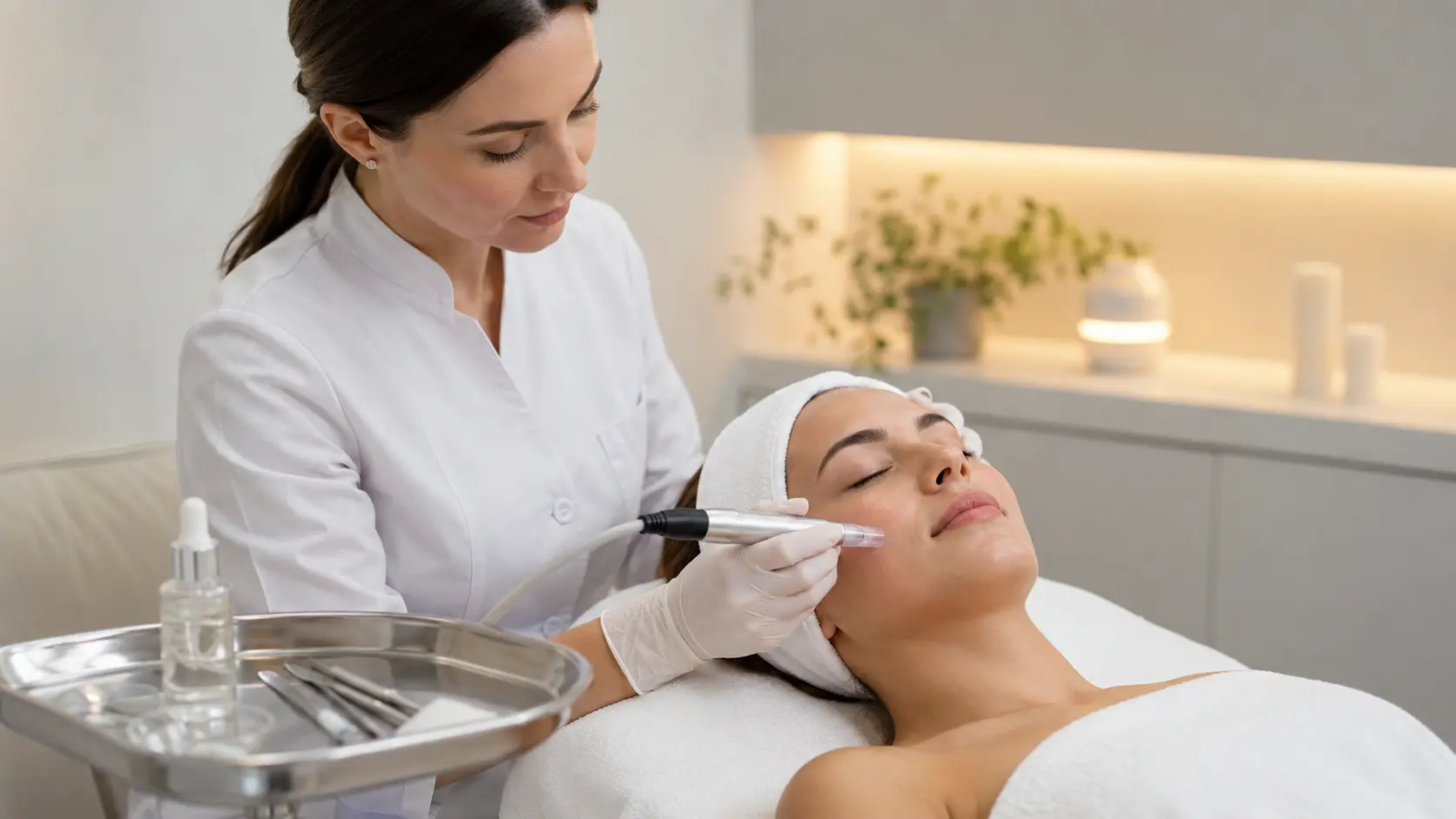
What Is the Difference Between Nano Infusion and Microchanneling?
Nano infusion and microchanneling are both channel-based skin treatments that enhance serum delivery, but they differ fundamentally in depth of action, mechanism, skin trauma level, results profile, and scope of practice implications. Nano infusion works at the stratum corneum level using nano-scale tip oscillation to create temporary, superficial micro-pathways for serum absorption without breaking the skin or triggering a wound-healing response. Microchanneling uses fine needles that penetrate into the epidermis and upper dermis, creating channels that initiate a collagen induction cascade.
- Nano infusion depth: approximately 0.01 to 0.15 mm — stratum corneum and superficial epidermis only. No dermal penetration, no bleeding, no wound-healing response.
- Microchanneling depth: 0.25 mm to 1.5 mm or deeper — reaches the upper dermis and activates fibroblasts to produce collagen and elastin.
- Nano infusion is widely within esthetician scope of practice; microchanneling scope varies significantly by state and often requires medical oversight or is restricted to medical professionals.
- Nano infusion delivers immediate hydration, radiance, and texture results. Microchanneling produces progressive structural skin remodeling over weeks following treatment.
- Both treatments require water-based serums formulated for professional channel-delivery use — oil-based products are not appropriate for either technique.
- Estheticians can offer both services on a treatment menu, but they serve different client needs, carry different risk profiles, and should never be combined in a single session.
Few comparisons in professional esthetics generate more genuine confusion than nano infusion versus microchanneling. On the surface, the two treatments appear closely related — both involve a device gliding across the skin with a tip that creates some form of channel or pathway. Both are associated with enhanced serum absorption. Both are marketed under overlapping terminology, and both have found their way onto treatment menus alongside each other.
But these surface similarities obscure fundamental clinical differences that matter enormously for professional practice: differences in mechanism, depth, skin response, appropriate client selection, results timeline, risk profile, and — critically — scope of practice compliance. An esthetician who treats nano infusion and microchanneling as interchangeable or “basically the same thing” is making a professional and potentially legal error.
This guide provides a thorough, education-first breakdown of both treatments — what each one actually does to the skin, how they differ in every clinically meaningful way, when each is appropriate, and how they fit into a professional esthetician’s treatment menu. Understanding this comparison at a foundational level changes how you consult with clients, how you position your services, and how confidently you can speak to both treatments in your practice.
What Separates Nano Infusion From Microchanneling in Professional Practice
- Nano infusion is a superficial serum delivery treatment. Microchanneling is a collagen induction treatment. They are not interchangeable terms for the same procedure.
- Depth is the defining clinical distinction: nano infusion stays in the stratum corneum; microchanneling reaches the dermis where collagen-producing fibroblasts live.
- Nano infusion does not cause bleeding, visible skin trauma, or a wound-healing cascade. Microchanneling does — and that cascade is the mechanism behind its structural results.
- Esthetician scope of practice regulations generally permit nano infusion; microchanneling is restricted or regulated in many states. Always verify before offering either service.
- Nano infusion is appropriate for a broader client population including sensitive skin, first-time clients, and those who want no downtime. Microchanneling requires more careful client screening.
- The two treatments serve different treatment goals and different stages of a client’s skin journey — building both into a menu serves clients at multiple levels.
- Serum selection is critical for both treatments: water-based, professionally formulated, channel-delivery-appropriate serums only.
How Each Treatment Actually Works: Mechanism at the Skin Level
Nano Infusion: Superficial Channel Creation for Serum Delivery
Nano infusion devices use a cartridge tipped with an array of nano-scale silicon or metal pyramidal micro-cones — typically ranging from 81 to 144 or more individual nano-tips depending on the device and cartridge type. The device oscillates these tips at high speed across the skin surface, creating thousands of temporary, superficial micro-pathways per second through the stratum corneum — the outermost layer of the epidermis that normally functions as the skin’s primary barrier against topical ingredient penetration.
These micro-pathways are transient. They close within minutes to hours as the stratum corneum self-repairs. The clinical purpose of creating them is to dramatically increase the permeability of this barrier layer during the treatment window, allowing serums applied simultaneously to be driven into the skin at a depth and volume that standard topical application cannot achieve. The skin does not bleed. The dermis is not reached. The body does not initiate a wound-healing or inflammatory cascade in response to nano infusion.
The primary clinical outcomes of nano infusion are therefore serum delivery-dependent: improved hydration, enhanced radiance, refined texture, and skin-response improvements tied to whatever active ingredients the esthetician is driving into the skin through the enhanced pathway. Results are often visible immediately and accumulate progressively over a treatment series.
Microchanneling: Dermal Penetration and Collagen Induction
Microchanneling uses fine needles — arranged in cartridges similar in some ways to microneedling devices — that penetrate significantly deeper than nano infusion: typically from 0.25 millimeters into the epidermis up to 1.5 millimeters or more into the upper dermis, depending on device, cartridge configuration, and treatment goal. At these depths, the treatment is creating actual dermal channels — true punctures through the epidermis into the dermis.
This depth of penetration is clinically meaningful in two distinct ways. First, it creates a significantly enhanced channel for serum delivery, allowing professional actives to reach the dermis where cellular and structural changes can be more directly influenced. Second — and this is the central mechanism behind microchanneling’s structural results — it triggers the skin’s wound-healing cascade. Dermal injury, even when created by controlled micro-channels, activates growth factor release, cytokine signaling, and fibroblast proliferation. Fibroblasts produce new collagen and elastin in response to the controlled injury signal. Over weeks following a microchanneling session, this collagen synthesis produces measurable improvements in skin structure: reduced fine lines and wrinkles, improved acne scarring, increased skin density, and enhanced overall skin quality.
Why Depth Determines Everything About These Two Treatments
The stratum corneum is approximately 10 to 20 micrometers thick — roughly 0.01 to 0.02 millimeters. Nano infusion operates within and just below this layer. The dermis begins at approximately 0.1 to 0.2 millimeters below the surface, where fibroblasts, collagen bundles, blood vessels, and nerve endings are located.
Nano infusion tips reach 0.01 to 0.15 mm — staying within the epidermis. No fibroblast activation. No collagen induction. No bleeding. Primary mechanism: enhanced transepidermal permeability for serum delivery.
Microchanneling needles reach 0.25 to 1.5 mm — penetrating through the epidermis into the dermis. Fibroblasts are activated. Collagen and elastin synthesis begins. Bleeding may occur at deeper settings. Primary mechanism: controlled wound-healing cascade for collagen induction.
This is not a quantitative difference — it is a qualitative one. The two treatments operate in anatomically different skin structures and produce their results through fundamentally different biological pathways.
Nano Infusion vs Microchanneling: A Direct Professional Comparison
The table below compares the two treatments across the clinical and professional variables that matter most for esthetician decision-making — from treatment design through scope of practice compliance.
| Variable | Nano Infusion | Microchanneling |
|---|---|---|
| Depth of action | 0.01 – 0.15 mm (stratum corneum / superficial epidermis) | 0.25 – 1.5+ mm (epidermis through upper dermis) |
| Primary mechanism | Temporary stratum corneum permeability for serum delivery | Controlled dermal injury triggering collagen induction cascade |
| Skin trauma | Minimal — no bleeding, no dermal injury | Moderate — dermal puncture, possible pinpoint bleeding |
| Wound-healing response | None — not required for mechanism | Yes — this is the primary collagen-induction mechanism |
| Results type | Serum-dependent: hydration, radiance, texture, tone | Structural: collagen density, scar improvement, wrinkle reduction |
| Results timeline | Immediate + progressive over series | Develops progressively over 4 – 12 weeks post-treatment |
| Downtime | Minimal to none — mild transient redness only | 24 – 72 hours redness; possible pinpoint crusting at depth |
| Scope of practice | Generally within esthetician scope in most US states | Restricted or regulated in many states; verify before offering |
| Sensitive skin suitability | High — suitable for reactive and sensitive skin with appropriate serum selection | Lower — requires careful screening; reactive skin may not tolerate |
| Client population | Broad — most adults seeking hydration, glow, texture improvement | Specific — clients targeting structural concerns: scars, wrinkles, laxity |
| Serum requirements | Water-based, channel-delivery appropriate, professional-grade | Water-based, sterile-grade, post-procedure safe actives only |
| Contraindications | Active infections, open lesions, known ingredient allergies | Active acne, Accutane use, bleeding disorders, keloid history, pregnancy, immunosuppression |
Visualizing the Depth and Mechanism Difference
The single most important conceptual tool for understanding nano infusion versus microchanneling is a clear picture of where each treatment actually operates within the skin’s anatomical layers. The infographic below illustrates this depth distinction alongside the mechanism differences that follow from it.
Scope of Practice: Why These Two Treatments Are Not in the Same Legal Category
The scope of practice distinction between nano infusion and microchanneling is one of the most practically important reasons an esthetician needs to understand these treatments as genuinely separate procedures. The legal landscape is not identical for both — and in many states, it is meaningfully different.
Why Nano Infusion Is Generally Within Esthetician Scope
Nano infusion is widely considered within esthetician scope of practice across most US states because it operates at the stratum corneum level without breaking the skin, causing bleeding, or penetrating the dermis. State boards that regulate esthetic practice typically draw the line between cosmetic and medical procedures at dermal penetration — specifically, at treatments that break the dermis, cause bleeding, or create a wound-healing response requiring medical monitoring.
Because nano infusion does none of these things, it falls — in most regulatory frameworks — into the category of treatments that enhance topical product absorption through superficial temporary channel creation, similar in regulatory logic to microdermabrasion or chemical exfoliation at appropriate concentrations. That said, regulations evolve, and “generally permitted” does not mean universally permitted. Verifying your specific state board’s current position on nano infusion before adding it to your menu is a professional obligation regardless of how clear the general principle seems.
Why Microchanneling Is More Legally Complex
Microchanneling occupies a fundamentally more contested legal space. Because it uses needles that penetrate the dermis — and because its mechanism involves triggering a wound-healing response that constitutes, in a meaningful biological sense, skin injury — many state boards classify it differently from superficial esthetic treatments.
In some states, microchanneling at shallow depths (often 0.25 to 0.5 mm) is permitted for licensed estheticians. In others, any needle-based treatment that penetrates the epidermis is classified as a medical procedure requiring medical oversight, a nurse’s license, or physician supervision. In still others, the question has not been formally addressed, leaving estheticians in a regulatory gray area where practice without clarification carries professional and liability risk.
The practical guidance for estheticians is straightforward: before adding microchanneling to your menu, contact your state board directly, obtain written confirmation of what is and is not permitted under your license, and ensure your liability insurance covers the service if it is permitted. Do not rely on device manufacturer claims about legality — manufacturers have a commercial interest in their devices being sold and used widely, and their statements about legal scope should not substitute for verification with your regulatory authority.
Why Both Services Can Coexist on an Esthetician’s Menu in Many States
Where state regulations permit both, nano infusion and microchanneling serve genuinely different client needs and are not redundant on a professional treatment menu. Nano infusion is an accessible, no-downtime hydration and glow treatment appropriate for a broad client population — including first-time clients, those with sensitivity concerns, and those who want visible immediate results with no recovery period. Microchanneling, where permitted, serves a more specific client demographic: those with structural skin concerns like acne scarring, established wrinkles, skin laxity, or reduced density, who are willing to accept a recovery period in exchange for more significant structural change.
Estheticians who offer both — in compliance with their state’s regulations — can build a treatment progression pathway: starting clients on nano infusion for immediate hydration and skin quality improvements, and transitioning appropriate clients to microchanneling for deeper structural results when their skin health and treatment goals justify the step up in intensity.
Serum Selection: Why Both Treatments Demand Professional-Grade Water-Based Formulations
Both nano infusion and microchanneling create enhanced transdermal delivery pathways — which means that whatever is on the skin during and immediately following these treatments will be absorbed at significantly higher rates than under normal topical application conditions. This is the therapeutic mechanism. It is also a professional safety responsibility.
Water-Based Serums Are the Only Appropriate Choice for Either Treatment
Oil-based products, physical sunscreens, occlusive creams, and thick emulsions are not appropriate for delivery via nano infusion or microchanneling tip channels. These molecules are too large, too occlusive, or too likely to block the channels themselves or create comedogenic effects when driven deeper into the skin. Water-based serums with low molecular weight actives are the appropriate category for both treatments.
What to Look for in a Nano Infusion Serum
Estheticians building their nano infusion protocols consistently prioritize the following serum characteristics: water-based with a lightweight, low-viscosity texture; professional-grade actives at treatment-room-appropriate concentrations; fragrance-free and sensitizer-free formulation; and specific actives that benefit from the enhanced delivery that nano infusion provides. Hyaluronic acid serums drive exceptional hydration results through nano infusion channels. Polyglutamic acid formulations leverage their stratum corneum affinity in an enhanced delivery context. Peptide complexes, growth factors, and vitamin C derivatives show improved efficacy when delivered via nano infusion compared to standard topical application.
What Nano Infusion Serum Selection Gets Wrong Most Often
The most common professional error is using serums formulated for standard topical application in a nano infusion context without evaluating them for channel-delivery appropriateness. High concentrations of exfoliating acids, retinoids at clinical strengths, and sensitizing actives may be appropriate for topical use but can cause unwanted reactions when driven into the skin via nano infusion channels. Evaluate every serum specifically in the context of enhanced delivery, not just standard topical safety.
Estheticians integrating the ILUMIPEN by Luminous Skin Lab into their nano infusion protocols report that the device’s precise oscillation speed and consistent nano-tip contact pressure make serum delivery noticeably more uniform compared to variable-speed alternatives they had previously used. In practice, the most common transition observation is that clients who previously received nano infusion with general esthetic devices experience a measurable improvement in immediate post-treatment hydration response with the ILUMIPEN — attributed by practitioners to the device’s optimized channel-creation rate at the stratum corneum level, which maximizes the active delivery window without exceeding it into deeper tissue.
Practitioners also note that the ILUMIPEN’s design is particularly effective when pairing hyaluronic acid and polyglutamic acid serums in a sequential protocol — with HA serum applied and infused first to hydrate deeper layers, followed by a PGA-dominant finishing serum driven through the enhanced channels to seal the surface and extend the hydration effect. This dual-phase serum approach, using the ILUMIPEN at consistent settings, produces a more sustained post-treatment skin response than either humectant serum alone, which aligns with the underlying PGA + HA dual-depth hydration mechanism described in the broader nano infusion ingredient science literature.
How to Choose the Right Treatment for Each Client
Experienced estheticians approach the nano infusion versus microchanneling decision through a client-centered lens: what does this specific client need, what can their skin handle, and what results are they seeking within what time frame? The following framework provides a practical decision guide.
Clients Who Are Ideal Nano Infusion Candidates
- First-time clients who are new to active treatments and want to assess skin response before committing to more intensive services.
- Clients with sensitive, reactive, or compromised skin who need enhanced product delivery without triggering an inflammatory response.
- Clients seeking immediate results — event-prep facials, pre-photoshoot treatments, before-occasion glow treatments.
- Clients targeting hydration, dehydration, dullness, fine surface texture irregularity, or general skin quality improvement.
- Clients who cannot accept any visible post-treatment recovery period due to professional or personal schedule commitments.
- Clients who have contraindications to needle-based treatments (active breakouts, certain medications, needle sensitivity).
Clients Who Are Stronger Microchanneling Candidates
- Clients with established acne scarring who have tried surface-level treatments without sufficient structural improvement.
- Clients presenting with moderate to deep wrinkles who are seeking dermal collagen remodeling rather than surface hydration.
- Clients with reduced skin density, laxity, or loss of structural volume who need fibroblast activation.
- Clients who understand and accept the post-treatment recovery window and are committed to a multi-session treatment series.
- Clients who have plateaued with less intensive treatments and are ready for a progression in treatment intensity.
The Consultation Question That Separates Them
One of the most practically useful consultation questions for differentiating appropriate candidates is: “Are you looking for something that improves how your skin looks and feels right now, or are you trying to address something structural that has built up over years?” Clients answering the first question are typically nano infusion candidates. Clients answering the second are more likely microchanneling candidates — subject to skin assessment, contraindication review, and scope of practice confirmation for your state.
Common Misconceptions Estheticians Encounter About These Treatments
Misconception: Nano Infusion Is Just a Gentler Version of Microchanneling
This is one of the most pervasive misconceptions in the treatment room. Nano infusion is not a gentler version of the same procedure — it is a different procedure with a different mechanism and different results profile. Calling it “gentle microchanneling” misrepresents both treatments to clients and creates false expectations about what nano infusion can achieve structurally. A client expecting microchanneling’s collagen remodeling results from a nano infusion series will be disappointed, not because nano infusion underperformed, but because they were consulting toward the wrong treatment goal.
Misconception: More Depth Always Means Better Results
Client education sometimes runs into the assumption that deeper must mean more effective. For a client seeking hydration and radiance, deeper does not mean better — it means unnecessary trauma, extended recovery, and potential for adverse reactions. The appropriate treatment is the one that addresses the client’s actual concern through its specific mechanism. Nano infusion is not a compromise version of microchanneling; it is the correct treatment for the clients and goals it serves.
Misconception: These Terms Are Interchangeable in the Market
The professional esthetics supply and marketing landscape has contributed to significant terminology blurring between nano infusion, microchanneling, nanoneedling, nano-needling, and related terms. Some device manufacturers use these terms loosely or interchangeably for marketing purposes. Estheticians evaluating any device should verify its actual tip configuration, operating depth, and mechanism rather than relying on category naming to determine what the device actually does and what scope of practice category it belongs to.
Misconception: Both Treatments Work With the Same Serums
While both treatments benefit from water-based professional serums, microchanneling’s dermal penetration creates a more acute requirement for sterile-grade or near-sterile formulations and careful avoidance of sensitizing actives at the concentrations used in some nano infusion contexts. A serum that is appropriate for nano infusion delivery may not be appropriate for microchanneling delivery, where it will be driven into the dermis rather than the stratum corneum. Serum selection decisions must be made independently for each treatment context.
Professional and Scientific References
The clinical and anatomical information referenced in this article draws from established dermatology and cosmetic science literature:
- Stratum corneum anatomy, thickness, and barrier function. Standard dermatology anatomy references; Proksch et al., Experimental Dermatology, 2008.
- Transdermal drug and cosmetic ingredient delivery enhancement mechanisms: iontophoresis, sonophoresis, and micro-channel creation. Cosmetic chemistry literature; Journal of Controlled Release, multiple years.
- Collagen induction therapy mechanisms — wound healing cascade, fibroblast activation, HAS stimulation. Dermatologic Surgery; Fernandes, 2005; Aust et al., 2008.
- Microchanneling versus microneedling depth and mechanism differentiation. Aesthetic practitioner continuing education references; ASCP professional education series.
- Scope of practice regulations for estheticians performing needle-adjacent and channel-based treatments. State board regulatory documentation — varies by jurisdiction. Always verify current state board position directly.
- Serum formulation requirements for channel-delivery treatments: water-based, molecular weight, sensitization risk. Professional esthetic formulation literature; cosmetic chemistry peer review.
For estheticians ready to add nano infusion to their treatment menu — or evaluate an upgrade to their existing nano infusion device — the ILUMIPEN by Luminous Skin Lab is the device our education team most frequently references for treatment-room nano infusion protocols. Designed by a licensed esthetician for the specific operational demands of professional nano infusion — consistent oscillation, precise nano-tip engineering, and serum delivery performance within the stratum corneum window where esthetician scope is clear — the ILUMIPEN supports the kind of reproducible, client-visible results that build treatment room confidence and client retention. Compatible with professional water-based serums including hyaluronic acid, polyglutamic acid, and peptide formulations.
Explore the ILUMIPEN Nano Infusion DeviceFrequently Asked Questions: Nano Infusion vs Microchanneling
What is the difference between nano infusion and microchanneling?
Nano infusion uses a nano-tip cartridge with silicon or metal pyramidal micro-cones that oscillate at high speed to create temporary, superficial micro-pathways in the outer stratum corneum, allowing serums to be driven into the skin without causing bleeding or true dermal injury. Microchanneling uses fine needles that penetrate deeper into the epidermis and upper dermis, creating more significant channels that trigger a wound-healing response and collagen stimulation. The key distinction is depth and tissue response: nano infusion is a superficial delivery system while microchanneling is a collagen-stimulation treatment.
Can estheticians legally perform both nano infusion and microchanneling?
Nano infusion is widely considered within esthetician scope of practice across most US states because it does not break the skin or cause bleeding. Microchanneling occupies a more legally complex position: some states permit estheticians to perform microchanneling at shallow depths, while others require medical supervision or restrict it entirely to licensed medical professionals. Always verify your specific state board regulations before adding either service.
Does nano infusion actually get serums into the skin?
Yes. Nano infusion temporarily disrupts the stratum corneum barrier, creating transient micro-pathways that significantly increase serum absorption compared to topical application alone. The high-speed oscillation of the nano-tip cartridge drives water-based serum molecules into the superficial skin layers during the treatment window. This enhanced delivery is the primary clinical mechanism behind nano infusion’s results.
Which one is better for sensitive skin clients?
Nano infusion is generally better suited to sensitive skin clients because it does not penetrate the dermis, does not cause bleeding, and produces minimal post-treatment redness. Most sensitive skin clients can tolerate nano infusion with little to no visible reaction. Microchanneling carries a higher risk of post-treatment sensitivity, redness, and transient barrier disruption, making it a more cautious choice for reactive or sensitized skin types.
How deep does nano infusion go compared to microchanneling?
Nano infusion works at the level of the stratum corneum and superficial epidermis, generally reaching a depth of 0.01 to 0.15 millimeters depending on device and tip type. Microchanneling needles typically penetrate from 0.25 millimeters to 1.5 millimeters or deeper, reaching the upper dermis where collagen-producing fibroblasts are activated. This depth difference explains why microchanneling produces collagen induction while nano infusion does not.
What results can clients expect from nano infusion vs microchanneling?
Nano infusion clients typically see immediate improvements in hydration, radiance, and skin texture, with results from a series including reduced fine lines, improved tone, and enhanced product absorption. Microchanneling produces more significant structural changes over a treatment series, including collagen remodeling, improvement in acne scarring, wrinkle reduction, and skin tightening. Nano infusion results are immediate and cumulative; microchanneling results develop progressively over weeks as collagen synthesis occurs.
Do I need special training to perform nano infusion in my treatment room?
While nano infusion does not require medical training, professional device-specific training is strongly recommended before adding it to your treatment menu. Training should cover device operation, tip selection, serum compatibility, contraindications, skin assessment, and protocol sequencing. Many device manufacturers offer training programs, and additional esthetic continuing education courses are available. Thorough training protects both your clients and your professional standing.
Can nano infusion and microchanneling be performed in the same treatment session?
Combining nano infusion and microchanneling in a single session is generally not recommended and is not a standard professional protocol. Microchanneling already creates channel pathways for serum delivery, making nano infusion redundant in that context. More importantly, performing both in one session increases the cumulative skin trauma load and recovery burden without proportional additional benefit. Most protocols sequence these as separate services.
What serums work best with the ILUMIPEN nano infusion device?
The ILUMIPEN by Luminous Skin Lab is designed for use with water-based, professional-grade serums that are free from occlusive oils, high-molecular-weight compounds, and sensitizing actives at concentrations above professional safety thresholds. Optimal serums for nano infusion with the ILUMIPEN include hyaluronic acid serums, polyglutamic acid formulations, peptide complexes, growth factors, and brightening serums containing niacinamide or vitamin C derivatives. Oil-based serums and physical sunscreens are not appropriate for delivery via nano infusion tip.
Knowing the Difference Makes You a Better Clinician and a Clearer Communicator
The confusion between nano infusion and microchanneling is understandable — the market has not always served estheticians well with clear, education-first information about how these treatments actually differ. But the distinction matters in ways that directly affect your professional practice: it determines which clients you select for which treatment, how you explain outcomes, what results you can honestly promise, and whether you are practicing within your legal scope.
Nano infusion is a serum delivery treatment that operates in the stratum corneum, produces immediate hydration and radiance results, serves a broad client population, and is generally within esthetician scope. Microchanneling is a collagen induction treatment that operates in the dermis, produces progressive structural results, serves a more specific client demographic, and carries scope of practice complexity that must be verified by state before offering.
Building both treatments into a compliant, well-structured service menu — and being able to explain the distinction fluently to clients — positions you as the kind of technically knowledgeable esthetician that clients return to, refer from, and trust with their skin over the long term.